

Note: This article contains affiliate links. If you click on these links and make a purchase, I may earn a small commission at no extra cost to you. This helps support my research and content. Read my full affiliate disclosure here.
Getting the first weeks of a tomato plant right makes a big difference for vigor, fruit set, and disease resistance later in the season. A starter fertilizer for tomatoes supplies the targeted nutrients young transplants need to develop sturdy roots and healthy foliage without burning tender tissues. In this guide we shortlisted the top options suited to garden beds, containers, and early-season transplants and evaluated them on practical gardener-focused criteria like nutrient balance and ease of application. Read on to find a starter fertilizer approach that matches your planting method and soil conditions.
Top Picks at a Glance
| Best Overall The best all-around choice for most situations | Espoma Organic Bio-Tone Starter Plus 4-3-3 Organic Starter Fertilizer, 8 lb |  |
| Best Quality Built to a higher standard if you want something more solid | FoxFarm Happy Frog Jump Start Fertilizer (4 lb) |  |
| Best Value The sweet spot between price and what you get | Dr. Earth Root Zone Starter & Transplant Fertilizer, 4 lb |  |
| Best Budget The cheapest option that still gets the job done reliably | Espoma Bio-Tone Starter Plus Organic Starter Plant Food, 5 oz trial packet |  |
| Highest Rated A top-rated pick with lots of positive feedback | Espoma Bio-Tone Starter Plus Organic Starter Fertilizer (4 lb) | |
| Most Popular A crowd favorite that many people choose with confidence | Miracle-Gro Quick Start Planting & Transplant Starting Solution, 48 fl. oz. |  |
| Best Seller A high-volume bestseller chosen again and again | Miracle-Gro Shake 'N Feed Tomato, Fruit & Vegetable Plant Food (1 lb) |  |
Espoma Organic Bio-Tone Starter Plus 4-3-3 Organic Starter Fertilizer, 8 lb

| Item Form | Granules |
|---|---|
| Application Method | Mix with soil |
| Specific Uses For Product | Gardening |
| Target Species | For everything you plant |
Espoma Organic Bio-Tone Starter Plus is a granular, ready-to-use starter fertilizer designed for planting and transplanting a wide range of garden plants. You mix it into backfill soil or potting mixes so the nutrients and added mycorrhizae sit in the root zone at planting time. The formula combines an organic 4-3-3 nutrient ratio with beneficial bacteria, humates, and both endo and ecto mycorrhizae to encourage faster root development, improved soil structure, and better establishment under stressful conditions. Typical uses include flower beds, bulbs, transplant holes, and planting mixes where quick root growth matters. Because it is organic and approved for organic gardening, it is suited to gardeners who prefer natural inputs. The main limitations are that it is intended as a starter or planting amendment rather than an all-season feed and dosing is by volume for different applications so you need to follow the mixing instructions for correct results. For gardeners wanting an easy organic boost at planting, this product provides a focused, microbially active start.
Best for: Gardeners who prioritize natural, microbially active amendments and want a reliable organic boost when planting or transplanting ornamentals, vegetables, and bulbs.
Less Ideal for: Buyers looking for a one-product solution for seasonal feeding or those who prefer liquid feeds or quick-release chemical fertilizers for immediate foliar results.
- Contains both endo and ecto mycorrhizae to aid root establishment
- Organic 4-3-3 formula enhanced with beneficial bacteria and humates
- Ready-to-use granules that are mixed into soil at planting
- Approved for organic gardening and made by a long-standing organic fertilizer brand
- Formulated primarily for initial planting and transplant use rather than ongoing feeding
- Dosing instructions vary by application and require measuring by volume for correct results
Verdict: Choose this if you want an organic, microbe-enhanced starter fertilizer to help new plantings establish strong roots.
FoxFarm Happy Frog Jump Start Fertilizer (4 lb)

| Item Form | Granules |
|---|---|
| Specific Uses For Product | Root Development |
| Unit Count | 64 Ounce |
| Mixing Ratio | 3-4-3 |
FoxFarm Happy Frog Jump Start is a granular transplant and seedling fertilizer designed to help new plants take hold after moving or repotting. You mix the granules into potting mix or soil at the recommended rate, set the plant, and water to begin feeding phosphorus-rich nutrients that encourage early shoot and root growth. The 3-4-3 NPK ratio emphasizes phosphorus for establishment, and the included mycorrhizal fungi aim to improve root efficiency and nutrient uptake. Practical benefits include straightforward application, OMRI-listed formulation suitable for organic systems, and a 4 lb size that covers multiple repottings or small beds. Expect faster initial rooting and reduced transplant shock when used as directed. Limitations are that it is a starter formula not intended for long-term feeding or bloom boosting, and users must follow mixing directions to avoid over-application; it also provides modest nutrient concentrations compared with concentrated liquid feeds. This product fits into a seasonal early-spring routine when the goal is to get transplants established before regular fertilizer schedules resume.
Best for: Gardeners who prioritize consistent establishment of transplants in early spring and want a reliable, easy-to-use starter fertilizer to reduce transplant shock.
Less Ideal for: Gardeners seeking a single product to feed mature, flowering plants long term or those who prefer quick-adjustable liquid nutrient programs.
- Formulated specifically for transplanted seedlings and repotted plants
- Contains phosphorus-focused 3-4-3 NPK to support early growth
- Includes mycorrhizal fungi to help root establishment and nutrient uptake
- Granular form is easy to mix into soil and apply for small beds or containers
- Designed as a starter fertilizer so it is not a complete long-term feeding solution
- Lower nutrient concentration compared with concentrated liquid fertilizers
Verdict: Use this starter fertilizer in early spring to reliably help transplants and seedlings establish strong roots and reduce transplant shock.
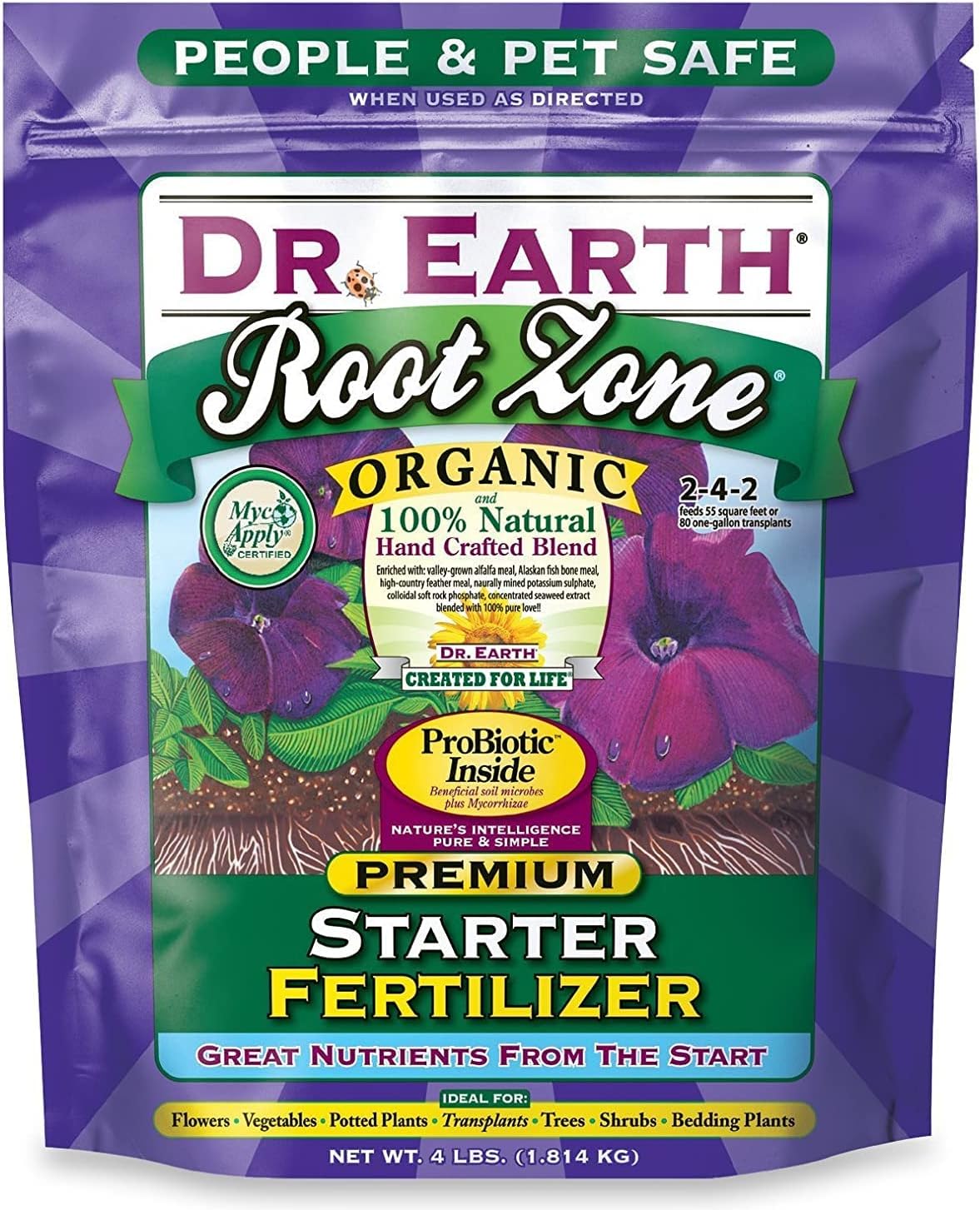
Dr. Earth Root Zone Starter & Transplant Fertilizer, 4 lb
| Item Form | Rectangular |
|---|---|
| Specific Uses For Product | Organic |
| Coverage | 2000 |
| Mixing Ratio | 2:1000 |
Dr. Earth Root Zone Starter is a 2-4-2 organic granular fertilizer designed for use at planting and transplanting to give young plants an early nutrient advantage. You work it into the root zone at planting or feed containers at transplant and then follow up every six weeks with a maintenance formula. The formula includes organic nutrients plus probiotic soil microbes and mycorrhizae to improve nutrient uptake, drought tolerance, and root development. It is labeled safe for tender transplants and claims feeding that continues for several months, so it reduces how often you need to reapply compared with some fast-release products. Important limitations are that it contains phosphorus, so local rules about phosphorus application to lawns or turf may apply, and granular organics deliver nutrients more slowly than synthetic starters in some situations. For tomato seedlings and newly transplanted tomato plants in garden beds or containers, this product provides a low-risk, soil-building way to establish strong roots and steady early growth.
Best for: Gardeners who prioritize building soil health and want a safe, low-risk starter for tomato transplants in beds or containers; ideal for growers who value organic inputs and reduced application frequency.
Less Ideal for: Growers seeking the fastest possible soluble nutrient spike for immediate top-growth or those who must avoid phosphorus entirely for regulatory reasons.
- Organic formula with no GMOs, chicken manure, or sewage sludge
- Includes beneficial microbes and ecto/endo mycorrhizae to improve root health and nutrient uptake
- Feeds for several months so applications are less frequent
- Safe for tender transplants and small containers when used as directed
- Contains phosphorus which may be restricted for non-agricultural turf in some areas
Verdict: Choose this organic starter fertilizer when you want a soil-building transplant feed that supports root development and reduces reapplication.
Espoma Bio-Tone Starter Plus Organic Starter Plant Food, 5 oz trial packet

| Item Form | Granules |
|---|---|
| Specific Uses For Product | Plant Growth |
| Coverage | Medium |
| Mixing Ratio | 4:3:3 |
Espoma Bio-Tone Starter Plus is a small trial packet of organic granular starter fertilizer designed to be mixed into backfill when planting or transplanting. It supplies a balanced 4-3-3 N-P-K ratio plus 5% calcium and includes both endo and ecto mycorrhizae to encourage early root establishment. Typical use is straightforward: mix the granules into the soil in the root zone during planting so nutrients and beneficial fungi are immediately available. Practical benefits include its organic certification for use in organic gardens, the addition of mycorrhizae for better root-to-soil contact, and the convenience of a ready-to-use trial size for testing on a few tomato transplants. Limitations are its small 5 oz packet which only covers a few plants, so larger tomato plantings will require multiple packets or a larger product, and granules mean you must apply at planting rather than feed later as a liquid. For budget-focused gardeners looking to give new tomato starts a biological boost, this packet is a low-risk way to try an organic starter fertilizer, but plan for follow-up feedings for continued growth after establishment.
Best for: Gardeners who want an organic, low-risk starter boost for a few tomato transplants and who prefer natural amendments over synthetic starters.
Less Ideal for: Growers planting many tomato seedlings or large beds who need bulk coverage or ongoing fertilization without repeated purchases.
- Organic formulation approved for organic gardening
- Contains both endo and ecto mycorrhizae to support early root development
- Balanced 4-3-3 nutrient analysis with added calcium for starter needs
- Ready-to-use granules easy to mix into backfill at planting
- Small 5 oz trial size limits coverage to a few plants
- Not suitable as a later-season liquid feed without additional products
Verdict: A convenient organic starter packet that gives tomato transplants a biological root boost at planting.
Espoma Bio-Tone Starter Plus Organic Starter Fertilizer (4 lb)
| Item Form | Granules |
|---|---|
| Specific Uses For Product | Gardening |
| Coverage | Medium |
| Mixing Ratio | 9 pounds per cubic yard or 1 cup per cubic foot |
| Target Species | plants |
Espoma Bio-Tone Starter Plus is a ready-to-use granular starter fertilizer intended for use at planting or transplanting to help young plants establish strong root systems. It combines a 4-3-3 nutrient analysis with organic ingredients, 5% calcium, and both endo and ecto mycorrhizae to support root colonization and nutrient uptake. Typical use is mixing the granules into the backfill soil around roots or incorporating into potting mixes at the recommended rate to place nutrients in the root zone. Practical benefits for tomato growers include improved early root vigor, better water and nutrient uptake, and suitability for organic gardens. Because it is granular and formulated for starters, it does not require dilution or special equipment. Limitations include the medium coverage of a 4 lb bag, which may require multiple bags for larger plots, and it is designed for initial establishment rather than ongoing feeding through the season. Users should follow the mixing ratio instructions to avoid over-application when working in concentrated beds or containers.
Best for: Gardeners who prioritize reliable, organic establishment for new tomato transplants and want a product that promotes root development at planting time.
Less Ideal for: Growers looking for an all-season feed or a concentrated liquid starter for foliar or quick-feed applications should consider other products.
- Contains both endo and ecto mycorrhizae to support early root colonization
- Organic formula approved for organic gardening and made from natural ingredients
- Ready-to-use granular form requires no mixing before placement in the root zone
- Includes 5% calcium which helps reduce transplant stress and supports cell development
- 4 lb bag provides medium coverage and may not be sufficient for larger vegetable beds
Verdict: Choose this product if you want a reliable organic starter fertilizer that boosts early root growth for newly planted tomatoes.
Miracle-Gro Quick Start Planting & Transplant Starting Solution, 48 fl. oz.

| Item Form | Liquid |
|---|---|
| Specific Uses For Product | Agriculture,Starting |
| Application Method | Mix with water and pour around new plantings |
| Target Species | For all flowers, vegetables, trees, shrubs, transplants and seedlings |
| Mixing Ratio | Fill cap to 1st line and mix with 1 gallon of water |
Miracle-Gro Quick Start is a liquid concentrate designed for use when planting or moving seedlings and transplants. You measure the concentrate with the bottle cap, mix with a gallon of water, and pour the diluted solution around the root zone to settle soil and feed young roots. The 4-12-4 NPK formula emphasizes phosphorus to encourage root development and faster blooms versus unfed plants. Typical use is at planting and again seven days later, after which you can switch to a regular feeding schedule. Practical benefits include an easy, measured application, compatibility with flowers, vegetables, trees, shrubs and seedlings, and clear instructions for gardeners who want a simple transplant routine. Limitations to note are that this is a starter solution only, so it is not intended as a long-term sole fertilizer, and frequent large-scale applications without following label guidance could overfeed delicate seedlings. Also it is a liquid concentrate, so you need a watering can and care when diluting to avoid spills or accidental over-concentration.
Best for: Gardeners who want a simple, reliable way to reduce transplant shock and give seedlings a nutrient-rich start when planting in beds or containers.
Less Ideal for: People seeking an all-in-one, long-term fertilizer solution for ongoing feedings or those who prefer granular or organic-only products.
- Focused 4-12-4 NPK formula to encourage root development at transplanting
- Liquid concentrate with a measured cap makes dosing straightforward
- Suitable for a wide range of plants including vegetables, flowers, shrubs and trees
- Simple application that settles soil and feeds roots right after planting
- Designed as a short-term starter solution rather than a complete feeding program
- Requires correct dilution and handling to avoid overfeeding seedlings
Verdict: Use this easy-to-dose liquid starter to give seedlings and transplants a nutrient boost that helps roots establish quickly.
Miracle-Gro Shake 'N Feed Tomato, Fruit & Vegetable Plant Food (1 lb)

| Item Form | Granules |
|---|---|
| Target Species | Tomato, Fruit & Vegetable Plant Food |
| Unit Count | 16 Ounce |
| Item Type Name | Continuous Release Plant Food Plus Calcium |
| Coverage | Full |
Miracle-Gro Shake 'N Feed Tomato, Fruit & Vegetable is a granular, continuous-release fertilizer aimed at vegetable gardens and container-grown edibles. You apply it dry to the soil surface or mix it into potting mix at planting, then water to activate feeding that lasts up to three months. The formula includes natural ingredients that feed soil microbes and added calcium to strengthen cell walls and reduce common calcium-related disorders in fruiting crops. For container cucumbers this product provides steady nutrition without weekly liquid feeding and is simple to dose at planting or between seasons. Limitations include the fixed N-P-K profile and that it is not water-soluble for immediate foliar feeding, so rapid correction of major nutrient deficiencies will require a soluble supplement. It also requires correct incorporation or surface application and watering to avoid uneven distribution in small pots. Overall it is a low-effort option to keep container cucumbers producing through a season when used alongside regular watering and good potting mix.
Best for: Gardeners who want a low-maintenance fertilizing routine for container-grown cucumbers and value steady month-to-month feeding over frequent liquid feeds.
Less Ideal for: Growers who need rapid correction of a diagnosed nutrient deficiency or who prefer precise, water-soluble dosing for each watering cycle.
- Continuous-release granules feed plants for up to three months reducing application frequency
- Contains calcium to help prevent blossom end rot and improve fruit quality
- Formulated for fruits and vegetables and suitable for both in-ground and container use
- Feeds soil microbes via natural ingredients which can improve root health and nutrient availability
- Not water-soluble so it will not correct acute nutrient deficiencies quickly
- Fixed formulation may not match specific soil test recommendations for containers
Verdict: A convenient, slow-release granular feed that keeps container cucumbers nourished for months with minimal fuss.
Choosing the Right Starter Fertilizer for Tomatoes: Key Factors to Consider
Nutrient Ratio for Transplants
Young tomato plants need a different balance of nutrients than mature, fruiting plants. A starter fertilizer should emphasize phosphorus to encourage root formation while keeping nitrogen moderate so foliage grows strong without becoming overly soft or leggy.
Too much nitrogen in the early stage can produce lush top growth at the expense of root-to-shoot balance, making transplants more prone to stress when moved outdoors. Conversely, too little nitrogen will slow leaf development and overall vigor. Look for clearly labeled N-P-K ratios and guidance on how those ratios translate to your planting method.
Salt Content and Root Safety
Soluble fertilizers often carry salts that can dehydrate fine roots if applied too concentrated. For seedlings and newly set transplants, low salt index formulations or clear dilution instructions reduce the risk of transplant shock or leaf scorch.
High-solubility concentrates can be useful but only when used at the correct dilution. If you plan to apply fertilizer as a root dip or drench at planting, choose a product explicitly tested for that use or labeled safe for seedlings.
Formulation and Solubility
Starter fertilizers come as water-soluble powders, concentrated liquids, or gentle organic options. Solubility affects how uniformly nutrients are delivered and whether you can use the fertilizer in a watering can, hose-end applicator, or seedling tray.
A fully soluble formula is easier to meter for small plants and ensures nutrients reach roots quickly. However, some growers prefer low-concentration liquid blends or mild organic teas for gradual, gentler feeding. Consider how you want to apply the product and pick a formulation that fits your equipment and routine.
Application Method and Timing
Decide whether you will feed seedlings as a light drench, add fertilizer to the potting mix, or use a root dip at transplant. Each method has practical implications. Drenching requires soluble mixes and frequent light applications, while pre-mixing the potting medium suits granular or slow-release starter blends designed to be incorporated.
Timing matters too. Apply starter fertilizer shortly before or at transplanting to encourage root establishment, but avoid heavy feeding in the first few days after planting. Follow label dilution rates closely and adjust based on seedling size and environmental stressors like heat or wind.
Compatibility with Containers and Soil
Container-grown tomatoes have different nutrient dynamics than those in open beds. Pots dry and leach more quickly, so a starter fertilizer that performs well in containers should provide soluble nutrients without building up salts between waterings.
In-ground transplants benefit from starter products that complement existing soil fertility. If you know your soil has adequate phosphorus from prior amendments, you may choose a milder starter feed or rely on localized root dips.
Organic Vs Synthetic Options
Organic starter fertilizers typically release nutrients more slowly and improve soil biology, while synthetic starters deliver immediately available nutrients for quick root response. Organic options are gentler and reduce the risk of burn but may require more frequent applications to meet early growth demands.
Your choice depends on garden philosophy and the urgency of establishment. Organic starters are often preferred for long-term soil health, while water-soluble synthetics are chosen when rapid root stimulation is the priority.
Using Starter Fertilizer with Seedlings and Transplants
When starting seeds indoors, use a light, well-diluted starter feed after seedlings have their first true leaves. Heavy feeding at the cotyledon stage can cause stress and uneven growth. A gentle, regular schedule-small doses every one to two weeks-encourages steady root and shoot development without shocking delicate roots.
At transplanting, a brief root dip or a shallow drench at planting time helps establish contact between roots and nutrients. Avoid applying concentrated granules against root balls. After the initial establishment period, transition to a balanced grow feed as the plants develop.
- Use a weaker dilution for seedlings than for transplants.
- Allow a day of acclimation after moving plants outdoors before heavier feeding if they show stress.
- Rinse containers occasionally to prevent salt buildup if using soluble synthetics.
Container Growing Considerations
Containers require more frequent monitoring of moisture and nutrients. A starter fertilizer that dissolves cleanly prevents uneven nutrient pockets and reduces the risk of root scorch. Choose soluble or water-compatible blends for small pots, and consider a low-salt formula for long-term container culture.
For larger containers, incorporate a measured amount of starter into the potting mix at planting to give transplants a nutrient cushion. Top-dress and water in gently rather than placing undiluted granules on exposed roots.
- Check potting mix pH and amend if necessary before applying starter feeds.
- Use saucers and good drainage to avoid salt accumulation at the pot base.
Applying Starter Fertilizer in Raised Beds and In-Ground Gardens
In beds and open soil, a localized root drench or banded starter at the transplant hole focuses nutrients where roots will grow. This reduces waste and limits nutrient contact with surface weeds. Work the starter in lightly if using a granular formula, or apply a diluted liquid directly to the planting zone.
If your soil has been recently amended with compost or bone meal, adjust starter rates downward to avoid overloading phosphorus. Soil testing before planting gives the clearest picture of starter needs.
- Place liquid starter drench 2 to 3 inches from the root ball to encourage outward growth.
- Avoid high-phosphorus dressings in soils already rich in phosphorus.
Common Application Mistakes to Avoid
Applying full-strength concentrate, adding granules directly onto roots, or overusing starter fertilizer in an attempt to speed growth are frequent errors. These practices often result in burned roots, stunted plants, or nutrient imbalances that impede later development.
Another common mistake is not adjusting application rates for pot size or seedling age. Smaller seedlings need much weaker solutions than larger transplants. Read and follow dilution instructions, and when in doubt, err on the side of a weaker feed.
- Do not apply starter fertilizer to dry root balls; water first for even uptake.
- Reduce or skip starter feedings when plants show signs of stress such as wilting or leaf edge browning.
Integrating Starter Fertilizer with Organic Practices
Organic gardeners can use mild, soluble organic starters such as fish emulsion or compost teas at low strength to promote early root growth while supporting beneficial microbes. These feeds are less likely to cause burn but may need more frequent application.
Pair organic starters with a soil-building program so that as plants move from establishment to fruiting, the soil itself supplies a greater share of nutrients.
- Top-dress with finished compost after several weeks to provide slow-release nutrition.
- Use cover crops or mulches to maintain moisture and microbial activity that support nutrient uptake.
How We Chose the Best Starter Fertilizer for Tomatoes
We focused on what matters to gardeners feeding young tomato plants. Selection began with products formulated for transplant and early growth phases rather than maintenance or bloom boosters. We prioritized nutrient profile accuracy, measuring starter blends by their phosphorus level and the ratio between nitrogen and potassium because these ratios influence root development and leaf growth without encouraging leggy seedlings. Application simplicity was the next filter. We looked for options that work with common garden workflows: mixing with potting medium, diluting for drench applications, or applying as a root dip at planting. Safety for tender roots and predictable dilution instructions were required attributes. Solubility and salt index were treated as separate criteria because a high salt load can scorch young roots. We excluded formulas designed only for mature fruiting stages, slow-release granulars meant for long-term feeding without early soluble nutrients, and products that lack clear dilution guidance. Finally, we considered gardener feedback around consistency of results, but we did not include products lacking basic label transparency about N-P-K or application rates.
FAQ
When should I first feed tomato seedlings a starter fertilizer?
Usually feed seedlings after the first true leaves appear. Start with a weak dilution and increase strength slightly as seedlings grow, being careful not to over-fertilize delicate young roots.
Can I use the same starter fertilizer for containers and garden beds?
Often yes, but adjust dilution and frequency. Containers need gentler, more frequent feedings and formulas with lower salt risk, while beds can tolerate slightly stronger applications if soil fertility is low.
Is a high-phosphorus starter always better for root growth?
Higher phosphorus supports root initiation, but excess phosphorus can be unnecessary or harmful if your soil already contains sufficient levels. A balanced starter tailored to transplant needs is typically preferable.
How often should I apply a starter fertilizer after transplanting?
A light application at or just before transplanting helps. Follow up with diluted feeds every one to two weeks during establishment, then transition to a regular feeding schedule as plants mature.
Are organic starters effective for quick root establishment?
Organic starters can be effective and are gentler on roots, but they usually release nutrients more slowly than synthetic liquids. For rapid establishment, choose a water-soluble organic product and use it more frequently at low strength.
What signs indicate a starter fertilizer was applied too strongly?
Leaf edge browning, sudden wilting, slowed growth, or crusted soil surface are common signs of over-application. If you suspect burn, flush the root zone with water to dilute salts and hold off further feeding until plants recover.
Final Verdict
Prioritize a starter fertilizer that matches how you grow tomatoes: soluble, low-salt formulas for seedlings and containers, and targeted root drenches or banded starters for in-ground transplants. Focus on clear N-P-K ratios, safe dilution guidance, and compatibility with your planting method. Choosing based on nutrient balance and application safety helps you avoid common establishment problems and sets plants up for strong growth. Use the evaluation criteria above to pick an approach that fits your workflow, then monitor and adjust feeding as plants move from establishment into active growth.
