

Note: This article contains affiliate links. If you click on these links and make a purchase, I may earn a small commission at no extra cost to you. This helps support my research and content. Read my full affiliate disclosure here.
If pests are tunneling, nesting, or feeding in your beds, choosing the right mulch can help reduce shelter and discourage infestations without harming plants. Mulch for pest control balances physical barriers, plant health, and moisture management so you do not inadvertently create better habitat for rodents, slugs, or overwintering insects. This guide covers the top shortlisted mulches suited to pest-conscious gardens and explains the practical tradeoffs you should expect in a yard, raised bed, or container planting. We evaluated performance in pest suppression alongside durability, impact on soil moisture, and garden handling so you can pick a solution that fits your planting style. Read on for what mattered most and how to use mulch effectively to reduce pest problems in typical garden settings.
Top Picks at a Glance
| Best Overall The best all-around choice for most situations | Cedarcide Insect-Repelling Cedar Granules (8 lb, pack of 4) |  |
| Best Quality Built to a higher standard if you want something more solid | Double Tree Cedar Granules — Flea, Ant & Mosquito Repellent for Yard, 16 Qt |  |
| Best Value The sweet spot between price and what you get | Wood Smith USA 100% Natural Cedar Shavings Mulch (4 Quart) |  |
| Best Budget The cheapest option that still gets the job done reliably | Wood Smith USA 100% Natural Cedar Chips, 4 Quart Bag |  |
| Highest Rated A top-rated pick with lots of positive feedback | GranuCide Cedar Granules — 100% Natural Cedar Chips, 8 lb |  |
| Most Popular A crowd favorite that many people choose with confidence | Cedarcide Original Cedar Granules (8 lb) |  |
| Best Seller A high-volume bestseller chosen again and again | Cedarcide Cedar Granules Insect Repellent, 8 lb |  |
Cedarcide Insect-Repelling Cedar Granules (8 lb, pack of 4)

| Manufacturer | Cedarcide |
|---|---|
| Material | 100% cedar shavings |
| Recommended reapply interval | Every 4–6 weeks |
| Indoor/outdoor use | Yes |
Cedarcide cedar granules are a straightforward, chemical-free option for reducing insect activity around planted areas and outdoor living spaces. You apply them by sprinkling or spreading the granules around lawns, flower beds, planters, along foundations and fences, or in sachets for indoor closets and pots. The product relies on the natural aroma of cedar to interfere with insect pheromones and deter mosquitoes, fleas, chiggers, ants and similar pests, and the brand cites third-party testing for several species. Practical benefits include easy application with a hand or seed spreader, reapplication intervals of roughly 4 to 6 weeks, and a low-risk profile for households with children and pets since the material is 100 percent cedar shavings. Limitations to expect are modest efficacy compared with targeted chemical treatments and the need to reapply after heavy rain or flooding; the scent also fades over time so performance depends on regular maintenance. Best used as part of an integrated approach to pest control rather than a single-season cure-all.
Best for: Gardeners and homeowners who want a low-risk, natural way to reduce common outdoor pests and prefer gentle, maintenance-based solutions for yards and planted areas.
Less Ideal for: People facing severe or persistent infestations who need fast, high-efficacy chemical control or professional treatments.
- 100% natural cedar shavings provide a chemical-free repellent option
- Safe for use around children and pets when applied as directed
- Easy to apply around beds, foundations, planters, and patios
- Works indoors or outdoors (sachets for closets, pots, or spread outside)
- Less immediately potent than chemical insecticides for heavy infestations
- Needs reapplication every 4–6 weeks and after heavy rain
Verdict: Choose these cedar granules when you want an easy, pet-safe, natural mulch that reduces common outdoor pests as part of a balanced pest-control plan.
Double Tree Cedar Granules — Flea, Ant & Mosquito Repellent for Yard, 16 Qt

| Ingredients | 100% Natural Cedar |
|---|---|
| Directions | Sprinkle in lawn and garden, reapply every 6 weeks or as needed |
| Coverage | Covers up to 3,500 sq ft (16 quarts) |
Double Tree Cedar Granules are kiln-dried incense cedar pieces sold as a ready-to-use ground treatment to reduce insect presence in outdoor spaces. You spread the granules around patios, garden beds, walkways, dog runs and perimeter edges; the product’s natural cedarwood oils are claimed to make treated ground less inviting to mosquitoes, fleas, ants, spiders and mites. Because these are coarse granules rather than powder, they resist washing away in rain or sprinkler cycles and do not leave a chalky film on plants. The bag covers up to about 3,500 sq ft and the brand recommends reapplying every 4 to 6 weeks for ongoing protection. Limitations include that this is a preventive, scent-based barrier rather than a knockdown insecticide, so results will vary by pest pressure and site conditions, and it requires periodic reapplication. For people seeking a low-toxicity, maintenance-friendly mulch-like repellent, it performs as an easy, natural option; if you need immediate pest elimination or long-term residual chemical control, combine it with other targeted methods.
Best for: Gardeners and homeowners who prioritize nonchemical, maintenance-friendly pest reduction and want a mulch-like product they can sprinkle around outdoor living areas and beds.
Less Ideal for: People who need rapid insect elimination or season-long chemical residual control should consider stronger targeted treatments or professional services.
- 100% incense cedar with no synthetic fillers for a natural repellent option
- Granule form resists washing away in rain or sprinklers compared with powder products
- Suitable for multiple outdoor spots including patios, garden beds, walkways and dog runs
- Ready-to-use product that requires no mixing or spraying
- Works as a scent-based deterrent rather than delivering immediate insect knockdown
- Requires reapplication every 4 to 6 weeks for continued effectiveness
Verdict: A low-toxicity, easy-to-apply cedar granule barrier that reduces outdoor pest activity while acting as a durable mulch alternative.
Wood Smith USA 100% Natural Cedar Shavings Mulch (4 Quart)

| Indoor Outdoor Usage | Indoor, Outdoor |
|---|---|
| Other Special Features of the Product | Pet Friendly |
| Material Features | Natural, Organic |
| Sunlight Exposure | Full Sun |
| Moisture Needs | Moderate Watering |
This bag of 100% natural cedar shavings is sold as a light mulch for potted plants, hanging planters, and pet bedding. You spread a thin layer over potting soil or scatter in animal bedding to help hold moisture, suppress minor surface evaporation, and add a mild cedar aroma that helps mask odors. The material is organic and pet friendly, and the loose shavings make it easy to use around containers and in sachets for small-space air freshening. Because the product is raw wood shavings, it is best used as a top dressing rather than a heavy playground of mulch around garden beds where fine bark mulch is preferred for long-term weed suppression. Expect variable shaving sizes since this is a natural product and occasional dust that can settle into pots. For pest control, cedar’s natural scent can deter some insects in small areas, but it should be treated as a supplementary measure alongside other pest-management steps rather than a standalone solution.
Best for: Buyers who want a versatile, natural top dressing for container plants, hanging planters, or pet bedding and value odor control and easy application.
Less Ideal for: Gardeners needing a heavy-duty landscape mulch for large beds or long-term weed suppression should choose heavier bark or manufactured mulches instead.
- 100% natural cedar that is organic and pet friendly
- Light cedar scent that helps mask odors and can freshen small spaces
- Loose shavings are easy to apply to pots, sachets, or animal bedding
- Helps retain surface moisture in potting soil when used as a top dressing
- Shavings vary in size and may produce dust that can settle into pots
- Not formulated for long-term weed suppression in large garden beds
Verdict: Use this natural cedar shaving as an easy-to-apply top dressing to freshen containers and pet areas while adding modest pest-deterring scent.
Wood Smith USA 100% Natural Cedar Chips, 4 Quart Bag

| Brand Name | Wood Smith USA |
|---|---|
| Unit Count | 148.92 Ounce |
| Number of Packs | 1 |
| Volume | 1 |
These 100% natural cedar chips are a lightweight, aromatic mulch sold in a 4-quart bag that works best as a top dressing for potted plants, hanging baskets, and small garden patches. The cedar scent helps deter some insects and can freshen indoor potting mixes, while the chips also help retain surface moisture and reduce light reaching weed seeds. Because the bags are hand sifted and packed, quality is generally consistent for small jobs, and the product is easy to spread with minimal tools. The obvious limitation is the small volume — a single 4-quart bag covers only a very small area, so multiple bags are required for beds or larger weed-control projects. The chips are also coarse compared with fine mulches, so they are better for decorative surface cover than for forming a dense, weed-suppressing mat. Handle the product carefully to avoid inhaling dust and follow guidance if using around animals.
Best for: Buyers looking for an inexpensive, small-quantity mulch to refresh pots, hanging planters, or to try cedar for insect control in limited areas.
Less Ideal for: Gardeners who need to cover large beds or who want a fine-textured mulch for dense weed-smothering should choose larger bulk bags or finer mulches instead.
- Natural cedar composition that repels some insects and adds a pleasant scent
- Small 4-quart bag useful for potted plants, hanging baskets, and spot treatments
- Helps retain surface moisture and reduces light to surface weed seeds
- Hand-sifted and hand-packed for generally consistent small-batch quality
- Very small volume so not cost-effective for large beds
- Coarse chip size offers less dense weed suppression than finer mulches
Verdict: A handy, low-cost 4-quart cedar chip bag for small-scale potting and spot weed control where you want a natural scent and insect-repellent benefits.
GranuCide Cedar Granules — 100% Natural Cedar Chips, 8 lb
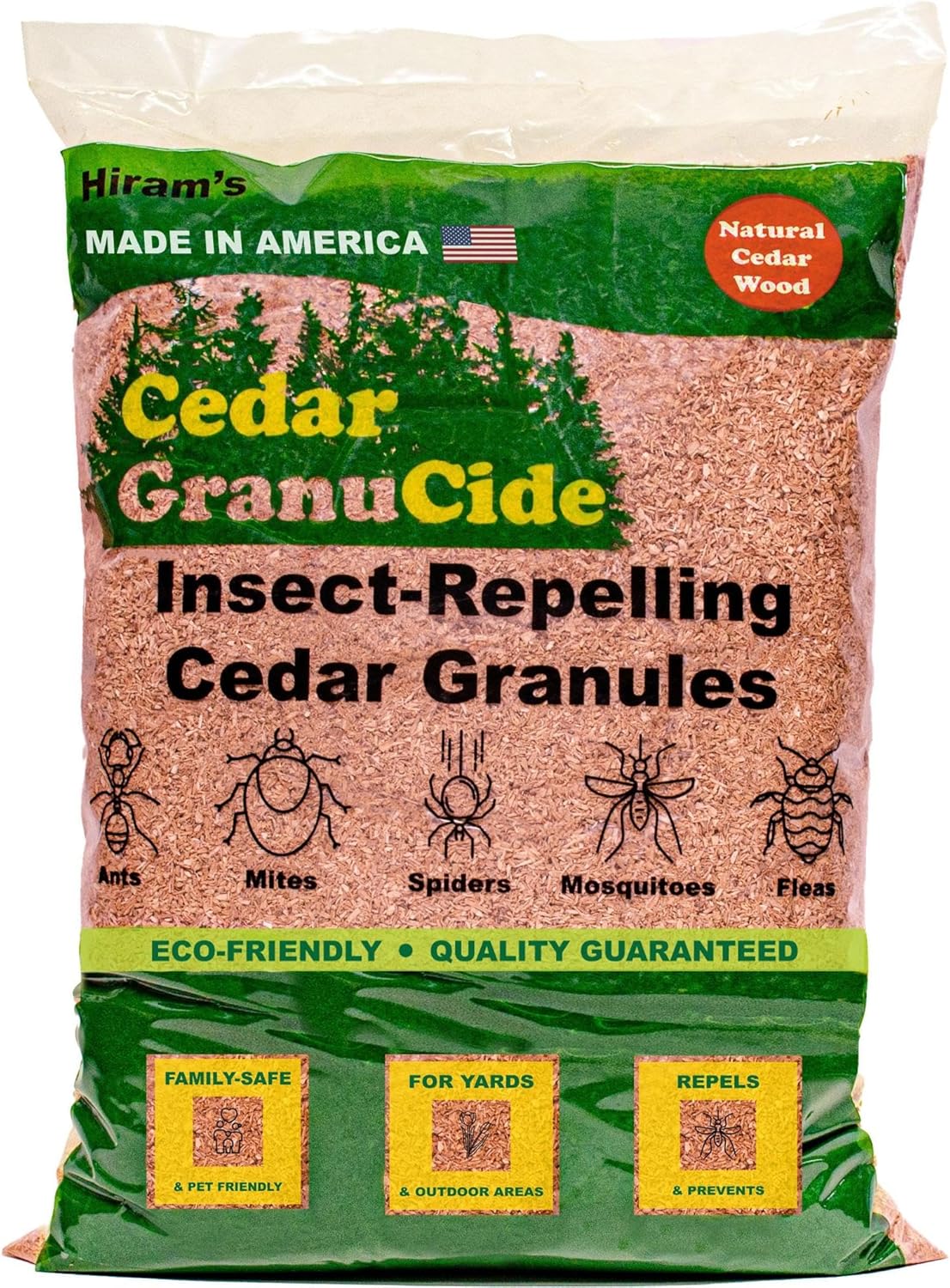
| Ingredients | 100% cedar granules |
|---|---|
| Weight | 8 pounds |
| Made in | America |
These GranuCide cedar granules are small, untreated cedar shavings sold in an 8 lb bag for use as a mulch and insect repellent around the yard and home. You sprinkle them around garden beds, potted plants, patios, and along foundation lines to release cedar aroma that deters mosquitoes, ants, fleas, spiders, aphids and other pests. The product is made from sustainably sourced cedar and is safe to use around people and pets, so it suits regular landscape maintenance without special handling. As a mulch it also improves appearance and helps reduce surface evaporation. Because it is a simple loose material there is no mixing, dilution, or equipment needed, but it will break down over time and needs periodic replenishing after weather exposure or heavy foot traffic. For heavy infestations or larval control you may still need targeted treatments, but for routine, low-risk pest prevention this provides a low-toxicity, eco-friendly option that is easy to apply.
Best for: Buyers who want a reliable, low-toxicity pest-prevention mulch for routine garden maintenance and prefer simple, no-fuss applications that are safe around children and pets.
Less Ideal for: People dealing with heavy or persistent pest infestations that require insecticides or professional treatment should choose stronger, targeted control methods instead.
- Made from 100% untreated cedar for a natural, low-toxicity repellent
- Pleasant cedar aroma that deters a wide range of insects including mosquitoes and ants
- Versatile for indoor and outdoor use on garden beds, potted plants, patios, and around home perimeters
- Also functions as an attractive mulch that helps reduce surface evaporation
- Granules decompose and need periodic replenishing after weather exposure
- Not a standalone solution for severe infestations or larval problems
Verdict: A straightforward, pet-safe cedar mulch that reliably reduces common garden and yard pests while serving as an attractive, eco-friendly ground cover.
Cedarcide Original Cedar Granules (8 lb)

| Unit Count | 128 Ounce |
|---|---|
| Item Form | Granules |
| Target Species | Insects |
| Special Features | Weather-Resistant |
| Active Ingredients | cedar granules |
Cedarcide Original Cedar Granules are loose cedar shavings you sprinkle around lawns, flower beds, planters, patios, and along foundations to discourage insects. The product works by releasing cedar aroma that interferes with insect pheromones and behavior, and the manufacturer recommends reapplying every 4 to 6 weeks or after heavy rain. Typical use is straightforward: broadcast by hand or with a seed spreader to create a perimeter or spot treatments where pests congregate. Notable features include 100% cedar chips as the active ingredient and weather-resistant granules suitable for outdoor use. Practical benefits are that the material is chemical-free, safe to use around people and pets when used as directed, and can double as a mild mulch or aromatic topdressing in beds and containers. Important limitations are that efficacy is variable by species and conditions, it requires regular reapplication and coverage to be effective, and it will not eliminate an established infestation on its own.
Best for: Buyers who prioritize low-toxicity, natural pest control for yards and beds and who prefer solutions supported by broad user acceptance rather than chemical knockdown.
Less Ideal for: People needing immediate eradication of a heavy infestation or those who want a long-lasting, maintenance-free pest barrier should consider stronger targeted products or professional services instead.
- Made from 100% natural cedar chips so no synthetic insecticides are applied to lawn and beds
- Designed to repel a range of insects including mosquitoes, fleas, ants, mites, and chiggers based on testing
- Weather-resistant granules can be used outdoors and reapplied after heavy rain
- Simple to apply by hand or with a spreader for perimeter or spot treatments
- Requires regular reapplication (every 4–6 weeks or after heavy rains) to maintain effectiveness
- Not a substitute for targeted treatment of active infestations or professional pest control
Verdict: Choose these cedar granules if you want a pet- and family-safe, low-toxicity mulch-style option to reduce common outdoor insects while maintaining a natural yard care approach.
Cedarcide Cedar Granules Insect Repellent, 8 lb

| Active ingredient | Cedarwood Oil — 1% |
|---|---|
| Inert ingredients | Red Cedar Chips — 99% |
| Reapplication interval | Every 4–6 weeks |
| Intended use areas | Lawns, gardens, patios, decks, foundations |
Cedarcide Cedar Granules are loose cedarwood shavings intended to be spread across lawns, garden beds, around foundations, patios and fences to create a natural insect-repelling barrier. You apply them by hand or with a seed/spreader and reapply every 4–6 weeks or after heavy rain. The product is 99% cedar chips with 1% cedarwood oil, so it relies on cedar scent and pheromone disruption rather than synthetic pesticides. Practical benefits include an easy, low-effort application, a biodegradable material that can double as a light mulch or top dressing, and a formulation marketed as safe for families and pets when used as directed. Important limitations are that efficacy is modest compared with chemical treatments and requires regular reapplication and adequate coverage to be effective; the granules will also break down over time and will not provide long-term soil stabilization like heavier mulches. Follow the label precautions when handling and avoid applying before rain to prevent washing away.
Best for: Buyers who want a low-risk, chemical-free method to reduce outdoor pests and prefer natural materials for family and pet-safe yard care.
Less Ideal for: Homeowners seeking a single-season, high-strength knockdown of heavy infestations or long-lasting soil erosion control should consider stronger targeted treatments or heavier mulches instead.
- Made from 100% natural cedar shavings with added cedarwood oil for scent-based insect deterrence
- Easy to apply by hand or with a seed spreader for quick coverage of lawns, beds and perimeters
- Biodegradable and can function as a light mulch or top dressing
- Formulated and marketed for use around people and pets when directions are followed
- Requires reapplication every 4–6 weeks and after heavy rain to maintain effectiveness
- Less immediately powerful than synthetic insecticides and depends on sufficient coverage to work
Verdict: A simple, family- and pet-friendly natural mulch-style granule that reduces outdoor pests through cedar aroma and regular top-dressing.
Choosing the Right Mulch for Pest Control: Key Factors to Consider
Type of Pest You Need To Deter
Different pests respond to mulch in different ways. Rodents and voles seek dense, insulating layers with loose material for nesting, while slugs and snails prefer damp, cool surfaces that let them travel and hide. Insect pests that overwinter in leaf litter or bark will use thick organic mulches as shelter. Identifying the main pest problem in your garden will narrow which mulch types are likely to help and which might accidentally worsen the issue.
For example, if ground-nesting rodents are the concern, avoid very loose, fluffy mulches that provide burrowing opportunities. If slug pressure is high, choose mulches and application methods that reduce persistent dampness near plant crowns.
Mulch Particle Size and Texture
Particle size influences how easily pests can burrow or hide. Fine-textured mulches like shredded bark or leaf mold compact differently than coarse wood chips or gravel. Coarser, angular materials tend to be less attractive to burrowing rodents and are harder for slugs to traverse, while very fine or fluffy materials can form insulating pockets that attract wildlife.
Texture also affects how the mulch settles and how it contacts plant stems. Dense contact with stem bases can increase rot risk for some species, so consider a mulch that sheds water away from crowns and allows airflow at the soil surface.
Moisture Retention Versus Drying
Mulch influences soil moisture and surface humidity, which in turn affects pest populations and disease risk. Mulches that retain a lot of moisture create a favorable environment for slugs, snails, and some fungal pathogens. Conversely, very porous or reflective mulches can keep the soil drier and less attractive to those pests but may stress drought-sensitive plants.
Think about the moisture needs of the plants you grow and local climate. In a wet climate, choose mulches that promote drying near the surface and reduce prolonged dampness. In dry regions, balance pest control with the need to conserve moisture for plant health.
Impact on Soil Health and Beneficials
Some mulches release compounds as they break down that can affect soil organisms, nutrient availability, and beneficial insects. Organic materials feed soil life over time but may temporarily immobilize nitrogen during decomposition if incorporated or mixed into the soil. Inorganic mulches do not provide organic matter but can be less hospitable to pests.
Consider whether you want the mulch to improve soil over seasons or primarily serve as a barrier. Also consider impacts on pollinators and predatory insects: avoid treatments or materials that repel beneficials that help control pest populations naturally.
Maintenance Requirements and Replacement Frequency
Different mulches require different upkeep. Lightweight materials can blow away or wash into planting areas, while heavy aggregates stay put but may compact over time. Organic mulches decompose and need replenishing, which can interrupt established habitats and require periodic reapplication. Maintenance also includes monitoring for pest signs and adjusting depth or clearing mulch away from vulnerable trunks, stems, and crowns.
Plan for how much time you will spend topping up, raking, or replacing mulch each season. Frequent disturbance can deter pests but also disturbs soil life, so find a maintenance rhythm that matches both pest-control and soil-health goals.
Safety for Plants and Surrounding Areas
Some mulches alter soil temperature and chemistry in ways that are beneficial for certain plants but harmful to others. For example, acidic mulches can lower pH over time, affecting sensitive species. Also consider fire risk in dry climates: certain coarse organic mulches can be more flammable than inorganic options. Placement near foundations, walkways, and tree trunks matters because some materials can trap moisture against bark or create a rodent corridor.
Choose a mulch that will not introduce chemicals or residues harmful to pets or wildlife in your yard, and consider local regulations or neighbor impacts when using very coarse or dusty options.
How Mulch Reduces Pest Habitat
Mulch changes the structure of the surface layer where pests live and move. By altering temperature, moisture, and shelter availability, the right material can make a bed less appealing to rodents, slugs, or overwintering insects. For example, coarse mineral mulches create uneven surfaces that are harder to nest in, while porous organic mulches may either shelter pests or, when applied correctly, speed surface drying and reduce slug activity.
Proper depth and installation are crucial. A material applied too thickly creates insulating layers that encourage nesting, while an appropriately thin, well-aerated layer can discourage shelter-seeking animals without sacrificing plant protection.
- Surface texture affects pest movement and visibility
- Depth influences insulation and nesting opportunities
- Placement around stems should avoid direct contact to reduce rot risk
Application Methods That Improve Effectiveness
How you lay mulch often matters more than the specific product. Keep mulch pulled back a few inches from plant stems and trunk bases to prevent rodents from using the material as direct cover and to reduce moisture against bark. In vegetable beds, avoid piling mulch against low stems where slugs and snails can bridge the gap from cover to plant tissue.
Combine mechanical barriers with mulch for stubborn pests. For example, a narrow band of coarse gravel or landscape fabric beneath a decorative layer can block burrowing entry points. Also consider alternating mulch types in problem areas to limit continuous shelter.
- Pull mulch away from trunks and crowns
- Use barrier layers under or around mulch in high-risk zones
- Monitor and adjust depth seasonally
Mulch and Integrated Pest Management
Mulch is one component of a broader integrated pest management approach. Good cultural practices like tidy debris removal, proper irrigation timing, and encouraging predators reduce reliance on mulch alone. Mulch can complement biological controls by making the environment less favorable to pests while leaving predators and ground beetles able to function.
When planning pest control, assess whether changing mulch type will interact with other tactics. For example, reducing surface moisture with a different mulch may enhance the effectiveness of beneficial nematodes used for root pests, or it may reduce slug activity and thus lower the need for additional slug-specific measures.
- Combine mulch choices with cultural and biological controls
- Adjust irrigation timing to reduce nighttime dampness
- Regularly inspect mulch for pest signs rather than assuming it is protective
Seasonal Considerations for Mulch Use
Seasons change pest behavior and mulch performance. In winter, thick organic mulch can protect roots but also provide overwintering sites for some insects and small mammals. In spring and summer, moisture-retaining mulches may raise slug pressure during wet weather. Plan seasonal adjustments such as thinning layers in damp months or removing and refreshing mulch near sensitive young plants.
Timing of application matters. Applying fresh mulch in late spring after soil has warmed and creatures have finished nesting reduces the chance of trapping pests. Conversely, early fall application can provide insulation but may invite overwintering pests if applied too late or too densely.
- Avoid thick fall layers that encourage overwintering pests
- Refresh or thin mulch in spring to discourage nesting
- Match mulch choices to local climate seasonality
Environmental and Neighborhood Impacts
Your mulch choice can affect more than your beds. Some materials wash away easily and create downstream sediment issues, while others can change runoff patterns. If mulch attracts rodents, you may see increased activity near foundations or sheds, so placement and depth have neighborhood implications.
Consider fire regulations and wildlife corridors in your area. In drought-prone places, choose materials that lower fire risk and avoid piling combustible mulch against structures. In suburban areas where neighbors share hedgerows, pick options that do not dramatically increase rodent habitat along property lines.
- Avoid lightweight mulches that wash into storm drains
- Maintain clear zones near structures to reduce rodent harborage
- Select materials that match local fire and wildlife guidelines
How We Chose the Best Mulch for Pest Control
Our selection focused on mulches that demonstrably change pest habitat, reduce pest access to stems and crowns, or create unfavorable conditions for common garden pests. We prioritized materials that are available to most gardeners and that can be applied without specialized equipment. Key evaluation criteria included how the material affects pest presence, moisture control (which influences slug and fungal pests), physical durability and maintenance frequency, and safety for plants and beneficial wildlife. We excluded materials that are primarily decorative with no pest-related benefit, highly toxic amendments, or products that require frequent replacement beyond normal seasonal upkeep. We also filtered out mulches that are known to attract pest species when used in typical garden depths. The resulting picks favor mulches that serve multiple garden functions: reducing pest harborage, managing soil moisture, and being practical to install and maintain. Scoring focused on measurable, gardener-relevant dimensions such as pest-repellent properties, moisture behavior, durability, and ease of handling.
FAQ
Will any mulch completely stop rodents from getting into my garden?
No mulch will guarantee complete exclusion. Rodents can burrow or climb, so mulch is best used with other measures like keeping vegetation trimmed, removing nearby shelter, and using physical barriers. Choosing coarse, less-insulating materials and avoiding deep, loose layers reduces nesting opportunities.
Does mulch encourage slugs and snails?
Some mulches that hold moisture can increase slug and snail activity, especially if applied thickly and left in constant damp conditions. Using coarser, well-draining mulches and avoiding direct mulch contact with low plant stems can reduce slug pressure.
Can mulch harm beneficial insects or soil organisms?
Mulch generally supports soil life, but very thick or chemically treated materials can disrupt beneficial insects and microbial activity. Organic mulches that break down slowly usually enhance soil health, while inorganic mulches do not add organic matter but are less likely to harbor pests.
How deep should I apply mulch to minimize pests without damaging plants?
Aim for a depth that suppresses weeds and moderates moisture but does not provide deep insulation for nesting. Typically this means a modest layer rather than a heavy blanket. Keep mulch pulled back from stems and crowns so moisture and pests are not trapped against plant tissue.
Is it better to remove old mulch if I have a pest problem?
Removing or thinning old mulch can help reveal pest activity and reduce shelter. Replacing with a different material or adding a barrier layer can also help. Inspecting and refreshing mulch periodically reduces the buildup of conditions that favor pests.
Do inorganic mulches help with pest control?
Inorganic materials like gravel or crushed stone can be less hospitable to burrowing and slugs and may reduce rodent nesting when used correctly. They do not improve soil organic matter, so weigh pest benefits against long-term soil-building goals.
Final Verdict
For pest-conscious gardeners, the best mulch choice balances reducing shelter for pests with maintaining soil health and proper moisture. Prioritize materials and application methods that minimize insulating, loose layers near plant crowns, promote surface drying where slugs are a problem, and avoid trapping moisture against stems. Combine mulch with tidy cultural practices and targeted barriers for the most reliable results. Decide first which pests matter most, then choose a mulch and maintenance plan that limits habitat for those species while supporting the plants and beneficial organisms you want in the garden.
