

Note: This article contains affiliate links. If you click on these links and make a purchase, I may earn a small commission at no extra cost to you. This helps support my research and content. Read my full affiliate disclosure here.
Perlite is a simple soil amendment that changes how potting mixes behave in containers, raised beds, and seed trays. Choose the right perlite and you will see faster drainage, less soil compaction, and healthier root development, particularly for potted ornamentals, edibles, and propagation. This guide covers seven shortlisted options that gardeners commonly use and explains the evaluation criteria we applied. Below you will find clear explanations of why particle size, purity, and application method matter, plus practical guidance for mixing and using perlite in common garden situations.
Top Picks at a Glance
| Best Overall The best all-around choice for most situations | AeroSoil Premium Horticultural Perlite, Coarse — 4 Cubic Foot |  |
| Best Quality Built to a higher standard if you want something more solid | PVP Industries Organic Coarse Perlite, 102 qt (4 cu ft) |  |
| Best Value The sweet spot between price and what you get | Back to the Roots Organic Horticultural Perlite, 24 Quart (3 × 8 qt) |  |
| Best Budget The cheapest option that still gets the job done reliably | HAINANSTRY Organic Perlite for Plants, 1 qt |  |
| Highest Rated A top-rated pick with lots of positive feedback | Mother Earth Perlite Natural, Size 3 Large and Coarse, 4 cu ft |  |
| Most Popular A crowd favorite that many people choose with confidence | Miracle-Gro Perlite, 8 qt. (2-Pack) |  |
| Best Seller A high-volume bestseller chosen again and again | Plantonix Perlite Bliss — Horticultural Perlite (8 Qt) |  |
AeroSoil Premium Horticultural Perlite, Coarse — 4 Cubic Foot

| Unit Count | 3830 Ounce |
|---|---|
| Item Type Name | Premium Horticultural Grade Soil Additive |
| Style Name | Moisture-retaining |
| Volume | 4 cubic feet |
AeroSoil horticultural perlite is a straightforward, no-frills soil amendment for gardeners who want better aeration and drainage without changing soil chemistry. It is used mixed into potting soil, for rooting cuttings, and as a component in hydroponic and shrub/tree planting mixes. The coarse, expanded particles stay open and resist compaction, which maintains air space around roots and reduces waterlogging. Its neutral pH and inert nature mean it will not decompose or draw down soil nitrogen, so it is reliable when blended with organic materials. Practical benefits include easier transplant removal of rooted cuttings, reduced risk of overwatering, and lighter containers that are easier to move. Limitations are inherent to perlite: it holds less organic nutrients than soil amendments and must be combined with compost or fertilizer for long-term container plants, and loose particles can be dusty when pouring so a mask or dampening helps during handling.
Best for: Gardeners who want a reliable, easy-to-use amendment to improve root aeration and drainage for containers, propagation, and general potting mixes.
Less Ideal for: Gardeners seeking an all-in-one potting medium that supplies nutrients and organic matter should choose a compost-rich soil blend instead.
- Improves aeration and drainage by maintaining stable air space in mixes
- Lightweight and sterile, reducing transplant shock and disease risk
- Neutral pH so it blends predictably with organic amendments
- Suitable for propagation, container mixes, and hydroponic crops
- Does not provide nutrients so needs pairing with compost or fertilizer
- Can be dusty when handling unless dampened or handled carefully
Verdict: Choose AeroSoil perlite if you need a lightweight, sterile additive that reliably improves aeration and drainage for propagation, containers, and hydroponics.
PVP Industries Organic Coarse Perlite, 102 qt (4 cu ft)

| Brand | PVP Industries, Inc |
|---|---|
| Volume | 1 gallons |
| Item Type Name | Horticultural Coarse Perlite – 4 Cubic Feet |
| Unit Count | 1 Count |
PVP Industries Organic Coarse Perlite is a sterile, pH-neutral volcanic mineral used to lighten potting mixes and improve drainage and aeration. Typical use is blending roughly 25 percent into potting soil for houseplants, mixing with compost or bark for outdoor beds, or using alone in hydroponic and seed-starting setups where consistent drainage is needed. The bagged coarse granules create air pockets that reduce waterlogging and help roots establish and spread, while being lightweight compared with sand. Because it is inert and does not decay it maintains soil structure season after season. It also pairs well with vermiculite when additional moisture retention is desired. Limitations are that perlite provides little fertility on its own and can be dusty when poured, so pre-wetting or wearing a mask is advisable for handling and it must be combined with organic material to supply nutrients for plants.
Best for: Gardeners and plant growers focused on maximizing root health and drainage performance, including those mixing custom potting blends or running hydroponic/seed-starting systems.
Less Ideal for: People who want a single all-in-one potting medium with built-in fertility or high moisture retention should consider mixes with compost or vermiculite instead.
- Sterile and pH-neutral so it will not alter soil chemistry
- Creates consistent aeration and improves drainage to prevent root rot
- Lightweight alternative to sand, easy to mix into potting media
- Stable, does not decompose so soil structure is maintained long term
- Does not provide nutrients or significant water retention on its own
Verdict: Choose this coarse perlite when you need a sterile, long-lasting amendment that dramatically improves drainage and aeration for performance-focused growing.
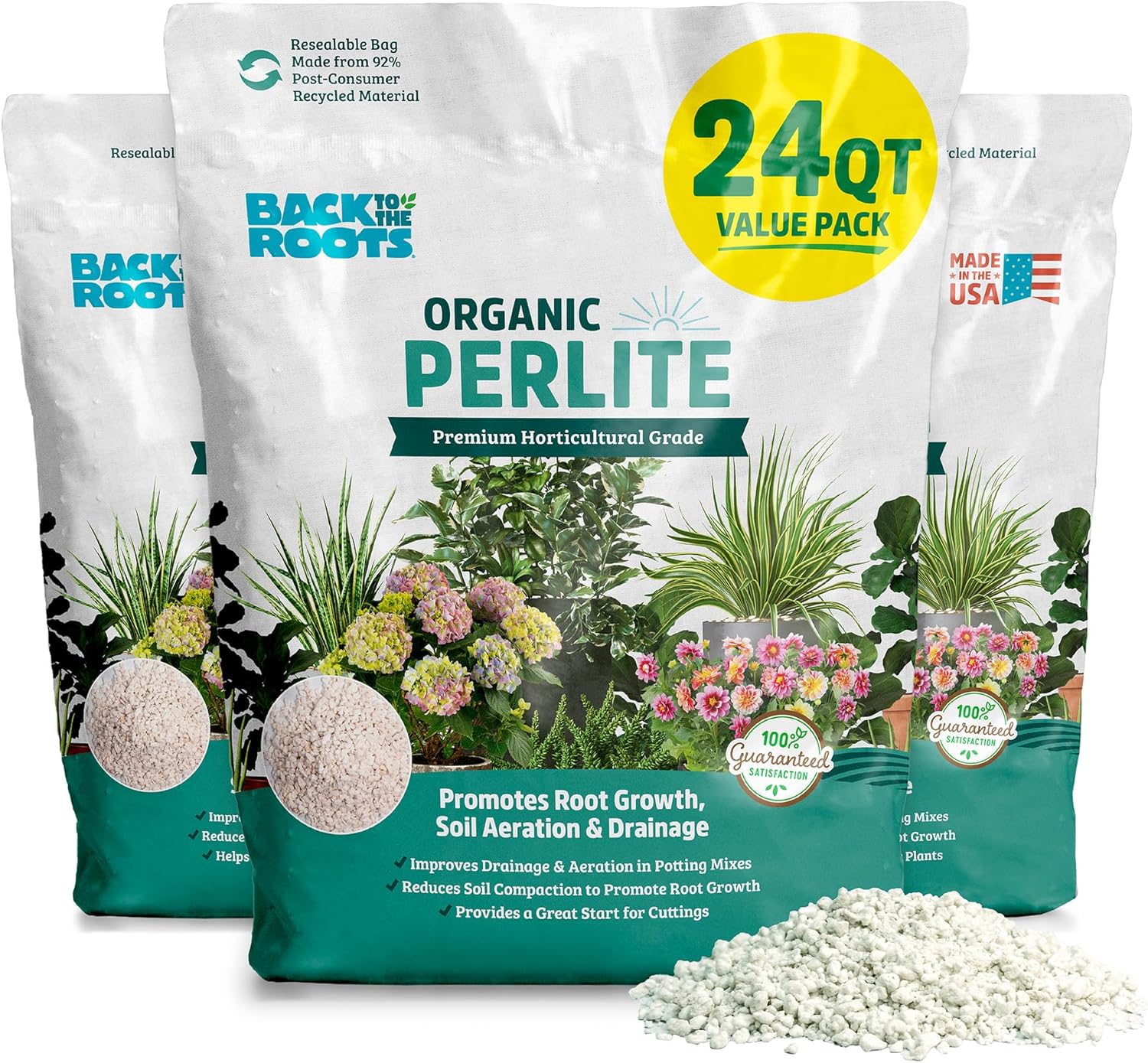
Back to the Roots Organic Horticultural Perlite, 24 Quart (3 × 8 qt)
| Item Form | Granules |
|---|---|
| Specific Uses For Product | General Purpose |
| Coverage | 4000 sq ft. |
| Unit Count | 768 Fluid Ounces |
| Mixing Ratio | 1:1:5 |
This three-pack of Back to the Roots organic perlite is a straightforward, no-frills amendment for improving soil structure, whether you are potting houseplants or amending garden beds. The product is coarse granules of horticultural perlite intended to increase aeration, speed drainage, and reduce the risk of waterlogged roots. Typical use is mixing perlite into potting mixes or topdressing heavy soils; the listing even provides a mixing ratio for seed starting when combined with vermiculite and coconut coir. The value pack covers a large area and is convenient for gardeners who refresh multiple containers or reshape potting blends. Practical benefits include lightweight, inert material that will not break down over time and helps roots access oxygen for healthier growth. Limitations are inherent to perlite: it does not add nutrients or improve water retention and can be dusty when handled, so basic safety precautions are needed. For gardeners focused on improving drainage and root health, this product delivers usable, consistent perlite in a ready-to-use quantity.
Best for: Gardeners who prioritize practical soil improvement and want a reliable, ready supply of perlite to improve drainage in potting mixes and container gardens.
Less Ideal for: Growers seeking an amendment that adds fertility or holds moisture should consider composts or water-retentive soil additions instead.
- Sold in a three-pack that supplies a large coverage for multiple pots or beds
- Horticultural-grade granules that improve soil aeration and reduce waterlogging
- Inert and long-lasting amendment that does not decompose or alter pH
- Provided mixing ratio for seed starting makes it easy to create consistent blends
- Does not provide nutrients or boost water retention on its own
- Can generate dust during handling so masks and gloves are advisable
Verdict: A practical, value-packed perlite supply that reliably improves drainage and root aeration for container and outdoor gardening.
HAINANSTRY Organic Perlite for Plants, 1 qt

| Brand Name | HAINANSTRY |
|---|---|
| Unit Count | 32 Ounce |
| Volume | 1 quarts |
| Style Name | Moisture-retaining |
This 1-quart HAINANSTRY perlite is a straightforward soil amendment that loosens potting mixes, improves drainage, and increases aeration for healthier root development. Gardeners typically mix it into container soils, seed-starting mixes, or raised bed blends at small percentages to reduce compaction and speed drying between waterings. Notable attributes include a reportedly high-purity, low-dust processing and lightweight, durable particles that do not break down quickly. For everyday use it performs the core tasks expected of perlite: it keeps mixes fluffy, helps prevent root rot in overwatered conditions, and makes repotting and root inspections easier. The main limitation is the small 1-quart volume, which is convenient for trialing or treating a few pots but means cost per volume is higher than bulk options if you need material for many containers or larger gardens. It is a simple, no-frills product that does what perlite should without extras.
Best for: A gardener looking to improve drainage in a few houseplants or to try perlite for the first time while keeping costs low and avoiding large bulk purchases.
Less Ideal for: People who need perlite for many containers, large raised beds, or ongoing seasonal use should opt for larger bags to lower cost per volume.
- Improves soil aeration and drainage to reduce root rot risk
- High-purity, low-dust processing minimizes mess and contamination
- Lightweight particles that remain durable and do not break down quickly
- Small package suitable for trying perlite or treating a few pots
- Only 1 quart volume makes it impractical and more expensive for larger projects
Verdict: A convenient, low-commitment 1-quart perlite bag for gardeners who need a small, clean way to improve potting mix drainage and aeration.
Mother Earth Perlite Natural, Size 3 Large and Coarse, 4 cu ft

| Brand Name | Mother Earth Products |
|---|---|
| Item Type Name | Mother Earth Perlite Natural |
| Volume | 4 cubic feet |
| Style Name | Modern |
Mother Earth Perlite Natural is a coarse, size 3 perlite sold in a 4 cubic foot bag for mixing into potting soil or using alone for cuttings and seedlings. It is most commonly used to lighten heavy soils, increase drainage, and boost root aeration in containers and raised beds; the coarse particle size helps prevent compaction and keeps mix structure stable over time. The product directions note it is suitable for seedlings once they germinate and for cuttings after roots appear, and that mixes should be allowed to dry between waterings to avoid standing water. Practical benefits include long-term physical stability compared with fine media, easy incorporation into potting blends, and suitability for outdoor containers that need frequent watering. Limitations are that perlite is an inert mineral so it provides no nutrients and will require you to feed plants separately, and the coarse texture can increase watering frequency in hot, dry conditions. For reliability-focused gardeners this offers predictable performance but must be paired with appropriate fertilization and watering routines.
Best for: Gardeners who prioritize predictable, long-lasting drainage and soil structure for containers and raised beds and who plan to manage feeding and watering themselves.
Less Ideal for: Buyers who want a ready-to-use nutrient-rich potting mix or those who prefer a finer seed-starting medium that retains more moisture.
- Coarse size resists compaction and maintains aeration over time.
- Large 4 cu ft volume reduces need for frequent repurchases for multiple pots.
- Neutral, inert medium that will not alter pH or introduce pests.
- Suitable for seedlings and for rooting cuttings once roots form.
- Provides no nutrients so regular fertilization is required.
- Coarse perlite increases drainage which can require more frequent watering in hot or dry conditions.
Verdict: Choose this coarse 4 cu ft perlite when you need a reliable, long-lasting amendment to improve drainage and aeration in containers and potting mixes.
Miracle-Gro Perlite, 8 qt. (2-Pack)

| Number of Packs | 2 |
|---|---|
| Unit Count | 2 Count |
| Item Type Name | Perlite |
| Item Highlight | Enriched with Plant Food, Improves Drainage and Aeration in Potting Soil Mixes, For Container Plants |
Miracle-Gro Perlite is a lightweight soil amendment sold in a two-pack of 8-quart bags for use in container mixes, propagation and bulb storage. It is intended to be blended with potting soil or sphagnum peat to open the mix, reduce compaction and speed drainage so roots get more air. The product is pre-enriched with Miracle-Gro plant food, which can help feed plants in container use without additional immediate fertilizing. Practical uses include loosening houseplant potting mixes, a 1:3 perlite-to-soil ratio for general houseplants, a 1:1 mix for succulents and using straight perlite to root cuttings or store bulbs. Important limitations are handling precautions and dust: perlite can irritate eyes and lungs so wear a mask and avoid inhaling during mixing. Also perlite does not retain much water on its own, so mixes with high perlite content will need more frequent watering for thirstier plants.
Best for: Buyers who want a proven, easy-to-use amendment to reduce compaction and improve root health in container plants and propagation projects and who value established brand formulations and social proof.
Less Ideal for: Gardeners who need a moisture-retentive medium for thirsty plants or who prefer entirely organic, compost-based amendments should consider alternatives.
- Improves drainage and aeration when mixed into potting soil
- Sold in two 8-quart bags for multiple repots or propagation projects
- Pre-enriched with Miracle-Gro plant food to provide added nutrients
- Versatile for container mixes, rooting cuttings, and bulb storage
- Fine dust can cause skin, eye, or respiratory irritation during handling
- Provides little water retention by itself, requiring more frequent watering in high-perlite mixes
Verdict: A reliable perlite choice for container gardeners who want a lightweight, drainage-focused amendment with the convenience of built-in plant food.
Plantonix Perlite Bliss — Horticultural Perlite (8 Qt)

| Brand | plantonix |
|---|---|
| Unit Count | 24 Ounce |
| Style Name | Organic Perlite for Indoor Plants & Outdoor Plants |
| Volume | 8 quarts |
Plantonix Perlite Bliss is a medium-coarse horticultural perlite intended as a lightweight soil amendment to improve aeration, drainage, and moisture retention in potting mixes and garden soil. Typical uses include mixing it into potting soil for houseplants, blending with coco coir or compost for container gardens, and loosening garden beds to reduce compaction. The product’s neutral pH and coarse grade mean roots get better access to oxygen while excess water drains more readily, which helps prevent waterlogging and supports steady nutrient uptake. The 8-quart volume is handy for small to medium projects and the material is naturally sterile so it reduces the risk of introducing pathogens. Important limitations are that perlite does not provide nutrients or structure long term and it can be dusty when poured, so handle it outdoors or wear a mask to avoid inhaling particles. For larger landscaping jobs you will need multiple bags because each bag covers only a modest area.
Best for: Buyers who want a reliable, low-risk amendment to improve drainage and root oxygenation for houseplants or container gardens and who prefer straightforward, proven products.
Less Ideal for: Gardeners seeking an all-in-one soil amendment that supplies nutrients or for large-scale landscaping where buying many small bags would be impractical.
- Medium-coarse grade improves soil aeration and prevents compaction.
- Neutral pH and sterile material reduce risk of introducing contaminants.
- Holds moisture in its porous structure while improving drainage to prevent waterlogging.
- Mixes easily with potting soil, coco coir, and vermiculite for flexible use.
- Can produce fine dust when handled, requiring respiratory protection or outdoor mixing.
- Does not add nutrients or organic matter, so must be combined with fertilizing amendments.
Verdict: A safe, no-frills medium-coarse perlite that reliably improves aeration and drainage for pots and small garden projects.
Choosing the Right Perlite: Key Factors to Consider
Particle Size And Mix Ratio
Particle size determines how perlite influences porosity and water movement in a growing medium. Coarse particles create larger air pockets and faster drainage, which suits larger containers, succulents, and mixes that need quick drying. Finer grades hold a bit more water and pack more closely with potting soil, which can be better for seed starting or mixes that need uniform moisture.
Decide on a mix ratio based on plant needs. A common starting point is 10 to 30 percent perlite by volume in potting mix for general container plants; increase to 30 to 50 percent for cacti and succulents. For seed starting, smaller particle perlite at lower percentages helps maintain moisture contact without waterlogging delicate roots.
Purity, Dust, And Sterility
Perlite should be free of clay, salt, or other contaminants that will affect soil chemistry or clog pores. Dust and fines are common with lower-quality perlite and can cause respiratory irritation when handling and reduce the effective porosity of the mix. For indoor use and seed starting, look for perlite described as screened or washed to reduce dust content.
While perlite itself is an inert volcanic glass that does not carry pathogens, handling cleanliness matters. If sterility is a concern for propagation, choose product presentations that minimize dust and that come in clean, resealable packaging to avoid contamination during storage.
Moisture Retention Versus Drainage
Perlite increases both drainage and air space, but different grades shift the balance between water retention and quick drying. Coarse perlite favors rapid drainage and strong aeration; fine grades hold more water within small pore spaces. Consider the watering frequency you can reliably provide. If you water infrequently or grow drought-tolerant plants, choose a higher perlite percentage with coarser particles. If you grow moisture-loving seedlings or plants that need even moisture, opt for finer perlite and a lower percentage in the mix.
Also account for pot size and container type. Small pots dry more quickly, so too much coarse perlite can lead to overly dry conditions in small containers.
Handling And Application Practicalities
How easy perlite is to use affects daily gardening workflow. Lightweight perlite can float when watered hard, so choose a grade and mixing method that reduces surface float. Wetting perlite before mixing or working it into a damp potting medium can reduce airborne dust and floatation. Packaging that allows pouring without spillage and resealing helps keep workspaces clean and preserves product quality between uses.
Also consider whether you need a screened or blended product for specific tasks. Some gardeners keep multiple grades on hand for seed starting versus large containers to avoid constantly adjusting mix ratios.
Environmental And Disposal Considerations
Perlite is an inert mineral with a long lifespan in mixes, but consider the environmental footprint of sourcing, packaging, and disposal. Choose products with minimal unnecessary packaging when possible and keep used mix in the garden rather than sending it to landfill. When reusing potting mix that contains perlite, check for compaction or breakdown of organic components; perlite itself remains effective but the overall mix may need reviving with fresh amendments.
If local regulations or community garden rules affect disposal of potting mix, plan ahead. Perlite does not decompose, so think about how much you add to containers and whether you will reuse that substrate over multiple seasons.
Intended Use And Compatibility
Match perlite grade and percentage to the specific plants and containers you use. Seed starting, cuttings, and sensitive plugs often benefit from finer perlite blended with a light seed mix. Larger ornamentals, vegetables, and succulents do better with coarser particles that prevent root rot in deeper pots.
Also consider compatibility with other amendments such as vermiculite, coco coir, or bark. Perlite works well in blends but will change water dynamics when combined with these materials, so adjust ratios and observe how mixes behave during the first few weeks after potting.
How To Measure And Mix Perlite For Different Containers
Measure perlite by volume for most home gardening tasks rather than by weight. Use a consistent container such as a quart measure or a bucket scoop to keep ratios repeatable. For general container mixes, start with about 1 part perlite to 3 or 4 parts potting mix and adjust based on drainage observations.
When mixing, combine dry ingredients first then add water gradually so fines are less likely to become airborne. For small pots and seed trays, pre-wet the perlite lightly to reduce floating and dust when you water for the first time.
- Use coarse perlite for large pots and plants prone to root rot.
- Use finer perlite for seed starting and propagation.
- Pre-wet perlite to reduce float and dust.
Managing Dust And Safety When Using Perlite
Perlite dust can irritate eyes and lungs. Work outdoors or in a well-ventilated area and consider wearing a dust mask and safety glasses when pouring or sifting product. Wetting the perlite slightly before heavy handling cuts down on airborne particles.
Store perlite in sealed containers to keep dust contained and prevent moisture from altering handling characteristics. Clean workspace surfaces promptly after mixing to avoid tracking fine particles into indoor areas.
- Wear a mask and eye protection for bulk handling.
- Work over a tarp or in a cleanable area to catch spills.
- Seal unused product to reduce dust and contamination.
Using Perlite In Raised Beds And In-Ground Gardens
Perlite can be used in raised beds to lighten heavy soils and improve drainage, but it should be mixed thoroughly with existing soil and organic matter. Large additions of perlite in in-ground beds can migrate and create drainage pockets, so blend it evenly and avoid localized concentrations.
For amending heavy clay, work perlite in with compost and coarse sand or grit to create a stable, free-draining structure that still retains nutrients. Monitor moisture because in-ground mixes with high perlite content can dry out faster than anticipated.
- Blend perlite with compost when amending clay soil.
- Avoid large unmixed pockets of perlite that change local drainage.
- Reassess moisture after amendment and adjust watering schedule.
Storing Perlite For Long-Term Use
Keep perlite dry and sealed to prevent contamination and to preserve handling qualities. Moisture can cause fines to clump and change how the product mixes into soils. Use durable, resealable bags or rigid containers stored in a dry shed or garage.
Label containers with grade and purchase date so you can rotate older stock into tasks like soil amendment if fines develop. Proper storage reduces waste and keeps mixes predictable season to season.
- Store in resealable, moisture-resistant containers.
- Label grade and date to track stock.
- Keep away from high-humidity areas.
Alternatives And When To Use Them
Perlite is not the only way to increase porosity in potting mixes. Coarse sand, pumice, and expanded shale each have different weights and water-holding characteristics. Pumice is heavier and less likely to float, so it can be preferable in windy or outdoor potting situations. Coarse sand adds weight and improves drainage but can compact over time.
Choose alternatives when weight, permanence, or local availability make them a better fit. For example, pumice may be better for outdoor bonsai where stability matters, while sand can work for large in-ground beds when mixed properly with organic matter.
- Pumice: heavier, stable, low float.
- Coarse sand: adds weight and drainage, can compact.
- Expanded shale: long-lasting structure, often used in professional mixes.
How We Chose the Best Perlite
We focused on the attributes that actually matter when adding perlite to potting mixes and garden soils. Selection began with products widely specified for container gardening and propagation, then narrowed by four to six concrete performance dimensions that influence real-world results. Key evaluation criteria included particle size distribution because that affects drainage and air space, material purity and absence of dust to protect seedlings and indoor growers, and consistency of batch grading so mixes behave predictably. We also weighed moisture retention versus drainage balance to ensure mixes do not dry out too quickly, and ease of handling such as dust suppression and packaging that permits accurate measuring. We excluded products with inconsistent sizing claims, heavy fines that create dust problems, or unclear sourcing notes. We did not consider brand popularity alone; instead we prioritized measurable specs and gardener-focused handling traits. The resulting shortlist reflects perlite options that meet these practical standards across container growing, seed starting, and soil amendment uses.
FAQ
How much perlite should I add to a standard potting mix?
A typical starting point is 10 to 30 percent perlite by volume for general container plants. Increase to 30 to 50 percent for succulents and cacti. Adjust based on pot size and how quickly the mix dries in your environment.
Will perlite change soil pH or nutrient levels?
No. Perlite is an inert volcanic glass and does not significantly alter soil pH or nutrient content. Its role is strictly physical, improving aeration and drainage rather than supplying nutrients.
Can I reuse potting mix that contains perlite?
Often yes. Perlite itself remains effective, but organic components of the mix may be depleted or compacted. Refresh reused mix with compost or fresh potting mix and check drainage before repotting sensitive plants.
Is perlite safe for indoor use around children and pets?
Perlite is non-toxic, but the dust can irritate lungs and eyes. Use good ventilation, wet the product slightly to reduce dust, and store it sealed and out of reach. Avoid ingesting and keep pets away during bulk handling.
Does perlite float when I water my pots?
Perlite can float, especially fine or very lightweight grades, when pots are heavily watered. To reduce floatation, pre-wet perlite before mixing or work it into a damp potting medium so particles settle into the mix.
Final Verdict
Choose perlite grade and percentage based on the plants you grow and the containers you use. Prioritize particle size consistency and low dust for seed starting and indoor use, and favor coarser grades for larger containers and drought-tolerant species. Balance drainage needs with moisture retention so mixes do not dry out too quickly or hold excess water. When you match grade, mix ratio, and handling practices to your gardening situation, perlite is an inexpensive and reliable way to improve root health and potting mix performance. Focus on the tradeoffs described here and you will select a product that fits your maintenance style and growing goals.
