

Note: This article contains affiliate links. If you click on these links and make a purchase, I may earn a small commission at no extra cost to you. This helps support my research and content. Read my full affiliate disclosure here.
Choosing the right wood mulch for vegetable gardens changes how often you water, how many weeds you pull, and how healthy your soil feels over a season. In a vegetable patch, mulch must protect roots, regulate soil moisture, and avoid harming young plants. This guide focuses on five carefully shortlisted wood mulches suited to vegetable beds and patio planters. Each option below was evaluated for how it behaves in a working vegetable garden: nutrient interactions, application ease, persistence, and how it affects soil moisture and temperature. Read on to see the deciding factors we used and practical guidance for using wood mulch around edibles.
Top Picks at a Glance
| Best Value The sweet spot between price and what you get | GARDENWISE Premium Brown Wood Mulch (0.2 cu ft) |  |
| Best Budget The cheapest option that still gets the job done reliably | Gardenera Brown Mulch Cover — 1 Quart |  |
| Highest Rated A top-rated pick with lots of positive feedback | Soil Sunrise 100% Natural Pine Bark Mulch Nuggets (30 Quarts) |  |
| Most Popular A crowd favorite that many people choose with confidence | Rio Hamza Trading Pine Bark Mulch Nuggets, 8 Quarts (All Natural) |  |
| Best Seller A high-volume bestseller chosen again and again | Wood Smith USA 100% Natural Cedar Chips, 4 Quart Bag |  |
GARDENWISE Premium Brown Wood Mulch (0.2 cu ft)
| Unit Count | 1 Count |
|---|---|
| Included Components | Brown Wood Mulch |
| Item Type Name | Mulch |
| Manufacturer | Summit Sales Company LLC |
| Volume | 0.2 cubic feet |
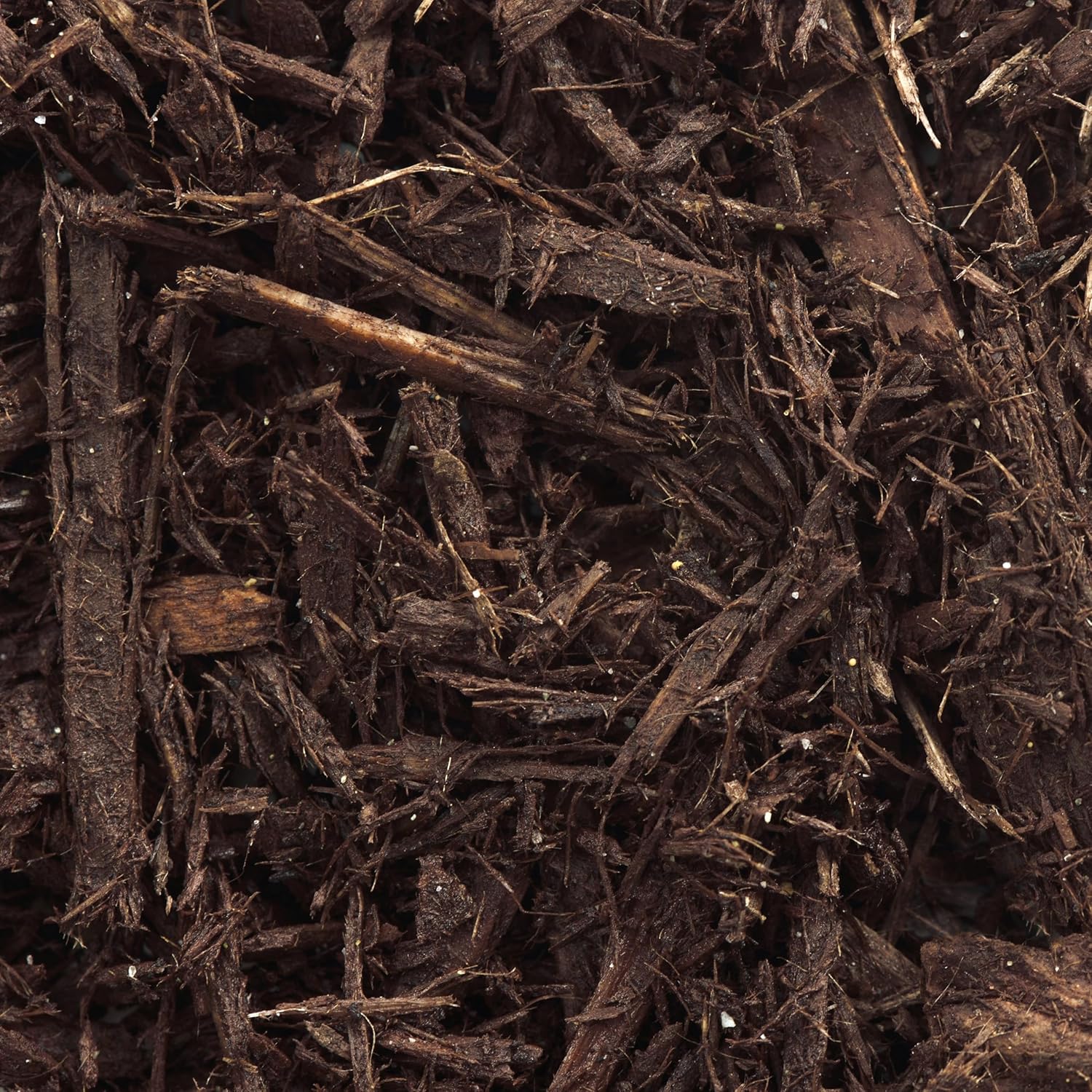
This GARDENWISE Premium Brown Wood Mulch is a basic, small-volume bag of shredded wood intended for topping garden beds, planters, and small landscaping areas. It is used as a surface layer to suppress weeds, conserve soil moisture and moderate soil temperature around plants. The product is sold in a 0.2 cubic foot unit that makes it convenient for spot applications, container gardening, or testing mulch choice before committing to bulk. Practical benefits include simple application, an attractive natural brown appearance that blends into vegetable beds, and the familiar moisture-retention and insulation effects of wood mulch. Important limitations are the small volume per bag, which means multiple bags are needed for larger vegetable beds, and that fresh wood mulch can temporarily tie up nitrogen as it decomposes so you should monitor fertility when used directly over vegetable soil. For vegetable gardens this works well in small plots or around individual plants, but plan on replenishing and supplementing soil nutrients when installing over growing beds.
Best for: Gardeners who want an affordable, ready-to-use mulch for container plants, small vegetable beds, or spot applications and who prefer to buy in trial-sized quantities before scaling up.
Less Ideal for: Large vegetable plots or those planning a one-time full-bed application should avoid this small bag and consider bulk mulch or delivery options instead.
- Good for small projects and container or spot mulching
- Helps retain soil moisture and reduce watering frequency
- Suppresses surface weeds and gives a finished look to beds
- Small 0.2 cu ft volume requires many bags for full garden coverage
- Fresh wood mulch can temporarily reduce available nitrogen as it decomposes
Verdict: A convenient trial‑size bag that lets practical gardeners test and use wood mulch on pots and small vegetable patches without committing to bulk purchases.
Gardenera Brown Mulch Cover — 1 Quart

| Brand Name | Gardenera |
|---|---|
| Unit Count | 1 Count |
| Item Type Name | Brown Mulch |
| Volume | 1 quarts |
Gardenera Brown Mulch is a 1-quart natural mulch intended for small garden beds, containers, and indoor plantings where a tidy top layer and moisture retention are desired. It is applied by spreading a thin, even layer around plant bases to reduce evaporation and block light from weed seeds. The product emphasizes natural ingredients and colorfastness so it maintains an attractive brown tone under sun exposure. Practical benefits include easier watering schedules thanks to reduced surface drying and less time spent weeding for small-scale projects. Because this listing is a single 1-quart unit, it is best used for touch-ups, potted plants, or trialing color and texture before committing to larger quantities. Limitations are the small volume provided and the need to avoid piling mulch against stems to prevent rot. For larger beds you will need multiple bags or a bulk alternative, but for spot use and decorative finishes this mulch performs as advertised.
Best for: Buyers looking for an inexpensive, small-quantity mulch to refresh containers, finish planter beds, or try a product before buying larger quantities.
Less Ideal for: Gardeners who need to cover large landscape areas or who prefer bulk bags for regular seasonal replenishing should consider larger-volume options.
- Designed to conserve soil moisture and reduce watering frequency
- Formulated to suppress weeds by blocking sunlight at the soil surface
- Natural ingredients and colorfast finish suitable for indoor and outdoor use
- Handy 1-quart size good for potted plants, small beds, or trial use
- Small 1-quart volume requires many units to cover even modest garden beds
Verdict: A convenient, budget-friendly 1-quart brown mulch best suited for containers, small beds, and trying out color and moisture-retention benefits before buying larger quantities.
Soil Sunrise 100% Natural Pine Bark Mulch Nuggets (30 Quarts)

| Volume | 30 quarts |
|---|---|
| Ingredients | Pine bark mulch |
| Unit Count | 1 Count |
Soil Sunrise pine bark mulch is a simple, single-ingredient bagged mulch made from aged pine bark broken into roughly 1/2-inch nuggets. It is used as a top dressing for potted plants, bonsai, terrariums, and acid-loving or ornamental containers, or mixed into potting media to increase aeration and drainage. The nuggets help reduce surface evaporation, shade roots, and give pots a finished reddish-brown look while breaking down slowly to add organic matter over time. Practical benefits include improved water management for indoor and container setups, reduced risk of surface compaction and root rot when blended into mixes, and an attractive natural appearance. Limitations are that the chunky nuggets are not suitable as a fine soil amendment where a uniform fine texture is needed and they will slowly decompose so periodic top-up is necessary; they also do not provide fertilizer or pH adjustments on their own. For gardeners seeking a low-maintenance, decorative mulch for containers, this delivers the expected functions without extras.
Best for: Buyers who want a low-maintenance, all-natural top dressing or amendment for container plants, bonsai, and terrariums and who value improved drainage plus an attractive finished look.
Less Ideal for: Gardeners who need a fine-textured soil conditioner for mixing into beds or who expect a fertilizing or pH-correcting product should consider other soil amendments.
- 100% natural pine bark with no additives
- Nugget size improves drainage and airflow when mixed into potting media
- Helps retain moisture at the surface and shades roots to reduce evaporation
- Attractive reddish-brown finish that tidies container tops
- Chunky 1/2-inch pieces are not suitable for applications needing fine soil texture
- Does not supply nutrients or alter soil pH
Verdict: A straightforward, all-natural pine bark mulch that improves container drainage, reduces evaporation, and gives potted plants a polished, low-maintenance top layer.
Rio Hamza Trading Pine Bark Mulch Nuggets, 8 Quarts (All Natural)

| Brand Name | Rio Hamza Trading |
|---|---|
| Unit Count | 256 Square Feet |
| Item Type Name | Potting Soil |
| Volume | 8 quarts |
| Ingredients | All natural pine shavings |
These 100% natural pine bark nuggets are small half-inch pieces intended as a top dressing or soil amendment for containers, bonsai, terrariums, and beds. You can sprinkle them as a decorative layer over potting mix to reduce surface evaporation and discourage pests, or blend a portion into heavy soil to increase aeration and reduce waterlogging around roots. The product emphasizes chemical-free bark with a red-brown look that tidies planters and complements evergreen plantings like arborvitae. An 8-quart bag covers modest container projects and provides enough to refresh a single large pot. Because the nuggets are coarse, they persist on the surface and do not compact quickly, which helps long-term drainage but means they will not break down fast to enrich soil. Also the bag size is small for landscape-scale mulching, so this is best for focused use around specimens rather than blanket beds. For someone managing moisture around ornamental evergreens, these nuggets work as an attractive, low-maintenance surface mulch.
Best for: A buyer who prioritizes plant safety and wants visible social validation will appreciate a chemical-free, attractive mulch for protecting root zones of specimen shrubs or container arborvitae and for tidying planters.
Less Ideal for: Not a good fit for someone needing bulk mulch for wide beds or wanting a fast-breaking organic amendment to quickly enrich soil.
- Made from 100% natural pine bark with no added chemicals
- Half-inch nuggets improve soil aeration and reduce surface compaction
- Durable, coarse texture provides long-lasting decorative top dressing
- Versatile for indoor pots, bonsai, terrariums, and small outdoor containers
- Small 8-quart bag is insufficient for mulching large landscape areas
- Coarse nuggets decompose slowly and provide limited short-term nutrient addition
Verdict: Choose these pine bark nuggets when you want a chemical-free, long-lasting decorative mulch to improve drainage and keep arborvitae planters looking tidy.
Wood Smith USA 100% Natural Cedar Chips, 4 Quart Bag

| Brand Name | Wood Smith USA |
|---|---|
| Unit Count | 148.92 Ounce |
| Number of Packs | 1 |
| Volume | 1 |
These 100% natural cedar chips are a lightweight, aromatic mulch sold in a 4-quart bag that works best as a top dressing for potted plants, hanging baskets, and small garden patches. The cedar scent helps deter some insects and can freshen indoor potting mixes, while the chips also help retain surface moisture and reduce light reaching weed seeds. Because the bags are hand sifted and packed, quality is generally consistent for small jobs, and the product is easy to spread with minimal tools. The obvious limitation is the small volume — a single 4-quart bag covers only a very small area, so multiple bags are required for beds or larger weed-control projects. The chips are also coarse compared with fine mulches, so they are better for decorative surface cover than for forming a dense, weed-suppressing mat. Handle the product carefully to avoid inhaling dust and follow guidance if using around animals.
Best for: Buyers looking for an inexpensive, small-quantity mulch to refresh pots, hanging planters, or to try cedar for insect control in limited areas.
Less Ideal for: Gardeners who need to cover large beds or who want a fine-textured mulch for dense weed-smothering should choose larger bulk bags or finer mulches instead.
- Natural cedar composition that repels some insects and adds a pleasant scent
- Small 4-quart bag useful for potted plants, hanging baskets, and spot treatments
- Helps retain surface moisture and reduces light to surface weed seeds
- Hand-sifted and hand-packed for generally consistent small-batch quality
- Very small volume so not cost-effective for large beds
- Coarse chip size offers less dense weed suppression than finer mulches
Verdict: A handy, low-cost 4-quart cedar chip bag for small-scale potting and spot weed control where you want a natural scent and insect-repellent benefits.
Choosing the Right Wood Mulch for Vegetable Gardens: Key Factors to Consider
Nitrogen Interaction and Soil Nutrition
Wood mulch can temporarily tie up nitrogen as microbes break down high-carbon material. That matters most in early season when seedlings need available nitrogen. A coarse, well-aged mulch typically causes less immediate drawdown than fresh, finely shredded wood. When using wood-based mulches near young vegetables, plan for a small sidedressing of balanced fertilizer or use aged mulch that has partially decomposed.
Understanding nitrogen dynamics helps you avoid poor early growth and leaf yellowing. If you prefer to avoid any risk, consider keeping a small mulch-free band around new transplants until roots establish, then apply mulch once plants are larger and the soil nutrient balance is steadier.
Particle Size and Consistency
Particle size affects how the mulch lies on the soil, how well it suppresses weeds, and how quickly it breaks down. Fine shredded mulch hugs soil and suppresses small weeds quickly but can compact and reduce airflow if applied too thick. Larger chips provide better air space and slower decomposition but may let small weeds poke through and can be less tidy around close-planted rows.
For densely planted vegetable beds, a medium-fine consistency is often a good compromise. Pay attention to screened versus unscreened material; screened mulch tends to be more uniform and easier to spread in a thin, effective layer.
Moisture Retention and Temperature Moderation
One of the main reasons gardeners use wood mulch in vegetable plots is to conserve soil moisture and buffer temperature swings. A proper mulch layer slows evaporation, cutting back on frequent watering during hot, dry periods. It also keeps soil cooler during heat waves and warmer during cool nights, which benefits root development and microbial activity.
Thickness matters: a 2-3 inch layer is often enough to retain moisture without overly insulating the crown of many vegetable plants. Too thin a layer will fail to suppress weeds effectively; too thick a layer can harbor slugs or keep crowns wet, increasing disease risk for certain crops.
Decomposition Rate and Maintenance Frequency
How quickly wood mulch decomposes determines how often you need to top up beds and how it contributes organic matter to the soil. Faster-decomposing material feeds the soil sooner but requires more frequent replenishment. Slow-decomposing chips last longer and reduce annual maintenance but add organic matter at a slower rate.
Consider your maintenance rhythm and whether you want mulch to be a low-effort, long-lasting cover or an active part of soil-building. Mixing in compost beneath the mulch can offset slow nutrient contributions while still benefiting from durable surface coverage.
Cleanliness, Contaminants, and Weed Seed Load
Not all wood mulches are equally clean. Some garden-grade mulches are screened and free of stickers and weed seeds, while others can include fines, soil, or seeds that introduce weed pressure. Contaminated wood from treated lumber, painted wood, or material exposed to chemicals should be avoided because residues can harm edible plants.
Inspect product descriptions and source information when possible. If you doubt cleanliness, consider solarizing a thin layer or using a screened organic material instead. Clean, bark-free mulches are usually best for close-planted vegetable beds where direct contact with the soil and roots occurs.
Application Practicalities and Accessibility
Think about how you'll transport and spread the mulch in raised beds, containers, and ground plots. Lightweight, finely shredded mulch is easier to rake into rows and around small plants, while heavy, coarse chips are awkward in narrow beds but useful for paths and perennial borders. Accessibility matters if you have limited tools or physical constraints.
Also consider storage if you buy in bulk. Some mulches compact and can become matted in a pile; rotating stock and keeping material dry until use preserves its performance.
Using Wood Mulch Safely Around Young Vegetables
Avoid piling fresh wood mulch directly against plant stems and crowns. For young transplants, leave a 1- to 2-inch mulch-free collar to prevent stem rot and to make watering easier. Once plants are established and roots are deeper, pull mulch back in to conserve moisture.
If you are worried about nitrogen immobilization, apply a light side-dressing of compost or a balanced organic fertilizer before mulching. That supports early growth while the mulch begins to break down.
- Maintain a 1-2 inch bare zone around stems for vulnerable crops
- Add compost under mulch for a nutrient buffer
- Use aged or composted wood mulch if planting immediately after application
Layer Thickness and Timing for Best Results
For most vegetable crops, a 2- to 3-inch layer of wood mulch gives good weed suppression and moisture control without smothering plants. Place thinner layers around closely spaced seedlings and increase to 3 inches in wider rows or around established perennials.
Apply mulch after soil has warmed in spring and after seedlings have had a chance to root. In autumn, adding a slightly thicker layer helps protect roots through winter and reduces early spring weeds.
- Spring application: wait until soil is warm and seedlings established
- Autumn application: increase thickness to insulate overwintering roots
- Replenish annually or as decomposition dictates
Combining Wood Mulch with Compost and Organic Amendments
Wood mulch works best when paired with soil-building practices. Spread compost or well-rotted manure lightly over the bed before mulching to supply accessible nutrients while the wood breaks down more slowly. This approach supports steady vegetable growth without forcing heavy fertilizer use.
Top-dress with compost midseason if plants show nutrient needs. The compost will be more immediately available than carbon-rich wood as it integrates into the soil.
- Apply compost under mulch at planting
- Use midseason compost side-dressing for heavy feeders
- Avoid heavily fresh green waste under wood mulch to reduce heat and composting mess
Common Pests and Disease Considerations
Wood mulch can provide habitat for slugs, earwigs, and other moisture-loving pests if placed too close to stems or in thick, compact layers. To minimize issues, avoid excessive thickness at plant crowns and monitor for pest activity during damp weather.
Ensure good air circulation by not compacting mulch and by choosing coarser material where drainage is a concern. Proper spacing and plant pruning also reduce disease risk associated with overly moist crowns.
- Keep mulch away from direct stem contact
- Use coarser chips in poorly drained beds
- Inspect beds regularly for slug and insect activity
Sourcing and Storage Tips for Garden-Grade Wood Mulch
Source mulch that is labeled as clean, composted, or screened to reduce weed seeds and fines. Avoid material that could include treated lumber or painted scraps. When in doubt, pick a product described as garden-grade or naturally processed.
Store mulch in a covered, ventilated area to prevent it from becoming waterlogged and matted. For small gardens, order smaller quantities or buy loose material in bags if storage space is limited.
- Choose screened, garden-grade material when possible
- Keep mulch dry in storage to maintain fluff and ease of spreading
- Rotate stock to prevent compaction and anaerobic pockets
How We Chose the Best Wood Mulch for Vegetable Gardens
We focused on attributes that matter in active vegetable beds and selected products that met practical gardener standards. Key evaluation criteria included nutrient interaction with soil, specifically the risk of short-term nitrogen immobilization; particle size and consistency to judge how well the mulch suppresses weeds without smothering seedlings; decomposition rate to estimate how often gardeners will need to replenish material; and moisture management to assess how the mulch moderates soil drying and temperature swings. We also assessed application ease and dust or contaminant concerns because sloppy, dusty material complicates planting and can carry weed seed. Durability in a garden setting was measured by how long a layer remains intact under watering and foot traffic. Exclusions included any materials with known toxic residue, heavy contamination, or poorly screened mixes likely to contain high weed seed loads. The result is a list of five wood mulch options that align with common vegetable garden priorities and real-world use.
FAQ
Is wood mulch safe to use around edible vegetable plants?
Wood mulch is safe around edibles when it is free of treated wood, paint, or chemical contaminants. Use clean, garden-grade material and avoid placing mulch directly against stems. Properly applied, wood mulch reduces weeds and conserves soil moisture without harming crops.
Will wood mulch rob my soil of nitrogen and harm seedlings?
Fresh, high-carbon wood can temporarily immobilize nitrogen as microbes decompose it, which may affect very young seedlings. Using aged or composted wood mulch, adding compost beneath the mulch, or applying a light side-dressing of fertilizer will mitigate this risk.
How thick should I apply wood mulch in a vegetable bed?
A 2- to 3-inch layer is suitable for most vegetable beds. Use a thinner layer around newly planted seedlings and increase thickness for established plants or for winter insulation. Avoid overly thick layers that can retain too much moisture near crowns.
Can I use wood mulch in raised beds and containers?
Yes, but choose finer, well-aged material for containers and shallow raised beds to avoid excessive air space loss and slow water penetration. Monitor watering frequency because mulch changes surface evaporation and can mask when containers need water.
How often do I need to replenish wood mulch in my vegetable garden?
Replenishment depends on decomposition rate and material type. Finely shredded, fast-breaking mulch may need topping each year, while coarser chips can last multiple seasons. Check mulch depth annually and add material to restore 2 to 3 inches as needed.
Final Verdict
For vegetable gardening, prioritize mulch that balances moisture conservation with minimal negative effects on available nutrients. Choose screened or well-aged wood mulch with a particle size suited to your bed layout, and pair it with compost or light fertilizer to support steady plant growth. Consider how often you want to maintain beds and select a material with a decomposition rate that matches your maintenance plan. By focusing on nitrogen interaction, particle consistency, and moisture benefits, you can pick a wood mulch that reduces weeds, eases watering, and contributes to healthier soil over time without introducing unnecessary risk to your crops.
