

Note: This article contains affiliate links. If you click on these links and make a purchase, I may earn a small commission at no extra cost to you. This helps support my research and content. Read my full affiliate disclosure here.
If elm seed bugs are congregating on your trees, siding, or nearby walkways, the right insecticide can reduce feeding damage and limit the nuisance of adults moving into structures. You want a product that delivers quick knockdown of adults and nymphs, plus enough residual activity to cover the elm feeding period without excessive reapplication. This guide shortlists seven insecticide options that fit typical homeowner and landscape scenarios and explains how they perform in garden and yard use. We evaluate efficacy, application method, and safety so you can choose the option that fits your application style and site constraints.
Top Picks at a Glance
| Best Overall The best all-around choice for most situations | HARRIS Asian Lady Beetle, Japanese Beetle and Box Elder Killer Gallon Spray (128 fl oz) |  |
| Best Quality Built to a higher standard if you want something more solid | Demon Max Insecticide 16 oz |  |
| Best Value The sweet spot between price and what you get | Quali-Pro Bifenthrin I/T 7.9F Insecticide, 1 Gallon |  |
| Best Budget The cheapest option that still gets the job done reliably | GardenTech Sevin Insect Killer Dust, 1 lb |  |
| Highest Rated A top-rated pick with lots of positive feedback | Envu Tempo SC Ultra Insecticide Concentrate, 240 ml |  |
| Most Popular A crowd favorite that many people choose with confidence | Atticus Talak 7.9% Bifenthrin Indoor/Outdoor Insecticide Concentrate, 32 oz |  |
| Best Seller A high-volume bestseller chosen again and again | Compare-N-Save Concentrate Indoor & Outdoor Insect Control, 32 oz |  |
HARRIS Asian Lady Beetle, Japanese Beetle and Box Elder Killer Gallon Spray (128 fl oz)

| Unit Count | 128 Fluid Ounces |
|---|---|
| Item Form | Spray |
| Target Species | Insects |
| Active Ingredients | Deltamethrin |
| Specification Met | EPA |
This gallon jug of HARRIS insecticide is designed for targeted surface treatments around windows, doors, screens and siding to control Asian lady beetles, box elder bugs and similar insects. It ships with an attachable trigger sprayer and instructions to apply from about 12 inches so surfaces become slightly moist but not dripping. The active ingredient, deltamethrin, provides residual control that can continue killing insects for weeks after application, and the formula is labeled as odorless and non-staining so it can be used on many indoor and outdoor surfaces when directions are followed. The product is EPA registered for household use and covers a lot of area per fill, which helps if you need repeated or seasonal treatments. Important practical limits are that it is a chemical pesticide requiring dry time before people or pets re-enter treated areas and that intense sunlight can break down effectiveness so reapplication may be needed on south-facing walls. This product is not for use in jurisdictions where sale is restricted.
Best for: Buyers who prioritize proven, EPA-registered chemical control and want a high-volume product for treating entry points and surfaces around homes to prevent beetle infestations.
Less Ideal for: People seeking non-chemical, organic, or pet-safe-only approaches or those uncomfortable applying residual insecticides should consider alternative controls.
- Large one-gallon volume reduces frequency of refills for repeated treatments
- Contains deltamethrin for extended residual control on treated surfaces
- Odorless, non-staining formula suitable for many indoor and outdoor surfaces
- Includes instructions and fits a trigger sprayer for straightforward application
- Requires surface dry time and precautions around children and pets after application
- Residual effectiveness can degrade in direct, intense sunlight requiring reapplication
Verdict: Choose this gallon HARRIS spray when you want an EPA-registered, high‑volume residual insecticide to treat entry points and surfaces for persistent beetle control.
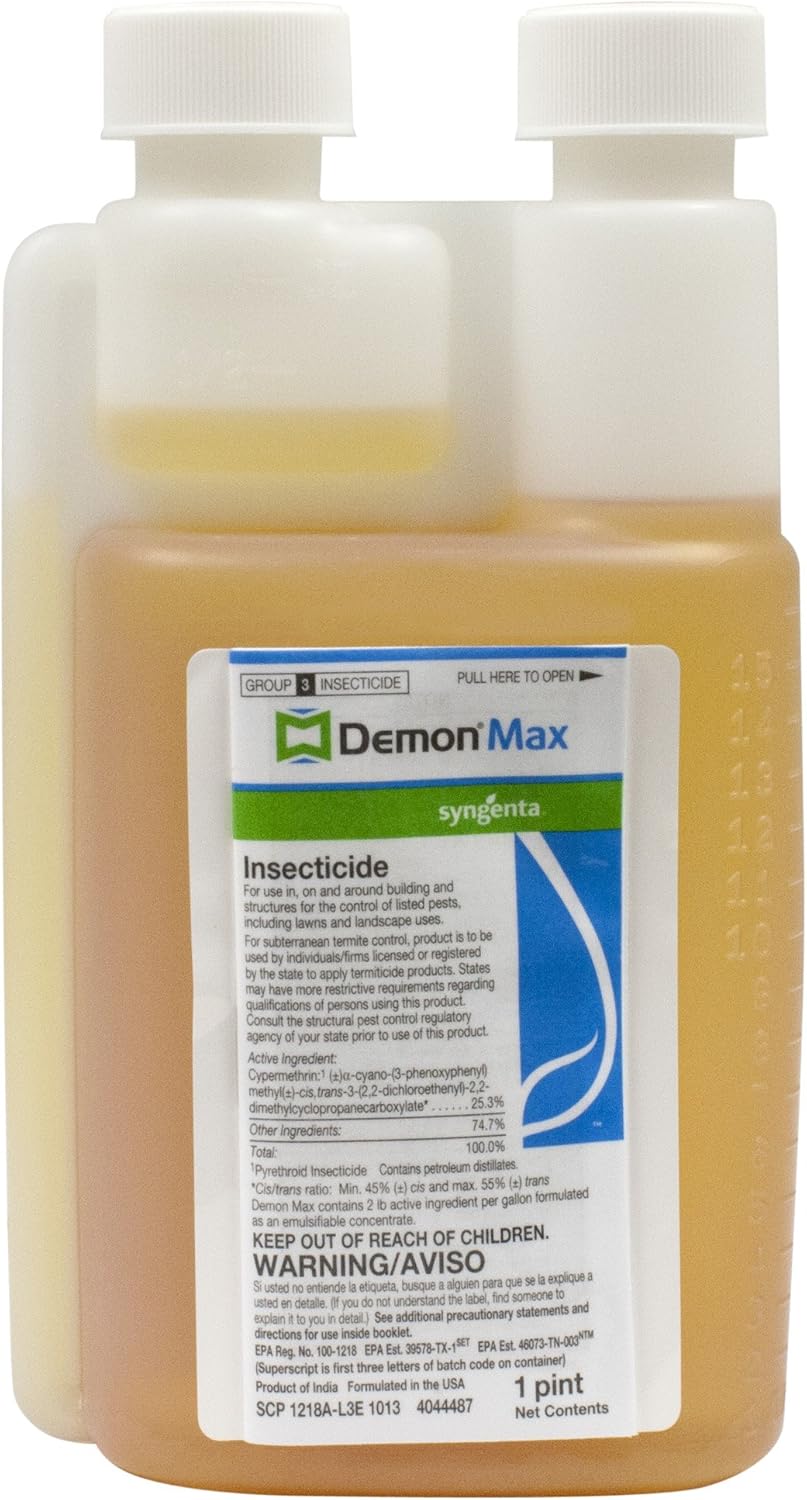
Demon Max Insecticide 16 oz
| Unit Count | 16 Ounce |
|---|---|
| Item Form | Liquid |
| Target Species | Insects |
| Active Ingredients | Cypermethrin |
Demon Max is a concentrated 16 ounce liquid insecticide designed for both quick knockdown and lasting residual control of more than 30 insect pests, making it suitable for spot, crack-and-crevice, and perimeter treatments. It is typically mixed in a hand-pump or compressed sprayer and applied around foundations, on lawns and vegetation, and in and around structures where pest activity is observed. The product lists cypermethrin as the active ingredient, which delivers fast contact mortality and residual protection when applied according to label directions. Practical benefits include flexible application options across multiple surfaces and economical coverage from a small concentrate. Important limitations are the need to measure and mix correctly for the treatment area and to follow safety precautions, including keeping it away from children and avoiding application on unintended plants or areas. This is a professional-strength, pesticide-focused option for users who want effective, long-lasting roach and general insect control when applied responsibly.
Best for: Buyers who prioritize strong, long-lasting pest control results and are comfortable mixing and applying a concentrated insecticide for targeted indoor and outdoor treatments.
Less Ideal for: Casual users seeking ready-to-use sprays or nonchemical options should consider simpler consumer products or mechanical controls instead.
- Fast knockdown and residual control against a wide range of insect pests
- Versatile use for crack-and-crevice, spot treatments, lawns, vegetation, and building perimeters
- Concentrated liquid formula that can be mixed to cover varied square footage
- Contains cypermethrin, a proven synthetic pyrethroid active ingredient
- Requires careful measuring and mixing for correct coverage and safety
- Labeled for professional-style applications and may need precautions for use near ornamentals and non-target areas
Verdict: Choose Demon Max when you need a concentrated, professional-strength liquid that delivers fast knockdown and lasting residual control of roaches and other insects.
Quali-Pro Bifenthrin I/T 7.9F Insecticide, 1 Gallon

| Item Form | Spray |
|---|---|
| Target Species | Termites, Carpenter Ants |
| Liquid Volume | 1 gallons |
| Active Ingredients | Bifenthrin |
This one-gallon Quali-Pro Bifenthrin I/T 7.9F is a flowable pyrethroid designed for preventive and residual control of a broad range of pests in lawns and landscaped areas. It is typically mixed and applied as a spray to turf, ornamental beds, foundations and around structures to suppress termites, carpenter ants, fleas, ticks, mites and similar pests. Key features include a long-lasting residual, compatibility with many turf and ornamental tank-mix partners, and a no-odor, non-irritating formulation that dries without visible residue. In practice it provides dependable knockdown and weeks of protection when applied at recommended rates, making it suited for routine perimeter treatments and spot-control of persistent infestations. Important limitations are that it is a concentrated professional-style product requiring careful dilution, protective equipment, and adherence to label directions for safe use around people, pets and desirable plants. It is not a ready-to-use consumer spray and should be used only where labeled.
Best for: Buyers who prioritize a reliable, long-lasting perimeter or spot-treatment solution for recurring or hard-to-control outdoor pests and who are comfortable following label directions and using concentrated products.
Less Ideal for: Casual users who want a simple ready-to-use spray for occasional bug bites or very small lawns should consider consumer-grade aerosols or hose-end products instead.
- Long-lasting residual control effective against termites, carpenter ants and other pests
- Compatible with herbicides, fungicides, insecticides and liquid fertilizers for tank mixes
- No-odor, non-irritating formula that dries with no visible residue
- Available in a one-gallon concentrated flowable for multiple applications
- Concentrated product requires dilution and protective equipment for safe handling
- Not intended as a ready-to-use consumer spray and may be overkill for very small yards
Verdict: Choose this product when you need a dependable, long-lasting concentrated insecticide for routine perimeter and spot treatments in lawns and ornamentals.
GardenTech Sevin Insect Killer Dust, 1 lb

| Item Form | Dust |
|---|---|
| Target Species | Insects |
| Active Ingredients | Bifenthrin |
| Unit Count | 1 Count |
Sevin Insect Killer Dust is a handheld dust formulation of bifenthrin for spot and perimeter treatment of garden pests, including Japanese beetles. You apply it by shaking a thin, uniform layer onto leaves, stems and around plants as a preventative or when you first see damage. The product kills by contact and lists more than 150 target insects, so it works across vegetables, fruit, ornamentals and turf. Practical features include a flip-open cap for easy dispensing and a 1 pound container sized for small-to-medium beds; the manufacturer states one pound treats about 2,000 sq. ft. The dust does not require mixing and settles quickly so treated areas can be reoccupied after it dries. Important limitations are typical for contact insecticides: it should not be applied to open blooms to protect pollinators and it provides little residual control if plants are watered or receive heavy rain within 24 hours of application. Users must follow label safety steps like avoiding the eyes and washing hands after use.
Best for: Gardeners who want a straightforward, no-mix contact treatment to quickly reduce visible beetle and chewing insect pressure in mixed vegetable, fruit and ornamental plantings.
Less Ideal for: People prioritizing pollinator-safe or long-residual biological controls should choose targeted or non-chemical methods instead.
- Kills by contact a wide range of garden pests including Japanese beetles and aphids
- Ready-to-use dust needs no mixing and is simple to apply with a flip-open cap
- Label lists use on vegetables, fruits, ornamentals and lawns so it fits mixed garden beds
- Contains bifenthrin which can harm beneficial insects if applied to open blooms or overused
Verdict: If you need a simple, ready-to-use contact treatment to quickly knock down Japanese beetles and other common garden pests, Sevin dust delivers fast, broad-spectrum control.
Envu Tempo SC Ultra Insecticide Concentrate, 240 ml

| Item Volume | 240 ml |
|---|---|
| Item Form | Liquid |
| Target Species | Ants, flies, cockroaches, crawling pests, and ticks |
| Ingredients | Beta-Cyfluthrin |
Tempo SC Ultra is a liquid concentrate insecticide designed for perimeter and spot treatments where dependable, lasting control of ants, spiders, cockroaches and other crawling pests is needed. The product mixes with water and is applied as a general surface, spot, crack and crevice or mist treatment, so it works both indoors around entry points and outdoors along foundations and patios. Its active ingredient, beta-cyfluthrin, provides quick knockdown plus residual activity so treated areas remain protected between applications. The suspension concentrate formulation spreads evenly and the low-odor, non-staining claim makes it practical for use near garages and basements where smell and marks matter. Users should follow label dilution and safety directions carefully since concentrated insecticides require proper handling and mixing. This product is best used as part of regular perimeter maintenance rather than for one-off fumigation of large infested structures.
Best for: Homeowners who prioritize a reliable, long-lasting perimeter treatment to reduce crawling insect activity around entry points and common harborage areas and who are comfortable following label mixing and application steps.
Less Ideal for: People seeking immediate fumigation-style control for heavily infested interiors or those unwilling to handle concentrated pesticides should consider alternative application methods or professional services.
- Broad-spectrum control effective against ants, spiders, cockroaches and ticks
- Fast knockdown with residual activity that continues working after application
- Water-based concentrate mixes easily for even surface coverage
- Low odor and non-staining formula suitable for use near living areas
- Concentrate requires careful mixing and safe handling to avoid exposure
- Not formulated for airborne or fumigation treatments of whole structures
Verdict: Choose this concentrate when you need a dependable, low-odor perimeter insecticide that delivers quick knockdown plus lasting residual control.
Atticus Talak 7.9% Bifenthrin Indoor/Outdoor Insecticide Concentrate, 32 oz

| Active Ingredient | Bifenthrin |
|---|---|
| Formulation | Suspension Concentrate |
| Liquid Volume | 32 fluid ounces |
| Length of Control | Up to three months |
| Target Species | Insects |
Talak 7.9% is a liquid concentrate for treating lawns, landscaping, outdoor living areas and indoor perimeter spots like baseboards and cabinets. You dilute the concentrate with water to create a spray for barrier treatments, spot applications or lawn mixes; label rates explain how much to mix per gallon depending on the use. The product uses bifenthrin, a proven broad-spectrum active ingredient, and the manufacturer states it controls over 75 species and can give residual control for as long as three months. Its water-based formula dries clear, leaves no odor or visible residue, and is not phytotoxic on plants when used per label. Practical benefits include flexible indoor and outdoor use, clear drying, and a bottle designed for easier pouring. Important limitations are that solutions should be mixed only for same-day use, it is not registered for sale in a few states, and it is not approved for fogger application, so professional-style misting methods are not appropriate.
Best for: Buyers who want a single, reliable product to protect yards, patios and building perimeters from a wide range of common pests and prefer conservative, label-driven application practices.
Less Ideal for: People seeking ready-to-use sprays or fogger-compatible products or those in states where this formulation is not registered should look at alternatives.
- Broad-spectrum control listed for 75+ indoor and outdoor pest species
- Water-based formula that dries clear and leaves no odor or residue
- Flexible label directions for lawns, landscapes, hardscapes and indoor perimeter treatments
- Long residual activity up to three months when applied at recommended rates
- Mixed spray solutions cannot be stored and must be used the same day
- Not approved for fogger application and not available for sale in some states
Verdict: A versatile, water-based bifenthrin concentrate that delivers long-lasting, broad-spectrum outdoor (and perimeter indoor) control when used according to the label.
Compare-N-Save Concentrate Indoor & Outdoor Insect Control, 32 oz

| Unit Count | 32 Fluid Ounces |
|---|---|
| Item Type Name | Insecticide |
| Item Form | Spray |
| Target Species | Insects |
This Compare-N-Save concentrate is a practical, no-frills insecticide for homeowners who need a single product to treat both indoor hiding spots and outdoor ornamentals. It contains bifenthrin and is labeled for many pests from ants and cockroaches indoors to mosquitoes and mites on lawns and shrubs. You mix small amounts into water to make a ready-to-use spray, which makes a large volume of treatment solution and is economical for regular maintenance or covering large areas. Typical use is spot and crack-and-crevice treatments inside and low-pressure spray applications outside; it is not meant as a space spray. The label includes specific rates and precautions for different pests, so following directions is important for safety around people, pets, and edible surfaces. The concentrate format means initial handling and mixing are required, and it contains an active synthetic pyrethroid that some users avoid, so protective gear and careful application are necessary.
Best for: Homeowners who prioritize an affordable, multipurpose insecticide to treat both indoor problem spots and outdoor plants and lawns and who are willing to mix concentrate and follow label directions.
Less Ideal for: People seeking an all-natural or non-chemical pest solution or those who want a ready-to-use spray that requires no mixing.
- Concentrate makes a large amount of ready-to-use spray for economical coverage
- Labeled for both indoor crack-and-crevice use and outdoor ornamental and lawn treatments
- Effective against a wide range of pests including ants, cockroaches, fleas, mosquitoes and mites
- Contains synthetic bifenthrin, requiring protective gear and careful handling
- Not formulated for space-spray or broadcast interior surface applications
Verdict: Buy this concentrate if you want a cost-effective, single-product solution for targeted indoor crack-and-crevice treatments and outdoor ornamental and lawn pest control.
Choosing the Right Insecticide for Elm Seed Bugs: Key Factors to Consider
Efficacy Against Adults and Nymphs
Elm seed bugs have distinct life stages that respond differently to insecticidal chemistries. Adults can be more mobile and sometimes require a faster-acting active ingredient to prevent large congregations and nuisance movement into structures. Nymphs tend to cluster on foliage and may be controlled with lower volumes if the product has good contact activity.
When choosing an insecticide, check whether the active ingredient and formulation list both adult and nymph control on the label. Some products reduce feeding quickly but have short residual life, which may be appropriate for spot treatments. Others provide longer residual protection but act more slowly, which can matter if adult numbers are already high.
Residual Duration and Reapplication Interval
Residual control determines how often you need to reapply and how long elm trees stay protected during peak activity. Longer residual products reduce labor and disturbance to the site but can pose higher risk to beneficial insects if applied to flowering plants.
Consider the timing of elm seed bug emergence and local weather. Heavy rain or irrigation can shorten residual life for foliar sprays. Some trunk or bark-directed applications offer longer residual protection because they are less exposed to direct water. Match the reapplication interval on the label to your maintenance schedule and weather patterns to avoid gaps in control.
Application Method and Equipment Compatibility
Application practicality affects both effectiveness and safety. Homeowners and landscapers use different equipment: pump sprayers, hose-end sprayers, backpack sprayers, or targeted trunk injectors. Some formulations are better suited to high-volume canopy sprays, others to banded trunk or perimeter treatments.
Think about how you will reach the portions of the tree where elm seed bugs concentrate. For taller street trees you may rely on professional equipment or trunk-and-canopy combos. Ensure the product label includes directions for the chosen equipment and that mixing rates are compatible with your sprayer to achieve adequate coverage without waste.
Non-target and Pollinator Safety
Many insecticides can harm beneficial insects, especially pollinators, and may affect aquatic life if runoff occurs. Since elm trees may bloom or be near flowering lawns and plantings, timing and placement matter. Avoid foliar sprays during bloom and follow label precautions about pollinator exposure.
Choose products with clear restrictions around flowering plants and water bodies if these are present. Some formulations and application methods, such as trunk sprays or systemic options, provide control while reducing direct contact with pollinators when used properly.
Label Permissions and Legal Use
The product label is the law. Legal and safe use depends on following label directions for the specific pest, tree species, application site, and equipment. A product may be effective in trials but unusable for your situation if the label does not list landscape trees, street trees, or elm species.
Before acquiring a product, verify label permissions for the site type you intend to treat, any required personal protective equipment, and whether certain application methods are restricted. Products without explicit landscape or perimeter directions should be excluded from consideration.
Timing and Integration with Cultural Controls
Insecticide choice interacts with cultural control tactics such as pruning, sanitation, and habitat modification. Reducing nearby sheltering sites and cleaning up dropped seeds can lower egg and nymph densities and reduce reliance on chemical controls.
Plan insecticide applications around cultural practices. For example, apply contact treatments after pruning to hit exposed surfaces, and use residual products when you expect multiple generations. Integrating non-chemical tactics can allow selection of lower-risk chemistries or reduction in total applications.
Understanding Elm Seed Bug Behavior
Elm seed bugs feed on developing seeds and congregate on foliage, trunks, and sometimes building exteriors, especially in late summer and fall. Adults are strong fliers and can move from tree to tree, which means localized treatment may not prevent re-infestation if nearby trees are untreated.
Knowing whether you are dealing with a feeding infestation on the tree or a nuisance population moving into structures helps choose between targeted trunk and canopy treatments or perimeter barrier applications.
- Adults tend to cluster on sunny sides of trees and on smooth bark
- Nymphs are less mobile and concentrate on seed sources and lower canopy
- Control timing often aligns with seed maturation and adult dispersal
Choosing Between Contact, Residual, and Systemic Options
Contact insecticides kill on impact and are useful for immediate knockdown of visible adults and nymphs. They require good coverage and may need follow-up treatments because they lack long-lasting protection.
Residual foliar sprays extend protection but can be lost to rain and may expose non-target insects. Systemic options are taken up by the tree and provide internal protection for feeding insects, but they can take longer to act and are subject to label restrictions for specific tree species and sizes.
- Contact: fast action, best for spot treatments
- Residual foliar: moderate longevity, requires coverage
- Systemic: longer protection, delayed effect
Safe Application Practices Near Homes and Water
When treating trees near homes, patios, or water features, minimize drift and runoff. Use low-pressure sprays, avoid applications before heavy rain, and choose no-spray buffers near ponds or streams. Always follow label setbacks for water and storm drains.
Wear recommended protective equipment and inform household members before applying treatments. If treating near flowering plants, schedule applications when blooms are absent to reduce pollinator exposure.
- Use targeted trunk or basal band applications to limit off-target exposure
- Avoid spraying during windy conditions
- Rinse equipment responsibly and dispose of rinse water per label
Timing Treatments for Best Effect
Monitor elm trees for seed development and watch for the first signs of nymph emergence. Early-season targeted treatments can reduce population growth later in summer. For nuisance adults arriving at homes in fall, late-season perimeter treatments may reduce the number entering structures.
Multiple, well-timed applications based on label intervals typically outperform frequent, random spraying. Track local phenology and weather to avoid wasted applications and to synchronize with peak vulnerabilities.
- Treat when nymphs are present for best mortality
- Use residual products before peak adult dispersal
- Avoid applications during rain or extreme heat
Minimizing Impact on Beneficial Insects
Not all insecticides have equal impact on beneficial insects. Using targeted application methods, timing treatments to avoid bloom, and selecting lower-toxicity options where possible will reduce harm to pollinators and natural enemies.
Encourage beneficial populations by maintaining diverse plantings away from treated elms and by avoiding broadcast spraying across landscape beds when treating trees.
- Prefer trunk-directed treatments when nearby flowers are blooming
- Avoid broadcast sprays across mixed planting beds
- Consider spot treatments combined with cultural sanitation
How We Chose the Best Insecticide for Elm Seed Bugs
We prioritized products and formulations that address the biology and behavior of elm seed bugs. Key evaluation criteria included proven adult and nymph efficacy, residual activity on elm foliage and bark, label directions for landscape and perimeter use, and safe application options for nearby structures and non-target plants. We also considered ease of application for common homeowner equipment, including hose-end, pump sprayer, and granular spreaders where applicable. Label restrictions around pollinators, water features, and proximity to vegetable gardens were factored into selection and any product excluded if the label did not permit typical landscape or street-tree use. Lastly, we screened for formulations that minimize drift and odor for urban and suburban settings. Exclusions: we omitted products limited to agricultural or professional-only use and any formulations lacking explicit directions for elm or general landscape tree application.
FAQ
When is the best time to treat elm seed bugs?
Treat when nymphs are first observed or when adults begin clustering and feeding on developing seeds. Early treatment of nymph stages reduces overall population growth, while late-season perimeter work can reduce household intrusion.
Can trunk-only treatments control elm seed bugs?
Trunk-focused applications can be effective for reducing populations that shelter on bark or move along trunks, and they limit non-target exposure. For heavy canopy infestations, combine trunk treatments with targeted canopy sprays if the label allows.
Are systemic insecticides better than foliar sprays for elm seed bugs?
Systemic products can offer longer internal protection for feeding insects but often act more slowly. Foliar contact or residual sprays provide faster knockdown. Choice depends on urgency, tree size, and label permissions.
How does rain affect treatment efficacy?
Rain and irrigation can shorten the residual life of foliar sprays and wash away contact residues. Apply treatments during dry forecasts and follow label guidance for reapplication after heavy rain if necessary.
Will treatments harm pollinators in nearby plantings?
Some treatments can harm pollinators if applied to blooming plants. To reduce risk, avoid spraying during bloom, use trunk-directed methods, and follow label precautions about pollinator exposure.
Do I need a professional to treat large street trees?
Large trees often require equipment and access beyond homeowner tools. Professionals can safely reach canopy and apply trunk or soil treatments per label. If you choose to treat yourself, ensure the product label allows the application method and that you have suitable equipment.
Final Verdict
Choosing an insecticide for elm seed bugs means balancing quick knockdown with appropriate residual protection and minimal non-target impact. Prioritize products labeled for landscape and elm use, match the formulation to your equipment and site, and time applications to vulnerable life stages. When in doubt, start with targeted, low-drift applications and integrate cultural controls to reduce overall chemical use.
