

Note: This article contains affiliate links. If you click on these links and make a purchase, I may earn a small commission at no extra cost to you. This helps support my research and content. Read my full affiliate disclosure here.
Spending time on your back porch should be pleasant, not a battle with mosquitoes. The right mosquito repellent for back porch use reduces nuisance biting, protects family and guests, and preserves the atmosphere of outdoor meals and evening relaxation. This guide examines a shortlist of top-rated options suited to porch conditions and varied user preferences. We considered real porch scenarios like covered decks, screened porches, and open patios and evaluated each option by coverage area, application method, and user safety. Read on for a practical look at what to expect from the best porch repellents and which product features matter most.
Top Picks at a Glance
| Best Overall The best all-around choice for most situations | Thermacell Fuel-ZoneGuard Base Mosquito Repeller |  |
| Best Quality Built to a higher standard if you want something more solid | Thermacell E-ZoneGuard E55 Rechargeable Patio Mosquito Repellent |  |
| Best Value The sweet spot between price and what you get | KICKOUTOR Citronella Mosquito Repellent Incense Sticks, 120 Count |  |
| Best Budget The cheapest option that still gets the job done reliably | W4W Mosquito Repellent Coils — 3 Pack (12 Coils, 6 Stands) |  |
| Highest Rated A top-rated pick with lots of positive feedback | Virine Rechargeable No‑Spray Mosquito Repeller with Plant‑Based Refills |  |
| Most Popular A crowd favorite that many people choose with confidence | SCFKAOF Mosquito Repellent Balls (8 Pack) |  |
Thermacell Fuel-ZoneGuard Base Mosquito Repeller

| Protection Zone | 15 Feet |
|---|---|
| Refill Hours | 12 Hours |
| Active Ingredient | D-Cis/Trans Allethrin 21.97% |
The Thermacell Fuel-ZoneGuard Base is a portable, fuel-powered repeller designed to keep mosquitoes away from a small outdoor area without sprays or lotions. You insert a repellent mat, twist in the included 12-hour fuel cartridge, and the unit heats the mat to diffuse repellent that reaches full effectiveness in about 15 minutes. It is typically used on patios, near outdoor dining, or while sitting around a campsite to protect a roughly 15-foot radius. Notable features include scent-free mats, DEET-free formulation, and clearly marked mats that change color when it is time to replace them. Practical benefits are immediate hands-free protection, no sticky residue on skin or furniture, and a compact form factor that is easy to move and set in the center of an activity area. Limitations are that it is for outdoor use only and relies on fuel cartridges and disposable mats, so operating costs and the need for replacements should be expected over a season. It also creates a defined protection zone rather than treating an entire yard.
Best for: Buyers who want a simple, moveable solution to protect a defined outdoor seating area from mosquitoes without applying products to skin and who value quick setup and low fuss operation.
Less Ideal for: People who need whole-yard mosquito control or want a maintenance-free, one-time treatment should consider yard-wide systems or professional services instead.
- Creates a measurable 15-foot zone of protection for outdoor seating areas
- Scent-free and DEET-free mats reduce skin exposure to repellents
- Quick setup and hands-free operation with 12-hour fuel cartridge
- Mats change color to indicate when replacement is needed
- Requires replacement fuel cartridges and repellent mats for continued use
- Protection is limited to a zone around the device rather than whole-yard coverage
Verdict: An easy, hands-free way to protect a seated outdoor area from mosquitoes with a scent-free 15-foot zone and 12-hour fuel run time.
Thermacell E-ZoneGuard E55 Rechargeable Patio Mosquito Repellent
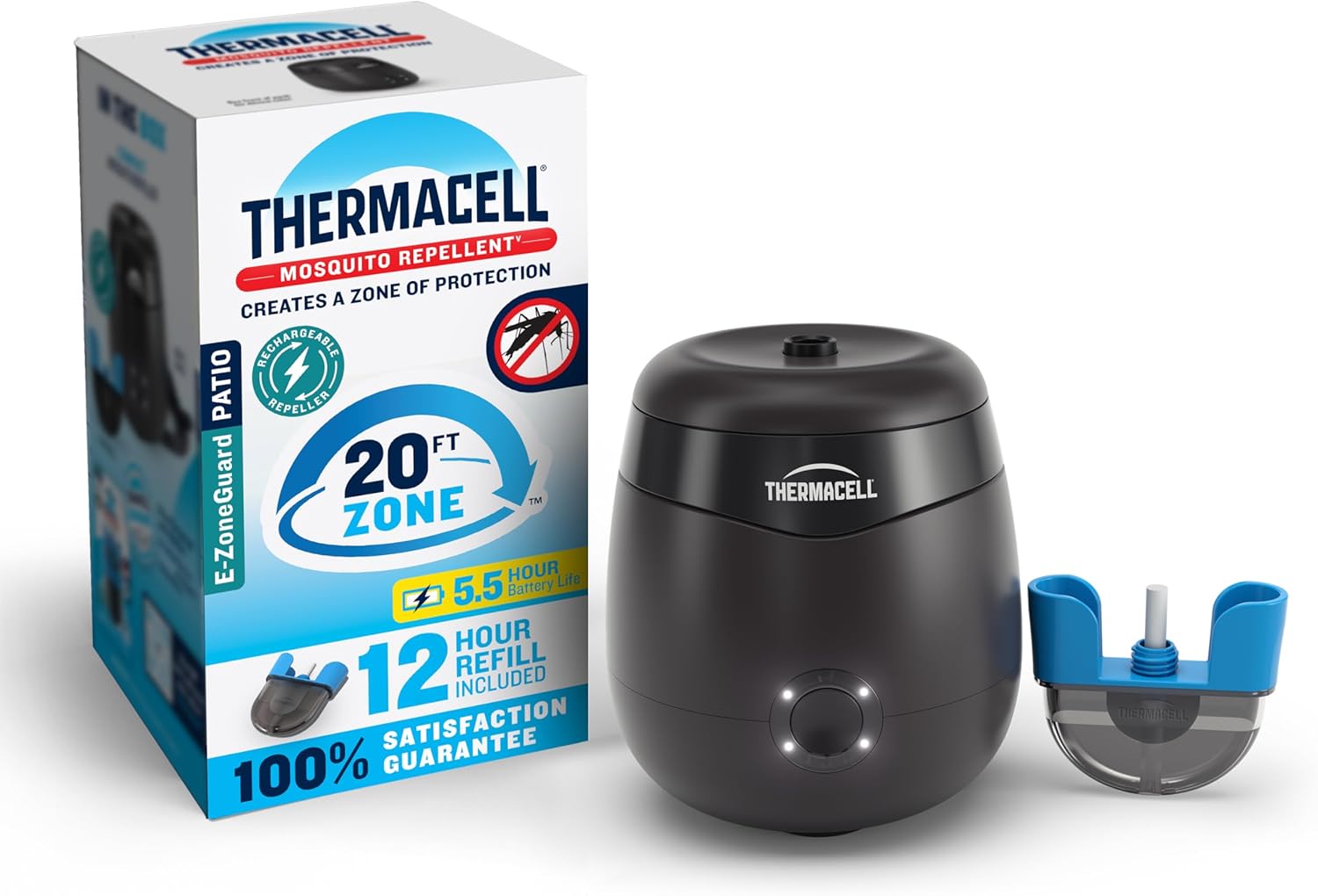
| Target Species | Mosquito |
|---|---|
| Battery Life | 5.5 Hours |
| Included Components | Battery, Repellent Cartridge, USB charging cable |
| Protection Zone | 20 Feet |
The Thermacell E-ZoneGuard E55 is a portable, rechargeable mosquito repeller intended to protect a small outdoor gathering area without sprays or candles. It works by heating a DEET-free repellent cartridge to produce an invisible protection zone of up to about 20 feet; full effect is reached in roughly 15 minutes. The unit is simple to use: insert the refill, press the power button and set it in the center of your seating area. Notable features are the rechargeable lithium-ion battery with about 5.5 hours runtime, TSA-compliant design for travel, and included 12 hours of repellent refill to get started. In practice it is quiet, scent-free, and avoids the mess and skin application of topical repellents. The main compromises are run time and reliance on replaceable cartridges, so for very long events you will need spare refills or recharging. It also protects a limited radius rather than large yards, so placement matters for best results.
Best for: Buyers who prioritize reliable, hands-off mosquito protection for small to medium outdoor gatherings and want a portable, rechargeable solution that avoids sprays on skin.
Less Ideal for: Homeowners who need continuous, whole-yard coverage for large properties or those who prefer permanent hardwired pest control solutions.
- Creates an EPA-reviewed protection zone of about 20 feet without sprays or open flames
- Rechargeable lithium-ion battery offers about 5.5 hours of continuous operation per charge
- Scent-free and DEET-free repellent formula suitable for people and pets outdoors
- Easy one-button operation and reaches full protection in roughly 15 minutes
- Protection radius is limited to around 20 feet, so it is not ideal for large yards
- Requires replaceable repellent cartridges for continued use
Verdict: Choose the Thermacell E-ZoneGuard E55 when you want portable, hands-free mosquito protection for concentrated outdoor seating areas without sprays or flames.
KICKOUTOR Citronella Mosquito Repellent Incense Sticks, 120 Count

| Unit Count | 120 Count |
|---|---|
| Scent Name | Citronella |
| Item Form | Stick |
| Indoor Outdoor Usage | Outdoor |
| Target Species | Mosquito, Gnat, No-see-ums |
These KICKOUTOR citronella incense sticks are a straightforward, low-tech way to reduce mosquitoes around a back porch or patio. Each stick is plant-based and formulated with citronella, lemongrass, and rosemary; when lit and allowed to smolder it produces a fragrant smoke that can help deter mosquitoes and gnats for roughly an hour per stick under calm conditions. Typical use is simple: light the end, blow out the flame, and place the stick in a holder, pot of sand, or the ground about 12 feet apart to create a perimeter. The bamboo core promotes an even burn and the 120-count pack is convenient for regular summer use or for supplying multiple gatherings. Expect the smoke and scent to be noticeable, so this works best in open-air, well-ventilated porches rather than enclosed spaces. Wind can shorten burn time and heavy mosquito pressure may require multiple sticks or complementary controls. Safety instructions matter because sticks are an open flame source and should be kept away from children, pets, and dry foliage.
Best for: Buyers who want an affordable, easy-to-use perimeter repellent for routine back-porch evenings and outdoor gatherings and who prefer plant-based ingredients over aerosol or chemical sprays.
Less Ideal for: People seeking smoke-free or scent-free mosquito control or those who need a long-duration, high-intensity solution for heavy mosquito infestations.
- Large 120-count pack provides long-term supply for frequent outdoor use
- Plant-based formula (citronella, lemongrass, rosemary) for a natural scent
- Bamboo core design promotes an even, consistent burn
- Each stick burns about one hour, useful for single evenings or events
- Effectiveness depends on wind and insect pressure so results can vary
- Produces noticeable smoke and scent that may bother some people
- Requires open-air placement and is not suitable for enclosed spaces
Verdict: A cost-effective natural option to create a smoke perimeter and reduce mosquitoes around a back porch for routine summer evenings.
W4W Mosquito Repellent Coils — 3 Pack (12 Coils, 6 Stands)

| Pack contents | 3 pack (12 coils, 6 stands) |
|---|---|
| Burn time | 5-7 hours per coil |
| Coverage | Up to 10 feet per coil |
| Ingredients | Rosemary Oil |
These W4W mosquito coils are a straightforward, low-tech way to reduce biting insects around patios, campsites, and backyards. Each spiral separates into two coils; the three-pack includes 12 coils and six metal stands. A single coil burns for roughly 5 to 7 hours and is rated to cover about a 10-foot radius, so you can run one or more depending on the size of your gathering. The active ingredient is rosemary oil, and the coils are labeled for outdoor use only and described as biodegradable. Practical benefits are long burn time per coil, included stands for easy use, and a simple setup that requires no batteries or electricity. Limitations are that performance depends on wind and open-air conditions, the coverage is localized rather than whole-yard, and coils produce smoke and scent that some people may find bothersome. For routine backyard evenings or camping trips where you want an inexpensive, disposable barrier against mosquitoes, these are an easy option.
Best for: Buyers who want a low-cost, disposable way to reduce mosquitoes at small outdoor gatherings, patios, or while camping and prioritize simplicity over whole-yard solutions.
Less Ideal for: People needing wind-resistant or whole-yard mosquito control or those who cannot tolerate smoke or strong scents should consider alternate repellent methods.
- Long burn time of about 5–7 hours per coil for extended outdoor use
- Included stands make the coils easy to position and keep off surfaces
- Biodegradable material and rosemary oil formulation rather than synthetic chemicals
- Large pack quantity provides multiple uses for several outings
- Smoke and scent may be unpleasant for some people or guests
- Effective coverage is limited and affected by wind so multiple coils are needed for larger areas
Verdict: A very affordable, easy-to-use option for short-term, localized outdoor mosquito protection.
Virine Rechargeable No‑Spray Mosquito Repeller with Plant‑Based Refills

| Target Species | Mosquito |
|---|---|
| Power Source | Battery Powered |
| Number of Pieces | 1 |
| Included Refills | 2 ten‑day cartridges |
The Virine rechargeable mosquito repeller is a portable, battery‑powered device designed for outdoor use around patios, campsites and decks. You charge it with the included UL 5V adapter and USB‑C cable, insert a plant‑based refill pad, and the internal fan disperses the natural repellent for an advertised effective range up to about 30 feet. Controls let you run the repeller, the night light, both, or set an 8‑hour daily cycle that remembers the last setting. The kit ships with one device and two 10‑day refill cartridges, which makes it ready for short trips. Practical benefits are low odor compared with aerosol sprays, simple one‑button operation, and USB charging for campsite power banks. Important limitations are that coverage will depend on wind and open‑air conditions and that protection relies on refills so you need spares for multi‑night camping; avoid using high‑voltage fast chargers. For campers who prioritize an easy, no‑spray option and predictable charging, the Virine is a sensible lightweight choice.
Best for: Campers and outdoor hosts who want a low‑maintenance, no‑spray mosquito solution that charges from USB and is easy to deploy around a campsite or patio.
Less Ideal for: People needing full protection in large open fields, high‑wind sites, or multi‑night expeditions without access to refill cartridges or ability to carry spares.
- Rechargeable with included UL 5V adapter and USB‑C cable for reliable charging
- Plant‑based refill pads provide a no‑spray alternative to topical repellents
- Compact, travel‑friendly design easy to pack for camping and patios
- Simple one‑button controls plus an 8‑hour memory cycle for set‑and‑forget use
- Effectiveness is reduced in windy or very open environments since it disperses repellent passively
- Requires replacement refill cartridges for continued protection
Verdict: A compact, rechargeable no‑spray repeller that gives easy USB‑powered mosquito protection for short camping trips and patio evenings.
SCFKAOF Mosquito Repellent Balls (8 Pack)

| Number of Items | 8 |
|---|---|
| Unit Count | 8 Ounce |
| Size | 1 Ounce (Pack of 8) |
| Coverage | 120 Sq. Ft |
| Duration | Up to 60 Days |
These mosquito repellent balls are small, plant-based disks sold in an eight-pack that you place where you need protection. They are designed for simple, no-setup use indoors or on covered patios: put a ball in a room, near a doorway, or inside a tent and the manufacturer says a single ball helps deter mosquitoes within roughly 120 square feet. The product emphasizes plant-derived ingredients and a scent-based deterrent rather than sprays or open flames, which makes them easy to move and suitable for living rooms and bedrooms. Each ball is intended to last up to 60 days, reducing the need for frequent replacement. Limitations to expect are that scent-based repellents depend on air movement and room layout, so coverage can be uneven in larger or open-plan spaces and may need multiple balls for reliable protection. Also, while marketed for indoor use, people sensitive to fragrances should test one in a small area first.
Best for: Buyers who want a low-effort, plant-based indoor mosquito option they can place around living spaces and who prioritize ease of use and milder ingredients over industrial-strength control.
Less Ideal for: People needing rapid knockdown in heavily infested rooms or large open-plan interiors should consider more powerful or active control methods instead.
- Plant-based formula suitable for families preferring non-chemical options
- Simple place-and-forget application with no mixing or power source
- Each ball is rated to last up to 60 days, lowering replacement frequency
- Claims to cover about 120 square feet, useful for single rooms or small indoor spaces
- Effectiveness can vary with room ventilation and layout, requiring multiple balls for larger areas
- Contains fragrances that may bother people with scent sensitivities
Verdict: A convenient, plant-based place-and-forget option for reducing indoor mosquito presence in single rooms without sprays or devices.
Choosing the Right Mosquito Repellent for Back Porch: Key Factors to Consider
Coverage Area
Coverage area determines how much of your back porch will be protected at once. A repellent with a small effective radius might be fine for a narrow screened porch or a small patio table, but it will leave corners and entry points exposed on a larger deck.
Think about the dimensions and layout of your porch, whether you need overhead protection or ground-level treatment, and how many people usually occupy the space. Coverage affects how many units you need and where to place them to avoid gaps where mosquitoes can gather.
Duration and Consistency of Protection
Duration tells you how long a single setup or application keeps mosquitoes away. Some methods offer multi-hour protection from a single activation, while others need frequent reapplication or battery changes. Consistency matters because fluctuating protection can lead to periods with little defense when insects are most active.
Consider typical porch use patterns: evening dinners, long gatherings, or short breaks. If you host prolonged events, prioritize products that sustain coverage for the full period without repeated intervention.
Application Method and Ease of Use
Application method affects convenience and ongoing maintenance. Options range from passive devices that you set and forget to spray treatments and wearable repellents. Ease of use influences how often you will maintain the system, refill cartridges, or reapply treatments.
Consider how comfortable you are handling sprays or chemicals on a porch near furniture and fabrics, how often you want to change batteries or refills, and whether quick activation or long-term placement fits your routine.
Safety for People, Pets, and Plants
Safety is critical on a family porch where pets, children, and potted plants share the space. Different repellent types have distinct exposure risks and clearance requirements. Some are low on chemical emission and safe for enclosed or screened porches; others rely on combustion or higher concentrated actives that need more ventilation.
Check labels for guidance on proximity to food areas and plant foliage. Favor approaches with clear instructions for reducing inhalation, preventing skin contact, and keeping curious pets out of treated zones.
Wind, Weather, and Porch Configuration
Porch microclimate influences repellent performance. Windy conditions disperse active ingredients and reduce localized protection, while covered or screened porches trap aerosols and can extend effective range. Rain and humidity can shorten residual efficacy for some surface treatments.
Match repellent type to your porch setting. For open porches, look for options with stronger area coverage or multiple units. For screened or semi-enclosed porches, low-emission devices or passive systems may give prolonged protection without heavy chemical build-up.
Maintenance, Durability, and Long-Term Costs
Maintenance affects convenience and the true cost of ownership. Durable units with infrequent refills reduce ongoing effort but may require higher initial setup. Disposable or single-use options are simple but can add up if you use them often.
Consider how often you want to replace cartridges, clean components, or store equipment off-season. Durability also means resistance to porch dust, moisture, and sun exposure so units keep working across a season.
Best Repellent Types for Different Porch Setups
Porches vary: open-air decks, screened-in sunrooms, and covered patios all behave differently. Passive devices that emit a gentle repellent cloud can work well on screened porches because the enclosure helps contain the active area. For open porches, consider options that create broader coverage or let you place multiple units around seating zones. Spray-based treatments are useful for spot control and immediate knockdown, while spatial repellents are better for continuous protection during long gatherings.
- Screened porches: low-emission spatial repellents or electric units placed at perimeter
- Open porches: wider-range devices or multiple units to form an overlapping shield
- Covered patios: consider ceiling-mounted or elevated units to optimize airflow
Placement Tips for Maximum Effectiveness
Placement matters more than power. Put devices upwind of seating areas so the repellent drifts across people rather than blowing away. Mounting units slightly above head height often gives better dispersion and keeps children and pets out of reach. Leave some spacing between units to create an overlapping protective envelope instead of a single concentrated plume.
Avoid placing repellents directly next to open food or drink areas, and keep them away from delicate potted plants that might react to certain ingredients. For spray applications, treat perimeter vegetation and entry points rather than central seating surfaces to reduce residue on furniture.
- Mount or place units above seating where safe
- Space multiple units to overlap coverage
- Treat perimeters and entry points for sprays, not just seating
Integrating Repellents with Natural Pest Control
Combining repellents with habitat reduction reduces mosquito pressure. Eliminating standing water in containers, clearing clogged gutters, and replacing saucers with dry solutions shrink local breeding sites and make repellents more effective. Planting mosquito-repelling herbs and using fans to increase airflow can also deter mosquitoes and lower reliance on chemical treatments.
When using both natural and product-based measures, stagger timing. For example, remove breeding sources during the day and deploy repellents in the evening when adult mosquitoes are most active. This layered approach prolongs porch comfort with less frequent direct intervention.
- Remove standing water to cut breeding
- Use fans to disrupt mosquito flight paths
- Place repellent units after habitat reductions to maximize effect
Seasonal Use and Storage Advice
Mosquito activity and repellent needs change through the season. Early spring and late fall often need lighter treatment, while midsummer demands more consistent protection. Store refillable devices and cartridges in a cool, dry place over winter to prevent degradation, and drain or protect any liquid reservoirs from freezing.
Check seals and battery health before the season starts, and run a short test activation to confirm coverage. Rotate or refresh consumables if they are past their recommended shelf life to maintain reliable performance throughout the warm months.
- Perform maintenance checks before peak season
- Store consumables in cool, dry conditions
- Adjust intensity of use as mosquito pressure changes
Minimizing Odor and Residue on the Porch
Some repellents leave noticeable odors or surface residue that can linger on furniture and fabrics. To minimize this, position devices to direct emissions away from seating and textiles and give sprays time to dry before using cushions or tableware. For sensitive noses, consider low-odor formulations or devices designed for screened porches where dispersion is slower and less concentrated.
Routine cleaning of treated surfaces helps avoid buildup. Wipe down dining surfaces after use and remove any droplets from planters or railings to prevent staining or plant stress.
- Aim emissions away from fabrics and food areas
- Allow sprays to dry before reusing seating
- Wipe treated surfaces to prevent residue buildup
How We Chose the Best Mosquito Repellent for Back Porch
We focused on solutions that perform reliably in back porch environments and that match common homeowner priorities. Evaluation emphasized coverage area, how repellents are applied and maintained, suitability for semi-enclosed spaces, and health and safety considerations for people and pets. We also considered durability of effect, ease of setup or reapplication, and compatibility with porch features such as screens, ceiling fans, and nearby plants. Products that relied on a single unproven delivery method or required complex, frequent refills were excluded. We avoided items that lack clear usage instructions for semi-enclosed outdoor spaces or that have known compatibility problems with common porch surfaces. The final shortlist reflects options that balance consistent mosquito reduction, practical deployment on a porch, and acceptable safety profiles for families and pets. Editorial judgment prioritized real-world reliability and low maintenance during typical evening use.
FAQ
Are electric spatial repellents safe to use on a screened porch?
Electric spatial repellents are often suitable for screened porches because the enclosure helps contain the active cloud. Safety depends on following product guidance for ventilation and keeping devices away from children and pets. Choose low-emission options if the porch is used by sensitive individuals.
How many units do I need for a medium-sized back porch?
The number depends on unit coverage and porch layout. For wider or open porches, multiple units spaced to overlap coverage usually work better than a single powerful device. Refer to coverage area guidance and place units to form a protective envelope around seating.
Can I use plant-based or natural repellents on the porch?
Plant-based repellents can reduce biting but often provide shorter duration and smaller coverage than some synthetic options. They are useful as part of a layered approach combined with habitat reduction, fans, or targeted devices for evening protection.
Will ceiling fans or portable fans help repel mosquitoes?
Fans do not repel mosquitoes in the chemical sense but they disrupt flight and make it harder for mosquitoes to locate hosts. A fan can significantly reduce biting in a seating area and is a helpful, low-maintenance complement to repellents.
How should I protect pets when using repellents on the porch?
Keep pets away from active devices and follow label directions about safe distances and reentry times. Choose pet-safe formulations when possible and avoid applying sprays directly on pet-accessible surfaces. Consult a veterinarian if you are unsure about specific ingredients.
When is the best time to deploy repellents on the back porch?
Deploy repellents shortly before mosquito activity increases, typically at dusk and early evening. For longer events, activate devices early enough to establish coverage and check periodically to ensure consistent protection.
Final Verdict
Prioritize coverage, safety, and how the repellent fits your porch layout when choosing a solution. Bigger porches need broader coverage or multiple units, while screened or semi-enclosed spaces often work well with low-emission spatial options. Balance convenience against duration of protection and consider maintenance demands before committing to a system. Decide which tradeoffs matter most to you-continuous low-maintenance protection, minimal odor and residue, or rapid knockdown for short gatherings-and choose a repellent strategy that matches your porch use and household safety needs.
