

Note: This article contains affiliate links. If you click on these links and make a purchase, I may earn a small commission at no extra cost to you. This helps support my research and content. Read my full affiliate disclosure here.
Picking the right chainsaw for landscaping matters because yard work demands a blend of power, balance, and safe handling more than raw engine size alone. Whether you prune mature shrubs, limb fallen branches, or section small trees for removal, the wrong tool makes routine tasks slower and more hazardous. This guide covers five shortlisted chainsaws for landscaping that perform well across typical yard chores and differing user skill levels. We focus on real-world factors gardeners care about: cutting ability, user control, durability, and serviceability. Below are our top picks and the evaluation criteria that shaped the list.
Top Picks at a Glance
| Best Overall The best all-around choice for most situations | Husqvarna 450 Rancher 20" Gas Chainsaw (50.2 cc, 3.2 HP) |  |
| Best Quality Built to a higher standard if you want something more solid | Husqvarna Power Axe 350i Cordless Chainsaw, 18-Inch with Battery and Charger |  |
| Best Value The sweet spot between price and what you get | Greenworks 40V 12 in Cordless Electric Chainsaw with 2.0 Ah Battery and Charger |  |
| Best Budget The cheapest option that still gets the job done reliably | VEVOR 25.4cc Top-Handle Gas Chainsaw, 12-Inch Bar |  |
| Highest Rated A top-rated pick with lots of positive feedback | Milwaukee M18 FUEL 16 in. Cordless Chainsaw (Tool Only) |  |
Husqvarna 450 Rancher 20" Gas Chainsaw (50.2 cc, 3.2 HP)

| Power Source | Gas Powered |
|---|---|
| Horsepower | 3.2 hp |
| Chain Length | 20 inches |
The Husqvarna 450 Rancher is a workhorse gas chainsaw aimed at users who need reliable power for pruning, yard cleanup, and firewood cutting. It pairs a 50.2-cc X-Torq two-stroke engine with a 20-inch bar to deliver strong cutting performance and steady torque under load. Practical features include Smart Start and an air purge for easier, quicker startups and an Air Injection centrifugal pre-cleaning system that reduces debris reaching the air filter to help engine longevity. LowVib technology, an ergonomic rear handle and soft inlay improve comfort during extended use, and an inertia-activated chain brake adds a safety layer against kickback. Expect robust power and professional handling, but also the usual maintenance needs of a gas saw such as fuel mixing, routine filter and spark plug service, and higher noise and emissions compared with battery models. For buyers wanting consistent heavy-duty cutting and proven engine performance, this model is a solid choice; for very light occasional jobs, it may be more saw than necessary.
Best for: Experienced homeowners and semi-pro users who prioritize sustained cutting power and durability for frequent tree work, firewood cutting, and heavy yard cleanup.
Less Ideal for: Casual users with only occasional light trimming needs or those who prefer low-noise, low-maintenance battery tools.
- Powerful 50.2-cc X-Torq engine delivers strong cutting performance for heavy tasks
- Smart Start and air purge make starting quicker and less finicky
- Air Injection centrifugal system reduces debris in the air filter for longer service intervals
- Ergonomic design with LowVib and soft inlay improves comfort during extended use
- Requires regular gas and two-stroke oil mixing and routine maintenance inherent to gas engines
- Heavier and louder than cordless electric alternatives
Verdict: Choose the Husqvarna 450 Rancher when you need a durable, high‑power gas chainsaw for frequent heavy cutting tasks.
Husqvarna Power Axe 350i Cordless Chainsaw, 18-Inch with Battery and Charger

| Power Source | Battery Powered |
|---|---|
| Horsepower | 1.9 hp |
| Chain Length | 18 inches |
| Included Components | Chainsaw, Battery, Charger, Owner's Manual |
The Husqvarna Power Axe 350i is an 18-inch cordless chainsaw kit designed for homeowners and landscapers who need near-professional cutting power without gas. It uses a brushless motor and a 40V BLi30 battery to deliver strong, sustained cuts and includes boost mode for a temporary 25 percent power increase when tackling larger limbs. The X-Cut chain promises longer lasting sharpness and the tool-less chain tensioning system makes on-the-fly adjustments quick and simple. In practice this saw is well suited to pruning, limb removal, and cutting firewood around the yard while producing less vibration and noise than many gas models. The kit ships with a charger so you can start work right away, but run time will depend on battery charge and the intensity of use; heavy continuous cutting may require spare battery packs for all-day jobs. At roughly 7.7 pounds it is easier to maneuver than comparable gas saws, though users who need industrial continuous use should plan for battery rotation or a different power source.
Best for: Buyers who prioritize cutting performance in a cordless saw and want a robust, easy-to-use tool for pruning, limb removal, and cutting firewood around the property.
Less Ideal for: Professionals who need uninterrupted all-day chainsaw use without swapping batteries should consider corded or gas alternatives.
- Brushless motor with boost mode for higher power on demand
- Includes BLi30 40V battery and charger so it is ready to use out of the box
- X-Cut chain for longer-lasting sharpness and consistent cutting performance
- Tool-less chain tensioning and chain brake indicator light for fast adjustments and safer operation
- Battery run time will limit continuous heavy-duty work without spare batteries
- Heavier than some compact pruners at the 18-inch bar length for extended overhead work
Verdict: If you want near-gas cutting power in a cleaner, quieter cordless package, the Power Axe 350i delivers strong performance and convenient features in a ready-to-use kit.
Greenworks 40V 12 in Cordless Electric Chainsaw with 2.0 Ah Battery and Charger

| Power Source | Battery Powered |
|---|---|
| Horsepower | 0.73 |
| Chain Length | 12 inches |
This Greenworks 40V 12-inch cordless chainsaw is built for homeowners who need a portable, low-maintenance saw for pruning, storm cleanup, and cutting small logs. It uses a 40V 2.0Ah lithium battery that Greenworks says will deliver around 50 cuts through 4×4 treated lumber on a single charge, and the same battery can act as a USB power bank for devices. Notable convenience features include tool-less auto chain tensioning, an automatic oiler with a visible oil window, and a dual-start safety that reduces accidental activation. The lightweight, wrap-around handle and low-kickback bar make it easier to hold in multiple positions for limb work and trimming. Limits are its modest cutting capacity and runtime compared with larger gas or higher-voltage cordless saws, so it is best for small-to-medium tasks rather than heavy felling or long continuous cuts. For buyers prioritizing a clean, quiet, and easy-to-maintain saw for routine yard care, this model hits the balance between portability and practical power.
Best for: Buyers who want a low-maintenance, portable chainsaw for regular yard tasks like pruning, limb removal, and storm cleanup and who value ease of use and tool compatibility over heavy cutting power.
Less Ideal for: People who need a chainsaw for large tree felling, professional forestry work, or long uninterrupted cutting sessions should choose a higher-voltage or gas model instead.
- Includes battery and charger so it is ready to use out of the box
- Tool-less auto chain tensioning speeds maintenance and reduces downtime
- Automatic oiler with transparent oil window helps keep the bar and chain lubricated
- Lightweight wrap-around handle improves control and reduces operator fatigue
- 40V battery is compatible with many Greenworks tools and can act as a USB power bank
- 2.0Ah battery gives limited runtime for extended cutting sessions
- 12-inch bar restricts the saw to small-to-medium jobs and not large tree felling
Verdict: A convenient, lightweight cordless chainsaw that delivers easy maintenance and portable power for routine yard work and cleanup.
VEVOR 25.4cc Top-Handle Gas Chainsaw, 12-Inch Bar

| Power Source | Gas Powered |
|---|---|
| Horsepower | 1.2 hp |
| Chain Length | 12 inches |
| Model Number | CN-25 |
The VEVOR 25.4cc top-handle gas chainsaw is a compact, handheld saw built for pruning, light felling and general property maintenance. It uses a 2-cycle 25.4cc engine rated at about 1.2 hp and drives a 12-inch bar and high-strength steel chain that handles branches and small logs up to roughly 9.8 inches in diameter. Practical features include an easy-start system, a tool-free chain tension knob, a protective guard to reduce sawdust spray and onboard tanks for fuel and chain oil to limit downtime. At roughly 9 to 10 pounds the saw is relatively nimble for one-handed trimming and working in trees when combined with proper climbing gear. Important limitations are its modest power and short bar, which make it unsuitable for heavy felling or cutting large logs, and the usual maintenance needs of a 2-cycle gas engine such as mixing fuel and regular spark plug and carburetor care. For users who need a portable, serviceable saw for routine yard and tree work, it delivers sensible capability for its class.
Best for: Buyers who want a portable, serviceable gas saw for regular pruning, tree trimming and light felling and who value straightforward features and ease of use over maximum cutting power.
Less Ideal for: Not a good fit for landowners who need a saw for heavy timber work, milling logs, or frequent long-duration cutting where a larger bar and higher horsepower are required.
- Compact and lightweight for easier handling during pruning and above-ground work
- 12-inch steel bar and chain suited to trimming, limb work and small log cutting
- Tool-free chain tensioning for quick adjustments in the field
- Easy-start system and included maintenance kit simplify setup and upkeep
- 12-inch bar and 1.2 hp output limit use to light-duty cutting and small trees
- Requires routine 2-stroke engine maintenance and fuel mixing
Verdict: A lightweight, easy-to-use top-handle gas chainsaw that reliably handles pruning and light felling for homeowners and tree care hobbyists.
Milwaukee M18 FUEL 16 in. Cordless Chainsaw (Tool Only)
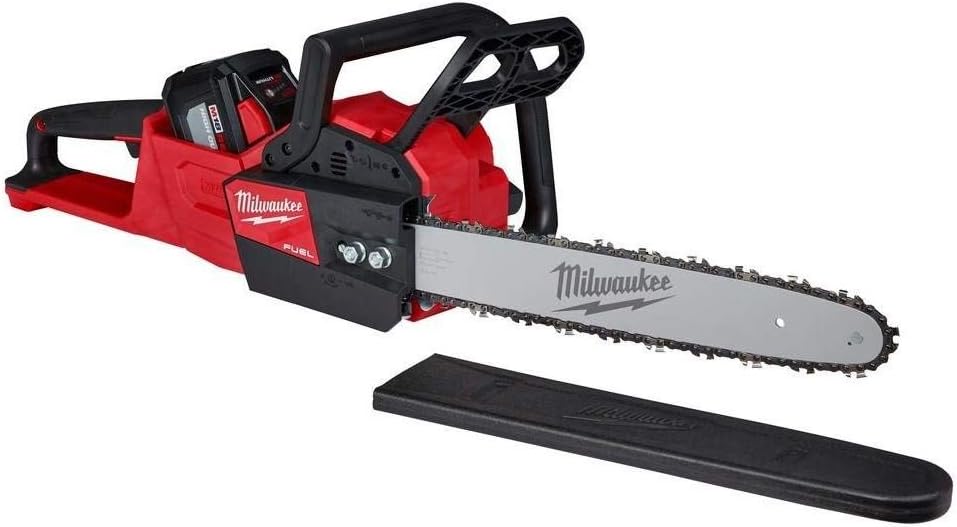
| Power Source | Battery Powered |
|---|---|
| Horsepower | 5.3 hp |
| Chain Length | 16 inches |
The Milwaukee M18 FUEL 16 in. cordless chainsaw is a tool-focused model that brings high power and convenient cordless operation to homeowner cutting tasks. It uses the M18 battery platform (battery and charger sold separately) and is built around a 16-inch Oregon bar and chain with an automatic oiler and variable speed trigger so you can control cut speed for different wood types. In practice this saw handles hardwood and mid-size logs quickly and is reported to deliver many cuts per charge with higher-capacity M18 packs. Notable features include the brushless FUEL motor for stronger acceleration and reduced maintenance compared with brushed motors, and a compact build that makes limbing and pruning easier in tight spaces. Important limitations are that the battery and charger are not included so you must already own or purchase compatible M18 batteries to realize the reliability benefits, and run time depends heavily on battery capacity. For homeowners who want near-professional cutting performance without gas fuss, this is a dependable cordless option when paired with a robust M18 battery.
Best for: Homeowners who prioritize a reliable, high-performance cordless saw and either already own M18 batteries or are prepared to invest in them for consistent, gas-free cutting around the yard.
Less Ideal for: Casual users who want an all-in-one package with battery and charger included or people needing very long continuous cutting sessions without spare batteries.
- Powerful brushless motor claims faster cuts than gas models for efficient work
- Automatic oiler maintains chain lubrication for consistent cutting performance
- Variable speed trigger gives precise control for pruning or larger cuts
- Compatible with the M18 battery ecosystem so higher-capacity packs boost runtime
- Battery and charger are not included so additional purchase is required
- Run time and cutting output depend on which M18 battery you use
Verdict: Choose this Milwaukee M18 FUEL 16 in. cordless chainsaw if you want near-professional cordless cutting performance and already use or plan to buy M18 batteries for dependable, gas-free operation.
Choosing the Right Chainsaw for Landscaping: Key Factors to Consider
Engine Type and Power Output
Engine type determines how a chainsaw behaves in a landscape setting. Gas engines deliver higher continuous power and longer runtime between refuels, useful for tackling thicker trunks and extended sessions. Battery-electric options provide quieter operation, lower maintenance, and instant throttle response, which is advantageous in noise-restricted neighborhoods or for lighter cutting tasks.
Power output matters because landscaping often involves a range of diameters. Too little power forces you to make multiple cuts and increases chain wear, while too much power can be harder to control for precise pruning. Match engine size and output to the largest diameter you expect to cut regularly to avoid overworking the saw or compromising safety.
Bar Length and Cutting Capacity
Bar length dictates how large a single pass you can make and affects saw weight and maneuverability. Shorter bars, typically 12 to 14 inches, are easier to handle for pruning, limbing, and working close to structures. Longer bars increase cutting capacity for thicker trunks but add weight and change balance, making overhead or awkward-angle cuts more fatiguing.
Think about the typical diameter of branches and trunks in your yard. For most residential landscaping, a moderate bar length provides a balance between reach and control. Also consider whether you want the flexibility to swap bars or chains if you occasionally face larger tasks.
Weight, Balance, and Ergonomics
A chainsaw that balances well between the handles reduces wrist strain and improves control during long jobs. Weight distribution is more important than raw weight; a heavier saw centered near the rear handle can feel lighter to operate than a lighter saw with a forward-biased weight.
Handle shape, trigger layout, and anti-vibration features influence how comfortable you remain after extended use. For landscaping tasks that include repeated overhead or horizontal cuts, prioritize models that allow a secure two-handed grip and have accessible controls so you can maintain safe posture while cutting.
Safety Systems and Kickback Reduction
Landscaping work often places the bar near irregular wood and hidden knots, which increases kickback risk. Robust safety features like chain brakes, inertia-activated systems, and low-kickback chain designs materially reduce the chance of a sudden bar movement. A well-designed front hand guard and chain catcher help protect the operator's hands if a chain derails.
Beyond mechanical features, consider how easily you can engage safety systems while wearing gloves and whether the saw provides clear feedback when a safety device has activated. These systems are critical to keeping routine yard tasks safe.
Starting, Controls, and Cold-Weather Use
If you will use a chainsaw across seasons, reliable starting is essential. Cold or humid conditions amplify starting problems in small engines. Features such as easy-access choke settings, primer bulbs, decompression valves, or simplified electric start options reduce frustration and lost work time.
Control layout also matters for quick throttle response. Controls that are operable with gloved hands and that return to neutral reliably reduce operator error. Evaluate how intuitive the starting procedure and control feel during short test starts before committing to a tool.
Maintenance Accessibility and Parts
Routine maintenance keeps a chainsaw operating safely and extends service life. Easier access to the air filter, spark plug, and chain tensioning makes field servicing faster and more likely to be performed properly. Tools that allow chain tension adjustments without special tools or that include convenient chain lubrication systems simplify upkeep.
Also consider the availability of replacement parts and standard-sized consumables like chains and bars. A saw that uses common chain pitches and standard bar mounts will be easier to service locally and less likely to be sidelined when a part wears out.
Matching a Saw to Typical Landscaping Tasks
Different landscaping chores call for different tool traits. Pruning and limbing favor nimble, well-balanced saws with moderate bars and softer throttle response so you can make careful cuts without overcutting. Cutting and sectioning small trees requires more consistent power and a slightly longer bar to move through thicker wood in fewer passes.
Think about how often you face each task. If most of your work is pruning and trimming, prioritize ergonomics and safety. If you frequently clear storm damage or remove small trees, prioritize power and a durable chain system.
- Pruning and shaping: shorter bars, lighter weight, smooth throttle.
- Limbing and small tree work: moderate bars, higher continuous power.
- Occasional heavy cuts: consider swapping to a longer bar or a higher-displacement option.
Fuel and Power Preferences for Residential Use
Gas, battery, and corded electric saws each have tradeoffs for landscaping. Gas saws offer runtime and refill convenience for larger properties but need fuel mixing and more maintenance. Battery saws are quiet, low-maintenance, and increasingly capable for routine jobs, though runtime depends on battery capacity and recharge options.
For many homeowners, a battery saw with a spare battery covers routine landscaping without the upkeep of gas engines. However, heavy or extended sessions still favor gas for uninterrupted cutting.
- Gas: best for long sessions and thicker wood.
- Battery: best for quiet, lower-maintenance yard work.
- Corded electric: limited by reach but good for continuous small tasks in one area.
Noise, Neighbors, and Local Restrictions
Noise considerations affect when and where you can use a chainsaw. Battery and corded electric saws are significantly quieter, which matters in suburban neighborhoods or shared properties with noise rules. Gas saws are louder and may limit the hours you can legally or politely operate the tool.
If your landscaping takes place close to homes, schools, or during early hours, opt for a lower-noise system or plan work for permitted times. Also factor in hearing protection regardless of saw type to reduce long-term exposure.
- Check local noise ordinances before scheduling extended cutting.
- Use hearing protection and consider quieter power options near neighbors.
Transport, Storage, and Winter Care
How you transport and store a chainsaw affects convenience and longevity. Smaller saws fit into compact tool boxes and are easier to carry up ladders or into tight garden beds. Larger saws may need a dedicated case or rack in your vehicle.
For winter storage, drain fuel or follow manufacturer winterizing procedures for gas models and store batteries at recommended temperatures. Regular cleaning and light lubrication before storage prevent rust and gumming. These simple habits keep a landscaping saw ready when the next storm or job arrives.
- Use a locking case or rack for safe transport.
- Follow winterizing steps for fuel or battery systems to protect the saw.
Accessory Choices That Make Landscaping Easier
Accessories can turn a general-purpose chainsaw into a landscaping workhorse. Useful add-ons include spare batteries, an easy-access sharpening tool, a compact chain file, and a protective bar cover for transport. A quality carrying harness or sling disperses weight and reduces fatigue when moving between tasks.
Also consider replacement chains in low-kickback designs and a small field-maintenance kit so you can handle tension adjustments and cleaning on the spot. These items keep interruptions short and work moving efficiently.
- Spare battery or fast charger for battery models.
- Sharpening tools and spare chains for continuous cutting.
- Protective case, harness, and field-maintenance kit.
How We Chose the Best Chainsaw for Landscaping
We shortlisted chainsaws based on features that directly affect landscaping use rather than forest logging or heavy timber work. Priority went to cutting power appropriate for branches and small trunks, ergonomic balance for overhead and lateral cuts, and safety systems that reduce kickback and operator fatigue. Durability and maintenance accessibility were included because landscaping tools need frequent service and durable parts when used across seasons. We also evaluated ease of starting and vibration control since these affect daily comfort and task endurance. Excluded items were high-displacement professional logging saws and extremely lightweight hobby models that lack sufficient cutting capacity. We filtered out specialty saws designed solely for pole or arborist work. The final selection represents tools that fit typical residential and small-estate landscaping tasks, balancing power, control, safety, and maintainability. These are the dimensions we scored against when choosing the five chainsaws in this roundup.
FAQ
What bar length is best for general landscaping?
For most residential landscaping, a moderate bar length in the 12 to 16 inch range balances reach and control. Shorter bars are easier to handle for pruning, while the upper end of this range gives extra capacity for small trunks.
Is a battery chainsaw powerful enough for trimming and small trees?
Often yes. Modern battery chainsaws can handle pruning, limbing, and many small-tree tasks, especially with a spare battery. Their suitability depends on battery capacity and the diameter of wood you cut regularly.
How important is anti-kickback technology for landscaping work?
Very important. Landscaping puts the bar near knots and irregular cuts where kickback risk rises. Chainsaws with inertia-activated chain brakes and low-kickback chains reduce abrupt movements and improve safety during common yard tasks.
How often should I sharpen the chain when using a saw for landscaping?
Sharpen the chain whenever it starts to tear wood rather than cut cleanly, which can be after a few hours of heavy use or sooner if you hit dirt or nails. Routine inspection and light sharpening keep cuts efficient and reduce strain on the saw.
Can I use a longer bar on a saw designed for landscaping tasks?
Sometimes. Many saws accept a range of bar lengths within manufacturer limits. Keep in mind that a longer bar changes balance and stress on the drive system, so only use approved bar sizes and be prepared for increased weight and different handling characteristics.
Final Verdict
Choose a chainsaw for landscaping by matching the saw to the work you do most often. Prioritize cutting power and bar length for the largest diameters you expect to cut, but do not overlook ergonomics, balance, and safety systems that reduce fatigue and risk during repeated tasks. Consider maintenance accessibility and parts availability to keep downtime low. The right pick balances those tradeoffs for your yard: a well-balanced saw with adequate power and solid safety features will make routine landscaping faster, safer, and less tiring. Focus on the criteria discussed here to select the best option for your needs.
