

Note: This article contains affiliate links. If you click on these links and make a purchase, I may earn a small commission at no extra cost to you. This helps support my research and content. Read my full affiliate disclosure here.
If you want healthier soil and stronger plants, choosing the right bio fertilizer matters more than simply adding nutrients. Biological fertilizers seed beneficial microbes, improve nutrient cycling, and change how your garden retains moisture and feeds roots. This guide covers six shortlisted bio fertilizers that perform well across common garden uses, from vegetable beds to container plants and established lawns. We evaluated each option for how it releases nutrients, how well it works with different soil types, and how easy it is to apply in small or large spaces. Read on to understand the tradeoffs so you can pick the best biological fertilizer for your situation.
Top Picks at a Glance
| Best Overall The best all-around choice for most situations | Espoma Organic Bio-Tone Starter Plus 4-3-3 Organic Starter Fertilizer, 8 lb |  |
| Best Quality Built to a higher standard if you want something more solid | MicroLife Bio-Matrix 7-1-3 Liquid Organic Biological Fertilizer, 1 qt |  |
| Best Value The sweet spot between price and what you get | Down To Earth Bio-Live Organic Starter & Transplant Fertilizer, 5-4-2 (4 lb) |  |
| Best Budget The cheapest option that still gets the job done reliably | Dr. Earth Organic Tomato, Vegetable & Herb Fertilizer (64 oz) |  |
| Highest Rated A top-rated pick with lots of positive feedback | Espoma Organic Bio-Tone Starter Plus 4-3-3 Starter Plant Food (18 lb) |  |
| Most Popular A crowd favorite that many people choose with confidence | Burpee Bone Meal Fertilizer, 3 lb |  |
Espoma Organic Bio-Tone Starter Plus 4-3-3 Organic Starter Fertilizer, 8 lb

| Item Form | Granules |
|---|---|
| Application Method | Mix with soil |
| Specific Uses For Product | Gardening |
| Target Species | For everything you plant |
Espoma Organic Bio-Tone Starter Plus is a granular, ready-to-use starter fertilizer designed for planting and transplanting a wide range of garden plants. You mix it into backfill soil or potting mixes so the nutrients and added mycorrhizae sit in the root zone at planting time. The formula combines an organic 4-3-3 nutrient ratio with beneficial bacteria, humates, and both endo and ecto mycorrhizae to encourage faster root development, improved soil structure, and better establishment under stressful conditions. Typical uses include flower beds, bulbs, transplant holes, and planting mixes where quick root growth matters. Because it is organic and approved for organic gardening, it is suited to gardeners who prefer natural inputs. The main limitations are that it is intended as a starter or planting amendment rather than an all-season feed and dosing is by volume for different applications so you need to follow the mixing instructions for correct results. For gardeners wanting an easy organic boost at planting, this product provides a focused, microbially active start.
Best for: Gardeners who prioritize natural, microbially active amendments and want a reliable organic boost when planting or transplanting ornamentals, vegetables, and bulbs.
Less Ideal for: Buyers looking for a one-product solution for seasonal feeding or those who prefer liquid feeds or quick-release chemical fertilizers for immediate foliar results.
- Contains both endo and ecto mycorrhizae to aid root establishment
- Organic 4-3-3 formula enhanced with beneficial bacteria and humates
- Ready-to-use granules that are mixed into soil at planting
- Approved for organic gardening and made by a long-standing organic fertilizer brand
- Formulated primarily for initial planting and transplant use rather than ongoing feeding
- Dosing instructions vary by application and require measuring by volume for correct results
Verdict: Choose this if you want an organic, microbe-enhanced starter fertilizer to help new plantings establish strong roots.
MicroLife Bio-Matrix 7-1-3 Liquid Organic Biological Fertilizer, 1 qt

| Item Form | Liquid |
|---|---|
| Specific Uses For Product | Organic |
| Target Species | all plants |
| Liquid Volume | 1 quarts |
| Mixing Ratio | 2 oz per gallon of water |
MicroLife Bio-Matrix is a concentrated liquid fertilizer that combines a 7-1-3 N-P-K formula with kelp, amino acids, humic acids, and a high microbial load of 39 species at 378 million CFU per gallon. It is typically mixed into water at the recommended rate and applied as a soil drench or foliar spray to supply quick-acting nutrients while also inoculating the root zone with beneficial microbes. The formulation makes it useful as a complete feed and as a compost-tea style boost for tired soils, and its liquid form is readily absorbed by leaves and roots for faster response than many solids. For performance-minded growers the product offers both immediate nutrient delivery and longer-term biological improvement to soil structure and nutrient cycling. The main limitations are that it requires regular mixing and handling precautions and a modest learning curve to integrate with an existing fertilization schedule, and results depend on correct application rates and baseline soil conditions.
Best for: Growers focused on measurable performance gains who want both immediate nutrient feed and ongoing soil biology improvement; ideal for growers willing to follow mixing instructions and track results.
Less Ideal for: Casual gardeners who want one-step, no-mix products or users who prefer granular slow-release fertilizers that require less frequent applications.
- Combines balanced 7-1-3 nutrients with kelp, amino acids, and humic substances for multi-faceted plant support
- Includes 39 microbial species at a high CFU count to help rebuild and maintain soil biology
- Liquid formula is fast-acting and can be applied as a foliar spray or soil drench
- Suitable as a complete fertilizer or as a compost-tea style biological inoculant
- Requires measuring and mixing at the specified ratio rather than ready-to-use convenience
- Effectiveness depends on correct application frequency and existing soil health
Verdict: Choose this if you want a performance-focused organic liquid that delivers nutrients quickly while actively rebuilding soil biology.
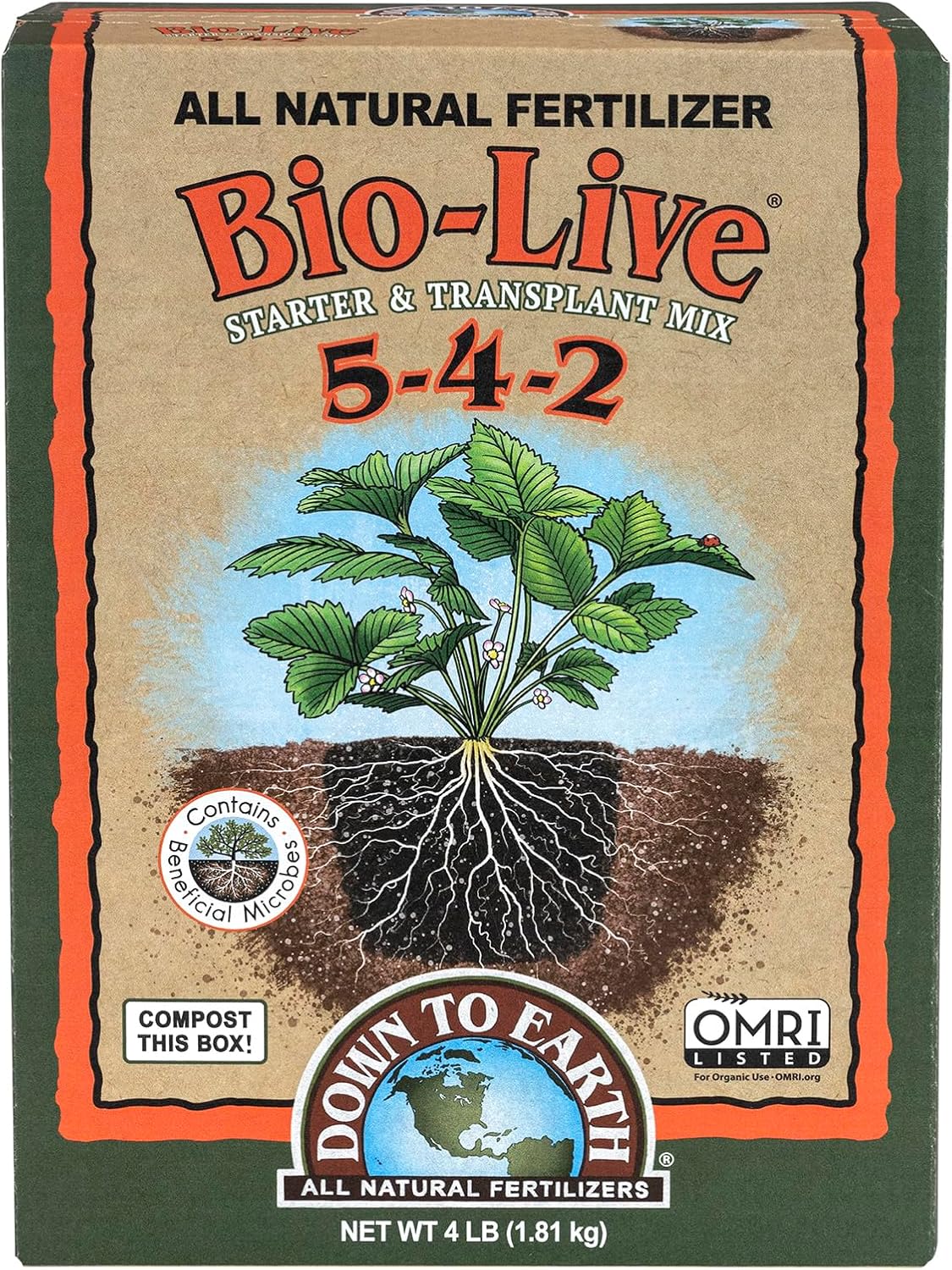
Down To Earth Bio-Live Organic Starter & Transplant Fertilizer, 5-4-2 (4 lb)
| Item Form | Powder |
|---|---|
| Application Method | soil drench |
| Coverage | 80 square feet |
| Mixing Ratio | 5:4:2 |
| Specific Uses For Product | Plant Growth |
Down To Earth Bio-Live is a granular organic starter and transplant mix designed to be worked into potting soil, garden beds, or soilless mixes to promote root development and early vigor. It combines marine- and plant-based meals with langbeinite, humates, seaweed, mycorrhizal fungi, and beneficial bacteria so planted roots make direct contact with both nutrients and inoculants. Typical use is pre-plant incorporation for containers or garden transplants and occasional soil drenches; the package lists a 5:4:2 mixing ratio and coverage around 80 square feet for the 4 lb unit. The practical benefits are stronger root colonization, improved early growth for seedlings and transplants, and organic nutrient sources that work with soil biology rather than supplying quick-release salts. Limitations to note are that it is not water soluble and must be mixed into the medium for best effect, the beneficial microbes have limited shelf life so storage matters, and the 4 lb box covers a modest area so larger container programs will need multiple units or larger sizes.
Best for: Serious container gardeners and vegetable growers who prioritize long-term plant performance and want an organic starter mix that strengthens roots and soil biology before planting.
Less Ideal for: Gardeners who need an immediate soluble fertilizer for foliar feeding or quick correction of nutrient deficiencies should consider a water-soluble product instead.
- Includes mycorrhizal fungi and beneficial bacteria to boost root colonization
- Uses marine and plant meals plus seaweed and humates for slow organic nutrition
- OMRI-listed formulation suitable for organic container growing
- Designed for pre-plant incorporation so nutrients and inoculants contact roots directly
- Not water soluble so cannot be used as a quick liquid feed
- Contains perishable microbes that lose efficacy after about two years if not stored properly
Verdict: Choose this product if you want an organic starter fertilizer that builds strong root systems and soil biology for better container plant performance.
Dr. Earth Organic Tomato, Vegetable & Herb Fertilizer (64 oz)

| Unit Count | 64 Ounce |
|---|---|
| Item Form | Granules |
| Specific Uses For Product | Organic |
| Target Species | Herb |
| Coverage | Medium |
This granular organic fertilizer is designed to boost vegetable and herb production by supplying balanced nutrients and soil biology support. It is typically broadcast into beds, mixed into potting mixes, or applied at planting and midseason for a nutritional lift; the manufacturer recommends reapplying every six weeks for containers. Notable features include a fully organic ingredient list, fast but sustained nutrient release, and a blend of probiotic microbes plus ecto and endo mycorrhizae intended to improve nutrient uptake and drought tolerance. In practice that means healthier root systems and potentially better yields and flavor in crops like cucumbers when used as part of an organic program. Limitations are that it is a medium coverage product in a 64 ounce bag so larger plots will need more frequent purchases, and it contains phosphorus so local runoff rules should be checked before use. Follow the directions for pH and application timing to avoid overapplication in small containers.
Best for: Gardeners who prioritize organic soil health and want a single, biology‑focused fertilizer to support vegetables like cucumbers in beds or containers.
Less Ideal for: Large‑scale growers seeking a bulk, high‑coverage fertilizer or those who must avoid phosphorus due to local regulations should consider other options.
- 100 percent organic formula suitable for certified organic gardens
- Contains beneficial microbes and eight strains of mycorrhizae to support root health and nutrient uptake
- Granular form releases nutrients quickly and continues feeding for several months
- Works for beds, raised planters and containers and can be used at planting, transplanting or midseason
- Bag is medium coverage so not economical for very large vegetable plots
- Includes phosphorus which may be restricted in some local jurisdictions
Verdict: Choose this product if you want an organic, microbe‑rich granular fertilizer that supports root health and steady feeding for cucumber and other vegetable plantings.
Espoma Organic Bio-Tone Starter Plus 4-3-3 Starter Plant Food (18 lb)

| Item Form | Granules |
|---|---|
| Application Method | Mix thoroughly with soil |
| Specific Uses For Product | Organic plant food |
| Mixing Ratio | 4:3:3 |
Espoma Organic Bio-Tone Starter Plus is a granular starter fertilizer designed for use at planting or transplanting to encourage rapid root establishment. You work it into backfill soil around new plants so nutrients and beneficial endomycorrhizae and ectomycorrhizae sit in the root zone where seedlings and transplants can access them immediately. The 4-3-3 NPK formulation with added calcium supplies balanced nutrition without synthetic inputs, and the product is certified for organic gardening. Practical benefits include reduced transplant shock, stronger early root systems that improve water and nutrient uptake, and a ready-to-use granular form that does not require dilution. Limitations to expect are that this is intended for initial planting rather than long-term feeding, so follow-up fertilization or a different maintenance feed will be necessary later in the season; the bag is relatively heavy to handle when full and coverage is described as medium rather than whole-yard. For gardeners wanting a reliable organic option to give new plants a strong start in spring, this product is straightforward and focused on establishment rather than ongoing fertility management.
Best for: Gardeners who prioritize reliable, organic establishment of new plants and want a product that reduces transplant shock and builds stronger roots from the start.
Less Ideal for: Those looking for an all-season or high-coverage fertilizer for large beds or turf should choose a maintenance or bulk fertilizer instead.
- Formulated specifically for planting to promote rapid root development
- Contains both endo and ecto mycorrhizae to improve early nutrient and water uptake
- Organic certified ingredients suitable for organic gardening
- Balanced 4-3-3 NPK with added calcium for gentle, starter nutrition
- Designed for use at planting so it is not a substitute for season-long maintenance feeding
- Coverage labeled as medium so a single bag may not be sufficient for larger planting projects
Verdict: Choose this product when you want a dependable organic starter fertilizer that helps new transplants establish strong roots in spring.
Burpee Bone Meal Fertilizer, 3 lb

| Item Form | Powder |
|---|---|
| Specific Uses For Product | Plant Growth, Root Development |
| Coverage | 240 Sqaure Feet |
| Target Species | tomatoes, peppers, and bulbs |
Burpee Bone Meal is a slow-release granular fertilizer designed to boost early root development and flowering in root and bulb crops. Gardeners typically work it into planting holes for bulbs or mix it into soil and potting media when starting seeds or transplanting vegetables like carrots, beets, and onions. The product is OMRI listed for organic gardening and provides phosphorus and calcium that support stronger root systems and better early-season growth. Its fine granular texture makes it easy to apply evenly, and because it breaks down slowly it feeds plants over the season without burning them. Practical benefits include targeted support for root vegetables and an easy application method for beds and containers. Limitations are that it supplies mainly phosphorus and calcium rather than a balanced NPK profile, so it is best used alongside a nitrogen source if foliage development is needed, and results are gradual rather than immediate because of the slow-release nature.
Best for: Gardeners focused on improving root development and bulb planting who prefer organic inputs and want a simple amendment to add at planting or during bed preparation.
Less Ideal for: Growers seeking an all-in-one balanced fertilizer for both foliage and root development or those who need fast-acting, soluble nutrients for immediate correction.
- OMRI listed for organic gardening, suitable for certified organic beds
- Fine granular form that is easy to spread and incorporate
- Provides phosphorus and calcium to encourage strong root and bulb development
- Slow-release action reduces risk of burning plants and supplies season-long support
- Not a complete fertilizer profile so additional nitrogen may be needed for leafy growth
Verdict: A reliable organic bone meal to strengthen roots and jump-start bulbs and root vegetables when added at planting.
Choosing the Right Bio Fertilizer: Key Factors to Consider
Microbial Profile and Function
A bio fertilizer's microbial composition determines what biological functions it supports in the soil. Beneficial bacteria and fungi can fix atmospheric nitrogen, solubilize phosphorus, decompose organic matter, and form root symbioses. Understanding whether a product contains nitrogen-fixers, phosphorus-solubilizers, mycorrhizal fungi, or a broad microbial consortium helps match the product to specific soil deficiencies.
Microbes are living organisms and perform differently under varying temperatures, moisture levels, and soil chemistry. Choose products with strains or species that suit your climate and garden conditions. Look for clear information about colony-forming units or microbial types to set realistic expectations for how quickly and strongly they will influence soil biology.
Nutrient Content and Release Pattern
Bio fertilizers may provide measurable macronutrients or primarily act through biological activity that makes existing soil nutrients more available. Check the guaranteed analysis where present and note whether nutrients are quickly soluble or bound within organic matrices for slow release.
Fast-release nutrients give an immediate growth response but can wash away more easily, while slow-release organic forms feed plants over time and support microbial populations. Match release patterns to your planting timeline: fast feeds for transplants, slow feeds for long-season crops and perennials.
Soil Type Compatibility
Soil texture, pH, and organic matter influence how a bio fertilizer performs. Sandy soils benefit from products that improve water retention and biological activity, while heavy clay soils may need microbes that help aggregate particles and improve drainage. Soil pH affects microbial survival and nutrient availability, so select formulations known to persist under your typical pH range.
If you garden in pots or raised beds, consider concentration and salt index to avoid root burn. For lawns, pick spreadable and easily activated forms that integrate with core aeration or topdressing routines.
Application Method and Timing
Ease of application affects whether you will use the product correctly and consistently. Bio fertilizers come as granules, powders, liquids, or inoculants for seed and roots. Granules and slow-release pellets are convenient for broadcast or banding; liquids and drenches give fast activation but require measuring and often repeated applications.
Timing matters because microbial establishment is easiest when soil moisture and temperature conditions are favorable. Apply at planting, during active root growth, or after soil amendments to help microbes colonize. Read label directions for compatibility with other fertilizers or pesticides to avoid killing beneficial organisms.
Environmental and Long-Term Soil Effects
A key reason to choose a bio fertilizer is to build long-term soil health rather than just short-term growth. Consider whether a product adds organic matter or stimulates native microbial communities. Products that increase soil structure, water-holding capacity, and nutrient cycling deliver cumulative benefits across seasons.
Also weigh environmental persistence and runoff risk. Low-salt, biologically active products reduce the chance of nutrient leaching and support more resilient plant systems, which matters for downhill waterways and shared landscapes.
Storage, Shelf Life, and Stability
Because many bio fertilizers contain living organisms or labile organic compounds, storage conditions and shelf life influence product efficacy. Check whether a product needs refrigeration, dry storage, or protection from direct sunlight. Longer shelf life reduces waste and makes it easier to buy in seasonally convenient quantities.
Stability also affects how well microbes survive transport and handling. Stable formulations or those packaged to preserve moisture balance are more likely to deliver the advertised benefits when applied in the garden.
When to Use Bio Fertilizer in Your Garden
Bio fertilizers are most effective when used as part of a regular soil-building program rather than as a one-off corrective. Apply them at planting to help seedlings establish, incorporate them into spring bed preparations, or use as periodic soil drenches during active growth.
Use bio fertilizers after adding compost or organic amendments to boost biological activity and accelerate decomposition. For lawns, apply after aeration or in early spring and fall to support root growth and microbiome recovery.
- Starter application at transplanting improves root colonization.
- Periodic topdressings sustain biology through the season.
- Combine with organic matter additions for best long-term results.
How to Read a Bio Fertilizer Label
Labels can vary widely in the level of detail provided. Look for clear lists of microbial strains, colony counts, and a guaranteed analysis of nutrients when present. Application rates, suggested timing, and compatibility notes are critical for correct use.
If a label lacks basic information about the microbial content or storage requirements, treat that as a red flag. Good labels also specify whether the product is intended for soil drench, seed treatment, foliar spray, or granular application.
- Check for microbial strain names and functional descriptions.
- Verify recommended application rates per square foot or per plant.
- Note storage and shelf life instructions to preserve efficacy.
Combining Bio Fertilizers with Other Garden Inputs
Bio fertilizers usually work best in combination with compost, organic mulches, and sensible irrigation. These inputs create the environment microbes need to multiply and deliver benefits. Avoid applying strong synthetic fertilizers or nonselective fungicides at the same time, since they can suppress beneficial organisms.
When using other amendments, stagger application times if labels warn about incompatibility. For example, apply a microbial inoculant days before or after a high-salt fertilizer or herbicide application.
- Pair with compost or compost tea to boost microbial food sources.
- Avoid tank-mixing with harsh chemical controls without guidance.
- Use irrigation to help distribute microbes into the root zone after application.
Using Bio Fertilizer in Containers and Small Spaces
Containers concentrate root activity and can benefit quickly from bio fertilizers, but they also make plants more sensitive to salts and concentration. Use lower application rates and choose formulations designed for potting mixes. Repeated light applications are often safer than a single heavy dose.
Ensure good drainage and regular watering to allow microbes to establish. Refresh potting mixes with small amounts of compost and reapply biological inoculants during repotting or at the start of the growing season.
- Reduce typical broadcast rates for container use.
- Apply during repotting for best root contact.
- Combine with fresh compost or worm castings for quicker results.
Monitoring Results and Adjusting Use
Track simple indicators like improved soil smell, crumb structure, water infiltration, and steady plant growth rather than expecting immediate dramatic changes. Some effects, such as increased organic matter breakdown and better phosphorus availability, may appear within weeks to months.
If you do not see progress after a season, reassess soil pH, organic matter levels, and irrigation. Bio fertilizers supplement soil biology but do not correct every underlying soil limitation on their own.
- Look for improved soil texture and moisture retention over time.
- Measure plant vigor and root development rather than leaf color alone.
- Adjust application frequency based on observed benefits.
How We Chose the Best Bio Fertilizer
We prioritized products that demonstrably support soil biology and plant nutrition without relying solely on soluble chemical inputs. Our filters focused on formulation transparency, presence of live microbial strains or stable organic matrices, and nutrient analysis that clarifies nitrogen, phosphorus, and potassium levels where applicable. Application versatility was important: we favored formulas usable in beds, pots, and broadcast lawn applications. Practical handling matters in garden use, so we checked application rates, ease of measuring, and compatibility with common irrigation and mulching practices. Stability and shelf life were considered so gardeners can store product between seasons. We excluded any products that lacked clear ingredient information, contained high levels of synthetic salts that can harm soil microbes, or were unsuitable for typical home garden scales. Final selection balanced botanical and microbial support with measurable nutrient contribution, reliability across soil types, and straightforward application instructions. These dimensions align with the scoring criteria used in each product card.
FAQ
How often should I apply a bio fertilizer?
Frequency depends on formulation and garden context. Granular slow-release products are often applied once per season, while liquid inoculants or drenches may be used every few weeks during active growth. Follow label directions and monitor plant response.
Can I use bio fertilizers with synthetic fertilizers?
Often yes, but timing matters. High-salt synthetic fertilizers can reduce microbial survival, so apply them at different times or use reduced rates. Blending biological inputs with moderate synthetic feeds can balance immediate nutrient needs and long-term soil health.
Will bio fertilizers change my soil pH?
Most bio fertilizers have minimal direct effect on soil pH. They influence nutrient availability and microbial activity, which can indirectly affect pH over time. If pH adjustment is needed, address it with lime or sulfur based on soil test results.
Are bio fertilizers safe for edible gardens?
Yes, many bio fertilizers are formulated for edible gardens and support safer nutrient cycling. Choose products labeled for food crops and follow application intervals, especially close to harvest, to meet any recommended withholding periods.
Do bio fertilizers work in poor or compacted soils?
They can help, but results depend on other conditions. In compacted or very low-organic soils, combine biological products with physical improvements like aeration, organic matter additions, and drainage changes to allow microbes to establish and function.
Final Verdict
Choosing the right bio fertilizer means balancing microbial support with nutrient delivery and practical handling for your garden size and soil type. Prioritize products that clearly describe microbial function, match the nutrient release pattern you need, and fit your chosen application method. Focus on long-term soil improvement rather than quick fixes. With reasonable expectations and consistent application, a good bio fertilizer will boost soil biology, improve nutrient availability, and make your garden more resilient over multiple seasons.
