

Note: This article contains affiliate links. If you click on these links and make a purchase, I may earn a small commission at no extra cost to you. This helps support my research and content. Read my full affiliate disclosure here.
Picking the right dry organic fertilizer matters because the wrong product can underfeed plants, overload soil with a single nutrient, or disrupt beneficial microbes. In real gardens you need a product that feeds steadily, supports soil structure, and fits your planting schedule whether you are topdressing lawns, amending beds, or preparing containers. This guide examines six top dry organic fertilizers shortlisted for garden use. We focus on nutrient composition, release rate, and how easy each option is to apply and integrate with common garden practices. Read on to see which options match your soil goals and maintenance style.
Top Picks at a Glance
| Best Overall The best all-around choice for most situations | Down To Earth Vegetable Garden Organic Fertilizer, 4-4-4, 15 lb |  |
| Best Quality Built to a higher standard if you want something more solid | BUILDASOIL Organic Vegetable Garden Fertilizer, Craft Blend (3 lb) |  |
| Best Value The sweet spot between price and what you get | Jobe's Organics All-Purpose Granular Fertilizer (16 lb) |  |
| Best Budget The cheapest option that still gets the job done reliably | Dr. Earth Organic Tomato, Vegetable & Herb Fertilizer (64 oz) |  |
| Highest Rated A top-rated pick with lots of positive feedback | Brut Organic Worm Castings, 5 lb |  |
| Best Seller A high-volume bestseller chosen again and again | Burpee All-Purpose Organic Granular Plant Food, 4 lb |  |
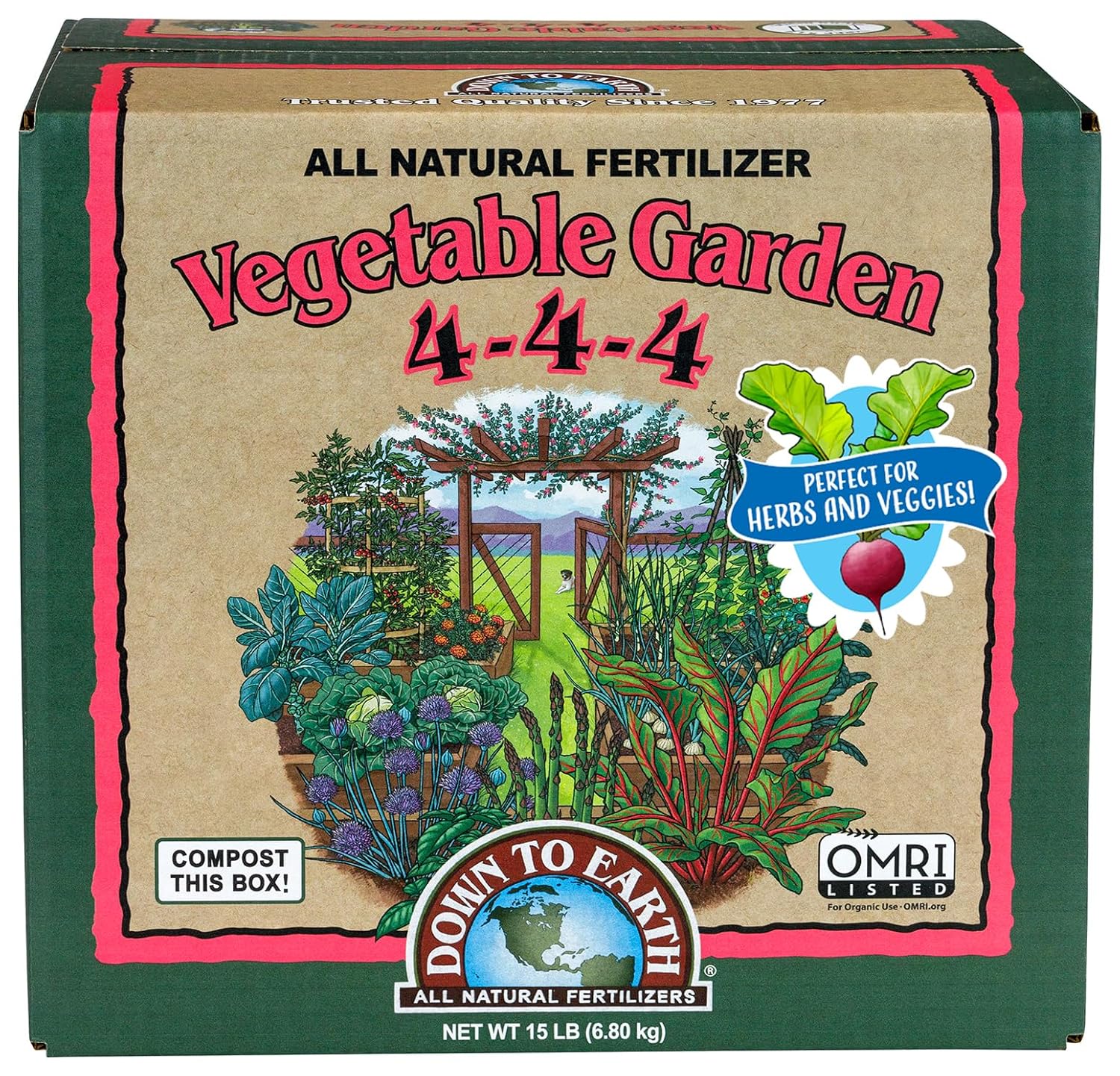
Down To Earth Vegetable Garden Organic Fertilizer, 4-4-4, 15 lb
| Item Form | Granules |
|---|---|
| Specific Uses For Product | Organic Gardening, Vegetable Gardens |
| Target Species | vegetables |
| Mixing Ratio | 4:4:4 |
| Unit Count | 240 Ounce |
This box of Down To Earth Vegetable Garden fertilizer is a granular, all-natural 4-4-4 formula designed to feed vegetables, herbs and leafy greens through the growing season. You apply it by sprinkling around plant bases and lightly mixing into the topsoil, then watering in; the blend of feather meal, fish bone meal, alfalfa, rock phosphate, kelp and other amendments supplies immediate and slow-release nutrients. It works well as a seasonal baseline feeding across raised beds and backyard plots and supports steady growth rather than aggressive, quick flushes. Practical benefits include OMRI-friendly ingredients for organic systems, a balanced NPK that suits mixed plantings, and a 15 lb size that covers multiple beds. Limitations are that it is a general-purpose mix so gardeners seeking crop-specific blends or fast soluble feeds will need to supplement for bloom or heavy fruit set, and as a granular organic product it requires proper incorporation and watering to activate nutrient release.
Best for: Gardeners who want a dependable, organic baseline fertilizer for mixed vegetable beds and herbs and who prioritize steady, sustainable growth over quick-release chemical boosts.
Less Ideal for: Growers focused on single-crop high-yield production or those who need fast soluble feeds for rapid bloom or ripening should consider specialized or supplemental products.
- Balanced 4-4-4 NPK suitable for a wide range of vegetables and herbs
- OMRI-friendly all-natural ingredients that support organic gardening
- Granular form is easy to apply and incorporates into topsoil
- Contains both quick and slow-release nutrient sources for steady feeding
- Not crop-specific so may need additional fertilizer timed for flowering or heavy fruiting
- Requires mixing into soil and regular watering to mobilize nutrients
Verdict: A reliable, OMRI-friendly 4-4-4 granular fertilizer that provides steady, all-season nutrition for mixed vegetable beds.
BUILDASOIL Organic Vegetable Garden Fertilizer, Craft Blend (3 lb)

| Item Form | Granules |
|---|---|
| Specific Uses For Product | Plant Growth, Soil Conditioning |
| Coverage | Medium |
| Mixing Ratio | 1/4 to 1 cup per 5 gallons of water |
| Unit Count | 48 Ounce |
This BuildASoil Craft Blend is an all-purpose organic granular fertilizer aimed at improving vegetable garden performance and overall soil health. It is typically used as a top dressing, re-amendment, or brewed into a nutrient tea using the suggested ratio of 1/4 to 1 cup per 5 gallons of water. The formula lists a 2-4-2 NPK along with rock dust and calcium, which supports root development, flowering, and nutrient balance for faster visible plant response. Practical benefits include flexible application methods, suitability for both re-amending spent soil and regular feeding, and a composition intended to boost vigor and flower fragrance. The bag size and medium coverage make it convenient for home vegetable plots and raised beds. Important limitations are that specific nutrient analysis beyond NPK is not itemized on the label and the product requires regular application or tea brewing to see results rather than acting as a long-term one-time soil overhaul. Gardeners should also follow the recommended mixing rates to avoid overapplication when using concentrated brews.
Best for: Gardeners who prioritize measurable plant performance and want an organic fertilizer that promotes rapid growth and bloom response in vegetable beds and raised beds.
Less Ideal for: People seeking a single-application, long-term soil conditioner for large landscapes or those who need precise micronutrient analysis for corrective fertilization.
- Balanced 2-4-2 NPK formula suited to fruiting vegetables and flowering
- Contains mineral inputs like rock dust and calcium to support soil biology
- Versatile application: top dressing, soil re-amendment, or brewed nutrient tea
- Organic and GMO-free formulation appropriate for organic vegetable gardening
- Label does not provide a detailed ingredient breakdown or trace nutrient amounts
- Requires repeated applications or brewed teas rather than acting as a single long-term amendment
Verdict: Choose this handcrafted organic blend if you want a performance-focused, versatile fertilizer that boosts vegetable vigor and flowering with repeatable, measurable feeding methods.
Jobe's Organics All-Purpose Granular Fertilizer (16 lb)

| Item Form | Granules |
|---|---|
| Specific Uses For Product | Plant Growth, Root Development, Seed Development, Soil Conditioning |
| Mixing Ratio | 4-4-4 |
| Coverage | Resealable |
This is a straightforward organic granular fertilizer designed for regular feeding of vegetable gardens and other ornamentals. With an NPK of 4-4-4 and ingredients like feather meal, bone meal, and processed poultry manure, it supplies balanced nutrients and some calcium and sulfur for steady growth and improved root development. You apply it to soil every 2 to 3 weeks during the growing season; as a slow-to-release granular it reduces the need for daily attention and lowers the risk of burning when used as directed. The product is OMRI listed for organic gardening and is presented in a resealable bag for tidy storage. Limitations to be aware of are the modest NPK numbers, which mean it is best for maintenance feeding rather than rapidly correcting severe nutrient deficiencies, and the need to reapply frequently compared with longer-term slow-release formulations. For growers wanting an easy, certified-organic feed for vegetables and mixed beds, this covers most bases without complex application methods.
Best for: Home vegetable gardeners and practical growers who prioritize organic inputs and want a simple, repeatable feeding routine to maintain steady plant growth.
Less Ideal for: Growers who need a high-concentration or targeted corrective fertilizer for severe nutrient deficiencies or for single-crop intensive production should consider specialized formulas instead.
- OMRI listed and made from organic-derived sources suitable for certified organic vegetable production
- Balanced 4-4-4 NPK supports foliage, flowers, and fruit development without strong spikes
- Granular, slow-to-release form reduces immediate burn risk and simplifies feeding schedule
- Resealable packaging helps keep product dry and minimizes mess during storage
- Lower nutrient concentrations mean more frequent application or higher volumes are needed for nutrient-poor soils
- Not formulated for a single crop nutrient correction so may be insufficient for plants with specific high-demand deficiencies
Verdict: A reliable, OMRI-listed all-purpose granular fertilizer that gives practical, balanced organic feeding for vegetable gardens with minimal fuss.
Dr. Earth Organic Tomato, Vegetable & Herb Fertilizer (64 oz)

| Unit Count | 64 Ounce |
|---|---|
| Item Form | Granules |
| Specific Uses For Product | Organic |
| Target Species | Herb |
| Coverage | Medium |
This granular organic fertilizer is designed to boost vegetable and herb production by supplying balanced nutrients and soil biology support. It is typically broadcast into beds, mixed into potting mixes, or applied at planting and midseason for a nutritional lift; the manufacturer recommends reapplying every six weeks for containers. Notable features include a fully organic ingredient list, fast but sustained nutrient release, and a blend of probiotic microbes plus ecto and endo mycorrhizae intended to improve nutrient uptake and drought tolerance. In practice that means healthier root systems and potentially better yields and flavor in crops like cucumbers when used as part of an organic program. Limitations are that it is a medium coverage product in a 64 ounce bag so larger plots will need more frequent purchases, and it contains phosphorus so local runoff rules should be checked before use. Follow the directions for pH and application timing to avoid overapplication in small containers.
Best for: Gardeners who prioritize organic soil health and want a single, biology‑focused fertilizer to support vegetables like cucumbers in beds or containers.
Less Ideal for: Large‑scale growers seeking a bulk, high‑coverage fertilizer or those who must avoid phosphorus due to local regulations should consider other options.
- 100 percent organic formula suitable for certified organic gardens
- Contains beneficial microbes and eight strains of mycorrhizae to support root health and nutrient uptake
- Granular form releases nutrients quickly and continues feeding for several months
- Works for beds, raised planters and containers and can be used at planting, transplanting or midseason
- Bag is medium coverage so not economical for very large vegetable plots
- Includes phosphorus which may be restricted in some local jurisdictions
Verdict: Choose this product if you want an organic, microbe‑rich granular fertilizer that supports root health and steady feeding for cucumber and other vegetable plantings.
Brut Organic Worm Castings, 5 lb

| Item Form | Granules |
|---|---|
| Specific Uses For Product | Gardening,Organic |
| Target Species | All plants |
| Mixing Ratio | 1:5 |
Brut Organic Worm Castings function as a concentrated, natural soil amendment you mix into potting mixes or top-dress garden beds and raised beds. Typical use is mixing at the recommended 1:5 ratio for new indoor plants, sprinkling a cup around established houseplants, or working into outdoor planting holes and beds according to the brand directions. The product is OMRI/CDFA listed and produced in controlled conditions, which supports consistent nutrient content and beneficial microbial life that help roots establish, improve soil structure, and increase moisture retention without burning plants. Practical benefits for raised garden beds include improved aeration, slow-release nutrients, and a boost in microbial activity that supports long-term fertility. Limitations are that it is not a complete NPK fertilizer for immediate heavy feeding needs and larger beds require significant quantities to hit the suggested per-square-foot rates, so frequent applications or bulk purchases may be needed for big projects.
Best for: Gardeners who prioritize dependable, organic soil improvement for raised beds and container gardens and prefer predictable, low-risk amendments that support long-term soil health.
Less Ideal for: Those needing immediate, high-NPK feeding for heavy-feeding crops or gardeners who want to amend very large beds without buying supplemental bulk material.
- Certified organic and produced indoors for consistent purity
- Rich in beneficial microbes that improve soil structure and plant vigor
- Easy-to-use granular form suitable for mixing or top-dressing
- Not a standalone high-NPK fertilizer for rapid nutrient correction
- Five-pound bag may be small for large raised beds and repeated seasonal use
Verdict: Use this OMRI/CDFA-listed worm castings product to reliably build long-term fertility and microbial health in raised beds and containers.
Burpee All-Purpose Organic Granular Plant Food, 4 lb

| Item Form | Granules |
|---|---|
| Specific Uses For Product | Gardening,Plant Growth,Root Development |
| Coverage | 213 Square Feet |
| Target Species | Herba |
Burpee All-Purpose Organic Granular Plant Food is a ready-to-use organic fertilizer designed for vegetable gardens, flower beds, herbs and container plants. The granules supply major and minor nutrients plus calcium and beneficial microbes that begin releasing nutrients quickly and continue feeding plants for up to three months, so you can apply less frequently during the growing season. It is OMRI-listed, which makes it suitable for gardeners who prefer organic-approved inputs, and the coverage figure on the package helps plan application for small to medium beds. Typical use is a surface application worked lightly into the soil or mixed into potting media for containers and seed starting. Practical advantages include straightforward application, multi-month nutrient release, and compatibility with a wide range of garden plants. Limitations are the small bag size for larger plots and the lack of detailed N-P-K numbers on the listing, which means gardeners wanting precise nutrient ratios or high- rate corrective feeding may need a supplemental product.
Best for: Gardeners who prefer low-risk, organic-approved inputs and want a simple, multi-purpose fertilizer that reduces the need for frequent feeding in small to medium vegetable beds and container gardens.
Less Ideal for: Large-scale vegetable growers or gardeners who need exact N-P-K values and high-strength corrective applications should consider more concentrated or bulk fertilizers.
- OMRI-listed organic formula suitable for certified-organic and home organic gardens
- Granular form releases nutrients immediately and continues feeding for up to three months
- Suitable for seed starting, vegetables, herbs, flowers, trees, shrubs and containers
- Clear coverage guidance provided for planning applications to small and medium beds
- Bag is only 4 lb so not economical for large vegetable plots
- Product listing does not show explicit N-P-K ratio for precision nutrient planning
Verdict: A small, OMRI-listed granular fertilizer that gives low-risk, multi-month feeding for home vegetable beds and container gardens.
Choosing the Right Dry Organic Fertilizer: Key Factors to Consider
Guaranteed Analysis and Nutrient Ratios
A clear guaranteed analysis tells you the percentages of nitrogen, phosphorus, and potassium and any secondary nutrients. Knowing the N-P-K ratio matters because different garden tasks need different balances: a lawn or leafy crop benefits from higher nitrogen, while bulbs and fruiting plants often need more phosphorus and potassium.
Also check for secondary nutrients and micronutrients. Iron, calcium, magnesium, and trace elements can correct common deficiencies without needing additional amendments. Transparent labeling helps you calculate application rates accurately and avoid over-application that can stress plants.
Organic Matter and Carbon Content
Dry organic fertilizers that include high organic matter also help soil structure and water retention. Materials like composted plant matter, kelp meal, or bone meal add carbon and bulky organic material that feeds soil microbes as they break down.
Higher carbon content supports long-term improvements in soil tilth and can reduce compaction and erosion. For containers or raised beds, products with modest organic matter are easier to mix in; heavy, very woody products may take longer to break down and can temporarily tie up nitrogen unless balanced.
Release Rate and Feeding Schedule
Different dry organics release nutrients at different speeds. Fast-release materials like blood meal or certain fish meals give a quick boost but can be short-lived. Slow-release inputs such as rock phosphate, feather meal, or well-composted manures feed over months.
Match release rate to plant needs and season. Use quicker-release sources for rapid greening in spring, and choose slower-release sources for long-term soil building or for perennials where steady feeding is preferred. Consider how often you want to reapply and whether the product works well with split applications.
Physical Form and Ease of Application
Granular, powdered, and pelletized dry organics behave differently in the garden. Granules are easy to spread with a handheld or drop spreader and reduce dust. Powders can be great for mixing into potting soil but may clump or blow away during application.
Also consider solubility and how well the product integrates when topdressed versus incorporated. If you plan to broadcast over a lawn, choose a texture that distributes evenly. For raised beds and container mixes, look for products that mix uniformly without leaving pockets of concentrated material.
Compatibility With Soil Biology
One advantage of organic fertilizers is their ability to feed soil microorganisms, which in turn make nutrients available to plants. Products containing diverse carbon sources, beneficial microbes, or humic materials help support this biological cycling.
Avoid products high in readily oxidizable nitrogen that can temporarily disrupt microbial balance. Also consider whether the fertilizer has been composted or cured; fully composted inputs are gentler on roots and generally more microbe-friendly than raw manures or fresh meals.
Application Rate, Safety, and Environmental Impact
Dry organics require careful rate calculation to avoid burning tender roots or causing nutrient runoff. Check the recommended application rates for lawns, beds, and containers and translate those into volume or weight per square foot.
Think about environmental impact too. Slow-release, biologically active organics reduce leaching risk compared with soluble synthetic salts. Also factor in handling safety: dusty materials need masks and eye protection, and some animal-based meals can attract wildlife if applied on the surface.
Matching Fertilizer Type to Garden Tasks
Different garden jobs call for different dry organic formulas. For building new beds, choose products with higher organic matter and a balanced N-P-K to improve texture and provide a steady supply of nutrients. For lawns or leafy vegetable beds, favor formulas with a higher proportion of available nitrogen to promote green growth.
- Topdressing lawns: choose fine granules that spread evenly and release nitrogen steadily.
- Preparing potting mixes: use powdered or finely milled organics that incorporate well without clumping.
- Soil rebuilding: favor compost-rich blends and inputs with diverse carbon sources.
Application Timing and Seasonal Strategy
Plan applications around plant growth cycles. Apply a soil-building topdress in autumn or early spring so microbes have cool conditions to begin decomposition. For quick spring green-up, apply a faster-release nitrogen source a few weeks before peak growth.
Split applications can provide steady feeding through high-demand periods. For long-season crops, combine a slow-release base at planting with light surface feedings during peak growth to avoid nutrient dips.
- Autumn: focus on organic matter and slow-release nutrients.
- Spring: time a quick feeding ahead of active growth if needed.
- During growth: use light side-dressings or foliar feeds for targeted correction.
Mixing With Compost and Amendments
Dry organics work best when used as part of a broader soil-amending program. Mixing fertilizers with compost dilutes concentrated nutrients and promotes even distribution of food for soil life. When incorporating into beds, blend fertilizer into the top few inches so roots encounter a balanced supply.
Be mindful of overlapping nutrient sources. If your compost is already high in nitrogen, avoid doubling up with strong nitrogen meals. Test soil when possible to tailor inputs and prevent nutrient imbalances.
- Pre-mix with compost for beds and containers.
- Avoid stacking multiple high-nitrogen materials at once.
- Use soil testing to adjust phosphorus and potassium inputs.
Storage and Handling Best Practices
Store dry organic fertilizers in a cool, dry place in sealed containers to prevent moisture uptake and caking. Keep animal-based meals and manure-derived products sealed to avoid attracting pests. Label containers with application rates to simplify future use.
When handling dusty materials wear a dust mask and gloves. For large gardens, consider transferring a workable quantity to a smaller dispenser to reduce waste and limit exposure.
- Keep products dry and sealed to preserve potency.
- Use masks when handling fine powders.
- Transfer bulk material into labeled smaller containers for daily use.
Environmental Considerations and Runoff Prevention
Even organic nutrients can run off into waterways if applied excessively or just before heavy rain. Apply at recommended rates and avoid broadcasting high-phosphorus materials near drains or water features. Use buffer strips and mulch to slow water movement and trap particulates.
Favor slow-release, microbe-driven products to minimize soluble nutrient pulses. For sloped sites use incorporation or targeted banding instead of surface broadcasting to reduce loss.
- Do not apply before heavy rain forecasts.
- Incorporate fertilizers on slopes to reduce runoff.
- Use mulch and buffer strips to trap moving soil and nutrients.
How We Chose the Best Dry Organic Fertilizer
We started by screening widely available dry organic fertilizers designed for home and small-scale garden use. Products were included only if they use primarily organic nutrient sources rather than synthetic salts and if manufacturers provided transparent guaranteed analysis and ingredient listings. We excluded blends that rely mainly on inert fillers or that lack clear nutrient profiles. Our evaluation emphasized concrete, gardener-relevant dimensions: nutrient balance and concentration, carbon and organic matter content, release profile and feeding schedule, physical handling and application ease, and suitability across common garden tasks such as soil building, lawn topdressing, and container mixes. We also considered how compatible formulas are with compost and cover-crop programs. Excluded items included liquid concentrates, synthetic granular fertilizers, and specialty products intended only for commercial row-crop use. The final picks represent a range of nutrient ratios and textures so gardeners can choose by feeding speed, soil-improvement goals, and application method.
FAQ
How often should I apply dry organic fertilizer to vegetable beds?
It depends on the product and crop. Many gardeners apply a base application in spring and then light sidedressings during peak growth every 4 to 8 weeks. Fast-release organics may need more frequent reapplication, while slow-release inputs can last the season.
Can I use dry organic fertilizer in containers and hanging baskets?
Yes, but choose finely milled products and reduce rates. Containers need gentler, more frequent feeding because nutrients wash out with watering. Mix some into potting mix at planting and follow up with light topdressings.
Will dry organic fertilizer attract pests or pets?
Some animal-based meals and manures can attract wildlife if left on the surface. Incorporate these materials into the soil, store them sealed, and avoid surface applications near areas where pets forage to reduce attraction.
How do I convert recommended application rates to my yard size?
Start with the product label's per-area rate and calculate your lawn or bed area in square feet. Multiply the per-square-foot rate by your area, or scale the per-1000-square-feet rate accordingly. Using a spreader makes even distribution easier.
Is it okay to combine several dry organics at once?
Combining products is often fine but do so with care. Check total nutrient inputs so you do not create a high spike in a single nutrient, especially nitrogen or phosphorus. Mixing with compost helps buffer concentrations and supports microbe activity.
How long before planting should I apply dry organic fertilizer?
Apply slow-release, high-organic-matter inputs several weeks to a few months before planting to allow microbial breakdown. Faster-release meals can be applied closer to planting but avoid high concentrations in direct seed furrows or next to young roots.
Final Verdict
Choose a dry organic fertilizer based on how you garden and what your soil needs. Prioritize a clear guaranteed analysis, appropriate release rate, and sufficient organic matter when building soil or feeding heavy feeders. Match physical form to your application methods and store materials to preserve performance. Balance short-term feeding needs with long-term soil biology support. Gardeners who plan applications around plant growth cycles and pair fertilizers with compost and soil testing will see the best, most sustainable results.
