

Note: This article contains affiliate links. If you click on these links and make a purchase, I may earn a small commission at no extra cost to you. This helps support my research and content. Read my full affiliate disclosure here.
Evergreen arborvitae need steady, predictable nutrition to hold color, keep dense foliage, and survive winter stress. The right fertilizer for evergreen arborvitae supports steady shoot growth without provoking weak, late-season flushes that can be damaged by cold. This guide shortlists seven top options that fit common planting situations from young hedges to established specimens. We evaluated products for nutrient balance, release type, and practical application in landscapes and small gardens. Read on to see which feeding approaches match your site and maintenance style.
Top Picks at a Glance
| Best Overall The best all-around choice for most situations | Jobe's Evergreen Tree & Shrub Fertilizer Spikes (15-Pack) |  |
| Best Quality Built to a higher standard if you want something more solid | Jobe's Evergreen Fertilizer Spikes, Slow-Release, 15 Count |  |
| Best Value The sweet spot between price and what you get | SimplyGro Fertilizer Spikes for Evergreen Trees & Shrubs (12 Spikes, 12-3-3) |  |
| Best Budget The cheapest option that still gets the job done reliably | GARDENWISE Evergreen Fertilizer (8-4-8) Slow-Release Granular Plant Food, 12 oz |  |
| Highest Rated A top-rated pick with lots of positive feedback | Espoma Organic Evergreen-Tone 4-3-4 Fertilizer for Evergreen Trees & Shrubs, 18 lb |  |
| Most Popular A crowd favorite that many people choose with confidence | Miracle-Gro Tree & Shrub Plant Food Spikes, 12 Spikes |  |
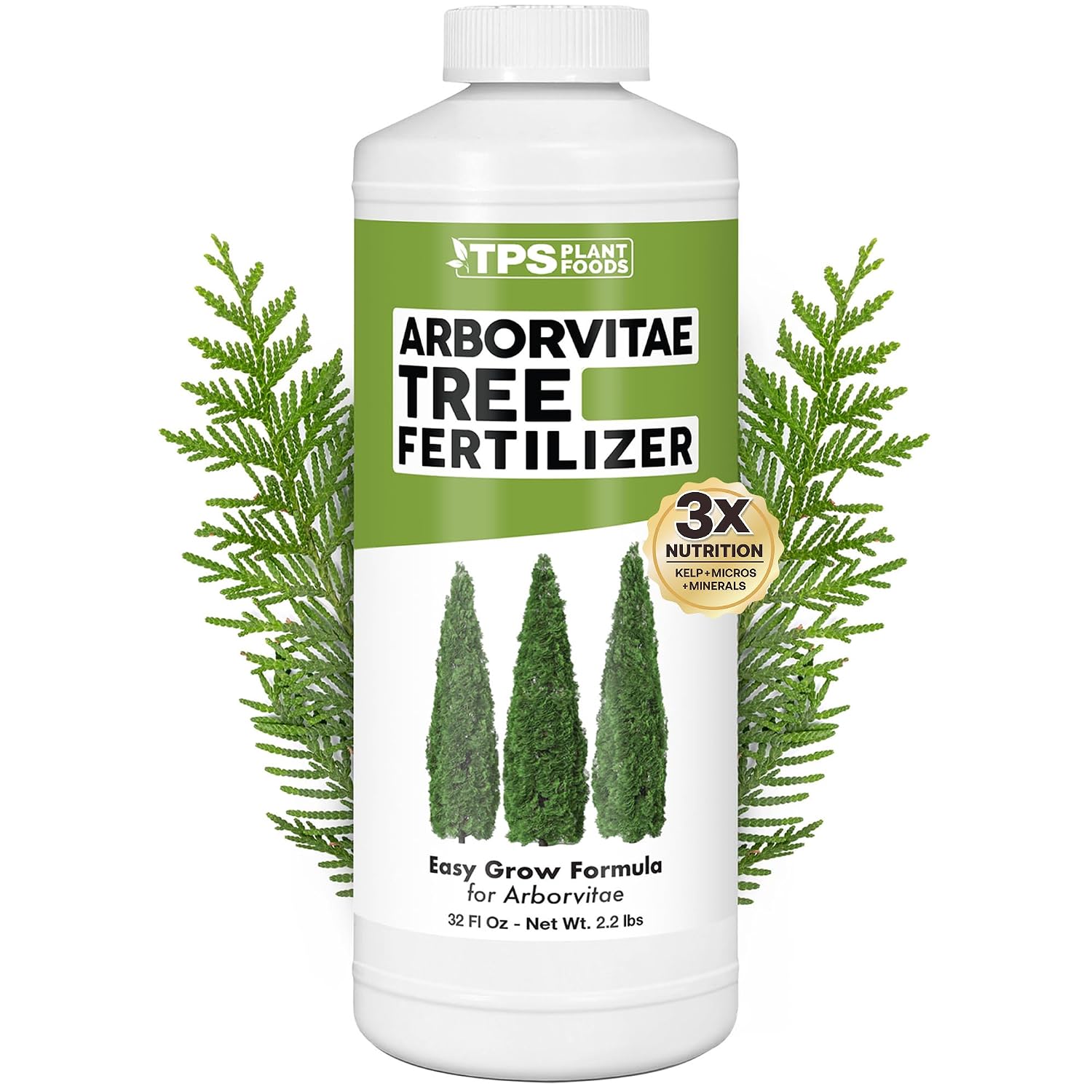
| Best Seller A high-volume bestseller chosen again and again | TPS NUTRIENTS Arborvitae Liquid Fertilizer, 32 oz |  |
Jobe's Evergreen Tree & Shrub Fertilizer Spikes (15-Pack)

| Item Form | Sticks |
|---|---|
| Application Method | Pound spikes into ground |
| Target Species | Evergreens |
| Mixing Ratio | 15-3-4 |
Jobe's Evergreen Tree & Shrub Fertilizer Spikes are premeasured, slow‑release sticks designed to feed evergreens like arborvitae without frequent reapplication. You pound the spikes into the soil around the root zone and the product releases nutrients over an extended period, letting rain and soil moisture carry the feed to roots. The 13-3-4 NPK analysis and slow-release formula reduce the risk of burning and provide steady nitrogen to support green growth. A 15‑spike pack is convenient for spot treating multiple shrubs and requires minimal skill or equipment to use. Limitations are that spikes only treat the area where they are placed so coverage can be uneven if root zones extend beyond placement, and they do not replace a soil test or address micronutrient deficiencies. For upright evergreens planted in typical landscape beds these spikes simplify feeding and cut down on seasonal maintenance, but dense or large specimens may need more spikes or complementary granular applications for full coverage.
Best for: Buyers who want a low‑effort, reliable way to keep arborvitae green with predictable, maintenance‑free feeding throughout the season.
Less Ideal for: Gardeners managing very large or densely planted specimens, or those needing customized nutrient programs based on soil tests, should consider granular or soluble fertilizers instead.
- Slow‑release formula reduces risk of fertilizer burn and provides steady feeding
- Premeasured spikes make application quick and low‑skill
- Formulated specifically for evergreens, matching nutrient needs of arborvitae
- 15‑count pack convenient for treating multiple shrubs
- Placement-dependent coverage can miss root extensions beyond spike locations
- Does not address micronutrient imbalances or soil pH concerns
Verdict: If you want a dependable, low‑maintenance feed for arborvitae, these premeasured slow‑release spikes deliver steady green growth with minimal effort.
Jobe's Evergreen Fertilizer Spikes, Slow-Release, 15 Count

| Unit Count | 15 Count |
|---|---|
| Item Form | Sticks |
| Application Method | Insert spikes into soil |
| Target Species | Evergreen Trees |
| Ingredients | 13% Nitrogen, 3% Phosphorus, 4% Potassium |
Jobe's Evergreen Fertilizer Spikes are premeasured slow-release sticks designed to feed acid-loving evergreens like arborvitae, cypress, pine, and cedar. You insert the spikes around the tree dripline twice a year using a hammer and cap; the spikes release nutrients slowly at the root zone so there is minimal runoff or surface mess. The 13-3-4 NPK formula supports foliage color and general growth while reducing the risk of overfertilizing because each spike contains a controlled dose. Practical benefits include simple twice-yearly application, no mixing, and targeted delivery that is easy to manage on multiple trees. Limitations are that coverage is medium so larger or densely planted specimens will need more spikes, and spikes must be placed correctly around the dripline and kept at the recommended distance from the trunk. This product is best as a low-effort maintenance feed rather than a quick corrective treatment for nutrient deficiencies.
Best for: Homeowners who want a low-maintenance, no-mess way to maintain arborvitae and other acid-loving evergreens with predictable twice-yearly feeding.
Less Ideal for: Gardeners needing rapid correction of nutrient deficiencies or feeding large specimen trees that demand heavier or more frequent fertilization.
- Slow-release formula delivers nutrients directly to active root zones, reducing runoff
- Premeasured spikes eliminate mixing and make twice-yearly application quick and tidy
- Formulated for acid-loving evergreens, supporting foliage color and steady growth
- Minimal surface mess or odor compared with granular or liquid fertilizers
- Medium coverage means larger trees require many spikes for adequate feeding
- Must be driven into soil at correct depth and spacing for effectiveness
Verdict: A simple, low-effort slow-release feeding option that keeps arborvitae healthy with twice-yearly, no-mess applications.
SimplyGro Fertilizer Spikes for Evergreen Trees & Shrubs (12 Spikes, 12-3-3)

| Item Form | Sticks |
|---|---|
| Specific Uses For Product | Evergreen Tree & Shrub Fertilizer, Outdoor Gardening, Plant Growth |
| Application Method | Hammer the spikes into the ground |
| Target Species | Evergreen, Fir, Coniferous Trees & Shrubs |
| Mixing Ratio | 12:3:3 |
These SimplyGro fertilizer spikes are a set-and-forget root-feeding option for evergreen arborvitae and other conifers. Each pre-measured 5-inch spike contains a 12-3-3 N-P-K formula and is driven into the root zone with a hammer, delivering nitrogen, phosphorus, and potassium directly where roots absorb them. They are designed to feed continuously for up to three months, so typical use is two applications per year: once in spring and once in fall. Practical benefits include precise dosing that reduces the risk of overfertilizing, minimal surface mess, and reduced runoff compared with granular broadcast options. The spikes are claimed to be sturdy and resistant to breaking, making installation quicker and cleaner. Limitations are that coverage is listed as variable so you need to match spike spacing to tree size and root spread, and spikes cannot address pH, micronutrient deficiencies, or soil structural issues. For landscapes with established arborvitae, these spikes simplify maintenance and deliver focused nutrition, but they are not a substitute for soil testing or corrective amendments.
Best for: Home gardeners and property managers with established evergreen arborvitae who want a low-effort, reliable feeding routine and prefer targeted root-zone nutrition over frequent granular applications.
Less Ideal for: Gardeners who need to correct soil pH, provide specific micronutrients, or who want a fast-acting foliar or liquid treatment should consider alternative products or a soil test and tailored amendment plan.
- Pre-measured 12-3-3 formula supplies N, P, K directly to root zone
- Feeds continuously for up to three months per spike, reducing application frequency
- Sturdy TruSpikes design resists breaking for easy hammer-in installation
- Reduces surface runoff and mess compared with loose granular fertilizers
- Coverage is listed as variable so spacing must be calculated by the user
- Does not correct soil pH or provide specific micronutrients
- Not suitable for rapid correction of severe nutrient deficiencies
Verdict: A convenient, low-maintenance root-feeding option that delivers a pre-measured 12-3-3 formula ideal for routine spring and fall feeding of evergreen arborvitae.
GARDENWISE Evergreen Fertilizer (8-4-8) Slow-Release Granular Plant Food, 12 oz

| Item Form | Granules |
|---|---|
| Specific Uses For Product | Evergreen tree and shrubs fertilizer |
| Mixing Ratio | 8-4-8 |
| Unit Count | 12 Fluid Ounces |
| Included Components | 1 Bag of Evergreen Fertilizer |
This granular Evergreen Fertilizer from GARDENWISE is designed to feed acid-tolerant trees and shrubs like arborvitae, azaleas, pines, and hollies. You apply it by sprinkling evenly around the root zone and watering in; the slow-release formula delivers steady nutrients so you only need 2 to 3 applications per season. The 8-4-8 NPK and added micronutrients promote leafy density and root strength, which helps evergreen hedges hold color and fill in gaps. The 12 ounce bag is easy to handle for small yards or a few specimens and the granules make uniform distribution straightforward. Limitations are the small unit size for larger plantings and the product gives general coverage guidance rather than exact per-plant rates, so you may need to calculate amounts for multiple trees or consult soil tests for precise feeding. For routine seasonal maintenance of individual arborvitae, it simplifies care and reduces risk of overfeeding compared with fast-release options.
Best for: Gardeners looking for a simple, low-maintenance seasonal fertilizer to keep one or a few arborvitae or evergreen shrubs healthy without frequent feeding.
Less Ideal for: Landscapers or homeowners managing long hedgerows or many trees who need bulk quantities or exact per-plant dosing for large-scale applications.
- Formulated specifically for evergreens with an 8-4-8 NPK ratio appropriate for foliage and root development
- Slow-release granules provide steady feeding and reduce frequency of applications
- Granular form is easy to apply evenly around the root zone
- Includes micronutrients to support overall plant vigor and foliage color
- Small 12 oz unit may require multiple bags for hedges or larger plantings
- Directions give general coverage guidance rather than precise per-tree application rates
Verdict: A convenient slow-release granular fertilizer tailored to maintain the health and foliage of individual arborvitae and other evergreens with minimal fuss.
Espoma Organic Evergreen-Tone 4-3-4 Fertilizer for Evergreen Trees & Shrubs, 18 lb

| Item Form | Granules |
|---|---|
| Application Method | Ready to use |
| Target Species | Evergreen trees and shrubs |
| Mixing Ratio | 4:3:4 |
Espoma Organic Evergreen-Tone is a granular, ready-to-use fertilizer aimed at promoting steady growth and color in evergreen trees and shrubs. You apply it at planting and as a regular feed in early spring and late fall to supply balanced nitrogen, phosphorus, and potassium along with organic matter and Bio-tone microbes that support root development. Because it is formulated specifically for needleleaf and broadleaf evergreens, it is useful for young ornamental pines, firs, rhododendrons, azaleas, and camellias where steady, gradual feeding and improved soil biology matter. The product is certified for organic production and contains no sludges or fillers, so it suits gardeners who want natural inputs. Limitations are that coverage is described as medium, so an 18 lb bag may not be sufficient for large plantings, and the granules provide slower nutrient release compared with soluble feeds when immediate greening is required. For performance-focused gardeners, this delivers reliable, low-risk nutrition while emphasizing long-term root health.
Best for: Gardeners who prioritize steady, long-term performance and healthier root systems for young evergreen trees and shrubs, and who prefer organic inputs over quick-release chemical feeds.
Less Ideal for: People needing fast-visible results or feeding large numbers of trees quickly should consider concentrated soluble fertilizers or bulk commercial products instead.
- Balanced 4-3-4 NPK formulated for evergreen growth and color
- Contains Bio-tone microbial formula to support root development
- Ready-to-use granular form requires no mixing
- Approved for organic gardening with natural ingredients
- Medium coverage means the 18 lb bag may require multiple purchases for larger landscapes
- Slower nutrient release than water-soluble fertilizers when rapid correction is needed
Verdict: A performance-minded organic granular fertilizer that supports steady growth and root health in young evergreen trees and shrubs.
Miracle-Gro Tree & Shrub Plant Food Spikes, 12 Spikes

| NPK | 15-5-10 |
|---|---|
| Coverage | 12 spikes per season |
| Target Species | trees, shrubs, evergreens and acid-loving plants |
| Application Method | Place spikes around the tree's drip line |
These Miracle-Gro Tree & Shrub Plant Food Spikes are pre-measured sticks that deliver slow-release nutrition directly to the root zone of trees and shrubs. They are typically used by watering the soil around the drip line, spacing spikes around the drip line at least 3 feet apart, and driving them into the ground so they sit below the soil surface. The 15-5-10 NPK mix supplies a higher proportion of nitrogen for foliage with phosphorus and potassium to support root and overall plant health, and the package contains 12 spikes intended for seasonal feedings. Practical benefits include simple, low-effort applications for established cherry trees where precise granular spreading is inconvenient, and the spikes help localize nutrients to the root zone rather than blanket-feeding the whole bed. Limitations are that they are designed for early spring and mid-fall use only, so they do not replace a tailored feeding schedule for trees needing summer supplements, and they require firm soil for insertion which can be difficult in very compacted or rocky sites. The product is best as an easy seasonal maintenance feed rather than an intensive corrective treatment.
Best for: Gardeners who want a low-effort, dependable seasonal feed for established flowering trees and shrubs and prefer an application that targets the root zone without granular spreading.
Less Ideal for: People needing aggressive summer corrections, quick nutrient fixes, or those working on newly planted trees that require a different feeding routine.
- Slow-release formula delivers nutrients directly to the root zone
- Pre-measured spikes make application simple and low-mess
- NPK 15-5-10 supports foliage color and overall tree vigor
- Includes 12 spikes, enough for multiple small trees or one larger drip line
- Intended for two seasonal applications only and not for summer feeding needs
- Can be hard to install in very rocky or compacted soils
Verdict: A simple, targeted seasonal feeding option that makes it easy to maintain vibrant foliage on established flowering trees with minimal effort.
TPS NUTRIENTS Arborvitae Liquid Fertilizer, 32 oz
| Item Form | Liquid |
|---|---|
| Application Method | Watering Can, Hose End Sprayer, Leaf Misting |
| Target Species | Arborvitae |
| Mixing Ratio | 2 tablespoons per gallon |
This liquid fertilizer is designed for arborvitae and similar evergreen hedges and is mixed at 2 tablespoons per gallon for regular watering applications. It can be applied with a watering can, hose-end sprayer, or as a leaf mist, so you can feed established Green Giant arborvitae during the growing season without special equipment. The formula emphasizes faster tip growth and denser green foliage while supporting root development, which helps hedges fill in and improves water and nutrient uptake. Practical benefits include flexible application methods, full-coverage liquid delivery that absorbs quickly, and a small 32 oz concentrated bottle that treats multiple applications. Limitations are the need to follow the mixing ratio closely to avoid overfeeding and the smaller bottle size if you manage a long row of mature trees, which will require frequent repurchase or bulk buying. For best results feed during active growth and combine with proper watering and mulching.
Best for: Home gardeners who want a simple, targeted feeding routine to improve color and fill-in for privacy hedges and single Green Giant arborvitae plants.
Less Ideal for: Landscapers or large properties needing high-volume fertilization who prefer granular slow-release products or bulk concentrates.
- Formulated specifically for arborvitae to encourage fuller tip growth and greener foliage
- Multiple application methods: watering can, hose-end sprayer, or leaf mist for flexible use
- Concentrated liquid that is fast-absorbing for quicker nutrient uptake
- Supports root development to improve long-term plant resilience
- 32 oz bottle may be small for long hedges or multiple mature trees
- Requires correct mixing and timing to avoid over-application
Verdict: A compact, easy-to-apply liquid fertilizer made to quickly green up and thicken Arborvitae hedges.
Choosing the Right Fertilizer for Evergreen Arborvitae: Key Factors to Consider
Nutrient Ratio and Timing
Arborvitae respond to steady, moderate nitrogen rather than heavy feeds that trigger soft new growth late in the season. Look for formulations with an N-P-K profile suited to evergreens, typically higher in nitrogen but not so aggressive that it causes a late flush. Timing also matters: spring and early summer applications support green-up and shoot fill, while late summer or fall high-nitrogen feeding can reduce cold hardiness.
Consider products that specify seasonal feeding schedules or slow-release nitrogen to avoid repeated applications. A balanced program will maintain foliage color without creating tender growth that is vulnerable to pests and winter injury.
Release Type and Longevity
How a fertilizer releases nutrients affects how often you need to feed and how stable growth will be. Slow-release granular or coated fertilizers provide steady nutrition over months and reduce the risk of nutrient spikes. Soluble or quick-release options can be useful for a rapid green-up but require careful timing and more frequent applications.
For hedgerows and landscape specimens, longer-duration products cut labor and lower the chance of overfeeding. Match release duration to your maintenance rhythm: a single spring application from a slow-release product may suffice for many sites, while high-light, fast-growing locations might benefit from an additional midseason feed.
Micronutrients and Soil Deficiencies
Arborvitae can show chlorosis or twig dieback when micronutrients like iron, magnesium, or manganese are lacking. Some fertilizers include these trace elements to correct or prevent deficiency symptoms. If your soil is alkaline or shows signs of nutrient lockup, a product with chelated micronutrients or an appropriate soil amendment will be more effective.
Consider getting a soil test if you suspect deficiencies. Using a fertilizer that supplies both macronutrients and necessary micronutrients reduces the need for separate treatments and supports uniform foliage color across the plant.
Salt Index and Root Safety
Evergreen arborvitae have relatively shallow root systems, so high-salt fertilizers can cause root burn and foliage browning. The salt index indicates how harsh a formulation might be when applied at label rates. Low-salt, controlled-release options are generally safer for young plants and closely spaced hedges.
Follow label application rates and avoid overlapping heavy applications where root zones intersect. When in doubt, choose lower salt-index products or apply more frequently at reduced rates rather than a single heavy dose.
Application Method and Practicality
How you apply fertilizer influences results and labor. Granular broadcast spreaders are efficient for long hedges, while banding or root-zone placement is better for individual specimens. Liquid foliar feeds can correct deficiencies quickly but do not replace soil-applied, long-term nutrition.
Consider the tools you already own, access to the planting (tight spaces reduce spreader usefulness), and whether you prefer a set-and-forget option. Ease of measuring, even spreading, and compatibility with irrigation schedules will affect how consistently you can feed your arborvitae.
Feeding Young Transplants Versus Established Plants
Young transplants need careful, moderate feeding to encourage root establishment and steady shoot growth without overstimulating top growth. Use lower-rate, slow-release formulas applied in a ring outside the root ball to avoid direct contact with sensitive roots. Frequent light feedings are less advisable than a single, appropriately measured application designed for young plants.
Established arborvitae tolerate broader application options and can benefit from longer-duration products that support seasonal growth. For dense hedges, apply fertilizer uniformly along the trench or spread a granular product evenly under the canopy to maintain consistent vigor across plants.
- Transplants: low-rate, slow-release; avoid direct root contact
- Established plants: wider application area; longer-duration products
Correcting Yellowing Needles and Chlorosis
Yellowing needles can indicate nutrient deficiency, often iron or magnesium, or it can signal environmental stress. A targeted soil test helps identify the specific deficiency. If the problem is micronutrient-related, choose a product with chelated iron or magnesium to treat the plant while also maintaining macronutrient balance.
Foliar applications deliver quick symptom relief but are temporary. Pair foliar treatment with a soil-applied fertilizer that supplies ongoing nutrition to avoid repeat spot treatments.
- Soil test before aggressive correction
- Use chelated micronutrients for alkaline soils
- Combine foliar fixes with soil feeding for long-term results
Timing Fertilizer Applications Around Winter
Avoid high-nitrogen applications late in the growing season that can stimulate soft growth vulnerable to frost. Aim to finish primary feeding several weeks before expected hard frosts so plants can harden off. Slow-release products applied in spring usually pose less risk of promoting late flushes and offer steady nutrition through the summer and into early fall.
In colder climates, prioritize winter hardiness over rapid late-season growth. Use balanced formulations and follow label timing to reduce the chance of winter damage.
- Finish major feeding well before first hard frost
- Prefer slow-release spring applications in cold regions
- Adjust timing by local climate and growth habit
Applying Fertilizer in Tight Landscape Spaces
Hedges and narrow planting strips require even distribution to avoid zones of over- or under-fertilization. Use a calibrated spreader for long runs or banded application when access is limited. When applying near patios or walkways, sweep granules back into the soil to prevent runoff or contact with non-plant surfaces.
For very narrow spaces, consider liquid soil drenches or root injections that target the root zone without spillover. These methods reduce waste and limit accidental concentration of salts near shallow roots.
- Use calibrated spreader for uniform coverage
- Consider soil drenches for narrow strips
- Avoid runoff onto hard surfaces
Organic Versus Synthetic Feeding Approaches
Organic fertilizers release nutrients as soil microbes break down material, improving soil structure and biological health over time. They are usually lower in immediate available nitrogen, so results are slower but often safer for long-term plant and soil health. Synthetic slow-release products can deliver predictable nutrient delivery and precise N-P-K ratios favored by some landscape managers.
Decide based on your management goals: if building soil and microbial life is a priority, organic options pair well with mulching and compost programs. If predictable, measurable nutrient delivery and timing are critical, choose controlled-release synthetics that match your season plan.
- Organics improve soil biology but act slowly
- Synthetics give predictable release and control
- Combine approaches for both immediate and long-term benefits
How We Chose the Best Fertilizer for Evergreen Arborvitae
We focused on practical, landscape-tested attributes that matter for evergreen arborvitae health. Primary evaluation criteria included nutrient ratio and balance to ensure adequate nitrogen without excessive late-season push; release type, comparing slow-release granules, coated fertilizers, and controlled-release organics for feeding duration and labor; micronutrient content, since iron and magnesium deficiencies show as needle yellowing; application practicality covering spreader and soil drench options and safe winter timing; and salt index and root safety to avoid root burn in shallow-rooted arborvitae. Products were excluded if their label recommended high late-season nitrogen, lacked clear guaranteed analysis, or relied solely on high-salt formulations unsuitable for close hedging. We also filtered out options that required specialized equipment most gardeners would not have. The final shortlist balances reliable formulations with ease of use for both DIY gardeners and landscape pros.
FAQ
How often should I fertilize arborvitae?
It often depends on the product type. Slow-release granular fertilizers usually need a single spring application or one application in spring and another midseason. Quick-release products require more frequent, lower-rate feeds. Match frequency to release duration and local growth rates.
Can I use a general shrub fertilizer on arborvitae?
Often yes, if the formula has a balanced N-P-K appropriate for evergreens and includes or allows micronutrient supplementation. Avoid general-purpose high-nitrogen blends applied late in the season, and follow label directions for evergreen use.
Will foliar feeding fix yellowing needles quickly?
Foliar sprays can provide rapid symptom relief, especially for micronutrient deficiencies, but effects are temporary. Combine foliar treatments with a soil-applied fertilizer that provides sustained nutrition to prevent recurrence.
Is granular fertilizer better than liquid for hedges?
Granular slow-release products are often more practical for long hedges because they reduce application frequency and are easier to spread evenly. Liquids can be useful for spot treatments or correcting deficiencies but usually require more frequent applications.
How do I avoid fertilizer burn on shallow-rooted arborvitae?
Choose low salt-index or controlled-release products and apply at recommended rates. Keep granules away from direct trunk contact and water in gently after application to move nutrients into the root zone. Avoid overlapping heavy applications where root systems intersect.
Final Verdict
Choose a fertilizer program for evergreen arborvitae that balances steady nitrogen with necessary micronutrients and a release profile that matches your maintenance routine. Prioritize low-salt, slow-release options for young plants and tight hedges to protect shallow roots and reduce labor. Adjust timing to avoid late-season pushes and consider soil testing if discoloration or dieback appears. A practical feeding plan focuses on nutrient balance, application method, and seasonal timing rather than chasing high numbers. That approach will keep arborvitae dense, green, and more resilient to pests and winter stress.
