

Note: This article contains affiliate links. If you click on these links and make a purchase, I may earn a small commission at no extra cost to you. This helps support my research and content. Read my full affiliate disclosure here.
A ficus hedge needs steady, balanced feeding to keep leaves glossy, stems vigorous, and the screen dense across seasons. Choosing the right fertilizer for ficus hedge matters because these plants respond quickly to nutrient changes and show deficiency signs on leaves or via slowed growth. You want a product that supplies the right ratio of nitrogen, phosphorus, and potassium plus essential micronutrients, and that fits how you like to apply fertilizer in a home landscape. This guide covers six top shortlisted fertilizers for ficus hedge, explains how each was evaluated, and highlights the delivery methods and maintenance rhythm gardeners should expect. Read on to match your hedge care routine to a fertilizer strategy.
Top Picks at a Glance
| Best Overall The best all-around choice for most situations | TPS NUTRIENTS Ficus Tree Liquid Fertilizer, 1 Gallon |  |
| Best Quality Built to a higher standard if you want something more solid | Osmocote Smart‑Release Plant Food Plus Outdoor & Indoor, 2 lb |  |
| Best Value The sweet spot between price and what you get | Southern Ag All Purpose Granular Fertilizer 10-10-10 (5 lb) |  |
| Best Budget The cheapest option that still gets the job done reliably | Scotts Evergreen, Flowering Tree & Shrub Continuous Release Plant Food |  |
| Highest Rated A top-rated pick with lots of positive feedback | Miracle-Gro Water Soluble All Purpose Plant Food, 12.5 lb |  |
| Most Popular A crowd favorite that many people choose with confidence | Miracle-Gro Water Soluble All Purpose Plant Food, 1.5 lb |  |
TPS NUTRIENTS Ficus Tree Liquid Fertilizer, 1 Gallon

| Brand | TPS NUTRIENTS |
|---|---|
| Item Form | Liquid |
| Target Species | Ficus |
| Mixing Ratio | 2 Tbs per gallon of water |
| Unit Count | 128 Fluid Ounces |
This one-gallon liquid fertilizer is formulated specifically for ficus trees and indoor fig plants, and is meant to be diluted and applied on a regular feeding schedule. It mixes at 2 tablespoons per gallon and is recommended every 1 to 2 weeks during active growth and monthly in fall and winter, which makes it easy to incorporate into routine watering for hedges, potted specimens, and indoor trees. The formula is presented as a balanced feed to support lush foliage, root strength, and steady development rather than aggressive spurts of growth. Practical benefits include convenience of a ready-to-use concentrate and species-targeted guidance for ficus varieties like weeping fig and Audrey. Limitations are that the product description does not list an NPK breakdown or micronutrient details, so precise dosing for special soil tests or specialty fert programs may require caution. Also the gallon size is bulky for small collections but useful for multiple plants or a hedge run.
Best for: Buyers who want a straightforward, species-focused feed for ficus hedges or multiple indoor/outdoor ficus plants and prefer a ready-to-mix liquid they can use on a regular schedule.
Less Ideal for: Growers seeking full lab-style nutrient breakdowns, growers following strict fertilization programs, or casual owners with only one small plant who prefer pre-measured packets.
- Formulated specifically for ficus species and houseplants
- Easy-dilute liquid concentrate with clear mixing ratio (2 Tbsp/gal)
- Feeding schedule provided for seasonal use (every 1–2 weeks spring/summer, monthly fall/winter)
- Large one-gallon volume suitable for multiple plants or a hedge
- No NPK ratio or detailed nutrient analysis listed
- Gallons can be cumbersome for single-plant owners or tight storage spaces
Verdict: A practical, species-targeted liquid concentrate that makes regular feeding of ficus hedges and multiple container trees simple and efficient.
Osmocote Smart‑Release Plant Food Plus Outdoor & Indoor, 2 lb

| Item Form | Granules |
|---|---|
| Application Method | Sprinkle |
| Target Species | All plants |
| Mixing Ratio | 1 capful (3 tablespoons) per 2 gallons soil or per 4 sq. ft. |
| Unit Count | 32 Ounce |
Osmocote Smart‑Release Plant Food Plus is a granular, resin‑coated fertilizer designed to feed flowers and other plants steadily for up to six months with 11 essential nutrients. You apply it by sprinkling the recommended amount into the top inch or two of potting mix or garden soil, watering it in, and reapplying every six months; indoor plants use about half the outdoor rate. The resin coating times nutrient release to moisture and temperature, which reduces the need for frequent feedings and lowers the risk of fertilizer burn when used as directed. It works across containers, raised beds, and in‑ground flower beds and covers up to roughly 75 square feet per 2 lb container. Limitations are that a single 2 lb container is only enough for small gardens or several pots, and the slow‑release formula is not suitable when an immediate corrective boost is needed for acute nutrient deficiencies. For gardeners focused on steady, maintenance feeding for flowering plants this is an easy, low‑effort option.
Best for: Gardeners who want reliable, low‑maintenance feeding for flowers and mixed plantings and prefer a consistent supply of nutrients over months rather than frequent liquid feedings.
Less Ideal for: Growers who need fast corrective feeding for visible nutrient deficiencies or those managing very large beds who want bulk fertilizer options to reduce trips to reapply.
- Feeds continuously up to six months with a single application
- Resin coating times nutrient release to plant needs based on moisture and temperature
- Formulated with 11 essential nutrients suitable for a wide range of flowering plants
- No-burn pledge when used as directed reduces risk of overfeeding
- 2 lb container only covers about 75 sq. ft., so frequent repurchase is needed for larger gardens
- Slow‑release formulation does not provide a rapid corrective nutrient boost
Verdict: Choose this product if you want a hands-off, long‑lasting fertilizer that keeps flowering plants fed for months with a single application.
Southern Ag All Purpose Granular Fertilizer 10-10-10 (5 lb)
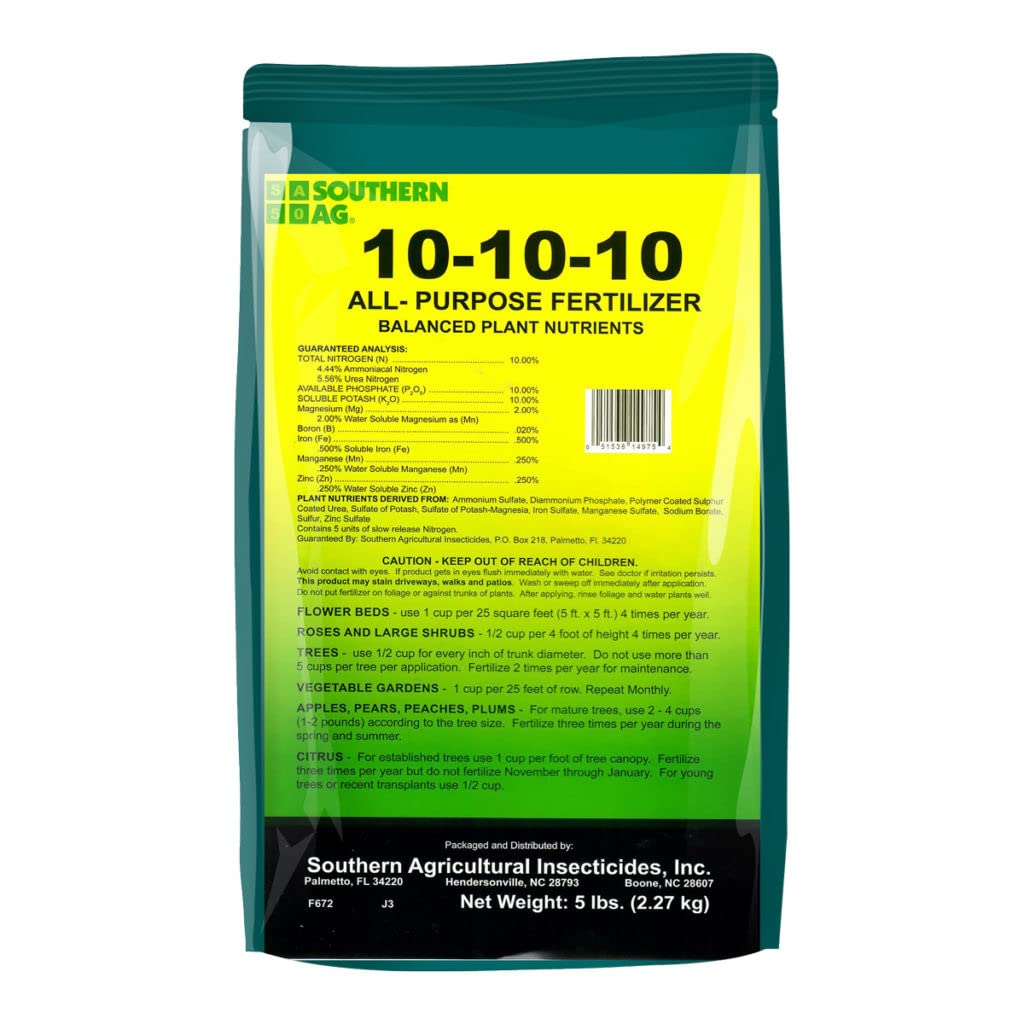
| Item Form | Granules |
|---|---|
| Specific Uses For Product | Citrus and Fruit Trees, Flowerbeds, Roses, and Large Shrubs, Vegetable Gardens |
| Application Method | Broadcast evenly over area and water in. |
| Mixing Ratio | 10:10:10 |
This 5 lb bag of Southern Ag 10-10-10 granular fertilizer is a straightforward, balanced all-purpose feed for vegetable beds, fruit trees, roses, and shrubs. You spread the granules uniformly over soil or beds and water them in; directions and recommended cup measurements are printed for common uses so dosing is easy. The formula supplies equal parts nitrogen, phosphorus, and potassium plus trace minerals like magnesium, iron, manganese, zinc, and boron, which supports steady vegetative growth and overall plant health. For asparagus specifically it can be used as a periodic maintenance feed during the growing season to support fern growth and energy storage in crowns. The product is simple to store and apply, and the small bag size is convenient for trialing on a single bed or patch. Limitations are that it is a general blend rather than a tailored asparagus formula, so heavy feeders or soils needing specific nutrient correction may require additional amendments, and granular broadcast feedings require careful placement to avoid contact with foliage or runoff risks described on the label.
Best for: Gardeners on a budget who want a simple, balanced fertilizer to maintain small asparagus patches and other mixed beds without buying specialty formulas.
Less Ideal for: Growers managing large asparagus plantings, or who need a targeted high-potassium or soil-specific amendment, should choose a crop-specific or soil-test-driven fertilizer.
- Balanced 10-10-10 N-P-K supports general growth and root development.
- Includes micronutrients (iron, manganese, zinc, boron) for broader plant nutrition.
- Clear application instructions and coverage rates for common garden uses.
- Small 5 lb size is convenient for testing on a single asparagus bed or small garden.
- Not formulated specifically for asparagus so may lack the higher potassium or phosphorus some heavy beds benefit from.
- Granular broadcast application can stain hard surfaces and requires watering after application to activate nutrients.
Verdict: A low-cost, easy-to-use balanced granular fertilizer that is a practical maintenance feed for small asparagus beds and mixed gardens.
Scotts Evergreen, Flowering Tree & Shrub Continuous Release Plant Food

| Item Form | Powder |
|---|---|
| Application Method | Apply directly to soil |
| Coverage | Medium |
| Target Species | Evergreens, dogwoods, hydrangeas, magnolias, azaleas, camellias, rhododendrons |
This Scotts continuous-release plant food is designed for established magnolias, hydrangeas, azaleas and other acid-loving trees and shrubs. You apply the powder directly to the soil under the canopy, rake it into the top 1 to 3 inches, then water to start the slow-release feeding that lasts about two months. The formulation emphasizes steady nutrient availability to encourage vigorous root growth and lush foliage without the quick spikes that can stress woody shrubs. It is straightforward to use and sized for repeated applications through the growing season every two months. Limitations are that it is a general shrub formula rather than a magnolia-specific mix and coverage is described as medium, so larger trees will require multiple bags or repeated applications to treat the whole drip line. Also it is a granular/powder form so you must measure and distribute it evenly rather than using a liquid drench for quick correction of deficiencies.
Best for: Home gardeners on a budget who want a low-effort, periodic fertilizer to maintain established magnolia trees and similar acid-loving shrubs during the growing season.
Less Ideal for: People seeking a quick corrective treatment for nutrient deficiencies or a fertilizer tailored with a magnolia-specific N‑P‑K balance for intensive bloom or fruiting goals.
- Continuous-release formula feeds for up to two months reducing application frequency
- Formulated for acid-loving trees and shrubs common to magnolia care
- Easy application: apply from bag, rake into topsoil and water in
- Promotes root growth and fuller foliage suitable for woody ornamentals
- Coverage rated as medium so larger magnolias may need additional product to treat full canopy
Verdict: A simple, budget-friendly slow-release shrub fertilizer that keeps magnolias fed with minimal effort every two months.
Miracle-Gro Water Soluble All Purpose Plant Food, 12.5 lb

| Item Form | Powder |
|---|---|
| Specific Uses For Product | Plant Food |
| Coverage | general purpose, suitable for various plants |
| Mixing Ratio | 1 tablespoon per gallon of water |
Miracle‑Gro Water Soluble All Purpose is a powder fertilizer designed to dissolve in water and deliver fast nutrients to indoor and outdoor plants. Gardeners mix the recommended scoop with a watering can or use a compatible garden feeder to apply directly to the soil around roots; the product gives routine feedings every 7 to 14 days outdoors or every 2 weeks for houseplants. Notable features include an NPK of 24‑8‑16 for strong vegetative growth, a quoted coverage of about 5,000 sq ft from a 12.5 lb container, and an included scoop with separate measuring ends for indoor and outdoor rates. In practice this means quick uptake for leafy growth and an easy, repeatable dosing routine for reliability across container and in‑ground Clusia specimens. Limitations are that it is a general‑purpose formula rather than a Clusia‑specific mix and frequent applications are required during the growing season, so you will need to follow the label closely to avoid overfeeding.
Best for: Buyers who want a dependable, easy‑to‑measure fertilizer to keep Clusia healthy with consistent, repeatable feedings and straightforward application routines.
Less Ideal for: Growers seeking a slow‑release or custom‑formulated Clusia fertilizer or those who prefer lower‑frequency, hands‑off feeding strategies.
- Fast‑acting water‑soluble formula for near‑instant nutrient availability
- Simple mixing ratios and included scoop make dosing consistent
- Large 12.5 lb container covers a lot of garden area for routine feedings
- Suitable for both container and in‑ground use so it works with potted Clusia and landscape plantings
- General all‑purpose NPK may not match specialized nutrient needs of Clusia at every growth stage
- Requires regular applications during the season rather than a slow‑release schedule
Verdict: A reliable, easy‑to‑mix water‑soluble fertilizer that delivers fast, consistent feedings for Clusia in both pots and landscape settings.
Miracle-Gro Water Soluble All Purpose Plant Food, 1.5 lb

| Item Form | Powder |
|---|---|
| Application Method | Watering Can |
| Target Species | For all flowers, vegetables, trees, shrubs and houseplants |
| Mixing Ratio | 24-8-16 |
Miracle-Gro Water Soluble All Purpose Plant Food is a powdered, water-soluble fertilizer formulated to deliver fast nutrition to a broad mix of plants. You mix the powder into a watering can or a garden feeder and apply every 1 to 2 weeks depending on whether plants are indoors or out. The 24-8-16 NPK ratio supplies a strong nitrogen boost for leafy growth along with phosphorus and potassium to support flowering and fruit set. For pepper growers this means it can help produce vigorous plants and encourage fruit development when used at the recommended strengths. Notable features include clear mixing guidance for both indoor and outdoor use and compatibility with container and in-ground plantings. Practical benefits are quick uptake by roots and flexible application options. Important limitations are the high nitrogen proportion, which can favor foliage over fruit if overused, and the need to follow dilution instructions to avoid nutrient burn. This product is best used as a regular boost within a balanced feeding plan rather than the only fertility source for long-term soil health.
Best for: Home gardeners looking for an affordable, easy-to-use boost to support vigorous pepper plant growth and quick results in both containers and garden beds.
Less Ideal for: Growers who want a low-nitrogen or slow-release fertility plan for long-term soil building should consider specialized or organic alternatives.
- Water-soluble powder that feeds plants quickly through the roots
- Clear mixing instructions for indoor and outdoor applications
- Broadly labeled for use on flowers, vegetables, trees, shrubs and houseplants
- Feeds approximately 600 sq. ft. from the 1.5 lb container
- High nitrogen ratio may encourage foliage more than fruit if used too frequently
Verdict: A budget-friendly, fast-acting soluble fertilizer that gives bell pepper plants a regular nitrogen-rich boost to promote vigorous growth and quicker results.
Choosing the Right Fertilizer for Ficus Hedge: Key Factors to Consider
Nutrient Ratio and Formulation
The macronutrient ratio of nitrogen, phosphorus, and potassium determines how a fert will influence leaf growth, root development, and overall stress tolerance. Ficus hedges often need higher nitrogen during the active growing season to maintain a dense, green screen, but too much nitrogen can encourage weak, leggy growth or increase pruning needs.
Check labels for the N-P-K ratio and also look at whether nitrogen is provided as nitrate, ammonium, or urea because each form releases and moves differently in the soil. Balanced formulations that include modest phosphorus and potassium with added micronutrients usually support steady, healthy foliage without creating long-term nutrient imbalances.
Release Type: Quick-Release Vs Controlled-Release
Quick-release fertilizers give an immediate boost and are useful for correcting visible deficiency symptoms, but they require more frequent applications and carry a higher risk of foliar burn or salt buildup if overapplied. Controlled-release or slow-release granules supply nutrients over weeks to months, lowering application frequency and reducing flushy, uneven growth that can ruin hedge shape.
For long stretches between feedings or for low-maintenance landscapes, controlled-release options are often preferable. For rapid recovery from deficiency or after heavy pruning, a short-term quick-release follow-up can be effective when used carefully.
Application Method and Timing
How you apply fertilizer affects efficacy and convenience. Granular spread-and-work products are simple for long runs of hedge and can be combined with a drop spreader. Water-soluble formulations are excellent for targeted feeding or for use with irrigation but require mixing and more frequent applications. Foliar feeds deliver micronutrients fast but are supplemental and can stress leaves if applied in hot sun.
Timing matters too. Apply during active growth in spring and early summer for most ficus hedges, and avoid heavy feeding in peak heat or right before cold snaps. Follow label guidance on intervals and rates to prevent nutrient burn or excessive succulent growth.
Salt Index and Plant Safety
Some fertilizers have a higher salt index, which can dehydrate roots and cause leaf tip burn when overapplied or used in poor-draining soils. Ficus species can be sensitive to salt build-up over time, so low to moderate salt formulations are safer for established hedges and for use in containers.
If your soil is already high in salts or if you irrigate with water that has elevated mineral content, choose products with lower salt potential and plan periodic soil leaching with deep irrigation to prevent accumulation.
Micronutrients and Soil Health
Beyond the primary macronutrients, micronutrients such as iron, manganese, magnesium, and zinc influence leaf color and long-term vigor. Ficus frequently shows iron or manganese deficiency as leaf yellowing while veins remain darker. A fertilizer that includes or is compatible with micronutrient supplements can prevent or correct subtle nutrient disorders.
Consider soil pH and existing soil test results because micronutrient availability depends heavily on pH. If you do not have a soil test, choose a balanced product and monitor leaf appearance over the season.
Compatibility With Irrigation and Soil Type
Hedge rooting depth and soil structure influence how fertilizer moves through the root zone. In sandy soils, nutrients leach faster and require more frequent, smaller applications or controlled-release products. Clay soils hold nutrients longer but may suffer salt concentration without adequate drainage.
Also check that the fertilizer is compatible with your irrigation system if you plan to inject soluble feeds into drip lines. Physical compatibility and clear mixing instructions protect both equipment and plant health.
Feeding Schedule for Different Hedge Ages
Young hedges and newly planted cuttings need gentler, more frequent feeding to support root establishment without forcing excessive leafy growth. Use a lower-rate, balanced formula every 4 to 6 weeks during the first growing season, focusing on steady root development.
Established hedges benefit from a seasonal rhythm: a stronger feeding in early spring to fuel new shoots, a midseason maintenance feed for leaf color and density, and a lighter application late summer or early fall only if growth will not interfere with seasonal hardening.
- Newly planted: low-rate, more frequent applications.
- Established: controlled-release or two seasonal feeds.
- Avoid heavy late-season nitrogen in cooler climates.
Applying Granular Fertilizers to a Linear Hedge
For long, narrow hedges, spreading granules evenly along the base and lightly working them into the topsoil ensures even nutrient availability. Use a calibrated spreader or measure by hand to keep application uniform and avoid concentrated spots that can burn roots.
After spreading, water thoroughly to move nutrients into the root zone. On slopes or raised beds, avoid overapplying near the top edge to prevent runoff and ensure the root zone receives the benefit.
- Use a drop spreader for long runs for consistent distribution.
- Water in well after application to activate granules.
- Measure by length of hedge and follow label rate for linear application.
When to Use Foliar Feeding
Foliar sprays are a fast way to correct micronutrient deficiencies or when quick color improvement is desired. Apply in the cooler part of the day to avoid leaf burn and only as a supplement to root feeding, since foliar uptake cannot replace full-root-zone nutrition.
Limit foliar feeding to short correction cycles and follow label dilution rates. Repeated foliar applications cannot sustainably replace soil-applied macronutrients for heavy feeders such as dense hedges.
- Best for quick micronutrient correction.
- Apply during cool morning or late afternoon.
- Not a substitute for regular root-zone fertilization.
Soil Testing and pH Management
A soil test guides fertilizer choice and prevents guesswork. Tests reveal available nutrients and pH, which influences micronutrient availability. Adjustments to pH are slow but necessary when persistent deficiencies reappear despite feeding.
If pH amendments are needed, plan them with seasonal timing in mind so that changes do not interfere with active growth periods. Use soil test results to choose formulations that supply lacking elements rather than blanket feeding.
- Test every 2 to 3 years for established hedges.
- Address pH issues before adding micronutrient supplements.
- Follow test recommendations for long-term corrections.
Safety and Environmental Considerations
Avoid overapplication and runoff near water features or into storm drains. Use products with lower salt potential when hedges sit near paved areas or in containers where leaching is limited. Keep children and pets away from recently applied fertilizers until watered in.
Consider slow-release formulations to reduce the risk of nutrient runoff and to lower the number of applications required. Proper storage in a dry, cool place prevents caking and preserves product efficacy.
- Prevent runoff with careful application and irrigation.
- Choose controlled-release to reduce environmental impact.
- Store products sealed and dry to maintain shelf life.
How We Chose the Best Fertilizer for Ficus Hedge
We selected products that suit established outdoor ficus hedges and young hedge starts in garden beds or planters. Primary evaluation criteria included nutrient formula accuracy and balance, application method and frequency, release type (quick-release versus controlled-release), and how the product performs in common landscape soils. We also considered formulation safety for hedged plantings, including salt index and risk of foliar burn when used on leaves during warm weather. Practical handling factors such as ease of measuring, spreader compatibility, and compatibility with irrigation or foliar feeding were included. Products were excluded if their labels did not provide clear nutrient analysis, if they were solely intended for houseplants rather than outdoor hedges, or if they required specialist equipment not typical for home gardeners. Our choices favor fertilizers that give predictable, steady results for density, color, and seasonal growth control in ficus hedges.
FAQ
How much fertilizer does a ficus hedge need per linear foot?
Recommended rates depend on product concentration and type. Often gardeners measure by label rate per 100 square feet or per plant. For linear hedges, calculate area covered by the root zone, then follow the product's linear application guidance or convert the recommended area rate to your hedge length to avoid overapplication.
Can I use houseplant fertilizer on an outdoor ficus hedge?
Houseplant fertilizers may be formulated for lower light and smaller containers and can lack the controlled-release profile needed for outdoor hedges. They can be used in a pinch, but choose a product labeled for landscape or shrub use for consistent results and safer long-term feeding.
When will I see results after fertilizing a ficus hedge?
Quick-release feeds can show visible leaf color and shoot growth within one to three weeks under favorable conditions. Controlled-release products act more slowly, delivering steady improvement over several weeks to months. Soil condition and weather strongly influence how fast plants respond.
Is foliar feeding safe during hot weather?
Foliar applications during the hottest part of the day increase the risk of leaf burn. Apply foliar sprays in the cool morning or late afternoon and avoid spraying when temperatures are extreme. Use recommended dilutions and do not rely on foliar feeding as the sole nutrition source.
How do I prevent fertilizer burn on a ficus hedge?
Prevent burn by following label rates, avoiding concentrated placement at the base of stems, and watering in after application. Choose lower-salt or controlled-release formulas for sensitive situations and do not apply before prolonged hot, dry spells.
Should I adjust feeding if my hedge is in a container or raised bed?
Yes. Containers and raised beds have smaller soil volumes and faster nutrient depletion. Use lower, more frequent doses or switch to a controlled-release product formulated for containers to maintain steady fertility without risking salt buildup.
Final Verdict
Choosing the right fertilizer for a ficus hedge is about matching nutrient form, release characteristics, and application method to your hedge age and site conditions. Prioritize a balanced formula with appropriate nitrogen during active growth, include micronutrients if soil tests indicate deficiencies, and pick a release type that fits your maintenance rhythm. Watch for salt buildup and adjust timing to avoid late-season soft growth. With the right approach you can keep a ficus hedge dense, healthy, and easy to maintain.
