

Note: This article contains affiliate links. If you click on these links and make a purchase, I may earn a small commission at no extra cost to you. This helps support my research and content. Read my full affiliate disclosure here.
Centipede grass has a low nutrient appetite and responds best to mild, steady feeding rather than heavy fertilizer applications. Choosing the right organic fertilizer for centipede grass matters because overly rich or fast-release products can burn thin turf, while weak formulations leave lawns pale and sparse. In this guide we shortlisted six top organic fertilizer options suited for centipede lawns across home lawns, small properties, and coastal soils. We evaluated products for nutrient balance, release profile, turf safety, and soil-building benefits so you can pick an option that fits your mowing, irrigation, and soil conditions. Below are practical notes to help you match a fertilizer to your centipede grass situation before the product breakdowns.
Top Picks at a Glance
| Best Overall The best all-around choice for most situations | Lawnbox Grass Genie 10-0-6 Organic Spring Lawn Fertilizer, 16 lb |  |
| Best Value The sweet spot between price and what you get | Purely Organic Products Lawn Food 10-0-2, 15 lb |  |
| Best Budget The cheapest option that still gets the job done reliably | O.M. Scott & Sons Natural Grass Food, 12.72 lb |  |
| Highest Rated A top-rated pick with lots of positive feedback | CountryMax Organic Lawn Fertilizer 36 lb (10-6-4) Slow-Release |  |
| Most Popular A crowd favorite that many people choose with confidence | GS Plant Foods Liquid Fish & Kelp Fertilizer (1 Gallon) |  |
| Best Seller A high-volume bestseller chosen again and again | Milorganite 6-4-0 Slow-Release Fertilizer, 32 lb (with Feeding Tips Brochure) |  |
Lawnbox Grass Genie 10-0-6 Organic Spring Lawn Fertilizer, 16 lb

| Item Form | Granules |
|---|---|
| Specific Uses For Product | Lawn,Lawns,Organic |
| Target Species | lawn grasses |
| Mixing Ratio | 10:0:6 |
Lawnbox Grass Genie is a granular, 100% organic spring fertilizer designed to deliver an immediate green-up and slow-release nutrition for up to six weeks. It is typically broadcast across the lawn in spring to help turf recover from winter dormancy and support early season growth. The 10-0-6 mixing ratio supplies available nitrogen for quick color improvement plus additional nutrients for steady feeding, and the formula includes humic acid to improve soil health. Being free of animal byproducts and biosolids makes it family friendly and safe to use with minimal waiting time after application. Practical benefits include suitability for all turf types and coverage geared toward full-lawn applications, so it works well on centipede grass when applied at recommended rates. Limitations are that it is a spring-specific formulation and not balanced for phosphorus needs, and it is not sold for use in some states which restrict certain organic mixes.
Best for: Homeowners seeking an organic, family-friendly spring fertilizer that delivers quick greening and ongoing feeding for established centipede grass and other warm-season lawns.
Less Ideal for: Gardeners who need a balanced N-P-K product that supplies phosphorus or who want a multi-season all-purpose fertilizer should consider other formulations.
- 100% organic granular formula suitable for family and pet-safe yards
- Provides both quick-release and slow-release nitrogen for immediate green-up plus extended feeding up to six weeks
- Includes humic acid to support soil health and nutrient uptake
- Formulated for full-lawn coverage and safe on all turf types
- No phosphorus content in the listed mixing ratio, so it will not address phosphorus deficiencies
- Not intended as a year-round fertilizer since it is marketed for spring use
- Restricted sale in certain states which limits availability in those regions
Verdict: Choose this if you want a 100% organic spring fertilizer that safely greens and feeds centipede grass with both quick and extended-release nitrogen.
Purely Organic Products Lawn Food 10-0-2, 15 lb
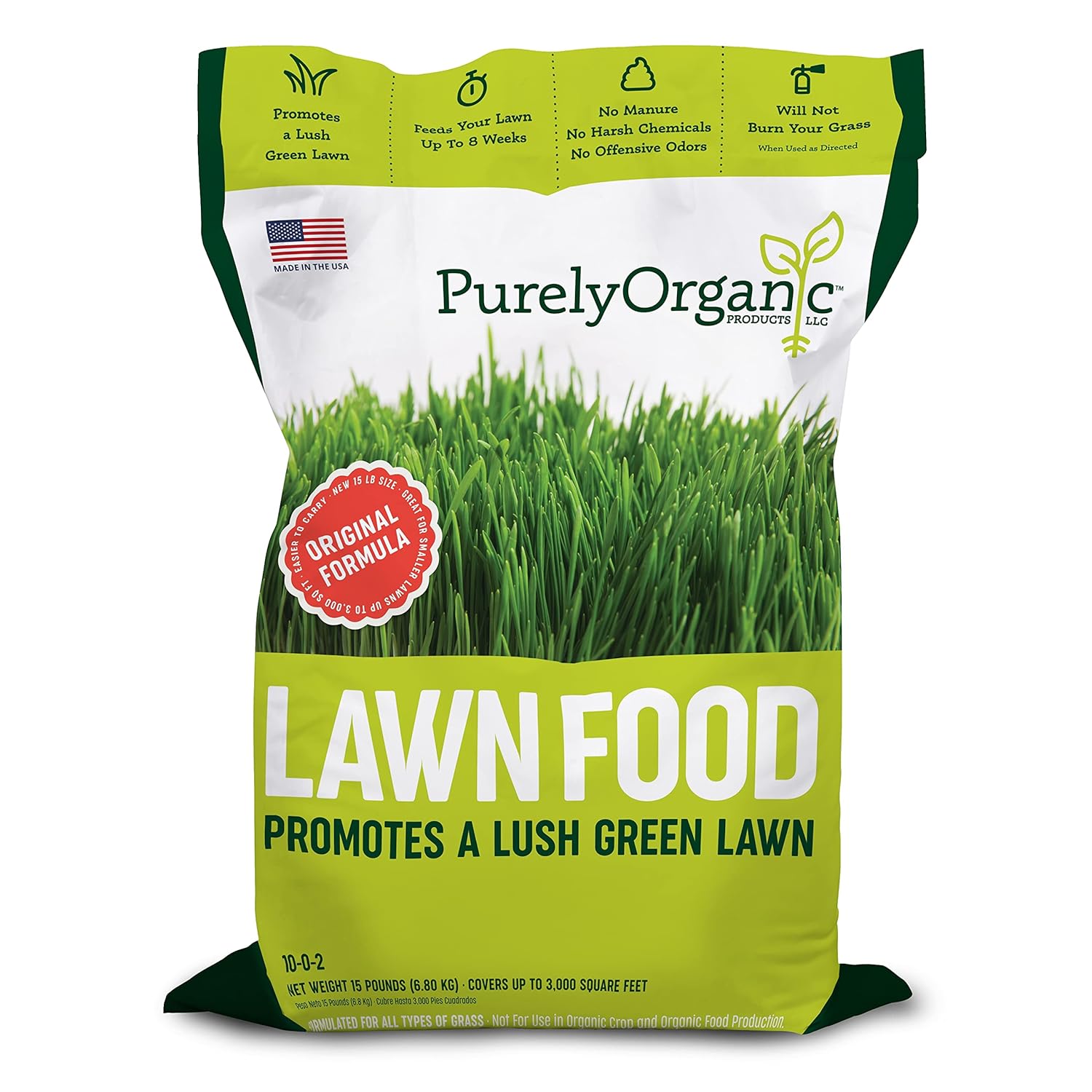
| Item Form | Granules |
|---|---|
| Application Method | Drop or rotary spreader |
| Coverage | 3,000 Square Feet |
| Specific Uses For Product | Plant Growth, Root Development, Soil Conditioning |
| Mixing Ratio | 10:0:2 |
This Purely Organic Lawn Food is a granular, plant-based fertilizer designed for routine lawn feeding on cool- and warm-season grasses. It spreads with a drop or rotary spreader at the recommended 4–8 lbs per 1,000 sq ft and supplies nitrogen-heavy nutrition (10-0-2) for greener leaf growth while also contributing to root development and soil conditioning. The blend uses soybean meal and distillers dried grains instead of synthetic chemicals, which reduces odor and eliminates phosphorus to comply with phosphate-restriction rules in some towns. It is family and pet friendly with no re-entry restrictions noted, making it practical for yards with animals. Expect slower, steady green-up compared with quick-release synthetic fertilizers, so results are gradual rather than instant. Also, coverage is calibrated to the 15 lb bag for roughly 3,000 sq ft, so larger lawns will need multiple bags and more storage space.
Best for: Buyers who want a pet- and family-friendly, plant-based lawn fertilizer that supports steady, natural green-up and prefers practical, regulation-compliant choices over fast-acting chemical feeds.
Less Ideal for: Homeowners who need rapid, dramatic color change or who manage very large lawns and expect each application to cover extensive acreage.
- Plant-based formula using soybean meal and distillers grains instead of synthetic chemicals
- No phosphorus in the 10-0-2 formula to meet phosphate-restriction rules
- Can be applied with common drop or rotary spreaders and covers about 3,000 sq ft per bag
- Family and pet friendly with no re-entry time required
- Slow-release effect means slower visible results compared with synthetic quick-release fertilizers
- 15 lb bag may be insufficient for larger lawns requiring multiple applications or bags
Verdict: Choose this product if you want a practical, pet-safe, plant-based fertilizer that steadily builds greener turf while avoiding phosphorus.
O.M. Scott & Sons Natural Grass Food, 12.72 lb

| Feeds up to | 10 weeks |
|---|---|
| Coverage | Up to 2,000 sq. ft. |
| Usage | Outdoor |
| Unit count | 203.52 Ounce |
O.M. Scott & Sons Natural Grass Food is a straightforward, natural lawn fertilizer meant for routine spring and seasonal feedings. You use it by filling a spreader, setting the dial per the bag directions, walking the lawn to apply, then lightly watering so the nutrients start working right away. The formula contains no added artificial ingredients or pesticides and is marketed as safe for people and pets when directions are followed. A single 12.72 lb. bag covers about 2,000 square feet and is formulated to feed for up to 10 weeks, so one bag can support a small-to-medium yard through the main growing season. The recyclable paper bag is a small eco-friendly plus. Limitations are its coverage and frequency: homeowners with larger lawns will need multiple bags and repeat applications every 8 to 10 weeks, and the product is not presented as a targeted solution for specific problems like weed control or soil pH correction. Still, for routine spring feeding on common grass types it delivers predictable, easy-to-follow results.
Best for: Homeowners who want a simple, natural spring feed for a small to medium lawn and prioritize easy application and pet-safe ingredients.
Less Ideal for: Those with large lawns, persistent weed issues, or who need specialty fertilizers for nutrient-deficient or pH-imbalanced soils should consider more targeted products.
- Natural formula without added artificial ingredients or pesticides
- Feeds immediately after watering and continues feeding up to 10 weeks
- Easy to apply with a standard spreader using bag dial settings
- Covers up to 2,000 sq ft per 12.72 lb. bag suitable for small to medium yards
- Recyclable paper packaging
- Limited coverage per bag so larger lawns require multiple purchases
- Not formulated to handle weeds or specific soil deficiencies
Verdict: A simple, pet-safe natural lawn food that makes spring feeding easy for small to medium yards.
CountryMax Organic Lawn Fertilizer 36 lb (10-6-4) Slow-Release

| NPK | 10-6-4 |
|---|---|
| Net weight | 36 lb |
CountryMax Organic 10-6-4 is a slow-release, high-organic lawn fertilizer intended to feed grass gradually while supporting root development and overall turf strength. In practice you spread it across new or established lawns to encourage denser turf and improved color without the spike-and-burn risk of fast-release synthetic products. The formula emphasizes organic sources and time-release nitrogen, so feeding is steady and helps plants tolerate drought and common stresses better. For centipede grass this means gentler nutrition that reduces the chance of lush, disease-prone growth while promoting deeper roots. The bag size suits a medium to large lawn and will require a broadcast spreader for even application. Limitations are that results take longer to appear than quick-release fertilizers and you should follow centipede-specific fertility guidelines to avoid overfeeding phosphorus and potassium. It is a practical choice if you prioritize steady, reliable feeding and root support over immediate greening.
Best for: Buyers who want dependable, steady nutrient delivery and root-strengthening nutrition for centipede lawns and who prefer organic-based products over fast-acting synthetics.
Less Ideal for: Gardeners seeking immediate, dramatic greening or quick turf thickening after a single application should consider faster-release products instead.
- Slow-release organic formula provides steady feeding with lower burn risk
- Promotes stronger root development and improved turf density
- Formulation includes stress support for drought and insect recovery
- Slower to produce visible greening compared with quick-release fertilizers
- Large 36 lb bag may be bulky to handle and apply without a spreader
Verdict: Choose this slow-release organic 10-6-4 fertilizer when you want reliable, steady feeding that builds root strength and sustained health in centipede grass.
GS Plant Foods Liquid Fish & Kelp Fertilizer (1 Gallon)

| Item Form | Liquid |
|---|---|
| Application Method | foliar spray or soil drench |
| Liquid Volume | 128 fluid ounces |
| Mixing Ratio | 1:128 (Indoor), 1:64 (Outdoor) |
GS Plant Foods Liquid Fish & Kelp is an organic, cold-processed concentrate intended to feed garden plants via soil drenches or foliar sprays. It mixes at recommended rates (about 2 fl oz per gallon for outdoor use) and supplies natural compounds from fresh fish hydrolysate and Ascophyllum nodosum kelp that support root strength, microbial activity, and nutrient uptake. Typical use is every 2–4 weeks on vegetables, flowers, shrubs, lawns, and even houseplants at a weaker indoor dilution. Notable features are its OMRI listing for organic growing, dual application method (foliar or drench), and a large 1 gallon volume that covers multiple feedings. Because it is a biological product, results accumulate over weeks as soil life and plant physiology respond rather than giving an immediate synthetic nutrient spike. Some gardeners may notice an initial odor and will need to follow mixing and application rates carefully to avoid overapplication. The product is straightforward to handle and pairs well with a regular feeding schedule for growers focused on improving soil biology and long-term plant performance.
Best for: Gardeners who prioritize plant performance through soil biology and want an organic, repeatable feeding program for vegetables, ornamentals, and turf.
Less Ideal for: People seeking rapid, high-analysis synthetic nutrient boosts or immediate visible change after a single application should consider a different product.
- OMRI-listed organic formula suitable for certified organic gardens
- Dual application as foliar spray or soil drench for flexible use
- Made from fish hydrolysate and North Atlantic kelp to support soil biology and root development
- Large 1 gallon concentrate provides many feedings for home gardens and hobby farms
- Biological, slow-acting nutrition that does not provide immediate synthetic nutrient spikes
- May have a noticeable fishy odor on mixing
Verdict: Buy this if you want an OMRI-listed, kelp-and-fish concentrate that builds soil biology and long-term plant performance rather than quick synthetic results.
Milorganite 6-4-0 Slow-Release Fertilizer, 32 lb (with Feeding Tips Brochure)

| Item Form | Pelletized |
|---|---|
| Application Method | Broadcast, Rotary or Manual |
| Coverage | 2,500 Square Feet |
| Specific Uses For Product | Lawns, Flowers and Gardens, Education |
Milorganite 6-4-0 is an organic, pelletized slow-release fertilizer intended for routine lawn and garden feeding. It is typically broadcast with a rotary or manual spreader and provides nitrogen slowly over 8 to 10 weeks, which reduces the need for frequent applications and lowers burn risk. The product contains organically complex iron for greening without the strong staining associated with iron salts and is low in soluble salts, so it performs well in warm or drier conditions. The 32 lb bag covers roughly 2,500 square feet and comes with a printed feeding and spreader tips brochure to simplify seasonal timing and application rates. Because it is made from heat-dried microbes, it also adds organic matter to improve soil structure in heavy clay or sandy soils. Limitations are that nutrient release is gradual so it is not suited to quick color fixes or rapid turf recovery, and users seeking tightly controlled N-P-K ratios or fast-acting synthetic performance may prefer a different product.
Best for: Buyers who want a low-maintenance, environmentally minded fertilizer that steadily feeds established lawns and mixed garden beds with minimal risk of burn and fewer repeat applications.
Less Ideal for: If you need rapid turf recovery, immediate color correction, or precise synthetic nutrient control for athletic fields or newly sodded lawns, choose a fast-release or specialty fertilizer instead.
- Slow-release nitrogen feeds lawns and plants for 8–10 weeks, reducing application frequency
- Low-salt formulation minimizes fertilizer burn and streaking in hot or dry conditions
- Organically complex iron promotes deep greening without heavy staining of concrete
- Pelletized form works with broadcast, rotary, or manual spreaders for easy application
- Adds organic matter that can improve drainage and soil structure in clay or sandy soils
- Not fast-acting, so it will not deliver an immediate green-up after application
- Contains biosolids which some buyers may prefer to avoid for personal or local reasons
Verdict: Pick this if you want a reliable, low-salt slow-release fertilizer that feeds lawns and gardens for weeks with minimal maintenance.
Choosing the Right Organic Fertilizer for Centipede Grass: Key Factors to Consider
Nutrient Ratio and Low Nitrogen Needs
Centipede grass thrives with low nitrogen inputs and a balanced nutrient profile. High nitrogen can cause excessive top growth, increase disease susceptibility, and stress the shallow root system. Choose fertilizers with modest nitrogen levels and adequate amounts of phosphorus and potassium when soil tests indicate a need.
Matching the fertilizer N-P-K to your soil test results reduces the chance of overfeeding. If you lack a recent soil test, err toward lower nitrogen and products labeled for low-maintenance or southern grasses because they are formulated to avoid the vigorous, often unhealthy growth seen with standard turf fertilizers.
Release Rate and Feeding Frequency
Organic fertilizers often release nutrients slowly as soil microbes break down the organic matter. Slow release is beneficial for centipede grass because it provides steady nutrition without pushing rapid top growth. Understand whether a product provides immediate soluble nitrogen for a quick green-up or relies mostly on microbial mineralization for gradual feeding.
Feeding frequency matters: a true slow-release organic can be applied fewer times per season, while products with a mix of soluble and slow-release fractions may need more frequent, lighter applications. Consider your ability to apply on schedule and the local climate, since temperature influences microbial activity and nutrient release.
Turf Safety and Salt Index
Salt concentration in a fertilizer influences burn risk, especially on fine-textured, shallow-rooted centipede grass. Organic amendments typically have lower soluble salt levels than synthetic options, but concentrations vary. Look for products that state low burn potential or provide guidance for safe application rates.
Even with organic fertilizers, proper watering after application and following recommended rates matter to prevent localized stress. Avoid applying when the turf is drought stressed or during intense heat, as even mild fertilizers can aggravate stressed grass.
Soil Health and Organic Matter Contribution
One of the main advantages of organic fertilizers is their contribution to soil structure and microbial life. Materials that add organic carbon, humates, or microbial stimulants help build a healthier root zone and improve water retention over time. For centipede grass, which prefers slightly acidic, well-drained soils, building organic matter can aid nutrient availability and drought resilience.
Consider products that list composted materials, kelp, humic substances, or microbial inoculants. These ingredients support slow nutrient release and create a more resilient lawn ecosystem, reducing the need for frequent feeding.
Application Method and Lawn Size
Fertilizer formats-granular, powdered, or liquid-affect accuracy, labor, and coverage. Granular products are convenient for medium to large yards and for using broadcast spreaders. Liquid or water-soluble organics suit small patches, spot treatments, or gardeners who prefer hose-end application. Some organics require calibration for even spread to avoid streaking or overapplication.
Match the format to your lawn size and equipment. If you have only a small yard, a liquid concentrate or small-bag granular product may be easiest. For larger areas, check compatibility with standard spreaders and look for guidance on spreader settings to simplify even application.
Seasonal Timing and Local Climate
Centipede grass follows a warm-season growth pattern, so timing fertilizer to match active growth ensures efficient nutrient use. Overapplication in the wrong season leads to wasted nutrients and higher disease risk. In warm climates, feed in late spring after soil warms and again in early summer if needed, but avoid heavy fall nitrogen that can delay dormancy.
Consider local rainfall and irrigation patterns. In regions with heavy summer rain, a slower-release organic keeps nutrients available longer. In drier areas, choose products that improve moisture retention or plan to irrigate lightly after application to help nutrients move into the root zone.
When to Feed Centipede Grass
Feed centipede grass when soil temperatures consistently reach the active growth range in spring and avoid late-season nitrogen that can interfere with dormancy. A modest application in late spring usually provides needed nutrients without pushing excessive growth.
Monitor turf color and density rather than following a strict calendar. If the lawn stays pale despite proper mowing and irrigation, a light follow-up application during the early summer growth window can help.
- Ideal timing: late spring when soil warms
- Avoid heavy fall nitrogen
- Adjust frequency based on color and vigor
How to Apply Organic Fertilizer Safely
Follow label rates carefully and calibrate your spreader or measuring tools before applying. Uneven application leads to patches of over- or under-fed turf. For granular products, use recommended spreader settings and overlap passes slightly to maintain uniformity.
Water lightly after application if the label suggests it to move soluble components into the root zone. Do not apply during drought stress or before extreme heat events, and store unused fertilizer in a dry place to prevent caking.
- Calibrate equipment for even coverage
- Light irrigation may help incorporation
- Avoid application during drought or heat
Interpreting Soil Tests for Targeted Feeding
A soil test is the best way to decide what nutrients your centipede lawn actually needs. Organic fertilizers can supply broad benefits, but if your soil is deficient in phosphorus or potassium, choose a formula that addresses that specific need rather than adding unnecessary nitrogen.
Local extension services often provide region-specific recommendations for centipede grass. Use test results to adjust application rate and timing to minimize waste and improve long-term lawn health.
- Base fertilizer choice on soil test ppm and pH
- Adjust N-P-K to correct identified deficiencies
- Consider micro-nutrient needs if tests show imbalances
Combining Organic Amendments with Cultural Practices
Fertilizer works best alongside good cultural practices. Proper mowing height, consistent irrigation, and managing thatch and compaction all influence how well centipede grass takes up nutrients. Raise mowing height slightly to encourage deeper rooting and reduce stress.
Aerate compacted areas and apply topdressing with a thin layer of compost when appropriate to improve soil structure. These practices amplify the benefits of organic feeding by improving root access to nutrients and water.
- Mow at recommended height for centipede grass
- Aerate compacted spots to improve root growth
- Topdress with compost to boost soil organic matter
Environmental and Neighborhood Considerations
Avoid applying fertilizers before heavy rains that can wash nutrients into storm drains. Organic materials reduce soluble nutrient runoff but do not eliminate it. Be mindful of local regulations around fertilizer use, buffer zones near waterways, and community lawn care rules.
If pets or children frequent the lawn, choose low-odor, low-staining products and follow re-entry guidance on labels. Organic options often have milder odors than synthetic fertilizers and can reduce short-term exposure risk.
- Do not apply before heavy rain
- Follow local fertilizer ordinances and buffer rules
- Check label re-entry times for family and pets
How We Chose the Best Organic Fertilizer for Centipede Grass
We focused on formulations and performance traits that matter specifically for centipede grass, then filtered out products that did not meet mild nutrient or turf-safety standards. Key evaluation criteria included nutrient ratio and release rate to ensure gentle, sustained feeding appropriate for a low-nitrogen turf; turf safety and burn risk based on concentration and salt index; soil-building benefit looking at organic matter, microbial stimulants, and slow carbon sources; application flexibility for spreader, granular, or liquid use on small lawns; and ease of use including odor, clumping, and storage stability. We excluded aggressive, high-nitrogen or quick-release fertilizers and blends designed for high-maintenance turf. Products were also screened out if they relied solely on soluble synthetic nutrients rather than organic or naturally derived sources. The final shortlist emphasizes predictable, slow-release nutrient delivery and measurable soil improvement because these dimensions most directly affect centipede grass health and long-term lawn resilience.
FAQ
How often should I apply organic fertilizer to centipede grass?
Often one light application in late spring is sufficient for many centipede lawns. Depending on the product release rate and soil results, a second light application in early summer may help, but frequent feedings are usually unnecessary.
Can I use a regular lawn fertilizer on centipede grass?
Regular high-nitrogen lawn fertilizers can overstimulate centipede grass and increase disease risk. It usually depends on the formulation, but choose low-nitrogen or specifically labeled southern grass formulas when possible.
Will organic fertilizer change my soil pH?
Some organic materials can slowly influence soil pH over time, but most provide small changes compared with lime or sulfur applications. Use a soil test to determine pH and apply pH-specific amendments separately if needed.
Is it safe to apply organic fertilizer before heavy rain?
It is not recommended to apply any fertilizer immediately before heavy rain because runoff can occur. Organic fertilizers generally pose lower runoff risk than soluble synthetics, but timing applications to avoid storms is still best practice.
How do I know if my centipede grass is getting too much nitrogen?
Signs of excess nitrogen include rapid, dark green growth, increased mowing frequency, and higher disease incidence. If you see these signs, reduce future application rates and avoid late-season nitrogen.
Final Verdict
Choose organic fertilizers for centipede grass that deliver modest, slow-release nitrogen and contribute to soil health. Prioritize formulations with low burn risk, appropriate N-P-K for your soil test results, and ingredients that build organic matter. Balance feeding with good cultural practices like proper mowing, irrigation, and aeration to get the most consistent results. The right choice depends on your lawn size, soil condition, and how hands-on you want to be. Favor gentle, predictable products and timing that match centipede grass growth to keep turf healthy without overstimulating top growth.
