

Note: This article contains affiliate links. If you click on these links and make a purchase, I may earn a small commission at no extra cost to you. This helps support my research and content. Read my full affiliate disclosure here.
If your lawn feels hard underfoot, holds water, or struggles to green up, an aerator can make a visible difference. Choosing the right homeowner lawn aerator matters because tool type, tine or plug depth, and how you operate it determine how well air, water, and fertilizer reach grassroots. This guide covers seven shortlisted options suitable for typical yards and small properties, each evaluated for how it performs in everyday homeowner conditions. We look at soil penetration, ease of use, durability, and maintenance demands to help you pick an aerator that fits your lawn size and physical comfort. Read on for practical notes that explain the tradeoffs between manual, tow-behind, and powered styles.
Top Picks at a Glance
| Best Overall The best all-around choice for most situations | Landzie Rolling Manual Core Lawn Aerator |  |
| Best Quality Built to a higher standard if you want something more solid | Agri-Fab 48 in Tow-Behind Plug Aerator with 32 Galvanized Knives |  |
| Best Value The sweet spot between price and what you get | Xuperace Core Lawn Aerator with Hollow Alloy Tines |  |
| Best Budget The cheapest option that still gets the job done reliably | Qsxou Manual Lawn Aerator with 11 Steel Spikes and T-Handle |  |
| Highest Rated A top-rated pick with lots of positive feedback | LawnVigor Rolling Lawn Aerator with Hollow Tines |  |
| Most Popular A crowd favorite that many people choose with confidence | Yard Butler Manual Lawn Coring Aerator (Long-Handled, Powder-Coated Steel) |  |
| Best Seller A high-volume bestseller chosen again and again | Walensee 15-Spike Manual Lawn Aerator Tool |  |
Landzie Rolling Manual Core Lawn Aerator

| Manufacturer | Landzie |
|---|---|
| Item model number | L-AER-COR-2 |
| Tine material | Stainless steel |
| Item Weight | 50.8 pounds |
The Landzie Rolling Manual Core Lawn Aerator is a push-style roller that extracts soil cores as you walk, using seven hollow stainless steel tines to let air, water, and nutrients reach deep roots. It is typically used by homeowners to relieve compaction on established lawns before overseeding or applying topdressing. The powder-coated steel frame and chamfered tines are built for durability and resist clogging by ejecting plugs as the unit rolls, and the tines are replaceable when they wear. Assembly is straightforward and the rolling design makes it easier to use than stand-and-pull coring tools, so you can cover moderate areas with less effort. Important limitations are that it is a manual tool so it still requires physical pushing and works best on moist but not soggy soil, and it is sized for homeowner yards rather than commercial acreage. For someone wanting a dependable, low-maintenance coring aerator to use a few times a year, this model balances durability and ease of use effectively.
Best for: Homeowners who want a reliable, low-maintenance coring aerator for routine lawn care and prefer a manual tool that balances effectiveness with ease of use.
Less Ideal for: Large properties or professional landscapers who need faster coverage or a powered aerator for very compacted soil.
- Hollow stainless steel tines remove and eject cores to reduce clogging
- Powder-coated heavy-duty steel frame for rust resistance and durability
- Rolling design makes aeration less physically demanding than pull-type corers
- Replaceable tines extend service life and simplify maintenance
- Manual push operation still requires physical effort and is slower than powered aerators
Verdict: A durable, easy-to-use rolling core aerator that gives homeowners an effective, low-maintenance way to relieve compaction and improve lawn health.
Agri-Fab 48 in Tow-Behind Plug Aerator with 32 Galvanized Knives

| Knives | 32 galvanized self-sharpening |
|---|---|
| Plug depth | Up to 3 inches |
| Hitch | Universal hitch |
| Weight tray capacity | Holds up to 140 lbs |
| Tires | Flat-free transport tires |
The Agri-Fab 48 in Tow-Behind Plug Aerator is built for performance-minded homeowners who want deep, mechanical aeration without hiring a service. It mounts to a lawn tractor via a universal hitch and pulls 3-inch plugs with 32 galvanized, self-sharpening coring knives; a cantilever transport handle lets you raise and lower the drum from the tractor seat. The unit includes flat-free tires for low-maintenance towing and a weight tray to add ballast for better penetration. In practice this machine covers wide swaths quickly and produces consistent cores that improve air, water, and nutrient movement into compacted soils. Expect straightforward assembly and durable steel construction, but note it requires a tractor or tow vehicle to operate and is large to store. Also the aerator is primarily for turf that needs core aeration rather than lighter spike-style maintenance, so it may be overkill for very small yards.
Best for: Gardeners who prioritize effective, professional-level aeration on medium to large lawns and already own or plan to use a lawn tractor to tow the unit.
Less Ideal for: Urban gardeners with small yards, renters, or anyone without a tractor should consider smaller walk-behind or rental options instead.
- Pulls up to 3-inch plugs for deep core aeration across larger areas
- 32 galvanized self-sharpening knives for consistent penetration and reduced maintenance
- Universal hitch and tractor-seat transport handle for easy hookup and on-the-go control
- Flat-free tires reduce transport maintenance and roll smoothly over turf
- Weight tray allows added ballast for improved soil penetration
- Requires a lawn tractor or compatible tow vehicle to use
- Large footprint makes storage and maneuvering in tight spaces more difficult
Verdict: If you have a lawn tractor and want deep, consistent core aeration across medium to large lawns, this robust tow-behind aerator delivers professional-level results.
Xuperace Core Lawn Aerator with Hollow Alloy Tines
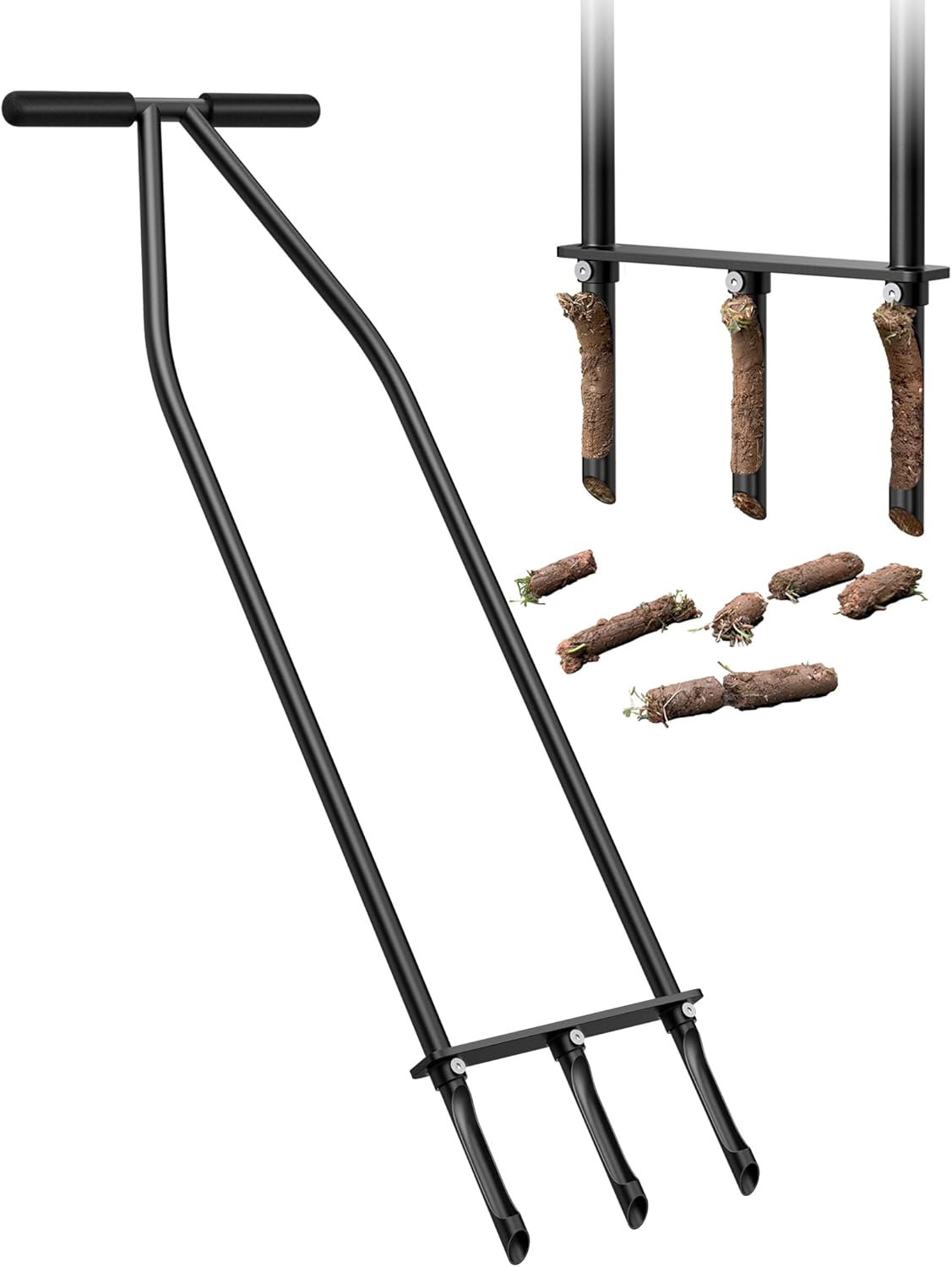
| Manufacturer | Xuperace |
|---|---|
| Item model number | GD0001-02 |
| Hollow tine length | 5.9 inch |
This Xuperace core aerator is a straightforward, homeowner-oriented tool for relieving compacted lawns by pulling small soil plugs to improve water and nutrient penetration. It has three 5.9 inch hollow tines that extract cores rather than merely poking holes, and a patented side-eject ramp that helps soil plugs slide out without frequent cleaning. The footplate and knee-friendly step design make it easier to apply downward force, and the middle tine is removable to reduce effort on harder ground. Built from alloy steel with an integrally formed frame, the tool feels solid and meant to last through regular seasonal use. It works best on moist soil or after rain and is suited to small to medium yards where you can work in sections. Expect some physical exertion for larger areas and harder soils, and pre-wetting very compacted ground is advisable for easier insertion. Overall the aerator offers effective core removal and a few user-friendly features that simplify manual aeration for practical homeowners.
Best for: Homeowners who want a durable, no-frills manual aerator to improve lawn health on small to medium yards and who prioritize practical, long-lasting tools over powered alternatives.
Less Ideal for: People with large properties, limited physical strength, or consistently dry, heavily compacted turf should consider motorized aeration or professional services instead.
- Hollow 5.9 inch tines remove soil plugs to improve water and nutrient access
- Side-eject ramp design reduces clogging and limits stops to clear tines
- Removable middle tine provides an easier option for very firm soil
- Sturdy alloy steel frame and integrally formed construction for durability
- Manual operation requires significant physical effort on large lawns or very compacted soil
- Performs best on moist ground so effectiveness drops on dry, hard surfaces
Verdict: A simple, durable core aerator that reliably pulls plugs and reduces clogging, ideal for homeowners who want effective manual aeration for small to medium lawns.
Qsxou Manual Lawn Aerator with 11 Steel Spikes and T-Handle

| Material Type | Alloy Steel |
|---|---|
| Power Source | Manual |
| Operation Mode | Manual |
| Unit Count | 1 Count |
This Qsxou manual lawn aerator is a straightforward, low-tech tool for homeowners who want to relieve soil compaction without renting powered equipment. You use it by stepping on the foot bar to drive the 11 steel spikes into the turf, then pulling it out to leave evenly spaced holes that let air, water, and seed reach the root zone. The T-handle and foot bar reduce bending and make repeated steps more comfortable than a simple spike shoe. The 11-spike layout aims to balance effective coverage with easier step-in and extraction, so it is less tiring than very dense spike heads. Powder-coated alloy steel construction should resist rust and stand up to normal lawn tasks. Limitations include manual effort on larger lawns and reduced effectiveness in very dry, heavily compacted soils unless the turf is watered first. For small to medium yards and occasional overseeding or drainage work it delivers solid, no-frills performance at a modest cost.
Best for: Homeowners with small to medium lawns who want an inexpensive, low-maintenance tool to improve drainage and overseed without renting powered aerators.
Less Ideal for: People with large acreage, limited mobility, or who need deep core aeration for severe compaction should consider motorized or plug-style aerators instead.
- 11-spike design balances effective aeration with easier step-in and removal
- Sturdy foot bar and T-handle reduce bending and make repeated use more comfortable
- Powder-coated alloy steel construction resists rust and improves durability
- Manual operation requires no fuel or power and is simple to store
- Requires significant physical effort on larger lawns
- Less effective in very dry or heavily compacted soil without pre-watering
Verdict: A simple, durable manual aerator that gives budget-minded homeowners an effective way to relieve compaction and improve lawn health without renting equipment.
LawnVigor Rolling Lawn Aerator with Hollow Tines

| Item Weight | 30 pounds |
|---|---|
| Manufacturer | LawnVigor |
| ASIN | B0HM7TJSVC |
| Item model number | LV-RLA-Orange-Z1 |
This LawnVigor rolling aerator is a manual core aerator designed to pull soil plugs and relieve compacted turf with six non-clogging hollow tines and two spare tines. You push the roller across the lawn and the hollow tines extract cores so air, water, and nutrients can reach grassroots; the drum can be filled with dry sand to add weight for deeper penetration. Built from powder-coated steel, it feels solid and resists bending when used on compacted soil, and the integrated wheels make it easier to push and maneuver across small to medium yards. Setup is straightforward and replacement tines are available, which keeps maintenance simple and extends the tool's useful life. The main limitations are that it is a manual tool so it still requires physical effort and it is best suited to lawns rather than very rocky or extremely large commercial areas where a powered aerator would be faster.
Best for: Homeowners who prioritize a durable, long-lasting tool for regular DIY lawn aeration and want to avoid rental equipment while maintaining a healthy yard.
Less Ideal for: Landscapers, commercial properties, or anyone needing to aerate very large areas quickly or work frequently in rocky terrain should consider a powered or heavier-duty solution.
- Sturdy powder-coated steel construction resists bending for reliable, season-to-season use
- Six non-clogging hollow tines with two spares allow consistent core removal and easy replacement
- Drum can be filled with sand to increase weight and achieve deeper aeration
- Integrated wheels provide smoother pushing and better maneuverability across lawns
- Manual push design requires physical effort and is slower than powered aerators
- Not intended for very rocky soil or large commercial lawns where mechanized equipment is preferable
Verdict: A robust, user-serviceable manual aerator built to give homeowners reliable core aeration without renting heavy equipment.
Yard Butler Manual Lawn Coring Aerator (Long-Handled, Powder-Coated Steel)

| Material | Powder-coated steel |
|---|---|
| Handle type | Long-handled with cushioned grips |
| Aeration mechanism | Dual plug coring |
| Includes foot bar | Yes |
The Yard Butler Manual Lawn Coring Aerator is a straightforward tool for seasonal core aeration of small to medium lawns. You use it by stepping on the integrated foot bar and driving the dual-spike coring tubes into the turf to extract plugs, then removing the cores by hand or with a rake. The long handle and cushioned grips reduce bending and make it easier to apply leverage compared with short hand tools. Built from powder-coated steel it resists rust and stands up to repeated use. Its advantages are simplicity and minimal maintenance since there are no moving parts or motors to service. Limitations are that it is manual work so it requires physical effort and is slower than gas or electric aerators on large properties. Extremely compact soil plugs mean it is best for alleviating moderate compaction rather than heavy clay that needs deeper mechanical aeration. For routine DIY lawn care this model offers reliable cores, sturdy construction, and easy storage.
Best for: Homeowners who perform seasonal DIY lawn care on small to medium yards and prioritize a durable, low-maintenance tool that reduces bending and strain.
Less Ideal for: Landscapers or owners of large acreage who need faster, deeper aeration should choose a powered or tow-behind machine instead.
- Dual coring tubes that extract plugs for effective aeration
- Long handle and cushioned grips reduce bending and improve leverage
- Powder-coated steel construction resists rust for outdoor durability
- Integrated foot bar provides simple, stable foot leverage
- Manual operation requires significant physical effort on large or very compacted lawns
- Not suitable for very large properties where powered aerators are far faster
Verdict: A durable, easy-to-use manual coring aerator that lets homeowners perform effective seasonal aeration without complex equipment.
Walensee 15-Spike Manual Lawn Aerator Tool

| Spikes | 15 iron spikes |
|---|---|
| Spike length | about 2.8 inches |
| Handle length | 34.6 inches |
| Material | powder-coated iron/steel |
The Walensee 15-spike manual lawn aerator is a walk-on tool that opens small channels in turf so air, water, and nutrients reach grass roots more easily. You use it by stepping on the foot pedal and levering the 15 iron spikes into the ground, making it suitable for spot aeration, lawn edges, bare patches, and routine small-area maintenance. Notable features include a three-row spike layout for wider coverage per step, a cushioned T-handle and foot pedal for leverage, a 34.6-inch handle to reduce bending, and a detachable design for easier assembly and storage. In practice it moves faster than single-row spike tools on soft or recently watered lawns and avoids the balancing issues of strap-on aerator shoes. Important limitations are that it is intended for light to moderately compacted soils only and is not recommended for heavy clay, rocky ground, or large lawns where a powered or rolling aerator would be far more efficient. For best results on firmer ground water the lawn before aerating.
Best for: Homeowners who prioritize easy, low-cost lawn upkeep and want a simple, stable tool for spot aeration, edges, and small lawns backed by solid user feedback.
Less Ideal for: People with large properties, very compacted clay soil, or frequent large-scale aeration needs should consider a rolling or powered aerator instead.
- 15 sturdy iron spikes provide broader coverage per step than single-row spike tools
- Three-row layout and foot pedal speed up spot aeration and edge work
- Cushioned T-handle and 34.6-inch handle reduce bending and improve leverage
- Detachable, powder-coated steel construction is durable and easy to store
- Not suited for heavy clay, rocky, or very compacted soils where a powered aerator is needed
- Small-area tool only, so it is inefficient for large lawns
Verdict: A practical, durable manual aerator that makes spot and small-area aeration faster and more reliable than strap-on shoes for homeowners who need occasional turf maintenance.
Choosing the Right Homeowner Lawn Aerator: Key Factors to Consider
Aerator Type and Lawn Size
Different aerator types suit different yard sizes and physical abilities. Manual spike or plug aerators work well on small patches and allow precise control but become tiring over larger areas. Tow-behind or cart-style aerators cover ground much faster when attached to a lawn tractor, making them practical for quarter-acre yards and larger. Walk-behind powered aerators offer a middle ground, combining deeper, more consistent penetration with reasonable coverage for medium-sized lawns.
Choosing a type that matches your lawn size affects how often you will have to aerate and how much effort is required. For a homeowner, the right match reduces strain and ensures the job gets done thoroughly in a single session rather than leaving compacted strips untreated.
Spike Versus Core (Plug) Action
Spike aerators simply punch holes in the soil and are lightweight and easy to use. They are often adequate for slightly compacted turf but can make compaction worse deeper in the soil in heavy clay conditions. Core or plug aerators remove small cores of soil, which helps relieve compaction and brings fresh soil and organic matter to the surface. This action is generally preferred for lawns with persistent compaction problems.
Understanding soil type matters here. Sandy soils respond well to spike aeration, while clay and compacted soils benefit more from core aeration. The choice also influences post-aeration tasks, because plug aeration leaves soil cores on the surface that should be broken up or left to decompose depending on your follow-up plan.
Tine Length and Adjustability
Tine length determines how deep you can aerate and whether you disturb the root zone enough to improve gas exchange. Adjustable tines let you tailor depth for seasonal needs: shallower in cool, wet conditions and deeper when you need to break a hardpan. Longer tines penetrate deeper but require more force or power to drive into dense soils.
Look for models with clear depth settings and easy adjustment mechanisms. If you have variable soil across your property, the ability to change tine depth between passes helps you avoid excessive turf stress while addressing the most compacted areas effectively.
Traction and Maneuverability
How an aerator moves across turf affects operator fatigue and the consistency of coverage. Walk-behind and hand-push models should have comfortable grips and a wheel or roller system that permits steady forward motion without tearing turf. Tow-behind units need secure hitching points and a stable weight distribution so they do not bounce or skid when turning.
Maneuverability also matters around landscape features. Narrow designs or models with a short turning radius make it easier to handle beds, trees, and pathways. For many homeowners, a machine that is simple to turn and position will produce a more uniform result and reduce accidental damage to lawn edges.
Durability and Materials
Residential aerators often see heavy use over a few seasons and then long storage intervals, so build quality affects long-term value. Look for durable steel tines, reinforced frames, and corrosion-resistant coatings on metal parts that contact soil. Plastic components are acceptable for handles and housings but should be robust enough to withstand repeated leverage and impacts.
Consider how parts that wear out can be serviced or replaced. Models with user-replaceable tines or simple fasteners make routine upkeep easier and lengthen service life compared with sealed or proprietary assemblies that require special tools or full-unit replacement.
Storage, Transport, and Maintenance
Homeowners need to think about where the aerator will live when not in use and how easy it is to move to and from the lawn. Compact folding designs and removable tines reduce garage and shed space requirements. Lightweight manual units are easy to carry, while powered and tow-behind units may need ramps or vehicle access for transport.
Maintenance is another practical consideration. Tines should be easy to clean of soil and debris, and bearings or moving parts should be accessible for lubrication. Fewer maintenance steps make it more likely the unit will be ready when you need it, especially if you aerate only once or twice per year.
When and How Often to Aerate Your Lawn
Timing aeration correctly makes the work more effective. Cool-season grasses are best aerated in early fall or early spring when roots are actively growing. Warm-season grasses respond best to aeration in late spring through early summer when they are actively pushing new growth.
Frequency depends on soil compaction and traffic. A typical homeowner lawn on average soil benefits from annual or biennial aeration. Lawns with heavy foot traffic, clay soils, or a history of compaction may need aeration every year. Lightly used lawns on sandy soils often do well with aeration every two to three years.
- Aerate when soil is moist but not saturated to allow tines to penetrate without smearing.
- Avoid aeration during drought stress or extreme heat to prevent additional turf shock.
- Combine aeration with overseeding and topdressing to maximize turf recovery.
Preparing Your Lawn Before Aeration
Mow the lawn to a slightly lower height and remove surface debris so tines can contact the soil evenly. Watering lightly the day before can ease penetration if the soil is dry, but avoid making it muddy.
Mark utility lines and sprinkler heads, and move obstacles such as stones or toys out of the way. For lawns with recently applied herbicides or treatments, check label instructions before aerating to prevent spreading chemicals unevenly.
- Clear the area of thatch thicker than one half inch by raking; excessive thatch can reduce aeration effectiveness.
- Note problem spots to make extra passes where compaction is worse.
Aftercare: Overseeding, Fertilizing, and Watering
Aeration opens pathways for seed, fertilizer, and water to reach the root zone. Plan to overseed thin areas within a day or two after aeration and use a starter fertilizer suited to your grass type. The holes left by plug aeration create ideal seed-to-soil contact for germination.
Water newly overseeded areas gently and frequently until seedlings are established, then reduce frequency and increase depth to encourage deeper roots. For lawns with core plugs on the surface, you can break the plugs up with a light rake or leave them to decompose over a few mowings.
- Keep foot traffic low on newly seeded areas until seedlings are established.
- Follow a regular watering schedule that supports young roots rather than frequent shallow watering.
Common Problems and How to Address Them
If tines struggle to penetrate, check soil moisture and try a shallower tine setting or a second pass after light watering. Persistent resistance in clay soils may indicate you need a plug-style aerator rather than spikes.
If the aerator tears turf rather than making clean holes, slow your pace, check wheel alignment, or shorten tine length. Uneven coverage often comes from inconsistent forward motion or a clogged tine assembly that needs cleaning.
- Remove clogged soil from tines frequently during use to maintain clean cuts.
- Inspect fasteners and bearings after a session to catch wear before it causes bigger damage.
Safe Use and Ergonomics
Protect your back and joints by choosing a tool you can operate comfortably. For manual units, use proper body mechanics and avoid overreaching. Powered models should have clear controls and safety shutoffs for unexpected stalls or obstructions.
Wear sturdy footwear and eye protection when operating any aerator. Lift and transport heavier units with assistance or use ramps and dollies to avoid injury.
- Take frequent short breaks during long sessions to reduce fatigue.
- Use gloves to prevent blisters and improve grip while handling tines and fasteners.
How We Chose the Best Homeowner Lawn Aerator
We prioritized tools and implements that suit typical homeowner lawns and practical use over specialty or commercial-grade machines. Selection began by focusing on aerator types most common for residential turf: manual spike and plug models, tow-behind carts that attach to lawn tractors, and walk-behind powered units. We evaluated each candidate across measurable, garden-relevant dimensions: penetration depth and tine durability for soil disturbance, user ergonomics and maneuverability for handling, coverage rate relative to typical yard sizes, and maintenance needs for season-to-season reliability. We excluded heavy commercial units and one-off DIY rigs not intended for regular homeowner use. We also left out accessories that merely complement aeration rather than perform core aeration. The resulting shortlist highlights options that balance effectiveness on compacted soils with ease of use and realistic upkeep for homeowners. These criteria align with the scoring metrics used for each product and reflect what matters most when restoring lawn health through aeration.
FAQ
What is the difference between spike aeration and core aeration?
Spike aeration punches holes in the soil and is lightweight and fast for minor compaction. Core aeration removes small soil plugs and is better at relieving deep compaction and improving long-term soil structure.
How deep should a homeowner aerate?
Most homeowners aim for two to three inches of penetration to reach the root zone. Adjust depth based on soil type and compaction: shallower in wet conditions, deeper in heavily compacted or clay soils.
Can I aerate my lawn after overseeding?
It is usually better to aerate before overseeding so seed can settle into the holes. Aerating after overseeding can disturb fresh seed unless done very lightly and carefully.
Will aeration damage my sprinkler system or utilities?
Properly used aerators should not damage buried utilities if common-sense precautions are taken. Mark sprinkler heads and known lines before aerating and avoid running tines over shallow irrigation components.
How long does it take to see results after aeration?
Improved water infiltration and reduced surface runoff can be noticed within days. Turf density and root growth improvement usually appear over weeks to the next growing season as seed germinates and roots thicken.
Is it better to leave soil plugs on the lawn or remove them?
Leaving plugs to break down naturally is fine and returns organic matter to the turf. If you prefer a neater appearance or the plugs are large, you can break them apart with a rake and distribute the material with a light topdressing.
Final Verdict
Choose an aerator that matches your lawn size, soil type, and physical ability. For small lawns, a lightweight manual or spike tool minimizes storage and upfront effort, while medium and larger yards benefit from tow-behind or walk-behind units that improve coverage and penetration. Prioritize tine adjustability, durable construction, and straightforward maintenance so the tool stays reliable across seasons. Balance the tradeoffs between speed and depth: fast spike-style options are easy to use but less effective in heavy clay, whereas core aerators deliver better long-term relief from compaction at the cost of extra weight and slower passes. Focus on the factors discussed earlier to pick a machine that will get routine aeration done properly and keep your lawn healthier year after year.
