

Note: This article contains affiliate links. If you click on these links and make a purchase, I may earn a small commission at no extra cost to you. This helps support my research and content. Read my full affiliate disclosure here.
Dealing with a bed bug infestation calls for products that work reliably on mattress seams, baseboards, upholstered furniture, and other hiding spots. Choosing the right professional bed bug spray matters because treatment failures waste time and can let an infestation spread. This guide covers the top shortlisted options and explains how they perform in real home and multiunit situations. We evaluated sprays for how long they keep killing on contact and after drying, how they behave on common household surfaces, and what application looks like for a homeowner or contractor. Read on to understand the practical tradeoffs and pick the solution that fits your treatment plan.
Top Picks at a Glance
| Best Overall The best all-around choice for most situations | MGK CrossFire Insecticide Aerosol (13 fl oz) |  |
| Best Value The sweet spot between price and what you get | BASF PT Alpine Flea & Bed Bug Killer Ready-to-Use Spray, 14 oz |  |
| Best Budget The cheapest option that still gets the job done reliably | JT Eaton Kills Bedbugs II Water-Based Spray for Mattresses, 1 Gallon |  |
| Highest Rated A top-rated pick with lots of positive feedback | MGK Crossfire Bed Bug Concentrate, 13 fl oz |  |
| Most Popular A crowd favorite that many people choose with confidence | Ortho Home Defense Max Bed Bug, Flea & Tick Killer, 1 gal. |  |
MGK CrossFire Insecticide Aerosol (13 fl oz)

| Item Volume | 13 fluid ounces |
|---|---|
| Item Form | Oil |
| Scent Name | Unscented |
| Target Species | Insects |
| Active Ingredients | Clothianidin 0.40%, Metofluthrin 0.01%, Piperonyl Butoxide 1.00% |
MGK CrossFire Aerosol is a professional-strength bed bug spray designed for indoor use on mattresses, furniture, baseboards and other hiding spots. It combines three active ingredients to deliver fast knockdown plus a residual effect that continues to control bed bugs after application. Typical use is spot treatment and perimeter sprays in bedrooms, apartments and institutional settings; the product is non-repellent and labeled for direct application to mattresses and similar surfaces. Notable features include claims of activity against pyrethroid-resistant bed bugs, egg-hatch prevention, and a non-staining formulation for water-safe fabrics. In practice the aerosol gives targeted, effective coverage where applied and can reduce infestations when used as part of an integrated approach. Limitations are that it is a contact and residual insecticide rather than a room fumigant so it will not reach bugs sealed in voids, and safe use requires following label directions for ventilation and treated-area reentry. The formula may leave removable marks on dark surfaces despite being non-staining on water-safe fabrics.
Best for: Homeowners who prioritize fast, professional-level control of bed bugs and want a product suitable for targeted indoor treatments where residual activity and resistance control matter.
Less Ideal for: People seeking a whole-room fumigation solution or a non-chemical approach should consider alternatives; this is not intended for outdoor use or for treating inaccessible voids.
- Formulated to kill pyrethroid-resistant bed bugs and all life stages including eggs
- Ready-to-use aerosol for targeted spot and perimeter treatments
- Non-repellent action helps avoid driving bugs deeper into hiding
- Non-staining on water-safe fabrics and removable marks on dark surfaces
- Contains three active ingredients for both quick knockdown and residual control
- Not a fumigant so will not eliminate bugs hidden in sealed voids or deep structural cracks
- Requires careful adherence to label safety and reentry instructions
Verdict: Choose MGK CrossFire Aerosol when you need a ready-to-use, resistance-busting spray that delivers quick knockdown plus lasting residual control for targeted indoor bed bug treatments.
BASF PT Alpine Flea & Bed Bug Killer Ready-to-Use Spray, 14 oz

| Item Form | Spray |
|---|---|
| Target Species | Fleas, Flea Eggs, Bed Bugs, Ticks |
| Special Features | Fast-Acting, Long-Lasting, Non-Staining, Pet-Safe |
| Active Ingredients | Dinotefuran .25%, Pyriproxyfen .10%, Prallethrin .05% |
| Specification Met | EPA |
This BASF PT Alpine spray is a premixed aerosol designed for targeted treatment of bed bug and flea infestations in homes and commercial spaces. You spray perimeters, mattress edges, seams, furniture bases, and other hiding spots; the formula knocks down adult insects quickly while an IGR component helps prevent hatching for months. It dries fast, is non-staining, and is labeled for use around people and pets when directions are followed, which makes routine spot treatments straightforward. The product covers a large area per can and is convenient for quick response without mixing or extra equipment. Important limitations are that it is intended for spot and perimeter treatments rather than whole-room fumigation and label directions restrict direct application to full mattresses. As with all pesticides, careful reading of the label and appropriate protective measures are required before use.
Best for: Buyers who want a practical, ready-to-use treatment for visible bed bug or flea activity and prefer a product that combines quick knockdown with longer-term egg control for targeted indoor treatments.
Less Ideal for: Those seeking a non-chemical prevention method or a product intended for structural fumigation or whole-house treatment should look at alternative approaches.
- Fast-acting formulation gives quick knockdown of fleas and bed bugs
- Includes insect growth regulator active to reduce hatching of eggs for extended control
- Premixed ready-to-use aerosol is simple to apply without mixing or special equipment
- Dries rapidly and is labeled non-staining for use on mattresses and carpets when used as directed
- Designed for spot and perimeter treatments not for whole-room fumigation or full mattress saturation
- Contains pesticide active ingredients that require careful adherence to label safety instructions
Verdict: A convenient ready-to-use spray that gives fast knockdown plus longer-term egg control for practical, targeted bed bug and flea treatments.
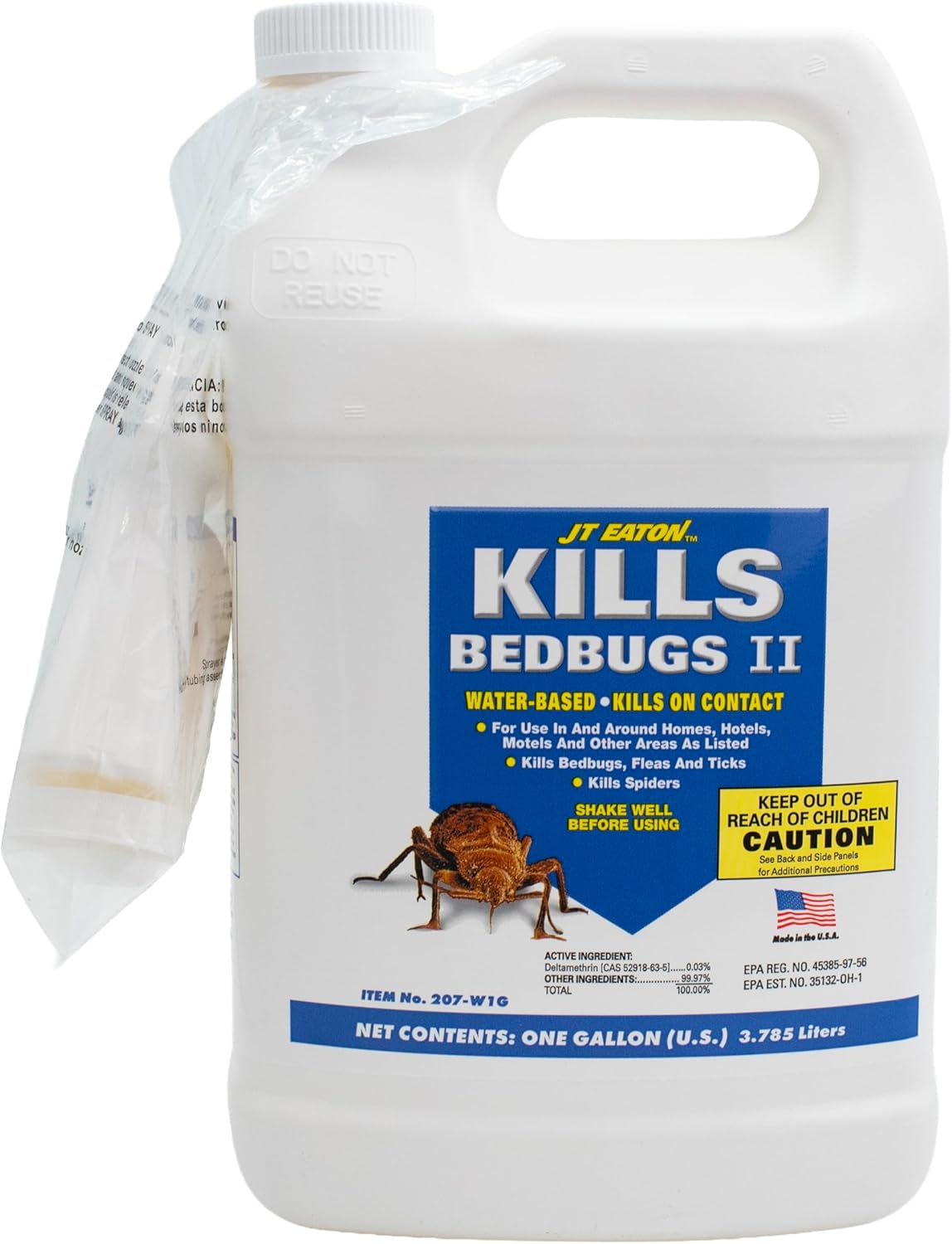
JT Eaton Kills Bedbugs II Water-Based Spray for Mattresses, 1 Gallon
| Formulation | Water-based |
|---|---|
| Size | 1 gallon |
| Intended use | Mattresses, box springs, bed frames, baseboards |
| Targets | Multiple bed bug life stages |
This gallon-size JT Eaton Kills Bedbugs II is a water-based spray designed for treating mattresses, box springs, bed frames, baseboards, and other cushioned surfaces as part of an integrated bed bug program. The included sprayer makes it practical to cover multiple rooms or a larger infestation without constantly refilling small bottles. Its formula is described as fast-acting with residual activity, so treated areas continue to kill bed bugs after the spray dries while avoiding a strong chemical odor. Typical use is spot and seam applications along mattress tufts, folds, and perimeter crevices, plus light treatment under and around furniture and baseboards. The product targets multiple life stages, which helps improve overall knockdown when combined with other measures like laundering and vacuuming. Important considerations are that it is intended as one component of a control plan rather than a standalone guarantee, and professional-level effectiveness still depends on thorough application and follow-up treatments.
Best for: Buyers who need an affordable, large-quantity treatment for repeated or multi-room bed bug control and who plan to use it as part of a broader treatment routine.
Less Ideal for: People looking for a one-time guaranteed elimination without follow-up or those who prefer non-chemical-only control methods.
- Gallon size with sprayer lets you treat multiple rooms or large infestations without frequent refills
- Water-based formula reduces harsh chemical odor compared with solvent products
- Long-lasting residual protection continues to kill bed bugs after drying
- Safe for use on mattresses, box springs, bed frames, and many cushioned surfaces
- Not a complete eradication solution on its own; best used as part of an integrated treatment plan
- Requires careful, thorough application to reach hiding spots and life stages
Verdict: Choose this gallon water-based spray when you want an economical, residual product to treat mattresses and surrounding areas as part of a professional bed bug control strategy.
MGK Crossfire Bed Bug Concentrate, 13 fl oz

| Unit Count | 13 Fluid Ounces |
|---|---|
| Item Form | Oil |
| Target Species | Bed Bugs |
| Active Ingredients | Clothianidin, Metofluthrin, Piperonyl Butoxide |
| Specification Met | EPA |
MGK Crossfire is a ready-to-dilute concentrate designed for fast, professional-style control of bed bugs in homes and commercial spaces. Mix one 13-ounce bottle to make a gallon of finished spray and apply to mattress seams, bed frames, baseboards and other hiding spots; the formula contains two active ingredients and a synergist that provide quick knockdown and activity against resistant strains and eggs. Its oil-based concentrate is labeled as non-staining for direct mattress application, which makes it practical for treating sleeping areas without obvious residue. Because it is a concentrated, EPA-recognized product with professional-strength actives, it delivers more persistent control than many consumer aerosols but requires careful measuring and responsible indoor use. It is not a ready-to-use spray, so buyers should plan to mix and apply with appropriate PPE and follow label directions to avoid overapplication or exposure to people and pets.
Best for: Buyers who prioritize effective, professional-level eradication of bed bugs and are comfortable mixing a concentrate and following label safety precautions for indoor treatments.
Less Ideal for: Casual users who want a ready-to-use spray or those unwilling to follow safety measures around children and pets should consider simpler, lower-strength options.
- Concentrated formula makes one gallon from a single bottle for multiple treatments
- Dual active ingredients plus a synergist target pyrethroid-resistant bed bugs and eggs
- Labeled non-staining for direct application on mattresses
- EPA-recognized specification indicating regulatory review
- Requires mixing and proper personal protective equipment for safe indoor use
- Oil-based concentrate may not be suitable for all surfaces without spot testing
Verdict: Choose this concentrated, professional-strength product when you need fast, reliable control of pyrethroid-resistant bed bugs and their eggs.
Ortho Home Defense Max Bed Bug, Flea & Tick Killer, 1 gal.

| Volume | 1 gal. |
|---|---|
| Active ingredients | Bifenthrin; Imidacloprid; Piperonyl Butoxide |
| Use type | Ready-to-use spot treatment |
| Intended pests | Bed bugs, bed bug eggs, fleas, ticks |
This one-gallon Ortho Home Defense Max is built for DIY spot treatments where bed bugs and other small pests hide. The bottle includes a battery-powered Comfort Wand that gives precise spray control for seams, tufts, baseboards and bed frames, making it practical for treating mattresses and cracks without saturating surfaces. Its formula combines bifenthrin and imidacloprid and is labeled to kill even pyrethroid-resistant bed bugs and eggs, so it can be useful when simpler sprays fail. The product is intended as Step 2 in Ortho's bed bug system, so best results come when you also use detection traps and crack-and-crevice treatments. Users should apply only to dry surfaces, keep people and pets away until treated areas are dry, and avoid use on finished or delicate materials because it can stain or damage them. For someone facing a persistent infestation, this offers a strong spot-treatment option, but it is not a broadcast treatment for whole-room saturation and requires repeat application as directed when activity continues.
Best for: Buyers who want a professional-strength DIY spot treatment and value precise application and documented user results to tackle persistent bed bug activity.
Less Ideal for: Those looking for a general-purpose household spray for routine pest prevention or a non-chemical approach should consider other products or methods.
- Includes battery-powered Comfort Wand for precise application in tight areas
- Ready-to-use formula that targets bed bugs, eggs, fleas, and ticks
- Formulated to kill pyrethroid-resistant bed bugs for tougher infestations
- Large 1 gallon supply suited to treating multiple spots or large rooms
- Not intended for broadcast whole-room spraying; designed for spot treatments only
- Contains strong active ingredients that require keeping people and pets away until surfaces are dry
Verdict: A precise, ready-to-use spot treatment that targets even resistant bed bugs and their eggs, built for homeowners facing persistent infestations.
Choosing the Right Professional Bed Bug Spray: Key Factors to Consider
Residual Efficacy and How Long It Lasts
Residual efficacy determines how long a treated area continues to kill or incapacitate bed bugs after the spray dries. Longer residual activity reduces the need for repeated treatments and helps catch bugs that emerge later from hidden harborage sites.
When assessing residual claims, consider whether the label reports days or weeks of activity and whether efficacy was demonstrated on the types of surfaces you will treat. Residual performance can decline with heavy foot traffic, regular cleaning, or exposure to sunlight and moisture, so plan reapplication intervals accordingly.
Surface Compatibility and Stain Risk
A spray that works on bare wood might damage finished furniture or stain certain fabrics. Surface compatibility matters because treating mattresses, sofas, baseboards, and carpet edges are common in indoor bed bug control.
Check label guidance for porous versus nonporous surfaces, and test sprays in an inconspicuous spot if surface staining is a concern. Some formulations are safe on upholstery and mattress ticking when used as directed, while others are limited to structural cracks and crevices. Choose a product that matches the surfaces you must treat to avoid unintended damage.
Application Method and Ergonomics
How a spray is delivered affects coverage and user fatigue. Products come in ready-to-use trigger bottles, pump-up sprayers, or concentrate forms that require dilution. For large jobs or professional use, concentrates with sprayers can be more economical but need careful mixing and measuring.
Consider nozzle adjustability for sweeping sprays versus pinpoint jets, tank capacity for continuous work, and whether the label permits simple spot treatments or requires extensive masking of areas. Application ergonomics influence thoroughness and the time it takes to complete a treatment.
Indoor Safety and Required Precautions
Indoor safety considerations include toxicity to people and pets, ventilation needs, and required personal protective equipment. Some sprays have low-odor, low-volatility formulas that are easier to use in occupied spaces, while others recommend vacating an area for a period after application.
Read label instructions on entry intervals, wash times for treated fabrics, and whether food-contact surfaces must be covered. Choosing a product with clear, practical safety directions reduces the risk of misuse and helps integrate control work into normal home routines.
Knockdown Speed Versus Long-Term Control
Fast knockdown provides immediate relief from visible bed bugs, which is important for occupant comfort. However, a quick knockdown alone does not prevent future sightings if residual control is weak.
Balance the need for fast-acting chemistry with a formulation that also offers lasting residual activity. For severe infestations you may prefer a mix of methods where a fast knockdown is used initially and longer-lasting products are applied to harborage sites for follow-up control.
Label Restrictions and Legal Use
Labels legally define where and how a spray may be used. Some professional-grade products have restrictions that require certified applicators for certain settings or forbid use on mattresses and pillows. Others permit broad indoor application by homeowners.
Always follow label limitations, including maximum application rates and allowable treatment locations. Using a product in a manner inconsistent with its label can be ineffective and may create liability or safety hazards.
When to Use a Professional-Grade Spray
Professional-grade sprays are appropriate when infestations are established, when repeated household treatments have failed, or when you need a product with known residual activity for targeted follow-up. They are often chosen by pest technicians because labels and performance data focus on durability and coverage.
For homeowners, a professional spray may be useful when treating baseboards, bed frames, and other structural hiding spots that require a stronger residual. If you are treating mattresses or sensitive fabrics, confirm the label permits such use and follow any fabric-cleaning instructions.
- Use for treatment of cracks, crevices, and structural harborage
- Consider professional-grade options for multiunit buildings or recurring infestations
- Confirm mattress and upholstery guidance before treating fabric surfaces
Application Tips for Better Coverage
Target application to likely hiding spots: mattress seams, box spring edges, headboard joints, baseboards, electrical outlets (with power off), and furniture seams. Avoid over-applying; follow label rates to prevent surface damage and to stay within safety margins.
When using concentrates, measure and mix according to label instructions. Use a consistent sweeping motion with the nozzle open enough to create a light mist rather than heavy drips. Allow treated surfaces to dry fully before reoccupying the area if the label recommends an entry interval.
- Treat both sides of mattress seams and the box spring perimeter
- Apply along baseboard seams and behind headboards
- Spot test on hidden fabric patches to check for staining
Combining Sprays with Nonchemical Control
Sprays are most effective when used alongside nonchemical measures. Vacuuming to remove bed bugs and eggs, using mattress encasements, and reducing clutter to eliminate hiding spaces all improve treatment outcomes. Heat treatments and steam can be used for items that cannot be safely sprayed.
Follow-up inspections are essential. Residual sprays can help reduce reinfestation, but monitoring with interceptors or careful visual checks will tell you whether additional treatments are needed.
- Vacuum seams and crevices before spraying to remove live insects and eggs
- Use encasements on mattresses and box springs to trap any survivors
- Inspect after a week and again at regular intervals to evaluate control
Safety Practices During and After Treatment
Wear the protective equipment recommended on the label, such as gloves and eye protection, when mixing and applying sprays. Keep children and pets away from treated areas until drying time has elapsed and the label indicates it is safe to return.
Ventilate treated rooms if the label allows and advises. Dispose of rinse water and empty containers according to local regulations and label directions to avoid environmental contamination.
- Follow label instructions for reentry intervals and ventilation
- Store concentrates out of reach of children and pets
- Clean application equipment promptly after use to prevent residue buildup
Signs an Infestation May Need Professional Help
If bites persist despite multiple treatments, if bed bugs are widespread across multiple rooms, or if you find continuous live bugs after follow-up inspections, escalation to a trained pest professional may be warranted. Professionals bring experience in integrated strategies and may use additional tools beyond sprays.
Also consider professional assistance in multiunit housing where infestations can easily spread between apartments. Coordinated treatment and building-wide inspections often produce better long-term outcomes than isolated efforts.
- Recurrent bites or live bugs after follow-up checks
- Multiple rooms or units affected
- Difficulty locating all harborage areas despite thorough inspection
How We Chose the Best Professional Bed Bug Spray
To build this shortlist we focused on attributes that matter in real-world bed bug control. Primary evaluation criteria included residual efficacy, meaning how long treated surfaces continue to kill or repel bed bugs after application. We also looked at formulation suitability for indoor surfaces, including compatibility with mattresses, upholstery, wood trim, and carpet edges. Application ergonomics and required safety practices were assessed because ease of application affects how thoroughly users treat infestations. We reviewed label directions to confirm safe dwell times, necessary protective equipment, and any required surface preparation. Speed of knockdown was considered for immediate control, while odor and ventilation requirements were noted for usability in occupied homes. Products were excluded if labels restricted typical indoor use, required specialty licensing for basic application, or lacked clear residual efficacy data. We prioritized options with transparent instructions and measurable performance indicators relevant to homeowners and pest technicians. Evaluation dimensions that guided selection are reflected in the scoring criteria below and informed exclusions based on surface restrictions, application complexity, and documented residual activity.
FAQ
Can professional bed bug sprays be used on mattresses and upholstery?
It depends on the product label. Some sprays are labeled for use on mattress seams and upholstery when applied as directed, while others restrict treatment to structural areas. Always read and follow label instructions and test on a small, hidden area if staining is a concern.
How often should I reapply a residual spray?
Reapplication intervals vary with the product and environmental factors. Labels often specify a recommended reapplication window based on measured residual activity. High-traffic or frequently cleaned surfaces may need retreatment sooner than low-traffic harborage sites.
Are professional sprays safe to use in homes with pets and children?
Many products can be used safely when label directions are followed, including recommended reentry times and ventilation. Some formulations require pets and children to be kept away until treated areas have dried. Read safety precautions carefully and take steps to minimize exposure.
Will a single spray treatment eliminate a bed bug infestation?
A single treatment often will not eliminate an established infestation. Effective control typically involves multiple tactics and follow-up inspections. Residual sprays help reduce populations but should be combined with vacuuming, encasements, and monitoring for best results.
Do professional sprays require special licensing to buy or use?
Most consumer-available professional sprays do not require a license to purchase, but some higher-concentration formulations or uses in certain settings may be restricted. Check the product label and local regulations to confirm whether certified applicator requirements apply.
Final Verdict
When choosing a professional bed bug spray, prioritize products whose residual performance and surface compatibility match the areas you must treat. Consider application ergonomics and indoor safety so you can apply treatments thoroughly without unnecessary exposure. Balance the need for quick knockdown with long-term residual control, and integrate sprays into a broader plan that includes vacuuming, encasements, and follow-up inspections. Following label instructions closely will produce the safest and most effective outcomes.
