

Note: This article contains affiliate links. If you click on these links and make a purchase, I may earn a small commission at no extra cost to you. This helps support my research and content. Read my full affiliate disclosure here.
If you do routine pruning, limb removal, or light tree work, the right limbing chainsaw makes the job faster, cleaner, and safer. You want a saw that is nimble on short cuts, easy to control in tight canopy spaces, and reliable when you need consistent bite through branches. This guide shortlists the top options for limbing tasks and explains the practical tradeoffs gardeners and property owners face. We evaluated cutting performance, handling and balance, safety features, and maintenance needs to help you pick the right saw for your typical jobs. Read on for the selection criteria and guidance to match a limbing chainsaw to your yard or maintenance routine.
Top Picks at a Glance
| Best Overall The best all-around choice for most situations | Husqvarna 120 Mark III Gas Chainsaw, 16-Inch Bar |  |
| Best Quality Built to a higher standard if you want something more solid | Husqvarna T435 12 in. Top-Handle Gas Chainsaw |  |
| Best Value The sweet spot between price and what you get | WORKIT 25.4CC 12" Top-Handle Gas Chainsaw (WX112) |  |
| Best Budget The cheapest option that still gets the job done reliably | Seesii M6 Lite 6" Cordless Mini Chainsaw with Two Batteries |  |
| Highest Rated A top-rated pick with lots of positive feedback | RazEdg 40V Brushless 12-Inch Cordless Chainsaw |  |
| Most Popular A crowd favorite that many people choose with confidence | SEESII 12-Inch Cordless Brushless Chainsaw |  |
| Best Seller A high-volume bestseller chosen again and again | SEESII M8 Boost 8" Cordless Mini Chainsaw (Brushless Motor) |  |
Husqvarna 120 Mark III Gas Chainsaw, 16-Inch Bar

| Power Source | Gas Powered |
|---|---|
| Horsepower | 1.88 hp |
| Chain Length | 16 inches |
The Husqvarna 120 Mark III is a compact gas chainsaw built for routine yard work: limb pruning, light felling and cutting firewood. It pairs a 38-cc X-Torq two-stroke engine with a 16-inch bar and an automatic oiler so you can keep cutting without frequent lubrication fiddling. Features aimed at ease of use include an air purge to simplify starting, a combined choke/stop control to reduce flooding, a simple chain tensioner for quick adjustments, and LowVib dampening to lower operator fatigue. Safety is addressed with an inertia-activated chain brake. The Air Injection centrifugal system helps keep the air filter cleaner for longer, which is useful if you run the saw regularly in dusty conditions. Expect a capable, user-friendly tool for homeowners who want dependable gas power in the sub-$300 range, but professional users needing long daily runtimes or larger cutting capacity should consider heavier commercial models.
Best for: Homeowners and weekend landscapers who want a reliable, easy-to-use gas chainsaw for pruning, small felling and firewood without the complexity of professional equipment.
Less Ideal for: Commercial loggers or users who need a high-hour production saw or larger cutting capacity for big timber should choose a heavier-duty model instead.
- Easy starting with air purge and combined choke/stop control
- LowVib technology reduces vibration and operator fatigue
- Air Injection centrifugal system extends time between air filter cleanings
- Simple chain tensioning and automatic oiler for low-maintenance use
- 16-inch bar and 38-cc engine are best for light to medium tasks, not heavy professional felling
Verdict: A user-friendly, gas-powered 16-inch chainsaw that balances easy starting, low vibration, and low maintenance for homeowners seeking dependable cutting power under $300.
Husqvarna T435 12 in. Top-Handle Gas Chainsaw

| Power Source | Gas Powered |
|---|---|
| Horsepower | 2.01 hp |
| Chain Length | 14 inches |
The Husqvarna T435 is a top-handle gas chainsaw designed for tree care professionals who need a light, maneuverable tool for pruning, limbing, and work in the canopy. It delivers 2.01 horsepower from a 35.2 cc X-Torq engine that maintains torque at low RPMs, making controlled cuts easier when working overhead. The unit is unusually light for its power, improving balance and reducing operator fatigue during long shifts. Practical user-focused features include Smart Start for easier pulls, LowVib anti-vibration isolation, an inertia-activated chain brake for safety, adjustable oil pump for different weather or cutting conditions, and simple maintenance with a quick-release air filter and side-mounted chain tensioning. The top-handle layout and heavy-duty rope attachment point make it straightforward to hoist and position in trees. Limitations are the inherent requirements of a gas saw: routine fuel and oil maintenance and higher noise and emissions than battery alternatives, plus a learning curve for safe top-handle operation in tight canopy situations.
Best for: Aimed at professional arborists or serious tree-care contractors who prioritize maneuverability, quick responsiveness, and minimal operator fatigue when working aloft.
Less Ideal for: Homeowners who want a low-maintenance, quiet saw or casual users uncomfortable with top-handle operation should consider simpler rear-handle or battery options.
- Excellent power-to-weight ratio for overhead and canopy work
- X-Torq engine for good low-RPM torque and improved fuel efficiency
- Smart Start and LowVib reduce startup effort and operator fatigue
- Adjustable oil pump and easy-access maintenance features speed field servicing
- Top-handle design with rope attachment simplifies hoisting into trees
- Requires regular gasoline maintenance and produces more noise and emissions than battery saws
- Top-handle layout is less forgiving for inexperienced users and demands careful handling
Verdict: Buy this if you need a lightweight, professional-grade top-handle saw that balances strong low-end power with excellent maneuverability for canopy and pruning work.
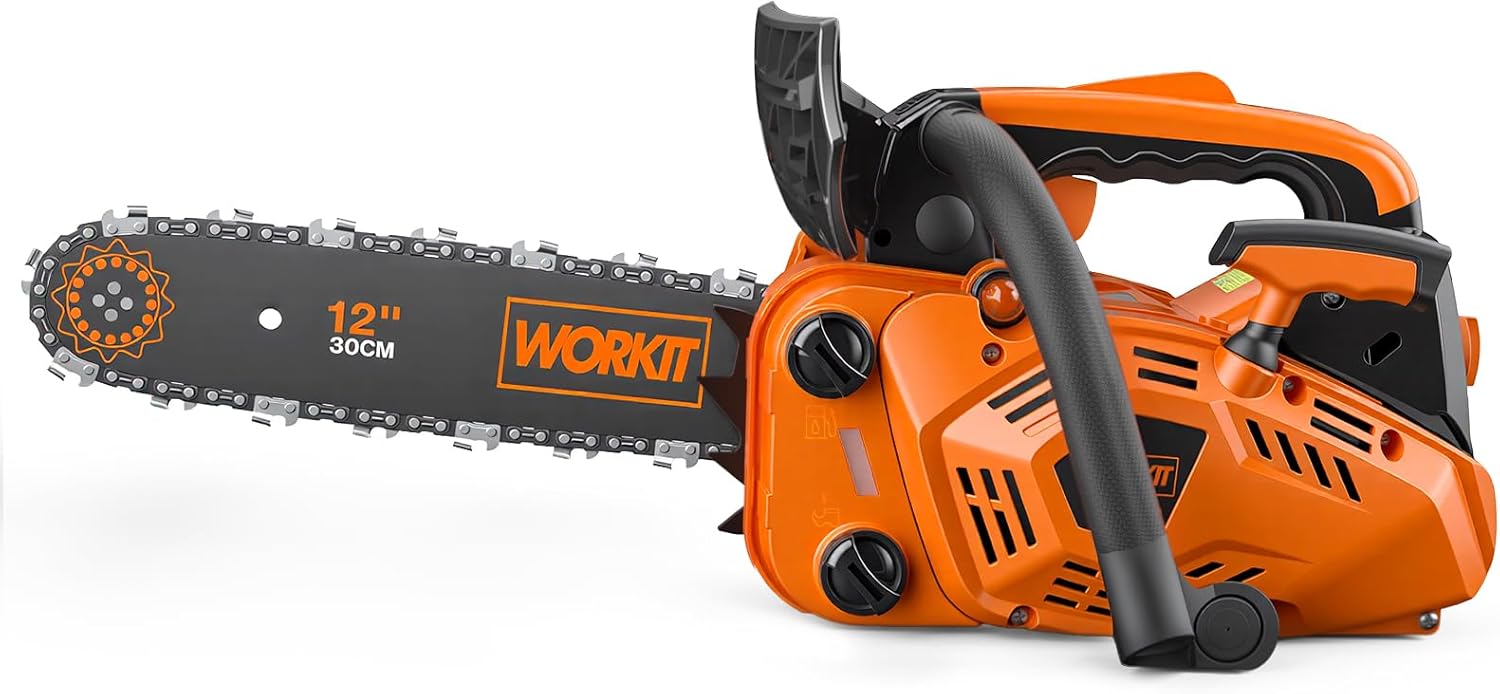
WORKIT 25.4CC 12" Top-Handle Gas Chainsaw (WX112)
| Power Source | Gas Powered |
|---|---|
| Horsepower | 1.2 hp |
| Chain Length | 12 inches |
The WORKIT WX112 is a lightweight top-handle gas chainsaw built for precision work in tight spaces. Its 25.4CC Xtreme two-cycle engine and 12-inch guide bar give it enough punch to cut hardwood, prune limbs, and handle routine storm cleanup while remaining nimble for high work or nursery tasks. Practical features include an OptiSpark ignition and an easy-start system to reduce pull-start frustration, an automatic stop switch to help avoid engine flooding, and an automatic oiler to keep the chain lubricated during extended runs. The reinforced body, heavy-duty bearings, and upgraded clutch aim to improve durability compared with entry-level units. Safety touches such as a chain brake, protective baffle, dual safety locks, and a one-stop engine switch make it suitable for pros who need a compact tool and for homeowners who value built-in protections. Expect some noise and the usual maintenance for a gas engine like fuel mixing and periodic spark plug/chain tuneups, and its 12-inch bar limits it to smaller-diameter cutting rather than full-size felling or large logs.
Best for: Buyers who need a compact, commercially styled top-handle saw for pruning, high work, and cleanup where maneuverability and dependable starts matter most.
Less Ideal for: Not a good choice for users who need a full-size felling saw or those who prefer low-maintenance electric or battery chainsaws for quiet, occasional yard chores.
- Compact, lightweight design for easy maneuvering in tight or overhead work
- 25.4CC Xtreme engine provides enough power for pruning, storm cleanup, and cutting hardwood up to small diameters
- Easy-start OptiSpark ignition and engine stop switch reduce starting problems and flooding
- Reinforced body, heavy-duty bearings, and improved clutch target better durability under heavier use
- Includes safety gear and protective features such as chain brake, dual safety locks, and protective baffle
- 12-inch bar restricts use to smaller limbs and logs rather than large-tree felling
- Being gas-powered requires routine maintenance, fuel mixing, and generates more noise and emissions than electric alternatives
Verdict: If you want a nimble, commercially oriented top-handle chainsaw for pruning and tight-space cutting, the WORKIT 25.4CC delivers dependable starts and durability in a compact package.
Seesii M6 Lite 6" Cordless Mini Chainsaw with Two Batteries

| Power Source | Battery Powered |
|---|---|
| Horsepower | 900 watts |
| Chain Speed | 29ft/s |
| Chain Length | 6 inches |
The Seesii M6 Lite is a lightweight cordless mini chainsaw built for pruning, branch trimming, and small timber cuts around the yard. It pairs a 900 W motor with a 6-inch chain and claims chain speeds near 29–30 ft/s, which helps it slice through small logs and thick branches quickly. The kit includes two 21V 2000 mAh batteries, so you can swap batteries for extended work sessions without long downtime. Safety features include a double lock to prevent accidental starts, a chain guard to reduce flying debris, and a low-recoil ergonomic body that makes one-handed use comfortable for many users. Practical benefits are quick setup out of the box, included spare chain and basic tools, and a relatively quiet operation that is less intrusive than gas saws. Limitations are the short bar length, which restricts reach and large-log capability, and the unit uses a smaller chain pitch that is suited to light to medium yard tasks rather than heavy felling. For buyers focused on occasional pruning and portability, its balance of power and low weight is convenient, but it is not a replacement for larger professional saws when cutting large-diameter wood.
Best for: Buyers who want a compact, easy-to-use electric saw for routine yard pruning and small wood projects and who prioritize portability and convenience over industrial power.
Less Ideal for: People who need a chainsaw for heavy felling, professional logging, or cutting large firewood rounds should choose a larger bar length and higher-power model instead.
- Lightweight ergonomic design for easier one-handed pruning
- Includes two batteries and charger for extended run time
- Powerful 900 W motor and high chain speed for fast cuts on small branches
- Arrives ready to use with spare chain and basic tools included
- 6-inch bar limits reach and is unsuitable for large-diameter logs
- No automatic oiling system noted, so chain lubrication may require manual attention
Verdict: Choose the Seesii M6 Lite if you want a portable, one-handed electric chainsaw that makes quick work of pruning and small yard jobs with the convenience of two included batteries.
RazEdg 40V Brushless 12-Inch Cordless Chainsaw

| Power Source | Battery Powered |
|---|---|
| Horsepower | 1800 watts |
| Chain Speed | 72 ft/s |
| Chain Length | 12 inches |
The RazEdg 40V brushless chainsaw is a compact cordless saw aimed at homeowners and pros who need reliable, controlled cutting for pruning, limbing, and small firewood. Powered by a 10,000 RPM brushless motor that drives a 12" bar at about 22 m/s chain speed, it delivers predictable cuts while the automatic oiler keeps the chain lubricated for consistent performance. Tool-free tensioning and a side-mounted knob make chain changes and adjustments fast on the job, and safety features such as an instant chain brake and two-step trigger lock reduce accidental starts and help manage kickback. The included 40V battery promises up to 50 minutes of typical runtime, which is useful for extended yard work without frequent recharges. Limitations are its 12" bar length and residential focus, so it is not intended for large timber or heavy commercial logging where longer bars and higher continuous power are required. For routine maintenance, landscaping, and light firewood tasks it balances convenience and dependable cutting performance.
Best for: Buyers who prioritize dependable, low-maintenance cordless performance for pruning, limbing, and routine firewood tasks and want easy upkeep and safety features on site.
Less Ideal for: Professionals who regularly cut large timber or run full-day commercial logging shifts should choose a larger bar length and higher continuous-power model instead.
- Brushless 10,000 RPM motor provides stable, efficient cutting power
- Automatic oiler maintains chain lubrication for consistent performance
- Tool-free chain tensioning allows quick adjustments without tools
- Dual safety systems with instant chain brake and two-step trigger lock
- 12-inch bar limits capability for large-diameter logs and heavy commercial work
Verdict: A reliable, low-maintenance cordless chainsaw focused on safe, consistent cutting for pruning and light firewood tasks.
SEESII 12-Inch Cordless Brushless Chainsaw

| Power Source | Battery Powered |
|---|---|
| Horsepower | 1200 watts |
| Chain Length | 12 inches |
| Included Components | chainsaw |
The SEESII 12-inch cordless chainsaw is designed for homeowners and pros who need portable, high-power cutting without a generator. It pairs a 1200W brushless motor with two 4.0Ah batteries to deliver sustained cutting power for pruning, cutting storm debris, and working on small to medium logs. The tool-free chain tension system and automatic lubrication reduce downtime and routine maintenance, and the 60 mL oil tank helps keep the chain running smoothly during longer sessions. Because it is cordless and relatively lightweight for its class, it is easy to move around the yard or use at remote sites where cords are impractical. Important limits to note are the 12-inch bar, which constrains maximum log diameter compared with full-size saws, and battery reliance for very long jobs where alternating charged packs or a backup power source is needed. For straightforward woodcutting tasks this model balances cutting performance, convenience, and low maintenance.
Best for: Buyers who prioritize efficient, portable wood cutting for yard cleanup, pruning, and medium DIY projects and want a low-maintenance cordless saw they can move around the property easily.
Less Ideal for: Contractors or users who regularly need to fell large trees or process large-diameter logs should choose a full-size gas or professional electric chainsaw instead.
- 1200W brushless motor provides strong, efficient cutting power for hardwood and storm debris
- Two 4.0Ah batteries extend runtime for longer jobs and include a built-in charge indicator
- Automatic oiling with a 60 mL tank reduces frequent stops for lubrication
- Tool-free chain tensioning simplifies on-the-job adjustments
- Cordless, relatively lightweight design improves portability and use at remote sites
- 12-inch bar limits the maximum log diameter compared with larger professional chainsaws
- Runtime depends on battery swapping for extended heavy-duty cutting sessions
Verdict: A powerful, low-maintenance cordless 12-inch saw that maximizes portable cutting performance for homeowners and weekend woodworkers.
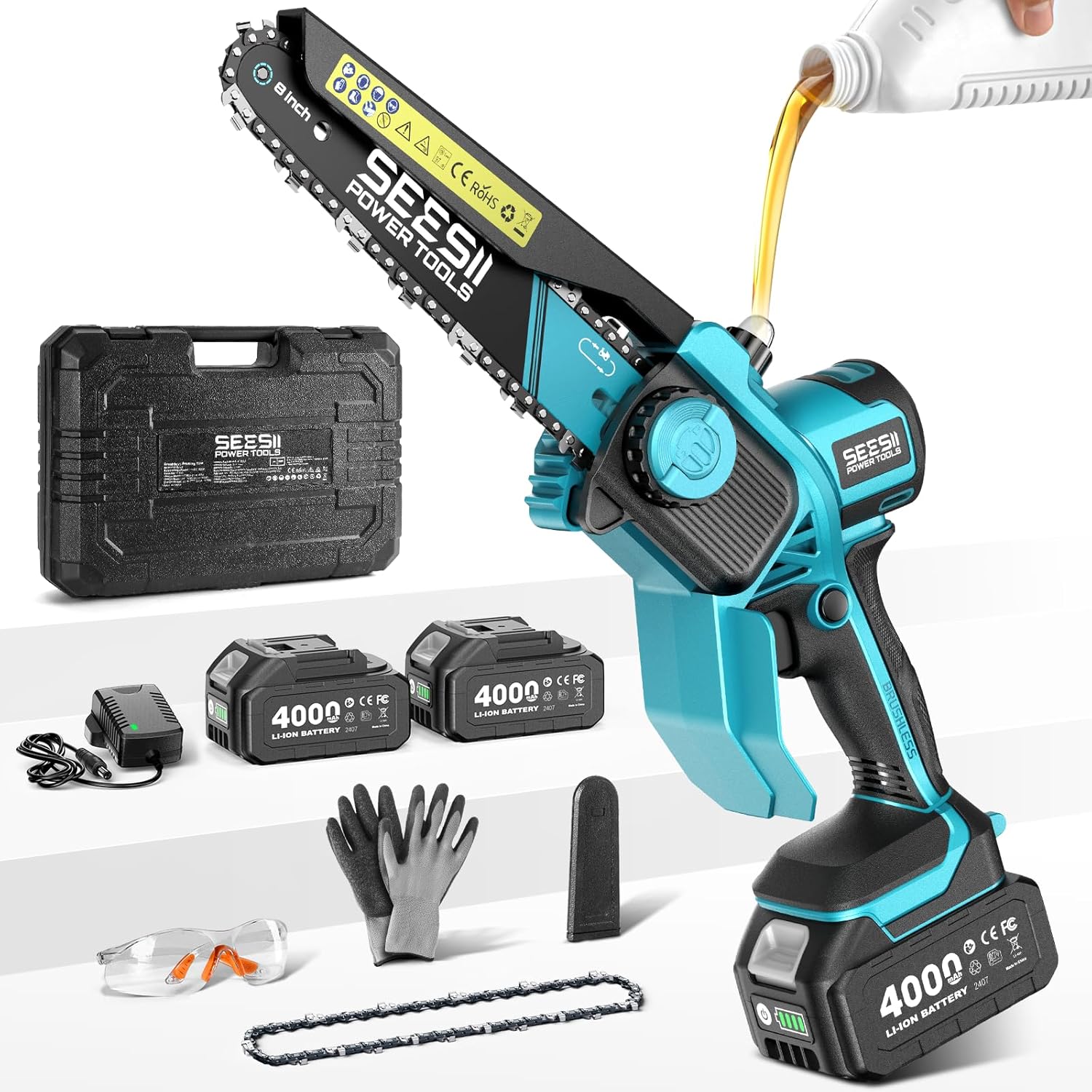
SEESII M8 Boost 8" Cordless Mini Chainsaw (Brushless Motor)
| Power Source | Battery Powered |
|---|---|
| Horsepower | 1000 watts |
| Chain Length | 8 inches |
The SEESII M8 Boost is a handheld cordless mini chainsaw built for trimming larger branches and routine yard maintenance. It pairs an 8-inch guide bar with a 1000-watt brushless motor, which boosts cutting speed and improves battery efficiency compared with brushed designs. Typical use is pruning trees, cutting limbs after storms, and cutting small logs for disposal or firewood. The kit includes two 4000 mAh batteries so you can swap packs for extended runtime and complete long sessions without frequent recharge. Practical features that matter in the yard are tool-free chain tensioning and an automatic chain oiler with a visible reservoir, both of which speed maintenance and keep cuts cleaner. The saw is relatively easy to handle and intended for homeowners who want a more powerful alternative to 6-inch mini saws. Limitations to note are that it is still a mini chainsaw intended for branches and small logs rather than heavy felling or professional forestry work, and buyers should follow safety guidance and protective gear when using a high-speed chain.
Best for: Practical homeowners who want a compact but more capable saw for seasonal tree pruning, storm cleanup, and yard maintenance without stepping up to gas-powered equipment.
Less Ideal for: Pros who need a pro-grade saw for large tree removal or contractors who require heavy continuous use should choose a larger professional chainsaw instead.
- Brushless 1000-watt motor for faster cutting and improved battery efficiency
- Includes two 4000 mAh batteries to extend continuous runtime and reduce downtime
- Tool-free chain tensioning for quick adjustments in the field
- Automatic chain lubrication with semi-transparent reservoir for easy monitoring
- 8-inch bar offers larger cutting capacity than typical 6-inch mini chainsaws
- Designed for pruning and small logs rather than heavy felling or commercial use
- May produce noticeable vibration during extended cuts
Verdict: A practical, higher-capacity mini cordless chainsaw that balances power and convenience for homeowners who want an efficient tool for tree pruning and yard cleanup.
Choosing the Right Limbing Chainsaw: Key Factors to Consider
Bar Length and Chain Pitch
Bar length and chain pitch determine the saws best use. For limbing, shorter bars typically 12 to 16 inches reduce nose weight and make the saw easier to swing into branches. Short bars also limit the temptation to cut larger-diameter wood that the saw is not designed to handle, keeping the tool within safe operating parameters.
Chain pitch and gauge affect cutting aggressiveness and ease of sharpening. A chain with a moderate pitch and a common gauge is easier to maintain and tends to offer smooth, controllable cuts on limbs rather than aggressive ripping. Choosing the right combination helps you get clean, quick cuts without excess kickback or frustration when working in a canopy.
Balance, Weight, and Handling
How a saw feels in your hands directly affects accuracy and fatigue. For limbing you will often make repeated short cuts, sometimes while reaching or on a ladder. A saw with a well-distributed weight and a lower center of gravity lets you control the bar tip and reduces the strain on your wrists and shoulders.
Consider overall weight, but also how weight is distributed between the motor and the bar. Lighter saws are easier for overhead and extended reach work, while slightly heavier models may steady the saw during a cut. Pick a saw whose handling matches how you work-one-handed low cuts versus two-handed overhead or angled cuts.
Anti-Kickback and Safety Design
Kickback is one of the most common hazards when limbing because cuts often bring the bar tip into contact with branch geometry or bark. Anti-kickback chain designs, reduced-kickback guide bars, and chain brakes that engage quickly are critical safety layers.
Additional safety considerations include chain guards, effective throttle trigger locks, and clear operator ergonomics that help you maintain a firm grip. For limbing near ladders or in tight spaces, consider features that reduce accidental throttle engagement and that make stopping the chain fast and predictable.
Engine or Motor Type and Low-End Torque
Whether gas, battery, or corded, the power source matters for how the saw behaves on frequent limb cuts. For gas saws, low-end torque helps initiate cuts on thicker or knotty limbs and reduces bogging when the chain meets resistance. For battery saws, look at torque under load and how long a charge maintains cutting power during repetitive cuts.
Torque and power delivery affect how many cuts you can do before fatigue from re-situating the saw or recharging. For limbing, consistent, predictable power is often more valuable than peak horsepower because you want steady bite through a variety of small to medium-sized branches.
Maintenance and Sharpening Accessibility
Limbing involves many short cuts that dull chains over time. A chain and bar system that is easy to tension, remove, and sharpen keeps downtime low and extends component life. Features like side-access chain tensioners or tool-free bar covers speed routine maintenance and make on-site sharpening or adjustments practical.
Also consider how easy it is to source replacement chains and bars and whether common field tools suffice for maintenance. The simpler the routine service, the more often you will keep the saw in peak condition, which translates to cleaner cuts and safer operation.
Vibration and Noise Control
Lower vibration reduces hand fatigue and improves cut accuracy when doing many repetitive limbing cuts. Look for designs with effective anti-vibration mounts between the handle and the engine or motor. Reduced noise can be important if you work in residential areas or need to meet local noise restrictions.
Less vibration and subdued acoustics also make it easier to communicate with helpers and to remain aware of your surroundings while working in trees or near structures.
Bar Lengths Best Suited to Limbing Tasks
Short bars give more control when trimming branches in the canopy and prevent overreaching into larger cuts. For typical yard limbing a bar between 12 and 16 inches is usually optimal because it balances reach with control.
If you regularly remove slightly larger limbs or anticipate occasional heavier cuts, choose the upper end of that range and pay attention to chain pitch so the saw still sharpens easily and behaves predictably.
- Short bar: easier tip control and less catch risk
- Mid-length bar: additional reach for thicker limbs without excessive weight
- Avoid overly long bars that encourage dangerous overcuts
Handling Techniques for Safer Limb Removal
Use a steady two-handed grip for most limbing cuts and keep the saw close to the body to reduce leverage and improve control. When working at heights, reposition the cut so you are stable before making the final pass.
Plan cuts to prevent bar pinching and support the limb when possible. For levered limbs make relief cuts to avoid sudden bar binds that can create unsafe situations.
- Keep elbows slightly bent and shoulders relaxed
- Make progressive cuts on suspended limbs to avoid binding
- Maintain a clear escape route and stable footing
Maintenance Habits That Keep a Limbing Saw Ready
Routine checks before each use keep a limbing saw reliable. Inspect chain tension, bar condition, and chain sharpness. Clean debris from the sprocket and bar groove and confirm the chain brake works properly.
Establish a sharpening cadence based on how much cutting you do. Frequent light touch-ups often keep a chain cutting better than waiting for it to become very dull and then performing aggressive filings.
- Check chain tension and lubrication daily during heavy use
- Carry a round file and tension tool for field adjustments
- Replace worn bars or chains before they degrade cutting quality
Battery Versus Gas for Limbing Work
Battery saws have improved torque and are quieter, with simpler maintenance. They are a good fit for shorter sessions, smaller properties, and neighborhoods with noise limits. Consider battery runtime and how many cuts you can expect on a single charge when assessing suitability.
Gas saws offer quick refueling and sustained run time for longer sessions or remote sites. They typically deliver strong low-end torque but require more routine engine maintenance and fuel handling precautions.
- Battery: lower noise, simpler upkeep, limited runtime
- Gas: extended runtime, stronger continuous power, more maintenance
Working Safely Around Structures and Utilities
When limbing near buildings, power lines, or other structures, plan the cut so falling limbs do not create new hazards. Keep bystanders well clear and use wedges or ropes to control limb direction where necessary.
If a limb is close to electrical lines or in a complex canopy, consider consulting or hiring a trained climber. Even with the right saw, complex situations require additional skill, rigging, and spotters to avoid property damage or personal injury.
- Assess drop path before cutting
- Use ropes or wedges to guide heavy limbs
- Stop work and get assistance for limbs near power lines
How We Chose the Best Limbing Chainsaw
We focused on attributes that matter for real-world limbing: cutting bite and bar length appropriate for branch work, handling and balance when making repeated short cuts overhead or at awkward angles, and safety features that reduce kickback risk during limbing and pruning. We also prioritized start-up reliability and ease of routine maintenance since those affect how often a saw is ready for the job. Editorial filters excluded heavy-duty felling chainsaws with long bars and commercial-only features that are unnecessary for limbing tasks. We did not include specialty pole saw heads or electric-only devices intended strictly for light pruning. Products considered had to offer bar lengths, chain types, or designs suited to frequent short cuts rather than long felling cuts. Concrete evaluation criteria included cutting performance on small- to medium-diameter limbs, balance and maneuverability for one- and two-handed limbing positions, safety and anti-kickback measures, and serviceability for routine sharpening and tensioning. These dimensions guided selection and ensured the list fits homeowners and property managers who perform consistent limbing and pruning.
FAQ
What bar length is best for pruning and limbing around a yard?
For most residential limbing tasks a 12 to 16 inch bar balances reach and control. Shorter bars improve tip control and reduce the risk of catching, while slightly longer bars help with thicker limbs without excessive weight.
How often should I sharpen the chain when doing regular limbing?
It depends on workload and wood type, but frequent small touch-ups are better than waiting until the chain is very dull. If cuts are producing fine sawdust rather than chips or the saw requires extra force, it is time to sharpen.
Are battery limbing chainsaws powerful enough for routine tree trimming?
Battery saws can be fully adequate for routine trimming and light to medium limbing, especially newer high-torque models. Consider expected cut volume and whether you can swap batteries or recharge during larger jobs.
What safety features are most helpful for limbing work?
Anti-kickback chains, effective chain brakes, and throttle cutouts matter most because limbing often involves awkward angles and tip contact. Good handle ergonomics and low vibration also help maintain control during repetitive cuts.
Can I use a limbing chainsaw for small felling tasks?
A limbing-oriented saw with a short bar can handle small felling in limited cases, but it is designed for branch work. For larger felling you want a saw with a longer bar and different cutting setup intended for that purpose.
How do I reduce chain pinching when cutting thicker limbs?
Make relief or undercuts to reduce binding and support the limb so the cut opens rather than pinches the bar. Using wedges and planning the cut sequence also helps prevent sudden pinching that can snag the chain.
Final Verdict
Focus on the combination of a short, controllable bar and a saw that feels balanced in your hands. Prioritize anti-kickback measures and a power delivery that stays steady under repeated cuts. Maintenance accessibility and predictable starting behavior keep a limbing saw ready when you need it. Weigh the tradeoffs between battery convenience and gas endurance based on how many cuts you do in a session. By matching bar length, handling, safety features, and maintenance expectations to your routine, you will choose a limbing chainsaw that makes pruning faster and safer.
