

Note: This article contains affiliate links. If you click on these links and make a purchase, I may earn a small commission at no extra cost to you. This helps support my research and content. Read my full affiliate disclosure here.
Getting the right Guava fertilizer makes a visible difference in tree vigor, flower production, and fruit quality. Young and established guava trees respond to balanced feeding, but gardeners must match fertilizer type and timing to soil conditions and climate. This guide outlines the top shortlisted options for guava-specific feeding, explains how we evaluated them, and highlights practical application tips for backyard and small-scale orchard settings. Below you will find our top picks for guava feeding along with clear criteria used to judge them, so you can pick the fertilizer that fits your tree age, soil test results, and maintenance routine.
Top Picks at a Glance
| Best Overall The best all-around choice for most situations | TPS NUTRIENTS Guava Tree Fertilizer Liquid, 32 oz |  |
| Best Value The sweet spot between price and what you get | Jobe's Organics Granular Fruit & Citrus Fertilizer, 4 lb |  |
| Best Budget The cheapest option that still gets the job done reliably | Miracle-Gro Water Soluble All Purpose Plant Food, 1.5 lb |  |
| Highest Rated A top-rated pick with lots of positive feedback | FoxFarm Tiger Bloom Liquid Plant Food (1 pint) |  |
| Most Popular A crowd favorite that many people choose with confidence | Miracle-Gro Fruit & Citrus Plant Food Spikes (12-count) |  |
| Best Seller A high-volume bestseller chosen again and again | TPS Nutrients Lemon Tree Fertilizer Liquid, 8 fl oz |  |
TPS NUTRIENTS Guava Tree Fertilizer Liquid, 32 oz

| Item Form | Liquid |
|---|---|
| Specific Uses For Product | Plant Growth |
| Target Species | guava |
| Mixing Ratio | 1:1 |
| Liquid Volume | 32 fluid ounces |
This TPS Nutrients guava-specific liquid fertilizer is designed to encourage flowering, reduce blossom drop, and promote healthier fruit set on backyard and container guava trees. It is mixed 1:1 and applied throughout the growing season with a watering can or hose-end sprayer, making it straightforward to use for regular maintenance. The formula highlights micronutrient enrichment to support shoot and leaf growth without overstimulating foliage at the expense of fruit, and it also emphasizes root development for better water and nutrient uptake. Practical benefits include easier application, targeted nutrition for guava, and suitability for outdoor fruit trees or small orchard plantings. Important limitations are that coverage is listed as low, so larger plantings will need more bottles or more frequent application, and users must handle the concentrated liquid carefully to avoid skin or eye contact. Follow safety directions and store in a cool, dry place.
Best for: Gardeners seeking a straightforward, guava-targeted fertilizer for steady flowering and fruit production in backyard trees or containers who value ease of use and balanced nutrition.
Less Ideal for: Large commercial growers or those who need broad high-coverage applications for many trees should choose formulations designed for high-coverage or bulk use.
- Formulated specifically for guava to support flowering and fruit set
- Liquid concentrate with a simple 1:1 mixing ratio for easy application
- Micronutrient-enriched to support root and shoot development
- Suitable for backyard trees, container-grown guava, and small orchards
- Coverage is rated low, so it is less efficient for large orchard-scale plantings
- Requires careful handling to avoid skin or eye contact
Verdict: Choose this if you want an easy-to-apply, guava-focused liquid fertilizer that promotes flowering and healthier fruit on backyard and container trees.
Jobe's Organics Granular Fruit & Citrus Fertilizer, 4 lb

| Item Form | Granules |
|---|---|
| Specific Uses For Product | Plant Growth, Root Development, Seed Development, Soil Conditioning |
| Application Method | Spread evenly around base |
| NPK | 3-5-5 |
| OMRI Listed | Yes |
This granular Jobe's Organics fertilizer is designed to feed fruit and citrus trees with a slow-release, root-targeted NPK of 3-5-5. It is typically applied by measuring and spreading the granules evenly around the base of the tree, then watering in; applications are recommended every 4 to 8 weeks during the growing season. Notable features include OMRI listing for organic gardening, a blend of feather meal, bone meal and processed poultry manure for organic nutrient sources, and a resealable bag for convenient storage. In practice the formula supports root development and fruit set without synthetic chemicals, and the slow-release nature reduces the need for very frequent feeding. Limitations are that the lower nitrogen level makes it better suited for fruiting and flowering stage nutrition rather than rapid leafy growth, and larger trees will require repeated applications or larger quantities. For gardeners aiming for an organic, low-fuss feed for citrus, this provides predictable, targeted nutrition, but it is not a quick-fix soluble feed for immediate green-up.
Best for: Gardeners who prefer organic, low-maintenance feeding for citrus and fruit trees and want a slow-release product that focuses on fruit and root health.
Less Ideal for: Growers needing fast, high-nitrogen correction or a soluble foliar feed; landscapers managing many mature trees who need bulk quantities more often.
- OMRI listed organic formula suitable for certified organic gardens
- Balanced 3-5-5 NPK aimed at improving flowering and fruit production
- Slow-release granules that feed roots over time and reduce application frequency
- Resealable packaging keeps product fresh between uses
- Lower nitrogen content means it will not rapidly promote leafy growth
- 4 lb bag may be insufficient for mature trees or larger plantings
Verdict: A reliable OMRI-listed granular fertilizer that delivers slow-release, fruit-focused nutrition for organic citrus gardeners.
Miracle-Gro Water Soluble All Purpose Plant Food, 1.5 lb

| Item Form | Powder |
|---|---|
| Application Method | Watering Can |
| Target Species | For all flowers, vegetables, trees, shrubs and houseplants |
| Mixing Ratio | 24-8-16 |
Miracle-Gro Water Soluble All Purpose Plant Food is a powder concentrate you mix with water to give a quick nutrient boost to flowers, vegetables, houseplants, shrubs and trees. It is typically dissolved in a watering can or used with a compatible garden feeder to soak soil at the base of plants, delivering nitrogen-heavy nutrition that shows effects faster than granular fertilizers. Notable features include an easy scooping method for indoor and outdoor dosing, compatibility with containers and in-ground planting, and clear directions for feeding every one to two weeks. In practice this makes the product a convenient option when you want visible growth and greener foliage quickly, and the 1.5 lb container covers roughly 600 sq. ft. Important limitations are that it is a fast-release, high-nitrogen formula best used as a regular quick feed rather than a long-term slow-release solution, and it requires careful measuring to avoid overfeeding. For routine maintenance combine with good watering and follow the label to avoid nutrient imbalance.
Best for: Buyers who prefer proven, easy-to-use feeding routines and want noticeable growth quickly for a variety of garden and houseplants, guided by established usage directions and broad user experience.
Less Ideal for: Gardeners seeking a single, long-term slow-release solution or those who prefer organic or low-nitrogen fertilizers for sensitive plantings should consider alternative products.
- Water-soluble powder starts working quickly at the roots when mixed and applied
- Clear, simple dosing for indoor and outdoor use with included scoop guidance
- Suitable for a wide range of plants including vegetables, flowers, shrubs and houseplants
- Covers a large area from a small container (about 600 sq. ft. per 1.5 lb)
- Fast-release formula means benefits are short-term compared with slow-release granular fertilizers
- Requires precise measuring and regular reapplication to avoid overfeeding
Verdict: A reliable, fast-acting water-soluble plant food for gardeners who want easy, repeatable feeding and quick visible results.
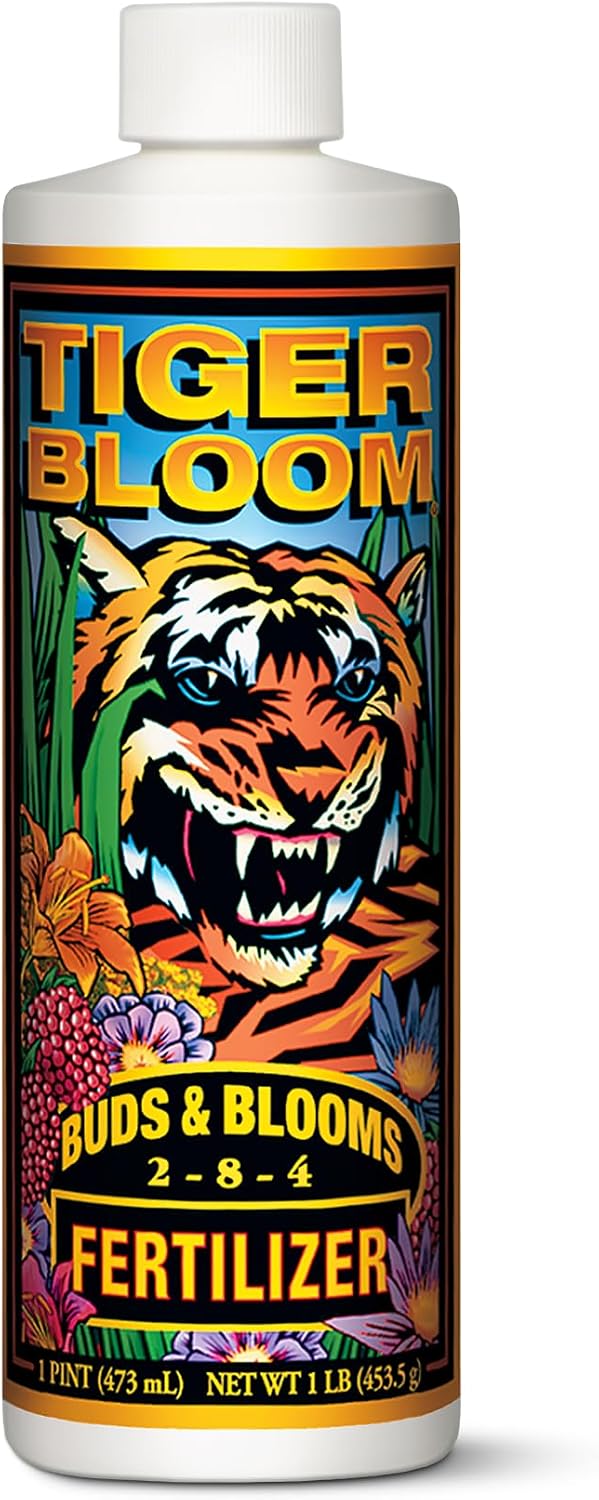
FoxFarm Tiger Bloom Liquid Plant Food (1 pint)
| Item Form | Liquid |
|---|---|
| Specific Uses For Product | Hydroponic |
| Application Method | Watering; Foliar spraying |
| Target Species | Flowering Plants |
| Mixing Ratio | 1:200 or 1:300 |
Tiger Bloom is a liquid, high-phosphorus fertilizer designed to push plants into a strong flowering and fruiting phase. You mix a small amount into the irrigation water or use it as a foliar spray and apply from first signs of flowering through harvest. The 2-8-4 formula and included micronutrients support bud set and larger blooms, and the concentrate mixes at 1:200 to 1:300 for routine feeding or 2 to 4 teaspoons per gallon for heavier feeding. It works in both soil and hydroponic setups and is formulated for quick nutrient uptake and stable micronutrient availability during storage. Practical benefits include flexible application methods, suitability for intensive flowering cycles, and a small bottle that lasts when used at recommended dilutions. Important limitations are that it is bloom-focused rather than an all-purpose feed so it may not meet vegetative needs, and the phosphorus content means users near waterways should follow local regulations to avoid runoff issues.
Best for: Serious growers who prioritize maximizing flower and bloom performance and want a concentrated, fast-acting bloom booster for soil or hydroponic environments.
Less Ideal for: Casual gardeners seeking a single all-purpose fertilizer for every growth stage or those managing turf or non-flowering lawns where phosphorus restrictions apply.
- High phosphorus NPK (2-8-4) concentrated for stronger bud development
- Works in soil and hydroponic systems for versatile use
- Liquid concentrate mixes easily for foliar or watering applications
- Formulated for quick nutrient uptake and stable micronutrient availability
- Focused on flowering so it is not a balanced all-stage fertilizer
- Contains phosphorus which may be restricted near waterways
Verdict: Choose Tiger Bloom when you need a concentrated, fast-acting bloom booster to maximize flower and fruit production.
Miracle-Gro Fruit & Citrus Plant Food Spikes (12-count)

| Item Form | Sticks |
|---|---|
| Specific Uses For Product | Fruit & Citrus Tree Care |
| Application Method | Insert spikes into the ground |
| Mixing Ratio | 10:15:15 |
| Number of Items | 12 |
These Miracle-Gro Fruit & Citrus Plant Food Spikes are pre-measured, slow-release sticks designed to feed in-ground fruit and citrus trees, including avocados, with a 10-15-15 NPK formula. Use is simple: water the soil to soften it, place spikes around the tree drip line according to the label chart, then drive them below the soil surface with a mallet or by stepping on them. The spikes deliver nutrients directly to the root zone, which reduces mess compared with granular feeding and eliminates monthly mixing. They are intended for a twice-yearly schedule, one application in early spring and another in mid-fall, so maintenance is low. Because the spikes are targeted and contain a balanced NPK higher in phosphorus and potassium, they can support flowering and fruit set for productive trees. Limitations to note are the infrequent feeding schedule and fixed nutrient ratio, so if your soil test shows different needs or you prefer monthly liquid feeding you may need supplemental products. Very compact root zones or heavy clay that stays hard when wet can make insertion difficult without extra effort or tools.
Best for: Home gardeners who want a low-effort, seasonal fertilizer for established avocado and other fruit trees and who prefer a simple apply-twice-a-year routine backed by broad user experience.
Less Ideal for: Growers who rely on frequent liquid feeding, need a customized nutrient program from soil tests, or work exclusively with container-grown trees.
- Direct root-zone delivery reduces surface runoff and mess compared with broadcast granules
- Pre-measured spikes make seasonal feeding fast and low-effort
- 10-15-15 NPK supports flowering and fruit development useful for fruiting trees
- Works on a range of trees listed for the product including avocado and palm
- Fixed NPK ratio and twice-yearly schedule may not match specific soil test recommendations
- May be hard to insert in very compacted or rocky soils without a mallet or tool
Verdict: A low-maintenance, targeted fertilizer solution that makes seasonal feeding of avocado and other fruit trees quick and reliable.
TPS Nutrients Lemon Tree Fertilizer Liquid, 8 fl oz

| Item Form | Liquid |
|---|---|
| Application Method | Watering can, hose end sprayer, or leaf misting |
| Target Species | Lemon Trees |
| Mixing Ratio | 1:200 |
| Liquid Volume | 8 fluid ounces |
This 8 fl oz liquid fertilizer from TPS Nutrients is made specifically for lemon and other citrus trees and is used by diluting at the recommended 1:200 ratio and applying with a watering can, hose‑end sprayer, or by leaf misting. It is designed to promote fruit production, support healthy leaves and shoots, and build stronger roots so trees absorb water and nutrients more effectively. The liquid form delivers nutrients quickly for potted trees on patios as well as in-ground specimens, and the medium coverage makes it suitable for individual trees or small groups. Practical benefits include fast absorption, simple dilution and multiple application methods that fit common garden routines. Limitations are the small 8 ounce bottle size, which means frequent repurchasing for larger citrus collections, and lack of detailed NPK values on the label for gardeners who prefer exact nutrient ratios. Overall this is a convenient, citrus-focused supplement for home growers seeking straightforward feeding for Meyer and dwarf varieties.
Best for: Home gardeners who want a ready-to-use, citrus-specific feed for one or a few lemon trees and prefer simple dilution and flexible application methods.
Less Ideal for: Growers managing larger orchards or multiple mature trees who need bulk quantities or exact NPK formulations should consider commercial‑scale fertilizers instead.
- Formulated specifically for lemon and citrus so nutrients suit citrus needs.
- Liquid concentrate with 1:200 mixing for quick uptake and flexible application.
- Multiple application methods: watering can, hose‑end sprayer, or foliar misting.
- Suitable for both potted and in‑ground citrus, useful for patios and small orchards.
- Small 8 fl oz bottle may not last for multiple trees or large plantings.
- Product listing does not provide explicit NPK numbers for precise nutrient planning.
Verdict: A convenient liquid concentrate tailored to lemon and citrus that makes regular feeding easy for home growers with one or a few trees.
Choosing the Right Guava Fertilizer: Key Factors to Consider
Nutrient Ratio and Timing
Guava trees need a balance of nitrogen, phosphorus, and potassium to support both vegetative growth and fruit production. Nitrogen encourages leafy growth early in the season, while phosphorus helps with root development and flowering, and potassium supports fruit set and quality. Choosing a fertilizer with a ratio that matches your tree's stage is important: higher nitrogen for young, actively growing trees and a more balanced or slightly higher phosphorus and potassium mix as trees approach flowering.
Timing of applications matters. Apply most fertilizers in the active growing season and reduce feeding during dormancy or slow growth. Over-application of nitrogen late in the season can delay fruiting and increase susceptibility to pests and disease.
Release Pattern and Solubility
Slow-release formulations provide a steadier supply of nutrients and reduce the risk of salt buildup in the root zone, which is useful for container-grown guavas or sites with limited irrigation. Water-soluble fertilizers give an immediate nutrient boost and are helpful when a quick response is needed, such as correcting a deficiency or stimulating flowering after a soil test.
Consider how often you want to apply fertilizer. Slow-release granules typically need less frequent application, while soluble feeds might be used monthly during peak growth. Match release pattern with your watering habits to avoid nutrient flush or leaching.
Soil Health and Secondary Nutrients
Guava trees benefit from a soil environment rich in organic matter and with good microbial activity. Fertilizers that include or complement organic amendments help maintain structure, moisture retention, and nutrient availability over time. Look for products that either contain beneficial secondary nutrients such as calcium, magnesium, and sulfur, or pair well with organic composts.
Avoid fertilizers high in salts or with excessive single-nutrient concentration that can harm soil biology. Regular soil testing helps you target missing micronutrients rather than blanket-feeding, which can create imbalances.
Application Method and Practicality
How a fertilizer is applied affects labor and effectiveness. Granular spreaders, root-zone banding, and surface broadcasting are common for in-ground trees, while water-soluble or liquid feeds are often best for container-grown guavas or foliar boosts. Consider whether your site is accessible for repeat applications and whether you prefer hands-on feeding or a low-maintenance slow-release approach.
Also check label guidance for safe rates based on tree size. Over-application is a frequent gardener mistake that can lead to leaf burn, excessive vegetative growth, and reduced fruiting. Choose a product whose instructions match your comfort with measuring and mixing.
Suitability for Tree Age and Size
Young trees need nutrients that prioritize root and structural growth, while mature fruiting trees require formulations that support flowering and fruit development. Smaller trees in containers have different nutrient dynamics than large in-ground specimens and are more prone to salt accumulation and nutrient swings.
Select a fertilizer whose application rates scale down for nursery-sized or patio trees and scale up for established orchard specimens. This ensures you do not underfeed young trees or overfeed small container specimens.
When to Feed Guava Trees
Feed guava trees during active growth to maximize nutrient uptake. In most climates that means a primary feeding in spring as new growth begins and lighter follow-up applications through the summer. Avoid heavy feeding late in the season when trees are preparing for slower growth or cooler temperatures.
For newly planted guava trees, delay full-strength fertilization until roots have begun to establish, and use diluted or lower-rate applications to avoid burning tender roots. Mature trees usually tolerate standard application rates, but always check label recommendations that correspond to trunk girth or canopy size.
- Primary feeding at the start of the growing season
- Smaller, more frequent doses for containers
- Avoid high-nitrogen late-season feeding
Using Soil Tests to Guide Feeding
A simple soil test can identify pH and nutrient deficiencies so you can tailor fertilizer choice. Guavas prefer slightly acidic to neutral soils, and a pH outside the optimal range can lock up nutrients even when fertilizer is applied.
Base fertilizer selection on test results: correct major nutrient shortfalls first and consider adding amendments for pH adjustment or organic matter to improve overall nutrient availability. Retest every couple of years to track changes after amendments.
- Test pH and major nutrients before routine feeding
- Adjust pH with lime or sulfur only when tests indicate need
- Use organic matter to improve long-term nutrient retention
Fertilizing Container-Grown Guava Trees
Containers create a different nutrient environment because water flow and root confinement can concentrate salts and deplete nutrients quickly. Use lower, more frequent doses of balanced soluble fertilizer or a controlled-release product formulated for containers.
Flush containers occasionally to prevent salt build-up, and top-dress with compost or slow-release granules at the start of the growing season. Monitor leaf color and growth rate closely, as container trees often show deficiency signs faster than in-ground trees.
- Prefer smaller, more frequent feedings
- Flush container soil to reduce salts
- Include organic top-dress for steady nutrient supply
Organic Vs Synthetic Options
Organic fertilizers release nutrients more slowly and help build soil organic matter, which benefits root health and microbial life. They are a good choice for gardeners focused on long-term soil improvement and steady, low-risk nutrient delivery.
Synthetic fertilizers offer precise N-P-K ratios and rapid correction of deficiencies. They can be useful when an immediate nutrient response is needed, such as to stimulate flowering. Many gardeners combine both approaches, using organic amendments as a base and targeted synthetic treatments for short-term corrections.
- Organics improve soil structure and microbial health
- Synthetics give quick, measurable nutrient boosts
- Blended approaches balance short-term needs with long-term soil care
Common Application Mistakes to Avoid
A frequent error is over-applying nitrogen in pursuit of green growth, which can suppress flowering and fruiting in guava. Another mistake is failing to account for fertilizer concentration in containers or small plots, resulting in burned roots or inhibited growth.
Also avoid applying fertilizer too close to the trunk where concentrated salts can damage bark and roots. Instead spread nutrients evenly across the root zone and water in after application to move nutrients into the soil where roots can access them.
- Do not concentrate fertilizer at the trunk base
- Avoid excessive nitrogen late in the season
- Follow label rates adjusted for tree size
How We Chose the Best Guava Fertilizer
Our shortlist focused on fertilizers that suit guava trees at different growth stages and common garden situations. We prioritized nutrient formulas that support flowering and fruiting while avoiding salts and imbalances that stress shallow-rooted fruit trees. Fertilizers were evaluated on nutrient balance and availability, ease of application for home gardeners, effects on soil health, and consistency of results across climates typical for guava cultivation. We excluded products whose labels lacked clear nutrient analysis or application guidance, and we did not consider specialty mixes intended only for large commercial operations. Practical performance indicators mattered most: clear N-P-K ratios and secondary nutrients, soluble versus slow-release behavior, application flexibility for pot or in-ground trees, and directions that gardeners can follow safely. We also considered packaging sizes and formulation types that reduce the risk of overfertilizing small urban plots. The criteria above align with the scoring metrics shown in our product cards, and they reflect the aspects of fertilizers that most affect guava growth, flowering, and soil resilience.
FAQ
How often should I fertilize an established guava tree?
Usually feed established guava trees two to three times during the active growing season, with the heaviest application in spring. Frequency depends on fertilizer type: slow-release may only need one application, while soluble feeds are applied more often at lower rates.
Can I use a general fruit tree fertilizer for guava?
Often a general fruit tree fertilizer will work if its nutrient ratio fits your tree's needs. Check that the mix supports flowering and fruit set and adjust timing and rate based on tree age and soil test results.
What signs indicate my guava tree needs feeding?
Pale or yellowing leaves, reduced new growth, and poor flowering can indicate nutrient deficiency. A soil test is the most reliable way to confirm which nutrients are lacking before applying fertilizer.
Is foliar feeding effective for guava trees?
Foliar feeding can quickly correct certain micronutrient deficiencies and provide a short-term boost, but it should not replace regular root-zone feeding. Use foliar sprays as a supplement when a soil test indicates specific micronutrient needs.
How should I adjust feeding for guava trees in pots?
Reduce application rates and increase feeding frequency for container trees, and flush pots periodically to prevent salt build-up. Use a balanced, water-soluble feed or a slow-release product formulated for containers.
Final Verdict
Pick a fertilizer that matches your guava tree's stage and the realities of your site. Prioritize a nutrient ratio that supports flowering and fruit set, a release pattern that fits your maintenance routine, and products that protect or build soil health. Be conservative with nitrogen late in the season and always follow label rates scaled to tree size. With the right approach you can improve flowering, fruit quality, and long-term tree vigor.
