

Note: This article contains affiliate links. If you click on these links and make a purchase, I may earn a small commission at no extra cost to you. This helps support my research and content. Read my full affiliate disclosure here.
A tow behind lawn fertilizer spreader can cut hours off lawn care by covering large turf areas evenly without repeated back-and-forth with a handheld tool. Choosing the right tow-behind spreader matters because capacity, spread pattern, and durability determine how fast you work, how uniformly fertilizer is applied, and how long the unit lasts under real yard conditions. This guide shortlists the top picks for residential lawn use, focusing on equipment that performs well behind a riding mower or ATV. We evaluated models on practical criteria gardeners care about: hopper capacity, spread consistency, frame durability, and ease of adjustments and maintenance. Read on for a clear explanation of the factors that matter and practical advice for using and storing a tow behind fertilizer spreader.
Top Picks at a Glance
| Best Quality Built to a higher standard if you want something more solid | Brinly BS26BH-A Tow-Behind Broadcast Spreader, 125 lb. Capacity |  |
| Best Value The sweet spot between price and what you get | GarveeLife Tow-Behind Broadcast Spreader, 130 lb Capacity |  |
| Best Budget The cheapest option that still gets the job done reliably | Takywep 80 lb Tow-Behind Broadcast Spreader with 10" Tires |  |
| Highest Rated A top-rated pick with lots of positive feedback | Agri-Fab 130-Pound Tow-Behind Broadcast Spreader with 110–130 lb Grate Kit |  |
| Most Popular A crowd favorite that many people choose with confidence | Agri-Fab 130 lb Pull-Behind Broadcast Spreader (Model 45-0463) |  |
Brinly BS26BH-A Tow-Behind Broadcast Spreader, 125 lb. Capacity

| Capacity | 125 lb (2.5 cu ft) |
|---|---|
| Hopper material | Polyethylene |
| Gears | Enclosed glass-filled nylon |
| Hardware | Stainless steel interior |
The Brinly BS26BH-A is a heavy-duty tow-behind broadcast spreader built for homeowners who need professional-style results on larger lawns. It attaches to a mower or tractor and distributes seed, fertilizer, ice melt and granular pest controls from a 2.5 cu ft (125 lb) rustproof polyethylene hopper so you can cover more ground between fills. Notable features include enclosed glass-filled nylon gears and stainless interior hardware to resist corrosion, a patented Autoflow system that stops product flow when you stop moving, and an adjustable directional spread pattern control to reduce striping and improve uniformity. Calibration is simplified with a locking dial and numerous pre-calibrated settings, and the unit is designed for seasonal use with fertilizers, seed, sand and ice melt. Expect sturdy, low-maintenance construction and efficient coverage, but plan on a one-time assembly and occasional gearbox maintenance if used heavily. The BS26BH-A is optimized for larger residential lawns where capacity and consistent distribution matter most.
Best for: Homeowners with yards around half an acre or larger who prioritize consistent, professional-level spreading and want to minimize trips to refill during fertilizing and overseeding.
Less Ideal for: People with small urban lawns, those who need a wheeled push spreader, or buyers without a compatible tow vehicle should consider smaller, self-contained options.
- Large 125 lb polyethylene hopper reduces refill frequency for half-acre and larger lawns
- Autoflow system stops material flow when the tractor stops to prevent overapplication and turf burn
- Directional spread pattern control helps achieve even, stripe-free coverage with different materials
- Corrosion-resistant components including stainless steel hardware and enclosed glass-filled nylon gears
- Requires assembly and occasional gearbox upkeep for heavy seasonal use
- Tow-behind design needs a compatible mower or tractor and appropriate hitch
Verdict: Choose the BS26BH-A when you need high-capacity, durable tow-behind performance and precise, uniform spreading across larger lawns.
GarveeLife Tow-Behind Broadcast Spreader, 130 lb Capacity

| Capacity | 130 lbs |
|---|---|
| Tire type | 10" pneumatic tires |
| Frame | Powder-coated steel |
The GarveeLife tow-behind broadcast spreader is a straightforward, work-focused machine for covering medium to large lawns and driveways. It mounts to a lawn tractor, ATV, or UTV via a durable tow bar and uses a powder-coated steel frame and rust-resistant poly hopper to resist corrosion in seasonal outdoor use. The adjustable flow handle and spreader plate let you control material output and achieve even coverage up to about 10 feet wide, making it usable for seed, fertilizer, ice melt, and sand. Ten-inch pneumatic tires give good traction and a smoother roll across uneven turf or gravel. Practical additions like a waterproof cover and sieve help keep materials dry and prevent clumping. Downsides are that it is a simple mechanical spreader without powered agitation, so very wet or compacted material may still clog, and assembly or hitching can take a little time for first-time users. For routine lawn maintenance and winter deicing this spreader performs the basic tasks reliably.
Best for: Buyers who want a practical, no-frills tow-behind spreader to cover medium to large lawns and driveways efficiently and reduce repeated trips to refill.
Less Ideal for: People who need a motorized or high-capacity commercial spreader for continuous heavy use or those who only have a small hand-push spreader need.
- Rust-resistant poly hopper and powder-coated steel frame resist corrosion for seasonal outdoor use
- Adjustable flow control and spreader plate deliver even distribution up to about 10 feet wide
- 10" pneumatic tires provide stable rolling and traction over uneven turf and gravel
- Large 130 lb capacity hopper reduces refill trips for larger yards
- No powered agitation system, so very wet or compacted materials can clog
- Requires hitching and some initial assembly which may be awkward for a single user
Verdict: A durable, easy-to-use tow-behind spreader that handles seed, fertilizer, and ice melt for homeowners who want efficient coverage without fancy electronics.
Takywep 80 lb Tow-Behind Broadcast Spreader with 10" Tires

| Hopper capacity | 80 lb (30 L) |
|---|---|
| Tire size | 10" pneumatic tires |
| Frame | Powder-coated carbon steel |
This Takywep tow-behind broadcast spreader is a straightforward, value-oriented option for covering medium to large lawns without repeated refills. It mounts to riding mowers, ATVs, UTVs, or small tractors with a pin-style hitch so you can spread seed, fertilizer, or ice melt while seated. The rust-resistant 80 lb poly hopper cuts down trips back to the bag, and the rate-control lever provides quick adjustments for light seed or heavier granules. Large 10-inch pneumatic tires help the unit roll smoothly over turf, mud, gravel, and light snow, and the powder-coated carbon steel frame adds basic weather resistance. Practical benefits include reduced labor, more even coverage from the broadcast disc, and multi-season use for both lawn care and winter de-icing. Expect assembly and occasional calibration to get the spread width dialed in, and the build quality is consistent with an affordable model rather than a professional-grade spreader. For budget buyers who want a capable tow-behind unit for seasonal tasks, this does the job well; those needing commercial durability or precise small-area spreading may want a heavier-duty alternative.
Best for: Homeowners who want an affordable tow-behind spreader to cover medium to large lawns with minimal refills and simple, seasonal use.
Less Ideal for: Landscape professionals or anyone who needs heavy commercial duty, higher longevity, or extremely precise small-area spreading.
- Large 80 lb poly hopper reduces how often you need to refill during a job
- Adjustable rate-control lever lets you switch quickly between seed, fertilizer, and ice melt
- 10-inch pneumatic tires provide better traction and smoother rolling over uneven ground
- Powder-coated carbon steel frame resists weathering for seasonal outdoor use
- Build quality is typical for an entry-level unit and not intended for heavy commercial use
- May require assembly and occasional calibration to achieve consistent spread patterns
Verdict: A budget-friendly tow-behind spreader that saves time on medium to large lawns by combining a large hopper and wide-terrain tires for simple, seasonal spreading tasks.
Agri-Fab 130-Pound Tow-Behind Broadcast Spreader with 110–130 lb Grate Kit

| Wheel Type | Pneumatic |
|---|---|
| Load Capacity | 130 pounds |
| Number of Wheels | 4 |
| Material Type | Metal, Rubber |
The Agri-Fab 130-pound tow-behind broadcast spreader is built for homeowners with larger lots who need a dependable way to distribute fertilizer, seed, or ice melt from a tractor. It uses a rod-linked on-off flow gate that can be operated from the tractor seat for quick start and stop control and a precise setting adjustment for consistent application. The enclosed tapered gearbox and pneumatic wheels with a wide wheelbase help the unit run smoothly over rough terrain while protecting internal parts from debris. The included grate kit reduces clumping and improves material flow, which means fewer blockages and more consistent spreading. The hopper is rust-resistant and sized to cut down on refills on acre-plus properties. Expect a durable, utilitarian machine that prioritizes consistent performance and low maintenance, though it is a heavy, tractor-towed unit rather than a compact push spreader and may be overkill for very small yards.
Best for: Homeowners with larger lots who prioritize a durable, low-maintenance spreader that delivers consistent application while being towed behind a lawn tractor.
Less Ideal for: People with small lawns, those who need a compact push spreader, or buyers who do not have a towing vehicle on hand.
- Large 130-pound poly hopper reduces refills for bigger properties
- Rod-linked on-off flow gate with adjustable settings for precise control from the tractor seat
- Enclosed tapered gearbox protects gears and provides smooth, reliable operation
- Pneumatic tires and wide wheelbase improve stability over uneven terrain
- Grate kit prevents clumping and maintains consistent material flow
- Designed as a tow-behind unit so it is not suitable for small yards without a tractor
- Requires occasional trimming or fitting of the grate on some models
Verdict: Choose this Agri-Fab tow-behind spreader if you need a robust, low-maintenance machine that reliably covers large lawns with consistent material flow.
Agri-Fab 130 lb Pull-Behind Broadcast Spreader (Model 45-0463)
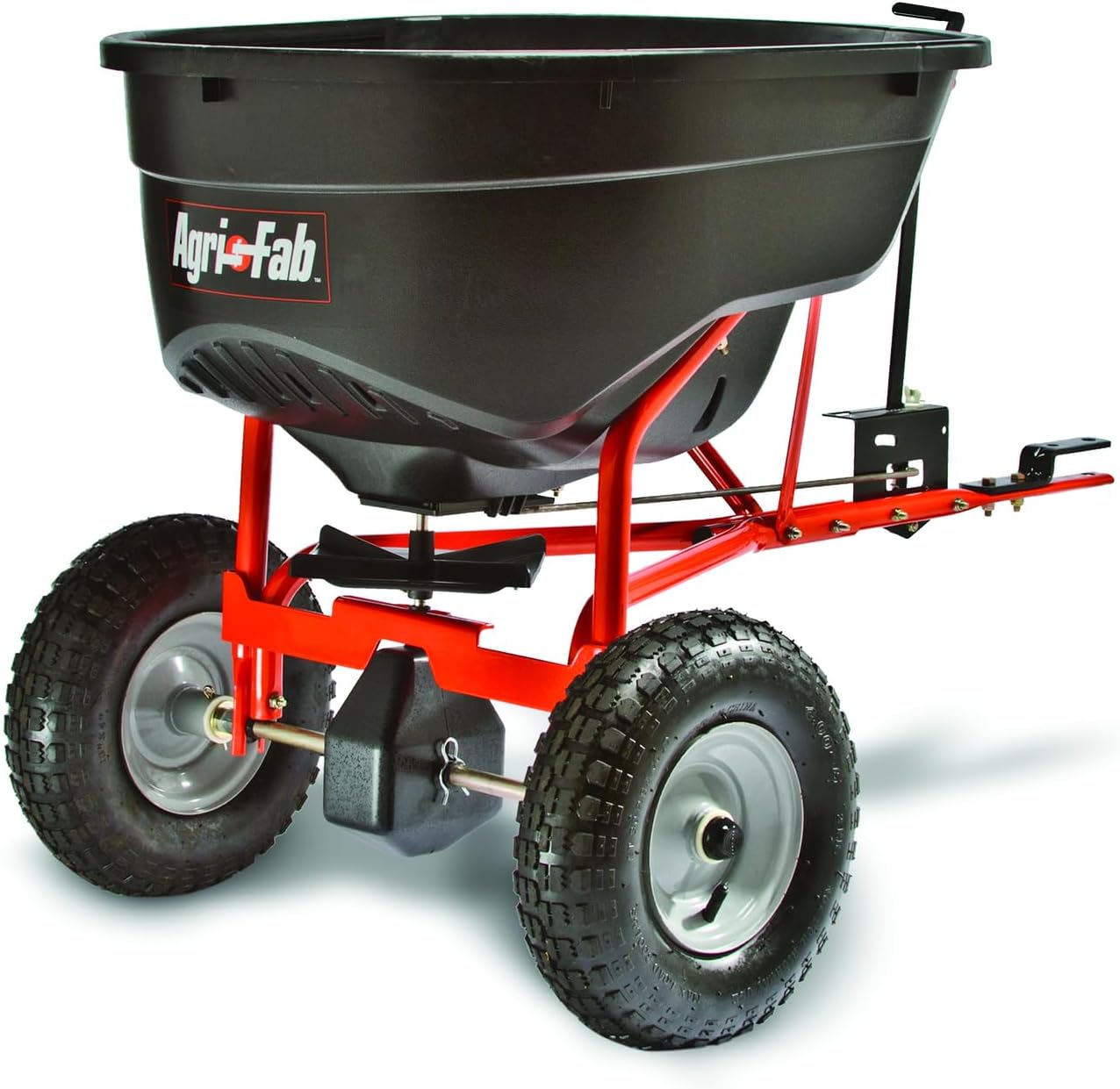
| Weight Capacity Maximum | 130 pounds |
|---|---|
| Spread Width | 10-12 ft |
| Tire Type | Pneumatic |
| Material Type | Alloy Steel, Polypropylene (PP), Rubber |
The Agri-Fab 130 lb pull-behind broadcast spreader is built for straightforward, dependable lawn care on larger yards. It mounts to most riding mowers with a universal hitch and holds up to 130 pounds, letting you cover roughly half an acre per fill to reduce interruptions. The wide 10 to 12 foot spread pattern and enclosed gear box promote more even dispersal and protect internal parts from dirt and moisture. A simple steel-rod flow control is reachable from the tractor seat so you can change application rates without stopping. The construction combines a poly hopper with alloy steel frame tubing and pneumatic tires for durability and smoother towing over uneven ground. Expect easy seasonal use for grass seed, fertilizer, granular lawn treatments, and salt. The main limitations are that it is a basic broadcast design, so very precise banding or ultra-fine calibration for specialty seed mixes may require additional passes or a different spreader type, and some assembly is required before first use.
Best for: Homeowners or property managers who want a reliable, no-nonsense tow-behind spreader to cover medium to large lawns efficiently and with minimal fuss.
Less Ideal for: Gardeners who need highly precise application patterns or small-plot users who prefer a handheld or walk-behind drop spreader for tight spaces.
- Large 130 lb hopper covers up to about 25,000 sq ft per fill to reduce refills on bigger lawns
- Universal hitch fits most riding mowers and lawn tractors for quick hookup
- Wide 10–12 ft spread width delivers even coverage with fewer passes
- Enclosed gear housing and steel frame improve durability and protect moving parts
- Seat-accessible steel-rod flow control lets you change settings without dismounting
- Broadcast design is less suited to precision banding or very narrow applications
- Requires assembly before first use
Verdict: A durable, easy-to-use tow-behind spreader that reliably covers larger lawns with fewer refills and minimal operator adjustments.
Choosing the Right Tow Behind Lawn Fertilizer Spreader: Key Factors to Consider
Hopper Capacity and Size
Hopper capacity determines how much material you can carry between fills. A larger hopper reduces the number of stops needed on bigger lawns, which speeds up work but also increases towing weight and may affect maneuverability around obstacles.
Consider the typical size of your lawn and the product application rate. If you routinely treat several acres or are applying heavy materials like seed or winter salt, prioritize a larger capacity. For tight suburban yards with many flower beds and trees, a mid-size hopper often balances convenience with easier handling.
Spread Pattern and Consistency
Spread consistency refers to how evenly the unit disperses granules across a swath. Even coverage means healthier turf and avoids concentrated burn spots where too much fertilizer lands. Look for spreaders with adjustable deflectors or fans and straightforward calibration markings so you can match the setting to the product label application rate.
Wind, vehicle speed, and the shape of the discharge opening all affect pattern. Choose a model with a reputation for predictable patterns at typical mowing speeds and that allows you to narrow or widen the broadcast to suit different materials and conditions.
Frame, Axle, and Wheel Durability
Durable frames, solid axles, and puncture-resistant wheels reduce service visits and keep the spreader tracking true behind a mower. Steel frames with corrosion-resistant finishes handle heavier loads and rough handling better than thin plastic components. Reliable wheel bearings and a stout axle matter because uneven wheel spin will distort the spread pattern and increase wear.
If you plan to store the spreader outdoors or use corrosive materials seasonally, prioritize corrosion-resistant hardware and easily replaceable wheels. Robust construction also helps when towing over rough turf or uneven driveways.
Adjustment and Calibration Ease
Being able to quickly and accurately set the feed rate and spread width makes on-the-fly changes straightforward when switching materials or targeting problem areas. Clear, graduated controls and simple linkages reduce mistakes and wasted material. Some units offer ratcheting levers or indexed plates that let you replicate settings from one application to the next.
Calibration is useful when you first use a new product or after adjusting the hitch or tow speed. Choose a design where you can access the control points without tools and that has readable markings that correspond to application charts.
Compatibility With Towing Vehicles
Tow compatibility covers hitch type, drawbar height, and how the spreader tracks behind different mowers or ATVs. A mismatched hitch or incorrect drawbar height can tilt the hopper or alter the agitation and feed, leading to inconsistent distribution. Some spreaders offer adjustable towing heights or universal hitches to fit a wider range of machines.
Confirm the spreader will connect securely to your equipment and consider how tight turns and backing will perform. For smaller tractors, a lighter, lower-profile unit may be easier to maneuver, while full-size residential tractors can handle heavier hoppers.
Maintenance and Cleaning Requirements
Regular cleaning and basic maintenance extend the life of a spreader and prevent blockages or corrosion. Look for hoppers with smooth interiors, easy-access drain points, and parts that can be rinsed without removing complex assemblies. Sealed bearings, replaceable agitators, and simple hardware make seasonal service faster and less likely to require special tools.
If you use several materials seasonally, plan for flush procedures and storage steps that minimize residue buildup. A spreader that is easier to maintain will stay accurate longer and reduce the chance of clogged openings.
Matching Spread Rate to Lawn Size
Choosing the right spread rate setting requires thinking in terms of area covered per hopper load and the application rate recommended on the fertilizer label. For small lawns, a lower flow rate reduces the chance of overapplication near edges. For larger properties, higher feed settings and a larger hopper minimize downtime.
Measure a fixed swath width and drive a test pass to confirm how much material is discharged per length. That practical check lets you calculate how many passes and how much product you will need, which is faster than guessing from charts alone.
- Do a short test run on an inconspicuous strip before treating the whole lawn.
- Record the vehicle speed and hopper setting that gave the desired coverage for future reference.
Setting Up the Tow Hitch and Height
Proper hitch attachment and drawbar height keep the spreader level so the feed mechanism works as designed. If the unit tips forward or back, flow rate and agitation can change unpredictably. Adjust the hitch to keep the axle roughly level with the tow vehicle's rear axle for the most consistent operation.
Check that the hitch pin and safety hardware are secure, and make trial turns at low speed to ensure the unit does not bind or catch on the mower's rear tires.
- Keep the spreader centered behind the vehicle to prevent uneven lateral discharge.
- Use a quick-release connector or properly rated hitch pin for easy removal and storage.
Material Compatibility and Handling
Not all spreaders handle every granular product equally. Large, irregular seed or heavy blends may require a wider opening or stronger agitation. Fine fertilizers need a smaller, controlled feed to avoid clouds of dust and wind drift. Check the manufacturer guidance on compatible materials when possible, and always test a new material at a low setting.
When applying wet or clumping materials, keep the hopper covered and avoid using products that have started to cake. Dry, free-flowing materials produce the most predictable patterns and minimize hopper cleaning later.
- Use screens or mesh covers to reduce the chance of debris entering the hopper.
- Avoid very fine powders in spreaders designed for larger granules to prevent clogging.
Seasonal Storage and Off-Season Care
Flush the feed mechanism and rinse the hopper after each use, especially if applying fertilizers that can corrode metal. Dry the unit thoroughly before long-term storage to reduce rust and degradation. If possible, store under cover or inside a shed to protect tires and plastic components from UV and temperature extremes.
Lubricate moving parts and inspect bearings and fasteners before returning the spreader to service in spring. Replacing worn tires or axle parts early prevents uneven wear and keeps spread patterns consistent.
- Keep a simple maintenance checklist: clean, dry, lubricate, inspect.
- Store with the hopper lid closed and off the ground to avoid moisture pooling.
Safe Operation Tips
Operate at moderate speeds recommended for your spreader and material. Excessive speed increases wind drift and reduces spread uniformity. Slow, steady passes produce the most reliable results and reduce material bounce or throw-off.
Wear appropriate personal protective equipment when loading and cleaning the hopper to avoid inhaling dust or exposing skin to concentrated fertilizer. Keep bystanders and pets away while applying materials.
- Avoid sharp turns while full to reduce the risk of tipping
- Shut off the feed before crossing sidewalks or driveways to prevent spillage
How We Chose the Best Tow Behind Lawn Fertilizer Spreader
We chose products that meet the needs of homeowners managing lawns from small to several acres, prioritizing items that deliver consistent material flow and durable construction. Our selection filters required a minimum of a robust hopper and a controllable flow mechanism suitable for common granular fertilizers, seed mixes, and ice melt. We favored spreaders with adjustable opening sizes and even, repeatable spread patterns so settings can be matched to application rate charts. Durability checks focused on frame material, axle and wheel quality, and corrosion-resistant components for outdoor storage. Ease-of-use considerations included how simple it is to adjust the spread width and rate, how easy the hopper is to refill and clean, and whether common maintenance tasks can be done without special tools. We excluded lightweight lawn-only units that lack the capacity or hitching options necessary for towing behind most lawn tractors or ATVs. The final list balances capacity, spread consistency, build durability, and straightforward maintenance for reliable seasonal performance.
FAQ
How wide a swath can I expect from a tow-behind fertilizer spreader?
Swath width varies by model and setting but usually ranges from a few feet to more than 10 feet. Wind and speed affect the effective width, so test a pass at your normal towing speed to establish a reliable working swath.
Can I use a tow-behind spreader for seed as well as fertilizer?
Often yes, but material size matters. Small seeds and fine fertilizers may require lower feed settings or different agitation. Test on a small area first to confirm even distribution and avoid burying seed too deep.
What maintenance keeps a spreader working reliably year after year?
Regular cleaning after each use, drying before storage, periodic lubrication of pivot points, and inspection of tires and bearings are the main tasks. Replace worn agitators or fasteners before they cause inconsistent flow.
Will a larger hopper always save time?
A larger hopper reduces refill frequency on big properties but adds tow weight, which can make maneuvering tighter spaces more difficult. Balance capacity against how you use your mower and the terrain you cover.
How do I avoid burn spots when applying fertilizer with a tow-behind unit?
Ensure the spread pattern is even and avoid double passes over the same area. Calibrate the feed rate with a test strip and follow the fertilizer label for recommended rates based on lawn area.
Final Verdict
Pick a tow-behind fertilizer spreader that matches the scale of your property and the materials you plan to use. Prioritize consistent spread pattern and a hopper size that reduces stops without making the unit unwieldy. Durable frame and axle components, plus easy adjustment and cleaning, prevent uneven applications and extend service life. Tradeoffs include capacity versus maneuverability and heavier construction versus easier storage. Focus on spread consistency and maintenance accessibility to get the most reliable results season after season.
