

Note: This article contains affiliate links. If you click on these links and make a purchase, I may earn a small commission at no extra cost to you. This helps support my research and content. Read my full affiliate disclosure here.
Choosing the right pre and post emergent weed killer makes a visible difference in how tidy and productive your lawn, beds, and borders stay across a season. The right product both prevents weed seeds from sprouting and tackles established broadleaf and grassy weeds so you do not fight the same patches repeatedly. This guide shortlists top-rated pre and post emergent weed killers suited for general garden and lawn use and evaluates each for effectiveness, safety, and ease of application. We focus on how quickly products work, how long they protect treated areas, and what using them looks like in a real yard or garden. Read on to see the picks and the practical criteria used to vet them.
Top Picks at a Glance
| Best Overall The best all-around choice for most situations | Agrisel Sulfentrazone 4F Weed Killer, Pre-Emergent, 8 fl oz |  |
| Best Budget The cheapest option that still gets the job done reliably | BioAdvanced Season-Long Weed Control for Lawns, Ready-to-Spray (29 oz) |  |
| Highest Rated A top-rated pick with lots of positive feedback | ALLIGARE Diuron 80 DF Granular Herbicide, 5 lb |  |
| Most Popular A crowd favorite that many people choose with confidence | Syngenta Tenacity Turf Herbicide, 8 oz |  |
| Best Seller A high-volume bestseller chosen again and again | Roundup Dual Action 365 Weed & Grass Killer Plus 12 Month Preventer with Pump 'N Go 2 Sprayer |  |
Agrisel Sulfentrazone 4F Weed Killer, Pre-Emergent, 8 fl oz

| Brand | Agrisel |
|---|---|
| Item Form | Spray |
| Unit Count | 8 Ounce |
| Coverage | Approximately 2,500 square feet for 8 ounces |
Agrisel Sulfentrazone 4F is a liquid herbicide designed to prevent and control many common turf and landscape weeds. The product is supplied in a "tip and pour" bottle with a measuring chamber that makes dosing straightforward for small to medium areas. It treats both newly germinating weed seeds and actively growing weeds, which gives it flexibility for seasonal use as a pre-emergent and for spot post-emergent applications. The formulation claims broad-spectrum control and a single 8 ounce bottle covers roughly 2,500 square feet at manufacturer guidance, so it is relatively economical when used at recommended rates. Safety instructions note wearing gloves and keeping pets away until the treated area is dry, and users must provide their own spray equipment for broadcast applications. Because it is a concentrated chemical specifically for turf and large outdoor spaces, careful attention to label directions is essential to avoid non-target damage and to achieve expected results.
Best for: Gardeners and turf managers who want one product that handles both preseason prevention and spot treatment of established weeds and who value an economical concentrated formulation.
Less Ideal for: Small indoor or container gardeners looking for ready-to-use sprays or people who prefer non-chemical weed control methods.
- Works as both a pre-emergent and post-emergent for flexible seasonal use
- Concentrated 4F formulation covers large areas with low application rates
- Tip-and-pour bottle with integrated measuring chamber simplifies accurate dosing
- Broad-spectrum activity against common turf weeds
- Requires separate spray equipment for broadcast treatments
- Contains a concentrated active ingredient that needs careful handling and strict label compliance
Verdict: Choose this concentrated sulfentrazone formula if you want one economical product that prevents weed germination and also treats existing turf weeds.
BioAdvanced Season-Long Weed Control for Lawns, Ready-to-Spray (29 oz)
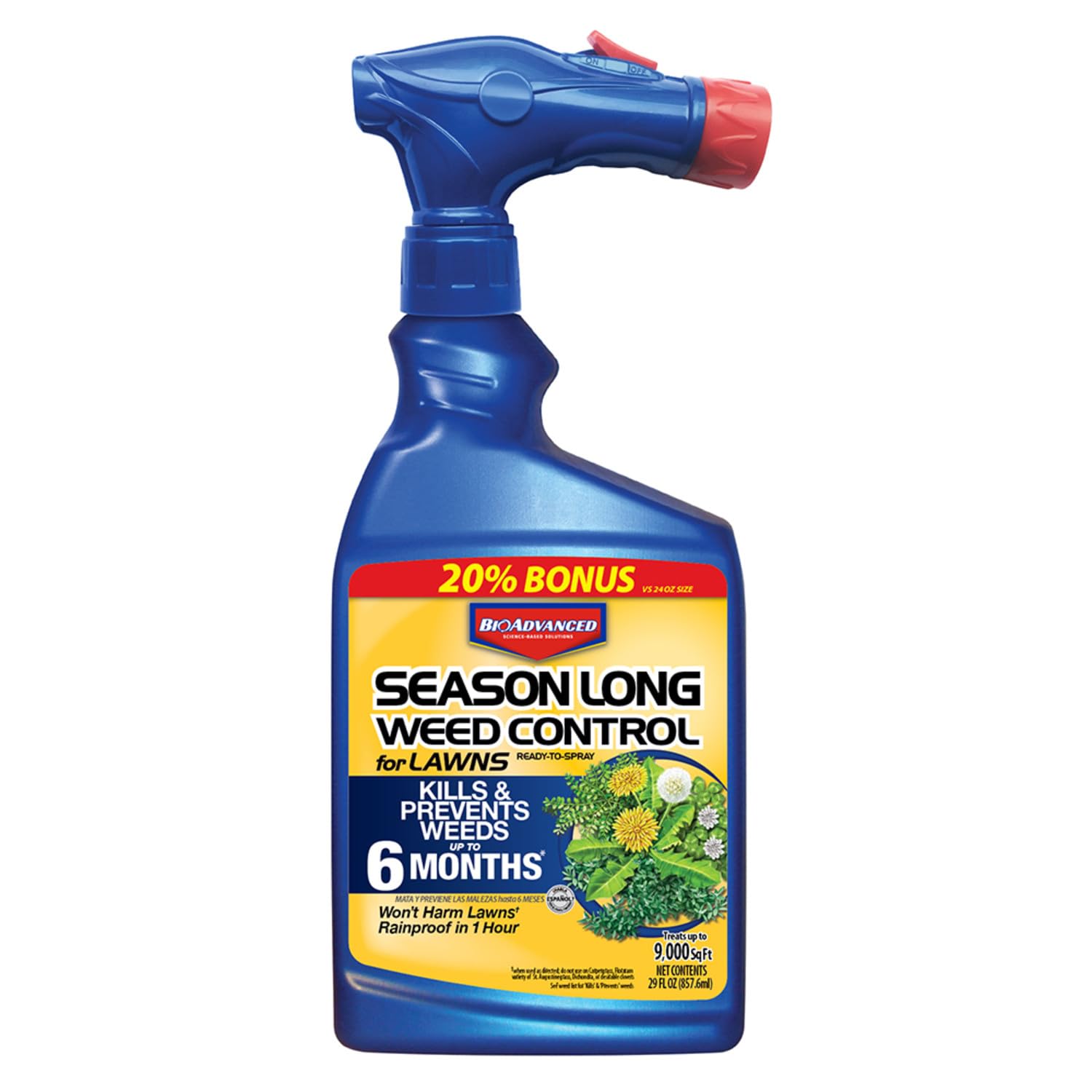
| Unit Count | 29 Fluid Ounces |
|---|---|
| Item Form | Oil |
| Coverage | 9000 square feet |
| Active Ingredients | 2,4-D dimethylamine Salt |
This ready-to-spray BioAdvanced product combines a post-emergent and pre-emergent formula to kill existing broadleaf weeds such as dandelion and clover and help prevent listed weeds for up to six months. It is supplied in a 29-ounce bottle with a trigger sprayer intended for spot or broadcast application on established lawns between 50 and 90°F. Key benefits include rainproofing in one hour and guidance for different regional application rates, which makes it straightforward to use on typical residential turf. Practical advantages are the convenience of a premixed applicator and long residual control that reduces how often you need to reapply. Important limitations are regional restrictions and the need to follow the specified rates for northern versus southern turf; it is for established lawns only and must be used with caution around desirable plants and children. For homeowners primarily trying to reduce follow-up treatments and simplify weed control, it delivers an easy, season-long option if applied according to directions.
Best for: Homeowners who want a low-effort, season-long weed control solution that reduces repeat treatments and simplifies lawn maintenance.
Less Ideal for: Gardeners with mixed beds, young/newly seeded lawns, or anyone needing an organic or non-chemical weed control method should consider other options.
- 2-in-1 formula kills existing broadleaf weeds and provides up to six months of prevention
- Ready-to-spray trigger applicator for easy, low-effort application
- Rainproof in one hour so treatments are less likely to wash away
- Clear directions for northern and southern turf application rates
- Not labeled for use in New York and has regional restrictions
- Intended for established lawns only and can harm non-target plants if oversprayed
Verdict: A convenient ready-to-spray option that kills broadleaf weeds and gives up to six months of prevention to cut down on repeat treatments.
ALLIGARE Diuron 80 DF Granular Herbicide, 5 lb

| Item Form | Granule |
|---|---|
| Coverage | 5-10 lb per acre or 3-4 lb per acre |
| Unit Count | 80 Ounce |
| Included Components | 1 5 lb bag of Alligare Diuron 80 DF |
| Active Ingredients | Herbicide |
ALLIGARE Diuron 80 DF is a granular herbicide designed for large-area, long-term weed suppression in non-crop settings. It is applied with standard ground spreaders or as part of tank mixes and works as both a pre-emergent and a post-emergent treatment, becoming active with rainfall to bind into the soil for persistent control. The formulation targets tough annual grasses and many broadleaf species, making it suitable for highways, airports, industrial lots, and other low-maintenance landscapes where reliability matters. Notable features include a broad species list and flexibility to mix with other herbicides for resistance management. Important limitations are regulatory and safety requirements that restrict where and how it can be used, plus the need for protective handling and careful application to avoid off-target exposure or water contamination. For managers needing durable, large-scale weed control, this product delivers consistent suppression when applied according to label directions, but it is not intended for home garden ornamentals or areas near surface water.
Best for: Landscaping or facility managers who need dependable, long-lasting weed control over large non-crop areas and value products proven for harsh environments and predictable performance.
Less Ideal for: Home gardeners, small-lot ornamental beds, or anyone needing an herbicide cleared for use near ponds, streams, or in crop production should choose a different product.
- Dual-action use as both pre-emergent and post-emergent for season-long control
- Formulated for large, harsh environments like highways and industrial sites
- Rain-activated binding provides persistent soil activity after application
- Tank-mix compatible to enhance coverage and resistance management
- Requires strict PPE and application controls to prevent off-target contamination
- Not suitable for use near surface water or in crop production areas
Verdict: Choose ALLIGARE Diuron 80 DF when you need reliable, rain-activated pre- and post-emergent control for large non-crop and industrial areas.
Syngenta Tenacity Turf Herbicide, 8 oz

| Unit Count | 8 Fluid Ounces |
|---|---|
| Item Form | Liquid |
| Coverage | 2000 ft^2 per 1sp of product |
| Active Ingredients | Mesotrione |
Tenacity Turf Herbicide is a concentrated mesotrione-based liquid designed for both pre-emergent and post-emergent control of common lawn weeds including crabgrass, clover, chickweed and dandelions. You apply it diluted according to label rates with a handheld or hose-end sprayer to target problem areas or broadcast across the lawn; when used as a pre-emergent it is taken up as weeds emerge and when applied post-emergent it acts systemically for selective control. The product covers a large area per bottle and the active ingredient provides residual control so you can expect longer suppression than a contact-only herbicide. Important practical points are that it is turf-selective so follow the label for grass species and mixing instructions to avoid turf injury, and results can take several days to appear. Also this is a concentrated chemical intended for careful, measured application rather than spot-use by people who prefer non-chemical methods.
Best for: Gardeners focused on strong, reliable crabgrass and broadleaf weed control who are comfortable using concentrated herbicides and following label directions for turf safety.
Less Ideal for: People seeking organic, mechanical, or spot-only solutions or those unwilling to follow detailed mixing and application instructions should consider other options.
- Systemic mesotrione active ingredient controls both pre- and post-emergent weeds
- Selective to turf when used per label, allowing treatment without killing desirable grass species
- Concentrated 8 oz liquid provides wide coverage per bottle
- Provides residual suppression, reducing frequency of repeat applications
- Requires careful mixing and adherence to label for turf safety
- Not a non-chemical or organic option for weed control
Verdict: Choose Tenacity when you want a concentrated, turf-selective herbicide that delivers pre- and post-emergent control of crabgrass and other common lawn weeds.
Roundup Dual Action 365 Weed & Grass Killer Plus 12 Month Preventer with Pump 'N Go 2 Sprayer

| Unit Count | 170 Fluid Ounces |
|---|---|
| Coverage | 400 sq.ft. |
| Item Form | Liquid |
This product combines an all-in-one herbicide and long‑term preventer in a 1.33 gallon ready-to-use formula with an integrated Pump 'N Go 2 sprayer. It is designed for non-lawn areas like driveways, patios, gravel and cracks where you want to both eliminate current weeds and stop new growth for up to a year. The concentrate-free container and extendable wand make spot and area spraying straightforward and reduce bending when treating edges and crevices. It claims visible results within hours and becomes rainproof in about 30 minutes, which helps when weather timing is tight. Practical benefits include broad-spectrum control of common tough weeds and a 400 sq ft coverage per container. Important limitations are that you must spray the entire target area—not just visible weeds—to get the preventer effect, and the product is intended for non-lawn surfaces only, so it is not for treating turf you want to keep. Follow the label for safety and reentry instructions since it is a strong herbicide.
Best for: Buyers who prioritize strong, long-lasting weed control for hardscape and non-lawn areas and want a ready-to-use product with a built-in sprayer for quick, targeted applications.
Less Ideal for: Gardeners who need a lawn-safe solution or who prefer spot-treatment of individual plants without treating whole areas should look for a turf-safe or selective product instead.
- Kills existing broadleaf and grassy weeds and prevents new growth for up to 12 months
- Ready-to-use formula with Pump 'N Go 2 sprayer for accurate, continuous spraying without mixing
- Rainproof in about 30 minutes for faster applications in variable weather
- Extendable wand improves reach and accuracy in cracks, edges, and under decks
- Must spray the entire area to activate the preventer effect, which can use more product
- Formulated for non-lawn areas only and will damage turf and desirable plants if applied there
Verdict: Choose this if you want a ready-to-use, long-lasting solution to both kill weeds now and prevent them from returning in non-lawn areas for up to a year.
Choosing the Right Pre and Post Emergent Weed Killer: Key Factors to Consider
Residual Protection Period
How long a product prevents new weed seedlings matters because it determines reapplication timing and long-term weeding workload. Longer residual protection reduces the frequency of treatments but can limit planting windows for transplants and seedlings. In practice, you need to check label windows for safe replanting of annuals, vegetables, and ornamental plugs. Understand that residual life is influenced by soil type, rainfall, and microbial activity, so real-world duration often differs from stated laboratory values.
Choose a product with residual protection that matches your gardening schedule. For beds that are regularly replanted, shorter residuals or targeted applications may be better. For established turf or long-term mulch beds, longer residual control can cut down on repeated spot weeding.
Contact Versus Systemic Action
Contact herbicides kill what they touch and are useful for quick visible cleanup of topgrowth. They are typically faster to show results but do not control resprouting from roots or perennial crowns. Systemic herbicides travel inside the plant to roots and storage organs, which makes them more effective on perennial and deep-rooted weeds but usually slower to show visible decline.
Understanding the dominant weed types in your space helps decide which mode of action you need. For dandelions and deep perennials, systemic action is often required. For annual seedlings or soft green growth, contact products or tank mixes that combine modes can give a faster, more complete control strategy.
Weed Species Coverage
Not all products target the same weeds. Some formulations are better for grassy weeds, others for broadleaf species, and only a few offer both. Knowing whether your problem is crabgrass, foxtail, chickweed, clover, or perennial thistles guides product choice. Readily identifying the dominant species in spring and summer helps you select a product that addresses the most troublesome targets.
For mixed weed populations, opt for solutions with a broad spectrum or plan for combined pre- and post-emergent approaches timed to each species' growth cycle.
Application Method and Timing
Application options-liquid spray, ready-to-use pump sprayer, or granular spreader-affect how precisely you treat problem areas. Sprays allow spot treatments and even coverage on irregular surfaces, while granules are often easier for large areas but can be less precise near desirable plants. Timing is critical: pre-emergents must be applied before seed germination and usually need activation by rainfall or irrigation, while post-emergents work best on actively growing weeds.
Plan applications around weather forecasts and planting schedules. For pre-emergents, apply to settled seedbeds before the critical germination window. For post-emergents, treat young, actively growing weeds when temperatures fit product recommendations for best uptake.
Environmental and Plant Safety
Consider runoff risk, pollinator exposure, and labeled restrictions near water, vegetable gardens, or ornamental beds. Some active ingredients have strict buffer zones or prohibit use where food crops or certain ornamentals grow. Rainfastness, volatilization risk, and reentry intervals also affect when you can irrigate or allow people and pets back onto treated areas.
Read label precautions for protective equipment, mixing and disposal instructions, and suggestions to minimize off-target drift. Select products with acceptable safety profiles for your planting layout and staging of edible or pollinator-friendly areas.
Mixing and Compatibility
Many gardeners tank-mix products or use sequential treatments. Compatibility affects whether you can combine pre-emergent and post-emergent treatments in one pass or need separate applications. Some formulations should not be mixed with surfactants, fertilizers, or other herbicides because of reduced efficacy or increased phytotoxicity.
Confirm mixing instructions and do spot tests on a small area if using a product near sensitive plants. Proper mixing and adherence to label directions reduce the chance of damage to desirable plants while maximizing weed control.
When to Use Pre-Emergent Versus Post-Emergent Control
Pre-emergent applications are timed to prevent seedlings from establishing. Use them in early spring and often again in midseason for warm-season weed prevention, depending on the product label. Post-emergent sprays are for weeds that have already appeared and are useful anytime weeds are actively growing.
Gardeners often employ both strategies: apply pre-emergent in bare or mulched beds to stop new flushes and follow up with spot post-emergent treatments for escapes or perennial regrowth. Timing each application to the weed life cycle gives the most efficient control with the least chemical use.
- Apply pre-emergent before soil temperatures trigger seed germination for target weeds.
- Treat with post-emergent when weeds are young and actively growing for best uptake.
- Avoid overlapping pre-emergent on newly transplanted seedlings until label allows replanting.
Safe Use Around Edible Gardens and Pollinator Areas
If you grow vegetables or maintain pollinator habitats, plan treatments to reduce off-target exposure. Many pre-emergents have planting restrictions in vegetable beds for weeks or months. When treating near pollinator plantings, avoid spraying during bloom and follow label guidance about drift control and timing.
Physical barriers, spot treatment, and targeted hand-weeding can reduce the need for broad chemical use in sensitive areas. Consider using granular or soil-directed treatments that minimize foliar contact with desirable plants.
- Do not apply during flowering to protect pollinators.
- Use spot treatments and avoid broadcast spraying adjacent to edible crops.
- Follow label replanting intervals for vegetables and annuals.
Managing Tough Perennials and Resprouting Weeds
Perennial weeds with deep roots or extensive crowns often require a systemic post-emergent approach for meaningful control. Single contact sprays might brown foliage but not prevent regrowth. Repeated treatments timed during active growth typically provide better control than one heavy application.
Combine cultural practices such as mulching, improving soil fertility, and mechanical removal where practical. After initial chemical treatment, monitor regrowth and retreat selectively when new leaves are actively transpiring to increase herbicide uptake.
- Systemic uptake is improved when weeds are actively growing.
- Multiple targeted treatments are often needed for severe perennial infestations.
- Use mechanical removal after chemical weakening to reduce root stock.
Application Equipment and Coverage Tips
Calibrate sprayers or spreaders to match the coverage rate on the product label. Overapplication can harm desirable plants and increase environmental risk, while underapplication reduces efficacy. Use fan nozzles for even coverage and low-drift tips when treating near sensitive areas.
Keep a consistent walking speed and overlap spray swaths slightly to avoid missed strips. For spot treatments, mask desirable plants to reduce accidental contact. Clean equipment thoroughly between treatments to avoid cross-contamination of incompatible products.
- Check nozzle type and spray pressure for even droplet distribution.
- Rinse tank and hoses thoroughly when switching formulations.
- Record application dates and conditions for future planning.
Timing Treatments with Weather and Irrigation
Pre-emergents often need activation by rainfall or irrigation within a specified window after application. Check product instructions for rainfall activation timing so the active ingredient moves into the upper soil where seeds germinate. Applying just before heavy rain can cause runoff, so time applications to avoid immediate downpours.
Post-emergent sprays usually require dry foliage at the time of application and a rain-free period afterward to ensure absorption. Windy conditions increase drift risk, so choose calm, low-wind windows for spraying.
- Avoid applying pre-emergents right before heavy rain to reduce runoff.
- Apply post-emergents during calm, dry periods for best uptake.
- Irrigate lightly after pre-emergent application only if the label calls for activation.
How We Chose the Best Pre and Post Emergent Weed Killer
We selected products that offer both pre-emergent and post-emergent activity or clear guidance for combined use in a home garden or lawn. Primary evaluation criteria emphasized weed control spectrum, contact versus systemic action, and residual protection because those determine whether a product will stop new seedlings and also eliminate existing weeds. Application flexibility and ease were judged by formulation options and whether the product works through broadcast spraying, spot treatments, or granules. Safety and environmental guidance were considered, focusing on label instructions, buffer requirements, and suitability for use near ornamentals, edible gardens, and turf. Finally, consistency of results in typical homeowner scenarios-such as driveways, beds, bare soil patches, and established turf-was assessed based on manufacturer usage patterns and common gardener reports. Exclusions: any product without clear pre- and post-emergent claims, agricultural-only formulations, or products lacking homeowner application instructions were not considered. The final shortlist balances control range, residual life, handling safety, and practical application for everyday gardeners.
FAQ
Can I use a pre-emergent in a bed with recently planted seedlings?
It depends on the product label and the age of the seedlings. Many pre-emergents have replant intervals that require waiting several weeks or months before planting. Choose a product labeled safe for use around new transplants or delay application until seedlings are established.
How soon will I see results after a post-emergent application?
Visible browning or wilting can appear within days for contact herbicides and often takes one to three weeks for systemic products as the chemical moves to roots. Results depend on weed type, growth stage, and weather conditions at the time of application.
Will rain wash away my pre-emergent treatment?
Pre-emergents usually require light rainfall or irrigation to incorporate the active ingredient into the soil surface, but heavy rain immediately after application can cause runoff and uneven coverage. Follow label guidance on activation and avoid applying before storms that produce large amounts of runoff.
Are pre and post emergent products safe to use around pets?
Safety depends on the active ingredient and label instructions. Many products have reentry intervals or recommend keeping pets off treated areas until residues dry or have been watered in. Always read and follow label precautions regarding pet exposure.
Can I mix pre-emergent and post-emergent products in the same tank?
Mixing depends on compatibility and label directions. Some combinations are formulated to be used together, while others may reduce efficacy or increase risk to desirable plants. Follow label instructions and perform a small jar test when in doubt.
How often should I reapply to maintain control?
Reapplication intervals vary by product and desired protection length. Some pre-emergents last several months, while others require reapplication each season. Use label intervals and local weed pressure to plan timing rather than fixed calendar dates.
Final Verdict
Choose pre and post emergent solutions based on the specific weeds you face, the planting schedule for beds and edibles, and where you need lasting protection versus quick knockdown. Prioritize products whose residual length, mode of action, and application method match your garden layout and seasonal timing. Accept that tradeoffs exist: longer residuals reduce frequency but restrict planting windows, while contact products give fast results but may miss perennial roots. Focus on following label directions for timing, safety, and activation to get consistent results and minimize unintended impacts.
