

Note: This article contains affiliate links. If you click on these links and make a purchase, I may earn a small commission at no extra cost to you. This helps support my research and content. Read my full affiliate disclosure here.
If your yard has sandy soil, blade choice matters more than you might think. Abrasive particles in the turf wear edges faster, accelerate corrosion near exposed metal, and can change the way clippings disperse. The right lawn mower blade for sandy soil reduces frequent sharpening, keeps cuts cleaner, and helps your mower stay efficient over the season. This guide shortlists seven top-rated options suited to sandy conditions and evaluates them on the practical factors that matter to gardeners. We focus on edge durability, corrosion resistance, balance, and compatibility so you can pick a blade that lasts and performs in an abrasive environment.
Top Picks at a Glance
| Best Overall The best all-around choice for most situations | Grasscool 21" Mulching Mower Blade (fits Troy-Bilt MTD Craftsman Cub Cadet) |  |
| Best Quality Built to a higher standard if you want something more solid | Oregon Gator G3 96-900 21-Inch Lawn Mower Blade |  |
| Best Value The sweet spot between price and what you get | Oregon Gator G3 Mulching Lawn Mower Blades, 2-Pack (22-7/8") |  |
| Best Budget The cheapest option that still gets the job done reliably | MaxPower 331951B 21-Inch Universal 3-in-1 Lawn Mower Blade |  |
| Highest Rated A top-rated pick with lots of positive feedback | MaxPower 331528B 21" Mulching Mower Blade (USA Made) |  |
| Most Popular A crowd favorite that many people choose with confidence | MaxPower 331737B 21-inch Mulching Mower Blade |  |
| Best Seller A high-volume bestseller chosen again and again | UDC Parts 942-0741A Troy-Bilt 21" Mulching Mower Blades, 2-Pack |  |
Grasscool 21" Mulching Mower Blade (fits Troy-Bilt MTD Craftsman Cub Cadet)

| Compatible deck size | 21" |
|---|---|
| Blade type | Mulching (3-in-1) |
| Material | 40MnB steel |
| Lift | High lift (1-1/8") |
| Center hole shape | Bow Tie |
This Grasscool 21-inch mulching blade is a direct-fit replacement engineered for 21" walk-behind and self-propelled mowers from Troy-Bilt, MTD, Cub Cadet and Craftsman. It is a 3-in-1 high-lift design that mulches, side-discharges, or feeds a bagger, which makes it useful for lawns that need both fine clippings for fertilizer and more aggressive debris clearing when using a bag. Made from heat-treated 40MnB steel with a painted cutting edge, the blade offers the durability and airflow needed to reduce clogging and manage damp or weedy grass. Installation is straightforward because the mounting pattern matches common OEM parts. Expect good suction for bagging and effective mulching of typical residential lawns, though the painted edge will wear with use and the blade will need periodic sharpening to keep a clean cut. For buyers on a budget, this blade provides OEM compatibility and multifunction capability without specialty pricing, but it is a standard replacement rather than a premium coated or laser-balanced aftermarket upgrade.
Best for: Homeowners who need an affordable, OEM-compatible replacement blade that can mulch and bag on a variety of 21" walk-behind mowers and prefer a practical, value-oriented swap-in part.
Less Ideal for: Users seeking a premium, long-lasting coated blade or factory-balanced performance for professional landscaping should consider higher-end specialty blades instead.
- 3-in-1 high-lift design supports mulching, bagging, and side discharge
- Direct OEM-style fit for many 21" Troy-Bilt, MTD, Cub Cadet, and Craftsman models
- Made from heat-treated 40MnB steel for durability during regular mowing
- Profile and lift reduce clogging and improve suction for bagging
- Painted cutting edge will wear off with use and requires sharpening to restore a crisp cut
- Not marketed as a precision-balanced or premium coated blade
Verdict: A budget-friendly, OEM-fit 3-in-1 mulching blade that gives reliable mulching and bagging performance for most 21" residential mowers.
Oregon Gator G3 96-900 21-Inch Lawn Mower Blade

| Brand | Oregon |
|---|---|
| Model Number | 96-900 |
| Material Type | Alloy Steel |
| Power Source | Manual |
The Oregon Gator G3 96-900 is a 21-inch replacement mower blade built for heavier cutting tasks and improved mulching performance. Its Gator Mulcher 3-N-1 profile redirects airflow so clippings are cut into smaller pieces, which helps reduce how often you need to bag and makes side discharge cleaner. Typical use is swapping this blade into compatible walk-behind or riding mowers to handle thick or damp turf, sandy conditions, and leaf cleanup. Made from alloy steel with an aggressive high-lift angle, it boosts airflow for better lift and bagging when needed while still allowing bagging with fewer stops. Because it is a direct replacement for many OEM part numbers, installation is straightforward on supported decks. Limitations are that it is a single blade sold as a one-pack and requires matching deck size and mounting pattern for proper fit, and heavier cutting action can slightly increase fuel or battery load compared with low-lift blades.
Best for: Budget-minded homeowners who need a durable replacement blade that improves mulching and reduces bagging for lawns with thick grass or seasonal leaf buildup.
Less Ideal for: Those who need a multi-blade set for multiple machines or who have nonstandard mounting patterns that the listed replacements do not cover.
- Gator Mulcher 3-N-1 design produces finer clippings for improved mulching and cleaner discharge
- High-lift angle improves airflow and bagging performance on thick or damp grass
- Alloy steel construction for durability in abrasive or sandy turf
- Direct replacement for many common OEM part numbers, simplifying installation
- Sold as a single blade rather than a multi-pack
- Requires exact deck size and mounting compatibility to fit properly
Verdict: Choose this Oregon Gator G3 blade if you want an affordable, durable replacement that noticeably improves mulching and reduces bagging on thick grass.
Oregon Gator G3 Mulching Lawn Mower Blades, 2-Pack (22-7/8")

| Blade length | 22-7/8" |
|---|---|
| Center hole | 5 Point Star |
| Thickness | 0.187" |
| Package quantity | 2 pack |
These Oregon Gator G3 mulching blades are a durable replacement set meant to restore or upgrade a mower’s mulching performance. They use a high-lift angle and a sharpened leading edge to lift grass and improve airflow, which helps produce finer clippings for quicker breakdown into the turf and cleaner side discharge. Typical installation is a simple swap of the existing blades on mowers that accept the 5-point star center hole and 22-7/8" length, making them suitable for routine seasonal sharpening or when worn blades start tearing instead of cutting. Notable features include a reinforced construction aimed at resisting bending in abrasive or sandy conditions and Oregon’s Gator mulcher geometry for improved bagging and mulching. Practical benefits are longer edge life and better-looking turf with less need to bag clippings. Limitations to expect are the need to verify fit with your mower model and that high-lift mulching blades can increase strain on lower-powered engines compared with low-lift options.
Best for: Gardeners who want a practical performance upgrade that improves mulching and reduces bagging time and who prefer durable, longer-lasting replacement parts.
Less Ideal for: Owners of compact or low-horsepower mowers who need low-lift blades to reduce engine load or users who cannot confirm the 5-point star fit for their deck.
- Gator mulcher design produces finer clippings for faster decomposition and neater appearance
- Heavy-duty construction resists bending and holds edge in abrasive or sandy turf
- High-lift angle improves airflow for cleaner side discharge and better bagging
- Sold as a two-pack so both blades can be replaced at once for balanced cutting
- Requires confirming compatibility with specific mower models and center hole patterns
- Higher lift design can increase load on low-power mower engines
Verdict: Choose these Gator G3 blades if you want a durable, two-blade replacement that improves mulching and produces finer clippings for a tidier lawn.
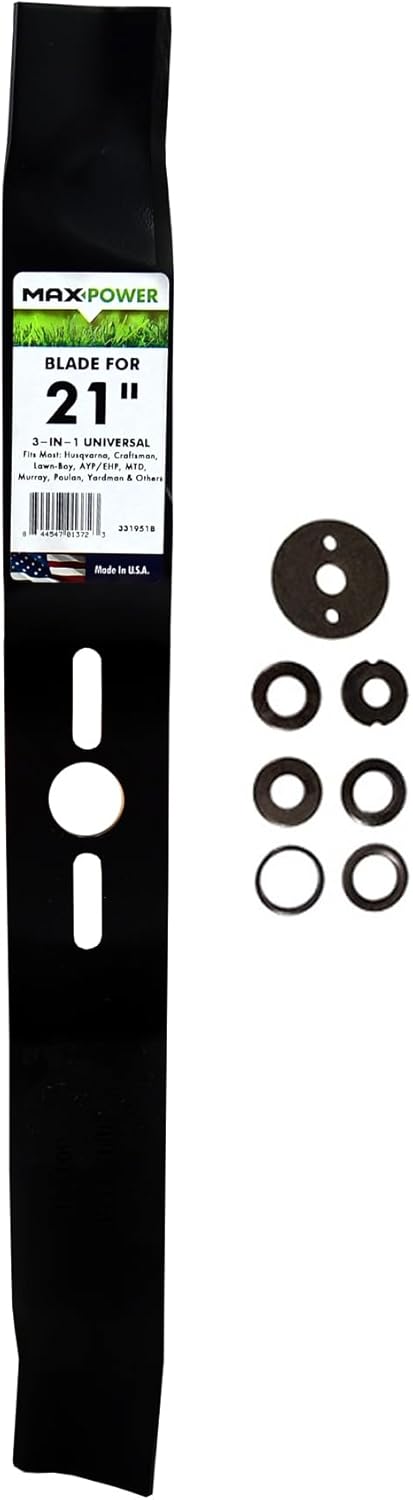
MaxPower 331951B 21-Inch Universal 3-in-1 Lawn Mower Blade
| Manufacturer | MaxPower |
|---|---|
| Item model number | 331951B |
| Made in | USA |
The MaxPower 331951B is a straightforward replacement blade intended to fit a wide range of 21-inch mowers using the included reducer washers. It is a 3-in-1 blade, so it can mulch, side-discharge, or give a clean cut depending on how you orient and install it. The kit includes a cover washer and six reducer washers for common spindle hole sizes, which makes installation easier on older or budget machines. Because MaxPower manufactures these blades in the United States and states a heat-treat process, it should offer decent edge retention for regular residential use. Expect reliable cutting performance on sandy soil when kept sharp, but you will need to inspect and re-sharpen more frequently than with premium, hardened blades because heavy abrasive sand accelerates wear. The blade is a practical, parts-focused choice for routine lawn maintenance and for homeowners who want a ready-to-install, low-complexity replacement rather than a specialty hardened or high-end aftermarket option.
Best for: Homeowners on a budget who need a simple, compatible replacement blade for routine mowing and value a ready-to-install kit over specialty materials.
Less Ideal for: Property owners with very sandy or abrasive turf who want maximum long-term edge life should consider hardened or specialty blades designed specifically for heavy abrasion.
- Universal fit with six reducer washers covers common spindle hole sizes for easy installation
- 3-in-1 design supports mulching, side discharge, or standard cutting with the same blade
- Manufactured in the USA with a heat-treat process for reasonable durability
- Includes necessary hardware (cover washer) so no extra parts are required for most installs
- Not specified as a premium hardened or abrasion-resistant alloy so it will wear faster in sandy conditions
- Dimensions and fit require verification against your mower despite the universal kit
Verdict: A practical, budget-friendly universal 21-inch replacement blade kit that gets you mowing quickly without extra parts.
MaxPower 331528B 21" Mulching Mower Blade (USA Made)

| Cut length | 21 in. |
|---|---|
| Fits OEM | Multiple MTD, Cub Cadet, Troy-Bilt, Craftsman part numbers |
| Center hole | Bow tie pattern, outside hole 5/16" |
The MaxPower 331528B is a direct-replacement 21-inch mulching blade intended for common walk-behind mowers from MTD, Cub Cadet, Troy-Bilt, and Craftsman. It installs using the bow-tie center hole pattern and is shipped sharpened and powder coated for protection during handling. In use it performs the core mulching task well: the shaped cutting surface and sharpened edge produce fine clippings that return to the lawn instead of large clumps, which is useful for weekly mowing and maintaining a tidy lawn. Key practical benefits are broad compatibility with many OEM part numbers and a U.S. manufacturing and heat-treat process that support consistent hardness and edge retention. Expect the powder coat to wear off during the first cut, revealing the factory-sharpened edge. Limitations to note are that fit depends on matching the exact OEM numbers listed and that this is a single blade unit, so replacement for multi-blade decks requires multiple purchases; buyers should verify hole pattern and outside-hole spacing before ordering.
Best for: Buyers who prioritize reliable, OEM-compatible replacement parts and want a factory-sharpened mulching blade made with consistent manufacturing processes and U.S. production.
Less Ideal for: People who need a full set for multi-blade decks in one purchase or who cannot confirm their mower's OEM blade number and hole pattern should consider other options.
- Made in USA with heat-treated steel for consistent hardness and edge retention
- Ships factory-sharpened so it is ready to cut after installation
- Powder coated for handling protection during shipping
- Replaces multiple OEM part numbers across popular mower brands for broad compatibility
- Compatibility requires matching OEM numbers and the bow-tie center hole pattern
- Sold as a single blade, so decks with multiple blades need multiple purchases
Verdict: A ready-to-install, heat-treated 21-inch mulching blade made in the U.S. that matches many OEM numbers for buyers who want a dependable OEM-style replacement.
MaxPower 331737B 21-inch Mulching Mower Blade

| Fits | Many 21-in Craftsman, Husqvarna, Poulan models |
|---|---|
| Center hole | 5/8-in |
| Made in | USA |
| Manufacturer | MaxPower |
The MaxPower 331737B is a 21-inch mulching blade intended as a direct replacement for a number of Craftsman, Husqvarna, and Poulan 21-inch decks. It installs in place of the OEM blade using the standard 5/8-inch center hole and is heat-treated and manufactured in the USA to match OEM strength and hardness. In routine use the blade's mulching profile helps recut clippings into finer pieces for faster breakdown into the turf rather than producing long clumps, which is useful for regular mowing and reducing bagging. Notable features are broad OEM compatibility and an emphasis on manufacturing quality. Practical benefits include reliable fit for the listed models, improved clipping dispersion for homeowners who want a cleaner cut and quicker decomposition, and a durable construction that holds an edge well. Limitations are that you must verify the OEM numbers match before buying and that it only fits 21-inch decks with a 5/8-inch center hole, so it is not a universal blade for other deck sizes or arbor patterns.
Best for: Homeowners with a 21-inch mower who want a dependable OEM-style mulching blade that improves clipping dispersal and lasts through routine mowing.
Less Ideal for: People with mower decks other than 21 inches or nonstandard arbor sizes should look for a blade made specifically for their deck or for a universal adapter solution.
- Designed to meet or exceed OEM specifications for durability and hardness
- Mulching profile chops clippings finer to aid decomposition and reduce clumping
- Fits many 21-inch Craftsman, Husqvarna, and Poulan mower models with a 5/8-inch center hole
- Proudly manufactured in the USA using a heat-treat process
- Only compatible with 21-inch decks that use a 5/8-inch center hole and listed OEM numbers
- No universal fit adapters included for other arbor patterns
Verdict: A durable, OEM-compatible 21-inch mulching blade that improves clipping shredding for homeowners with compatible decks.
UDC Parts 942-0741A Troy-Bilt 21" Mulching Mower Blades, 2-Pack

| Manufacturer | UDC Parts |
|---|---|
| Compatible OEM | Troy-Bilt 942-0741A (and listed equivalents) |
| Deck size compatibility | 21" |
| Pack quantity | 2 |
These UDC Parts 942-0741A blades are a straightforward replacement for 21-inch Troy-Bilt and similar push mowers when you want mulching performance. Sold as a two-pack, each blade arrives pre-sharpened and coated for safe handling during the initial uses. Installation is direct-fit using the existing blade mounting holes so you can swap them in during routine maintenance without modifications. The blades are made from high-strength steel and are designed with mulching contours that keep clippings circulating for finer mulch instead of throwing large clumps. Practical benefits include having a ready spare on hand, improved clipping distribution for lawns, and the ability to resharpen the cutting edge to extend life. Limitations are typical for aftermarket blades: you should verify exact compatibility with your mower model before buying and expect the safety coating to wear off after a few cuts. If you need a blade for heavy-duty commercial use or a different deck size, choose a part specified for that application.
Best for: Homeowners who prefer a reliable, ready-to-install replacement blade for routine mulching maintenance and want the security of having a spare on hand.
Less Ideal for: Commercial landscapers or anyone who needs blades for larger or non-21-inch decks should look for a heavy-duty or size-specific alternative.
- Two-blade pack gives a ready spare for seasonal maintenance
- Pre-sharpened and safety coated for immediate, safer installation
- Direct-fit replacement for many Troy-Bilt and compatible 21" decks
- Made from high-strength steel and resharpenable to extend service life
- Compatibility requires checking model lists because fit is not universal
- Not intended for commercial heavy-use decks or differently sized mowers
Verdict: If you want a dependable, ready-to-install pair of mulching blades for a 21-inch push mower, this two-pack delivers practical mulching performance and a spare for routine maintenance.
Choosing the Right Lawn Mower Blade for Sandy Soil: Key Factors to Consider
Edge Durability
Edge durability determines how long a blade will stay sharp when it repeatedly contacts sand and small grit along the turf. In sandy soil the abrasive particles act like a fine grinding medium, blunting the cutting edge faster than in loam or clay. A tougher edge means fewer sharpening sessions and more consistent cutting height and grass health.
When assessing edge durability look for information about edge thickness and whether the blade uses a tempered or induction-hardened cutting lip. Thicker, well-tempered edges resist rolling and chipping in abrasive environments.
Corrosion Resistance
Sand often carries moisture and salts that accelerate rust on exposed steel, especially where paint or plating has been scratched. Corrosion weakens the blade surface and can create pits that further increase wear from abrasive particles.
Choose blades with robust surface protection such as powder coating, polymer topcoats, or stainless alloys where possible. Also consider how easily protective finishes can be maintained; a small scratch is almost inevitable, so the underlying metal should tolerate moisture without rapid pitting.
Material Hardness and Heat Treatment
The metal alloy and heat-treat process dictate how a blade balances hardness and toughness. Hard edges cut longer but can become brittle if over-hardened, leading to chips when striking hidden debris or gravel common in sandy areas.
Look for blades that specify a measured hardness range or mention processes like tempering or induction hardening targeted at the cutting edge. That indicates a controlled approach to keeping the lip hard while preserving overall toughness.
Blade Balance and Vibration
A blade that is out of balance will vibrate, transfer stress to the spindle, and increase wear on bearings. In sandy soils where edges dull faster, imbalance can compound wear by creating uneven contact with grass and more friction points.
Balanced blades run smoother, produce cleaner cuts, and reduce mechanical stress on the mower. Consider blades that are factory-balanced and include balancing tolerances or that are easy to re-balance after sharpening.
Mounting Compatibility
Compatibility with your mower's spindle, bolt pattern, and deck clearance matters for safety and cutting geometry. Some high-performance blades use proprietary fitments or require specific clearance to avoid deck strikes.
Verify hole size, keyways, or adapter requirements before buying, and ensure the blade profile fits your deck height and mulching or bagging setup. Incorrect fit can change blade angle and reduce cutting efficiency in sandy turf.
Ease of Maintenance
Frequent light maintenance is often better than infrequent heavy repairs in sandy yards. Ease of sharpening, the ability to recoat or touch up corrosion-prone areas, and straightforward installation reduce downtime.
Look for blades with accessible edges for common sharpening tools, finishes that accept touch-up paint or rust inhibitors, and standard mounting patterns so you can perform routine care with typical homeowner tools.
How Sandy Soil Changes Blade Wear
Sand acts like an abrasive on the blade edge and on the deck components that contact it. Repeatedly cutting over sand-laden turf grinds the cutting lip thinner, reduces sharpness, and increases the chance of out-of-balance conditions from uneven wear. Over a season this shows up as more frequent sharpening, rougher cuts, and sometimes accelerated rusting where finish breaks down.
- Abrasive wear shortens sharpening intervals
- Fine grit can create pitting that traps moisture
- Uneven edge loss increases vibration and stress on the mower
Tips for Extending Blade Life in Sandy Yards
Simple changes in maintenance and mowing technique will stretch blade life. Raise cutting height slightly to reduce the amount of sand scooped up with each pass. Sharpen edges more often with light, consistent passes rather than trying to restore a very dull blade with heavy grinding. After mowing, rinse the deck and blade if sand buildup is visible and dry surfaces to slow corrosion.
- Mow at a higher height to reduce sand pickup
- Perform light sharpening every few outings in sandy conditions
- Rinse and dry the deck and blade when visibly dirty
Sharpening and Reconditioning Strategy
In sandy soil you will likely sharpen more frequently, but how you sharpen makes a difference. Maintain the original bevel angle and remove minimal material on each sharpening. Excessive removal thins the edge and shortens overall service life. After sharpening, rebalance the blade and inspect for chips or nicks that indicate the need for replacement rather than further sharpening.
- Keep the original bevel angle when sharpening
- Remove small amounts of metal each session
- Check balance after each sharpening and inspect for chips
Coatings and Finishes That Help in Abrasive Settings
Not all finishes perform the same when abrasion is a constant factor. Thick powder coats and polymer finishes can protect against corrosion for longer, but once abraded they can expose base metal. Stainless alloys resist pitting but may not hold as hard an edge unless alloyed and heat-treated correctly. Consider finishes that are easy to touch up and blades where the protective layer is complemented by a corrosion-resistant base metal.
- Powder coat protects against moisture but can wear off over time
- Stainless resists pitting but check for edge-holding properties
- Prefer finishes that can be maintained with touch-up products
Safety and Vibration Checks
Because sandy soil speeds edge wear, perform pre- and post-mow checks more frequently. Look for uneven wear, bent tips, or pitting. Run the mower briefly and feel for new vibration that may indicate imbalance. Address imbalance by rebalancing or replacing the blade promptly to protect the spindle and bearings.
- Inspect blades for uneven wear before each mowing season
- Run the mower briefly after installation to detect vibration
- Replace blades with visible chips or severe pitting
How We Chose the Best Lawn Mower Blade for Sandy Soil
We prioritized factors that directly affect performance and longevity in abrasive, sandy turf. Key evaluation criteria included edge retention under abrasive wear, corrosion resistance against salt and moisture mixed with sand, material hardness and heat treatment, and blade balance for safe, vibration-free operation. We also checked mounting compatibility across common spindle types and the ease of installation for typical homeowner tools. Products were excluded if specifications lacked clear metal composition, heat-treatment details, or measurable corrosion protection. We also omitted blades designed strictly for specialty cutting patterns that sacrifice edge thickness or hardness, because those designs wear quickly in sandy soils. Editorial judgment favored blades that balance a hardened cutting edge with a protective finish and stable balance, rather than extreme hardness that is brittle or decorative coatings that provide little abrasion protection.
FAQ
How often should I sharpen a blade used on sandy soil?
Often. In sandy soil you will need to sharpen more frequently than in other soils. A light sharpening every few mowing sessions is common, with full regrinds less often depending on how quickly the edge dulls.
Can I use stainless-steel blades in sandy environments?
Yes, stainless resists corrosion and pitting, but not all stainless alloys hold an edge equally. Look for blades that specify edge-hardening processes so you do not trade corrosion resistance for poor edge life.
Will thicker blades last longer in sand?
Thicker edges generally tolerate abrasive wear better because there is more metal to lose before performance degrades. However, thickness must be balanced with proper heat treatment to avoid brittleness.
Should I change mowing habits for sandy soil?
Adjustments help. Raising the cutting height and avoiding excessively low passes reduces the amount of sand a blade contacts, extending edge life and improving cut quality.
How can I tell when a blade must be replaced rather than sharpened?
Replace blades that have deep chips, significant pitting, or an edge so thin that sharpening would remove too much material. Severe imbalance or visible bends are also replacement triggers.
Final Verdict
In sandy soil the main tradeoff is between edge hardness and toughness plus a protective finish that resists corrosion. Prioritize blades that combine a hardened cutting lip with good corrosion resistance and factory balance. Expect more frequent light sharpening and routine deck cleaning to get the best life from any blade. Focus on compatibility with your mower and the ability to maintain the finish and balance. With the right blade and a few preventive habits you can keep cuts clean and reduce the wear problems that sandy yards create.
