

Note: This article contains affiliate links. If you click on these links and make a purchase, I may earn a small commission at no extra cost to you. This helps support my research and content. Read my full affiliate disclosure here.
If you manage a large yard, park, or property perimeter you need equipment that covers ground quickly and reliably. Backpack mosquito foggers let you treat large areas without lugging a handheld sprayer, and they are designed to keep application steady while you walk fences, trails, and foliage lines. This guide shortlists the top backpack mosquito foggers gardeners and groundskeepers reach for when treating biting insect pressure on lawns, patios, and property edges. We evaluated machine delivery, fuel or battery runtime, and ease of use to help you pick the best option for your situation. Read on to see the top picks and the practical reasons they made the list before the product details below.
Top Picks at a Glance
| Best Overall The best all-around choice for most situations | Invatech Italia 870 Backpack Mosquito Fogger (51.7cc, 4‑Gallon) |  |
| Best Quality Built to a higher standard if you want something more solid | Invatech Italia 915 Backpack Fogger & Mist Blower (63.3cc, 4‑Gallon) |  |
| Best Value The sweet spot between price and what you get | funrautz 43cc Gas Backpack Cold Fogger with 20L Tank |  |
| Best Budget The cheapest option that still gets the job done reliably | Rodiuiu 43cc Backpack Cold Fogger with 20L Tank |  |
| Highest Rated A top-rated pick with lots of positive feedback | Tomahawk Power TMD14 3HP Turbo Backpack Fogger with ULV Nozzle (3.7 gal) |  |
| Most Popular A crowd favorite that many people choose with confidence | Invatech Italia 868 Backpack Mosquito Fogger (Gas-Powered Mist Blower) |  |
| Best Seller A high-volume bestseller chosen again and again | Tomahawk Power TMD14-2 3.7 Gallon Backpack Mosquito Fogger and Leaf Blower |  |
Invatech Italia 870 Backpack Mosquito Fogger (51.7cc, 4‑Gallon)

| Engine size | 51.7cc |
|---|---|
| Tunnel volume | 805 CFM |
| Tank capacity | 4 gallons |
| Form factor | Backpack |
The Invatech Italia 870 is a backpack fogger built for homeowners and small‑scale operators who need a capable, portable pest control tool. Its 51.7cc engine and high tunnel volume produce strong airflow that the manufacturer rates at about 39 feet horizontal reach and 32 feet vertical reach, which helps cover yards and garden beds without repeatedly walking the same area. The translucent 4‑gallon tank with a wide mouth makes filling and checking fluid level straightforward, and the variable liquid dosage control lets you adjust output between light misting and heavier applications. It also handles powders and granules, expanding use beyond liquid insecticides. Padded shoulder straps and a backrest aim to keep the unit reasonably comfortable during typical yard work, but the device is still a substantial powered tool and requires basic protective gear and routine engine maintenance. This fogger suits seasonal or regular outdoor pest treatments, but it is not a tool-free appliance and demands careful handling, mixing, and storage of chemicals.
Best for: Gardeners and homeowners who want a robust, professional-style backpack fogger for recurring outdoor mosquito and pest control across small to medium yards and landscaped areas.
Less Ideal for: Casual users who need an infrequent, low-effort solution or those unwilling to maintain a small engine or handle pesticides should consider simpler, lower-maintenance options.
- High-power 51.7cc engine with strong airflow for extended mist reach
- Variable liquid dosage control for adjustable application rates
- Large 4‑gallon translucent tank with wide mouth for easier filling and level checks
- Capable of dispersing liquids, powders, and granular materials for multipurpose use
- At 22 pounds it is not featherlight and requires some stamina to carry during extended use
- Powered two-stroke engine requires fuel mixing, regular maintenance, and protective gear
Verdict: Buy this if you need a powerful, adjustable backpack fogger that covers large outdoor areas and handles both liquid and dry pest products.
Invatech Italia 915 Backpack Fogger & Mist Blower (63.3cc, 4‑Gallon)
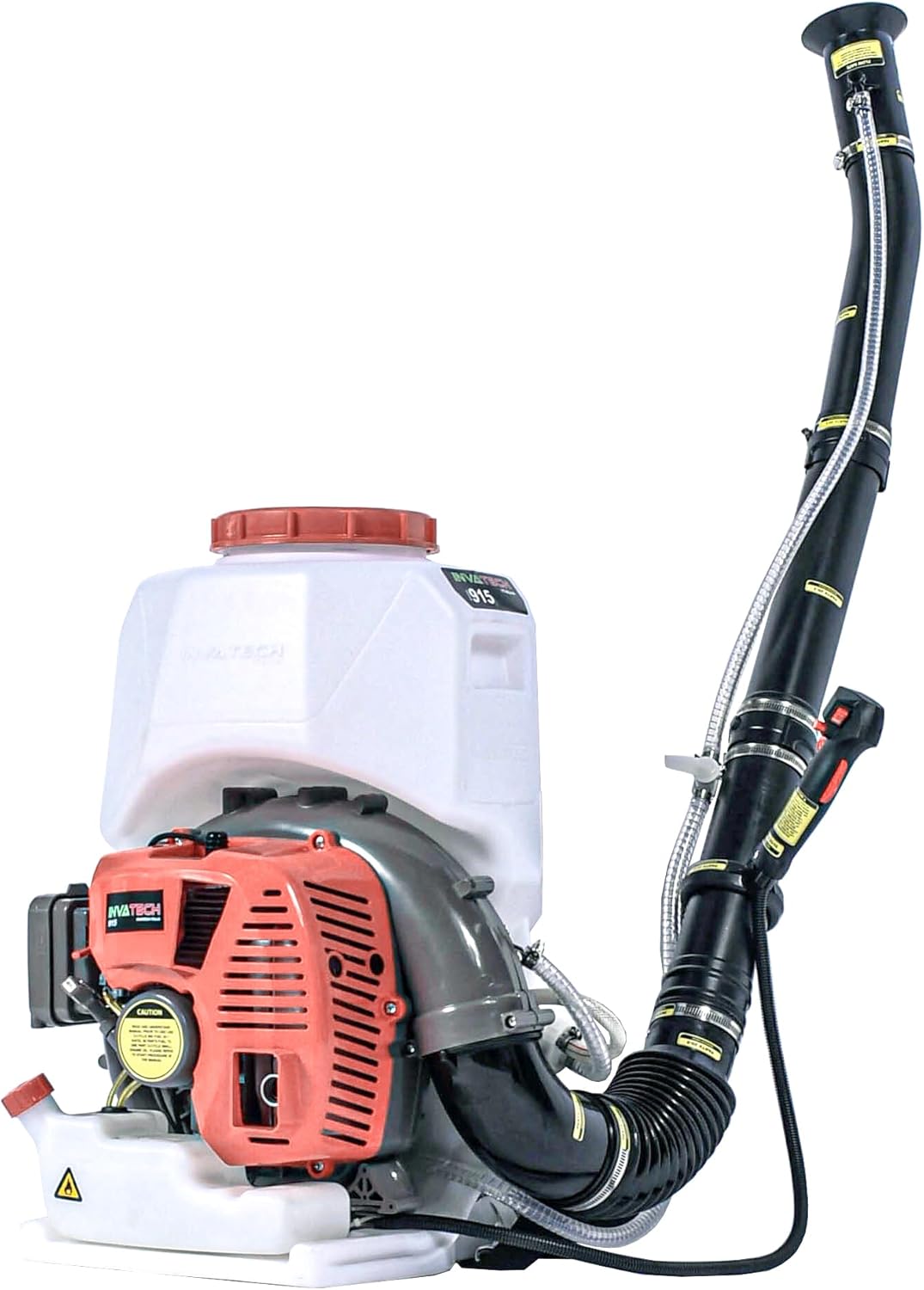
| Tank Volume | 4 gallons |
|---|---|
| Power Source | Gas-Powered |
| Engine | 63.3cc |
| Droplet Size | 52–70 microns |
The Invatech Italia 915 is a high-output backpack fogger designed for treating medium to large outdoor areas with water-based solutions. It pairs a 63.3cc engine and turbo boost pump with a high-efficiency fan to push up to 900 CFM of air, producing fine 52–70 micron droplets for even coverage and extended airborne time. Operators use the variable dosage control to set flow between 0.10 and 1.2 gallons per minute depending on the treatment and can reach roughly 39 feet horizontally and 32 feet vertically, which speeds treatment of yards, orchards, and large landscaped areas. Practical touches include a translucent 4-gallon tank with an extra-wide mouth, redesigned tank geometry and padded straps to improve balance and comfort, and dual handles for easier filling and carrying. The unit is lightweight for its class at 22 pounds but remains a gas-powered tool, so expect engine maintenance, fuel handling, and louder operation compared with electric or battery models. It is built for frequent, performance-focused use rather than occasional backyard spritzing.
Best for: Buyers who need a high-performance backpack fogger for frequent, professional or serious homeowner use and prioritize long reach, adjustable application rates, and fast coverage of large outdoor areas.
Less Ideal for: Casual users with only small yards or those who prefer quieter, low-maintenance electric or battery sprayers should consider simpler models instead.
- High airflow (up to 900 CFM) and fine droplet output for even coverage and long airborne time
- Wide adjustable flow range (0.10–1.2 GPM) and long horizontal/vertical reach for fast treatment of large areas
- 4‑gallon translucent tank with extra‑wide mouth and dual handles for easier filling and monitoring
- Ergonomic tank geometry, padded straps, and contoured backrest reduce upper‑back strain during long shifts
- Gas engine requires fuel, regular maintenance, and produces more noise and exhaust than electric alternatives
- Designed for water-based solutions only and sold as application equipment so chemicals must be supplied separately
Verdict: Choose the Invatech Italia 915 when you need a rugged, high‑output backpack fogger that delivers professional reach and adjustable flow for fast treatment of large outdoor areas.
funrautz 43cc Gas Backpack Cold Fogger with 20L Tank

| Tank Volume | 20 liters |
|---|---|
| Power Source | gas_powered |
| Engine Displacement | 43cc |
| Liquid Output | 0-4 L/min |
| Powder Output | 0-6 kg/min |
This funrautz backpack fogger pairs a 43cc gasoline engine with a 20 liter tank to deliver high-volume cold fogging for mosquito and pest control across large yards, orchards, and farms. It is typically worn like a backpack and used to apply liquid larvicides or powdered insecticides; the unit claims liquid spray output up to 4 L/min and powder output up to 6 kg/min, with an effective spray reach of about 12 meters (39 feet). Notable features include an ergonomic padded harness to reduce fatigue during extended use, an adjustable nozzle for liquid or powder application, and metal-plus-plastic construction intended for outdoor work. Practical benefits are fewer refills thanks to the large tank, the ability to switch between liquid and powder treatments, and a gasoline engine that keeps you mobile across big properties. Important limitations are the need to handle fuel and chemical concentrates safely, the weight and physical demand of backpack use for long sessions, and that setup and tuning can take time before achieving an even fog pattern.
Best for: A buyer who needs an efficient, mobile solution for treating large outdoor areas and prioritizes coverage and runtime over ultra-lightweight equipment. Ideal for property owners, small farmers, and maintenance crews who will use fogging as a regular seasonal task.
Less Ideal for: Not a good fit for casual users who only need occasional backyard treatments or for anyone unwilling to handle gasoline and concentrated pesticides; consider handheld or electric options for small yards.
- Large 20 L tank reduces refill frequency for extended jobs
- Gas engine provides mobile power for wide coverage without cords
- Dual liquid and powder capability lets you use different treatment types
- Padded ergonomic backpack harness eases carry during longer sessions
- Requires storing and mixing fuel and pesticide concentrates safely
- Backpack weight and balance can be tiring during long shifts
Verdict: Choose this gas backpack fogger when you need long runtime and wide, professional-style coverage across large outdoor properties.
Rodiuiu 43cc Backpack Cold Fogger with 20L Tank

| Tank Volume | 20 liters |
|---|---|
| Power | 2.13 kW (43cc engine) |
| Spray Range | 12 meters+ |
| Power Source | gas_powered |
This Rodiuiu backpack fogger is a gas-powered cold fogger built to treat large outdoor areas without constant refilling. It pairs a 43cc (2.13 kW) engine with a 20 L tank and can spray liquid or powder formulations, delivering a claimed range of about 12 meters so you can reach hedgerows, orchards, and open yard spaces from a distance. The unit is carried on the back with an ergonomic strap and padded support to reduce fatigue during longer jobs. Operation is straightforward with a pull-start and a simple throttle shutdown for secure stopping. Practical benefits include the large reservoir and the ability to handle both liquids and powders, which makes it versatile across pest control and disinfecting tasks. Limitations to note are its gas engine: it requires fuel mixing and produces noise, vibration, and emissions compared with electric options, and the unit weight and packing size mean it is best for outdoor work rather than small patios. Expect standard maintenance for a small engine and follow safety precautions when fogging populated areas.
Best for: Buyers who need a budget-friendly, heavy-duty fogger for regular outdoor mosquito and pest control across large yards, orchards, or farm outbuildings and value long runtime over compactness.
Less Ideal for: Not a good choice for users who need a quiet, emission-free solution for small patios, indoor spaces, or occasional spot treatments.
- Large 20 L tank reduces refill interruptions for bigger yards and fields
- Powerful 43cc engine delivers long spray distance for treating wide areas
- Compatible with both liquid and powder formulations for flexible pest control
- Ergonomic backpack straps and padded support ease carrying during extended use
- Gas engine requires fuel mixing, produces noise and emissions compared with electric alternatives
- Heavier and bulkier than handheld or battery foggers, making it less suitable for very small or enclosed spaces
Verdict: A cost-conscious choice for treating large outdoor areas that delivers long reach and versatile liquid or powder use without frequent refills.
Tomahawk Power TMD14 3HP Turbo Backpack Fogger with ULV Nozzle (3.7 gal)

| Power Source | Gas Powered |
|---|---|
| Form Factor | Backpack |
| Tank Capacity | 3.7 Gallon |
| Power | 3HP |
| Droplet Size | 25-100 Microns |
The Tomahawk Power TMD14 is a gas-powered backpack fogger intended for property-scale mosquito control and seasonal yard work. It pairs a 3HP two-stroke engine with a turbo boost and an included ULV nozzle to deliver a long horizontal reach and adjustable droplet sizes for targeted treatments. Typical use is walking perimeter and landscape areas while releasing ultra-low-volume insecticide mist to reach under leaves and into dense foliage; the unit also functions as a cordless leaf blower for fall and winter cleanup. Practical benefits include a large 3.7 gallon tank that shortens refill frequency, reported coverage rates suitable for an acre in under 30 minutes, and ergonomic padded straps for extended use. Important limitations are the gas engine which requires fuel mixing and periodic maintenance, a relatively high noise level, and the physical heft that comes with a powered backpack unit. This is a tool built for frequent, reliable outdoor applications where power and reach matter, but it requires basic small-engine care and safe handling of pesticides.
Best for: For homeowners or property managers who need a dependable, high‑output fogger for routine mosquito control and larger landscape jobs and are comfortable maintaining a small gas engine.
Less Ideal for: Not a good choice for casual users who prefer low-noise, low-maintenance electric equipment or for very small patios and enclosed spaces.
- Powerful 3HP engine and turbo boost for long horizontal reach up to about 40 feet
- Large 3.7 gallon tank reduces how often you need to refill during larger jobs
- Included ULV nozzle with adjustable droplet size enables fine control for ULV pest treatments
- Dual-function design doubles as a leaf blower, extending seasonal usefulness
- Ergonomic padded backpack straps improve comfort for extended operation
- Gas two-stroke engine requires fuel mixing, routine maintenance, and generates noise
- Heavier backpack unit that can be tiring to carry for extended periods
Verdict: Choose this fogger if you want a robust, high‑reach backpack unit that reliably covers large yards and doubles as a seasonal leaf blower.
Invatech Italia 868 Backpack Mosquito Fogger (Gas-Powered Mist Blower)

| Tank Volume | 3.7 gallons |
|---|---|
| Hose Length | 1.8 meters |
| Material Type | Stainless Steel or Aluminum Alloy |
| Power Source | Gas Powered |
The Invatech Italia 868 is a gas-powered backpack fogger built for routine pest control over larger outdoor areas. It combines a 51.7cc engine and fan system to generate high-volume airflow, letting the sprayer throw mist up to about 39 feet horizontally and 32 feet vertically. Typical use is filling the 3.7 gallon tank with an approved insecticide or sanitizer, slinging the padded backpack straps on, and walking treatment paths for yards, gardens, or perimeter spraying. Notable features include a robust metal construction option, an ergonomic translucent tank for fluid visibility, and a 1.8 meter hose for reach. The design favors professionals or experienced homeowners who need fast coverage and portability without electrical hookups. Important limitations are the need to handle gasoline and chemicals safely, the unit weight when filled, and routine engine maintenance and noise during operation. Safety guidance recommends well ventilated use and protective clothing. For buyers who prioritize reliable, engine-driven coverage, this fogger is a practical workhorse; casual or infrequent users may find its operating demands heavier than an electric or handheld alternative.
Best for: Best for experienced homeowners, landscapers, or pest control operators who need fast, engine-driven coverage over yards and outdoor spaces and who are comfortable with gasoline engines and chemical handling.
Less Ideal for: Not a good fit for casual users who prefer quiet, low-maintenance electric sprayers or for indoor use where ventilation is limited.
- Powerful 51.7cc gas engine and fan produce long-range misting for wide coverage
- 3.7 gallon tank lets you treat larger areas between refills
- Ergonomic backpack with padded straps and translucent tank for fluid visibility
- Works with both solutions and insecticides for pest control and sanitizing
- Requires handling gasoline and chemical concentrates with proper safety precautions
- Heavier and louder than electric or battery alternatives, especially when filled
Verdict: Choose this gas-powered backpack fogger when you need robust, long-range misting for regular outdoor pest control and sanitizing tasks.
Tomahawk Power TMD14-2 3.7 Gallon Backpack Mosquito Fogger and Leaf Blower

| Power Source | Gas Powered |
|---|---|
| Form Factor | Backpack |
| Additional Features | Adjustable Speed |
| Included Components | 3.7 Gallon Backpack Fogger |
The Tomahawk Power TMD14-2 is a gas-powered backpack fogger that doubles as a high-speed leaf blower, intended for treating mosquito populations and performing light leaf removal around yards. In practice you carry the 3.7 gallon tank on your back and use the adjustable-speed nozzle to produce a fine ULV mist that reaches tops and undersides of foliage; when needed the blower function delivers strong airflow for moving debris or helping spray coverage. Notable features include a backpack form factor with padded straps for longer use, an adjustable speed control to match application needs, and a reported 220 MPH air speed for effective distribution. The practical benefits are faster coverage of larger areas and the convenience of a combined spraying and blowing tool. Important limitations are that it is gas powered so it requires fuel mixing and regular engine upkeep, it is heavier than handheld units which may fatigue smaller users, and it is designed for yard-scale jobs rather than precision indoor or small-plot applications.
Best for: Buyers who prioritize reliable, proven equipment for treating mosquitoes across yards and need a tool that covers large areas quickly while offering simple controls and service support.
Less Ideal for: People who need a lightweight option for small patios, indoor spaces, or those who prefer electric battery-powered tools to avoid engine maintenance.
- Dual-function design combines ULV fogging and a high-speed blower for spraying and debris control
- 3.7 gallon tank allows extended run time between refills for larger properties
- Adjustable speed control helps match output to application and conserve product
- Backpack form with padded straps distributes weight for extended use
- Gas engine requires fuel, maintenance, and produces exhaust
- Heavier than handheld units which may be tiring for prolonged single-operator use
Verdict: Choose this dual fogger/blower when you need a durable, backpack gas unit that treats large outdoor areas quickly and reliably.
Choosing the Right Backpack Mosquito Fogger: Key Factors to Consider
Spray Pattern and Droplet Size
How the fogger atomizes liquid affects where the insecticide goes and how long it lingers. Finer droplets travel farther and can drift into adjacent areas, which can be useful for reaching canopy gaps but may increase off-target exposure. Coarser droplets deposit more quickly on foliage and reduce drift, which is often preferable near neighbors, water, or sensitive planting beds.
Think about whether you need long reach for tall hedges and tree lines or more localized deposition under eaves and dense shrubs. Adjustable nozzles or interchangeable tips let you tune droplet size for the task at hand and are a practical advantage in mixed landscapes.
Runtime and Fuel or Battery Type
Run time determines how much area you can treat before refilling or recharging. Gas-powered backpack units typically run for long periods on a full tank and are useful for larger properties or professional use. Battery-powered foggers are quieter, require less maintenance, and avoid combustion exhaust, but battery capacity and recharge time limit continuous coverage.
Estimate the acreage or linear distance you expect to treat in a session and match that to a fogger that can complete the job on one tank or charge where possible. Also consider how easy it is to swap batteries or refill fuel in the field to minimize downtime.
Tank Design and Refill Ergonomics
Tank capacity interacts with weight and balance. Larger tanks reduce stops but add load on the operator and stress the harness. A well-shaped tank sits close to the back and keeps the center of gravity manageable, reducing fatigue while walking.
Look for wide openings and clear level markings so you can mix chemicals accurately and refill without spills. Flip-top caps, integrated strainers, and secure venting reduce splashes and make filling faster when you need to do multiple passes.
Airflow, Reach, and Nozzle Placement
How air is routed through the fogger affects how far and where droplets travel. Strong, directed airflow can push mist into shrub interiors and under eaves, increasing knockdown in mosquito harborage sites. Poorly designed airflow results in uneven distribution and wasted product.
Nozzle placement matters too: a nozzle mounted on a boom or adjustable wand lets you target the spray while the blower maintains reach. Consider whether you need a fixed head for broad swaths or an adjustable delivery for focused treatment.
Operator Comfort and Harness Support
Backpack foggers are wearable equipment, so harness padding, strap adjustability, lumbar support, and overall weight distribution are critical. An uncomfortable harness shortens effective work time and increases risk of back strain during long jobs.
Try to match the unit weight and harness to the typical user's build and the expected session length. Features like quick-release buckles, breathable back panels, and adjustable load-bearing straps reduce fatigue and make frequent stops and starts easier.
When to Choose Gas Versus Electric
Gas and battery foggers each have practical tradeoffs. Gas units generally provide longer continuous run times and faster refill turnaround, which is useful for treating acreage, perimeter lines, or multiple properties in one outing. They require fuel mixing, more routine maintenance, and produce exhaust, factors to plan for around sensitive plants or enclosed spaces.
Battery foggers are cleaner and quieter and often require less mechanical upkeep. They can be a better fit for residential neighborhoods, small properties, or situations where noise and fumes would be a problem. Consider battery swap options and spare battery weights when deciding if electric models will meet your coverage needs.
- Gas: longer continuous runtime, higher payload weight, more maintenance
- Battery: quieter operation, lower maintenance, limited continuous coverage
Safe Mixing and Application Practices
Follow label directions for any insecticide you use and mix in a well-ventilated area with proper protective equipment. Measure concentrate carefully and use the fogger settings that produce the droplet size recommended for that material and target species. Incorrect mixing or excessively fine droplets can lead to drift and non-target exposure.
Plan treatment times for low-wind windows and when pollinators are least active, typically late evening or dawn. Keep people and pets away from treated areas until the spray has settled or as directed on the product label.
- Wear eye protection, gloves, and a respirator rated for pesticides during mixing and application
- Avoid treating near open water, sensitive ornamentals, or when wind exceeds recommended speeds
Maintenance Routines That Extend Service Life
Routine cleaning after each use prevents nozzle clogging and corrosion. Flush the system with clean water per the equipment and insecticide instructions, and inspect seals and hoses for wear. Store the unit dry and out of direct sunlight to protect plastic and rubber parts.
Keep a small toolkit and spare consumable parts like nozzles, O-rings, and filters on hand. Regularly check mounting hardware and harness attachments for signs of fatigue to avoid sudden failures during a treatment session.
- Flush lines after each use and remove deposits from nozzles
- Check and replace worn seals and hoses before they fail in the field
Application Strategies for Different Landscapes
Open lawns usually need broader swath coverage with medium droplet sizes to treat flying adults, while dense shrub borders and standing water margins benefit from targeted passes with more directed airflow. For properties with mixed conditions, combine broad perimeter passes with targeted treatments around likely mosquito harborage.
Match walking speed and nozzle setting so deposition is consistent. Moving too quickly reduces dose per area, while overly slow passes can over-apply and increase runoff or plant wetting.
- Use medium droplets and even passes for open turf
- Switch to directed bursts when treating dense vegetation or undergrowth
Transport, Storage, and Legal Considerations
Transport the fogger empty of concentrated chemical and well secured to avoid spills. Check local regulations for carrying certain insecticide classes and follow proper labeling and storage rules. Keep chemical containers in original packaging and store them in a locked, ventilated area away from living spaces.
Some jurisdictions restrict broadcast outdoor pesticide use or require specific licensing for commercial applications. Confirm local rules before planning large-scale treatments and keep records of application dates, materials used, and treated areas for compliance.
- Always transport chemical concentrates separately and in sealed containers
- Verify local application regulations for outdoor insecticidal treatments
How We Chose the Best Backpack Mosquito Fogger
We focused on practical performance metrics that matter when treating mosquitoes over large outdoor areas. Our shortlist prioritized consistent spray delivery and pattern, because even coverage prevents missed refuges where mosquitoes survive. Run time and power source were evaluated to match typical treatment jobs, separating units that complete an acre on a single tank or charge from those needing frequent refills. Tank capacity and refill ergonomics were considered to reduce downtime and fatigue during long treatments. We also examined blower airflow and nozzle adaptability since those determine droplet size, drift control, and reach into dense foliage. Durability of frame and harness comfort mattered for real-world wear, especially for grounds crews who use foggers repeatedly. Units were excluded if they lacked basic user-safety features, had poor customer feedback on reliability, or used unserviceable parts. Evaluation criteria used here include spray consistency, runtime and coverage, tank and refill design, airflow and droplet control, and operator comfort and durability. These criteria align with the scoring metrics we display for each entry and reflect the functional differences that affect everyday use in gardens, parks, and larger properties.
FAQ
How far will a backpack mosquito fogger spray effectively?
Effective reach depends on airflow and nozzle settings but many units can propel droplets several meters into vegetation. Dense foliage reduces penetration, so you may need closer passes or a directed nozzle to treat harborage sites.
Can I use any mosquito product in a backpack fogger?
Not all formulations are suitable for foggers. Use products labeled for thermal or cold fogging as applicable and follow dilution guidance. Using the wrong formulation can clog nozzles or produce unsafe droplet sizes.
How often should I treat my yard for mosquitoes with a fogger?
Treatment frequency depends on mosquito pressure, weather, and the product used. Often a few targeted treatments during peak season reduce nuisance levels, but heavy breeding conditions may require more frequent applications. Monitor mosquito activity and breeding sites to guide scheduling.
Is it safe to fog near vegetables and pollinator plants?
Fogging near edible crops and pollinator-attractive plants requires caution. Avoid direct application to blooms and follow label setbacks. When possible, treat areas at times when pollinators are inactive and use directed passes to limit drift onto desirable plants.
What maintenance does a backpack fogger need after use?
Flush the tank and lines with clean water and any recommended neutralizing agent, clean or replace nozzles and strainers, inspect hoses and seals, and let components dry before storage. Regular checks of the harness and fasteners reduce the risk of field failures.
Can a battery-powered fogger handle large properties?
Battery models can work for large properties if you plan for battery swaps or longer recharge cycles. For uninterrupted, extensive coverage, gas-powered units typically offer longer continuous runtime, but advances in battery capacity are narrowing that gap.
Final Verdict
Choose a backpack mosquito fogger by matching runtime and delivery style to the landscapes you treat. Prioritize spray consistency and droplet control for the habitat types on your property, and pick a tank and harness design that minimizes downtime and operator fatigue. Remember the tradeoffs between longer-running gas units and cleaner, quieter electric models, and plan maintenance to keep performance consistent. With the right balance of reach, comfort, and serviceability you can treat biting insect pressure efficiently and safely.
