

Note: This article contains affiliate links. If you click on these links and make a purchase, I may earn a small commission at no extra cost to you. This helps support my research and content. Read my full affiliate disclosure here.
Choosing the right mulch for newly planted trees matters because the first seasons set the root structure and long-term resilience. The proper mulch keeps soil evenly moist, reduces transplant stress, and moderates temperature swings around the root collar. In this guide we shortlisted five top options suitable for young trees in landscapes, yards, and small orchards. We evaluated each mulch for how well it conserves water, supports root development, and resists common problems like matting or nitrogen drawdown. Read on for the practical factors that influence establishment and the editorial approach we used to pick these top choices.
Top Picks at a Glance
| Best Overall The best all-around choice for most situations | ZeeDix 24" Coconut Fiber Tree Ring Mulch Mat, 6-Pack |  |
| Best Quality Built to a higher standard if you want something more solid | Plantonix Coco Chips Mulch Brick (10 lb) – Compressed Coconut Husk Chips |  |
| Best Value The sweet spot between price and what you get | HealthiStraw GardenStraw Premium Garden Mulch, 3 cu ft |  |
| Highest Rated A top-rated pick with lots of positive feedback | Moicstiy Coconut Fiber Tree Protector Mats — 10-Pack (11.8 inch) |  |
| Best Seller A high-volume bestseller chosen again and again | USA PINESTRAW Long Needle Pine Straw Mulch, Square Bale |  |
ZeeDix 24" Coconut Fiber Tree Ring Mulch Mat, 6-Pack

| Package quantity | 6 pack |
|---|---|
| Material | Coconut coir |
| Diameter | 24 inches |
| Inner hole diameter | 1.57 inches |
These ZeeDix coconut fiber tree rings are simple, natural mulch mats meant to sit around the base of newly planted trees or potted specimens. Made from 100% coconut coir, each 24-inch ring is breathable and holds moisture to help moderate soil temperature and reduce evaporation around roots. Typical use is to place a ring around the trunk, trim the inner hole if needed to fit, and replace or reposition as you water and tend the tree. The product helps block weed growth and reduces soil splash when watering, keeping the area neater and protecting roots from disturbance by pets. Because they are organic fiber, they gradually break down over time and will need periodic replacement or topping with additional mulch for longer-term coverage. The rings are thin and easy to trim but do not provide a rigid barrier, so they are best for decorative and moisture-retention purposes rather than heavy-duty animal protection or permanent edging.
Best for: Gardeners who want a natural, low-effort way to keep newly planted trees neat and retain soil moisture while minimizing weeds and splash.
Less Ideal for: Those needing a permanent, durable barrier against animals or a rigid landscape edging solution should consider alternatives.
- Made from 100% natural coconut coir for good breathability and water retention
- Large 24-inch diameter covers the root zone of many young trees and shrubs
- Easy to trim to fit around trunks and pots for a tidy appearance
- Suppresses weeds and reduces soil splash when watering
- Organic fiber will decompose over time and requires replacement or additional mulch for long-term use
- Not rigid enough to stop determined animals or provide firm edging
Verdict: Choose these coconut coir tree rings if you want a natural, easy-to-use mulch solution that conserves moisture and keeps the base of newly planted trees tidy.
Plantonix Coco Chips Mulch Brick (10 lb) – Compressed Coconut Husk Chips

| Unit Count | 160 Ounce |
|---|---|
| Item Type Name | Soil and Soil Amendments |
| Brand Name | plantonix |
| Volume | 15 gallons |
Plantonix Coco Chips arrive as a compact 10 pound brick that hydrates and expands into lightweight coconut husk chips for use as mulch, soil amendment, or terrarium bedding. You soak or wet the block to break it apart, then spread the chips over garden beds, containers, orchid pots, or raised beds to reduce evaporation and moderate soil temperature. The product is pre-screened, washed, and aged to remove dirt and rocks, and the low electrical conductivity and near-neutral pH make it safe to mix with potting mixes. Practical benefits include improved drainage and aeration compared with heavy wood mulches, long-lasting moisture retention that can reduce watering frequency, and an attractive tropical look. Important limitations are that you must rehydrate and break up the compressed brick before use which adds prep time, and coco chips do not supply nutrients so you will still need to fertilize regularly. Also note the safety warning about dust and keeping it away from children and pets during handling.
Best for: Buyers who prioritize reliable, consistent mulch performance and want a sustainable, low-maintenance material that retains moisture and improves soil structure for beds and containers.
Less Ideal for: Gardeners who need a nutrient-rich soil amendment or who prefer a no-prep, ready-to-spread loose mulch should consider alternatives.
- Made from 100% recycled coconut husks, a renewable alternative to peat and wood mulches
- Pre-screened and washed to remove dirt, rocks, and excess fiber
- Excellent at retaining moisture while maintaining airflow and drainage
- Lightweight and long-lasting so it does not compact like some organic mulches
- Requires soaking and manual breakup of the compressed brick before use
- Does not provide plant nutrients and should be used with a fertilizer plan
Verdict: A dependable, renewable mulch solution that holds moisture and improves aeration without compacting, ideal for gardeners who want consistent performance.
HealthiStraw GardenStraw Premium Garden Mulch, 3 cu ft

| Net volume | 3 cu ft |
|---|---|
| Intended use | Garden mulch, lawn seeding, compost-friendly |
| Material | 100% wheat straw |
| Source | Sustainably sourced, non-GMO |
HealthiStraw GardenStraw is a 3 cubic foot compressed bale of cleaned wheat straw formulated for use as garden mulch and seed protection. It is designed for vegetable, herb, flower and shrub beds where you want a lightweight, compostable mulch that retains soil moisture and suppresses weeds. The straw is processed to reduce dust and stray seeds and the short, specially cut fibers interlock when watered so the mulch stays in place without chemical tackifiers. For bushes you can apply a 2 to 3 inch layer around the drip line to cut evaporation, reduce compaction and gradually add organic matter as it breaks down. Practical benefits include easy spreading from a compressed bale, fast composting into the soil, and reduced watering needs. Limitations are that straw is less decorative than bark or wood chips and will decompose faster, so it requires periodic replenishing; it also provides less long-term weed barrier than heavier mulches. For gardeners focused on soil health and moisture conservation, it is a straightforward, low-risk choice.
Best for: Gardeners who prioritize soil health and want an easy-to-apply, compostable mulch for shrubs and mixed beds that reduces watering and improves organic matter over time.
Less Ideal for: People seeking a long-lasting, decorative mulch or a heavy-duty weed barrier for high-traffic beds should consider wood chips or stone instead.
- Cleaned, non-GMO wheat straw with reduced dust and seeds
- Fibers interlock when wetted so the mulch stays in place without binders
- Helps retain soil moisture and can reduce watering needs substantially
- Composts quickly and adds organic carbon to improve soil structure
- Decomposes faster than wood mulches so it needs topping up more often
- Less decorative and provides a lighter-duty weed barrier compared with heavier bark or rock mulches
Verdict: A clean, fast-composting straw mulch that conserves moisture and improves soil health, making it a safe, practical choice for mulching bushes.
Moicstiy Coconut Fiber Tree Protector Mats — 10-Pack (11.8 inch)

| Package quantity | 10 pieces |
|---|---|
| Diameter | 11.8 inch |
| Material | Coconut fiber (coir) |
These coconut fiber tree protector mats are simple, low-tech mulch rings intended to sit around the base of newly planted trees or container plants. Made from natural coir, each 11.8-inch mat can be trimmed to size and placed directly on the soil surface to reduce evaporation, moderate soil temperature, and help block weed growth. Installation is straightforward: place or cut the rings to fit your trunk and lay them around the root collar. The mats are lightweight and breathable, so they let water and air through while holding in moisture longer than bare soil. Because they are natural fiber, they will slowly break down over time and contribute organic matter to the soil, which is beneficial for young trees. Limitations are that the thin mats do not provide structural protection against mechanical damage or lawn equipment and will need periodic replacement as they decompose; they also do not replace thicker organic mulch for deeper weed suppression in larger planting beds.
Best for: Buyers who prioritize reliable moisture retention and low-maintenance organic mulch for newly planted trees or potted specimens and want a simple, natural option that degrades into soil amendment.
Less Ideal for: Not a good choice for people who need durable impact protection from lawn equipment or want long-lasting, deep mulch coverage for large landscape beds.
- Natural coconut fiber retains moisture and slowly adds organic matter as it decomposes
- Pre-cut round shape and thin profile make installation and trimming easy for container or small tree use
- Breathable material allows water and air to reach soil while reducing surface evaporation
- Thin mats offer little protection from physical damage or mulch displacement by wind or animals
- Will decompose over time and require periodic replacement for long-term coverage
Verdict: Choose these coconut fiber mats when you want a dependable, natural mulch that conserves moisture around newly planted trees and then safely decomposes into the soil.
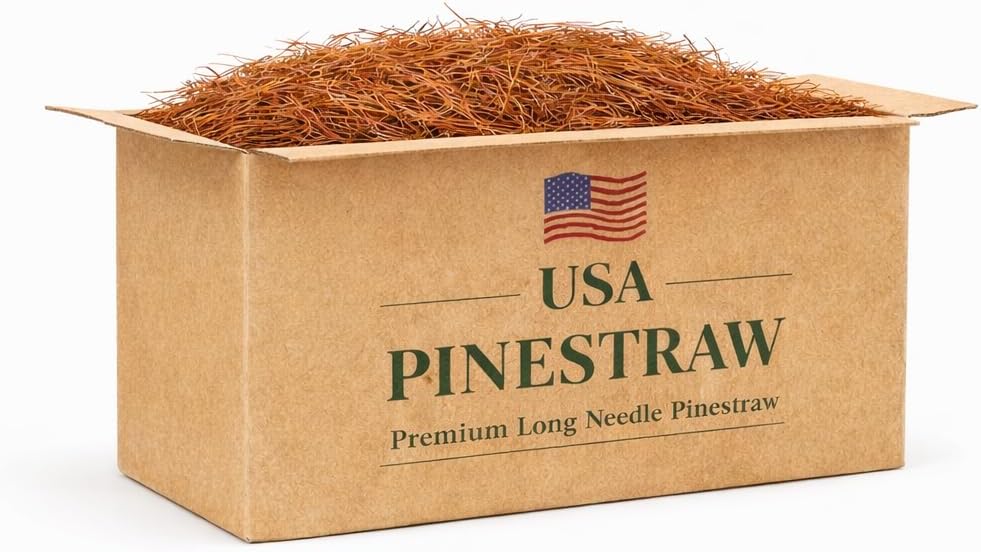
USA PINESTRAW Long Needle Pine Straw Mulch, Square Bale
| Material Type | Pine |
|---|---|
| Other Special Features of the Product | Organic |
| Package Size Name | Square Bale |
| Unit Count | 1 Count |
This product is a single premium square bale of long-needle pine straw intended for use as organic mulch around beds and shrubs. It is typically spread 2 to 4 inches deep around plants, pathways, and trees to suppress weeds, retain soil moisture, and protect roots from temperature swings. Because it is long-needle pine straw, it interlocks well and resists blowing away better than chopped mulches, and it decomposes slowly to add organic matter without dramatically altering soil texture. Practical benefits for blueberry plantings include good acidifying potential over time and excellent moisture retention, both helpful for blueberry health. Limitations are that you will need multiple bales for larger beds and periodic top-ups each season as the straw settles and decomposes. Also pine straw can be bulky to handle compared with bagged compost or wood chips, and it does not provide immediate nutrient boosts the way composted mulches do.
Best for: Gardeners seeking a low-maintenance, organic mulch for acid-loving shrubs who want better moisture retention and natural weed suppression in small to medium beds.
Less Ideal for: People who need a sterile, compacted mulch for container-grown blueberries or those wanting immediate nutrient-rich soil amendments rather than a slow-decomposing cover.
- Organic long-needle pine straw that naturally suppresses weeds
- Good moisture retention that reduces watering frequency
- Interlocking needles resist wind displacement better than loose shredded mulches
- Slow decomposition adds organic matter over time without rapid nutrient release
- Sold as single square bale so multiple purchases needed for larger beds
- Bulky to handle and store compared with bagged options
Verdict: Choose this long-needle pine straw bale if you want an organic, moisture-retaining mulch that stays put and supports acid-loving plants like blueberries.
Choosing the Right Mulch for Newly Planted Trees: Key Factors to Consider
Moisture Retention and Drainage Balance
Mulch must hold enough moisture to reduce watering frequency while allowing excess water to drain so roots are not waterlogged. For newly planted trees the root ball and surrounding backfill have limited capacity to buffer drought or excess moisture. Mulches that retain water well can reduce stress during dry spells and moderate soil temperature swings. However, overly dense or compacting mulches can impede infiltration, causing surface runoff and leaving roots too dry deeper in the soil. When selecting a mulch, consider how it behaves after rain and irrigation and whether it will help maintain even moisture at the root zone without creating persistent saturation.
Impact on Soil Nutrients and Biology
Some mulches slowly release organic matter and nutrients as they decompose, improving soil structure and microbial activity that support root growth. Others are inert or decompose too slowly to benefit the tree in its critical first seasons. Conversely, high-carbon mulches can temporarily immobilize nitrogen as microbes break them down, which may stress young trees unless you address the deficit. Evaluating how a mulch contributes to or competes for soil nutrients helps you plan supplemental feeding and decide whether to precondition the soil before planting.
Risk of Matting and Water Repellency
Certain fine-textured or overly compacted mulches can form a dense mat that sheds water rather than allowing it through. That matting reduces infiltration, forces water to run off the ring around the trunk, and prevents irrigation from reaching the root zone. For new trees, where roots are concentrated near the trunk, good infiltration is essential. Choose mulches less prone to matting or use application practices like looser layering and occasional raking to preserve water penetration.
Proximity to Trunk and Pest Considerations
How a mulch interacts with the trunk influences pest and disease risk. Mulch piled against the trunk can keep bark too moist, encourage rot, and attract rodents that gnaw on bark. For newly planted trees maintain a clear area at the trunk and build a shallow donut of mulch that covers the root zone but does not touch the bole. Also factor in whether a mulch type is likely to hide or harbor pests such as slugs or voles in your local climate.
Appearance, Maintenance Frequency, and Longevity
Different mulches last different lengths of time and require different maintenance. Long-lasting mulches reduce the need for frequent replenishment but may not break down into beneficial organic matter quickly. Shorter-lived, finely textured mulches may improve soil faster but need topping up and can blow or wash away unless contained. Consider how often you can realistically refresh the layer, how the mulch looks in your landscape, and whether its longevity aligns with your maintenance schedule.
Ease of Application and Local Availability
Practicality matters for most gardeners. Mulches that are easy to spread by hand or with common garden tools help ensure a correct depth and shape around the root zone. Bulky or heavy materials that require mechanical handling can be impractical for small yards. Local availability affects cost and freshness of organic mulches; materials sourced nearby are often more economical and arrive with better moisture and biological activity. Confirm whether the mulch you choose can be applied and maintained with the tools and time you have.
How Mulch Affects Early Root Establishment
A correct mulch layer moderates soil temperature and conserves moisture, which gives young roots a steadier environment to expand. Roots of newly planted trees are concentrated near the root ball and within the backfill, so the mulch should promote even moisture in that zone rather than only affecting surface soil.
Excessive depth or mulch that traps water against the trunk can slow cambial healing and encourage disease. Keep the layer shallow and focused on the root spread, and adjust irrigation to account for the reduced evaporation under mulch.
- Apply mulch in a 2 to 4 inch layer for most organic materials.
- Keep mulch several inches away from the trunk to prevent rot.
- Extend mulch to cover the root flare and the projected dripline for best moisture balance.
Organic Versus Inorganic Mulches: Practical Tradeoffs
Organic mulches such as shredded bark, wood chips, or composted materials improve soil structure and feed soil life as they decompose. They are generally better for long-term soil health but vary in how quickly they break down and whether they temporarily tie up nitrogen.
Inorganic mulches like gravel or rubber can reduce weed pressure and last a long time but do not contribute organic matter. For establishing trees, organic mulches typically offer more direct benefits to root development, while inorganic options can be useful in dry, rocky sites where organic matter is difficult to retain.
- Consider organic mulch if you want to build soil biology and nutrient-holding capacity.
- Use inorganic mulch where drainage and low maintenance outweigh the need for added organic matter.
Application Best Practices for Newly Planted Trees
Lay mulch in a loose ring that covers the root zone, tapering the edge so water can move from the surrounding soil into the mulched area. Avoid forming a volcano mound against the trunk; instead leave a clear zone directly at the base. A proper ring usually means a few feet across for young trees and wider as the tree grows.
Check mulch annually for compaction and moisture behavior and refresh the layer as needed. If you notice water pooling or matting, rake the surface or replace the material with a coarser alternative to restore infiltration.
- Do not exceed recommended depth for the material in use.
- Inspect the mulch after heavy rains to ensure it is still allowing infiltration.
- Replenish organic mulch when it has decomposed to maintain the protective layer.
Addressing Nutrient Drawdown and Soil Testing
If you use high-carbon mulches like fresh wood shavings or sawdust, they can temporarily tie up available nitrogen while microbes decompose the material. That effect is most pronounced when those fine materials are mixed into the planting backfill or applied in very thick layers.
A simple soil test before planting and a follow-up in the first year helps you detect nutrient shortfalls. If nitrogen drawdown is likely, plan a light supplemental feed or choose a mulch that is already composted and closer to stable organic matter.
- Favor composted materials over fresh high-carbon wastes when immediate nutrient availability is a concern.
- Monitor tree foliage for pale leaves or slow growth that may indicate nitrogen limitation.
Dealing with Pests and Rodents Near Mulch
Mulch can create habitat for pests when it is piled too deep or placed against trunks. Voles, mice, and certain insects can be attracted to dense, cool mulch layers. That risk varies by region and habitat surrounding your yard.
To reduce pest pressure, keep the mulch shallower, leave an open trunk zone, and avoid using materials that hold excessive moisture next to bark. For sites with known rodent activity consider a thin protective barrier near the trunk or alternative mulch approaches.
- Maintain a mulch-to-trunk gap of several inches to discourage rodents and bark rot.
- Avoid using mulch to hide debris or wood piles that attract pests.
How We Chose the Best Mulch for Newly Planted Trees
We focused on practical performance measures that affect a tree during establishment. Key evaluation criteria included moisture retention under typical garden conditions, contribution to soil nutrition or organic matter, risk of nitrogen immobilization, tendency to form a mat that repels water, and ease of application and maintenance. We also considered durability so a mulch stays effective for the first one to three seasons without frequent replacement. Exclusions included decorative or exotic mulches that are primarily cosmetic, materials unsuited to root-zone contact, and products that require specialized equipment to install. Our selection process filtered for mulches that balance water conservation with healthy soil biology, avoid creating excessive layers against the trunk, and are realistically manageable for home gardeners. The result is a list of five mulch types that meet those practical, establishment-focused requirements.
FAQ
How thick should I apply mulch around a newly planted tree?
Aim for about 2 to 4 inches of organic mulch. That depth conserves moisture without creating an anaerobic layer. Avoid deeper piles near the trunk and refresh the layer as it decomposes.
Can mulch cause root rot on young trees?
Mulch itself does not cause root rot but piling it against the trunk or creating a compacted, waterlogged layer can encourage conditions where rot develops. Keeping the trunk clear and using a loose, well-draining layer reduces that risk.
Will wood chips take nitrogen away from my newly planted trees?
Fresh fine wood shavings can temporarily immobilize nitrogen as microbes decompose them, especially if mixed into the backfill. Using composted wood chips or applying a modest supplemental nitrogen feed can prevent short-term deficiency.
When is it okay to let mulch reach the tree trunk?
It is best to leave several inches of bare trunk at planting and avoid letting mulch touch the bark. Mulch against the trunk keeps bark moist and can invite pests and disease, so maintain a clear collar for the first seasons.
How often should I replenish mulch for a young tree?
Check mulch annually and add enough to restore a 2 to 4 inch layer as it settles and decomposes. Frequency depends on the material: coarse wood chips may need topping less often than fine shredded bark or compost.
Final Verdict
Prioritize mulches that maintain consistent moisture while allowing good infiltration and air exchange at the root zone. Balance the desire for organic improvement with the need to avoid nitrogen drawdown or matting, and always keep mulch away from direct trunk contact. For most situations choose a material that is easy to apply, fits your maintenance routine, and supports steady root development through the tree's establishment period.
