

Note: This article contains affiliate links. If you click on these links and make a purchase, I may earn a small commission at no extra cost to you. This helps support my research and content. Read my full affiliate disclosure here.
Choosing the right Yard Compost changes how quickly yard waste becomes usable soil and how well beds, lawns, and containers perform. In a real garden, compost affects texture, drainage, water retention, and nutrient release schedules, so matching compost type to your soil and maintenance routine matters. This guide shortlists seven top-rated yard composts suitable for common yard sizes and gardening needs. We evaluate each on nutrient contribution, ease of application, breakdown speed, and suitability across beds, borders, and lawns to help you pick the best option for your yard. Read on for practical guidance and the criteria we used to select these picks.
Top Picks at a Glance
| Best Overall The best all-around choice for most situations | Algreen Soil Saver Classic 94‑Gallon Compost Bin |  |
| Best Quality Built to a higher standard if you want something more solid | Miracle-Gro Dual Chamber Compost Tumbler (2 × 18.5 gal) |  |
| Best Value The sweet spot between price and what you get | Redmon 65-Gallon Outdoor Compost Bin with Lift-Off Lid |  |
| Best Budget The cheapest option that still gets the job done reliably | JupiterForce 80 Gallon Garden Compost Bin (Polypropylene) |  |
| Highest Rated A top-rated pick with lots of positive feedback | BBTEQEKN 285-Gallon Outdoor Metal Wire Mesh Compost Bin |  |
| Most Popular A crowd favorite that many people choose with confidence | VIVOSUN Outdoor Tumbling Composter, Dual-Chamber 43 Gallon |  |
| Best Seller A high-volume bestseller chosen again and again | GEOBIN Backyard Compost Bin, Expandable Plastic Composter |  |
Algreen Soil Saver Classic 94‑Gallon Compost Bin

| Capacity | 94 gallons |
|---|---|
| Material Type | Plastic |
The Algreen Soil Saver Classic is a large, stationary outdoor composter built to accelerate backyard decomposition and hold a full season’s worth of scraps and yard waste. You load material through a wide top lid and finished compost is retrieved through two sliding doors at the bottom, which lets you pull out ready humus without disturbing new inputs. The solid, octagonal walls are molded from 100% recycled plastic and retain heat to help microbes break down material faster, while slim ventilation slots and bottom aeration openings provide airflow. A locking lid reduces problems with wildlife and odors. Practical benefits include a roomy 94‑gallon capacity for heavy users, simple top loading, and low-maintenance construction that will not rust. Limitations are that it is a stationary bin so turning is limited to manual mixing through the top, and its plastic walls mean it can warm well in cold weather but will not insulate like insulated or tumbling designs that speed processing further for very fast results.
Best for: Gardeners who prioritize steady, high‑volume compost production and want a low‑maintenance, pest‑resistant backyard bin that holds a large amount of material.
Less Ideal for: People needing a compact or portable solution, or those who want a fast‑acting tumbling composter that minimizes manual turning and boosts heat quickly.
- Large 94‑gallon capacity handles substantial household and yard waste
- Dual sliding bottom doors let you extract finished compost without disturbing new material
- Made from 100% recycled plastic with heat‑retaining walls to support decomposition
- Locking lid and solid walls reduce pest access and limit odors
- Stationary design limits mechanical turning so you must mix manually for faster decomposition
- No built‑in insulation or tumbling action to accelerate composting in cold climates
Verdict: Choose the Soil Saver Classic if you need a roomy, durable stationary bin that reliably converts large volumes of kitchen and yard waste into usable compost.
Miracle-Gro Dual Chamber Compost Tumbler (2 × 18.5 gal)

| Capacity | 37 gallons |
|---|---|
| Material Type | Alloy Steel (frame) and UV-protected plastic (barrel) |
This dual-chamber Miracle-Gro tumbler is a user-friendly solution for gardeners who want a steady supply of finished compost without manual turning. Each chamber holds 18.5 gallons, so you can load one side while the other finishes curing; the barrel rotates on a galvanized steel frame for easy turning and faster aeration. The molded, UV-protected plastic and side-locking seals are designed to resist weather and help keep pests out, and the maker claims finished compost in roughly 4 to 6 weeks under good conditions. Typical use is adding balanced green and brown materials, rotating the tumbler every few days, then unlocking the sliding door to remove cured compost. Practical benefits include reduced physical labor compared with pile turning and a continuous workflow from dual chambers. Limitations to note are modest total capacity for very large gardens and reliance on correct moisture and feedstock balance to hit the faster decomposition times; very cold winters will slow processing. Assembly and placement on a level spot are important for smooth rotation.
Best for: Gardeners who value steady, low-effort compost production backed by a well-known brand and want the assurance of a proven dual-chamber system for regular use.
Less Ideal for: People needing very large-volume commercial composting or those who prefer an open windrow or in-ground hot compost system for maximum throughput.
- Dual-chamber design lets you add fresh material while another batch cures for continuous compost supply
- Rotating barrel on a galvanized steel frame makes aeration easy with minimal physical effort
- UV-protected plastic and tight side locks help resist weather and reduce pest access
- Produces finished compost relatively quickly when fed and moistened correctly
- 37-gallon combined capacity may be small for very large or heavy-production gardens
- Performance depends on proper moisture, material mix, and ambient temperature to reach claimed speed
Verdict: Choose this dual-chamber tumbler if you want a simple, low-labor way to produce a steady stream of finished garden compost with reliable pest protection.
Redmon 65-Gallon Outdoor Compost Bin with Lift-Off Lid

| Capacity | 65 gallons |
|---|---|
| Material Type | Plastic |
| Manufacturer | Redmon |
| Item Highlight | 4 Door Access Composting Bin |
The Redmon 65-gallon outdoor compost bin is a practical backyard composter aimed at homeowners who want an easy, low-maintenance way to turn kitchen scraps and yard waste into usable compost. It is built from weather-resistant plastic made with a high percentage of post-consumer recycled material and includes multiple vent holes for aeration, a snap-off lift lid for adding fresh material, and four side access doors to remove finished compost without disturbing the pile. Assembly is tool-free so you can set it up quickly, and the trapezoid shape and sizable capacity let you handle seasonal yard cleanup and continuous kitchen scrap additions. Important limitations are that the unit does not have a tumbling mechanism, so turning will require a garden fork or aerator tool, and plastic construction can be less insulating than wooden or insulated bins in colder climates. For standard backyard composting this bin provides durable, simple containment and easy access to finished compost when you need it.
Best for: Homeowners who want a straightforward, low-effort compost solution to process kitchen scraps and regular garden waste and who value easy access to finished compost.
Less Ideal for: People seeking a fast-composting tumbler system or those needing an insulated composter for cold climates should consider alternative designs.
- Large 65-gallon capacity handles kitchen scraps and seasonal yard waste
- Four access doors allow easy removal of finished compost without emptying the whole bin
- Made from mostly post-consumer recycled plastic for weather resistance and durability
- Tool-free assembly and a snap-off lift lid make setup and daily use straightforward
- No tumbling or active mixing mechanism so aeration requires manual turning
- Plastic construction provides limited insulation in cold weather which can slow decomposition
Verdict: A simple, large-capacity outdoor bin that gives homeowners easy access to finished compost without complicated setup or maintenance.
JupiterForce 80 Gallon Garden Compost Bin (Polypropylene)

| Capacity | 80 gallons |
|---|---|
| Material Type | Polypropylene (PP) |
| Compost Completion Time | 4 to 5 weeks |
This JupiterForce compost bin is a basic, budget-friendly outdoor composter designed to turn kitchen scraps and yard waste into usable soil over several weeks. It assembles without tools and sits directly on the ground so you load materials through the top lid, rely on molded ventilation panels for airflow, and retrieve finished compost via a sliding bottom door. The molded polypropylene construction makes the unit lightweight and weather resistant while the included gloves are a helpful touch for handling material. Because it lacks a base, the bin depends on contact with soil and moisture for decomposition and will be easiest to use on bare ground rather than a hard patio. The relatively large 80 gallon capacity means less frequent emptying for small to medium gardens, but the plastic construction is basic compared with heavier-duty metal or insulated tumblers, so it will not retain heat as well in cold climates. For gardeners who want an inexpensive, simple way to compost and collect finished material, this does the job with minimal fuss.
Best for: Gardeners on a tight budget who need an easy, low-maintenance way to compost kitchen scraps and yard waste and who will place the bin on soil or garden beds.
Less Ideal for: People who need a compost system for a paved patio, require rapid high-heat composting year-round, or prefer heavy-duty insulated tumblers for faster results.
- Generous 80 gallon capacity reduces how often you need to empty it
- Tool-free assembly makes setup quick and straightforward
- Top lid plus sliding bottom door simplifies loading and removing finished compost
- Molded ventilation on each side improves airflow to speed decomposition
- Lightweight, weather-resistant polypropylene construction resists rot and rust
- No integrated base so it must sit on soil to compost efficiently
- Plastic construction offers limited insulation so composting slows in cold weather
Verdict: A simple, inexpensive 80‑gallon polypropylene composter that lets budget-minded gardeners turn yard and kitchen waste into usable compost with minimal setup.
BBTEQEKN 285-Gallon Outdoor Metal Wire Mesh Compost Bin

| Capacity | 285 gallons |
|---|
This 285-gallon metal wire mesh compost bin is built for gardeners who need a high-capacity, weather-resistant container for yard and kitchen waste. It uses an open mesh design with multiple ventilation openings to keep airflow moving through the pile, which helps speed decomposition and prevents excess moisture. The unit has openable access panels so you can add material, turn the pile, and remove finished compost without dismantling the structure. Because it is made from rust-resistant metal and intended for outdoor use, it stands up to seasonal conditions better than many thin plastic alternatives. Expect straightforward, low-tech operation rather than insulated or accelerated tumbling systems, so decomposition relies on regular turning and a balanced mix of green and brown materials. Assembly and location choice matter for stability and access, and it will work best where you can manage moisture and occasional maintenance to keep the mesh clear and the pile aerated.
Best for: Home gardeners and landscapers who prioritize a dependable, large-capacity outdoor composter for steady yard waste processing and prefer durable, low-tech equipment they can manage themselves.
Less Ideal for: People who want a self-contained, insulated, or motorized tumbler that speeds composting with minimal intervention should consider other designs.
- Extra-large 285-gallon capacity handles substantial yard waste and kitchen scraps
- Rust-resistant metal wire mesh construction designed for outdoor durability
- Multiple ventilation openings promote airflow and help accelerate decomposition
- Openable access panels simplify adding materials and retrieving finished compost
- Mesh design offers no insulation so composting may be slower in cold weather
- Requires manual turning and active management to maintain decomposition rate
Verdict: Buy this bin if you need a high-capacity, weather-resistant outdoor composter that reliably processes large volumes of yard waste with simple, proven ventilation and access features.
VIVOSUN Outdoor Tumbling Composter, Dual-Chamber 43 Gallon
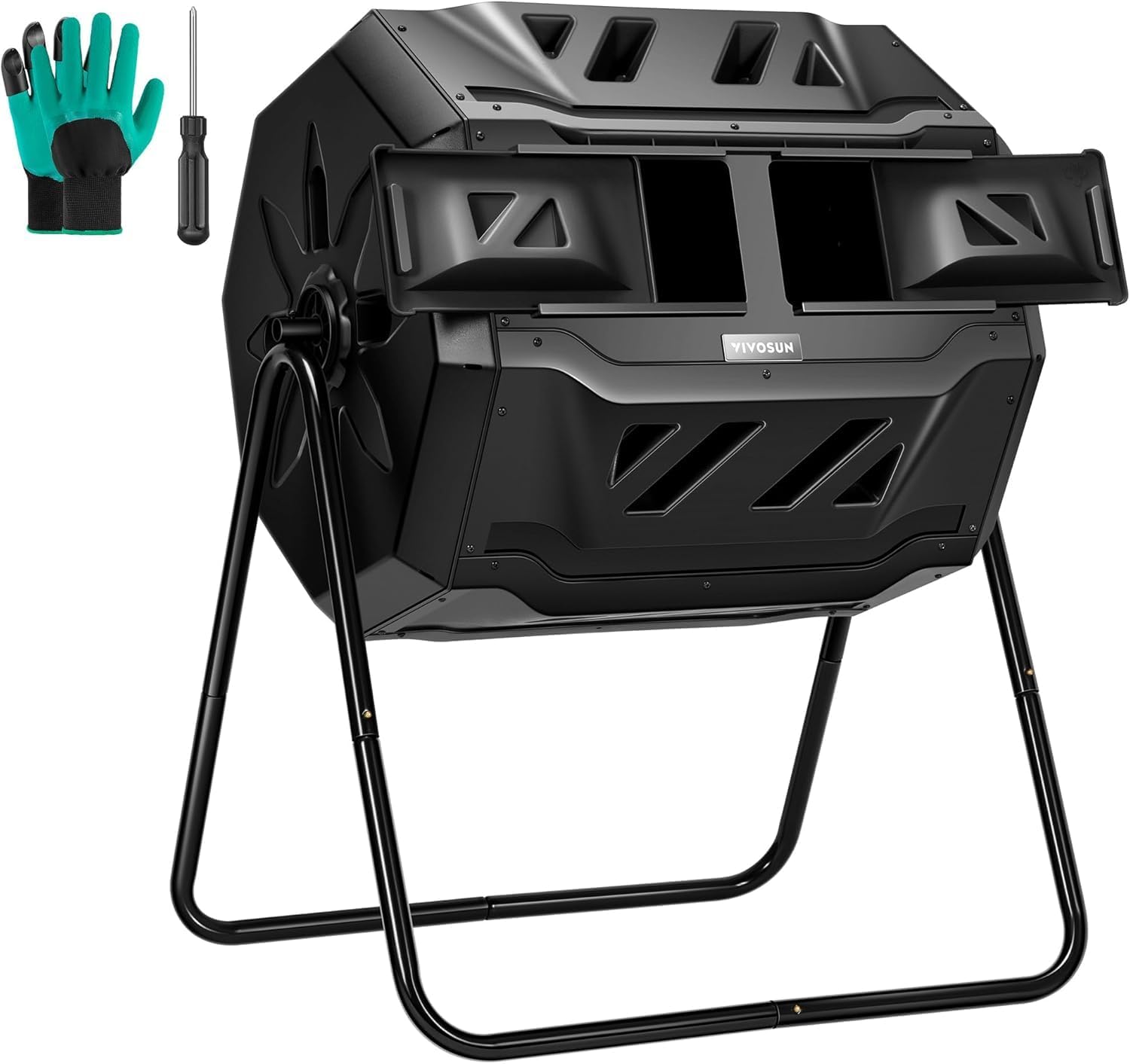
| Material Type | galvanized steel |
|---|---|
| Capacity | 43 gallons |
This VIVOSUN tumbling composter is a practical backyard unit built around two rotating chambers so you can add fresh waste to one side while the other finishes breaking down. The 360 degree tumbling design with deep internal fins makes turning the pile simple and helps break up clumps without digging. Ventilation slots around the drum promote airflow for aerobic decomposition, and the metal frame with a PP plastic barrel is designed to resist corrosion and outdoor weathering. It comes with waterproof garden gloves and small digging claws to make loading and aerating easier. At 43 gallons it is sized for a family garden or vegetable patch but is compact enough for a patio or small yard. Limitations to note are that it requires occasional manual turning to maintain activity and that the plastic drum means it will warm less in cold climates than insulated models, so composting speed will vary by season. Assembly and placement on a level spot are also important for smooth rotation.
Best for: Gardeners who want a hands-on, efficient system to produce regular batches of compost without digging a pile and who prioritize continuous output and easy turning.
Less Ideal for: People who need a completely hands-off hot composter or who compost only very large volumes; those in very cold climates seeking year-round rapid breakdown should consider insulated or electric options.
- Dual chambers let you load new material while another batch finishes, ensuring continuous compost production
- 360 degree tumbling with deep fins makes mixing and aeration easy without manual digging
- Galvanized steel frame and PP plastic barrel designed for outdoor durability and corrosion resistance
- Ventilation slots support aerobic breakdown for faster, less smelly composting
- Plastic drum offers less insulation than insulated or fully metal units, slowing composting in cold weather
- Requires manual turning and regular management to maintain heat and moisture for fast results
Verdict: If you want steady, manageable batches of compost with easy tumbling and continuous use, this dual-chamber VIVOSUN tumbler delivers practical, durable performance.
GEOBIN Backyard Compost Bin, Expandable Plastic Composter

| Capacity | 216 gallons |
|---|---|
| Material Type | Plastic |
| Shape | Cylindrical |
The GEOBIN Backyard Compost Bin is a lightweight, cylindrical plastic composter designed for straightforward backyard use. It assembles quickly with a few closure keys and expands to increase capacity, so you can start with a small footprint and add volume as your kitchen scraps and yard waste grow. The open-structure design gives excellent ventilation, which helps speed up decomposition when you layer greens and browns and turn the pile occasionally. Because it is low-tech and portable, it is easy to move, empty, or reassemble if you relocate it in the yard. The practical benefits are its affordability, ease of setup, and versatility for beginners and experienced gardeners who want a no-fuss system. Limitations are that it is a basic ring-style bin with no insulated walls or built-in access door, so it will not retain heat as well as tumblers or insulated bins and requires manual turning and occasional maintenance to keep the process active.
Best for: Budget-conscious gardeners who want a low-cost, low-effort way to compost yard trimmings and kitchen scraps without complicated setup.
Less Ideal for: People who need fast, high-temperature composting or a bin with a convenient bottom access door for frequent harvests should consider other designs.
- Expandable capacity up to 216 gallons (listed) to handle increasing compost volume
- Very easy assembly with simple closure keys
- Lightweight and portable for repositioning or storage
- Good ventilation that helps organic material break down faster
- No insulated walls or built-in access door for easy compost removal
- Basic plastic construction offers less heat retention than enclosed designs
Verdict: A very affordable, easy-to-assemble composter that gives budget gardeners a simple, expandable solution for backyard composting.
Choosing the Right Yard Compost: Key Factors to Consider
Nutrient Profile and Carbon-to-Nitrogen Balance
Compost is a slow-release nutrient source, and its C:N balance affects how it contributes nitrogen versus carbon to soil biology. A compost with a balanced carbon-to-nitrogen ratio supplies usable nitrogen without causing temporary nitrogen immobilization that can stress newly planted seedlings.
For yard use you should consider whether the compost was made from mostly green yard waste, mixed municipal organics, or more woody materials. Higher green-content composts tend to give an earlier nutrient boost, while woody-dominated piles provide longer-term organic matter but can tie up nitrogen if not fully matured.
Maturity, Stability, and Weed Seed Content
Mature compost has completed the hot, active breakdown phase and is biologically stable. Stable compost is less likely to reheat, smell, or rob soil nitrogen when incorporated. Immature compost can lead to plant stress, persistent odors, and unpredictable results in the yard.
Also consider weed seed and pathogen reduction. Properly finished compost usually reaches temperatures that kill most weed seeds and pathogens. If your compost origin is unclear or if you are using it around young seedlings or high-value plants, lean toward materials explicitly labeled as fully cured or finished.
Texture, Particle Size, and Mixing Ease
Particle size determines how compost behaves when spread or mixed. Fine, screened compost blends smoothly into existing soil and is ideal for topdressing lawns and finishing bed surfaces. Coarser, chunkier compost is better for building soil structure or improving heavy clay because it increases pore space and drainage.
Think about how you will apply the product. If you plan to work it into beds with hand tools, very coarse material may need extra shredding. For broadcast topdressing or container mixes, a screened, consistent texture saves time and gives predictable results.
Water-Holding Capacity and Drainage Effects
Compost improves both water retention and structure, but the degree varies. In sandy soils, compost increases moisture-holding capacity and nutrient retention, reducing irrigation frequency. In clay soils, compost can improve drainage and aggregation, making the soil easier to work and less prone to surface crusting.
Balance is key: too much very fine compost on heavy soils can create a dense layer that reduces infiltration. Consider the compost's texture and organic matter level relative to your existing soil to predict how watering needs may change.
Application Method and Handling
How you will apply compost affects the ideal form. Bagged compost is convenient for small yard jobs and containers, while bulk compost is better value for larger lawn topdressing or bed building. Consider whether you have the tools and labor to spread and incorporate bulk loads, or whether smaller bags that are easy to carry suit your yard layout.
Also evaluate dustiness, moisture at delivery, and whether the compost clumps. Wetter, heavier loads can be harder to handle but often settle well; drier, dusty compost is easy to move but may require wetting before use to reduce airborne particles.
Source Feedstock and Contaminant Risk
The original materials used to make compost influence nutrient ratios, salt levels, and the risk of contaminants such as plastics, glass, or persistent chemicals. Yard waste and food scraps produce nutrient-rich blends, while composts containing biosolids or industrial byproducts may have different regulatory or contaminant considerations.
If you grow edibles, check for source transparency and testing information. Even with yard-scale use, avoiding composts with visible contaminants or unclear feedstock helps protect soil health and reduces the need for remediation later.
Best Compost Uses Around the Yard
Different tasks call for different compost types. For lawn topdressing, choose a screened, fine compost that will integrate with turf without creating clumps. Spread thin layers and rake lightly to encourage soil contact.
For new beds and heavy clay amendments, coarser compost that boosts structure and pore space is beneficial. Work it into the topsoil to improve drainage and root penetration before planting.
- Topdressing lawns: fine, screened compost applied in thin layers
- Building beds: coarser mixes worked into the top 6 to 12 inches
- Container mixes: well-aged, sterile-feeling compost combined with lighter media
How Much Compost to Use and Application Timing
Application rates depend on the goal. For surface improvement and topdressing, apply a quarter- to half-inch layer annually or twice a year. For establishing beds or improving degraded soil, incorporate 2 to 3 inches into the top foot of soil.
Timing matters. Apply compost in spring to give soil organisms time to integrate organic matter before peak growth, or in fall so winter weather and biology continue the breakdown process.
- Annual lawn topdress: 1/4 to 1/2 inch
- Soil rebuilding: 2 to 3 inches worked into 6 to 12 inches of existing soil
- Container refresh: replace one-third to one-half of potting mix with compost when repotting
Incorporating Compost Without Disturbing Established Plants
If you need to improve soil around existing plantings, use surface applications and light mulching rather than deep digging. Spread a thin layer of mature compost and top with mulch to reduce root disturbance while feeding soil life.
For shrubs and perennials, gently fork compost into the top few inches of soil in rings around plants rather than aggressive trenching. Over time, repeated light applications can substantially improve soil without causing transplant shock.
- Use shallow forking or hand tools to avoid root damage
- Combine with mulch to protect soil moisture and reduce weed pressure
Storing Compost at Home and Avoiding Compaction
If you buy in bulk, store compost in a dry, covered area to prevent nutrient leaching and to keep it from becoming waterlogged. Piles left uncovered can compact and create anaerobic zones that produce odors and reduce quality.
Avoid piling compost directly on surfaces that could cause contamination, and keep storage away from edible gardens until you plan to apply. When using stored compost, fluff or screen it before application to break up compacted material.
- Cover bulk piles with breathable tarps
- Keep stored compost off paved surfaces when possible
Simple Tests to Check Compost Readiness
There are quick checks you can perform at home. Mature compost smells earthy rather than sour or ammonia-like. It should feel crumbly and hold moisture without being slimy. A simple bag test-sealing a scoop in a plastic bag at room temperature for a few days-can reveal off-odors indicating incomplete curing.
Look for visible, undecomposed large wood pieces or recognizable food scraps as signs that further composting is needed. For critical uses, consider requesting or checking for lab tests on soluble salts or heavy metals if feedstock is uncertain.
- Smell check: should be earthy
- Texture check: crumbly and moist, not slimy
- Visual check: few recognizable food scraps or large wood pieces
How We Chose the Best Yard Compost
We selected products by focusing on measurable, gardening-relevant attributes that affect real-world use. Key evaluation dimensions were nutrient content and balance, which determines how compost supports plant growth and how fast it reduces fertilizer needs; particle size and texture, because coarser or finer materials change incorporation, mulching behavior, and water-holding capacity; maturity and stability, since well-rotted compost avoids nitrogen tie-up and odors; and ease of handling and application, including bagged versus bulk options and how easily compost spreads or mixes into soil. We also considered supply consistency and source transparency where available, since feedstock and processing affect contaminants and performance. We excluded materials not intended primarily for yard or garden soil amendment, like unprocessed manure piles, raw wood chips for long-term paths, or specialty growth media designed exclusively for potted seedlings. Our shortlist favors composts that deliver steady soil improvement across typical yard tasks: topdressing lawns, building beds, and improving planting holes. Each product on the list met minimum standards for stability and garden suitability under the criteria above.
FAQ
Can I use yard compost on a vegetable garden?
Yes, mature yard compost is beneficial in vegetable beds as a source of organic matter and slow-release nutrients. Ensure the compost is fully cured and free of contaminants or persistent weed seeds before using it with edibles.
How soon after applying compost will I see results?
Soil structure and moisture retention often improve within a single season, while nutrient benefits can take several weeks as microbes cycle nutrients. Repeated annual applications produce the most noticeable changes over time.
Is bagged compost better than bulk compost for small yards?
Bagged compost is convenient and easier to handle for small yards and tight spaces, while bulk compost can be more practical for larger areas. Choose based on the scale of the job and how much manual handling you are willing to do.
Will compost make my clay soil worse or better?
Properly worked-in compost generally improves clay by increasing aggregation and drainage. Avoid leaving a very thick layer of fine compost on clay surfaces without mixing, as that can create a compacted mat that reduces infiltration.
How often should I apply compost to my lawn?
Light topdressings once a year are common for maintenance, while twice a year can help accelerate improvement. Apply thin layers to avoid smothering turf and rake to improve soil contact.
Can compost contain weed seeds or pathogens?
If compost reaches adequate temperatures during the active phase, most weed seeds and common pathogens are destroyed. Compost from uncertain sources or that appears immature may still carry viable seeds or pathogens, so choose cured materials for sensitive plantings.
Final Verdict
Pick a yard compost that matches your immediate task and long-term soil goals. Prioritize maturity and a texture that suits how you plan to apply it, and check feedstock transparency if you grow edibles. For general yard improvement, aim for steady annual applications rather than one large dose so your soil biology can adjust and deliver lasting benefits.
