

Note: This article contains affiliate links. If you click on these links and make a purchase, I may earn a small commission at no extra cost to you. This helps support my research and content. Read my full affiliate disclosure here.
If you want to turn vegetable scraps into usable soil amendment without a smelly bin in the kitchen, a countertop electric composter can make that possible. These compact units speed up decomposition, cut down on odors, and produce material you can mix into potted plants or the garden. Picking the right model matters because cycle time, capacity, and energy use affect how you will actually use it day to day. This guide covers seven shortlisted countertop electric composters suited to small kitchens and indoor gardeners. We evaluated units for processing speed, odor control, energy efficiency, and user convenience so you can match a machine to your household habits. Read on for practical features to prioritize and answers to common questions before you buy.
Top Picks at a Glance
| Best Overall The best all-around choice for most situations | Reencle Prime Electric Composter, 14L |  |
| Best Quality Built to a higher standard if you want something more solid | GEME PRO 19L Electric Kitchen Composter |  |
| Best Value The sweet spot between price and what you get | Airthereal Revive R500 Electric Kitchen Composter (2.5 L) |  |
| Best Budget The cheapest option that still gets the job done reliably | Home Zone Living Electric Pre-Composter (3 L) |  |
| Highest Rated A top-rated pick with lots of positive feedback | Saluna 4L Electric Kitchen Composter with LED Display and Visible Window |  |
| Most Popular A crowd favorite that many people choose with confidence | Ouaken 4L Electric Countertop Composter |  |
| Best Seller A high-volume bestseller chosen again and again | Ouaken 4L Electric Countertop Composter |  |
Reencle Prime Electric Composter, 14L

| Capacity | 14 liters |
|---|---|
| Material Type | Polypropylene (PP) |
| Item Type Name | Electric Composter |
The Reencle Prime is a countertop electric composter designed to turn everyday food scraps into finished compost quickly while keeping odors and noise to a minimum. You load mixed scraps (including meat, dairy, citrus and leftovers but not large bones or pits) into the 14 L chamber, the unit activates its aerobic microbe process and filtration system, and living microbes accelerate decomposition so you get usable material within weeks rather than months. Notable features are a three-layer carbon filter for low-odor operation, a hands-free lid, a whisper-quiet motor rated as low as 28 dB, and a starter pack plus shovel included so you can begin right away. The compact rectangular design fits on a kitchen counter and handles small household output — the manufacturer lists up to about 2.2 lb of daily waste processing. Trade-offs are capacity and throughput: the 14 L bin and the daily processing rate suit small households or couples but will require more frequent emptying for larger families, and the unit is a dedicated appliance that uses electricity and occasional filter replacements. For buyers wanting fast, low-odor indoor composting without outdoor bins, this is a practical, easy-to-use option.
Best for: Homeowners or renters who want a straightforward indoor solution to convert daily kitchen scraps into compost quickly and with minimal odor, and who prioritize ease of use and social reassurance from a well-reviewed device.
Less Ideal for: Large households that produce heavy daily food waste or gardeners who need high-volume outdoor composting should choose a larger or outdoor system instead.
- Rapid microbial decomposition that produces usable compost much faster than traditional methods
- Three-layer carbon filter and sealed design reduce kitchen odors
- Whisper-quiet operation (as low as 28 dB) suitable for indoor use
- Includes starter pack, shovel, and one carbon filter so you can begin immediately
- 14 L capacity and stated daily processing limit mean frequent emptying for larger households
- Requires electricity and periodic filter replacements
Verdict: A compact, low-odor electric composter that makes fast, hassle-free indoor composting practical for small households.
GEME PRO 19L Electric Kitchen Composter

| Capacity | 19 liters |
|---|---|
| Daily processing | Up to 11 lbs |
| Compost time | 6–8 hours |
The GEME PRO 19L electric composter is designed to convert everyday kitchen scraps into usable organic compost quickly using microbial degradation rather than dehydration. You load food waste directly into the 19-liter drum any time and the unit runs continuously, processing up to about 11 pounds per day and producing finished material in roughly 6 to 8 hours. Notable features include a permanent industrial-grade filter that the manufacturer says never needs replacing, an integrated deodorization system for low odor, and quiet operation for indoor use. The practical benefits are fast turnaround so you can harvest soil conditioner within hours, fewer trips to an outdoor bin, and reduced ongoing maintenance because the filter and routine cleaning requirements are minimal. Important limitations are its size and weight for placement in a small kitchen, and reliance on the included microbial starter supply to maintain breakdown performance over time. Also expect some electricity consumption compared with passive composting methods.
Best for: Buyers who prioritize fast, reliable on‑site composting and want a low-maintenance indoor unit that turns daily food waste into usable compost within hours.
Less Ideal for: People with very small kitchens or who prefer passive, electricity-free composting methods should consider other options.
- Fast processing: produces usable compost in about 6–8 hours using microbial degradation
- High daily capacity: can handle up to roughly 11 pounds of food waste per day
- Permanent built-in filter reduces ongoing maintenance and filter replacement costs
- Odor control and quiet operation make it suitable for indoor kitchen placement
- Relatively large and heavy for tight kitchens which can limit placement options
- Requires proprietary microbial starter (Kobold) to maintain optimal performance
Verdict: If you want rapid, low‑maintenance indoor composting that turns daily food waste into real compost in hours, this 19L GEME unit delivers performance-focused results.
Airthereal Revive R500 Electric Kitchen Composter (2.5 L)

| Capacity | 2.5 liters |
|---|---|
| Cycle time | 4-hr Cycle |
| Material Type | Aluminum |
| Item Highlight | SHARKSDEN Tri-blade, 90% Reduction in Waste Volume |
The Revive R500 is a compact electric composter designed for countertop use that turns kitchen scraps into dry powder for easier disposal or use as a soil amendment. You load up to the 2.5 liter aluminum bucket with mixed food waste, start the one-button 4-hour cycle and the SHARKSDEN tri-blade grinds and dries material while an activated carbon filter helps control odors. Its cast aluminum bucket is dishwasher-safe which makes cleanup straightforward, and the drawer-style container and straightforward controls suit busy households that want low-fuss waste reduction. Practical benefits include substantial volume reduction and a routine that lets you run the machine overnight and empty in the morning. Important limitations are the relatively small 2.5 L capacity, which means more frequent cycles for larger households, and the processing time that is not instantaneous. The unit is best where counter space and simple, predictable composting are priorities rather than high-volume or fully finished hot compost production.
Best for: For buyers who want a low-maintenance, countertop solution to reduce kitchen waste volume and odor with predictable, scheduled operation and easy cleanup.
Less Ideal for: Not a good fit for households that need to process large amounts of food scraps at once or gardeners seeking traditional finished hot compost without additional processing.
- Compact countertop footprint suitable for kitchens
- SHARKSDEN tri-blade grinds waste from multiple directions for effective size reduction
- 4-hour automated cycle simplifies daily use
- Aluminum bucket is easy to clean and dishwasher safe
- Carbon filter reduces odors during and between cycles
- 2.5 liter capacity requires frequent emptying for larger households
- Processing converts waste to powder but does not produce finished compost immediately
Verdict: If you want a compact countertop device that reliably grinds and dries daily food scraps into low-odor powder, the Revive R500 delivers an easy, low-maintenance solution.
Home Zone Living Electric Pre-Composter (3 L)

| Capacity | 3 liters |
|---|---|
| Noise level | Under 45 dB |
| Item Type Name | Electric Composter |
| Material Type | Plastic |
This Home Zone Living electric pre-composter is designed to turn daily food scraps into pre-compost in a small kitchen-friendly footprint. You load up to the 3-liter drum with fruit and vegetable scraps, start the automated cycle and the unit grinds and dries the material while an activated carbon filter helps control odors. It runs quietly at under 45 dB and includes an auto-cleaning and automatic shutoff after cooling to conserve energy. Practical benefits include a compact size that fits on a counter or under a cabinet, straightforward operation for frequent small loads, and reduced odor compared with an uncontained bin. Limitations are the modest 3-liter capacity, which means more frequent emptying for larger households, and the plastic construction that may feel less durable than metal alternatives. It also produces pre-compost rather than finished compost, so outdoor composting or soil mixing is still needed to finish the process.
Best for: Best for budget-minded single occupants or couples who want a low-effort way to cut kitchen waste and produce pre-compost without a large appliance footprint.
Less Ideal for: Not a good fit for large households or users who need finished compost straight from the unit rather than pre-compost that needs outdoor finishing.
- Compact 3 liter capacity fits on counters and in small kitchens
- Activated carbon filter helps reduce cooking and food odors
- Quiet operation below 45 dB suitable for indoor use
- Auto-cleaning cycle and automatic power-off for low-maintenance use
- Small capacity requires frequent emptying for multi-person households
- Made of plastic which may be less robust than metal-bodied models
Verdict: A compact, energy-conscious electric pre-composter that offers quiet, low-maintenance odor control for budget-minded kitchens.
Saluna 4L Electric Kitchen Composter with LED Display and Visible Window
| Capacity | 4 liters |
|---|---|
| Material Type | Metal, Stainless Steel |
| Item Highlight | One-Touch Produces Dry Pre-Compost, LED Display, Odorless & Auto-Cleaning |
| Model Number | Fc-385w |
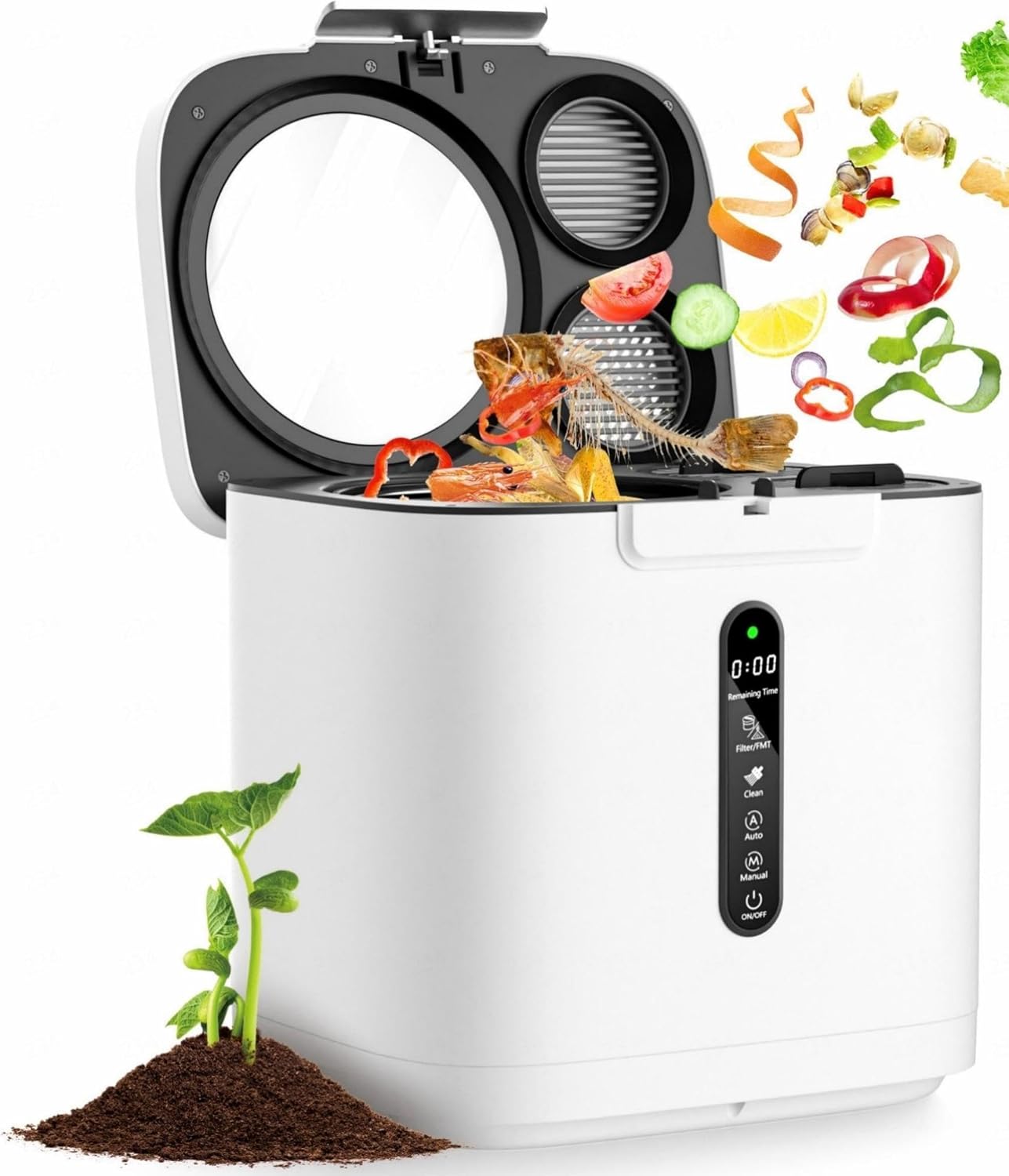
This Saluna 4L electric kitchen composter is designed for daily indoor use on a countertop to reduce food waste into a dry pre-compost product. It offers three programmable composting modes shown on an LED panel so you can set cycle time and monitor progress through the clear viewing lid without breaking the seal. Practical features include dual activated carbon filters for odor control, a removable stainless steel bucket that is dishwasher-safe, and a one-touch auto-cleaning rinse to simplify maintenance. The unit’s 4 liter capacity fits typical household scrap volumes for one to a few people but will require more frequent emptying in larger households. Because it concentrates material into a dry pre-compost rather than finished garden-ready compost, you will still need a backyard compost pile, worm bin, or municipal collection for final decomposition. The build appears aimed at durability with metal and stainless components, and the visible window and simple controls make it easy to integrate into a reliable kitchen routine.
Best for: A buyer who wants a dependable, low-fuss indoor system to reduce daily kitchen waste and prefers predictable, easy-to-use controls for routine composting.
Less Ideal for: Not well suited for households that need large-volume processing or gardeners who expect finished, soil-ready compost straight from the machine.
- Compact 4 L capacity suited to countertop placement and everyday kitchen scraps
- Three LED-controlled modes and visible lid let you monitor and customize cycles
- Dual activated carbon filters reduce kitchen odors during operation
- Removable stainless steel bucket is dishwasher-safe for easier cleaning
- One-touch auto-cleaning simplifies maintenance between uses
- 4 liter capacity requires frequent emptying for larger households or heavy cooking
- Produces dry pre-compost rather than finished compost, so further processing is needed
Verdict: Choose this compact electric composter if you want a reliable, low-maintenance countertop unit that turns daily scraps into dry pre-compost with straightforward controls and built-in odor control.
Ouaken 4L Electric Countertop Composter

| Capacity | 4 liters |
|---|---|
| Material Type | Aluminum |
| Noise level | <40 dB |
| Item Weight | 7.15 kg |
The Ouaken 4L electric composter is a compact countertop unit designed to convert daily kitchen scraps into usable compost or reduced-volume waste. It offers two processing modes: Crush to quickly reduce volume and control odors and Ferment to produce a richer, accelerated compost. The machine uses low-speed, high-torque blades plus a heating cycle and cooling step to break down food; a large activated carbon filter and double filtration help keep smells contained while a transparent lid lets you monitor progress. Noise is kept under 40 dB, so it runs quietly in a kitchen, and a smart clean mode plus a removable bucket that is dishwasher-safe simplify maintenance. Practical limits are the 4 L capacity, which suits small families or couples but requires more frequent cycles for larger households, and the recommendation to empty between runs to avoid extended runtimes. You will also need to replace filters periodically. For buyers who value a near-odorless, hands-off countertop solution, this unit streamlines indoor composting without major setup or outdoor space.
Best for: Buyers who want a low-effort, countertop solution to turn daily kitchen scraps into compost or reduced waste and who prioritize quiet, odor-controlled operation and easy maintenance.
Less Ideal for: Not a good fit for large families or households that generate heavy daily food waste and prefer bulk batch composting outdoors.
- Two processing modes (Crush and Ferment) for either fast volume reduction or higher-quality compost
- Large-capacity activated carbon filter and double filtration to minimize odors
- Quiet operation below 40 dB suitable for countertop use near living areas
- Auto-clean mode and a dishwasher-safe removable bucket for easier maintenance
- 4 L capacity requires frequent runs for larger households
- Requires periodic filter replacement and emptying between cycles to maintain performance
Verdict: A quiet, countertop-friendly electric composter that delivers near-odorless, low-effort composting for small households.
Ouaken 4L Electric Countertop Composter

| Capacity | 4 liters |
|---|---|
| Material Type | Aluminum alloy |
| Noise level | Under 40 dB |
| Item Type Name | Electric Composter |
The Ouaken 4L Electric Countertop Composter is a compact kitchen appliance that turns daily food scraps into reduced-volume compost through drying, grinding, and an accelerated fermenting option. Typical use is simple: load up to the 4 L bucket, choose Crush mode to reduce volume and odors or Ferment mode to produce richer compost, then monitor progress through the transparent lid. Notable features include a large activated carbon filter and double-filtration design for odor control, a low-noise motor claimed to run under 40 dB, and a smart cleaning mode plus a dishwasher-safe removable bucket for easier maintenance. In practice it will cut waste by a large percentage in hours and keep the kitchen relatively odor-free, making it suitable for countertop use in apartments or family kitchens. Important limitations are the small 4 L capacity if you generate lots of scraps and the recommendation to empty the bucket before each run, which adds a routine step; results also vary by food type and may not always be a fine powder. For buyers who prioritize quiet, hands-off composting on a countertop, this model offers a practical, low-fuss solution.
Best for: Buyers who want a low-effort, countertop solution to reduce daily food waste and value quiet, odor-controlled composting with simple controls and easy maintenance.
Less Ideal for: Not a good fit for households that produce large volumes of food scraps daily or for users who need instant, finely powdered compost without periodic manual emptying.
- Compact 4 L capacity fits on most countertops without taking much space
- Activated carbon filter and double-filtration design for effective odor control
- Quiet operation under 40 dB allows use at night or in open-plan kitchens
- Multiple modes (Crush, Ferment, Clean) let you choose volume reduction, compost quality, or automatic cleaning
- Removable bucket is dishwasher-safe for easier cleanup
- 4 L capacity may require frequent emptying for larger households
- Processed output texture varies by input and may not always be fully powdered
Verdict: If you want a compact, quiet countertop composter that reliably reduces kitchen waste and controls odors with minimal hands-on effort, this Ouaken 4 L model is a strong choice.
Choosing the Right Countertop Electric Composter: Key Factors to Consider
Cycle Time and Throughput
How quickly a unit reduces food scraps to a usable end product affects how you schedule runs and whether the composter keeps up with your household waste. Shorter cycle times mean you can process more batches per week and avoid a backlog of scraps sitting in a counter bin.
Throughput measures how much material the machine can handle per cycle. For couples or small families, a modest daily throughput can be sufficient, whereas larger households need higher capacity or more frequent cycles. Consider whether the unit lets you run partial cycles and how it handles mixed material like citrus peels, coffee grounds, and dairy scraps.
Odor Control and Sealing
Effective odor management is essential for indoor composters. Look for machines with active ventilation, charcoal filters, or airtight seals that limit smells between cycles. How the unit vents – whether it filters air before releasing it or recirculates it internally – influences kitchen comfort.
A design that minimizes exposed wet surfaces and that encourages quick drying of the material will reduce anaerobic pockets that produce bad smells. Removable filter cartridges and clear guidance on replacement intervals also matter for maintaining performance over time.
Energy Use and Operating Cost
Countertop electric composters run on household electricity, so efficiency affects running cost and environmental footprint. Compare wattage and typical cycle duration to estimate daily energy use. Some models use heat, agitation, or a combination of mechanical processes; each approach has different power demands.
Lower energy draw is important if you run many cycles or keep the appliance in a small, frequently used space. Also consider standby energy draw and whether the unit has energy-saving modes or timed cycles rather than continuous operation.
Noise and Placement
Noise level matters because the unit will likely sit near living areas. Mechanical agitation or fans can produce buzzing or humming that is more noticeable in small apartments. Check reported decibel ranges and consider when you will run cycles – daytime only, overnight, or intermittently.
Placement also affects convenience. A compact footprint and manageable weight make it easier to move the unit when cleaning or when you need counter space. If noise is a concern, look for models designed for quieter operation or that allow scheduling during times when noise is less intrusive.
Cleaning, Maintenance, and Waste Removal
Regular cleaning prevents odors and keeps the composter working smoothly. Look for models with removable inner liners or baskets that are easy to rinse or wash. Materials that resist staining and retain less residue reduce the time you spend on maintenance.
Consider how the processed output is removed and whether the residue is dry and crumbly or still moist. Drier material is easier to handle and store before adding to soil. Also check how often filters or other consumables need replacement and whether replacement parts are accessible.
End Product Use and Compatibility
Think about what you plan to do with the finished material. Some countertop electric composters produce a fine, dry amendment that can be mixed directly into potting soil or used as a soil conditioner. Others create a pre-compost that benefits from additional curing outdoors or in a bin.
If you grow houseplants or maintain a compact balcony garden, a unit that yields ready-to-use material is more convenient. For gardeners who want to bulk up a vegetable bed, expect to combine processed scraps with garden compost or allow extra curing time before incorporation.
How Countertop Electric Composters Fit Into a Small-kitchen Routine
Countertop electric composters are designed for daily kitchen use and for gardeners who want to avoid hauling scraps outdoors. They work best when integrated into a simple routine: collect scraps in a small countertop pail, run a cycle at convenient intervals, then empty and store the processed material. Consistent sorting of non-compostables avoids clogs and maintenance headaches.
Because these units reduce volume and dry or granulate material, they significantly cut the frequency of manual transfer to outdoor compost or soil. That makes them attractive for apartment gardeners, balcony growers, or anyone who wants to reduce kitchen waste without an outdoor pile.
- Keep a small pre-sorting container to remove bones, large citrus rinds, and non-compostables before loading.
- Run cycles on a predictable schedule to prevent overflow and keep odors down.
- Store processed material in a breathable container if you cannot immediately use it in potting mixes.
Setting Up and Maintaining Good Odor Control
Even with built-in filters, routine cleaning and the right mix of scraps help control smells. Avoid adding large amounts of high-moisture items at once and include dryer, carbon-rich scraps like paper napkins or small amounts of cardboard when allowed by the unit. Periodic rinsing of removable parts and changing filter cartridges on schedule maintain performance.
If an appliance has an active venting system, position it away from open dining areas or direct airflow paths. For persistent odors, short additional runs and airing the unit between uses can help.
- Check filter access and replacement intervals before committing to a model.
- Dry out wet residue with brief extra cycles if the output seems damp.
- Use small amounts of carbon material to balance very wet batches.
Practical Tips for Using Output in Houseplants and Garden Beds
Processed material from countertop electric units is often concentrated and may be hotter during processing. Let it cool and, if necessary, cure briefly in a small container before mixing into potting soil. For houseplants, use the amendment sparingly blended with potting mix to avoid overly rich nutrient bursts.
For outdoor beds, mix the processed material into existing compost or topsoil and let it integrate for a week or two. The convenience of indoor processing means you can maintain a steady supply of amendment for potted herbs or container vegetables throughout the season.
- Blend small amounts of processed material into potting mixes for seed starting or potted herbs.
- Top-dress containers lightly and water in rather than adding large volumes at once.
- Store cured output in a breathable bag to prevent rewetting.
Energy and Environmental Considerations
While countertop units use electricity, the overall environmental impact can be lower than frequent trips to a municipal compost drop-off or using single-use waste liners. When comparing models, look at typical cycle wattage and how many cycles you will run per week to estimate energy use.
Some gardeners offset energy use by scheduling cycles during lower-cost hours or combining multiple small loads into one run, as long as capacity allows. Also consider the tradeoff between a faster, higher-energy cycle and a slower, lower-energy one when prioritizing household footprint.
- Estimate weekly run frequency and multiply by cycle wattage to compare energy consumption.
- Choose energy-saving settings if you plan to run multiple cycles per week.
- Balance convenience and footprint based on how you use the processed material.
Troubleshooting Common Small-kitchen Issues
If the unit smells or the output is wet, first check for overloading with high-moisture scraps and run a drying or extra cycle. Ensure vents and filters are not clogged and that removable parts are rinsed. For machines that grind or agitate, inspect blades or paddles for stuck fibers or hard residues.
If noise seems excessive, confirm the unit sits on a level, stable surface and that internal parts are correctly seated. For persistent mechanical issues, follow the manufacturer's maintenance guidance and take care with parts that require periodic replacement.
- Avoid bones and very fibrous stalks that can tangle moving parts.
- Run a short maintenance cycle with a small amount of dry paper to absorb excess moisture.
- Keep the unit level to reduce vibration and noise.
How We Chose the Best Countertop Electric Composter
We prioritized features that matter for everyday indoor composting and excluded large outdoor systems or appliances intended for municipal-scale processing. Selection focused on units sized for counter placement and daily kitchen use. Evaluation emphasized cycle time and processing reliability, because faster, consistent breakdown determines how often you can run the unit and whether it keeps up with typical household food scrap volumes. Odor control and airflow design were assessed to ensure units reduce smells during and between cycles. Capacity and practical throughput were considered so a unit fits small kitchens without requiring constant emptying. Energy use and noise levels were factored to gauge how comfortable the appliance is for indoor use. Ease of cleaning and maintenance were checked since frequent handling affects long-term satisfaction. We excluded bulky machines, models designed only for yard waste, and products with unclear maintenance needs. The final list reflects units that balance processing speed, indoor comfort, and simple upkeep for countertop use.
FAQ
Can a countertop electric composter handle meat and dairy?
It depends on the model. Some indoor electric units process small amounts of meat and dairy without odor if sealed and run to completion, while others advise against those materials because they increase smell and attract pests. Check the unit's guidance and start with small batches if you plan to include those items.
How often will I need to empty the unit?
Emptying frequency depends on household scrap volume and the machine's capacity. Small households might run and empty a unit several times per week, while single users may only need weekly cycles. Choose a capacity that matches how much food waste you produce between convenient emptying intervals.
Is the output ready to use immediately in potting soil?
Many countertop electric composters produce material that is partially processed and may be used in small amounts in potting mixes. For larger applications or sensitive plants, allow the output to cure briefly or blend it with existing compost to stabilize nutrients before use.
How noisy are countertop composters during operation?
Noise varies by mechanism. Models with grinding or active fans are usually louder than passive thermal designs. Typical indoor units are audible but designed for kitchen use. If noise is a concern, look for reported decibel levels or choose a model that advertises quiet operation.
Do these units require special liners or bags?
Most countertop electric composters do not require single-use liners, but some recommend using compostable bags for easier cleanup or for containing particularly wet or messy loads. Check maintenance guidance for your chosen model and avoid non-compostable plastics.
Can I run partial loads or mix small amounts over multiple days?
Some machines permit partial loads and short cycles, while others work best when run with a full recommended charge. Running many small cycles can increase energy use and wear, so review the manufacturer's recommendations for load size and cycle frequency.
Final Verdict
Choosing a countertop electric composter comes down to matching capacity and cycle behavior to your kitchen routine. Prioritize models with reliable odor control, manageable capacity for your household, and easy maintenance to keep the machine practical for everyday use. Expect tradeoffs between processing speed, energy use, and noise; faster machines usually run hotter and draw more power, while quieter units may take longer. Focus on how you will use the end product and whether you need a ready-to-use amendment or something that will finish curing outdoors. With a clear idea of run frequency, placement, and maintenance willingness, you can pick a compact indoor composter that reduces waste and supports your container garden or houseplants effectively.
