

Note: This article contains affiliate links. If you click on these links and make a purchase, I may earn a small commission at no extra cost to you. This helps support my research and content. Read my full affiliate disclosure here.
Spring feeding sets the tone for the whole growing season. The right fertilizer for spring lawn feeding helps lawns green up faster, rebuild root mass after winter, and establish a healthier canopy before summer stress arrives. Choosing among products requires balancing immediate nitrogen for quick color with slower-release nutrition to avoid burn and support roots. This guide covers seven top-rated spring lawn fertilizers shortlisted for common turf situations. We evaluate each option for nutrient balance, release profile, and ease of application so you can pick a feed that matches your grass type and care plan.
Top Picks at a Glance
| Best Overall The best all-around choice for most situations | The Andersons 25-0-3 Turf Fertilizer with 2% Iron, 50 lb |  |
| Best Quality Built to a higher standard if you want something more solid | The Andersons Professional PGF Complete 16-4-8 Granular Lawn Fertilizer (covers 5,000 sq ft) |  |
| Best Value The sweet spot between price and what you get | GreenView Fairway Formula Lawn Fertilizer, 16.5 lb (covers 5,000 sq ft) |  |
| Best Budget The cheapest option that still gets the job done reliably | O.M. Scott & Sons Natural Grass Food, 12.72 lb |  |
| Highest Rated A top-rated pick with lots of positive feedback | Scotts Turf Builder Lawn Food, 12.5 lb |  |
| Most Popular A crowd favorite that many people choose with confidence | Scotts Green Max Lawn Food (16.67 lb) |  |
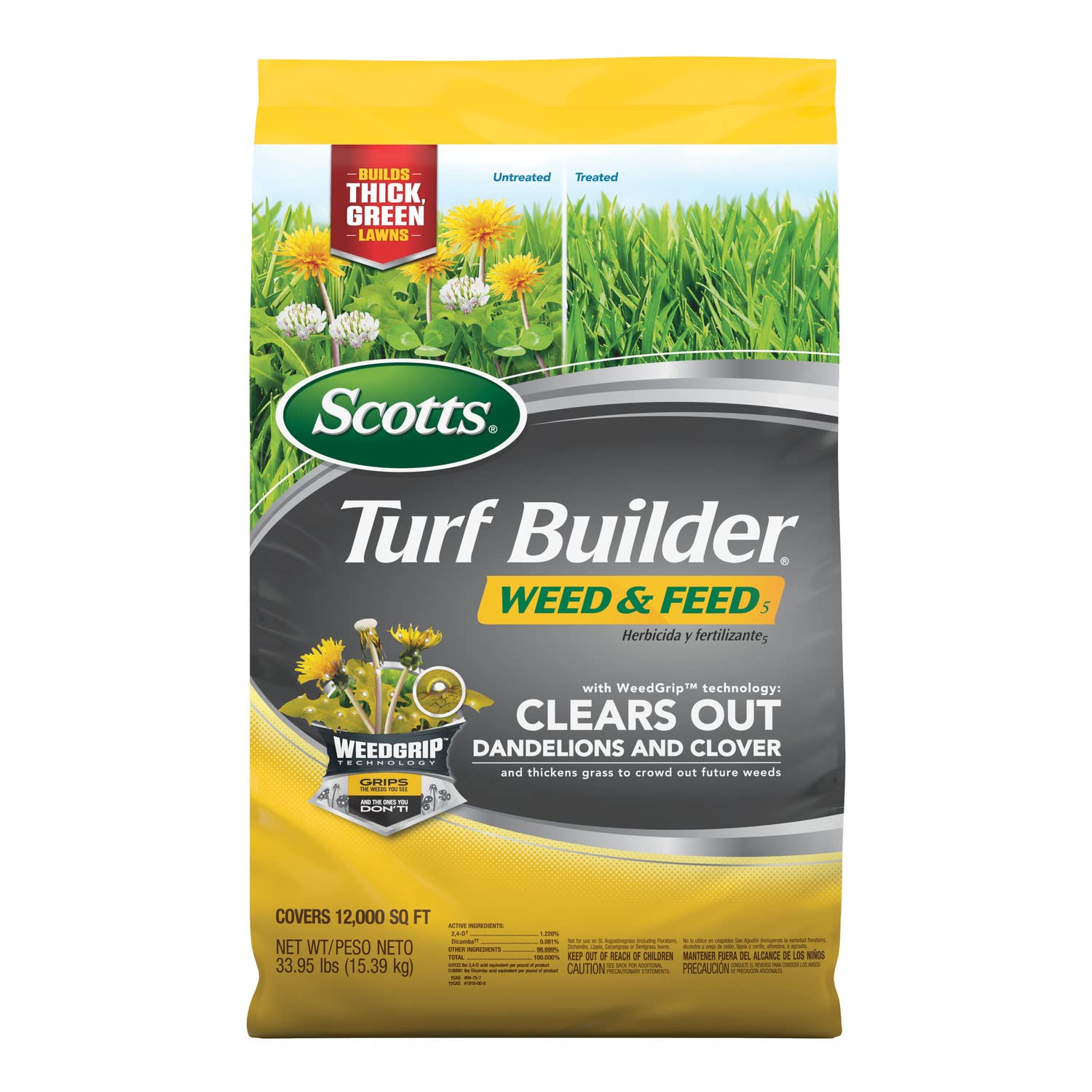
| Best Seller A high-volume bestseller chosen again and again | Scotts Turf Builder Weed & Feed5 Granular Lawn Fertilizer (33.95 lb) |  |
The Andersons 25-0-3 Turf Fertilizer with 2% Iron, 50 lb

| N-P-K | 25-0-3 |
|---|---|
| Iron | 2% |
| Form | Granules |
| Application | Broadcast or drop spreader |
| Coverage | 10,000 square feet |
This 25-0-3 granular turf fertilizer is designed for spring lawn feeding, pairing slow-release nitrogen with 2% iron to boost color and sustain green growth. It is applied with a broadcast or drop spreader and one 50 lb bag is labeled to cover about 10,000 square feet, making it practical for mid-size yards. About half the nitrogen comes from NutriSphere-N, a proprietary slow-release source that helps extend color and reduce the need for frequent reapplication. The added iron provides a noticeable darkening effect without adding phosphorus, which is suitable where phosphorus application is restricted. Expect several weeks of improved greenness after application, especially when used on actively growing cool- or warm-season turf. The main limitations are that it is a straight nitrogen-plus-iron formula, so it will not correct soil deficiencies beyond nitrogen or iron and will require additional products if you need phosphorus or micronutrient correction. Also plan to calibrate your spreader carefully to avoid uneven color or burn from overapplication.
Best for: Homeowners who want a straightforward spring feed to improve lawn color and reduce reapplication frequency, and who maintain typical cool- or warm-season turf with a spreader.
Less Ideal for: People managing small container lawns, those needing a complete multi-nutrient treatment, or gardeners who require soil-specific nutrient correction based on a soil test.
- Slow-release nitrogen (50% from NutriSphere-N) supports longer-lasting green-up
- Contains 2% iron to deepen turf color without adding phosphorus
- Granular form works with standard broadcast or drop spreaders for easy application
- One 50 lb bag covers up to 10,000 square feet, suitable for mid-size lawns
- No phosphorus or broad micronutrient mix included, so additional products may be needed
- Single-formula bag may not suit soils that need customized nutrient balance
Verdict: A practical spring fertilizer for homeowners who want extended green-up and deeper turf color using slow-release nitrogen plus iron.
The Andersons Professional PGF Complete 16-4-8 Granular Lawn Fertilizer (covers 5,000 sq ft)

| Item Form | Granules |
|---|---|
| Specific Uses For Product | Soil Conditioning |
| Target Species | lawn grasses |
| Unit Count | 288 Ounce |
| Mixing Ratio | 4-1-2 ratio |
This granular fertilizer is built to boost turf performance with a 16-4-8 N-P-K ratio that delivers both immediate and extended nitrogen release for up to eight weeks. It is typically applied with a broadcast spreader at the recommended rate on dry foliage, then lightly watered to activate the Humic DG technology that helps nutrients move into the root zone. Notable features include super-fine particles for even coverage, added iron and micronutrients for richer color, and a mix of quick and slow-release nitrogen for steady growth without frequent reapplication. Practical benefits for a performance-focused buyer are visibly greener turf, reduced application frequency, and improved soil conditioning from humic acids. Important limitations are that it is a granular product so precise spreader calibration and steady walking are required for uniform results, and it is not labeled for sale in California which restricts availability in that state.
Best for: Gardeners focused on high-performance, visibly greener lawns who want a single application product that delivers both immediate and extended feeding and supports soil health.
Less Ideal for: Small container gardeners or people who prefer liquid or organic-only fertilizer programs should consider other formats or formulations.
- Balanced 16-4-8 N-P-K with both quick- and slow-release nitrogen for immediate color and sustained feeding
- Super-fine particles designed for even distribution across the lawn
- Includes iron and multiple micronutrients to improve turf color and overall plant nutrition
- Humic DG additive to help move nutrients into the soil and support soil conditioning
- Requires correct spreader settings and consistent walking speed to avoid streaking
- Not available for sale in California
Verdict: Choose this fertilizer when you want a performance-focused granular formula that delivers quick color boost plus up to eight weeks of sustained feeding for greener grass.
GreenView Fairway Formula Lawn Fertilizer, 16.5 lb (covers 5,000 sq ft)

| Item Form | Granules |
|---|---|
| Specific Uses For Product | Root Development |
| Coverage | 5,000 sq. ft. |
| Mixing Ratio | 27-0-5 |
GreenView Fairway Formula is a granular spring lawn fertilizer designed to thicken and green turf with a mix of quick-release and 63% slow-release nitrogen that feeds for up to 12 weeks. You apply it with a broadcast or drop spreader across active turf; one 16.5 lb bag covers roughly 5,000 sq ft so it is sized for medium lawns or staggered spot treatments on larger yards. The time-release nitrogen helps avoid surge growth while supplying steady nutrition that promotes root development and denser grass, and the phosphate-free formula reduces risk to waterways. Practical directions and a mixing ratio are provided for established and new lawns, and the manufacturer warns against hand spreading and applying before heavy rain. Limitations are that it does not include weed or crabgrass control and should not be used on frozen turf, so you will need separate products if you want preemergent weed control or a combined feed-and-weed solution.
Best for: Homeowners who want a low-maintenance spring feed that delivers steady, long-lasting nitrogen to improve turf density and color without frequent reapplication.
Less Ideal for: People seeking an all-in-one fertilizer plus weed control product or those needing immediate post-emergent weed suppression should consider combined formulations instead.
- Long-lasting feeding with up to 12 weeks of time-release nitrogen to reduce application frequency
- Covers approximately 5,000 sq ft per bag, suitable for medium-sized lawns
- Granular form works with standard lawn spreaders for even application
- High percentage of slow-release nitrogen helps avoid rapid surge growth and promotes consistent color and thickness
- Phosphate-free formulation reduces potential impact on waterways
- Does not provide weed or crabgrass control so additional products may be needed
- Not safe to apply to frozen turf and should not be hand spread
Verdict: Choose this fertilizer if you want a reliable, long-lasting spring feed that thickens and greens lawn turf with minimal repeat applications.
O.M. Scott & Sons Natural Grass Food, 12.72 lb

| Feeds up to | 10 weeks |
|---|---|
| Coverage | Up to 2,000 sq. ft. |
| Usage | Outdoor |
| Unit count | 203.52 Ounce |
O.M. Scott & Sons Natural Grass Food is a straightforward, natural lawn fertilizer meant for routine spring and seasonal feedings. You use it by filling a spreader, setting the dial per the bag directions, walking the lawn to apply, then lightly watering so the nutrients start working right away. The formula contains no added artificial ingredients or pesticides and is marketed as safe for people and pets when directions are followed. A single 12.72 lb. bag covers about 2,000 square feet and is formulated to feed for up to 10 weeks, so one bag can support a small-to-medium yard through the main growing season. The recyclable paper bag is a small eco-friendly plus. Limitations are its coverage and frequency: homeowners with larger lawns will need multiple bags and repeat applications every 8 to 10 weeks, and the product is not presented as a targeted solution for specific problems like weed control or soil pH correction. Still, for routine spring feeding on common grass types it delivers predictable, easy-to-follow results.
Best for: Homeowners who want a simple, natural spring feed for a small to medium lawn and prioritize easy application and pet-safe ingredients.
Less Ideal for: Those with large lawns, persistent weed issues, or who need specialty fertilizers for nutrient-deficient or pH-imbalanced soils should consider more targeted products.
- Natural formula without added artificial ingredients or pesticides
- Feeds immediately after watering and continues feeding up to 10 weeks
- Easy to apply with a standard spreader using bag dial settings
- Covers up to 2,000 sq ft per 12.72 lb. bag suitable for small to medium yards
- Recyclable paper packaging
- Limited coverage per bag so larger lawns require multiple purchases
- Not formulated to handle weeds or specific soil deficiencies
Verdict: A simple, pet-safe natural lawn food that makes spring feeding easy for small to medium yards.
Scotts Turf Builder Lawn Food, 12.5 lb

| Item Form | Powder |
|---|---|
| Specific Uses For Product | Lawn |
| Coverage | 5,000 sq. ft. |
| Mixing Ratio | 32:0:4 |
Scotts Turf Builder Lawn Food is a general-purpose granular fertilizer formulated for use on any grass type to thicken turf and improve root strength. You spread it with a broadcast or drop spreader (Scotts provides recommended settings) and can apply it to wet or dry lawns in spring, summer, or fall. The formula is pesticide-free and emphasizes building deeper roots so the lawn better absorbs water and nutrients, which helps turf resist stress over the season. One 12.5 lb bag covers about 5,000 sq. ft., making it a simple option for small to medium yards or spot treatments. Practical benefits include clear application guidance, compatibility with common spreaders, and the option to water in for faster greening. Limitations are that this single bag covers a modest area compared with larger homeowner bags and it does not include weed control or insect protection, so you may need additional products for comprehensive lawn care.
Best for: Buyers who want a reliable, easy-to-apply granular fertilizer to strengthen and green a small to medium lawn and prefer products with widespread user approval and clear instructions.
Less Ideal for: Homeowners needing one-step weed or pest control, or those with large properties who want a single bag to cover many thousands of square feet.
- Works on all common grass types so one product fits mixed lawns
- Builds stronger, deeper roots to improve water and nutrient uptake
- Clear spreader settings and can be applied to wet or dry turf for flexibility
- Pesticide-free formula suitable when you only want fertilization
- Covers only about 5,000 sq. ft. per bag, requiring multiple bags for larger yards
- Does not include weed or insect control so additional products may be needed
Verdict: A reliable, easy-to-use granular lawn food that builds stronger roots and is a solid choice for feeding small to medium lawns.
Scotts Green Max Lawn Food (16.67 lb)

| Item Form | Granules |
|---|---|
| Coverage | 5000 square feet |
| Specific Uses For Product | Lawn |
| Target Species | lawn grass |
Scotts Green Max Lawn Food is a granular, all-purpose lawn fertilizer formulated to deliver fast greening with a 2-in-1 feed plus 5% iron supplement. It is applied with a broadcast or drop spreader to any grass type and is recommended for routine spring, summer, or fall applications. Notable features include a guaranteed nonstaining formula when used as directed and settings provided for Scotts spreaders to help get an even application across the advertised 5,000 sq ft coverage. The iron content speeds visible greening in as little as three days and the granules are ready to water in for faster uptake. For a risk-averse homeowner growing fescue in spring, the product is straightforward to use and safe to re-enter the lawn immediately after application. Limitations are that proper spreader settings and sweeping up excess product are important to avoid runoff and that it is a general lawn food rather than a specialized product for nutrient-deficient soils, so a soil test is still useful for targeted corrections.
Best for: Homeowners who want a low-risk, easy-to-apply lawn food that produces quick green results on fescue lawns in spring and prefer established brand guidance for application.
Less Ideal for: Gardeners seeking a product to correct a specific nutrient imbalance or those who prefer liquid or organic-only fertilizing approaches.
- Includes 5% iron for faster, deeper greening visible in about three days
- Premeasured granular form covers up to 5,000 sq ft from one bag
- Manufacturer provides spreader settings to simplify even application
- Formulated not to stain concrete or driveways when used as directed
- Not a tailored corrective fertilizer for specific soil deficiencies
- Requires correct spreader settings and cleanup to prevent runoff
Verdict: A simple, fast-acting granular lawn food with added iron that reliably greens fescue lawns when applied with a spreader.
Scotts Turf Builder Weed & Feed5 Granular Lawn Fertilizer (33.95 lb)
| Item Form | Granule |
|---|---|
| Coverage | 12000 square feet |
| Active Ingredients | 2.4‑D and Dicamba |
| Unit Count | 1 Count |
Scotts Turf Builder Weed & Feed5 is a combined granular weed killer and lawn fertilizer intended for use when broadleaf weeds are actively growing and daytime temperatures are between 60°F and 90°F. You apply it to a wet lawn with a broadcast, drop, or hand spreader (Scotts publishes spreader settings) and then avoid watering for 24 hours to let granules stick to weed leaves. The formula uses WeedGrip technology and active ingredients 2,4‑D and dicamba to target common lawn weeds such as clover and dandelion while the fertilizer portion delivers nitrogen and potassium to thicken turf. A single 33.95 lb. bag is sized to cover about 12,000 square feet, making it convenient for medium to large yards. Important limits: do not use on St. Augustine, bentgrass, dichondra, carpetgrass, or lippia and do not apply if rain is expected within 24 hours; the product can also require keeping people and pets off treated turf until dust settles. For homeowners seeking a combined weed control plus feeding step, this simplifies late‑spring applications, but those with excluded grass types or who need precise spot treatments should consider alternatives.
Best for: Homeowners with warm‑season Bahia and other listed grass types who want a single late‑spring application to control broadleaf weeds while feeding the lawn and prefer products with established brand usage guidance.
Less Ideal for: Anyone growing St. Augustine, bentgrass, dichondra, carpetgrass, or lippia or gardeners who need spot treatments, organic options, or year‑round fertilization plans.
- Kills a wide range of listed broadleaf lawn weeds including clover and dandelion using WeedGrip technology
- Feeds lawn while treating weeds so it both reduces weeds and promotes thicker turf
- Large 33.95 lb. bag covers up to 12,000 sq ft, suitable for medium to large lawns
- Published application guidance and spreader settings make it straightforward to apply evenly
- Not safe for use on several turf types including St. Augustine and bentgrass
- Requires dry window after application and restriction on people and pets until dust settles
- Contains synthetic herbicides that require careful handling and label compliance
Verdict: A convenient, proven weed‑and‑feed option for Bahia and other compatible lawns that combines broadleaf weed control with feeding in one late‑spring application.
Choosing the Right Fertilizer for Spring Lawn Feeding: Key Factors to Consider
Nutrient Ratio and Analysis
The guaranteed analysis on the bag tells you how much nitrogen, phosphorus, and potassium your fertilizer supplies. For spring feeding many lawns benefit from a higher nitrogen proportion to jump-start leaf growth, but you should check local recommendations about phosphorus limits and soil test results.
A balanced ratio helps roots and overall plant health. If your soil test shows low phosphorus or potassium, select a product that addresses those deficits. Keep in mind that nitrogen sources differ in speed and intensity, so the ratio interacts with release type to determine how the lawn responds over days and weeks.
Release Mechanism and Timing
Fertilizers use quick-release, slow-release, or blended chemistries to deliver nutrients. Quick-release nitrogen gives fast greening but can spike growth and increase mowing needs or risk burn if rates are high. Slow-release formulas feed steadily over weeks and lower the chance of leaching or stress during warm spells.
Match the release type to spring conditions: early cool springs may favor more soluble nitrogen for visible results, while late spring or variable weather often benefits from a controlled-release product that sustains growth into summer.
Root Development Vs Top Growth
Spring feeding should support both leaf recovery and root rebuilding after winter. Some fertilizers include higher phosphorus or specific organic components that encourage root growth. Others focus on nitrogen for turf color but do little for root mass.
If your lawn suffered from compaction, winter kill, or shallow rooting, prioritize products that mention root support or contain moderate phosphorus and potassium. Combining cultural practices like aeration with the right fertilizer will improve long-term root health more than feeding alone.
Application Method and Coverage Accuracy
How you can apply a fertilizer matters in real-world spring work. Granular products require a broadcast or drop spreader and even overlap to avoid streaking. Liquid feeds need a sprayer and often mix with water or tank additives. The product label should state application rates in pounds per 1,000 square feet or fluid ounces per gallon clearly.
Ease of calibration and clear instructions reduce the risk of over- or under-applying. Look for spreader settings when available, simple mixing ratios for sprays, and guidance for wet or windy conditions to minimize waste and environmental runoff.
Safety for Newly Seeded or Sodded Lawns
If you plan to overseed or have newly installed sod, pick fertilizers labeled safe for new grass. High soluble nitrogen can burn young seedlings or damage tender roots, so starter formulations or mild N rates are preferable in that situation.
Labels that specify timing for seeding, or products marketed as starter feeds, help prevent mistakes. When in doubt, delay aggressive feeding until seedlings have established several true leaves or follow recommendations for starter rates to support growth without injury.
Environmental Impact and Runoff Risk
Spring rains can carry soluble nutrients off-site, so the environmental profile of a fertilizer matters. Slow-release and stabilized nitrogen products reduce the chance of leaching, and formulations with lower salt index are gentler on soil biology and nearby waterways.
Avoid applying before heavy rain forecasts, and follow municipal rules about seasonal fertilizer bans. Choosing products with clear instructions for buffer zones near water features or guidance on maximum rates helps protect the local environment while maintaining lawn health.
Timing Your Spring Feed
Spring feed timing depends on turf species and local climate. Cool-season grasses benefit from an early spring application as they exit dormancy, while warm-season grasses often wait until soil temperatures consistently reach their active growth range.
Observe turf activity rather than calendar dates. Apply when grass begins steady green-up and growth resumes, not during brief warm spells followed by cold snaps. Staggered or split applications can reduce stress and give more consistent nutrition across the season.
- Check soil temperature for warm-season turf before feeding.
- Consider a light early feed followed by a second application later in spring.
- Avoid heavy nitrogen right before expected drought or heat.
How to Read Labels and Rates
Labels include guaranteed analysis and recommended application rates. Convert package instructions to your lawn size so you apply the correct pounds of nitrogen per 1,000 square feet. Many common mistakes happen because people apply whole bags without checking coverage.
For liquids, mix accurately and test-spray a small area to confirm spread pattern. For granules, calibrate your spreader and overlap methodically to prevent stripes. Keep a log of application dates and amounts to track what works for your lawn over time.
- Translate percentages into actual nutrient pounds per area.
- Calibrate spreader using a measured test strip.
- Record weather conditions when applying for future reference.
Combining Cultural Practices With Feeding
Fertilizer is most effective when combined with good cultural practices. Aeration reduces compaction and allows nutrients to reach roots more effectively. Mowing at the right height and following a consistent watering schedule helps turf use applied nutrients without excess top growth.
Address soil pH if nutrient uptake seems poor. A soil test can reveal pH imbalances or micronutrient deficiencies that fertilizer alone will not correct. Applying the right fertilizer is one step in a holistic spring lawn program.
- Aerate compacted lawns before topdressing or applying slow-release granulars.
- Mow regularly and avoid removing more than one-third of blade length at once.
- Water lightly after application if recommended to move granules into the root zone.
Managing Expectations and Mowing After Feeding
Different fertilizers produce different visual timelines. Quick-release nitrogen can create noticeable green-up within days but may demand more frequent mowing. Slow-release products deliver subtler, steady improvement over weeks and can reduce peak growth surges.
Plan mowing frequency around growth spikes. If you need immediate green color for an event, a soluble feed will help. For long-term lawn health and lower maintenance, favor products that support sustained growth with less shock to the turf.
- Expect faster color with soluble feeds and steadier growth with controlled-release options.
- Adjust mowing schedule to prevent scalping during rapid growth phases.
Special Situations: Shade, High Traffic, and Thin Lawns
Shaded lawns often require lower nitrogen rates and attention to root health rather than aggressive top-feeding. Choose feeds that emphasize slow release and root support to avoid stimulating weak, thin turf that cannot sustain excessive shoot growth.
High-traffic areas may benefit from nitrogen balanced with potassium to improve stress tolerance. Thin or patchy lawns may need a combined approach of overseeding, starter feed appropriate for new grass, and cultural corrections like dethatching.
- Use lower N rates in deep shade and prioritize slow-release formulas.
- Consider potassium-rich blends for high-traffic resilience.
- Combine overseeding with mild starter nutrition for best establishment results.
How We Chose the Best Fertilizer for Spring Lawn Feeding
We selected fertilizers that match practical spring lawn needs gardeners actually face. Our filters prioritized source and timing of nitrogen, presence of phosphorus and potassium for root and stress support, and the release mechanism that controls how quickly turf responds. We also considered application method compatibility with common spreaders and sprayers, clarity of label directions for timing and rates, and whether products include additives such as iron or soil conditioners that influence color or root health. Excluded from this list were formulations designed only for specialist turf sports fields, seed-start or transplant blends, and products with insufficient usage instructions for home lawns. We compared labels for guaranteed analysis, release technology descriptions, and typical recommended application windows. The result is a set of options that cover fast green-up, steady feeding through spring, and choices for lawns with differing nutrient needs.
FAQ
When is the best time in spring to apply fertilizer?
Apply when turf shows consistent green-up and active growth rather than at a fixed calendar date. For cool-season grasses this is often early spring; for warm-season grasses wait until soil temperatures consistently support growth. Split applications can help match nutrient delivery to growth phases.
Can I use a fast-release fertilizer for immediate green-up?
Yes, fast-release nitrogen produces quick color, but it can increase mowing and risk burn if overapplied. Use recommended low to moderate rates and consider following with a slow-release product for sustained nutrition.
Do I need a soil test before spring feeding?
A soil test is recommended if you have not tested in several years or if you suspect nutrient deficiencies or pH issues. Tests help you choose a fertilizer that corrects specific problems rather than applying nutrients blindly.
Is starter fertilizer necessary when overseeding in spring?
Starter fertilizer designed for new grass can improve seedling vigor by supplying phosphorus and gentle nitrogen. If overseeding, follow label guidance for starter rates and avoid high soluble nitrogen that could harm young seedlings.
How should I adjust fertilizer use in rainy spring weather?
Avoid applying before heavy rain to reduce runoff risk. Choose slow-release or stabilized nitrogen products to lower leaching potential. If rain is frequent, split smaller applications to maintain steady feeding without saturating the soil.
Can I combine fertilizer with weed-and-feed products in spring?
Combining fertilizer with broadleaf herbicides is common, but timing matters. Many weed-control products are most effective when weeds are actively growing. Read labels carefully because some herbicides can stress newly seeded areas or require different application windows than pure fertilizers.
Final Verdict
Prioritize fertilizer choices that match your turf species, soil conditions, and spring weather patterns. Decide whether you need fast greening or steady feeding, then select a nutrient ratio and release type that support that outcome while protecting roots and the environment. Balance immediate visual improvement with long-term root development and apply at recommended rates and timings. With the right approach you can strengthen your lawn through spring and reduce summer stress, making subsequent maintenance easier and more effective.
