

Note: This article contains affiliate links. If you click on these links and make a purchase, I may earn a small commission at no extra cost to you. This helps support my research and content. Read my full affiliate disclosure here.
If you get nervous seeing wasps around your porch, eaves, or garden, choosing the right bug spray for wasps matters for both safety and effectiveness. Different products behave very differently in real outdoor use: some deliver a near-instant knockout so you can retreat immediately, while others leave a residual barrier that reduces re-emergence. This guide shortlists six well-suited options and explains the tradeoffs you should expect in yards, patios, and small-property settings. Below we outline how the sprays were evaluated and what to watch for when treating nests or protecting outdoor living spaces before the product blocks.
Top Picks at a Glance
| Best Overall The best all-around choice for most situations | Raid MAX Foaming Wasp & Hornet Killer, 16.5 oz |  |
| Best Quality Built to a higher standard if you want something more solid | Bengal Non-Conductive Wasp and Hornet Killer, 15 oz |  |
| Best Value The sweet spot between price and what you get | Spectracide PRO Wasp & Hornet Killer Spray, 18 oz |  |
| Best Budget The cheapest option that still gets the job done reliably | Spectracide Wasp & Hornet Killer Aerosol Spray, 18.5 oz |  |
| Highest Rated A top-rated pick with lots of positive feedback | Raid Wasp & Hornet Killer Spray, 14 oz (Pack of 12) |  |
| Most Popular A crowd favorite that many people choose with confidence | Raid Wasp & Hornet Killer Spray, 14 oz, 2‑Pack |  |
Raid MAX Foaming Wasp & Hornet Killer, 16.5 oz

| Form | Foaming spray |
|---|---|
| Net weight | 16.5 oz |
| Active ingredients | Prallethrin 0.05%, Cypermethrin 0.10% |
| Intended use | Outdoor use to kill wasps, hornets and nests |
| Manufacturer | SC Johnson |
Raid MAX Foaming Wasp & Hornet Killer is an outdoor aerosol designed to saturate and eliminate wasp and hornet nests with a foaming insecticide. The foam expands into nest openings to reach insects inside, which helps kill the colony on contact and reduces the need to approach the nest closely. It is typically used in early morning or evening when insect activity is low; instructions recommend standing a safe distance, spraying toward the nest opening with the wind at your back, and waiting at least 24 hours before removing the nest. The product lists active ingredients including prallethrin and cypermethrin and includes safety and environmental warnings, so care is needed to avoid drift, contact with people or pets, and application near water. Practical benefits are quick nest knockdown and a foam that clings to nest surfaces for more thorough coverage. The main limitations are that it is for outdoor use only, requires careful handling because it is toxic to aquatic life and under pressure, and treated areas must remain undisturbed until dry.
Best for: Buyers who want a straightforward, effective outdoor product to remove visible wasp or hornet nests quickly and who will follow label safety directions.
Less Ideal for: People who need a long-term perimeter repellent, who cannot avoid treating areas near water, or who prefer non-chemical or DIY mechanical removal methods.
- Foaming formulation penetrates nest openings and clings to surfaces for more complete coverage
- Fast-acting insecticide that is formulated to kill wasps and hornets on contact
- Clear usage guidance for spraying times and safe application distance
- Convenient aerosol can for handheld, targeted application
- Contains insecticides that are highly toxic to fish and aquatic invertebrates so cannot be used near water
- Pressurized aerosol requires storage and handling precautions and should not be punctured or exposed to high heat
- Label restrictions prohibit use around people, pets, and edible crops until surfaces are dry
Verdict: If you need a quick, handheld solution to kill and saturate wasp and hornet nests outdoors, this foaming Raid spray is built for fast, effective nest knockdown.
Bengal Non-Conductive Wasp and Hornet Killer, 15 oz

| Liquid Volume | 15 fluid ounces |
|---|---|
| Item Form | Spray |
| Target Species | Insects |
| Active Ingredient | Permethrin 2.0% |
This Bengal wasp and hornet killer is a performance-focused aerosol that shoots a wide, long-range stream so you can treat high or distant nests without getting close. In real use it delivers a powerful 20-foot blast that quickly paralyzes and drops wasps, hornets and yellow jackets on contact, making nest neutralization faster and safer. The formula is solvent based and labeled as non-conductive, so it can be used near some electrical equipment up to the stated voltage, and the spray pattern covers a broad area which helps when attacking clusters or exposed nests. Practical benefits include fast knockdown of flying stingers and enough reach to stand well back while treating nests. Limitations are that it is a direct-contact insecticide so complete elimination may require multiple applications to the nest and it contains petroleum distillates and permethrin so careful handling, distance from people and pets, and adherence to label directions are necessary.
Best for: Buyers who prioritize fast, reliable field performance and want a long-range, hard-hitting spray to tackle visible wasp, hornet or yellow jacket nests quickly and from a safe distance.
Less Ideal for: People seeking a non-chemical, long-term colony control method or a product specifically formulated for indoor use should consider alternatives.
- Long 20-foot spray range lets you treat high or distant nests from a safe distance
- Non-conductive formulation suitable for use near electrical equipment within labeled limits
- Fast knockdown on contact for wasps, hornets and yellow jackets
- Wide shotgun-style spray pattern covers clusters and exposed nest areas
- Kills on contact only, so nests may need repeat applications for full control
- Contains permethrin and petroleum distillates, requiring careful use around people and pets
Verdict: Choose this can when you need a powerful, long‑range spray to quickly neutralize visible wasp, hornet or yellow jacket nests from a safer distance.
Spectracide PRO Wasp & Hornet Killer Spray, 18 oz

| Liquid Volume | 18 fluid ounces |
|---|---|
| Item Form | Spray |
| Target Species | Insects |
| Specification Met | EPA |
Spectracide PRO Wasp & Hornet Killer is an 18-ounce aerosol designed to stop aggressive stinging insects from a safe distance. The product shoots a focused jet spray that the manufacturer says can reach nests up to 20 feet away, which makes it useful for treating nests high under eaves or in trees without close approach. It is formulated to kill the entire nest and claims residual control that deters returning wasps and hornets for up to four weeks. Typical use is at sunrise or sunset and involves soaking the nest while standing well back, then waiting at least 24 hours before removing the nest. Notable features include the long spray reach and an EPA specification listed on the label. Limitations are that it is for outdoor use only and requires careful handling and adherence to label directions; its aerosol format means it is a single-use canister sized for spot treatments rather than large-scale infestations.
Best for: Buyers who want an inexpensive, ready-to-use spray to quickly eliminate a single nest or occasional wasp problems around a yard or patio.
Less Ideal for: Homeowners facing multiple large nests, commercial pest controllers, or anyone wanting a non-chemical or long-term integrated control solution should consider alternatives.
- Long jet spray that can reach nests up to 20 feet away
- Claims residual activity that reduces returning wasps and hornets for up to four weeks
- Aerosol format allows quick spot treatment without mixing or equipment
- Intended for outdoor, spot use only so not suitable for indoor infestations
- Single 18 oz can is limited for large or multiple nests
- Requires careful handling and timing (apply at dawn or dusk) due to active ingredients
Verdict: A low-cost, ready-to-use aerosol that lets you spray nests from a safe distance for fast, targeted wasp and hornet control.
Spectracide Wasp & Hornet Killer Aerosol Spray, 18.5 oz

| Item Form | Spray |
|---|---|
| Target Species | Insects |
| Liquid Volume | 18.5 fluid ounces |
This Spectracide aerosol is a straightforward wasp and hornet killer designed for DIY backyard nest control. It delivers a focused jet spray that the manufacturer says reaches up to 27 feet, so you can treat nests from a safer distance at dawn or dusk when insects are less active. The formula kills on contact and is intended to soak and eliminate nests so you can remove them after waiting the recommended time. The product is labeled for outdoor use only and notes a non-staining formula on most siding when tested first. Active ingredients are present at low concentrations and the can contains petroleum distillates, so follow label precautions and avoid spraying near sensitive evergreens where damage may occur. This is a simple, no-frills option for quick knockdown of stinging insects around homes and gardens, but it is a single-use aerosol format rather than a pro-grade or residual treatment for ongoing infestations.
Best for: Homeowners who want an affordable, easy-to-use spray to quickly eliminate occasional nests around yards and structures. Good for buyers prioritizing straightforward, moment-of-need control without professional equipment.
Less Ideal for: Property managers, frequent heavy-infestation situations, or users seeking long-lasting residual treatments or professional-grade application methods should consider different solutions.
- Long jet spray reaches nests from a greater distance for increased user safety
- Kills wasps, hornets and yellow jackets on contact and soaks nests for removal
- Ready-to-use aerosol requires no mixing or equipment
- Non-staining formulation for most home siding when tested first
- Contains petroleum distillates and low concentrations of pesticides requiring careful handling
- Single aerosol can provides a one-time treatment rather than long-term residual control
Verdict: A budget-friendly, ready-to-use aerosol that delivers long-range, on-contact knockdown for quick removal of wasp and hornet nests.
Raid Wasp & Hornet Killer Spray, 14 oz (Pack of 12)

| Item Form | Aerosol |
|---|---|
| Unit Count | 168 Ounce |
| Manufacturer | SC Johnson |
Raid Wasp & Hornet Killer Spray is an outdoor aerosol formulated to eliminate wasps, hornets, yellow jackets and mud daubers on contact and to treat entire nests from a safe distance. It sprays up to 22 feet and is electrically non-conducting up to 32,500 volts, which lets you tackle nests near wiring or high up without getting too close. Typical use is a daytime inspection followed by a targeted spray into the nest entrance or along activity routes to reduce the colony quickly. The product comes in multiple 14 ounce cans so you have spare cans for larger infestations or follow-up treatments. Practical benefits include fast knockdown of flying stingers and the ability to stand back while spraying, reducing personal exposure. Important limitations are that it is for outdoor use only and aerosol cans require careful storage and handling; repeated heavy use may be needed for very large or well-established nests. This is a straightforward, no-nonsense option for reliably removing stinging insect nests when used with standard safety precautions.
Best for: Buyers who prioritize a dependable, fast-acting solution for outdoor stinging insect nests and want the confidence of a product designed for safe distance spraying.
Less Ideal for: People needing an indoor-safe or low-drift application method or those who prefer non-aerosol long-term nest management strategies.
- Kills common stinging insects on contact, including wasps, hornets, yellow jackets and mud daubers.
- Sprays up to 22 feet so you can treat nests from a safer distance.
- Electrically non-conducting up to 32,500 volts, allowing use near electrical fixtures.
- Sold as multiple 14 oz cans so you have extras for follow-up or larger infestations.
- Formulated for outdoor use only and not suitable for indoor nest treatment.
- Aerosol delivery means limited control over drift and requires careful aiming and storage.
- May require repeat treatments for large or well-established colonies.
Verdict: Choose this spray if you want a reliable, long-distance aerosol that rapidly knocks down wasps and hornets so you can eliminate outdoor nests with minimal proximity.
Raid Wasp & Hornet Killer Spray, 14 oz, 2‑Pack
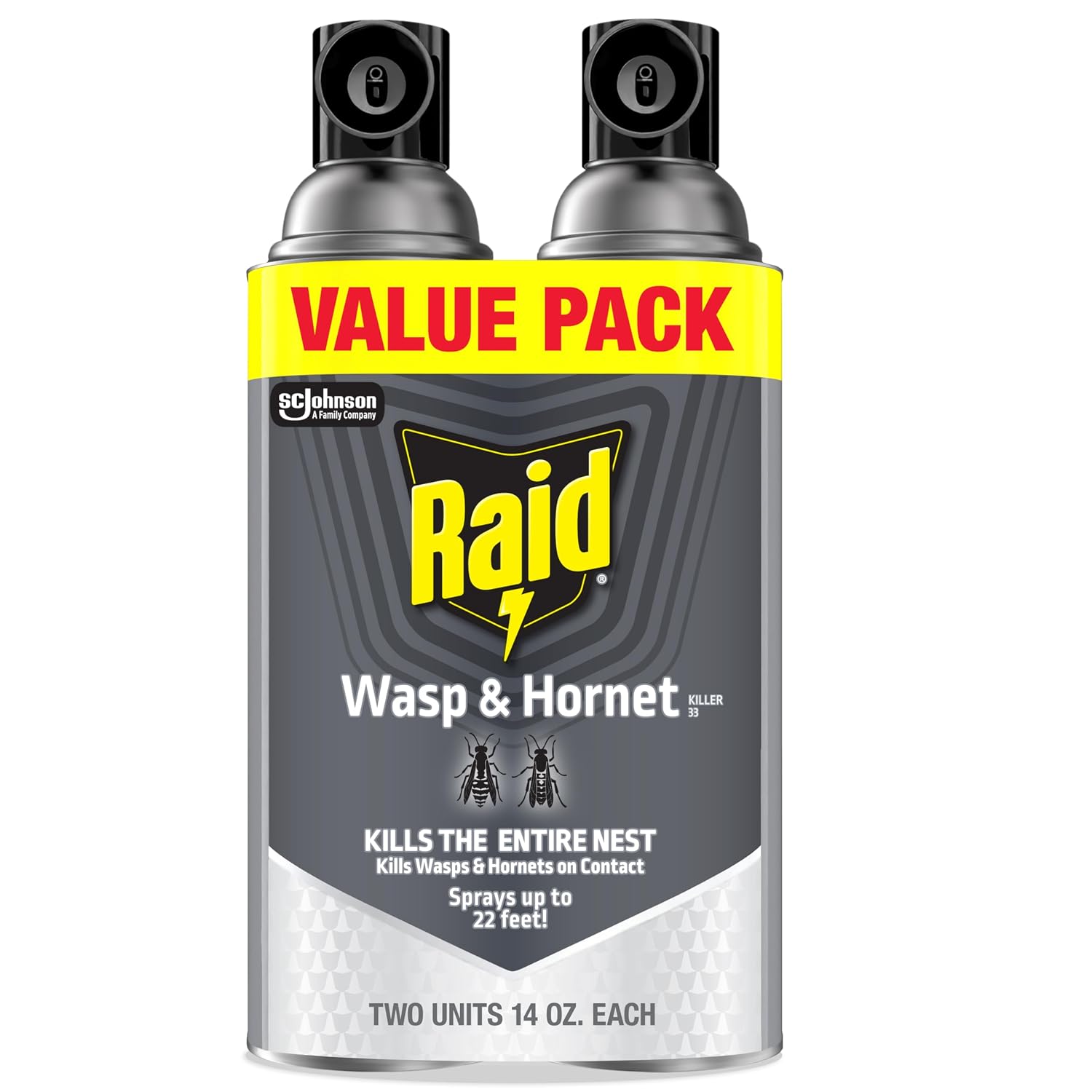
| Unit Count | 28 Ounce |
|---|---|
| Included Components | Two 14 oz cans |
| Item Form | Spray |
| Active Ingredients | Prallethrin, Cypermethrin |
Raid Wasp & Hornet Killer is a straightforward outdoor aerosol for quickly dealing with stinging flying insects and nests. Each 14 oz canister sprays up to about 22 feet so you can treat nests from a safe distance, and the formula is designed to kill paper wasps, yellow jackets, mud daubers and bald‑face hornets on contact. It is electrically non‑conducting up to 32,500 volts, which can be helpful if nests are near electrical equipment. Typical use is to spray a saturated stream at the nest in early morning or evening when insects are less active, then wait 24 hours before removing the nest. The product includes common active ingredients (prallethrin and cypermethrin) and comes as a two‑pack so you have a backup or enough coverage for multiple nests. Important limitations are that it is for outdoor use only, is extremely flammable and toxic to aquatic life, and requires careful handling to avoid exposure to people and pets. Follow label directions closely and avoid spraying vegetation or water sources.
Best for: Buyers who prioritize a reliable, no‑nonsense solution to quickly eliminate outdoor wasp and hornet nests and who follow label safety instructions.
Less Ideal for: People looking for non‑chemical, pet‑safe, or aquatic‑safe options or those who need an indoor insecticide should consider alternative approaches.
- Sprays up to 22 feet to allow treatment from a safer distance
- Kills common stinging wasps and hornets on contact for fast results
- Two 14 oz cans provide extra coverage or a spare for larger problems
- Non‑conducting formulation reduces electrical hazard when treating nests near power equipment
- Contains flammable propellants and petroleum distillates so it must be stored and used with caution
- Extremely toxic to fish and aquatic invertebrates so not safe near water
- Intended for outdoor use only and not for use on edible crops or around pets
Verdict: Choose this if you want a proven, distance‑spraying aerosol that quickly kills wasps and hornets so you can remove nests with confidence.
Choosing the Right Bug Spray for Wasps: Key Factors to Consider
Knockdown Speed and Immediate Control
How fast a spray incapacitates wasps matters for safety and for limiting stinging incidents. A product that delivers near-instant knockdown lets you retreat from a treated nest more quickly and reduces the chance of provoking cluster defensive behavior.
Look for laboratory or label claims about contact mortality and practical field reports of how many seconds it takes to immobilize typical wasp species. Remember that weather, nest size, and wasp species can slow action times, so faster sprays provide a wider safety margin.
Spray Range and Application Accuracy
Treating wasp nests often requires working from several feet away to avoid aggressive encounters. Effective spray range and a concentrated jet pattern let you hit the nest directly without standing too close.
Consider reach in outdoor settings where nests may be under eaves, in shrubs, or in hollow posts. A narrow, long-reaching spray is better for high or difficult-to-access nests, while a wider cone may be useful for flushing activity in low, exposed nests.
Residual Duration and Re-Infestation Prevention
Some sprays leave a residual film on nest surfaces that continues to kill or repel returning wasps. Residual control can reduce the need for follow-up treatments and help prevent re-establishment during the same season.
Check whether the product specifies residual activity against wasps and understand that outdoor exposure to rain and sun will shorten persistence. For long-term prevention, choose products with labeled residual claims and apply when dry conditions are expected.
Formulation Type and Surface Adherence
Aerosol foams, stream aerosols, and wettable sprays behave differently on nest materials. Foaming formulations cling to vertical surfaces and penetrate nest cavities, while strong stream aerosols punch through and reach deep into the comb.
Surface adherence affects how much active ingredient stays on the nest after application. If nests are tucked in gaps or under eaves, a clingier formulation can improve transfer to hidden comb and brood cells.
Safety Instructions and Use Around People and Pets
All wasp-control sprays require careful handling. Look for products with clear personal protective equipment recommendations, re-entry times, and restrictions for use near edible plants or water sources.
Products that provide straightforward mixing and disposal directions reduce misuse. If you have children, pets, or pollinator plants nearby, prioritize formulations with explicit guidance on protecting non-target organisms and limiting drift.
Ease of Use and Application Convenience
How easy a spray is to use affects whether you will apply it correctly. Trigger sprays, aerosol cans with long-range jets, and foaming dispensers each have different ergonomics and control characteristics.
Consider nozzle control for precision, the weight and balance of the can for overhead use, and whether the product requires pre-mixing. A user-friendly product reduces the chance of accidental exposure and encourages targeted treatments rather than broad, wasteful spraying.
When To Treat a Wasp Nest
Treat active nests that are too close to human activity or where sting incidents have already occurred. Small, newly established nests low to the ground are easier and often safer to remove than large, high, or concealed nests that may require professional tools and experience.
If a nest is more than a few feet above reach, in a wall void, or shows heavy defensive activity, consider non-chemical measures like restricting access to the area and scheduling treatment at dusk when wasps are less active. Always follow label directions on timing and protective equipment.
- Treat at dusk or early evening when most wasps are inside the nest
- Wear eye protection and gloves when applying sprays
- Keep children and pets away from the treatment area until the product label permits re-entry
Protecting Pollinators and Non-Target Insects
Wasps are predators and can be useful in the garden, so avoid indiscriminate spraying of flowering plants and pollinator habitat. Apply control products only directly to the nest or on structural surfaces where wasps rest.
If the nest is near blooming plants, temporarily cover flowers or delay treatment until after blooms fade. Choose sprays with targeted application patterns and follow restrictions about use around pollinator-rich areas.
- Do not spray open flowers or fruiting plants
- Use targeted jets or foams rather than broadcast sprays in pollinator zones
- Observe treated areas and avoid re-treating unnecessarily
Personal Protective Equipment and Safe Practices
Aerosol sprays can be used from several feet away but always use eye protection, long sleeves, and gloves. If treating overhead nests, consider respiratory protection if label guidance recommends it.
Plan an escape route before you begin, work at dusk when activity is low, and never put your face near the nest. Read and follow the label for ventilation, wash-up, and clothing recommendations.
- Plan how you will retreat from the area after spraying
- Check wind direction to avoid drift toward people or pets
- Have a flashlight and a second person available if possible
Nonchemical Alternatives and Complementary Measures
Physical removal, trap placement, and habitat modification can reduce wasp presence without widespread chemical use. Sealing entry points and reducing attractants such as exposed food or sweet residues can make your yard less appealing.
Traps can lower local forager numbers but rarely eliminate a nest alone. Use complementary methods together with targeted nest treatment for the best long-term outcome.
- Seal gaps and trim vegetation near eaves
- Remove food sources like open compost or spilled fruit
- Use traps as a supplementary reduction method
How We Chose the Best Bug Spray for Wasps
We focused on features that matter when dealing with wasps in everyday outdoor settings. Our evaluation emphasized knockdown speed, residual reach, spray-range and accuracy for treating nests from a safe distance, and safety guidance for use around people, pets, and edible gardens. We also weighed formulation type and active ingredients because those determine whether a spray is contact-only, aerosol with residual, or a foaming product that clings to nest surfaces. Exclusions: we excluded household insect control products that are not labeled for wasp control, non-aerosol solutions intended only for indoor use, and concentrates without ready-to-use application instructions. We did not consider specialty commercial-grade foggers or professional-only insecticides not intended for consumer use. Concrete evaluation criteria used across the shortlist include how quickly a product incapacitates wasps, the effective spray distance and jet accuracy, duration of any residual activity on nest materials, clarity and practicality of safety and application instructions, and how well the formulation adheres to vertical surfaces. Those dimensions guided placement on the final list and the scorecard metrics.
FAQ
Can I safely spray wasp nests myself?
Often you can, provided the nest is accessible and you follow label directions, wear protective clothing, and treat at low-activity times like dusk. If the nest is high, inside a void, or the colony is large and aggressive, professional removal is a safer choice.
How long after spraying is it safe to be near the treated area?
Re-entry times vary by product and formulation. Many labels allow return after treated surfaces are dry or after a specified waiting period. Always read the product label and keep children and pets away for the recommended interval.
Will a residual spray prevent wasps from returning next season?
Residual sprays can reduce re-infestation during the same season, but they rarely provide season-to-season protection outdoors because sun and rain degrade residues. Long-term prevention depends on site maintenance and nest exclusion methods.
Are foaming sprays better than stream sprays for nests?
Foaming sprays cling to vertical surfaces and can penetrate nest cavities, improving transfer of active ingredient in some situations. Stream sprays offer longer reach to treat nests that are farther away. Choice depends on nest location and access.
Can sprays harm beneficial insects in my garden?
Yes, drift or spraying on flowers can harm pollinators and beneficial insects. Use targeted application, avoid treating blooms, and follow label precautions to minimize non-target impacts.
Final Verdict
Focus first on safety: choose a spray that lets you treat from a safe distance and follow label PPE and re-entry guidance. Balance the need for quick knockdown with the advantage of a clingy or residual formulation when nests are hidden or likely to see return activity. Prioritize targeted application, proper timing, and site maintenance. With the right spray and sensible precautions, you can remove problem nests while minimizing risk to people, pets, and beneficial insects.
