

Note: This article contains affiliate links. If you click on these links and make a purchase, I may earn a small commission at no extra cost to you. This helps support my research and content. Read my full affiliate disclosure here.
If you are new to chainsaws, picking the right gas model shapes how quickly you gain competence and how safe you feel on the job. The wrong saw can be heavy, hard to start, or have controls that confuse a new operator. This guide focuses on easy-to-handle gas chainsaws for beginners, shortlisted for manageable weight, predictable power delivery, and safety-oriented features. We evaluated options across starting reliability, cage and chain controls, vibration and balance, and routine maintenance needs. Below are the top picks for common home tasks, followed by practical buying guidance to help you choose the best saw for your yard or property.
Top Picks at a Glance
| Best Quality Built to a higher standard if you want something more solid | Husqvarna 120 Mark III 16-inch Gas Chainsaw |  |
| Best Value The sweet spot between price and what you get | WORKIT 25.4CC 12" Top-Handle Gas Chainsaw (WX112) |  |
| Best Budget The cheapest option that still gets the job done reliably | JAYGOVAN 12" Top-Handle Gas Chainsaw, 25.4CC |  |
| Most Popular A crowd favorite that many people choose with confidence | VEVOR 25.4cc Top-Handle Gas Chainsaw, 12-Inch Bar |  |
| Best Seller A high-volume bestseller chosen again and again | Husqvarna 130 16-Inch Gas Chainsaw |  |
Husqvarna 120 Mark III 16-inch Gas Chainsaw

| Power Source | Gas Powered |
|---|---|
| Horsepower | 1.88 hp |
| Chain Length | 16 inches |
The Husqvarna 120 Mark III is a homeowner-focused gas chainsaw built to handle firewood cutting, light felling and pruning without complicated setup. It uses a 38-cc X-Torq two-stroke engine that delivers about 1.88 hp, a 16-inch chain and automatic oiler so you can get straight to work and keep the chain lubricated during use. Practical features include an air purge for easier starting, a combined choke/stop control to reduce flooding, a simple chain tensioning system for quick adjustments and an inertia-activated chain brake for added safety. LowVib dampening reduces operator fatigue and the Air Injection centrifugal cleaning helps keep large debris out of the air filter to extend service intervals. For a typical homeowner this saw offers a good balance of starting reliability, manageable power and comfortable handling. It is not aimed at heavy professional use and the user should be prepared for routine two-stroke maintenance and fuel mixing.
Best for: Homeowners who need a dependable, easy-to-start gas chainsaw for firewood, limb work and occasional small felling and who value manageable weight and user-friendly controls.
Less Ideal for: People who need a high-hour professional saw for commercial logging or landscapers who prefer electric models for low maintenance and quieter operation.
- Efficient 38-cc X-Torq engine provides reliable power for common homeowner tasks
- Air purge and combined choke/stop control make cold starts and restarting easier
- LowVib system reduces vibration for more comfortable handling during longer jobs
- Air Injection centrifugal system helps keep large debris out of the air filter to reduce maintenance
- Simple chain tensioning and automatic oiler make upkeep and on-the-job adjustments quick
- Designed for light to moderate work so it is not intended for prolonged professional logging
- Requires two-stroke fuel mixing and regular maintenance common to gas chainsaws
Verdict: A balanced, easy-to-start 16-inch gas chainsaw that suits homeowners who want reliable power and comfortable handling for routine yard work.
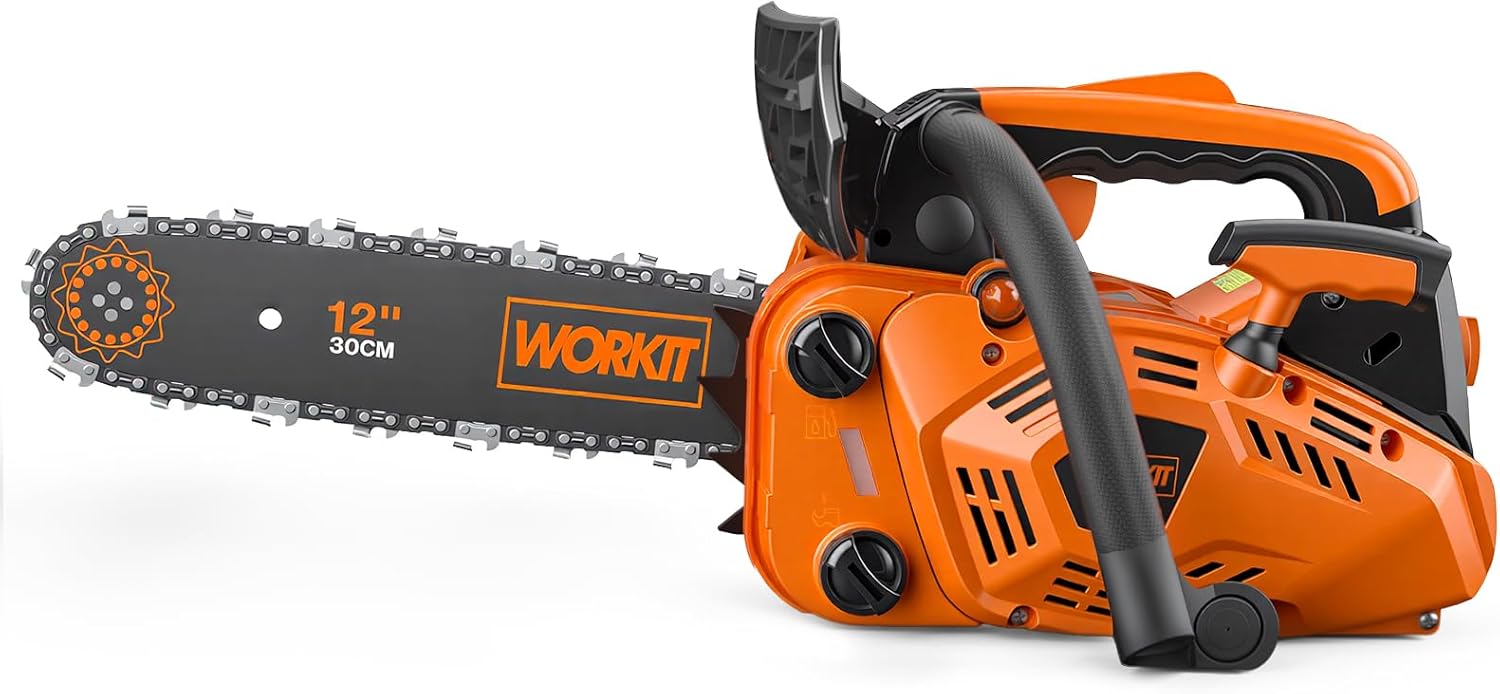
WORKIT 25.4CC 12" Top-Handle Gas Chainsaw (WX112)
| Power Source | Gas Powered |
|---|---|
| Horsepower | 1.2 hp |
| Chain Length | 12 inches |
The WORKIT WX112 is a lightweight top-handle gas chainsaw built for precision work in tight spaces. Its 25.4CC Xtreme two-cycle engine and 12-inch guide bar give it enough punch to cut hardwood, prune limbs, and handle routine storm cleanup while remaining nimble for high work or nursery tasks. Practical features include an OptiSpark ignition and an easy-start system to reduce pull-start frustration, an automatic stop switch to help avoid engine flooding, and an automatic oiler to keep the chain lubricated during extended runs. The reinforced body, heavy-duty bearings, and upgraded clutch aim to improve durability compared with entry-level units. Safety touches such as a chain brake, protective baffle, dual safety locks, and a one-stop engine switch make it suitable for pros who need a compact tool and for homeowners who value built-in protections. Expect some noise and the usual maintenance for a gas engine like fuel mixing and periodic spark plug/chain tuneups, and its 12-inch bar limits it to smaller-diameter cutting rather than full-size felling or large logs.
Best for: Buyers who need a compact, commercially styled top-handle saw for pruning, high work, and cleanup where maneuverability and dependable starts matter most.
Less Ideal for: Not a good choice for users who need a full-size felling saw or those who prefer low-maintenance electric or battery chainsaws for quiet, occasional yard chores.
- Compact, lightweight design for easy maneuvering in tight or overhead work
- 25.4CC Xtreme engine provides enough power for pruning, storm cleanup, and cutting hardwood up to small diameters
- Easy-start OptiSpark ignition and engine stop switch reduce starting problems and flooding
- Reinforced body, heavy-duty bearings, and improved clutch target better durability under heavier use
- Includes safety gear and protective features such as chain brake, dual safety locks, and protective baffle
- 12-inch bar restricts use to smaller limbs and logs rather than large-tree felling
- Being gas-powered requires routine maintenance, fuel mixing, and generates more noise and emissions than electric alternatives
Verdict: If you want a nimble, commercially oriented top-handle chainsaw for pruning and tight-space cutting, the WORKIT 25.4CC delivers dependable starts and durability in a compact package.
JAYGOVAN 12" Top-Handle Gas Chainsaw, 25.4CC

| Power Source | Gas Powered |
|---|---|
| Horsepower | 1.22 hp |
| Item Type Name | Top Handle Chainsaw |
This JAYGOVAN 12-inch top-handle gas chainsaw is a lightweight, budget-oriented tool for pruning, orchard work, and small firewood tasks. Its 25.4CC two-stroke engine produces about 1.22 hp and high RPM for quick cuts, while the roughly 11.8-inch guide bar handles single cuts near a foot in diameter. The saw is built for portability and maneuvering aloft thanks to its top handle and 9 to 9.4 pound reported weight, which reduces fatigue when working overhead. Practical features include an auto oiler, primer bulb and easy-start pull system, a safety lock to prevent accidental starts, and a supplied mixing bottle to simplify the 25:1 fuel mix. Limitations to keep in mind are its modest bar length and lower displacement compared with full-size chainsaws, so it is not suited to heavy logging, prolonged stump work, or large-diameter hardwoods. Buyers should also plan for routine two-stroke maintenance such as mixing fuel, chain tensioning, and filter care. For the price and intended light-duty tasks this saw offers strong cutting performance and straightforward controls.
Best for: A practical buyer who wants an affordable, portable gas saw for routine pruning, orchard tasks, and light property maintenance and values maneuverability over heavy cutting power.
Less Ideal for: Not a good choice for professional loggers or anyone who needs sustained cutting of large-diameter hardwoods or frequent heavy-duty timber work.
- Lightweight top-handle design eases overhead pruning and reduces operator fatigue
- 25.4CC 2-stroke engine with high RPM offers quick cutting for small logs and branches
- Auto oiler and included mixing bottle simplify chain lubrication and fuel prep
- Safety lock and easy-start components improve control during use
- Short guide bar and lower displacement limit use to light-duty pruning and small logs
- Requires regular two-stroke maintenance and manual fuel mixing
Verdict: A lightweight, no-frills gas top-handle chainsaw that delivers capable pruning and light cutting performance for budget-conscious owners.
VEVOR 25.4cc Top-Handle Gas Chainsaw, 12-Inch Bar

| Power Source | Gas Powered |
|---|---|
| Horsepower | 1.2 hp |
| Chain Length | 12 inches |
| Model Number | CN-25 |
The VEVOR 25.4cc top-handle gas chainsaw is a compact, handheld saw built for pruning, light felling and general property maintenance. It uses a 2-cycle 25.4cc engine rated at about 1.2 hp and drives a 12-inch bar and high-strength steel chain that handles branches and small logs up to roughly 9.8 inches in diameter. Practical features include an easy-start system, a tool-free chain tension knob, a protective guard to reduce sawdust spray and onboard tanks for fuel and chain oil to limit downtime. At roughly 9 to 10 pounds the saw is relatively nimble for one-handed trimming and working in trees when combined with proper climbing gear. Important limitations are its modest power and short bar, which make it unsuitable for heavy felling or cutting large logs, and the usual maintenance needs of a 2-cycle gas engine such as mixing fuel and regular spark plug and carburetor care. For users who need a portable, serviceable saw for routine yard and tree work, it delivers sensible capability for its class.
Best for: Buyers who want a portable, serviceable gas saw for regular pruning, tree trimming and light felling and who value straightforward features and ease of use over maximum cutting power.
Less Ideal for: Not a good fit for landowners who need a saw for heavy timber work, milling logs, or frequent long-duration cutting where a larger bar and higher horsepower are required.
- Compact and lightweight for easier handling during pruning and above-ground work
- 12-inch steel bar and chain suited to trimming, limb work and small log cutting
- Tool-free chain tensioning for quick adjustments in the field
- Easy-start system and included maintenance kit simplify setup and upkeep
- 12-inch bar and 1.2 hp output limit use to light-duty cutting and small trees
- Requires routine 2-stroke engine maintenance and fuel mixing
Verdict: A lightweight, easy-to-use top-handle gas chainsaw that reliably handles pruning and light felling for homeowners and tree care hobbyists.
Husqvarna 130 16-Inch Gas Chainsaw

| Power Source | Gas Powered |
|---|---|
| Horsepower | 2.2 hp |
| Chain Length | 16 inches |
The Husqvarna 130 is a compact, gas-powered chainsaw made for routine yard maintenance and light tree work. With a 38 cc X-Torq engine and a 16-inch bar it delivers enough power for limbing, pruning, and cutting small to medium branches while remaining easy to handle. Notable features include a fuel pump and combined choke/stop control for easier starting, an inertia-activated chain brake for safer operation, automatic oiler and a simple chain tensioning system for quick adjustments. LowVib dampening reduces vibration during extended use and Air Injection helps keep larger debris out of the air filter to extend engine life. Because it is a gas unit, expect the usual needs for fuel mixing, periodic maintenance and louder operation compared with battery models. It is well suited to homeowners who want a reliable, serviceable saw for seasonal cleanup rather than heavy professional felling or continuous commercial use.
Best for: Buyers who prioritize practical, reliable performance for seasonal yard cleanup and occasional tree work and who want a serviceable gas saw they can maintain themselves.
Less Ideal for: Professionals or users needing a saw for continuous heavy-duty felling or for those who prefer quieter, maintenance-free battery options.
- Enough power for typical homeowner tasks with a 38-cc X-Torq engine and 16-inch bar compatibility
- Fuel pump and combined choke/stop control make cold starts and restart attempts easier
- Inertia-activated chain brake and LowVib system improve safety and reduce operator fatigue
- Automatic oiler and simple tensioning system reduce routine upkeep time
- Requires gasoline and 2-stroke oil mixing and periodic engine maintenance
- Not intended for heavy commercial felling or prolonged professional use
Verdict: A no-nonsense, easy-to-start gas chainsaw that gives homeowners dependable cutting power for routine tree and yard maintenance.
Choosing the Right Gas Chainsaw for Beginners: Key Factors to Consider
Starting and Warm-Up Procedure
How a gas chainsaw starts affects how confident you feel before each cut. Simple choke and primer systems that are easy to operate reduce fumbling and repeated pulls, which is especially important when you are learning. A predictable warm-up behavior means the saw will idle without surging and will respond smoothly when you open the throttle.
Choose a model with a clear starting sequence and accessible starter components. Gas saws that require frequent or fiddly adjustments during starting can lead to frustration and improper handling, which can compromise safety. Consider whether the saw has a decompression valve or an assisted-start mechanism to reduce pull force.
Power Delivery and Throttle Control
Beginners benefit from engines that deliver steady, controllable power rather than sudden surges. Smooth low-end torque helps when cutting small-diameter limbs, avoiding chatter or kick from the chain. Throttle responsiveness matters when you need to feather power during tricky cuts or when trimming near structures.
Inspect how the throttle lock and trigger are positioned and how easily you can modulate speed with one hand. If the saw tends to rev aggressively with small throttle movement, it will be harder to learn precise cutting technique and may increase the risk of mistakes.
Weight, Ergonomics, and Balance
A chainsaw that is too heavy or poorly balanced will fatigue a new user quickly and make controlled cuts difficult. Weight distribution between the engine, handle, and bar should allow you to hold the saw steady at different cutting angles without excessive effort.
Ergonomic handle shapes and spacing between the front and rear handle let you adopt natural wrist and arm positions. Consider how the saw feels when you raise it to shoulder height or lower it for bucking. A lighter saw with good balance can improve learning speed and reduce strain during longer sessions.
Vibration and Comfort Features
Vibration transmits to your hands and arms and reduces control while increasing fatigue. Anti-vibration mounts and dampening systems make a meaningful difference if you plan to use a gas chainsaw for more than a few minutes at a time. Comfort features also include grip texture and handle diameter, which affect how firmly you can hold the saw without squeezing.
Less vibration helps you maintain a steady cutting line and lowers the risk of repetitive strain. For beginners, a machine with effective dampening means you can focus on technique rather than fighting the tool.
Chain and Safety Systems
Safety systems are essential for new chainsaw owners. An effective inertia or mechanical chain brake that stops the chain quickly during kickback events is critical. Equally important are visible chain tensioning controls and a clear handguard to reduce accidental contact with the bar.
Look for models where routine safety checks, like chain tension and brake function, are straightforward to perform. Accessible chain covers and uncomplicated tensioning reduce the chance of operating with a loose chain, which could lead to dangerous behavior.
Maintenance Simplicity and Access
Routine maintenance is unavoidable with gas engines. For beginners, how easy it is to clean or replace the air filter, adjust the carburetor, access the spark plug, and tension the chain matters a great deal. Tools that come with the saw and intuitive fasteners simplify these tasks.
If maintenance steps are simple and clearly documented, you are more likely to perform them correctly and regularly. That extends the saw's useful life and keeps it running predictably, which is safer and less frustrating for someone new to gas-powered tools.
Common Beginner Tasks and Appropriate Bar Lengths
Match your bar length to the jobs you expect. Short bars, around 12 to 14 inches, work well for pruning, limbing, and cutting small firewood. They are easier to control and reduce the likelihood of pinching or kickback during typical homeowner tasks.
If you plan to buck larger trunks, a slightly longer bar up to 16 inches might be necessary, but keep in mind that longer bars require more power and add weight. For most new users focused on yard cleanup and occasional firewood, shorter bars are safer and more manageable.
- 12-14 inch bar: best for pruning and light bucking
- 14-16 inch bar: for medium-diameter firewood and small trees
- Over 16 inches: generally not recommended for beginners
Safe Handling Practices Every Beginner Should Adopt
Always start the saw on firm ground with the chain brake engaged and a hand on the front handle. Keep a secure stance and clear the area of tripping hazards before each cut.
Use both hands on the saw at all times and avoid overreaching. Maintain awareness of the bar tip to reduce kickback risk and never cut above shoulder height. Wear appropriate protective gear, including eye, ear, and leg protection designed for chainsaw work.
- Engage chain brake when moving between cuts
- Inspect chain tension frequently
- Plan your cut path and escape route when felling small trees
Fuel and Two-Stroke Basics for Home Users
Most beginner gas chainsaws use two-stroke engines that require a specific gas-to-oil mix. Understand the correct mix ratio and use a fresh fuel blend to avoid carburetor issues. Store fuel in a labeled container and only mix what you expect to use within a short period.
Learn basic procedures like draining stale fuel, cleaning the fuel filter, and recognizing signs of carburetor fouling. These simple habits prevent frustrating starting problems and extend the life of the saw.
- Use freshly mixed fuel and proper oil grade
- Drain fuel before long storage
- Keep a spare, clean fuel filter on hand
Routine Safety Checks Before Each Use
Perform quick pre-start inspections: check chain tension, ensure the chain brake engages, verify that the chain is sharp, and confirm that the bar nuts are tight. These checks take only a few minutes but significantly reduce the chance of incidents.
Look for fuel leaks, air filter cleanliness, and secure handles. If a saw shows unusual vibration or smoke, stop and investigate rather than continuing to operate the machine.
- Chain tension and brake function
- Bar and chain sharpness
- No visible fuel or oil leaks
When to Move Up From a Beginner Saw
You may outgrow a beginner gas chainsaw when your regular tasks involve larger trees, extended cutting sessions, or professional workloads. Signs you need a more powerful or robust saw include consistently stalling under load, frequent need for high revs to cut effectively, or repeated maintenance issues due to under-spec equipment.
At that point, consider models with higher displacement, stronger bars, and upgraded cooling and filtration systems. Until then, a well-chosen beginner saw will serve most homeowner needs safely and efficiently.
- Increased cutting volume or larger-diameter trees
- Frequent high-load stalling
- Desire for more durability and advanced features
How We Chose the Best Gas Chainsaw for Beginners
We prioritized attributes that matter most to first-time gas chainsaw users and homeowners who need a safe, dependable saw for occasional to moderate yard work. Core evaluation criteria included engine starting ease, measured by choke and primer design and documented starting procedures; low-end and throttle response, which affect how predictable the saw feels during cuts; weight and balance, since lighter, well-balanced saws reduce fatigue and improve control; vibration dampening, to limit hand and arm strain over longer jobs; and safety controls, including chain brake effectiveness, handguard placement, and accessible throttle locks. We also considered maintenance needs that matter to beginners: how straightforward carburetor adjustments and air-filter access are, whether basic service can be done with common tools, and the availability of clear owner documentation. We excluded professional-grade, high-displacement chainsaws and models intended for heavy logging, because their power and complexity are not suitable for beginner operators. The final short list emphasizes usability, predictable performance, and straightforward upkeep aligned with novice needs.
FAQ
What bar length is best for a beginner using a gas chainsaw?
For most beginners, a 12 to 14 inch bar is best because it balances control and cutting capability for pruning and small firewood. A 14 to 16 inch bar may be useful if you expect occasional medium-diameter work, but longer bars add weight and complexity.
How do I reduce kickback risk when using a gas chainsaw?
Use a saw with an effective chain brake and keep both hands on the handles. Avoid cutting with the tip of the bar, maintain a stable stance, and make controlled cuts without overreaching. Regularly check the chain for correct tension and sharpness.
How often should I sharpen the chain on a beginner saw?
Sharpen the chain whenever cutting performance drops or the saw requires more force to advance. For casual homeowner use, this might be after several hours of cutting. Regular inspection and light sharpening prevent excessive wear and keep cutting predictable.
Is maintenance for a gas chainsaw hard for a new owner?
Basic maintenance is straightforward if you follow the owner's manual: clean or replace the air filter, inspect and tension the chain, check spark plug condition, and use fresh fuel. Some tasks, like carburetor adjustments, may require a technician if you are uncomfortable doing them yourself.
Can a beginner safely use a gas chainsaw for tree felling?
Beginners can fell small trees with proper training and safety precautions, but felling larger trees is risky without experience. Start with simple cuts and practice on small-diameter trees while learning notch and hinge techniques and always have an escape route planned.
Final Verdict
Choosing the right gas chainsaw for beginners means balancing manageable power, straightforward starting, and clear safety systems. Prioritize a model that feels light and balanced in your hands, has predictable throttle behavior, and includes accessible safety features like an effective chain brake. Accept that tradeoffs exist: lighter saws have less cutting capacity but are easier to control, while heavier saws cut larger wood but demand more skill. Focus on predictable handling and simple maintenance to build confidence safely before moving to more powerful equipment.
