

Note: This article contains affiliate links. If you click on these links and make a purchase, I may earn a small commission at no extra cost to you. This helps support my research and content. Read my full affiliate disclosure here.
Choosing the right compost for bonsai matters because pots constrain roots and change how quickly soil dries and breaks down. The wrong mix can hold too much moisture or break down into fine material that suffocates feeder roots. This guide looks at seven shortlisted composts selected for use with bonsai, focusing on how they handle drainage, nutrient release, and long-term stability in small containers. You will find practical notes on how these mixes behave in real pots and why certain particle sizes and organic blends work better for established trees versus young stock. The following picks were evaluated for drainage, structure retention, nutrient balance, and ease of repotting to help you choose the right compost for your bonsai style.
Top Picks at a Glance
| Best Overall The best all-around choice for most situations | Tinyroots All-Purpose Bonsai Soil Mix (2.5 Gallons) |  |
| Best Quality Built to a higher standard if you want something more solid | Tinyroots Premium Bonsai Soil Blend (2.25 qt) – Akadama, Red Lava Rock & Pumice |  |
| Best Value The sweet spot between price and what you get | Bonsai Jack Universal Organic Bonsai Soil Mix (2 Quart) |  |
| Best Budget The cheapest option that still gets the job done reliably | Doter Bonsai Soil Mix, 1 qt Ready-to-Use Organic Potting Mix |  |
| Highest Rated A top-rated pick with lots of positive feedback | Avalution Bonsai Soil Mix, 3 qt |  |
| Most Popular A crowd favorite that many people choose with confidence | Perfect Plants Bonsai Soil, Organic All-Purpose Potting Mix (2 qt) |  |
| Best Seller A high-volume bestseller chosen again and again | The Bonsai Supply Fast-Draining Bonsai Soil Mix (2 Quart) |  |
Tinyroots All-Purpose Bonsai Soil Mix (2.5 Gallons)

| Unit Count | 372.4 Ounce |
|---|---|
| Manufacturer | Tinyroots |
| Brand Name | Bonsai Outlet |
| Volume | 2.5 gallons |
This Tinyroots all-purpose bonsai soil is a ready-to-use premixed blend intended to provide the fast drainage and aeration bonsai need. It combines expanded slate, pine bark fines, pumice, and lava rock to create a coarse, breathable substrate that supports healthy root development and helps prevent waterlogging. Typical use is straight into pots when repotting or refreshing the surface layer for established trees; the mix is already sifted to remove dust and fine particles so it does not need conditioning before use. Practical benefits include reliable drainage for a wide range of species, reduced risk of root rot, and less frequent repotting because the inorganic components maintain structure over time. Because it is an all-purpose blend it suits tropical, coniferous, and deciduous bonsai without you having to custom-blend multiple components. One limitation is that very specific species or growers who prefer pure akadama or a custom ratio of components may find the preset proportions less flexible, and gardeners who need larger volume bags for many trees will need multiple units.
Best for: Buyers who want a reliable, nursery-formulated bonsai substrate that works across tropical, coniferous, and deciduous trees without mixing components themselves.
Less Ideal for: Specialist growers who require single-component soils or precise custom blends for a particular species or trained method should consider alternative substrates.
- Pre-mixed coarse blend of expanded slate, pumice, lava rock, and pine bark fines for consistent drainage
- Sifted to remove dust and fines, reducing risk of root compaction and poor aeration
- Formulated and used by a bonsai nursery with experience in bonsai horticulture
- Versatile all-purpose formula suitable for many bonsai species and repotting situations
- Preset proportions limit customization for growers who want pure akadama or specific component ratios
- Smaller 2.5 gallon volume means buying multiple bags for larger collections
Verdict: A convenient, nursery-formulated fast-draining bonsai soil that saves time and works well for most hobbyists repotting a variety of bonsai species.
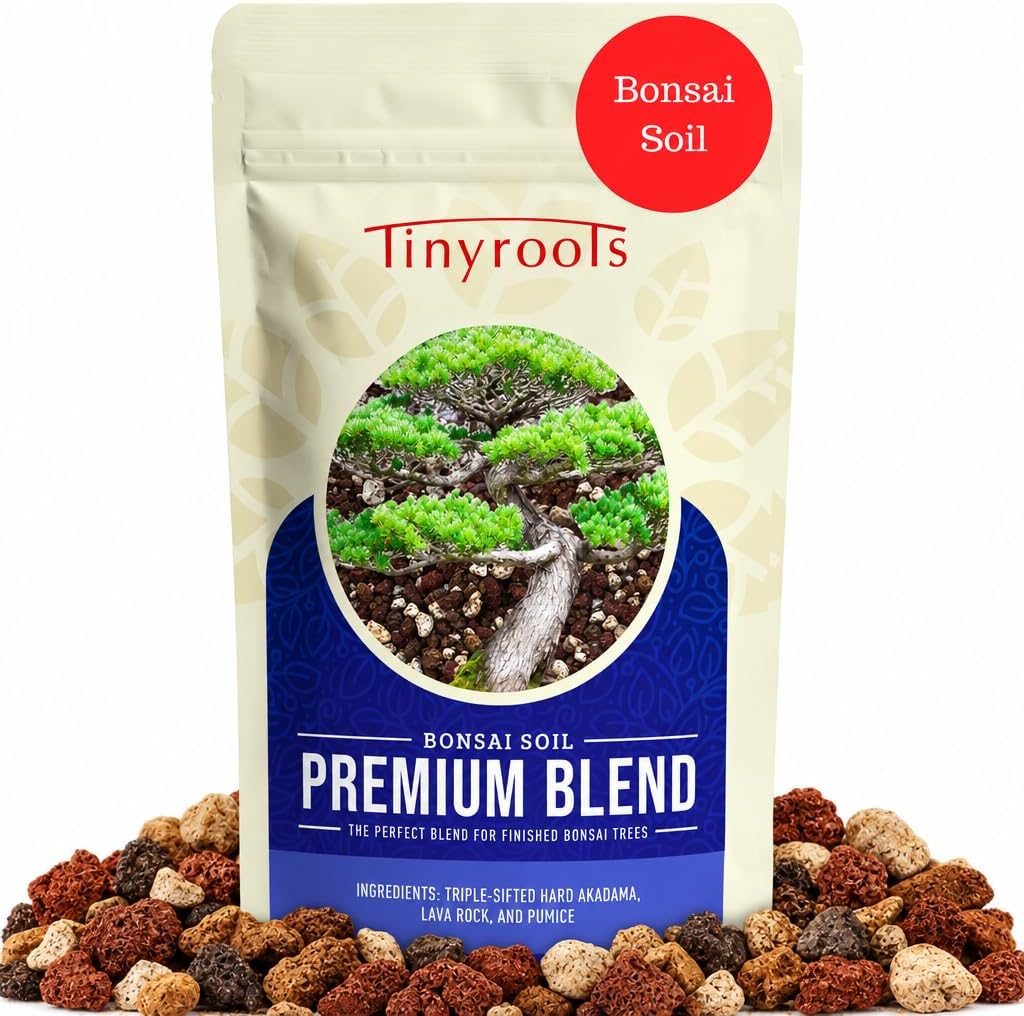
Tinyroots Premium Bonsai Soil Blend (2.25 qt) – Akadama, Red Lava Rock & Pumice
| Volume | 2 quarts |
|---|---|
| Unit Count | 72 Ounce |
| Blend components | Akadama, Red Lava Rock, Pumice |
| Style Name | Houseplant,Potting,Soil Mix |
This Tinyroots Premium Bonsai Soil is a pre-mixed, double-sifted blend of akadama, red lava rock and pumice designed for finished bonsai and houseplants. It is typically used when repotting or topping up bonsai; the mix is ready to use straight from the resealable pouch so you can pot quickly without additional amendments. The akadama helps with moisture retention and structure while the pumice and lava rock increase aeration and drainage, which supports healthy root development and reduces overwatering risk. The product is presented in a small, nursery-sized volume that makes it convenient for a few trees or for experimenting with mixes. Important limitations are the small 2.25 quart volume, which means multiple bags are needed for larger collections, and the fixed particle composition, so growers who prefer very specific particle sizes or custom ratios may still want to sieve or blend further. For general-purpose bonsai maintenance and for growers who value convenience, this is a practical, high-quality option.
Best for: Balanced hobbyists who want a reliable, ready-made bonsai substrate for repotting and routine maintenance without mixing components themselves.
Less Ideal for: Collectors with many trees or professional nurseries that need bulk quantities or custom soil formulas should look for larger volumes or component-grade aggregates instead.
- Pre-mixed and double-sifted for consistent particle distribution and ready use
- Blend of akadama, pumice, and red lava rock balances moisture retention and drainage
- Resealable pouch preserves the remaining soil between uses
- Formulated specifically for bonsai to support root development and aeration
- Small 2.25 quart volume requires multiple bags for several trees or larger pots
- Fixed blend may not suit growers who want bespoke particle ratios or very fine customization
Verdict: A convenient, pre-sifted akadama-pumice-lava mix that delivers reliable drainage and root support for hobby bonsai without any prep work.
Bonsai Jack Universal Organic Bonsai Soil Mix (2 Quart)

| Volume | 2 quarts |
|---|---|
| Ingredients | 40% Bonsai Block, 40% Lava, 20% Pine Bark Fines |
| Particle size | Screened to ~1/4 inch average |
| pH | Optimized around 6.4 |
Bonsai Jack Universal Organic Bonsai Soil Mix #221 is a ready-to-use gritty blend designed for bonsai repotting and ongoing culture. The mix combines bonsai block, lava, and pine bark fines in roughly a 40/40/20 ratio and is screened to an average particle size around a quarter inch so roots push outward quickly instead of circling. It arrives pre-washed with an optimized pH around 6.4 and is intended for use as-is on the majority of bonsai, including tropicals, or mixed with other ingredients for specific needs. Practical benefits include consistent drainage and fast drying compared with standard potting soils, plus reduced compaction that helps maintain oxygen around the root zone. Limitations are that it is a small 2 quart bag suited to individual repots or top dressing rather than filling multiple pots, and the coarse texture means it is not intended for regular houseplants or species that prefer finer media. The product also recommends staged conversion when moving trees from nursery soil to avoid transplant shock.
Best for: Buyers who prioritize reliable, ready-to-use bonsai substrate for repotting and want a coarse, fast-draining mix that encourages healthy root structure.
Less Ideal for: Growers who need large volumes of soil for many pots or who care for plants that require fine, moisture-retentive potting mixes should look elsewhere.
- Balanced gritty mix (bonsai block, lava, pine bark) promotes root ramification and good drainage
- Screened and pre-washed with an optimized pH around 6.4 for immediate use
- Consistent particle sizing reduces compaction and helps oxygenate the root zone
- Suitable for the majority of bonsai species including tropicals and usable as-is or as a base mix
- Small 2 quart bag size limits usefulness to single repots or top dressing
- Coarse blend is not suitable for standard houseplants or species needing fine-textured media
Verdict: A small, professionally blended gritty mix that gives bonsai owners a convenient, fast-draining substrate to promote strong root development.
Doter Bonsai Soil Mix, 1 qt Ready-to-Use Organic Potting Mix

| Brand Name | Doter |
|---|---|
| Unit Count | 32 Ounce |
| Item Type Name | Garden soil |
| Volume | 1 quarts |
| Style Name | Japanese |
This 1 qt Doter bonsai soil mix is a pre-mixed potting medium aimed at small bonsai, seedlings, and repotting tasks. It is sold ready to use so you can fill a small pot or top-dress plants without blending components. The formulation emphasizes drainage and aeration while retaining moisture long enough to reduce watering frequency, which helps prevent root rot in compact containers. In practice it works well for beginners or collectors who need a convenient, small-quantity mix for Japanese-style and other small bonsai. Notable features are its organic-focused blend and a balanced texture that supports root development and foliage vigor without adding fertilizers separately for a short period. Limitations are its small 1 qt volume and basic nutrient profile, so you will need larger quantities or supplemental feeds for multiple trees or longer-term potted specimens. Also serious hobbyists who custom-mix specific ratios of pumice, akadama, or lava rock may find this premix less adjustable than raw components.
Best for: Budget-minded bonsai owners who want a convenient, ready-made soil for small pots, starter trees, or occasional repotting without mixing their own components.
Less Ideal for: Experienced bonsai growers who prefer to custom-blend specific inorganic components or anyone repotting multiple or larger trees who needs bulk soil.
- Ready-to-use 1 qt bag saves time mixing components for small pots or repotting
- Formulation balances drainage and moisture retention to reduce overwatering risk
- Organic blend supports root development and short-term plant health
- Compact size is convenient for trying a new mix or working with single trees
- Only 1 quart volume is insufficient for multiple trees or large repots
- Basic nutrient profile means you will need to fertilize for long-term growth
Verdict: A low-cost, ready-to-use 1 qt bonsai mix that makes repotting and trying a new soil easy for single small trees.
Avalution Bonsai Soil Mix, 3 qt

| Unit Count | 35.27 Ounce |
|---|---|
| Item Highlight | Perlite, Lava Rock, Pine Bark, Clay Pebbles, Diatomite |
| Style Name | Bonsai Soil Mix |
Avalution Bonsai Soil Mix is a ready-to-use, coarse-textured potting medium formulated specifically for bonsai and other container succulents. It combines perlite, black lava rock, pine bark, diatomite, and clay pebbles to create a free-draining, airy substrate that reduces the risk of root rot and compaction. In practice you fill or top-dress pots with the mix, repot young trees, or use it as a grafting/seedling medium where quick drainage and stable aeration matter. The consistent chunk size makes watering and root inspection easier, and the diatomite component helps retain just enough moisture between waterings without staying soggy. Because it is pre-blended, there is no measuring or DIY mixing required, which saves time for both beginners and experienced growers. Limitations are typical of coarse bonsai mixes: it will dry faster than standard potting soil so watering frequency must be increased, and a single 3 quart unit may be small for multiple large repots. Overall it performs as a dependable, low-maintenance substrate for maintaining healthy bonsai root systems when used with an appropriate watering schedule.
Best for: Buyers who prioritize a reliable, low-compaction medium to protect bonsai roots and who prefer a ready-made product that simplifies repotting and routine care.
Less Ideal for: Growers who want a moisture-retentive mix for very moisture-loving species or who need bulk quantities for many plants should consider alternative products.
- Pre-blended mix ready to use with no DIY mixing required
- Coarse, well-draining ingredients reduce compaction and root rot risk
- Includes diatomite to hold moderate moisture between waterings
- Chunky particles simplify root inspection and repotting tasks
- Dries more quickly than standard potting mixes, requiring more frequent watering
- 3 quart bag may not be sufficient for multiple or larger bonsai repots
Verdict: A dependable, pre-mixed coarse bonsai substrate that safeguards root health with strong drainage and consistent aeration.
Perfect Plants Bonsai Soil, Organic All-Purpose Potting Mix (2 qt)

| Item Type Name | Bonsai Soil |
|---|---|
| Unit Count | 64 Fluid Ounces |
| Volume | 2 quarts |
| Brand Name | PERFECT PLANTS |
Perfect Plants Bonsai Soil is a ready-to-use, small-batch blend made for bonsai kept in small containers. You use it straight from the resealable bag to pot or top-dress a single bonsai; the mix is designed to retain moisture while allowing excess water to drain so roots do not become waterlogged. The listing emphasizes suitability for conifers such as juniper, cedar, redwood and pine, and the manufacturer notes natural ingredients that ‘‘sweeten’’ the soil and supply nutrients important in restricted pots. A handy heavy-duty, resealable bag keeps the remaining 2-quart supply fresh for later repotting. Practical benefits include easier water management for container trees and a composition tailored to promote root health in bonsai-sized containers. Limitations are inherent to the package size and scope: two quarts is enough for one small specimen and the product description gives general care guidance rather than precise ingredient ratios or pH information for buyers who want lab-grade detail.
Best for: Buyers who want a convenient, plant-ready bonsai mix that supports healthy roots and simpler watering for a single small tree and who prefer products with positive user feedback and established brand presence.
Less Ideal for: Collectors who need bulk soil for many trees, growers who require precise ingredient or pH specifications, or anyone needing a specialized mix for non-conifer bonsai without further amendments.
- Formulated for bonsai and small-container trees to balance moisture and drainage
- Organic, all-natural ingredients intended to provide nutrients and improve soil condition
- Resealable heavy-duty bag preserves unused soil between repottings
- Suitable for conifer bonsai species called out in the product notes
- Ready-to-use mix so no blending or amendments required before planting
- Only a 2-quart supply which suits a single small bonsai rather than multiple repottings
- Product information lacks specific component percentages and pH values for precision growers
Verdict: A convenient, organic 2-quart bonsai mix that simplifies watering and root care for one small container tree.
The Bonsai Supply Fast-Draining Bonsai Soil Mix (2 Quart)

| Volume | 2 quarts |
|---|---|
| Unit Count | 64 Ounce |
| Style Name | Bonsai-specific, fast-draining, nutrient-rich potting mix |
| Ingredients | Pumice, Calcined Clay, Pine Bark Fines, Black Lava |
This 2-quart pre-mixed bonsai soil is formulated to give container-grown plants the drainage and aeration they need without extra mixing. It combines pumice, calcined clay, pine bark fines, and black lava to create a chunky, free-draining medium that helps prevent root rot and improves oxygen flow to roots. The bag arrives sifted and ready to use, so it is convenient for repotting Japanese maples into smaller containers or for top dressing. Practical benefits include improved moisture control compared with standard potting soil and good long-term stability so the mix does not compact quickly. Limitations to note are the small pack size for larger trees or multiple repots and that the fixed blend leaves no room to adjust particle size or organic content for very specific cultivars or microclimates. For gardeners who prefer a ready-made, consistent bonsai substrate this mix reduces prep time and uncertainty, but those wanting custom proportions will need to amend or combine it with coarser or finer components.
Best for: Gardeners who want a reliable, out-of-the-bag bonsai substrate to repot or top-dress Japanese maples and other container-grown trees without mixing components themselves.
Less Ideal for: Specialist growers who prefer to custom-blend particle sizes and organic content for particular cultivars or landscapes with unusual moisture regimes.
- Ready-to-use pre-mix saves time when repotting bonsai or container trees
- Fast-draining aggregate blend reduces risk of waterlogged roots
- Contains pumice, calcined clay and lava for stable, long-lasting structure
- Sifted texture makes it easy to fill pots and position roots neatly
- Small 2-quart volume is insufficient for large trees or multiple repots
- Fixed particle mix limits ability to fine-tune substrate for very specific soil preferences
Verdict: Buy this if you want a consistent, ready-made fast-draining bonsai soil that simplifies repotting Japanese maples.
Choosing the Right Compost for Bonsai: Key Factors to Consider
Particle Size and Mix Structure
Particle size determines how water moves through a bonsai pot and how much air reaches feeder roots. Coarser particles such as grit and pumice create macropores that drain quickly and keep channels open after repeated wetting and drying cycles. Finer humus-rich particles retain water and nutrients but can clog pore space and form a dense mass that limits oxygen to roots.
When choosing compost for bonsai, balance coarse inorganic particles with a measured proportion of organic matter. The right structure supports healthy root architecture and makes root pruning and repotting less disruptive, because roots grow into stable pockets rather than a uniform, compacted paste.
Drainage Behavior in Small Pots
Drainage is more important in bonsai than in-ground gardening because small pots amplify wetness and can create anaerobic conditions quickly. A compost that drains well reduces the risk of root rot and maintains a dynamic wet-dry cycle that many bonsai species prefer. Look for mixes that show rapid percolation and do not stay soggy several hours after watering.
Consider how the mix performs with your watering routine. A fast-draining compost means you may water more often but for shorter intervals, whereas a water-retentive mix requires less frequent watering but increases the risk of poor aeration. Matching drainage behavior to your climate and pot size is essential.
Decomposition Rate and Longevity
Organic components break down over time and change the compost's physical properties. Fast-decomposing composts will increase fine particles, reduce aeration, and retain more water as they age. For bonsai, longevity matters because frequent complete repotting is labor-intensive and can stress the tree.
Choose a compost blend with stable materials that decompose slowly, or plan a maintenance schedule that includes scheduled re-mixing or partial media replacement. Longevity also affects nutrient management, since rapidly breaking-down mixes can release a flush of nutrients early and then require near-term replenishment.
Nutrient Content and Release Pattern
Bonsai benefit from steady, controlled nutrient availability rather than large, rapid releases that encourage weak shoots. Compost contributes both immediate and slow-release nutrients depending on its organic makeup. High-fiber organics and well-aged composted material release nutrients gradually, while fresh manures or green composts can spike fertility unpredictably.
Consider how a compost's nutrient profile complements your fertilizer program. A mix that provides baseline fertility reduces the need for frequent feeding, but you should still adjust supplemental fertilization based on species, season, and visible growth.
pH and Chemical Compatibility
Soil pH affects nutrient availability and species preference. Many bonsai species have moderate preferences for slightly acidic to near-neutral media. Compost components can alter pH over time, particularly if they contain high proportions of certain bark products or lime-treated materials.
Choose a compost that starts near your tree species' preferred pH or plan to amend pH gradually. Checking pH periodically helps maintain nutrient uptake and avoid deficiencies that mimic watering or root issues.
Workability and Repotting Practicalities
Repotting is a routine part of bonsai care, so the compost should be easy to work with when sifting, root pruning, and refilling pots. A mix that clumps excessively when wet or crumbles into dust when dry creates extra labor and can damage fine roots.
Workability includes how easy the compost is to wet evenly, how well it holds together around a root ball during handling, and how easily excess fines can be removed. Good workability shortens repotting time and reduces stress on the tree during root maintenance.
Matching Compost to Bonsai Species and Style
Different species and bonsai styles place distinct demands on compost. Succulent or drought-tolerant species do best in coarser, rockier mixes that shed water quickly, while temperate broadleaf trees may tolerate slightly more organic content to supply steady nutrients. Upright or formal styles often have denser root systems that need consistent aeration, so a stable, coarse mix helps maintain root health.
Consider growth habit and root vigor when selecting compost. Young or rapidly growing trees sometimes require a touch more fertility and moisture retention, whereas mature display trees often benefit from a leaner, well-draining mix that encourages finer root development and slower, controlled top growth.
- Match coarser mixes to drought-prone species or hot, sunny placements.
- Choose mixes with moderate organics for young trees or seedlings that need nutrients.
- Lean mixes support refined ramification and slower, healthier growth in display trees.
How to Amend Existing Compost
If you have a base compost that is too fine or too wet, you can amend it to improve structure. Adding inorganic grit, pumice, or coarse sand increases macropores and improves drainage. Incorporating aged bark or charred wood can boost aeration while contributing slow-release organics.
Amendments should be mixed thoroughly and tested in a small pot before applying broadly. Monitor how the amended mix wets and dries through a full watering cycle and adjust proportions as needed for your pot sizes and climate.
- Start with small trial mixes to test drainage changes.
- Avoid adding large amounts of fresh composted green material, which can shift nutrient balance and pH.
Watering Patterns and Compost Interaction
How you water interacts directly with compost performance. Fast-draining mixes require shorter, more frequent watering to keep the root zone active, while moisture-retentive mixes need less frequent watering but must be monitored for saturation. Observe the pot after watering to understand how quickly excess water exits and how evenly the root ball re-wets.
Adjust your watering routine seasonally and after repotting. Newly repotted trees in a different mix may need gentler, more frequent watering until roots reestablish, while established trees in coarse mixes benefit from regular checks of the lower pot media for signs of dryness.
- Use the finger or chopstick test to check moisture at root depth.
- Increase frequency in hot seasons for coarse mixes; reduce in cool seasons for water-retentive media.
Storage and Preparation of Bonsai Compost
Store compost in a dry, ventilated area to prevent anaerobic decomposition and odor. Keep bags elevated off concrete to reduce moisture wicking and check stored compost periodically for signs of pests or mold. Mixing small batches as needed preserves structure and prevents the entire supply from degrading.
Before use, sieve or break up compacted compost to restore particle separation. Pre-wetting some components can help composites mix evenly, but avoid soaking mixes that include fines prior to potting because they can clump and create impermeable zones.
- Rotate stock and use older material first to avoid long-term breakdown in storage.
- Sift before potting to remove excess fines and restore porosity.
Common Mistakes New Bonsai Growers Make
A frequent error is using garden compost or potting soil straight from the bag without considering particle size. Those mixes often contain fine organic matter that compacts in small pots and reduces oxygen to the roots. Over-watering combined with fine media accelerates root decline.
Another mistake is neglecting repotting intervals when using more organic-rich composts. As media breaks down, it retains more water and holds less oxygen, which hides root problems until they become severe. Regular checks and planned maintenance prevent these issues.
- Avoid fine garden compost in small bonsai pots.
- Schedule repotting or partial media replacement based on media decomposition, not only calendar years.
How We Chose the Best Compost for Bonsai
We prioritized criteria that matter for potted bonsai in small containers where water management and root health are critical. Our evaluation focused on particle structure and drainage to ensure mixes shed excess water quickly, and on decomposition rate because fast-breakdown composts turn into fine, water-retentive mud that harms roots over a season or two. Nutrient profile and release pattern were assessed to determine whether a compost can support seasonal growth without causing excessive, leggy shoots. We also considered aeration and oxygen flow at the root ball, testing how mixes retain macropores after wetting and drying cycles. Ease of repotting and sifting behavior were included to reflect real-world maintenance needs for repotting intervals and root pruning. We excluded general garden composts that produce very fine, soggy loam unsuitable for container bonsai and mixes formulated solely for in-ground beds. Products that rely entirely on slow-to-breakdown synthetic media without organic components were also deprioritized. The final short list emphasizes balanced mixes that maintain structural integrity, drain reliably, and provide steady, manageable nutrition for bonsai in small pots.
FAQ
How often should I repot bonsai using compost with organic content?
It depends on species, pot size, and how fast the compost breaks down. Trees in mixes with higher organic content often need repotting or partial media refresh every one to three years, while those in leaner, coarse mixes can go longer, usually three to five years.
Can I use garden compost for bonsai if I sieve it first?
Sieving garden compost helps remove large clumps and some fines, but typical garden compost still contains high levels of fine organic matter that can compact in small pots. It may work for seedlings or nursery stock in larger containers, but for finished bonsai it is usually better to use a purpose-made or amended mix designed for containers.
What amendments are best for improving aeration?
Pumice, coarse grit, and horticultural sand are common amendments that increase macroporosity and aeration. Aged bark or charred wood can increase structural stability while adding slow-release organics. Avoid overusing very fine sand which can fill pores and reduce aeration.
Should I change compost based on season?
You do not need a different compost for each season, but watering and feeding schedules should change. In hot seasons choose mixes and routines that prevent rapid desiccation. In cool or wet seasons watch for prolonged saturation and reduce watering frequency accordingly.
How can I tell if my compost is breaking down too quickly?
Signs include increased water retention, finer texture when handled, and roots growing into a dense, muddy mass. If you notice these changes, plan to refresh the media or perform a partial repot to restore porosity and oxygen flow.
Is pH adjustment necessary for bonsai compost?
Often it is helpful to check pH because some components shift acidity over time. Many species prefer near-neutral to slightly acidic mixes. Adjust pH gradually with appropriate amendments and monitor plant response rather than making large immediate changes.
Final Verdict
Selecting compost for bonsai is a balance between drainage, structural stability, and appropriate nutrient supply. Prioritize mixes that maintain macroporosity, decompose slowly, and match the water needs of your species and container size. Consider how often you repot and how hands-on you want to be with amendments and watering. Focus on particle structure and decomposition rate first, then match nutrient characteristics and pH to your tree. With the right compost and consistent maintenance, you can preserve root health and control growth for better bonsai development.
