

Note: This article contains affiliate links. If you click on these links and make a purchase, I may earn a small commission at no extra cost to you. This helps support my research and content. Read my full affiliate disclosure here.
If you grow hong kong orchid trees you know they reward consistent care with dramatic flowering and textured foliage. Choosing the right fertilizer makes a big difference in bloom frequency, branch vigor, and how well the tree weathers heat or dry spells. This guide covers five top fertilizer options shortlisted for Hong Kong Orchid Tree use and explains how we evaluated nutrient ratios, feeding schedules, and application methods. Read on for practical guidance on feeding frequency, how to avoid burn or excess foliage, and which formats suit pots, small yards, and larger landscape specimens.
Top Picks at a Glance
| Best Overall The best all-around choice for most situations | Nelson NutriStar Granular Fertilizer for Crape Myrtle & Flowering Trees 10-15-9 (2 lb) |  |
| Best Quality Built to a higher standard if you want something more solid | Osmocote Smart‑Release Plant Food Plus Outdoor & Indoor, 2 lb |  |
| Best Budget The cheapest option that still gets the job done reliably | Miracle-Gro Water Soluble All Purpose Plant Food, 1.5 lb |  |
| Highest Rated A top-rated pick with lots of positive feedback | Supply Solutions Triple Superphosphate 0-45-0 High-Phosphorus Granular Fertilizer (10 lb) |  |
| Most Popular A crowd favorite that many people choose with confidence | Miracle-Gro Shake 'N Feed Flowering Trees & Shrubs Plant Food, 8 lb. |  |
Nelson NutriStar Granular Fertilizer for Crape Myrtle & Flowering Trees 10-15-9 (2 lb)

| Item Form | Granules |
|---|---|
| Specific Uses For Product | Plant Food |
| Target Species | Crape Myrtle, Desert Willow, Mimosa, Orchid Tree |
| Mixing Ratio | 10-15-9 |
| Unit Count | 32 Ounce |
This NutriStar granular fertilizer is a performance-focused feed designed for crape myrtles and similar flowering trees. It supplies an NPK ratio of 10-15-9 with multiple nitrogen sources and added micronutrients such as sulfur, iron, zinc, manganese, and copper to promote bigger and more abundant blooms. Typical use is an early spring full-rate application, then follow-up half-rate applications every 60 days; it can be top-dressed around established trees or incorporated when planting. The slow-release formulation provides an immediate nutrient boost while continuing to feed for up to several months, which reduces the need for frequent applications. Practical benefits include targeted bloom enhancement from the higher phosphorus content and improved soil acidity from elemental sulfur for acid-loving species. Important limitations are the small 2 lb package size, which may be inconvenient for large landscapes, and the need to follow safety precautions when handling concentrated granules. For gardeners who want aggressive bloom performance, this product translates professional fertilizer chemistry into an easy granular format.
Best for: Gardeners who prioritize bloom performance and want a targeted, professional-style fertilizer for single or small numbers of crape myrtles and other flowering trees.
Less Ideal for: Large-scale landscapers or homeowners managing many trees who need bulk quantities or a lower-handling liquid feed option.
- NPK 10-15-9 formulation specifically balanced to boost flowering and bloom size
- Multiple nitrogen sources and slow-release technology provide sustained feeding
- Includes micronutrients (S, Fe, Zn, Mn, Cu) that support bloom color and plant health
- Can be used as top dress or incorporated at planting for in-ground and container trees
- Small 2 lb unit is not cost-effective for large properties or many trees
- Contains concentrated granules that require careful handling and protective gear
Verdict: Choose this granular NutriStar formula when you want a horticulturally tuned, slow-release fertilizer that increases bloom number and size on crape myrtles and other flowering trees.
Osmocote Smart‑Release Plant Food Plus Outdoor & Indoor, 2 lb

| Item Form | Granules |
|---|---|
| Application Method | Sprinkle |
| Target Species | All plants |
| Mixing Ratio | 1 capful (3 tablespoons) per 2 gallons soil or per 4 sq. ft. |
| Unit Count | 32 Ounce |
Osmocote Smart‑Release Plant Food Plus is a granular, resin‑coated fertilizer designed to feed flowers and other plants steadily for up to six months with 11 essential nutrients. You apply it by sprinkling the recommended amount into the top inch or two of potting mix or garden soil, watering it in, and reapplying every six months; indoor plants use about half the outdoor rate. The resin coating times nutrient release to moisture and temperature, which reduces the need for frequent feedings and lowers the risk of fertilizer burn when used as directed. It works across containers, raised beds, and in‑ground flower beds and covers up to roughly 75 square feet per 2 lb container. Limitations are that a single 2 lb container is only enough for small gardens or several pots, and the slow‑release formula is not suitable when an immediate corrective boost is needed for acute nutrient deficiencies. For gardeners focused on steady, maintenance feeding for flowering plants this is an easy, low‑effort option.
Best for: Gardeners who want reliable, low‑maintenance feeding for flowers and mixed plantings and prefer a consistent supply of nutrients over months rather than frequent liquid feedings.
Less Ideal for: Growers who need fast corrective feeding for visible nutrient deficiencies or those managing very large beds who want bulk fertilizer options to reduce trips to reapply.
- Feeds continuously up to six months with a single application
- Resin coating times nutrient release to plant needs based on moisture and temperature
- Formulated with 11 essential nutrients suitable for a wide range of flowering plants
- No-burn pledge when used as directed reduces risk of overfeeding
- 2 lb container only covers about 75 sq. ft., so frequent repurchase is needed for larger gardens
- Slow‑release formulation does not provide a rapid corrective nutrient boost
Verdict: Choose this product if you want a hands-off, long‑lasting fertilizer that keeps flowering plants fed for months with a single application.
Miracle-Gro Water Soluble All Purpose Plant Food, 1.5 lb

| Item Form | Powder |
|---|---|
| Application Method | Watering Can |
| Target Species | For all flowers, vegetables, trees, shrubs and houseplants |
| Mixing Ratio | 24-8-16 |
Miracle-Gro Water Soluble All Purpose Plant Food is a powder concentrate you mix with water to give a quick nutrient boost to flowers, vegetables, houseplants, shrubs and trees. It is typically dissolved in a watering can or used with a compatible garden feeder to soak soil at the base of plants, delivering nitrogen-heavy nutrition that shows effects faster than granular fertilizers. Notable features include an easy scooping method for indoor and outdoor dosing, compatibility with containers and in-ground planting, and clear directions for feeding every one to two weeks. In practice this makes the product a convenient option when you want visible growth and greener foliage quickly, and the 1.5 lb container covers roughly 600 sq. ft. Important limitations are that it is a fast-release, high-nitrogen formula best used as a regular quick feed rather than a long-term slow-release solution, and it requires careful measuring to avoid overfeeding. For routine maintenance combine with good watering and follow the label to avoid nutrient imbalance.
Best for: Buyers who prefer proven, easy-to-use feeding routines and want noticeable growth quickly for a variety of garden and houseplants, guided by established usage directions and broad user experience.
Less Ideal for: Gardeners seeking a single, long-term slow-release solution or those who prefer organic or low-nitrogen fertilizers for sensitive plantings should consider alternative products.
- Water-soluble powder starts working quickly at the roots when mixed and applied
- Clear, simple dosing for indoor and outdoor use with included scoop guidance
- Suitable for a wide range of plants including vegetables, flowers, shrubs and houseplants
- Covers a large area from a small container (about 600 sq. ft. per 1.5 lb)
- Fast-release formula means benefits are short-term compared with slow-release granular fertilizers
- Requires precise measuring and regular reapplication to avoid overfeeding
Verdict: A reliable, fast-acting water-soluble plant food for gardeners who want easy, repeatable feeding and quick visible results.
Supply Solutions Triple Superphosphate 0-45-0 High-Phosphorus Granular Fertilizer (10 lb)
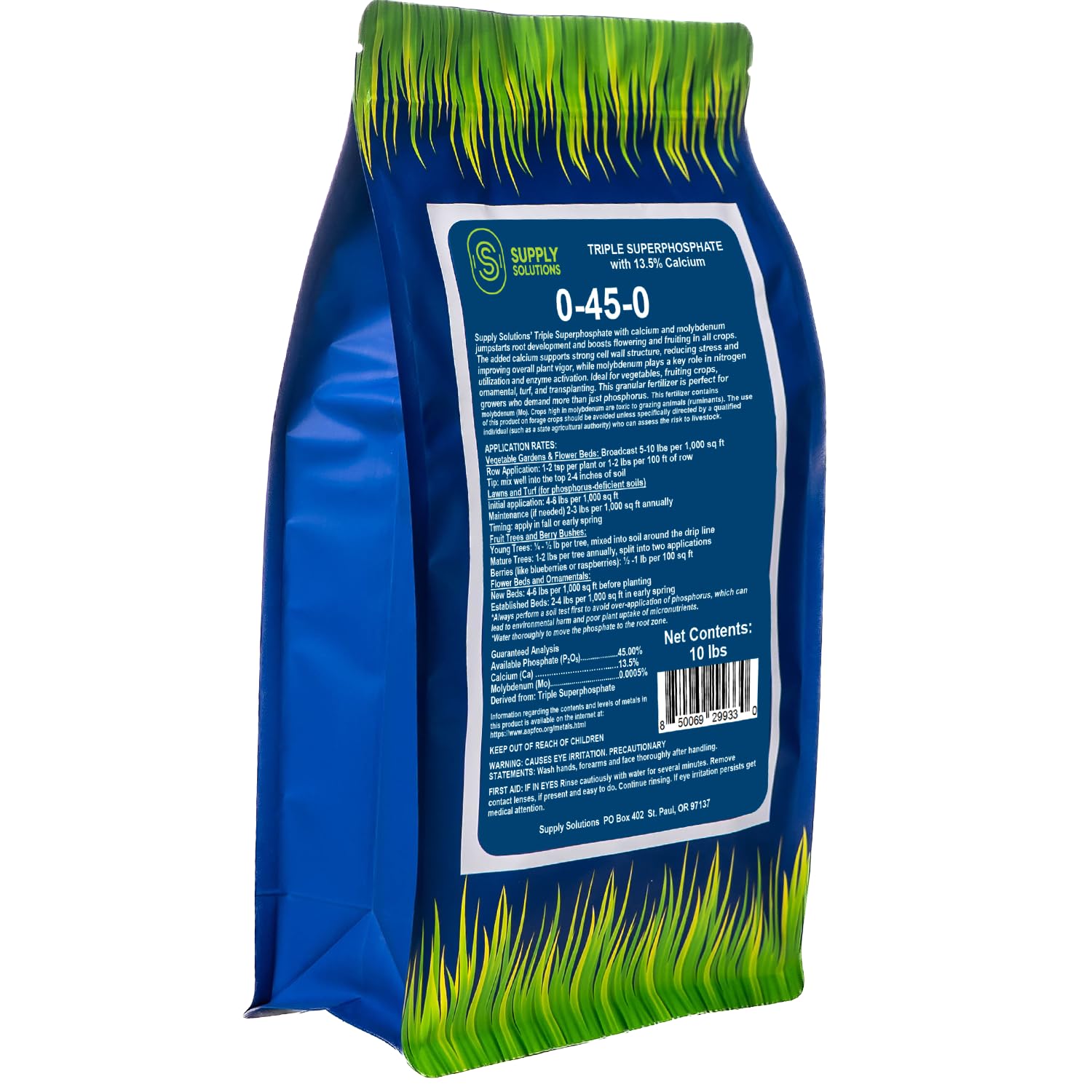
| NPK | 0-45-0 |
|---|---|
| Form | Granules |
| Unit Count | 160 Ounce |
| Includes | Granules Fertilizer |
Supply Solutions 0-45-0 Triple Superphosphate is a straightforward, phosphorus-focused granular fertilizer intended to strengthen roots and promote bigger blooms and fruit. You apply it as a dilute solution for potted plants or broadcast granules for outdoor beds and lawns following the label directions; typical use is every 4 to 6 weeks during active growth. Its concentrated 0-45-0 NPK delivers a strong phosphorus dose with added calcium to support cell strength and soil conditioning, which is useful as a starter treatment for transplants, for orchids and flowering shrubs, or as a seasonal booster for fruit trees and lawns. The product is versatile across indoor pots and garden plots and is easy to measure and mix with water or spread with a garden spreader. Important limitations are that it supplies virtually no nitrogen or potassium, so it should be used alongside a balanced fertilizer program when plants need overall nutrition, and it is not a complete feed for continuous use without complementary products.
Best for: Gardeners who prioritize consistent, measurable phosphorus boosts for flowering and fruiting plants and who plan to pair this with other feeds as part of a reliable fertilizer routine.
Less Ideal for: Beginners who want an all-in-one fertilizer or growers seeking a single-product maintenance feed for overall vegetative growth.
- Very high phosphorus concentration (0-45-0) for strong bloom and root stimulation
- Granular form that can be mixed for liquid feeds or broadcast for soil application
- Contains calcium to support cell strength and improve soil structure
- Clear application rates for both indoor and outdoor use make feeding predictable
- No nitrogen or potassium included, so it is not a standalone complete fertilizer
- Not suited for plants that need regular balanced feeding without additional products
Verdict: Choose this product when you need a dependable, high-phosphorus booster to reliably drive stronger roots, blooms, and fruit as part of a planned feeding program.
Miracle-Gro Shake 'N Feed Flowering Trees & Shrubs Plant Food, 8 lb.

| Item Form | Granules |
|---|---|
| Application Method | shake evenly onto the soil |
| Target Species | flowering trees, shrubs and other acid-loving plants |
| Mixing Ratio | 18:6:12 |
| Unit Count | 128 Ounce |
Miracle-Gro Shake 'N Feed Flowering Trees & Shrubs is a granular, slow-release fertilizer designed to support flowering shrubs and acid-loving plants over an extended period. You apply it by shaking the granules evenly onto the soil under the branch spread or working it into potting mix for containers, then watering to activate the nutrients. The formula lists an 18-6-12 N-P-K ratio and includes organic-derived inputs such as kelp, feather meal, bone meal and earthworm castings to help feed soil microbes and support root development. Practically, that means less frequent feeding and improved foliage and bloom quality across a season—Miracle-Gro recommends reapplying every three months. It works for both in-ground and container plantings and covers a medium area per bag. Limitations are that it is a general-purpose shrub formula tuned for acid-loving species so it is not a precision fertilizer for nutrient-deficient soils and you still need to avoid contact with trunks and foliage when applying. For best results monitor soil pH and follow labeled application rates for newly planted versus established shrubs.
Best for: Gardeners who want a low-effort, season-long feed for flowering shrubs like forsythia and prefer a product that supports soil health without frequent reapplication.
Less Ideal for: Growers who need a precise corrective fertilizer for diagnosed nutrient deficiencies or who maintain shrubs that prefer neutral to alkaline soils.
- Continuous-release granules feed plants for up to three months reducing application frequency
- Contains organic inputs like kelp and earthworm castings to support soil microbes and root health
- Clear application method for both in-ground and container plants makes it easy to use
- Higher nitrogen ratio (18-6-12) promotes lush foliage and supports flowering season-long
- Not a targeted corrective fertilizer for specific mineral deficiencies
- Designed for acid-loving plants so less suitable for neutral or alkaline-preferring shrubs
Verdict: Use this to give forsythia and other acid-loving shrubs an easy, three-month continuous feeding that boosts foliage and blooms with minimal effort.
Choosing the Right Fertilizer for Hong Kong Orchid Tree: Key Factors to Consider
Nutrient Ratio and Bloom Timing
The balance between nitrogen, phosphorus, and potassium dictates whether a Hong Kong Orchid Tree pushes foliage or flowers. A moderate nitrogen level paired with higher phosphorus during the flowering season encourages abundant blooms without runaway vegetative growth. Timing matters too. Fertilizers formulated for bloom induction or ones you switch to at the start of the flowering period will influence how many flowering flushes you get during warm months.
Knowing the tree's growth cycle helps you match fertilizer timing to bloom windows. Overfeeding with high-nitrogen formulas can delay or reduce flower production even if the tree looks lush, so choose a product and schedule with bloom promotion in mind.
Application Format and Practicality
Fertilizers come as water-soluble powders, liquid concentrates, granular slow-release, or spikes. Liquid and water-soluble options give quick responses and are useful for containers or when you need rapid correction. Slow-release granules and spikes reduce labor and provide steady nutrients over weeks or months, which is convenient for in-ground trees or busy gardeners.
Consider how often you want to feed and how much effort you will invest. Containers often need more frequent, mild feedings. Large landscape specimens can benefit from a measured granular program applied less often. Choose a format that fits your routine and watering habits.
Salt Content and Root Health
Some fertilizers have higher soluble salt levels that can accumulate in potting mixes or poorly draining soils, increasing the risk of root burn. Hong Kong Orchid Trees can show sensitivity to excess salts with leaf browning or drop. Look for formulations with clear application rates and lower salt indices, or plan routine flushing of container soils to avoid buildup.
If you plan heavier feeding, select products with gentle release profiles or water-soluble mixes designed for repeated use at reduced strengths to protect root health.
Feeding Frequency and Seasonal Needs
Feeding needs change through the year. Young trees and actively growing specimens need more regular nutrient inputs during spring and summer. During dormancy or cooler months, reduce or stop feeding to avoid pushing tender growth that could be damaged. A clear feeding schedule that matches seasonal growth patterns makes nutrient management predictable and prevents overapplication.
Check recommended intervals for each product type and adjust for your local climate. In hotter, faster-drying conditions you may apply more often but at lighter rates.
Compatibility With Potting Mix and Soil
The medium the tree grows in affects how nutrients are retained and released. Container mixes tend to leach nutrients faster and may require soluble or more frequent applications. Heavy clay soils hold nutrients differently and can benefit from slow-release granules or organic amendments that improve soil structure. Assess your planting medium and pick a fertilizer format that complements its drainage and cation exchange properties.
Also consider whether you want to combine fertilizer use with soil-improving practices like mulching or occasional organic compost top-dressings, which can moderate nutrient availability.
Ease of Correcting Deficiencies or Excesses
Some feeding programs make it easy to correct visible nutrient issues quickly, while others do not. Water-soluble fertilizers allow fast corrective feeding for deficiencies such as pale leaves or weak bloom. Slow-release formulas are less flexible once applied, so diagnosing and correcting problems can require leaching or waiting for the formula to taper off.
Choose a fertilizer approach that matches how comfortable you are with monitoring and adjusting fertilization. If you prefer low-maintenance care, accept less flexibility in exchange for steadier nutrient delivery.
When to Start Feeding
Begin a regular feeding routine in early spring as new growth appears. This supports the vigorous flushes that lead into the primary flowering season. For potted specimens start with lighter doses and increase gradually as the root system expands.
Stop or greatly reduce fertilizing as temperatures drop and the tree moves toward a less active state. Overfeeding late in the season can produce tender growth vulnerable to stress.
- Start light and build up to recommended rates
- Time higher phosphorus feeds to the flowering window
- Reduce feeding in cooler months
Feeding Containers Versus In-ground Trees
Containers dry and leach faster than landscape soils, so potted Hong Kong Orchid Trees often benefit from more frequent, milder feedings. Use water-soluble formulas at lower concentrations or a slow-release mix designed for containers to avoid salt buildup.
In-ground trees generally tolerate less frequent applications. Applying a measured amount of slow-release granules around the root zone in spring can provide steady nutrients through the season. Ensure even distribution and avoid placing granules against the trunk.
- Flush containers periodically to avoid salt buildup
- Apply granular fertilizer evenly in a root zone band for in-ground trees
- Adjust rates for container size and root volume
Organic Versus Synthetic Options
Organic fertilizers release nutrients more slowly and improve soil biology, which can support longer-term root health. They are less likely to cause rapid vegetative surges and tend to be gentler in containers. However, their nutrient concentrations are lower, so effects on flowering may take longer to appear.
Synthetic formulations offer precise nutrient ratios and predictable short-term responses, which is useful for correcting deficiencies or stimulating a bloom flush. Pair synthetic feeds with good watering practices to prevent salt stress.
- Organics improve soil structure and microbial health
- Synthetics provide fast, measurable results
- Consider combining both approaches seasonally
Signs of Overfeeding and How to Respond
Watch for sudden leaf edge browning, leaf drop, or excessive, soft foliage as indicators of overfeeding or salt stress. If you spot these, flush container soils with ample water or pause further applications for in-ground trees and allow natural rainfall to leach salts.
Reducing the next scheduled dose and shifting to a gentler maintenance formula helps recovery. For persistent issues consider testing the soil or potting mix to confirm salt levels and nutrient balance.
- Flush container soil thoroughly if burn appears
- Cut back feeding frequency before changing product
- Test soil when problems persist
Combining Fertilizer With Watering and Mulch
Fertilizer effectiveness is tied to watering. Apply soluble feeds when you can water in to move nutrients toward roots. For slow-release products, maintain consistent moisture so nutrients are released steadily. Mulch helps moderate soil temperature and moisture, which improves nutrient uptake and reduces stress during dry spells.
Avoid placing mulch directly against the trunk and ensure mulch depth allows air movement. A well-timed watering and mulching routine makes fertilization more efficient and reduces the risk of foliage damage.
- Water after applying soluble fertilizer to move nutrients into the root zone
- Use mulch to stabilize moisture and aid nutrient uptake
- Keep mulch away from the trunk base
How We Chose the Best Fertilizer for Hong Kong Orchid Tree
We shortlisted fertilizers based on criteria that matter in real garden practice for Hong Kong Orchid Trees. First, nutrient balance: we prioritized products with formulas or feeding programs that promote flowering without pushing excessive leafy growth. Second, application format and ease: how straightforward the feeding routine is for backyard gardeners, including liquid drenches, water-soluble mixes, slow-release granules, and spikes. Third, salt load and burn risk: Hong Kong Orchid Trees are sensitive to over-fertilizing, so formulations and recommended rates that limit soluble salt buildup were favored. Fourth, suitability across planting situations: effectiveness for container specimens, small urban yards, and larger in-ground trees was considered. Fifth, availability of clear instructions and gardener-friendly feeding schedules that reduce guesswork. We excluded products with ambiguous nutrient labeling, feeding regimens that require specialist equipment, and formulas primarily designed for unrelated plant groups. The selection emphasizes predictable results, manageable application, and minimized risk of root stress or blossom loss. These evaluation points align with the scoring metrics used in our product summaries.
FAQ
How often should I fertilize a Hong Kong Orchid Tree in a pot?
Usually feed potted trees lightly every 4 to 6 weeks during the active growing season, using a diluted water-soluble formula or a container-focused slow-release product. Increase frequency slightly for small pots and reduce or stop in cooler months.
Can I use general-purpose lawn fertilizer on a Hong Kong Orchid Tree?
General lawn fertilizers often have ratios optimized for grass and may be high in nitrogen, which can favor foliage over flowers. It usually works better to use a formula tuned for flowering trees or shrubs, or apply lawn fertilizer sparingly and monitor for excessive leafy growth.
What are signs my tree needs phosphorus for better blooms?
Signs include reduced or sparse flowering despite healthy foliage. There may not always be obvious leaf symptoms, so observing seasonal bloom performance is key. Switching to a bloom-focused feeding during the flower season can help if poor flowering is the main issue.
Is it safe to use slow-release granules around young transplants?
Slow-release granules can be safe for young transplants if applied at reduced rates and kept away from direct contact with roots or the stem flare. Use the lower end of recommended dosages and monitor growth to avoid stunting or root sensitivity.
How do I avoid fertilizer burn on a Hong Kong Orchid Tree?
Avoid high single-dose applications, follow label dilution instructions, and water well after applying soluble feeds. For containers, flush the potting mix occasionally to prevent salt accumulation. Use gentler formulations or lower rates if your tree shows sensitivity.
Final Verdict
Prioritize a fertilizer approach that balances bloom promotion with controlled nitrogen and low salt risk. Match the product format to how you grow the tree: soluble feeds for quick correction and containers, slow-release for low-maintenance in-ground care, and organics for long-term soil health. Be prepared to adjust rates seasonally and monitor for signs of burn or poor flowering. Choose the feeding routine that aligns with your planting situation and gardener rhythm, and you will gain more reliable blooms and healthier roots without unnecessary risk.
