

Note: This article contains affiliate links. If you click on these links and make a purchase, I may earn a small commission at no extra cost to you. This helps support my research and content. Read my full affiliate disclosure here.
When you are planting St. Augustine grass plugs, the right fertilizer can mean the difference between slow, patchy establishment and a quick, dense lawn. Turf plugs need a nutrient mix that supports root growth first, then top growth, and an application schedule that fits warm-season grass cycles. This guide highlights seven shortlisted fertilizers suited for St. Augustine plugs and explains why each made the cut. We evaluated products against practical gardener concerns such as nutrient ratios, release type, and ease of application so you can pick a fertilizer that matches your soil, schedule, and maintenance style. Read on for the criteria we used and clear guidance for getting new plugs to take hold quickly.
Top Picks at a Glance
| Best Overall The best all-around choice for most situations | Jonathan Green Green-Up Lawn Food for Seeding & Sodding (12-18-8), 15 lb |  |
| Best Quality Built to a higher standard if you want something more solid | Pro Trust Turf Trust Professional Starter Fertilizer, 16 lb |  |
| Best Value The sweet spot between price and what you get | GreenView Solutions Starter Fertilizer, 16 lb bag |  |
| Best Budget The cheapest option that still gets the job done reliably | BETHEL NutriPod Fertilizer Pods for Grass Plugs, 16-Pack |  |
| Highest Rated A top-rated pick with lots of positive feedback | Root 98 Warehouse Grass Lawn Plug Fast 12-12-6 Slow‑Release Liquid Fertilizer (5 lb) |  |
| Most Popular A crowd favorite that many people choose with confidence | Scotts Turf Builder Starter Food for New Grass, 42 lb. |  |
| Best Seller A high-volume bestseller chosen again and again | Scotts EZ Patch Lawn Repair for St. Augustine Lawns, 3.75 lb |  |
Jonathan Green Green-Up Lawn Food for Seeding & Sodding (12-18-8), 15 lb

| Item Form | Granules |
|---|---|
| Specific Uses For Product | Lawn |
| Application Method | spreader |
| Mixing Ratio | 12-18-8 |
| Coverage | Full |
Jonathan Green Green-Up is a granular starter fertilizer designed specifically for seeding, overseeding, and laying sod. With a 12-18-8 analysis it supplies extra phosphorus to promote root formation while added iron helps deepen green color. Use it the same day you seed or install sod, applied with a rotary, drop, or hand-held spreader; a single 15 lb bag claims coverage up to 5,000 sq ft and feeds for roughly two months. Practical benefits include faster establishment of seedlings, stronger root systems for improved turf durability, and humates that can improve nutrient availability in the soil. Important limitations are that it contains phosphorus so local regulations may restrict use in some areas and it is formulated for establishing new grass rather than routine maintenance feeding. Also the coverage and longevity will vary with application rate, soil type, and weather, so follow label directions for best results.
Best for: Buyers planting new grass in fall who want a focused starter fertilizer to speed root establishment and get seedlings off to a strong start.
Less Ideal for: Homeowners seeking an all-season maintenance fertilizer or those in regions that forbid phosphorus lawn products should consider alternate formulations.
- High phosphorus formula (12-18-8) supports rapid root development for new seed and sod
- Granular form works with common spreaders for even application
- Contains humates to improve nutrient availability and iron for deeper greening
- Feeds for up to about two months, reducing the need for immediate repeat applications
- Contains phosphorus which may be restricted by local regulations and can pose runoff risk
- Designed for establishment rather than long-term lawn feeding
Verdict: Choose this as your fall starter fertilizer when you need a high-phosphorus, spreader-applied product to help new seed or sod establish strong roots quickly.
Pro Trust Turf Trust Professional Starter Fertilizer, 16 lb

| Item Form | Liquid |
|---|---|
| Specific Uses For Product | Lawn |
| Target Species | grass or lawns |
| Mixing Ratio | 24:2:12 |
Pro Trust Turf Trust is a granular starter fertilizer intended to build strong turf and roots over a long feeding window. It uses CDU enhanced slow-release nitrogen in a 24-2-12 formulation so grass receives steady nitrogen for roughly three months while added phosphate and potassium promote root establishment and cell wall strength. Typical use is a broadcast application to newly seeded or plugged lawns or as an early fall feed; the manufacturer recommends bagging clippings and using a broadcast spreader for even coverage and to avoid grinding granules. The product covers up to 5,000 sq ft from a 16 lb bag and is pitched at homeowners or pros who want fewer applications and predictable nutrient release. Limitations are that it is a single-season starter feed with a fixed N-P-K ratio so you may need a complementary product for turf with different nutrient needs, and it requires correct spreader settings and sweep-up of runoff to avoid staining or uneven distribution.
Best for: Buyers who prioritize steady, long-lasting feeding and want a starter formula that promotes root development with fewer repeat applications.
Less Ideal for: Gardeners who need custom nutrient ratios based on soil test results or who prefer liquid feeds and more frequent, adjustable applications.
- Slow-release CDU nitrogen feeds for up to 12–14 weeks for longer-lasting results
- 24-2-12 N-P-K supports early turf top growth while emphasizing root development
- Covers up to 5,000 sq ft from one 16 lb bag for broad-area applications
- Designed for broadcast spreaders to deliver even distribution when used as directed
- Fixed 24-2-12 ratio may not match all soil test recommendations
- Granules can be damaged by drop spreaders and require proper spreader use and cleanup
Verdict: Choose Turf Trust when you want a professional-grade, slow-release starter fertilizer that establishes roots and feeds your St. Augustine plugs for up to three months.
GreenView Solutions Starter Fertilizer, 16 lb bag

| NPK | 10-18-10 |
|---|---|
| Form | Granules |
| Specific Uses | Root Development, Seed Development |
| Target Species | Lawn Grass |
| Unit Count | 256 Ounce |
GreenView Solutions Starter Fertilizer is a granular starter fertilizer designed for establishing new lawns and repairing bare spots. It delivers a 10-18-10 NPK blend with an emphasis on phosphorus to speed root development and improve seedling establishment. You typically apply it after seeding and then water it in; the product is slow-release and claims up to eight weeks of feeding so you do not need frequent reapplications during early establishment. Notable features include a high phosphorus content for root growth, slow-release nitrogen for steady top growth, and a formula without microplastic coatings. In practice this means stronger initial root systems and more consistent, manageable shoot growth while seedlings take hold. Limitations are that it is formulated specifically as a starter rather than a long-term maintenance fertilizer and coverage is oriented around the stated area per bag, so planning how much you need matters for larger areas. For builders of a new zoysia lawn or for repairing patches, it provides targeted early-season nutrition to help turf establish more reliably.
Best for: Homeowners planting or repairing zoysia who want a focused, low-maintenance starter feed to build strong roots and reduce the need for frequent early applications.
Less Ideal for: Gardeners looking for an all-season fertilizer program or those who need a product formulated for mature, established turf should consider a balanced maintenance fertilizer instead.
- High phosphorus (18%) formulation to encourage quick root establishment and stronger seedlings
- Slow-release nitrogen that feeds up to eight weeks, reducing the need for repeated early applications
- Granular form is easy to broadcast over seeded areas and bare spots
- No microplastic coatings, offering a more sustainable slow-release option
- Intended as a starter fertilizer not a season-long maintenance product
- Single bag size may require multiple bags for larger lawns
Verdict: If you are establishing zoysia or repairing bare spots, this high-phosphorus starter gives focused early nutrition to build strong roots and simplify early care.
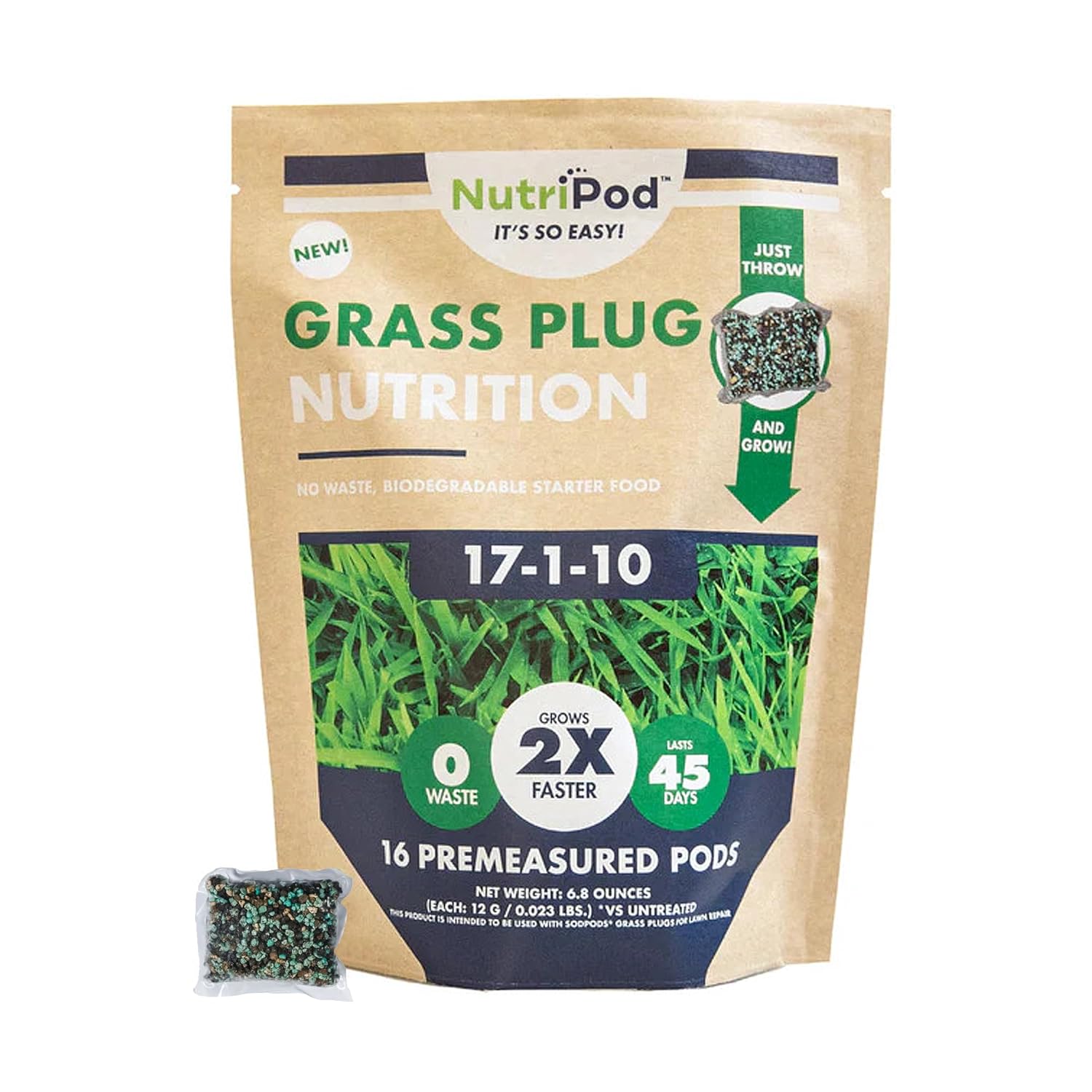
BETHEL NutriPod Fertilizer Pods for Grass Plugs, 16-Pack
| Item Form | Pods |
|---|---|
| Specific Uses For Product | Plant Growth, Root Development |
| Coverage | Medium |
| Target Species | grass plugs |
NutriPods are single-use, premeasured fertilizer pods made to be dropped into each grass plug hole to supply a slow-release nutrient dose for up to about 45 days. Typical use is straightforward: plant your St. Augustine plug, drop one pod into the hole, then cover and water. The pods dissolve naturally so there is no mixing, measuring, or leftover granular fertilizer to apply. That makes them handy for small plug-and-fill projects or for homeowners who want predictable feeding without specialized equipment. The product is marketed to speed plug establishment and root growth and claims up to twice the growth rate versus no amendment. Practical benefits include precise dosing that reduces the risk of over-application and a low-effort workflow that saves time on repeat feeding. Important limitations are that the pods are single-use and sold in a limited-count pack, so larger restorations will require many packs and could be less cost-efficient than bulk granular options; also the formulation is designed specifically for plugs rather than routine turf maintenance.
Best for: Homeowners repairing St. Augustine with small to medium plug jobs who want a low-effort, foolproof way to feed each plug and avoid measuring fertilizers.
Less Ideal for: Contractors or anyone restoring large lawns who need bulk, lower-cost fertilizer solutions or a product for ongoing seasonal feeding.
- Premeasured pods remove measurement and mixing guesswork
- Slow-release formula feeds new plugs for up to about 45 days
- Biodegradable pods dissolve with no residue or cleanup
- Simple drop-in application works at each plug hole without tools
- Single-use pods in small pack sizes can be less economical for large areas
- Designed specifically for plug establishment and not as a standalone season-long fertilizer
Verdict: If you want a no‑mess, accurately dosed fertilizer to help St. Augustine plugs establish faster, these premeasured dissolvable pods make plug-by-plug feeding simple and reliable.
Root 98 Warehouse Grass Lawn Plug Fast 12-12-6 Slow‑Release Liquid Fertilizer (5 lb)

| Item Form | Liquid |
|---|---|
| Unit Count | 80 Fluid Ounces |
| N‑P‑K | 12-12-6 |
| Contains Iron | 1% |
This liquid fertilizer is made for planting grass plugs and is designed to be used one teaspoon per plug placed directly in the planting hole. It contains 12% nitrogen, 12% phosphorus and 6% potassium with about 5.6% of the nitrogen as slow‑release, plus 1% iron, so it provides an early phosphorus boost to encourage root set while continuing to feed young plugs. The product is convenient for plug planting because the manufacturer gives a simple per‑plug rate and the liquid form makes it easy to apply into holes without dust. Practical benefits include targeted nutrient placement at planting, reduced risk of overfeeding surrounding turf, and iron to help early green up. Limitations are that the packaging and directions focus narrowly on plug planting rather than general feeding, and you must measure small teaspoon doses for many plugs which adds time for large jobs. Also the coverage claim is generic so plan quantities by plug count rather than assumed area coverage.
Best for: Buyers who prioritize a reliable, plug‑specific starter fertilizer and want predictable, measured nutrient delivery when establishing St. Augustine plugs.
Less Ideal for: Gardeners looking for a broadcast or continuous lawn feeding product or those who want a granular one‑step solution for large area applications.
- Formulated specifically for planting grass plugs with a clear per‑plug application rate.
- Balanced N‑P‑K (12‑12‑6) with added iron to promote root development and early greening.
- Contains a measurable slow‑release portion of nitrogen to extend feeding after planting.
- Liquid form allows precise placement in plug holes and reduces airborne dust.
- Requires measuring small teaspoon doses which can be time consuming for large numbers of plugs.
- Packaging and directions are focused on plug use only and do not provide broader lawn application guidance.
Verdict: Choose this product when you need a dependable, plug‑specific starter fertilizer that gives a phosphorus root boost plus a slow‑release nitrogen component for reliable St. Augustine plug establishment.
Scotts Turf Builder Starter Food for New Grass, 42 lb.

| Item Form | Granules |
|---|---|
| Coverage | 14000 |
| Target Species | new grass |
| Mixing Ratio | 24-25-4 (N-P-K) |
Scotts Turf Builder Starter Food for New Grass is a granular starter fertilizer designed for use when planting seed, laying sod, or installing plugs and sprigs. The 24-25-4 formula supplies a high phosphate boost to encourage root development and quicker blade emergence during the first 2 to 4 weeks after planting. It is applied with a spreader at planting and again 2 to 4 weeks later, then switched to regular lawn food for ongoing maintenance. In practice the product makes seeding and sod establishment simpler for typical yards: the particles are uniform for even spreader coverage and the instructions spell out recommended spreader settings. Practical benefits include wide coverage from a single 42 lb bag and compatibility with all grass types. Limitations are that it is a one-purpose starter rather than an all-season fertilizer and it requires daily watering of new seed until seedlings reach about 2 inches tall, which may be a chore in drier climates. Users should also follow label directions for application rates to avoid overfeeding.
Best for: Homeowners planting a new lawn or repairing large seeded or sodded areas who want a proven, easy-to-follow starter fertilizer to improve establishment success.
Less Ideal for: Gardeners who need an all-in-one year‑round fertilizer or those unable to provide the consistent watering new seed requires.
- High phosphate 24-25-4 formula to encourage strong root development in new lawns
- Granular particles formulated for even spreader distribution and predictable coverage
- Covers a large area from one 42 lb bag, reducing the need for multiple purchases
- Clear application guidance including spreader settings and a recommended two-application schedule
- Designed specifically as a starter product so it is not intended for ongoing all-season feeding
- Requires regular watering of seed after application to be effective
Verdict: Choose this product if you want a reliable, high‑phosphate starter fertilizer that simplifies getting new grass to establish faster.
Scotts EZ Patch Lawn Repair for St. Augustine Lawns, 3.75 lb

| Item Form | Mulch and Fertilizer Mix, Ready-to-use |
|---|---|
| Coverage | 85 sq ft |
| Target Species | St. Augustinegrass |
| Unit Count | 60 Ounce |
Scotts EZ Patch is a ready-to-use mulch and fertilizer blend specifically formulated for St. Augustinegrass to help repair bare spots and establish plugs. You prep the spot by removing dead material and loosening soil, spread an even layer of the mix so no soil shows, then water until the mulch is saturated. The product’s super-absorbent mulch expands and holds moisture to protect newly exposed soil while the controlled-release fertilizer feeds the grass over time, which the brand says can speed visible repair. Because it contains no seed, it is best used with plugs or to cover recently installed sod rather than for overseeding. The small 3.75 lb jug covers up to 85 sq ft, making it convenient for spot repairs but not for large lawns. For homeowners looking for a simple three-step patch method, this is easy to apply and reduces the need for daily watering; users should plan to combine it with proper plug or sod selection and routine turf care for best results.
Best for: Homeowners with St. Augustine lawns who want an easy, low-effort product to repair bare spots or protect newly placed plugs and sod and who value proven product performance.
Less Ideal for: People trying to reseed large areas or establish a whole lawn from seed should choose a seed-containing product or larger coverage solution.
- Formulated specifically for St. Augustinegrass to support faster establishment
- Super-absorbent mulch expands to retain moisture and improve coverage
- Controlled-release fertilizer feeds turf over time to encourage growth
- Ready-to-use mix requires no measuring or mixing and is simple to apply
- Does not contain grass seed so it cannot establish turf on its own
- Small container size is suitable for spot repairs but not large areas
Verdict: A simple, ready-to-use mulch plus controlled-release fertilizer made to protect and speed repair of St. Augustine bare spots when used with plugs or sod.
Choosing the Right Fertilizer for St. Augustine Grass Plugs: Key Factors to Consider
Nutrient Ratio and Timing
For establishing St. Augustine plugs, the balance of nitrogen, phosphorus, and potassium matters because young plants need different nutrients at different stages. Higher phosphorus can encourage root development early on, while moderate nitrogen supports gradual leaf growth without forcing soft tissue that stresses new plugs. Look at the sequence of feedings too; an initial formulation tuned for roots followed by products aimed at shoot development is often better than a single high-nitrogen application.
Timing matters because St. Augustine is a warm-season grass. Apply the first establishment feeding when soil temperatures consistently support active growth, then follow with intervals recommended for the release type. Avoid late-season high-nitrogen feeds that push tender growth when the turf should be preparing for cooler periods.
Release Type and Feeding Frequency
Release profile determines how nutrients become available and affects both convenience and risk. Quick-release fertilizers give an immediate nutrient boost but raise burn risk and may require more frequent light applications. Slow-release or controlled-release products supply nutrients over weeks to months, reducing labor and smoothing growth but may not provide the instant root stimulation some gardeners want.
For plugs, a hybrid approach is common: a modest immediate-release dose to kick-start root activity paired with slow-release nutrients to sustain growth. Consider how often you can realistically apply fertilizer and choose a release type that aligns with that rhythm to avoid over- or under-feeding.
Salt Index and Burn Potential
New plugs have limited root systems and are more sensitive to soluble salts in fertilizers. High-salt formulations can pull moisture from plant tissues and damage roots, causing plug loss. Review product labeling or technical sheets for salt index indications and favor lower-salt options for initial establishment.
Granular formulations with lower water-soluble salt content or liquids diluted for safety are typically safer for early stages. If using a higher-salt product, reduce the application rate and water it in thoroughly to move salts away from the crowns and encourage rooting.
Application Method and Precision
How you apply fertilizer affects uniformity and the chance of harming new plugs. Granular spreaders offer convenience but may broadcast unevenly at small scales; handheld spreaders or hand-sprinkling can give more precise coverage around plugs. Liquid fertilizers can be applied with a hose-end sprayer or watering can for targeted feeding but require careful dilution.
Precision matters because plugs are small and concentrated fertilizer near the crown can cause burn. Look for products with clear, small-plot or starter-rate instructions and choose a form you can apply accurately across the area you are planting.
Compatibility With Soil and Water
Soil texture, organic matter, and existing fertility affect how a fertilizer performs. Sandy soils drain quickly and may need more frequent, lower-dose applications, while heavier soils hold nutrients longer. Also consider irrigation: frequent light watering works well with quick-release feeds, while slow-release products pair with less frequent deep watering schedules.
Test or estimate your soil fertility before major feeding and adjust phosphorus and potassium inputs based on those results. Match fertilizer selection to how you irrigate to avoid leaching or nutrient lock-up and support steady plug establishment.
When to Fertilize Plugs
Start fertilizing after plugs have been given time to root and show signs of active growth, which usually occurs once soil temperatures and moisture support steady development. Applying too early can stress plugs; waiting until you see initial root or shoot activity ensures nutrients will be taken up rather than sitting unused.
A typical approach is a light establishment feed at planting or within a week, then scheduled follow-up feeds based on the fertilizer release type. Monitor the plugs for color and growth, and avoid late-season heavy nitrogen applications that can interfere with seasonal hardening.
- Check soil temperature and moisture before the first application.
- Use lighter starter rates than for mature lawns.
- Space follow-up feeds according to release profile and observed growth.
Granular Vs Liquid Fertilizers
Granular fertilizers are convenient and often include slow-release options that save time and reduce the risk of over-application. They can be broadcast with a spreader for larger areas or applied by hand for small plug installations. The main downside is potential uneven distribution at small scales.
Liquid fertilizers provide quick availability and precise placement, which can be helpful for small plug plots or spot treatments. They require careful dilution and application to avoid concentrated burns but allow targeted feeding that matches plug locations.
- Granular: good for even, low-frequency feeding.
- Liquid: good for quick responses and precise placement.
- Choose based on plot size and how precisely you can apply product.
Watering and Fertilizer Interaction
Irrigation strategy should be matched to your fertilizer choice. For starter feeds, water in lightly to move nutrients into the root zone without creating soggy conditions. With quick-release fertilizers, more frequent light watering helps uptake and reduces burn risk. For slow-release products, deeper, less frequent watering supports steady nutrient delivery and encourages deeper rooting.
Avoid letting fertilizers sit on crowns or blades without watering, as concentrated granules can cause local damage. Adjust mowing and watering after application to support steady establishment.
- Lightly water after applying starter fertilizer to move nutrients into the soil.
- Use deeper watering with slow-release products to encourage root depth.
- Prevent overwatering that could dislodge plugs or promote disease.
Starter Programs and Follow-Up Care
A starter program for plugs typically begins with a phosphorus-inclusive feed to encourage root formation, followed by scheduled nitrogen boosts to promote canopy fill. The exact schedule depends on product release characteristics and local growing conditions.
Combine fertilization with best practices like proper mowing height for St. Augustine, pest and weed control, and soil improvement measures. Fertilizer alone will not guarantee success if soil compaction, shade, or water issues are not addressed.
- Plan a phased schedule: root support first, then maintenance feeding.
- Pair fertilization with irrigation, mowing, and soil health practices.
- Adjust program based on plug visual cues and seasonal timing.
Environmental Considerations
Minimize runoff and nutrient loss by applying fertilizers when heavy rain is not expected and by using slow-release formulas where possible. Over-application can contribute to leaching and harm downstream water quality. Use recommended rates and calibrate spreaders or sprayers to avoid hotspots.
Consider products with lower soluble salt content and those formulated to support soil biology, which can improve longer-term nutrient cycling and reduce the need for heavy repeat applications.
- Avoid fertilizing before heavy rain.
- Prefer slow-release blends to reduce leaching.
- Follow label guidance to limit environmental impact.
How We Chose the Best Fertilizer for St. Augustine Grass Plugs
We selected fertilizers that specifically support warm-season turf establishment and that are practical for planting St. Augustine grass plugs. Key evaluation criteria included nutrient ratio and formulation, measured as how well the N-P-K and supporting micronutrients promote root versus shoot development during the plug-establishment phase. Release type was assessed to prioritize options that provide steady feeding without burning tender new roots, comparing quick-release, slow-release, and controlled-release formulations. Application practicality was considered, including granule size or liquid concentration, ease of measuring and spreading, and compatibility with common spreaders or sprayers. Salt index and burn risk were evaluated because plugs have limited root mass and are vulnerable to high-salt fertilizers. Finally, environmental and turf health factors were checked, such as potential for runoff and whether the formulation supports microbial soil activity. We excluded products that are solely for mature turf maintenance or that lack clear N-P-K labeling for establishment use. Products without guidance for application rates on new plugs or with unusually high salt indices were not considered. The resulting list focuses on formulations and presentation styles that help gardeners establish St. Augustine plugs reliably.
FAQ
How soon after planting should I apply fertilizer to St. Augustine plugs?
Often a light starter application at planting or within the first week is recommended, but many gardeners wait until there are signs of root activity and new shoots. Timing depends on soil temperature and moisture.
Is phosphorus necessary for establishing plugs?
Phosphorus helps root development, so a starter fertilizer with some phosphorus can be beneficial. However, soil tests will show if additional phosphorus is needed, and local regulations sometimes limit phosphorus use.
Can I use the same fertilizer I use on my mature lawn for new plugs?
Sometimes, but products formulated for mature turf may have higher nitrogen or salt levels. For plugs, look for lower starter rates or formulations that emphasize root support and lower burn risk.
How often should I water after fertilizing plugs?
Water lightly to move nutrients into the root zone immediately after application, then follow an irrigation schedule that matches the fertilizer release type. Quick-release formulas pair with more frequent light watering; slow-release products work with deeper, less frequent irrigation.
Will fertilizer speed up plug establishment in shady yards?
Fertilizer supports growth but cannot fully overcome insufficient light. In shady conditions, growth will be slower and fertilizer should be used modestly while addressing light or turf selection issues.
What signs indicate a fertilizer burn on plugs?
Look for browning or wilting near the plug crowns, dry spots around applied granules, or stunted new growth. If you suspect burn, water thoroughly to dilute salts and avoid repeat high-rate applications.
Final Verdict
Choose a fertilizer strategy that prioritizes root development, minimizes burn risk, and fits your watering routine. For St. Augustine plugs, favor formulations that provide an early phosphorus boost or a gentle initial nitrogen dose combined with a slow-release follow-up to sustain growth. Balance convenience and precision when selecting product form and application method, and adjust feeding based on soil type and visible progress. With the right schedule and attention to salt risk and irrigation, you can speed establishment and build a healthy foundation for a dense St. Augustine lawn.
