

Note: This article contains affiliate links. If you click on these links and make a purchase, I may earn a small commission at no extra cost to you. This helps support my research and content. Read my full affiliate disclosure here.
If you want healthier roots and more efficient nutrient use in pots, raised beds, or open garden soil, choosing the right humic acid fertilizer makes a tangible difference. These products behave differently by concentration, carrier, and how you apply them, so matching the product to your planting system matters for results. This guide shortlists seven top-rated humic acid fertilizers suitable for home gardeners and small-scale growers. We focus on how concentrated the humic fraction is, how easy each product is to apply, and how it performs across common soil types and container mixes. Read on to see which characteristics to prioritize for your garden and how we evaluated the entries.
Top Picks at a Glance
| Best Overall The best all-around choice for most situations | The Andersons HumiChar Organic Soil Amendment with Humic Acid and Biochar (12 lb) |  |
| Best Quality Built to a higher standard if you want something more solid | The Andersons Humic DG Organic Soil Amendment (40 lb) |  |
| Best Value The sweet spot between price and what you get | GS Plant Foods Liquid Humic Acid Soil Amendment, 1 gal |  |
| Best Budget The cheapest option that still gets the job done reliably | Live Earth Humate Soil Conditioner Granules, 3 × 5 lb Bags (15 lb) |  |
| Highest Rated A top-rated pick with lots of positive feedback | Safer Gro Humax Liquid Humic Acid, Pint |  |
| Most Popular A crowd favorite that many people choose with confidence | Farmer's Secret Soil Revitalizer Organic Liquid Compost (32 oz) |  |
| Best Seller A high-volume bestseller chosen again and again | GS Plant Foods Humic Acid Liquid Soil Amendment (32 oz) |  |
The Andersons HumiChar Organic Soil Amendment with Humic Acid and Biochar (12 lb)

| Unit Count | 192 Ounce |
|---|---|
| Volume | 12 liters |
| Ingredients | Humic Acid, Coconut Husk Biochar, Leonardite, Proprietary Binding Agent, Water |
| OMRI Listed | Environmentally friendly, OMRI listed |
HumiChar is a granular organic soil amendment designed to boost soil structure and long-term fertility by combining high-concentration humic acid with granulated biochar. It is applied to lawns and garden beds either alone or blended with fertilizer to increase nutrient availability, improve moisture retention, and build soil carbon over time. The product's dispersible granule technology reduces dust and helps the particles break down more predictably in the soil, making it easier to apply evenly with a spreader. Because it contains both quickly available humic acid and persistent biochar, you get both near-term benefits for turf vigor and a durable improvement in soil tilth that can reduce reliance on repeat fertilizer applications. Important limitations are its chemical-safety notes and handling precautions and that measurable soil changes require repeated or follow-up applications for larger areas; it is not a one-time quick fix for heavily depleted soils. Overall this is a practical option for homeowners and groundskeepers seeking a reliable, low-dust organic amendment to improve lawn soil health.
Best for: Homeowners or lawn caretakers who prioritize consistent, long-term soil improvement and want a low-dust, organic amendment that fits into a routine fertilizing program.
Less Ideal for: People needing an immediate, dramatic correction for compacted or nutrient-depleted turf who require fast-acting chemical treatments or structural soil replacement.
- Combines 30% humic acid with 43% granulated biochar for both immediate and long-term soil benefits
- Dispersible granule formulation reduces dust and spreads evenly with common spreaders
- OMRI-listed organic ingredient set suitable for organic lawn programs
- Can be blended with fertilizers or used alone for flexible application
- Not a one-time solution for severely degraded soils because measurable changes take time and repeat applications
Verdict: Choose HumiChar when you want a dependable organic amendment that delivers both quick humic benefits and long-term soil-building biochar for healthier lawns over time.
The Andersons Humic DG Organic Soil Amendment (40 lb)

| Item Form | Granules |
|---|---|
| Specific Uses For Product | Potting |
| Coverage | 40000 |
| Target Species | plants |
The Andersons Humic DG is a granular humic acid amendment built for growers who want to improve soil carbon and root performance without changing their fertilizer program. It contains a highly concentrated humic fraction (listed at about 70 percent by the manufacturer) and uses a dispersing granule technology that breaks into micro-particles on contact with water so material moves toward the root zone. Typical uses include broadcast applications to turf, banded or in-furrow for crops, mixing into potting mixes, and spot treatments for trees, shrubs, and bedding plants. Practical benefits are improved nutrient chelation and uptake, greater microbial food source to support soil biology, and easier integration with existing fertilizers. Limitations are that it is a bulk-amendment requiring spreader or manual distribution and regular watering after application to get the granules to disperse; it is not a complete fertilizer so you still need a nutrient program. For performance-focused gardeners it is a targeted tool to increase fertilizer efficiency and root vigor when used to supplement, not replace, your primary fertility plan.
Best for: Gardeners and turf managers who prioritize measurable performance gains in nutrient efficiency and root health and want a concentrated humic product they can add to existing fertility programs.
Less Ideal for: Casual gardeners looking for an all-in-one fertilizer or buyers who want a simple liquid feed; this product is an amendment, not a complete nutrient source.
- High humic concentration for stronger nutrient chelation and microbial support
- Dispersing granule technology that breaks into micro-particles on contact with water for rapid root-zone delivery
- Versatile application: suitable for turf, in-furrow, potting mixes, trees, shrubs and garden beds
- OMRI-listed and compatible with existing fertilizer programs
- Supplies organic carbon and chelation but does not provide macronutrient N-P-K by itself
- Requires watering after application to activate granules and avoid loss from heavy rain
Verdict: Use this concentrated humic granule to boost root vigor and make your fertilizer program more efficient.
GS Plant Foods Liquid Humic Acid Soil Amendment, 1 gal

| Item Form | Liquid |
|---|---|
| Specific Uses For Product | Plant Growth, Root Develpoment, Nutrient Uptake |
| Application Method | Sprayer |
| Liquid Volume | 1 gallons |
| Mixing Ratio | 1:64 |
GS Plant Foods Liquid Humic Acid is a 6% leonardite-derived soil amendment meant to be used alongside regular fertilizers to help lawns and plants access nutrients more effectively. Applied through a sprayer, it mixes with most liquid fertilizers (avoid low-pH, high-liquid-calcium products and calcium nitrate) and is dosed at 4 oz per gallon for an initial treatment and 2 oz per gallon for follow-ups, usable as often as every three weeks. The liquid form and clear mixing ratio make it easy to add to standard lawn-care spray rigs for broad-area applications or to smaller sprayers for beds and containers. Practical benefits include improved root development, better micronutrient uptake, and economical coverage from a single jug when used at the recommended rates. Limitations are that it is not a fertilizer so it will not supply N-P-K and it requires careful mixing compatibility checks with certain fertilizers; heavy users will need to plan integrations with their regular feeding schedule rather than expect a standalone feed.
Best for: Gardeners and homeowners who want an easy-to-apply soil amendment to boost root health and nutrient uptake across lawns, beds, and containers and who plan to use it alongside their existing fertilizer routine.
Less Ideal for: People seeking a standalone fertilizer or those unwilling to check compatibility with their current liquid fertilizers should consider combined fertilizer options instead.
- Liquid form that mixes into standard sprayers for easy lawn and garden application
- Clear label dosing (4 oz initial, 2 oz follow-ups) for predictable coverage
- Supports root development and micronutrient uptake without adding N-P-K
- Covers large areas from one jug when used at label rates
- Not a fertilizer so it must be used alongside a regular nutrient program
- Cannot be mixed with low-pH or high-liquid-calcium products and never with calcium nitrate
Verdict: Use this liquid humic acid when you want a straightforward, sprayable amendment that improves root function and helps lawns and plants take up nutrients more effectively.
Live Earth Humate Soil Conditioner Granules, 3 × 5 lb Bags (15 lb)

| Item Form | Granules |
|---|---|
| Specific Uses For Product | Soil Conditioning |
| Coverage | Full |
| Target Species | lawns, turf, vegetable gardens, flowers, trees, shrubs |
This humate soil conditioner supplies concentrated humic and fulvic acids in granular form to improve soil organic matter and nutrient retention. It is typically broadcast or raked into soil for lawns, raised beds, vegetable gardens, trees, and shrubs; the product page lists application rates for new and established turf, garden beds, and trees so you can match the dose to your soil type. Because it is OMRI-listed and made from mined humic shale, it functions as a gentle, low-risk soil amendment that can be applied before or after fertilization without burning plants. Practical benefits for heavy clay include improved structure, increased water infiltration and retention, and enhanced microbial activity that helps roots establish. The format of three 5 lb bags makes it easy to handle and apply in small yards or raised beds. Limitations are that humates work gradually and are not a quick fix for severely compacted clay where mechanical loosening or larger-volume organic amendments may be needed, and recommended application rates for large areas can require significant material to see major change.
Best for: Home gardeners looking for an affordable, low-risk organic amendment to improve clay soil structure and boost plant root development in small to medium beds and lawns.
Less Ideal for: Gardeners who need immediate structural correction of heavily compacted clay or who prefer a single high-volume compost or tillage solution for large acreage.
- Contains humic and fulvic acids that improve nutrient retention and soil biology
- OMRI-listed natural source suitable for organic gardens and safe around kids and pets
- Granular bags are easy to spread by hand or with a spreader and can be raked into beds
- Includes application guidance for turf, vegetables, trees, and shrubs
- Effects are gradual and require repeat applications to build measurable organic matter
- Not a substitute for mechanical tilling or large-volume compost when correcting severely compacted clay
Verdict: A budget-friendly organic humate conditioner that steadily improves clay soil structure and nutrient holding capacity for home gardens.
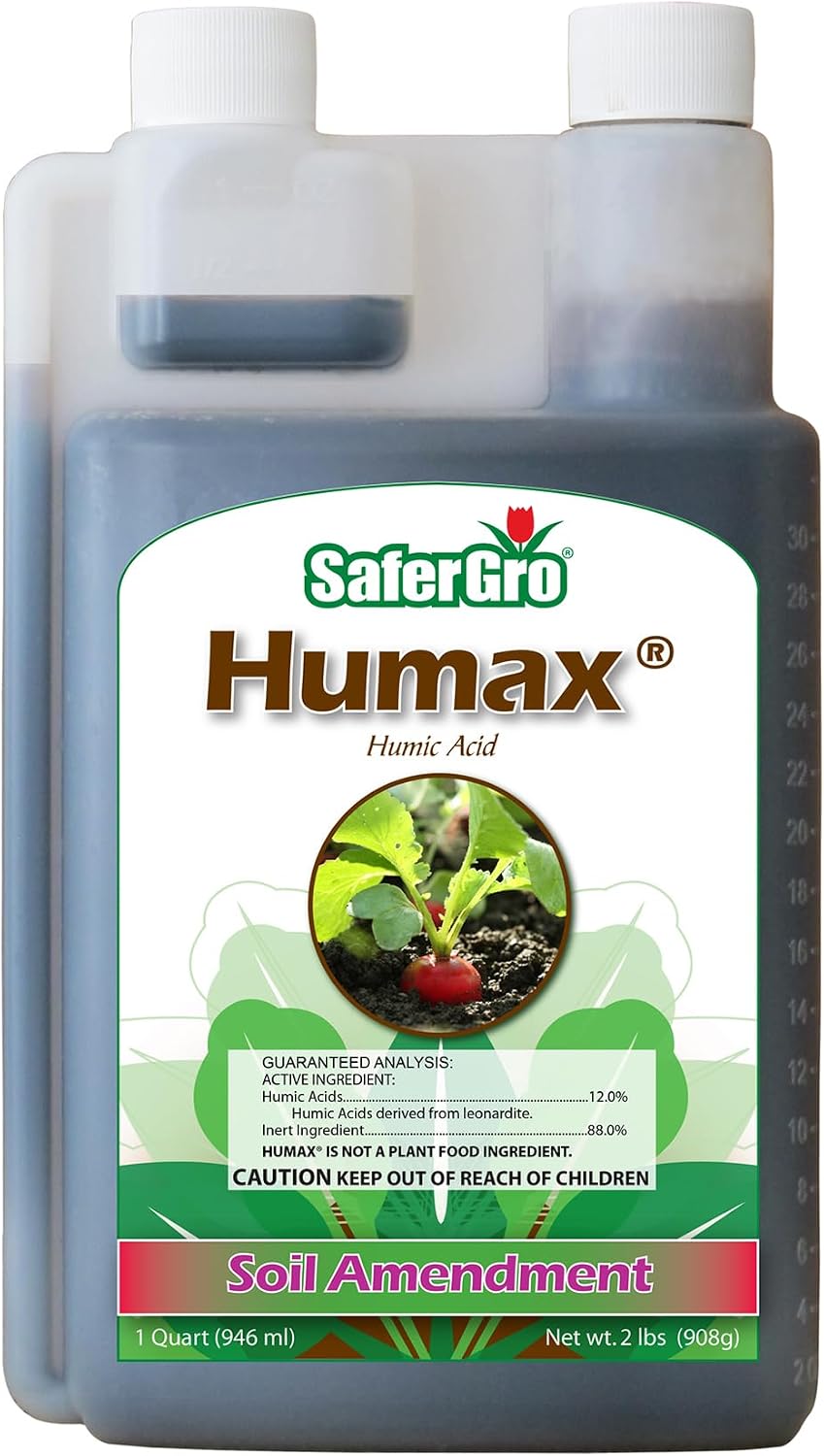
Safer Gro Humax Liquid Humic Acid, Pint
| Item Form | Liquid |
|---|---|
| Specific Uses For Product | Agriculture,Plant Growth |
| Application Method | Mix with water and spray or pour over soil area |
| Coverage | Medium |
| Target Species | Plants |
Safer Gro Humax is a concentrated liquid humic acid intended to be mixed with water and applied as a soil drench or spray to improve nutrient uptake and soil water-holding capacity. It is typically used by gardeners and growers who want to boost plant vigor, improve drought resilience, and make existing fertilizers more effective. Notable features include its leonardite-derived humic acids and a liquid form that dissolves easily for foliar or soil applications. In practice it can help plants take up nutrients more efficiently and make soils feel less prone to drying between waterings. Practical benefits are straightforward: easier mixing than solids, flexible application methods, and a product that complements other fertilizer programs. Limitations to consider are that it is a supplemental soil amendment rather than a complete fertilizer and specific mixing ratios are on the packaging so users must follow directions for safe application. Because effects depend on existing soil conditions you may see more benefit in depleted or sandy soils than in already fertile, well-structured soils.
Best for: Buyers who prioritize consistent, dependable soil amendments to boost nutrient uptake and improve moisture retention in their garden beds or containers.
Less Ideal for: People seeking an all-in-one fertilizer or immediate large nutrient corrections should look for balanced fertilizer blends instead.
- Concentrated liquid form mixes easily for soil drench or foliar use
- Derived from leonardite to increase nutrient availability and uptake
- Helps improve soil water-holding capacity for better drought resistance
- Compatible with standard fertilizer programs as a supplemental amendment
- Not a complete fertilizer so additional nutrients are required
- Effectiveness varies with existing soil health and may be limited in already fertile soils
Verdict: Choose this liquid humic acid if you want a reliable soil amendment that improves nutrient uptake and helps soils retain moisture.
Farmer's Secret Soil Revitalizer Organic Liquid Compost (32 oz)

| Item Form | Liquid |
|---|---|
| Specific Uses For Product | Organic |
| Application Method | spray/pour |
| Coverage | 32,000 square feet |
| Mixing Ratio | 1:128 |
Farmer's Secret Soil Revitalizer is a concentrated liquid amendment that uses activated humics to improve soil structure, stimulate microbial activity, and make nutrients more available to plants. It is mixed at 1 ounce per gallon of water and can be applied with a watering can, sprayer, irrigation system, or as a foliar feed for houseplants. For clay soils the product's humic-rich formula helps loosen compacted particles over time and supports biological activity that improves drainage and root penetration. It is OMRI listed and made from organic sources, so it is suitable for edible gardens and safe around children and pets when used as directed. The effects are gradual rather than immediate because it works by rebuilding soil biology rather than supplying fast-release NPK, so gardeners should expect cumulative improvement after several applications every 2 to 4 weeks. Coverage claims are high for the bottle size, so plan dosing carefully if treating a large lawn or landscape.
Best for: Gardeners who want a low-risk, soil-first approach to improve compacted or nutrient-poor soils and are willing to use a repeat feeding schedule to build long-term soil health.
Less Ideal for: People seeking rapid green-up or instant high-amount nutrient feeds for heavy-feeding annuals or lawns should consider a supplemental synthetic fertilizer instead.
- OMRI listed organic formula safe for edible gardens when diluted as directed
- Activated humics increase microbial activity and long-term soil structure improvement
- Versatile application options: watering can, sprayer, hose-end or irrigation
- Concentrated mixing ratio (1:128) stretches one bottle over many applications
- Not a fast-acting synthetic fertilizer so visible results take multiple applications
- Coverage per bottle may be optimistic for large yards, requiring multiple bottles for whole-lawn use
Verdict: Use this organic, humic-rich liquid if you want to rebuild clay soil biology and structure over time rather than chase quick fertilizer results.
GS Plant Foods Humic Acid Liquid Soil Amendment (32 oz)

| Form | Liquid concentrate |
|---|---|
| Source | Leonardite-derived |
| Organic certification | OMRI Listed |
GS Plant Foods Humic Acid is a leonardite-derived liquid concentrate meant to condition soil and make existing nutrients more accessible to plant roots. It is typically mixed into irrigation water or applied as a soil drench alongside regular fertilization to boost cation exchange capacity and support a healthier root zone. Notable features include its OMRI listing for organic use and a formulation intended to work with most fertilizer programs, so you can add it to vegetable beds, ornamentals, lawns, potted plants, and greenhouse crops without changing your routine. In practice it gives soils more buffering and can improve nutrient uptake over time rather than delivering an immediate nutrient spike. Limitations to be aware of are the need to avoid mixing with very low pH or high-calcium products and that benefits accumulate with repeated use rather than providing instant greening or growth spurts.
Best for: Buyers who prioritize predictable, organic-friendly soil improvement and want a supplement that integrates into existing feeding routines to slowly improve nutrient availability and root health.
Less Ideal for: Gardeners seeking an immediate, high-nitrogen feed or quick visual results should choose a conventional fertilizer designed for rapid greening instead.
- OMRI listed and suitable for certified organic growing programs
- Derived from leonardite, supplying naturally occurring humic substances for long-term soil conditioning
- Compatible with most fertilizer and soil programs when not mixed with low-pH or high-calcium products
- Liquid concentrate is easy to mix into irrigation or apply as a soil drench
- Effects are gradual and require repeated applications to notice significant soil or plant changes
- Must avoid mixing with low-pH or high-calcium formulations which limits some combination uses
Verdict: Choose this OMRI-listed leonardite humic acid if you want a reliable organic-compatible liquid to gradually improve soil structure and nutrient availability.
Choosing the Right Humic Acid Fertilizer: Key Factors to Consider
Humic and Fulvic Concentration
The proportion of humic and fulvic acids determines how much active material you actually apply per dose. Higher concentration means smaller application volumes to achieve the same effect, which is important in container growing where overwatering or overapplication is a risk.
Concentration also affects cost-efficiency and how the product interacts with other nutrients. Low-concentration carriers deliver noticeable effects only with larger volumes, which can change application frequency and logistics for gardeners who prefer foliar sprays or fertigation.
Formulation and Carrier Type
Humic products come as dry powders, granules, liquid concentrates, or soluble powders. Liquid concentrates are convenient for foliar sprays and quick soil drenches, while soluble powders and granules can be easier to store and measure for soil incorporation.
The carrier affects shelf life and compatibility with other inputs. For example, some carriers contain salts or surfactants that interact poorly with delicate seedlings or with certain fertilizers. Consider whether you need a sterile, low-salt carrier for seedlings or a robust concentrate for established beds.
Application Methods and Compatibility
Different humic acid fertilizers are designed for foliar feeding, soil drenching, mixing with fertilizer solutions, or banding into soil. If you rely on fertigation or have a drip system, ensure the product dissolves cleanly and will not clog emitters.
Compatibility with common fertilizers, soil amendments, and pesticides matters. Products with clear mixing charts and pH guidance reduce the risk of precipitation, nutrient lockup, or phytotoxicity when combined with other garden inputs.
Soil Type and Existing Organic Matter
Humic substances behave differently in sandy, loamy, or clay soils. In sandy soils they improve water retention and nutrient-holding capacity; in heavy clays they can help improve structure and nutrient availability. The amount of existing organic matter also influences how much additional humic material is useful.
Gardeners with high organic matter may prefer lower application rates, while those working with mineral or inert mixes should choose a product with a higher active humic fraction to achieve measurable benefit without excessive application volumes.
Labeling and Dosage Clarity
Clear labels that state humic and fulvic percentages, recommended dilution rates for various uses, and safety instructions make a product usable for most gardeners. Vague or missing dosage guidance forces guesswork and can lead to under- or over-application.
Labels that include mixing charts for container sizes, fertigation rates, and foliar spray concentrations reduce user error and make it easier to integrate the product into existing feeding schedules.
Environmental and Safety Considerations
Consider the source of the humic material and any additives. Natural sources vary, and some products include additives that enhance solubility but could affect soil life or beneficial microbes. Choose products with minimal harmful additives if you prioritize soil biology.
Also inspect safety guidance for application near water features or edible crops. Products with clear safe-use instructions reduce environmental risk and help you avoid unintended runoff or plant injury.
How Humic Acids Work In The Garden
Humic substances are complex organic molecules that interact with soil minerals, nutrients, and plant roots. They do not act like traditional N-P-K fertilizers. Instead, they improve nutrient availability by chelating micronutrients, buffering pH swings in the root zone, and enhancing root membrane function to support uptake.
Over time, regular use can change soil structure, increase cation exchange capacity in lighter soils, and help retain moisture. In containers, a well-formulated humic product can reduce leaching and help plants access nutrients between feedings.
- Enhances nutrient availability rather than supplying large amounts of NPK
- Improves root vigor and fine root development
- Can increase water retention in sandy mixes and improve structure in clays
Application Strategies for Different Garden Setups
Match the application method to your system. Foliar sprays can be useful for quick uptake and minor corrections, while soil drenches and incorporation are better for long-term soil conditioning. For drip irrigation, use only fully soluble concentrates and follow dilution instructions to avoid clogs.
For containers and raised beds, smaller, more frequent applications reduce the risk of salts building up. For in-ground beds, periodic soil drenches during the growing season are often sufficient to maintain benefits.
- Containers: diluted drench or light foliar applications
- Raised beds: incorporate at planting and follow with periodic drenches
- Lawns and large beds: use soluble concentrates through irrigation for even coverage
Mixing With Fertilizers and Soil Amendments
Many gardeners mix humic acid products with regular fertilizer solutions. Do a small jar test before large-scale mixing to check for precipitation or cloudiness. Avoid combining with products that have extreme pH or high salt content unless the label confirms compatibility.
If you use organic composts and teas, humic products can complement those practices by stabilizing nutrients and supporting microbial activity. Adjust fertilizer rates if humic amendments increase nutrient availability to avoid overfeeding.
- Perform a compatibility test when mixing with concentrated fertilizers
- Adjust feeding schedules if nutrient uptake improves after humic use
- Avoid mixing with unknown proprietary blends without label guidance
Timing And Frequency For Best Results
For establishing transplants and seedlings, use low-concentration applications to support root initiation without stressing young roots. For established plants, applications every 4 to 8 weeks during the growing season are common, but follow label recommendations for concentration and volume.
Long-term soil conditioning benefits accumulate over multiple seasons. Consistent, moderate use is usually more effective than occasional heavy applications, which can cause imbalances in container media or localized salt buildup.
- Seedlings: very low concentration, infrequent
- Established ornamentals and vegetables: regular diluted drench every 4 to 8 weeks
- Perennials and shrubs: seasonal soil drench during active root growth
Signs A Humic Product Is Working
Look for stronger root growth, steadier growth between fertilizer feedings, and improved plant turgor during dry periods. In crops, you may notice better fruit set or more even maturation when nutrient uptake is improved.
Soil indicators include improved crumb structure in heavy soils, better moisture retention in sandy mixes, and reduced visible nutrient deficiency symptoms when used alongside appropriate fertilizers.
- Denser fine roots on inspection
- Reduced yellowing from micronutrient deficiencies
- More even growth and improved drought tolerance
How We Chose the Best Humic Acid Fertilizer
We selected products that deliver usable concentrations of humic substances and include clear application guidance for home and small-scale garden use. Key evaluation criteria covered humic concentration or effective humate content, product formulation and carrier type, application versatility across foliar, drench, and soil incorporation, and clarity of dosing instructions. We also considered ingredient transparency and safety information, because gardeners need to know concentration and any inert carriers that affect mixing and compatibility with fertilizers and pesticides. Ease of use was measured by how simple it is to measure, dilute, and apply the product in typical garden settings like containers, raised beds, and in-ground beds. Products lacking clear labeling on humic or fulvic content, or those with unverifiable application guidance, were excluded. We did not include specialty industrial amendments intended only for large-scale commercial use. The resulting shortlist emphasizes practical performance metrics that matter to backyard gardeners and small growers.
FAQ
Can I use humic acid fertilizer on seedlings?
Often yes, but use much lower concentrations for seedlings than for established plants. Young roots are sensitive, so dilute according to the lowest recommended rate and apply less frequently until the plants are established.
How soon will I see results after applying a humic product?
It depends. Foliar or drench applications can produce visible improvements in vigor within weeks, while changes to soil structure and long-term nutrient retention may take months of regular use to become apparent.
Are humic products safe for edible crops?
Usually yes when used as directed. Choose products with clear labeling for use on food crops and follow pre-harvest guidance. Rinse edible harvests as a general precaution if you applied a foliar spray shortly before harvest.
Will humic acid replace my regular fertilizer?
No. Humic substances improve nutrient availability and root function but do not supply the primary macronutrients in the quantities plants need. Continue a balanced feeding schedule and use humic products as a complementary amendment.
Can I combine humic acid with my irrigation system?
Yes for many soluble concentrates, but only if the product dissolves cleanly and the label confirms compatibility with drip emitters. Use recommended dilutions and flush lines after application to prevent buildup.
Final Verdict
When choosing a humic acid fertilizer, prioritize clear labeling on humic and fulvic content, a formulation that fits your application method, and compatibility with your soil type or container mix. Consider concentration and carrier to avoid overapplication in small containers and to ensure clean mixing for fertigation. Focus on gradual, consistent use rather than one-off heavy treatments. That approach delivers steady root and soil improvements while minimizing risks to seedlings, irrigation systems, and soil biology, allowing you to choose the product that best fits your garden routine.
