

Note: This article contains affiliate links. If you click on these links and make a purchase, I may earn a small commission at no extra cost to you. This helps support my research and content. Read my full affiliate disclosure here.
When you plant or nurse a tree back to health, the fertilizer you apply to the root zone determines how quickly roots develop and how well the tree withstands stress. The right root fertilizer for trees supplies the nutrients trees need where they use them most, encourages feeder root growth and improves establishment after planting or transplanting. This guide shortlists six top options suited to tree planting, recovery and long-term root development. We evaluate each choice for nutrient balance, how it is applied, and how it performs in real garden and landscape conditions to help you pick the best fit for your site and skill level.
Top Picks at a Glance
| Best Quality Built to a higher standard if you want something more solid | MitoGrow It's Not Dead Yet Tree & Shrub Biostimulant Powder |  |
| Best Value The sweet spot between price and what you get | Ross Root Feeder Fertilizer Refills for Trees and Shrubs, 36 Count |  |
| Best Budget The cheapest option that still gets the job done reliably | Bonide Root & Grow Concentrate 32 oz |  |
| Highest Rated A top-rated pick with lots of positive feedback | Xtreme Gardening Mykos Granular Mycorrhizal Inoculant (2.2 lb) |  |
| Most Popular A crowd favorite that many people choose with confidence | Miracle-Gro Tree & Shrub Plant Food Spikes, 12 Spikes |  |
| Best Seller A high-volume bestseller chosen again and again | BioAdvanced 12-Month Tree & Shrub Protect and Feed Granules, 4 lb |  |
MitoGrow It's Not Dead Yet Tree & Shrub Biostimulant Powder

| Item Form | Granules, Powder |
|---|---|
| Specific Uses For Product | Growth Recovery, Plant Establishment, Planting, Stress Reduction, Transplanting |
| Target Species | Trees, Shrubs |
| Mixing Ratio | 2 tablespoons per gallon |
MitoGrow It’s Not Dead Yet Tree & Shrub is a powdered biostimulant intended to support root development and stress recovery for woody plants. Mixed at 2 tablespoons per gallon, it is typically applied as a root drench or watering supplement to newly planted trees, transplants, or declining established specimens. The formula combines 2.5% indole-3-butyric acid, B vitamins, beneficial Bacillus bacteria and a diverse blend of endo- and ectomycorrhizal fungi, so it promotes rooting, improves nutrient uptake, and helps plants tolerate transplant shock and environmental stress. Because it is a 0-0-0 NPK product, it complements rather than replaces fertilizer, making it useful alongside your regular feeding schedule. Practical benefits include faster establishment, stronger root systems, and year-round use. Important limitations are that results can take 1 to 4 weeks depending on plant size and it is not a standalone fertilizer, so expect to continue standard nutrient programs for significant top growth and leaf development.
Best for: Buyers who prioritize rapid root establishment and stress recovery for trees and shrubs and who plan to use the product alongside a regular fertilizer program.
Less Ideal for: Gardeners seeking an all-in-one fertilizer that supplies nitrogen, phosphorus, and potassium or those who want immediate visible topgrowth responses without continuing standard fertilization.
- Targets root development with 2.5% IBA to speed rooting and establishment
- Includes beneficial microbes and a broad mix of endo- and ectomycorrhizal fungi to improve long-term nutrient uptake
- Contains B vitamins and Bacillus to support stress recovery and microbial health in the root zone
- Simple mixing ratio (2 tablespoons per gallon) for use as a root drench or watering supplement
- No NPK nutrients so it will not replace fertilizer for aboveground growth
- Visible improvement can take several weeks and varies with tree size
Verdict: Use this biostimulant when your priority is faster, stronger root establishment and improved recovery for trees and shrubs rather than immediate foliar feeding.
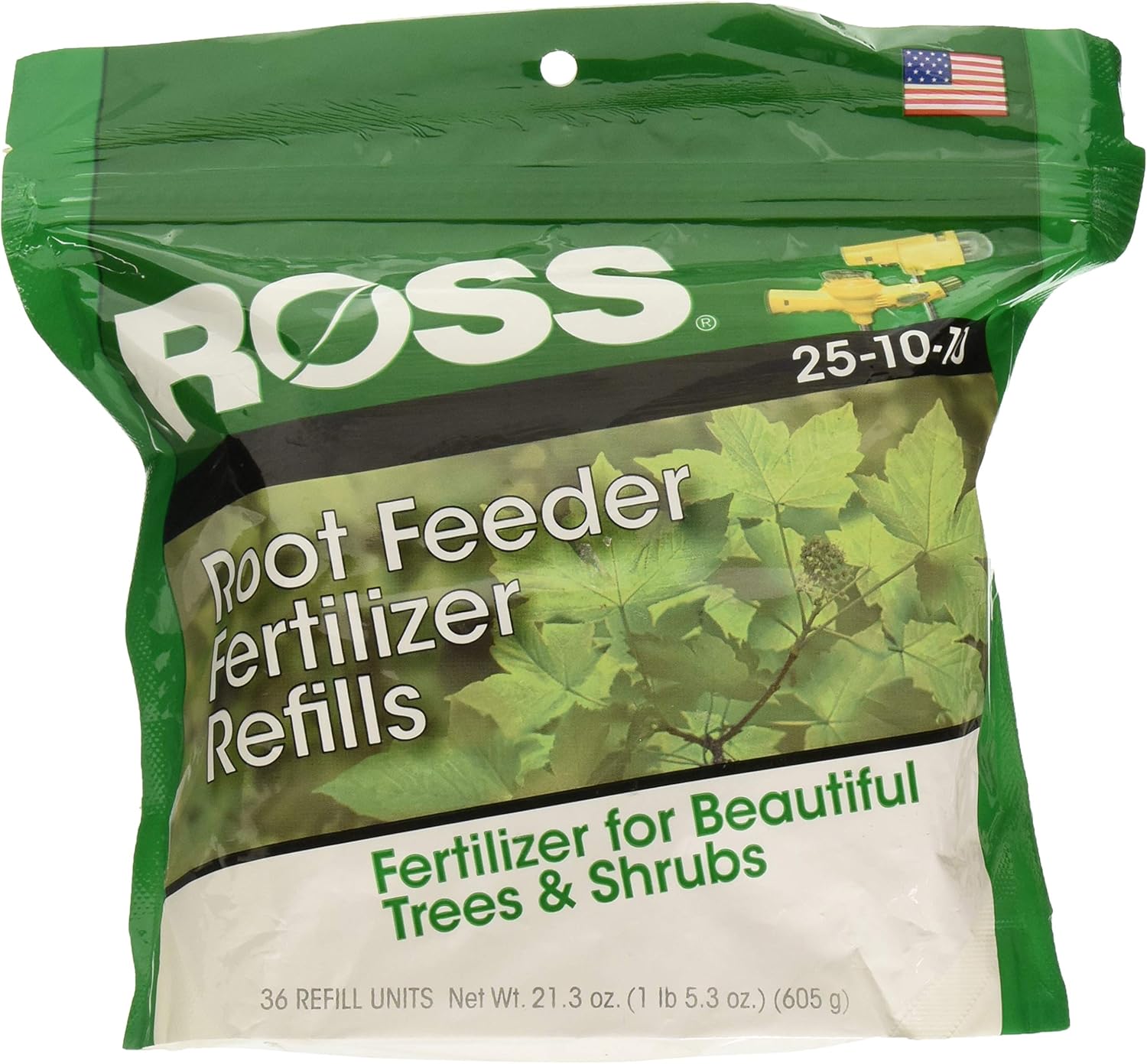
Ross Root Feeder Fertilizer Refills for Trees and Shrubs, 36 Count
| Item Form | Granules |
|---|---|
| Application Method | Watering |
| Specific Uses For Product | At The Roots |
| Target Species | Shade trees, shrubs, and various types of grass |
| Unit Count | 36 Count |
These Ross Root Feeder refills are premeasured granular packets designed to fit a root feeder and dissolve as you water, delivering a high-nitrogen 25-10-10 formula directly to tree and shrub root zones. Typical use is straightforward: insert the refill into the Ross feeder, connect to a water source, position at the base of the plant, and water to distribute nutrients without mixing or measuring. The main practical benefits are convenience and targeted feeding for deciduous trees and shrubs, which helps reduce surface runoff and ensures nutrients reach feeder roots. The refills come in a 36-count pack, so you can treat multiple trees or repeat applications through the growing season. Limitations are that these are single-use refill packets that require the Ross feeder hardware to apply them as intended and the formula is geared toward higher nitrogen needs so it may not suit all species or soil conditions without soil testing first.
Best for: Gardeners who want a low-effort, repeatable way to feed shade trees and shrubs and prefer targeted root-zone delivery over broadcast fertilizing.
Less Ideal for: People who do not own a root feeder or who need a tailored nutrient program based on soil test results and specific plant nutritional needs.
- Premeasured packets eliminate mixing and measuring for fast, tidy applications
- High-nitrogen 25-10-10 formula targets leafy growth for deciduous trees and shrubs
- Delivers nutrients directly to the root zone when used with a root feeder, reducing surface waste
- 36-count pack provides enough refills for multiple trees or repeat seasonal applications
- Requires the Ross root feeder device to apply as intended
- Single-use packets limit flexibility in adjusting nutrient rates for different plants
Verdict: If you already use a root feeder and want a simple, no-mess way to feed trees and shrubs, these premeasured refills make targeted seasonal feeding fast and reliable.
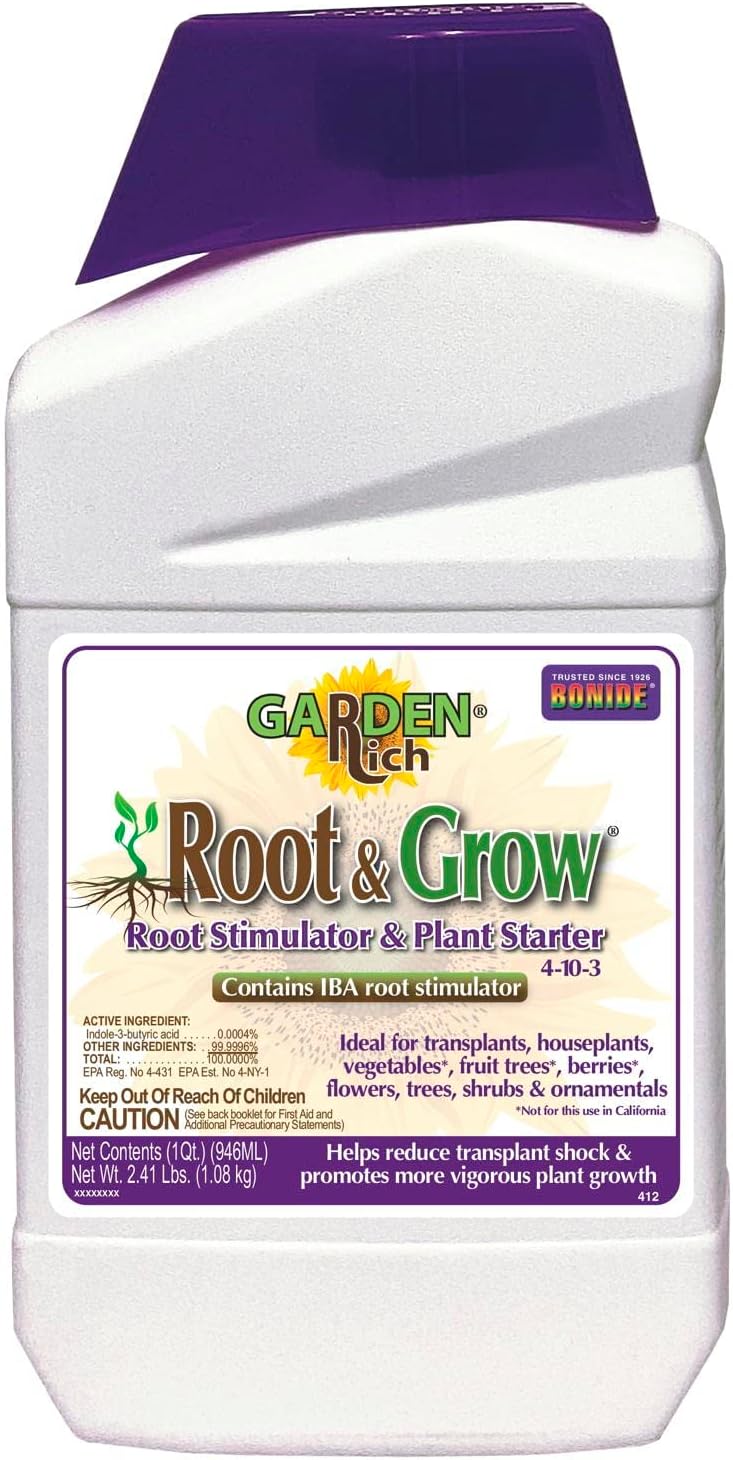
Bonide Root & Grow Concentrate 32 oz
| Item Form | Liquid |
|---|---|
| Specific Uses For Product | Root Development |
| Application Method | Pouring directly onto the soil and roots |
| Target Species | fruit, vegetables, flowers, trees, and bedding plants |
| Mixing Ratio | 4:10:3 |
Bonide Root & Grow is a liquid concentrate designed for use when seeding or transplanting to speed early root formation and help plants establish. You dilute the concentrate per label instructions and pour the solution onto soil and roots when potting seedlings, transplanting plugs, or setting out young vegetables and ornamentals. Notable features include an active IBA rooting hormone and a 4-10-3 nutrient ratio that supplies extra phosphorus to support root growth. In practice it can reduce transplant shock and promote quicker, stronger root systems, which is useful for both container-grown seedlings and recently set out bedding plants. Because it is a concentrate, a single 32 oz bottle yields multiple applications, which stretches a limited budget. Important limitations are that it is a specialized root stimulator rather than an all-purpose feed for ongoing growth and it requires careful dilution and label compliance to avoid overapplication.
Best for: Buyers wanting an affordable, concentrated product to give seedlings and recent transplants a stronger start and who prioritize preventing transplant shock over routine feeding.
Less Ideal for: Gardeners looking for a general weekly fertilizer or a balanced feed for mature plants should choose a different product.
- Contains IBA rooting hormone to stimulate root initiation
- 4-10-3 fertilizer ratio provides extra phosphorus for root development
- Concentrated 32 oz bottle yields many applications, good for tight budgets
- Easy to apply by diluting and pouring directly onto soil and roots
- Formulated mainly for root stimulation so not ideal as a regular all-purpose feed
- Requires careful mixing and label reading to use safely and effectively
Verdict: A budget-friendly concentrated root stimulator that helps seedlings and transplants establish faster by combining IBA with a phosphorus‑rich fertilizer.
Xtreme Gardening Mykos Granular Mycorrhizal Inoculant (2.2 lb)

| Item Form | Granules |
|---|---|
| Coverage | 4 cubic feet |
| Specific Uses For Product | Gardening,Growth |
| Target Species | Pumpkin |
Xtreme Gardening Mykos is a granular mycorrhizal root inoculant designed to colonize plant roots and expand their effective uptake zone. Typical use is to work the granules into planting holes, mix into potting media or apply around established root zones following the package directions. The product is OMRI listed and formulated to increase access to water and nutrients, which can help trees and other plants establish faster and maintain stronger root systems. Notable features include a granular form that promotes close root contact, coverage rated for about 4 cubic feet of soil per container, and specific dosing instructions for starts, transplants and established plants. Practical benefits for tree planting are improved early establishment and potentially better drought resilience as roots explore a larger volume of soil. Limitations are that results depend on existing soil biology and cultural care and that the inoculant works best when applied at planting or near active root growth rather than as a quick fix for a stressed mature tree.
Best for: Gardeners and landscapers who prioritize reliable, organic root support when planting or transplanting trees and want a product they can apply at planting to improve early root establishment.
Less Ideal for: People seeking an immediate, observable fix for ailing mature trees or those who prefer liquid inoculants or foliar treatments for quick application.
- OMRI listed organic formula suitable for organic gardening
- Granular form makes it easy to apply to planting holes, potting mixes, or around established roots
- Claims coverage of about 4 cubic feet per pound for soil amendment
- Clear dosing guidance for cuttings, transplants and established plants
- Effectiveness depends on soil conditions and existing microbial community
- Not a rapid remedy for already-stressed mature trees
Verdict: A dependable OMRI-listed granular mycorrhizal inoculant to boost root establishment when planting or transplanting trees.
Miracle-Gro Tree & Shrub Plant Food Spikes, 12 Spikes

| NPK | 15-5-10 |
|---|---|
| Coverage | 12 spikes per season |
| Target Species | trees, shrubs, evergreens and acid-loving plants |
| Application Method | Place spikes around the tree's drip line |
These Miracle-Gro Tree & Shrub Plant Food Spikes are pre-measured sticks that deliver slow-release nutrition directly to the root zone of trees and shrubs. They are typically used by watering the soil around the drip line, spacing spikes around the drip line at least 3 feet apart, and driving them into the ground so they sit below the soil surface. The 15-5-10 NPK mix supplies a higher proportion of nitrogen for foliage with phosphorus and potassium to support root and overall plant health, and the package contains 12 spikes intended for seasonal feedings. Practical benefits include simple, low-effort applications for established cherry trees where precise granular spreading is inconvenient, and the spikes help localize nutrients to the root zone rather than blanket-feeding the whole bed. Limitations are that they are designed for early spring and mid-fall use only, so they do not replace a tailored feeding schedule for trees needing summer supplements, and they require firm soil for insertion which can be difficult in very compacted or rocky sites. The product is best as an easy seasonal maintenance feed rather than an intensive corrective treatment.
Best for: Gardeners who want a low-effort, dependable seasonal feed for established flowering trees and shrubs and prefer an application that targets the root zone without granular spreading.
Less Ideal for: People needing aggressive summer corrections, quick nutrient fixes, or those working on newly planted trees that require a different feeding routine.
- Slow-release formula delivers nutrients directly to the root zone
- Pre-measured spikes make application simple and low-mess
- NPK 15-5-10 supports foliage color and overall tree vigor
- Includes 12 spikes, enough for multiple small trees or one larger drip line
- Intended for two seasonal applications only and not for summer feeding needs
- Can be hard to install in very rocky or compacted soils
Verdict: A simple, targeted seasonal feeding option that makes it easy to maintain vibrant foliage on established flowering trees with minimal effort.
BioAdvanced 12-Month Tree & Shrub Protect and Feed Granules, 4 lb

| Item Form | Granules |
|---|---|
| Target Species | Aphids, Leafminers, Japanese Beetles, Scale |
| Special Features | organic |
| Unit Count | 64 Ounce |
This granular Protect and Feed product combines year-long systemic insect control with slow-release nitrogen feeding in a single, easy-to-apply formula. It is designed for use around trees, shrubs and container plants: measure with the built-in cup, sprinkle the granules around the root zone and water them in. The active ingredient (imidacloprid 1.1%) targets sap-sucking and chewing pests named on the label such as aphids, leafminers, scale and Japanese beetles and helps prevent reinfestation for up to 12 months after one application. The slow-release fertilizer portion moves through the roots to support season-long growth, which is useful for maintaining foliage density and vigor in ornamental hedges like ligustrum. Important limitations are state restrictions on sale in several states and the need to follow safety directions when handling a systemic insecticide; it is not a contact spray so pests must feed on treated plants to be affected. For gardeners who want a low-effort, combined insect and fertilizer treatment once a year, this product simplifies maintenance but requires careful adherence to label instructions.
Best for: Gardeners who want a low-effort, once-a-year treatment that protects ornamental shrubs from sap-feeding and chewing insects while supplying steady nutrition. Ideal for homeowners maintaining hedges and landscape shrubs who prefer a simple granular application over repeated sprays.
Less Ideal for: Organic gardeners seeking strictly organic-certified inputs or anyone growing plants in states where this product is not sold should avoid this product.
- Provides up to 12 months of systemic protection with a single application
- Combined slow-release fertilizer supports season-long plant vigor
- Granular format requires no spraying or mixing and includes a measuring cup
- Labels listed target pests common on ornamental shrubs such as aphids and Japanese beetles
- Contains the systemic insecticide imidacloprid which requires careful handling and is restricted in several states
- Effectiveness depends on pests feeding on the plant rather than direct contact
Verdict: A single annual granular application delivers long-lasting insect protection and steady feeding for ornamental shrubs with minimal effort.
Choosing the Right Root Fertilizer for Trees: Key Factors to Consider
Nutrient Balance and Ratios
Tree roots need nutrients that encourage root growth rather than excessive top growth. Look for formulations with moderate nitrogen combined with higher phosphorus and sufficient potassium when establishing roots. Micronutrients such as iron, manganese and zinc support root function and early-season growth.
Excessive nitrogen can push leafy growth at the expense of roots and increase transplant shock. Slow-release or low-solubility phosphorus sources are often preferable because they provide a steady supply near the root zone rather than a quick spike that can tie up in some soils.
Formulation and Delivery Method
Root fertilizers come as granules, spikes, liquids, and water-soluble concentrates. Granules are easy to apply at planting and can be worked into the backfill. Spikes concentrate nutrients where they are driven into the root zone, which simplifies placement but may not reach widely distributed feeder roots for larger trees.
Liquids and water-soluble products can be mixed and applied with a watering can or hose-end injector to thoroughly wet the root zone. Consider whether you need a spread-and-wait solution or a product that can be applied with irrigation to reach roots throughout the rootball and surrounding soil.
Release Rate and Timing
The release profile affects how roots respond. Fast-release fertilizers give a quick nutrient boost but can burn roots if overapplied and may lead to shallow, rapid shoot growth. Slow-release formulas supply nutrients over weeks to months, supporting steady root expansion and reducing reapplication frequency.
Match the release rate to the planting or recovery scenario. Newly planted trees often benefit from a controlled-release approach that supports the slow process of root establishment. Trees recovering from stress may need a gentler, low-salt option applied over several feedings.
Soil Type and pH Interaction
Soil texture and pH determine nutrient availability and fertilizer behavior. Sandy soils leach soluble nutrients quickly, so a slow-release or split-application strategy helps maintain availability in the root zone. Clay soils hold nutrients but can lock some elements up if pH is unfavorable.
Test soil pH before choosing a fertilizer, because phosphorus availability declines in very acidic or alkaline soils. Some root fertilizers include amendments to buffer pH or supply chelated micronutrients that remain available across a wider pH range.
Application Safety and Root Health
Root fertilizers must be applied in ways that avoid direct contact with delicate roots at planting. High-salt or high-concentration products can cause root burn and dehydration. Follow label dilution rates and place granules or spikes at recommended distances from the trunk so feeder roots encounter nutrients without being damaged.
Also consider the risk of overapplication over multiple seasons. Using tools like a soil probe or measuring spread rates helps ensure even, safe distribution. When in doubt, err on the side of underfeeding and repeat applications rather than a single heavy dose.
Compatibility with Mulch and Soil Amendments
Mulch and organic amendments affect nutrient release and soil temperature, which changes how fertilizers behave. Thick mulch layers can slow water penetration and limit movement of soluble nutrients into the soil. Organic matter can improve nutrient retention and provide a steady background supply that complements a root fertilizer.
Plan fertilizer timing with mulch application. Apply root fertilizers to the soil surface or incorporate lightly into the backfill beneath the mulch so nutrients reach the root zone. Avoid mixing concentrated fertilizers directly into high proportions of organic amendment without following product guidance.
When to Fertilize Trees at the Root Zone
Timing makes a big difference. For newly planted trees, apply a root-focused fertilizer at planting or shortly after to encourage feeder root establishment, but avoid heavy applications that can stress young roots. Dormant season and early spring are common windows for targeted root feeding because uptake resumes as roots become active.
Some established trees benefit from root zone feeding when growth is slow, after a stress event such as drought or transplanting, or when soil tests show nutrient shortages. Avoid heavy root fertilization during peak summer heat when trees are under moisture stress.
- Apply at planting or in early active root growth periods
- Avoid heavy feeding during drought or heat stress
- Use repeat, lower-dose applications for recovery scenarios
Application Techniques for Effective Root Delivery
Place fertilizers where roots will encounter them. For planted trees, incorporate a measured amount into the backfill or place granules in a ring at the edge of the rootball. For existing trees, use a soil probe to place soluble fertilizers into the root zone or apply liquid mixes with deep watering to carry nutrients downward.
Careful placement reduces waste and increases uptake. When using spikes, space them evenly around the dripline but keep them away from the trunk flare. With liquid applications, water slowly and deeply so the solution moves into the active root soil layer rather than running off the surface.
- Incorporate small amounts into backfill at planting
- Use probes or deep watering for established trees
- Space spikes around the dripline, not against the trunk
Managing Fertilizer Around Newly Planted Trees
New plantings have concentrated root systems that need nearby nutrients without overexposure. Mix light, root-targeted fertilizers into the planting soil rather than creating a concentrated pocket that can dehydrate roots. Use controlled-release formulas to provide a steady supply while roots expand into surrounding soil.
Keep mulch a few inches away from the trunk to prevent fertilizer-mulch interactions that could concentrate salts near the stem. Monitor new trees for signs of overfertilization such as scorch or excessive shoot growth, and adjust subsequent applications accordingly.
- Avoid concentrated fertilizer pockets in the rootball
- Use controlled-release products for steady supply
- Maintain mulch gap at trunk to reduce salt concentration
Integrating Root Fertilizers Into Landscape Maintenance
For larger landscapes, combine periodic root fertilization with cultural practices that support root health: deep watering, aeration in compacted sites, and organic matter additions. Target feedings in spring or fall when roots are most active, and use soil tests to guide nutrient selection and avoid unnecessary applications.
Record applications and observe tree response over seasons. Regular, modest root feedings often outperform sporadic heavy doses because they sustain root activity without promoting imbalance between roots and canopy.
- Pair feeding with deep, infrequent irrigation
- Use soil tests to target missing nutrients
- Keep application records to track tree responses over time
How We Chose the Best Root Fertilizer for Trees
Our selection focused on products that specifically target the root zone and are appropriate for trees at planting, after transplanting or during recovery from stress. We prioritized formulations and delivery methods that promote feeder root growth, supply essential macro and micronutrients without causing fertilizer burn, and can be applied with typical garden tools or simple equipment. Evaluation criteria included nutrient composition and NPK ratios tuned for root development; formulation type and how reliably it delivers nutrients to roots; ease and safety of application for homeowners and landscape pros; and evidence of gentle, steady release or availability to roots. We also considered handling and storage, as well as compatibility with common soils and existing soil amendment practices. Excluded from the roundup were broad-purpose lawn fertilizers and products intended only for foliar feeding without root activity. Products that require specialized commercial equipment to apply or that carry high risk of root damage when misused were also filtered out. The resulting list emphasizes practical, tree-focused root fertilizers that work across common planting and recovery scenarios.
FAQ
How often should I apply root fertilizer to a newly planted tree?
Often a single measured application at planting followed by one or two light follow-up feedings during the first growing season is sufficient. Frequency depends on the product release rate and tree species; slow-release formulas reduce the need for repeated applications.
Can I use lawn fertilizer around tree roots?
Some lawn fertilizers are inappropriate because they are formulated for turf nutrient dynamics and may have high soluble nitrogen that favors top growth. If you consider a lawn product, check its NPK and release rate and apply only if it suits tree needs and root placement recommendations.
Will root fertilizer help a tree recovering from drought or transplant shock?
Root-targeted fertilizers can support recovery by supplying nutrients where uptake occurs, but they are only one part of recovery. Proper watering, mulching, and avoiding root disturbance are equally important. Use gentler, low-salt formulations and space applications to prevent additional stress.
Is it better to use spikes, granules, or liquid root fertilizers?
Each format has tradeoffs. Spikes simplify placement but may not reach the full feeder root network on larger specimens. Granules are versatile for planting and surface application. Liquids offer even distribution with irrigation and can be useful when you need quick availability without solid residues.
How deep should I place fertilizer in the root zone?
Place fertilizer where active feeder roots are concentrated, usually in the top 6 to 12 inches of soil for most trees. Use shallow probes or surface applications combined with watering for mature trees, and incorporate small doses into the backfill at planting for young trees.
Final Verdict
Focus on what the tree needs at its growth stage: encourage roots with balanced nutrients, gentle release profiles and placement that brings fertilizer into contact with feeder roots. Weigh formulation type, soil interactions and application safety when choosing a product. Prioritize steady, root-focused feeding over one-time heavy doses. With careful placement and timing you can speed establishment, reduce transplant stress and support long-term root health for trees in yards, orchards and landscapes.
