

Note: This article contains affiliate links. If you click on these links and make a purchase, I may earn a small commission at no extra cost to you. This helps support my research and content. Read my full affiliate disclosure here.
Getting fertilizer right for tomato seedlings changes how quickly they establish and how well they handle transplant shock. Young tomato plants need a different nutrient balance than mature vines. Too much salt or nitrogen in the first weeks can cause leggy growth or burned roots, while too little leaves seedlings weak and slow to develop. This guide covers five top-rated seedling fertilizers for tomatoes that suit common starting methods like cell trays, peat pots, and indoor grow lights. We shortlisted options that support root development, are easy to apply, and reduce the risk of overfeeding. The product list below is evaluated on nutrient profile, application ease, and seedling safety, so you can pick the best fit for your setup.
Top Picks at a Glance
| Best Overall The best all-around choice for most situations | Neptune's Harvest Tomato & Vegetable Organic Liquid Fertilizer (2-4-2), 36 oz |  |
| Best Quality Built to a higher standard if you want something more solid | FoxFarm Grow Big Liquid Plant Food, 6-4-4 Quart Concentrate |  |
| Best Value The sweet spot between price and what you get | Farmer's Secret Tomato Booster Liquid Fertilizer (8 oz) |  |
| Highest Rated A top-rated pick with lots of positive feedback | OFS Tomato Fertilizer 5-8-10 with 15% Calcium and Sulfur, 1.92 lb |  |
| Best Seller A high-volume bestseller chosen again and again | Burpee Organic Tomato & Vegetable Granular Plant Food, 4 lb |  |
Neptune's Harvest Tomato & Vegetable Organic Liquid Fertilizer (2-4-2), 36 oz

| Item Form | Liquid |
|---|---|
| Specific Uses For Product | Plant Growth, Vegetable Development, Houseplant Care |
| Application Method | Liquid |
| Coverage | Medium |
| Mixing Ratio | 2-4-2 |
Neptune's Harvest Tomato & Vegetable fertilizer is a fish and seaweed based liquid plant food designed for the vegetative stage of tomatoes and other vegetables. You mix the concentrate with water (manufacturer recommends about 1 oz per gallon for outdoor plants) and apply as a root drench or foliar feed every 1 to 2 weeks for garden plants or weekly for houseplants. The 2-4-2 NPK and added calcium, molasses, humates, yucca extract, and biological microbes support leafy growth, root development, and soil biology rather than just a short burst of nitrogen. In practice it helps produce fuller foliage and can improve fruit set and quality when used consistently through the season. Because it is organic and low in salt it is forgiving of slightly overenthusiastic feeding, but the nutrient concentrations are lower than synthetic bloom boosters so expect slower, steadier gains rather than immediate big pushes in flowering or fruiting. Best used by gardeners focused on steady yield improvement and soil health rather than rapid, high-N fertilization programs.
Best for: Potted-tomato growers who prioritize reliable plant health, steady yield increases, and improved soil biology over rapid chemical forcing. Ideal for gardeners who prefer organic inputs and regular, measured feedings.
Less Ideal for: Growers seeking very rapid, high-impact flowering or fruiting with synthetic-strength fertilizers or those who need an odor-free product for indoor use in tight spaces.
- Organic, fish-and-seaweed based formula that supports soil biology and root health
- Versatile application as both a root drench and foliar feed
- Includes secondary ingredients (calcium, molasses, humates, yucca extract) that aid overall plant vigor and stress resistance
- Concentrated 36 oz bottle provides many feedings for potted tomato plants when mixed to label rates
- Lower NPK intensity compared with synthetic bloom or fruit boosters, so results are steadier not immediate
- Strong natural odor from fish-based ingredients which some users may find unpleasant
Verdict: A dependable organic liquid fertilizer that builds healthier roots and steady yields for potted tomatoes while supporting long-term soil biology.
FoxFarm Grow Big Liquid Plant Food, 6-4-4 Quart Concentrate
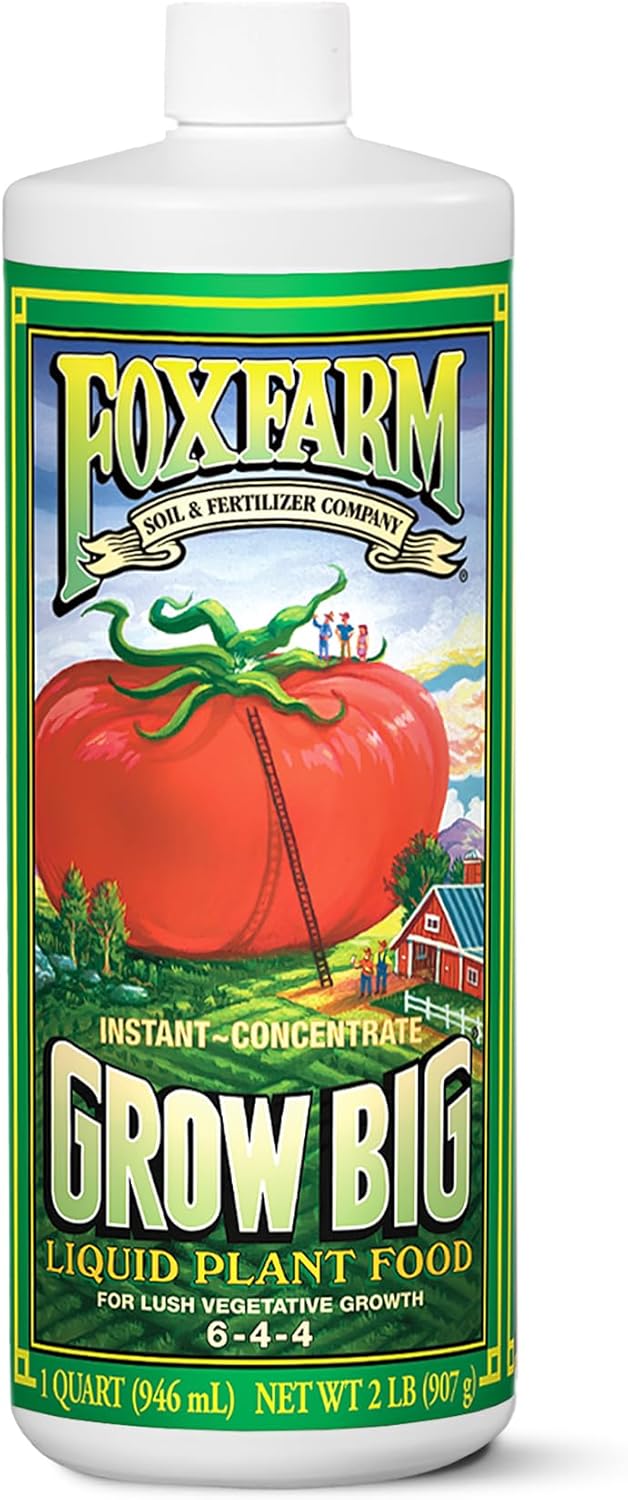
| N-P-K | 6-4-4 |
|---|---|
| Form | Liquid concentrate |
| Unit count | 32 Fluid Ounces |
| Mixing ratio | 2-3 teaspoons per gallon |
FoxFarm Grow Big is a water-soluble concentrate designed to boost vegetative growth and speed nutrient uptake in vegetable gardens and ornamentals. Mixed at 2 to 3 teaspoons per gallon, it can be applied through watering or foliar feeding to quickly deliver nitrogen-focused nutrition that supports larger plants and stronger stems. The low pH formula helps keep micronutrients stable so feedings remain effective, and the quart concentrate covers repeated applications for a small plot or a set of containers. Practical benefits include clear mixing instructions, versatility for both indoor and outdoor use, and a fast-acting effect when plants need a growth push. Limitations to note are the higher nitrogen emphasis, which favors leaf and stem growth over bloom or fruit set, and the presence of phosphorus in the formula that may be restricted in some local lawn rules. For gardeners who prioritize consistent, predictable feedings, this product is straightforward to measure and integrate into a regular watering schedule.
Best for: Gardeners who want a reliable, easy-to-dose liquid fertilizer to encourage rapid vegetative growth in vegetable beds, containers, and established plants and who value predictable results from each feeding.
Less Ideal for: Growers focused primarily on maximizing flowering or fruit set who need a bloom-boosting formula or those working under strict phosphorus-use restrictions in their area.
- Concentrated liquid formula for fast nutrient uptake and quick visible response
- Low pH formulation helps maintain micronutrient stability during storage and application
- Versatile application by watering or foliar feeding for indoor and outdoor use
- Clear mixing ratio (2–3 teaspoons per gallon) simplifies repeatable feedings
- Nutrient ratio (6-4-4) emphasizes vegetative growth rather than flowering or fruit production
- Contains phosphorus which may be restricted by local regulations for turf or non-agricultural use
Verdict: Choose this concentrate when you want a dependable, fast-acting liquid feed to promote vigorous leafy and structural growth in a vegetable garden.
Farmer's Secret Tomato Booster Liquid Fertilizer (8 oz)

| Item Form | Liquid |
|---|---|
| Specific Uses For Product | Tomato Plant Care |
| Target Species | Tomato |
| Mixing Ratio | 1:48 |
This concentrated tomato booster is designed to feed tomato plants throughout their life cycle with a formula developed by agronomists. It is supplied as an 8 oz liquid concentrate that you dilute (manufacturer directions: two teaspoons per gallon or mixing ratio 1:48) and apply weekly as a foliar spray or soil drench. The 3-8-7 N-P-K balance emphasizes phosphorus and potassium to support flowering and fruit development, and the label notes added humic acid, iron and calcium to help nutrient uptake and reduce common blossom-end issues. Because it is highly concentrated one small bottle produces many gallons of feed, which makes it convenient for someone managing a few seedlings up through established plants. Important limits: the product lists only primary ingredients without specific micronutrient concentrations, and safety guidance means you must measure carefully to avoid overfeeding sensitive seedlings. It is best used as part of a regular, measured feeding schedule rather than a one-time corrective treatment.
Best for: Gardeners who want an efficient, repeatable feeding plan for tomato seedlings and progressing plants and who prioritize measured, agronomist-developed formulations over ad hoc feeding.
Less Ideal for: Growers needing a complete guaranteed micronutrient analysis or those who prefer granular slow-release fertilizers for hands-off feeding.
- Super-concentrated formula yields many gallons from one 8 oz bottle
- N-P-K ratio (3-8-7) targets flowering and fruit set for tomatoes
- Includes humic acid plus iron and calcium to aid nutrient uptake and reduce common deficiencies
- Works as foliar spray or soil drench for flexible application
- No full breakdown of micronutrient concentrations is provided on the label
- Small bottle can lead to measurement errors if you do not use accurate measuring tools
Verdict: A small, super-concentrated liquid made to deliver targeted phosphorus and potassium support for tomatoes on a weekly feeding schedule.
OFS Tomato Fertilizer 5-8-10 with 15% Calcium and Sulfur, 1.92 lb

| NPK ratio | 5-8-10 |
|---|---|
| Calcium | 15% |
| Sulfur | 5% |
| Form | Granules |
| Package | 1.92 lb resealable bag |
This granular OFS tomato fertilizer is designed as an all-purpose feed from transplant through fruiting, combining a 5-8-10 NPK ratio with 15% calcium and 5% sulfur. You would apply it at transplanting and again every 6 to 8 weeks to encourage root establishment, stronger flowering, and fuller fruit set. The high calcium content helps reduce calcium-related disorders like blossom-end rot when used with consistent watering, while sulfur supports nutrient uptake and overall plant health. Packaged in a resealable, weather-tight 1.92 pound bag, it is convenient for small plots, container-grown seedlings, and home raised beds. As a single-application granular product it is simple to use but offers less fine control than a soluble seedling-specific starter fertilizer for very young or delicate transplants. Also the bag size suits hobby gardeners but may require multiple purchases for larger plantings.
Best for: Gardeners who prioritize consistent, reliable nutrition for tomato seedlings through to fruiting and want a simple granular product that reduces common calcium deficiencies.
Less Ideal for: Growers with large acreage or those who need a water-soluble starter fertilizer for very young transplants should consider alternative formats.
- Balanced 5-8-10 NPK tailored for tomato growth stages
- High calcium (15%) to help prevent blossom-end rot when watering is consistent
- Contains sulfur to support nutrient uptake and soil fertility
- Resealable weather-tight bag keeps granules dry between uses
- Not a soluble starter concentrate so less precise dosing for tiny seedlings
- Small 1.92 lb bag may be insufficient for larger gardens
Verdict: A dependable granular tomato fertilizer that supplies balanced NPK plus high calcium to support seedling establishment and reduce blossom-end rot risk.
Burpee Organic Tomato & Vegetable Granular Plant Food, 4 lb

| Item Form | Granules |
|---|---|
| Specific Uses For Product | Gardening,Plant Growth,Root Development |
| Application Method | Sprinkle |
| Coverage | 160 Square Feet |
| Mixing Ratio | 3-6-4 |
This Burpee organic granular plant food is an all-purpose, OMRI-listed fertilizer designed for vegetable gardens, containers, and seed starting. You apply it by sprinkling the granules around the base of plants and watering in; the formula provides an initial boost of nutrients and a slow release that the manufacturer says lasts up to three months. The product lists a 3-6-4 mixing ratio and a coverage of about 160 square feet for the 4 lb bag, making it easy to estimate how much to use across beds or several containers. Practical benefits include simple dry application with no measuring or mixing required for spot feeding, organic certification for gardeners who prefer low-chemical inputs, and a nutrient blend that supports root development and steady growth through the season. Limitations are the fixed bag size and coverage, which may require multiple bags for larger plots, and the granular form means you must distribute it evenly and water thoroughly to activate nutrients. For cautious gardeners wanting organic, low-effort feeding for vegetables, this is a straightforward option.
Best for: Practical home gardeners who prioritize organic, low-chemical inputs and want a simple, no-fuss fertilizer to feed tomatoes and other vegetables through the season.
Less Ideal for: Gardeners managing large-scale vegetable beds who need higher-volume or custom nutrient programs should consider bulk or concentrated alternatives.
- OMRI-listed organic formula suitable for organic vegetable production
- Granular form is easy to apply by sprinkling around plants with no mixing
- Provides both immediate nutrients and slow release feeding for up to three months
- Clear application method and coverage guidance simplify use for new gardeners
- 4 lb bag covers a limited area and may not be economical for large vegetable plots
- Granules require even distribution and consistent watering to be effective
Verdict: A simple OMRI-listed granular fertilizer that gives organic gardeners an easy, season-long feed for tomatoes and vegetables.
Choosing the Right Seedling Fertilizer for Tomatoes: Key Factors to Consider
Nutrient Ratio and Strength
Young tomato seedlings need a lower overall nutrient concentration than established plants and a balance that favors root development over immediate leaf bulk. Look for formulas with moderate nitrogen and adequate phosphorus to encourage strong roots, but avoid high-salt, high-nitrogen blends that push rapid top growth at the expense of sturdiness.
Concentration matters because many concentrated fertilizers for mature plants are too strong for seedlings even at the lowest labeled rate. Check recommended dilution ranges and choose products that allow very weak solutions so you can feed gently while roots are small.
Solubility and Application Method
How you apply fertilizer affects both effectiveness and convenience. Water-soluble fertilizers and liquid concentrates let you feed through a watering can or tray bottom soak, providing even uptake without disturbing delicate roots. Slow-release granules tend to be less predictable in small containers and can concentrate near roots, increasing burn risk.
Choose a formulation that matches your starting method. If you start seeds in dense flats or cells, a clear label on tray feeding or root drench rates makes routine care simpler and reduces mistakes during weekly feedings.
Salt Content and Burn Risk
Electrical conductivity and soluble salt levels determine how likely a fertilizer is to cause root burn when used at typical seedling rates. Seedlings have limited root mass and moisture buffering, so even modest salt buildup in small pots can cause leaf tip scorch or slowed growth.
Prefer products with low labeled salts or clear guidance for very dilute mixes. Organic or low-salt liquid formulas are often safer for frequent light feedings. Also consider how your potting mix drains and whether salts will accumulate in a small container over repeated waterings.
Micronutrients and Chelation
Tomato seedlings benefit from trace elements like iron, manganese, and zinc for steady, even leaf color and later vigor. Some inexpensive fertilizers omit chelated micronutrients, which can cause subtle deficiencies in soilless mixes or when pH is off.
When starting seedlings in sterile mixes, choose a fertilizer that includes a balanced micronutrient package or plan to supplement later. Chelated forms hold micronutrients available across a wider pH range, reducing the chance of deficiencies during the critical early weeks.
Compatibility with Seed Starting Media
Seed-starting mixes are typically low in nutrients and retain moisture differently than garden soil. The fertilizer you choose should be compatible with the water-holding and drainage characteristics of your media. For example, peat-based mixes dry differently than coir or perlite blends, which affects how often and how much you feed.
Consider how feeding frequency and concentration interact with media type so you can avoid overwatering or salt buildup. A fertilizer with flexible dosing and clear tray-bottom feeding instructions makes it simpler to match your media's needs.
Ease of Use and Label Clarity
Clear mixing instructions, labeled rates for seedlings, and visible dilution recommendations reduce the chance of overfeeding. Busy gardeners benefit from products with simple, repeatable dosing and guidance for different container sizes or propagation methods.
Avoid products with vague directions that require guesswork. Convenience features such as measured caps, pre-diluted concentrates, or feeding schedules for seedlings help you stay consistent, which is often more important than the precise formula.
Feeding Schedule for Tomato Seedlings
Establish a light, regular feeding rhythm rather than heavy, infrequent doses. A weak feed every 7 to 14 days is usually enough once true leaves appear, while sterile seed-starting mixes often require the first feed at the first set of true leaves.
Adjust frequency to growing conditions. Under bright grow lights or in warm greenhouse benches seedlings will use nutrients faster and may need slightly more frequent weak feeds. In cool or lower-light indoor windowsills reduce feeding frequency and keep concentrations minimal.
- Start with one quarter to one half the label rate for mature plants.
- Feed via tray bottom soak or gentle top waterings to avoid disturbing roots.
- Flush pots occasionally if salts build up or if foliage shows tip burn.
Organic Versus Synthetic Options
Organic seedling fertilizers often have lower soluble salt and release nutrients more gently, which reduces burn risk in small cells. They also contribute to microbial life in mixes when used with living media. However, organic formulas sometimes supply nutrients more slowly and may need slightly different timing than synthetics.
Synthetic liquids and soluble powders give precise, immediate nutrient availability and are easy to dilute for predictable results. If you choose a synthetic option, follow conservative dilution recommendations and watch seedlings closely for signs of stress.
- Organic: gentler release, supports microbes, may need earlier supplementation.
- Synthetic: precise dosing, immediate availability, higher burn potential if overapplied.
Transplant Preparation and Last Feed
In the week before transplanting, reduce nitrogen-heavy feeds and focus on root-strengthening nutrients and lower overall concentration. This helps seedlings harden off and reduces transplant shock when moved to garden beds or larger containers.
A final light feed can boost root activity without encouraging excessive top growth. Also flush pots with plain water a few days before transplanting if you have followed a regular feeding schedule to avoid high salt levels at the time of planting.
- Cut back concentration to the lowest effective rate before transplanting.
- Water to leach excess salts 48 to 72 hours before moving seedlings.
Troubleshooting Common Seedling Feeding Issues
Yellowing or pale leaves can signal underfeeding or micronutrient deficiency, while brown leaf tips and stunted roots often indicate overfeeding or high salt. Slow growth with dark green leaves may mean too much nitrogen or inadequate light rather than a feeding problem.
If you see signs of burn or deficiency, stop feeding, flush the media with plain water, and resume at a much lower concentration. Documenting your feed schedule and concentrations helps you spot patterns and adjust before problems become severe.
- Tip burn = likely salt buildup; flush and reduce concentration.
- Pale leaves = consider a balanced feed with micronutrients and check light levels.
Adjusting Feeding for Container Size and Light
Small cells and peat pots hold less water and concentrate salts faster than larger containers. Use weaker solutions and more frequent light feedings for tiny cells, and adopt slightly stronger but less frequent feeds for larger starter pots.
Light intensity changes nutrient uptake. Under high light, seedlings metabolize faster and will use nutrients more quickly. Under low light, reduce feeding to avoid pushing leggy, weak growth.
- Tiny cells: very dilute feeds, more frequent schedule.
- Larger starter pots: moderate dilution, less frequent feedings.
- High light: increase frequency slightly. Low light: decrease concentration.
How We Chose the Best Seedling Fertilizer for Tomatoes
We selected the five seedling fertilizers on this list by focusing on traits that matter to home tomato growers raising plants from seed or transplants. Key evaluation criteria included nutrient balance geared to seedlings, concentration and dilution flexibility, and the presence or absence of salts and additives that increase burn risk. We also assessed application methods for indoor and greenhouse starts, including soluble formulations, liquid concentrates, and gentle organic options. Other editorial filters covered ease of use for common container systems, clarity of feeding instructions, and how each fertilizer supports root development versus top growth. We excluded products formulated primarily for mature fruiting or general garden use when their labels lacked clear seedling guidance. Products that required specialist equipment or had overly complex mixing steps were deprioritized to favor practical home-gardener choices. Results emphasize seedling-safe nutrient ratios, predictable dilution ranges, and straightforward application guidance.
FAQ
When should I start feeding tomato seedlings?
Begin feeding when true leaves appear, not at the cotyledon stage. Start with a very weak solution and increase only if growth is slow or leaves turn pale.
How strong should the first fertilizer solution be for seedlings?
Use about one quarter to one half of the recommended rate for mature plants for the first few feeds. Many growers start even weaker and increase gradually while observing seedling response.
Can I use compost tea or worm castings on seedlings?
Compost tea and diluted worm-cast tea can supply gentle nutrients and microbes. Use them weakly and infrequently, and avoid undiluted teas that can clog small cells or introduce pathogens if not well-made.
How often should I flush seedling pots to prevent salt buildup?
Flush lightly every 3 to 4 weeks if you feed regularly, or immediately if you notice leaf tip burn. A thorough flush before transplanting helps reduce transplant shock.
Do seedlings need micronutrients right away?
Seedlings can show subtle micronutrient needs in sterile mixes. A balanced starter fertilizer with chelated trace elements prevents early deficiencies without overloading the roots.
Is foliar feeding useful for tomato seedlings?
Foliar sprays can correct specific deficiencies quickly but should not replace root feeding. Use very dilute foliar feeds and only when ventilation and humidity are controlled to avoid disease pressure.
Final Verdict
For tomato seedlings prioritize a gentle, low-salt fertilizer with a nutrient balance that supports root development more than rapid top growth. Match concentration and feeding frequency to your container size, media, and light levels to avoid burn and encourage sturdy seedlings. Your best choice will let you dilute confidently, include necessary micronutrients, and offer straightforward application guidance so you can focus on consistent care rather than corrective fixes.
