

Note: This article contains affiliate links. If you click on these links and make a purchase, I may earn a small commission at no extra cost to you. This helps support my research and content. Read my full affiliate disclosure here.
Orchids are vulnerable to a range of fungal problems that can ruin roots, leaves, and flowers if not treated promptly. Choosing the right systemic fungicide for orchids matters because these products move inside the plant and can arrest infections that contact sprays miss, protecting roots and new growth. This guide presents six shortlisted systemic fungicides selected for common orchid growing situations and evaluates them on plant safety, residual protection, and ease of use. Read on to understand the tradeoffs so you can pick the best option for your potting mix, greenhouse, or windowsill setup.
Top Picks at a Glance
| Best Overall The best all-around choice for most situations | VivaGrow Quest Reliant Systemic Fungicide, 32 oz |  |
| Best Quality Built to a higher standard if you want something more solid | VivaGrow Reliant Systemic Fungicide, 1 Gallon |  |
| Best Value The sweet spot between price and what you get | Monterey Garden Phos Systemic Fungicide, 1 qt (32 fl oz) with Measuring Spoon |  |
| Best Budget The cheapest option that still gets the job done reliably | Fertilome Liquid Systemic Fungicide, 32 fl oz |  |
| Highest Rated A top-rated pick with lots of positive feedback | Monterey Fungi-Max Systemic Fungicide, 16 oz (with Measuring Spoon) |  |
| Best Seller A high-volume bestseller chosen again and again | BioAdvanced Disease Control for Roses, Flowers & Shrubs Concentrate, 32 oz |  |
VivaGrow Quest Reliant Systemic Fungicide, 32 oz

| Item Form | Liquid |
|---|---|
| Special Features | organic |
Reliant is a systemic liquid fungicide that is absorbed through foliage and roots and moves throughout the plant to both protect new growth and help control existing infections. It is typically mixed with water and applied as a foliar spray or soil drench, making it suitable for spot treatments on individual plants or broader application across a small collection. The formula is described as concentrated and quickly taken up by plants, which lets it activate their natural defenses and address threats such as root rots, blights, mildews, leaf spots and certain bacterial problems. Because it is EPA-approved as a biorational product and labeled organic as a special feature, it poses less environmental impact than many conventional fungicides, though label precautions still apply. Users should follow the label for rates and safety and note that systemic action means results can take several days as the product moves through the plant rather than delivering instant surface knockdown.
Best for: Gardeners who want a single, versatile fungicide to protect and treat a variety of ornamental plants, including potted and container orchids, and who value a product with systemic action and lower environmental impact.
Less Ideal for: People who need immediate surface contact control for rapidly spreading outbreaks or those unwilling to follow specific label safety and application instructions.
- Systemic activity reaches foliage and roots for whole-plant protection
- Concentrated liquid mixes with water for foliar spray or drench applications
- Broad-spectrum control listed for fungi and some bacterial diseases
- Approved by EPA Biopesticide Division and marketed with minimal environmental impact
- Not an instant contact kill so visible improvement can take days
- Label precautions and application rates must be followed carefully
Verdict: A concentrated systemic fungicide that provides whole-plant protection for ornamental plants and is suited to growers who want a versatile, lower-impact disease control option.
VivaGrow Reliant Systemic Fungicide, 1 Gallon

| Item Form | Spray |
|---|---|
| Target Species | Fungus |
| Special Features | organic |
| Liquid Volume | 1 gallons |
Reliant is a concentrated systemic fungicide designed for foliar spray or drench applications to protect plants from fungal and bacterial diseases. It is absorbed through leaves and roots and moves throughout the plant to activate natural defense responses, offering both curative activity on existing infections and protective coverage for new growth. Typical use is mixing the concentrate with water and applying to affected orchids as a spray or soil drench, which makes it suitable for nursery, greenhouse, and high-value ornamental situations. Notable features include broad-spectrum control (Phytophthora, Pythium, downy mildews, leaf spots and more) and EPA approval as a biorational product, which signals lower environmental impact compared with many synthetic fungicides. Practical benefits for orchid growers are systemic protection that reaches hidden infection sites and flexible application methods for different cultural setups. Limitations are that users must follow label precautions and mixing rates carefully because it is a concentrated product and may require repeat applications for persistent pathogens; it does not replace good cultural disease management practices.
Best for: Orchid growers who prioritize strong, plant-wide disease control and want a versatile product they can use as a spray or drench in greenhouse or nursery settings.
Less Ideal for: Casual hobbyists who prefer ready-to-use products or growers seeking an all-in-one cultural solution without following label directions closely.
- Systemic action distributes active ingredient through foliage and roots for whole-plant protection
- Broad-spectrum control against common fungal and bacterial orchid pathogens
- Concentrated formula mixes with water for foliar spray or drench flexibility
- EPA Biopesticide approval indicates reduced environmental impact compared with many conventional fungicides
- Concentrated product requires careful mixing and adherence to label rates
- May need multiple applications and integration with cultural controls for persistent or severe infections
Verdict: Choose Reliant when you need a concentrated, systemic fungicide that delivers broad curative and protective control for high-value orchids.
Monterey Garden Phos Systemic Fungicide, 1 qt (32 fl oz) with Measuring Spoon

| Unit Count | 32 Fluid Ounces |
|---|---|
| Target Species | Fungus |
Monterey Garden Phos is a concentrated systemic fungicide intended to control root rot, downy mildew, fire blight, phytophthora, pythium and several other fungal diseases. It is mixed and applied with a pump sprayer and can be used as a soil drench, foliar spray, or basal bark treatment, which gives flexibility for treating orchids at the root zone or as a light foliar application. The included measuring spoon helps with accurate dilution, and label directions and safety guidance encourage protective gear during mixing and application. For orchids, the soil drench option is most useful for root rot and pythium problems because the systemic action moves through plant tissue. Limitations to consider are that it is a concentrated chemical requiring careful mixing and protective clothing, and specific orchid compatibility or concentration directions are not listed in the provided details so users should follow label instructions closely and test on a small number of plants first.
Best for: For gardeners who prioritize practical, effective disease control and want a versatile systemic option to treat root and foliar fungal issues on ornamentals, including orchids when used cautiously.
Less Ideal for: Not a good choice for growers seeking an organic or OMRI-listed product or those uncomfortable handling concentrated chemical treatments.
- Systemic activity suitable for root and vascular fungal infections
- Multiple application methods: soil drench, foliar spray, or basal bark
- Includes measuring spoon to help with accurate mixing
- Designed for use on ornamentals and trees so applicable to potted orchids with care
- Concentrated formula requires careful handling and personal protective equipment
- Product details do not include orchid-specific dilution rates or instructions in the provided data
Verdict: Choose this product if you need a versatile systemic fungicide that can be applied as a drench or spray to tackle root and vascular fungal diseases in ornamentals such as orchids.
Fertilome Liquid Systemic Fungicide, 32 fl oz

| Item Form | Liquid |
|---|---|
| Special Features | Ready-to-Spray |
| Liquid Volume | 32 fluid ounces |
| Active Ingredients | Propiconazole |
Fertilome Liquid Systemic Fungicide is a ready-to-use 32 fl oz spray formulated with propiconazole to move through plant tissue and suppress common fungal problems. You use it like a typical garden spray: attach or pour into a sprayer and apply to affected foliage and stems where it is absorbed and translocated, which helps protect treated growth from repeat infections. The product's liquid, ready-to-spray format makes application simple for hobbyists and small-scale growers, and the 32-ounce volume covers multiple treatments for potted orchids or small collections. Because it is systemic, expect longer residual protection than a contact spray, but systemic action means it is not an instant surface cleaner and timing of application matters for good results. It is labeled for ornamental use and contains a single active ingredient, so it fits growers who want a straightforward systemic option rather than a broad-spectrum tank-mix. Users should follow label directions for frequency and safety around sensitive plants and avoid overuse to limit plant stress or residue concerns.
Best for: Orchid hobbyists and small-scale growers who want an easy-to-use systemic fungicide that protects new growth and simplifies routine disease control.
Less Ideal for: Large commercial growers needing high-volume concentrated products or users seeking immediate-contact fungicides for heavy surface outbreaks.
- Ready-to-spray liquid simplifies application for small growers.
- Systemic active ingredient (propiconazole) provides translocated protection through treated growth.
- 32 fl oz volume is sufficient for multiple treatments on small orchid collections.
- Single-ingredient formulation reduces need to mix chemicals and keeps usage straightforward.
- Not formulated as an instant contact wash so it may not remove existing surface spores immediately.
- Labeling focuses on ornamentals generally and may require checking for specific orchid varietal guidance.
Verdict: A simple, ready-to-spray systemic fungicide that gives hobbyist orchid growers reliable translocated disease control with minimal mixing.
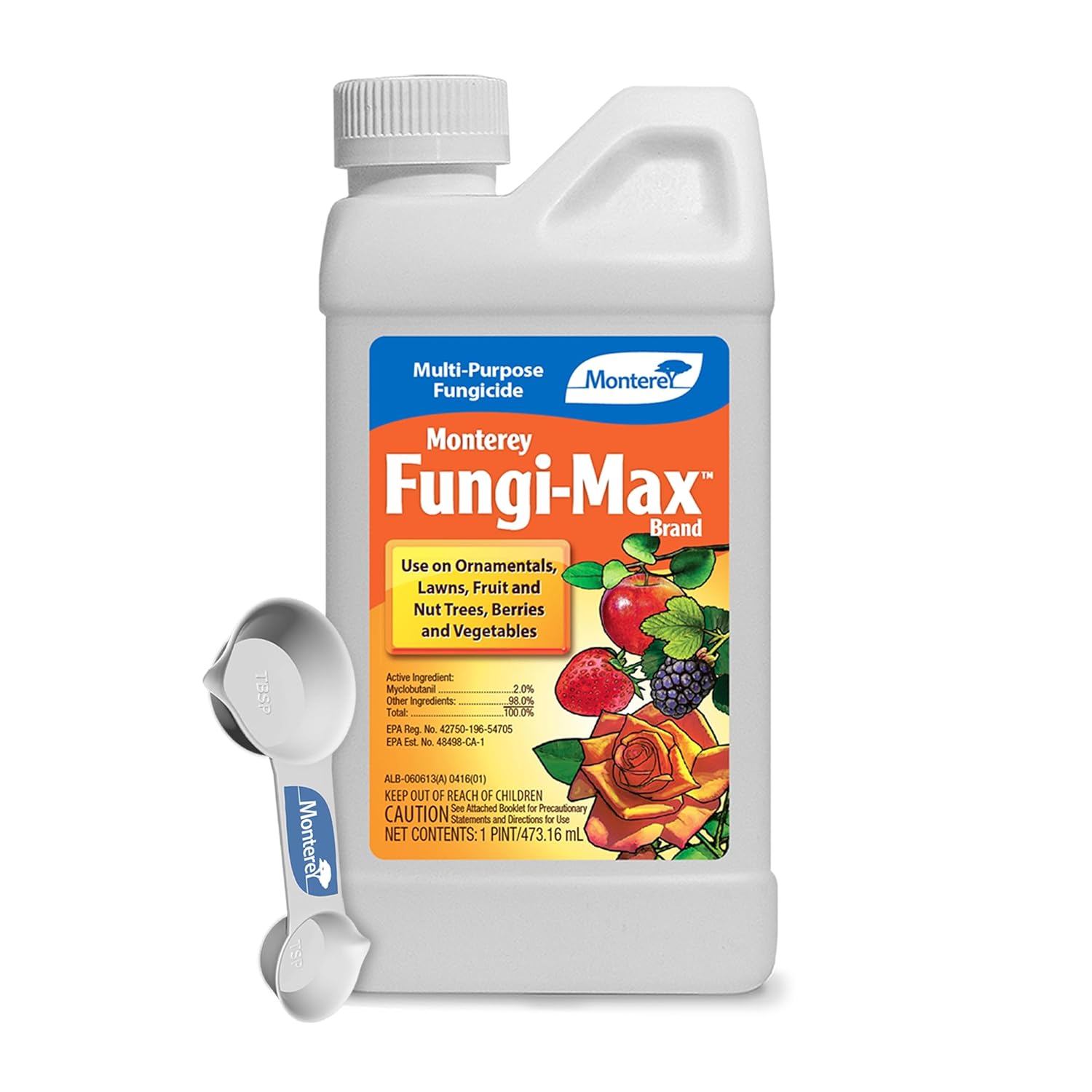
Monterey Fungi-Max Systemic Fungicide, 16 oz (with Measuring Spoon)
| Item Form | Liquid |
|---|---|
| Application Method | Spray |
| Coverage | Wide range of plants and plant types |
| Target Species | Flowers, Vegetables, Trees, Lawn Grass |
| Liquid Volume | 16 fluid ounces |
Monterey Fungi-Max is a concentrated liquid fungicide that you dilute and apply with a sprayer to prevent and control many common plant diseases. It is used outdoors on flowers, shrubs, trees, lawns and edible plants including vegetables and fruiting trees; for tomato growers it is intended to control leaf spots, blights and powdery mildew when applied at the first sign of disease. The product’s systemic action means it is absorbed and provides residual protection for up to two weeks, which reduces how often you need to spray during an outbreak. A measuring spoon is included to help with mixing and the spray application method works with standard pump or backpack sprayers. Important limitations are that it must be mixed and applied correctly according to the label and it is not listed as organic, so it may not suit organic-certified operations; also coverage on large plantings requires multiple bottles. For gardeners who want a reliable, easy-to-use fungicide to protect tomatoes and other outdoor plants, Fungi-Max delivers predictable, short-term disease control when applied promptly.
Best for: Gardeners who prioritize reliable, fast-acting disease control for outdoor tomato beds and mixed orchards and who want a product that gives measurable residual protection between applications.
Less Ideal for: Growers who require organic-certified products or those managing very large commercial tomato plantings where bulk coverage and cost per acre are primary concerns.
- Systemic action provides plant uptake and up to two weeks of protection per application.
- Broad labeled coverage for many plant types including vegetables and fruit trees.
- Liquid concentrate mixes for use with standard spray equipment for even coverage.
- Includes a measuring spoon to simplify accurate dilution amounts.
- Not listed as organic so unsuitable for certified organic production.
- One bottle may not cover large tomato plantings without repeated purchases.
Verdict: For home tomato growers seeking dependable, systemic disease control that reduces spray frequency, Monterey Fungi-Max is a practical, easy-to-use choice.
BioAdvanced Disease Control for Roses, Flowers & Shrubs Concentrate, 32 oz

| Unit Count | 32 Fluid Ounces |
|---|---|
| Item Type Name | Fungicide |
| Active Ingredients | Tebuconazole |
| Item Form | Spray |
| Target Species | Fungus |
BioAdvanced Disease Control is a systemic concentrate designed to protect ornamental plants from common fungal diseases by moving through plant tissue after application. You mix the concentrate with water and apply as a coarse spray using a pump sprayer or similar applicator; one 32-ounce bottle makes a large quantity of spray for multiple treatments. The active ingredient, tebuconazole, targets black spot, powdery mildew, rust and several listed diseases and is described as rainproof once dry, offering up to two weeks of protection. For growers, the product’s systemic action means it can help both treat existing infections and protect new growth, which is useful for plants that are difficult to coat thoroughly. Limitations are that the label and uses emphasize outdoor ornamentals and roses and the concentrate requires careful measuring and safe handling; it is not labeled for indoor application without treating plants outside. Also the formula is not specific to orchids so you must confirm labeled orchid diseases and follow directions to avoid phytotoxicity on sensitive species.
Best for: Buyers who prioritize dependable, science-based disease control for ornamental plants and want a systemic fungicide that treats and protects rather than just a surface spray.
Less Ideal for: Growers who only keep orchids strictly indoors or who need a product explicitly labeled for orchids and greenhouse use should look for fungicides with clear orchid-specific labeling.
- Systemic action treats infections from inside the plant and helps protect new growth.
- Controls a broad list of common foliar diseases including black spot and powdery mildew.
- Concentrate yields a large volume of spray, so one bottle covers multiple treatments.
- Rainproof once dry, so protection is less likely to wash away after application.
- Label and marketing focus on roses and outdoor ornamentals rather than orchids specifically.
- Requires precise mixing and outdoor application which adds handling steps for cautious users.
- Contains tebuconazole so sensitive plants may need a spot test before widespread use.
Verdict: A reliable systemic concentrate that delivers broad foliar disease control and lasting, rainproof protection for ornamental plants.
Choosing the Right Systemic Fungicide for Orchids: Key Factors to Consider
Residual Protection Length
How long a systemic fungicide continues to suppress or prevent infection after application affects how often you need to treat orchids. Residual length depends on the active ingredient, formulation, and environmental factors such as light and watering. Longer residual control reduces labor and disturbance to tender roots, but it can also mean longer intervals before reapplication if a different mode of action is needed.
For potted orchids, consider whether residual protection aligns with your watering schedule and repotting routine. Short-residual products may require more frequent applications during high-risk seasons, while long-residual options can bridge wet or humid periods when fungal pressure is highest.
Plant Safety and Phytotoxicity
Orchids include many sensitive genera that react differently to chemicals. Plant safety is critical because some systemic actives can cause leaf spotting, bud blast, or root stress if applied at the wrong rate or during high light or heat. Label instructions and observed grower reports help determine typical tolerance levels.
Assess safety by checking recommended concentrations, interval timing, and whether the product is labeled for flowering or bud stage. When in doubt, test any systemic product on a single plant or a lower leaf before treating an entire collection to avoid widespread damage.
Systemic Translocation and Mode of Action
Systemic movement describes how well the active ingredient moves within the plant to reach infection sites. Some systemic fungicides move primarily upward into shoots and leaves, while others translocate to roots and developing tissue. The mode of action also determines whether the product is better at preventing infections, stopping early infections, or reducing sporulation.
Choose products with translocation patterns that match your problem. Root or crown rot issues need actives that reach the root zone, while leaf spot or bud infections require good foliar movement. Alternating modes of action over time helps reduce resistance risk in fungal populations.
Application Flexibility and Compatibility
How you can apply a systemic fungicide matters for container-grown orchids. Some formulations are designed for foliar spray only, others for soil drench, and some allow both. Compatibility with other cultural treatments, fertilizers, and biological products is another practical concern.
Look for clear guidance on tank mixing limits and recommended surfactants. Drench applications may be more effective for root-bound plants, while sprays can protect foliage and buds. Ease of measuring and mixing reduces dosing errors, which is especially important for concentrated formulations.
Spectrum of Fungal Control
Different fungicide actives target different groups of fungi. Some offer broad-spectrum control including Botrytis, Fusarium, and some root pathogens, while others are narrow and ideal for single, identified pathogens. Knowing the likely pathogen will guide your choice between broad and narrow spectrum actives.
If you cannot confirm the causal fungus, a broader-spectrum systemic may reduce trial-and-error, but targeted chemistry can be more effective and lower resistance pressure when the organism is known.
Residue, Reentry, and Environmental Considerations
Even when used on container ornamentals, systemic fungicides can leave residues in potting mix and plant tissue. Check label directions for reentry intervals, safe disposal of leftover solutions, and any guidance on pollinator exposure when plants are placed outdoors. Environmental persistence influences whether treated potting media should be reused and how soon treated orchids can be repotted.
Consider whether the product's environmental profile fits your growing setup. Greenhouse growers may prioritize low-residue options to protect beneficials, while indoor hobbyists often focus on minimal odor and low vapors during application.
Common Orchid Fungal Problems and When to Use Systemics
Orchids face a handful of recurring fungal issues: root and crown rots, foliar spots, botrytis on blooms, and black rot in humid setups. Systemic fungicides are most useful when infections are established below the surface or when repeated contact sprays fail to stop recurrence.
Use systemic treatments for persistent root-borne pathogens, recurring leaf spots that reappear after contact sprays, and when decontamination of potting mix is impractical. For isolated foliar lesions, spot testing and localized treatment can limit exposure to the whole plant.
- Use systemic drenches for suspected root or crown infections
- Prefer foliar translocating systemics for leaf and bud diseases
- Combine good cultural hygiene with chemical control for best results
Safe Application Practices for Orchids
Always follow label directions for concentration, timing, and protective equipment. Avoid applying systemic fungicides during extreme heat or direct midday sun to reduce phytotoxic risk. When treating flowering plants, check whether the product permits application to blooms or if you should remove flowers first.
Wear gloves and eye protection and measure carefully to prevent overdosing. Rinse and store measuring tools separately from food items and dispose of unused mix according to label guidance rather than pouring it into landscape soil.
- Test on one plant first when using a new active
- Avoid application during peak sunlight or high temperatures
- Follow reentry and ventilation guidance for indoor growers
Integrating Systemic Fungicides with Cultural Controls
Systemic fungicides are most effective when combined with sound cultural practices. Improve air circulation, avoid overwatering, use fast-draining potting mixes, and remove infected tissue promptly to lower disease pressure. Fungicides treat the symptom and pathogen but do not replace poor culture.
Rotate between different modes of action when multiple applications are needed to reduce resistance development. Use sanitation measures such as sterilizing tools and replacing soilless mix that is heavily contaminated.
- Improve pot drainage and reduce humidity spikes
- Sanitize tools and isolate infected plants
- Rotate actives with different modes of action when possible
Timing Treatments for Best Effect
Treat early when you detect first signs of infection, because systemic products work best before disease is widespread. For preventive use, apply at times of known high risk, such as the start of a wet season or after repotting when roots may be stressed and vulnerable.
Follow recommended reapplication intervals closely. Over-application does not speed control and increases the chance of plant damage and resistance; under-application reduces efficacy and wastes effort.
- Apply preventively in high-humidity months
- Treat promptly at first symptoms for better outcomes
- Respect labeled reapplication intervals
Recordkeeping and Resistance Management
Keep a treatment log showing active ingredients used, application dates, concentrations, and observed results. This record helps you spot declining efficacy that may indicate resistance and guides rotation decisions.
When you see reduced control, stop repeating the same active and switch to a different mode of action. Combining chemical records with cultural notes makes it easier to identify patterns tied to potting media, watering, or seasonal conditions.
- Log active ingredients and application timing
- Rotate modes of action to delay resistance
- Note cultural conditions that correlate with outbreaks
How We Chose the Best Systemic Fungicide for Orchids
We focused on attributes that matter when using a systemic fungicide for orchids and applied strict exclusions for products that are formulated only for turf, broad-acre agriculture, or labeled for non-orchid ornamental uses. Our selection prioritized products with clear orchid-compatible labeling, documented systemic activity, and modes of action appropriate for common orchid pathogens. Evaluation criteria included residual length and systemic movement to assess how long protection lasts and whether the active ingredient translocates to roots and new shoots. Plant safety and phytotoxicity were measured by available labeling guidance and published grower reports for common orchid genera. Application flexibility covered dilution rates, spray versus drench compatibility, and suitability for greenhouse or container use. Ease of use and mixing accuracy looked at formulation type and clarity of instructions. Finally, spectrum of control considered which fungal groups the active ingredient targets. We excluded contact-only fungicides, products with ambiguous orchid labeling, and chemicals not registered for use on container-grown ornamentals. The remaining candidates were shortlisted because they meet the specific needs of orchid culture: systemic movement, clear safety guidance, and practical application options for hobby and small-scale growers.
FAQ
Can systemic fungicides harm orchid blooms or buds?
Some systemic actives can cause spotting or bud blast if applied during sensitive stages or under high light and heat. Follow label timing and rates, and test on a single plant or leaf before treating a whole collection.
How soon will I see results after applying a systemic fungicide?
You may see symptom suppression within a few days, but full control can take longer because systemic movement and disease cycles vary. Treatment outcome often improves when combined with cultural corrections.
Is a drench or foliar spray better for root rot?
For root and crown infections, drenches that deliver active ingredient to the root zone are generally preferred. Foliar-moving systemics may help leaf issues but might not reach deep-seated root pathogens as effectively.
Can I repot an orchid right after systemic treatment?
It usually helps to wait until the labeled reentry or repotting interval has passed. Repotting immediately can disturb treated roots and reduce systemic uptake. Check label guidance for specific timing.
Should I rotate products to prevent resistance?
Yes. Alternating fungicides with different modes of action reduces the risk of resistance in fungal populations. Keep records so you do not repeat the same active repeatedly.
Are systemic fungicides safe for use in small indoor collections?
Many systemic products are formulated for container ornamentals and can be used indoors with proper ventilation and PPE. Review label safety sections and use careful measuring to minimize exposure.
Final Verdict
When selecting a systemic fungicide for orchids, prioritize plant safety, systemic movement to the infected tissue, and an appropriate residual window for your growing schedule. Balance the need for broad-spectrum control with resistance management by rotating modes of action and combining chemical treatment with strong cultural hygiene. Ultimately, choose a product that matches the type of infection you face and the application method you can perform safely. Careful testing, sensible timing, and accurate recordkeeping will help you control fungal problems while protecting delicate orchid growth.
