

Note: This article contains affiliate links. If you click on these links and make a purchase, I may earn a small commission at no extra cost to you. This helps support my research and content. Read my full affiliate disclosure here.
If you have dogs, cats, or other pets that share your yard, choosing a weed control option that reduces risk without sacrificing effectiveness matters. Pet-safe weed killers for lawns are formulated to target broadleaf weeds or grassy invaders while using active ingredients and application approaches intended to limit exposure to animals. This guide covers our shortlisted top picks for different lawn sizes and maintenance styles and explains the attributes that matter most in real-world lawn care. We evaluate each product on safety in active yards and how quickly the lawn recovers after treatment, plus ease of application and persistence against regrowth. Read on to find a solution suited to your lawn and pet routine.
Top Picks at a Glance
| Best Overall The best all-around choice for most situations | Spruce Snap & Spray Weed & Grass Killer Starter Kit, 64 oz |  |
| Best Quality Built to a higher standard if you want something more solid | ECO Garden PRO Organic Vinegar Weed Killer (1 gal) with Sprayer |  |
| Best Budget The cheapest option that still gets the job done reliably | Spruce EZ-AIM Weed & Grass Killer₃, Precision Spray 3-pack (10 oz each) |  |
| Highest Rated A top-rated pick with lots of positive feedback | Spruce Weed & Grass Killer Refill, Ready-to-Use 64 fl oz |  |
| Most Popular A crowd favorite that many people choose with confidence | Spruce Weed & Grass Killer Power Wand Kit with 64 oz Refill |  |
| Best Seller A high-volume bestseller chosen again and again | Just For Pets Pet Safe Weed Killer, 1 Gallon Ready-to-Use |  |
Spruce Snap & Spray Weed & Grass Killer Starter Kit, 64 oz

| Unit Count | 64 Fluid Ounces |
|---|---|
| Item Form | Spray |
| Coverage | 1 bottle treats up to 400 weeds |
| Active Ingredients | Sodium Lauryl Sulfate, Geraniol, Cornmint Oil |
This Spruce Snap & Spray starter kit pairs a 64 oz refill bottle with a reusable snap-on wand to deliver a no-mess, ready-to-use weed and grass killer for spot treatment. It works on contact, dehydrating plants so you can see darkening or wilting within an hour and complete dieback often by 24 hours. Use it on driveways, pavers, walkways, mulch beds and garden edges by holding the nozzle about a foot from the weed and thoroughly wetting leaves and stems. The formula is water-based and uses sodium lauryl sulfate, geraniol and cornmint oil instead of glyphosate, and the brand states it is safe around people and pets when used as directed. The powered wand and EZ-AIM options make precision spraying easier for cracks and tight spots, and one bottle claims coverage for up to 400 weeds. Limitations include the need to avoid desirable plants and lawns, follow temperature and dry-weather application guidance, and the spray may take extra priming on first use or between uses.
Best for: Buyers who prioritize a pet-conscious, practical approach to spot-treating weeds around yards and hardscapes and want an easy-to-use, ready-made spray system for targeted applications.
Less Ideal for: People looking for a lawn-wide systemic herbicide or a long-term preemergent solution should consider other products; those needing broadcast treatment of large turf areas will find this kit unsuitable.
- Ready-to-use kit with a reusable snap-on wand for no-mix, no-pour application
- Plant-based active ingredients reduce reliance on harsh synthetic herbicides
- Visible results often within one hour and full effect by 24 hours when used as directed
- Designed for precision spot treatments on hardscapes, mulch beds and garden edges
- One 64 oz bottle claims coverage up to about 400 weeds
- Not labeled for broadcast use on lawns so it is for spot treatment only
- Must be applied in dry, warm conditions and may require reapplication for persistent weeds
- Sprayer can take time to prime on first use or between applications
Verdict: A convenient, pet-conscious ready-to-use spray kit ideal for precise spot treatment of weeds on hardscapes and beds.
ECO Garden PRO Organic Vinegar Weed Killer (1 gal) with Sprayer

| Unit Count | 128 Fluid Ounces |
|---|---|
| Liquid Volume | 1 gallons |
| Item Form | Liquid |
| Coverage | covers a large area |
This 1 gallon ready-to-use herbicide uses a high-acidity white vinegar formula combined with organic rock salt and biodegradable plant activators to desiccate and kill weeds on contact. It is applied from the included sprayer or any garden sprayer and is best used on driveways, sidewalks, mulch beds and other non-turf hard surfaces or spot-treated patches in lawns. The product claims visible results within 24 hours and lists effectiveness against dandelions, clover, crabgrass, moss and poison ivy. Practical benefits are that it avoids synthetic glyphosates, is labeled biodegradable and emphasizes safety for pets and children when used as directed. Important limitations are that vinegar-based herbicides typically burn foliage but may not eliminate deep perennial roots, so repeat applications or follow-up digging can be required for persistent species. The label also warns to avoid overspray onto desirable plants and to keep the product away from water bodies, so care is needed when treating near flower beds or ponds.
Best for: Buyers who prioritize a pet- and child-conscious, non-synthetic approach and need a product that delivers fast foliar burn for routine lawn spot treatments and hard-surface weed control.
Less Ideal for: Users seeking a one-application systemic cure for deep-rooted perennials or broad broadcast lawn management should consider alternatives with systemic activity or long-term residual control.
- Ready-to-use 1 gallon volume for treating large areas without mixing
- Vinegar-based formula avoids synthetic herbicides and is labeled biodegradable
- Works on a wide range of common weeds including clover, dandelions, crabgrass and moss
- Included sprayer makes spot treatments and pavement applications straightforward
- May not kill deep perennial roots so multiple applications or manual removal may be needed
- Risk of damage to desirable plants from overspray; careful targeting is required
Verdict: A large ready-to-use vinegar-based herbicide that gives quick foliar control while avoiding synthetic chemicals, ideal for pet-conscious spot and hard-surface weed control.
Spruce EZ-AIM Weed & Grass Killer₃, Precision Spray 3-pack (10 oz each)

| Unit Count | 30 Fluid Ounces |
|---|---|
| Number of Packs | 3 |
| Item Form | Spray |
| Coverage | 1 bottle treats up to 60 weeds |
| Active Ingredients | Sodium Lauryl Sulfate, Geraniol, Cornmint Oil |
The Spruce EZ-AIM 3-pack is a spot-treatment weed and grass spray designed for cracks, edges, mulch beds, driveways and pavers. Each lightweight can is nitrogen-pressurized and dispenses a precision stream intended to wet leaves and stems until they wilt; visible leaf darkening or wilting can appear within an hour and complete death often follows by 24 hours. The formula relies on water, essential oils (geraniol and cornmint) and a surfactant (sodium lauryl sulfate), so it kills on contact without synthetic glyphosate. It is easy to use: unlock the nozzle, hold 12 to 24 inches from the target, spray until wet and relock when finished. Practical benefits include fast visible results, a precision applicator for small spaces, and a formula marketed as safe around people, pets and bees when directions are followed. Important limitations are that it is nonselective so avoid spraying desirable plants or lawns, effectiveness requires direct leaf contact and warm dry conditions above 60°F, and one can treats roughly 60 weeds so larger areas will need multiple cans or a refillable system.
Best for: Buyers who want a fast, easy, lower-toxicity option to spot-treat weeds around walkways, patios and beds without mixing concentrates and who prioritize straightforward, grab-and-spray convenience on a budget.
Less Ideal for: Homeowners needing to clear large lawns or heavy infestations should consider concentrated or larger-capacity solutions rather than single-use aerosol cans.
- Visible results often within one hour and full kill by 24 hours when used as directed
- Precision EZ-AIM nozzle for spot treating cracks, edges and small spaces
- Formulated with essential oils and surfactant as a non-glyphosate, ready-to-use spray
- Pack of three cans increases coverage without needing dilution or mixing
- Nonselective contact formula requires careful aim to avoid desirable plants
- Limited coverage per can—about 60 weeds—so not suited for large infestations
Verdict: A convenient, lower-toxicity ready-to-use spray that quickly kills individual weeds and is budget-friendly for spot treatments.
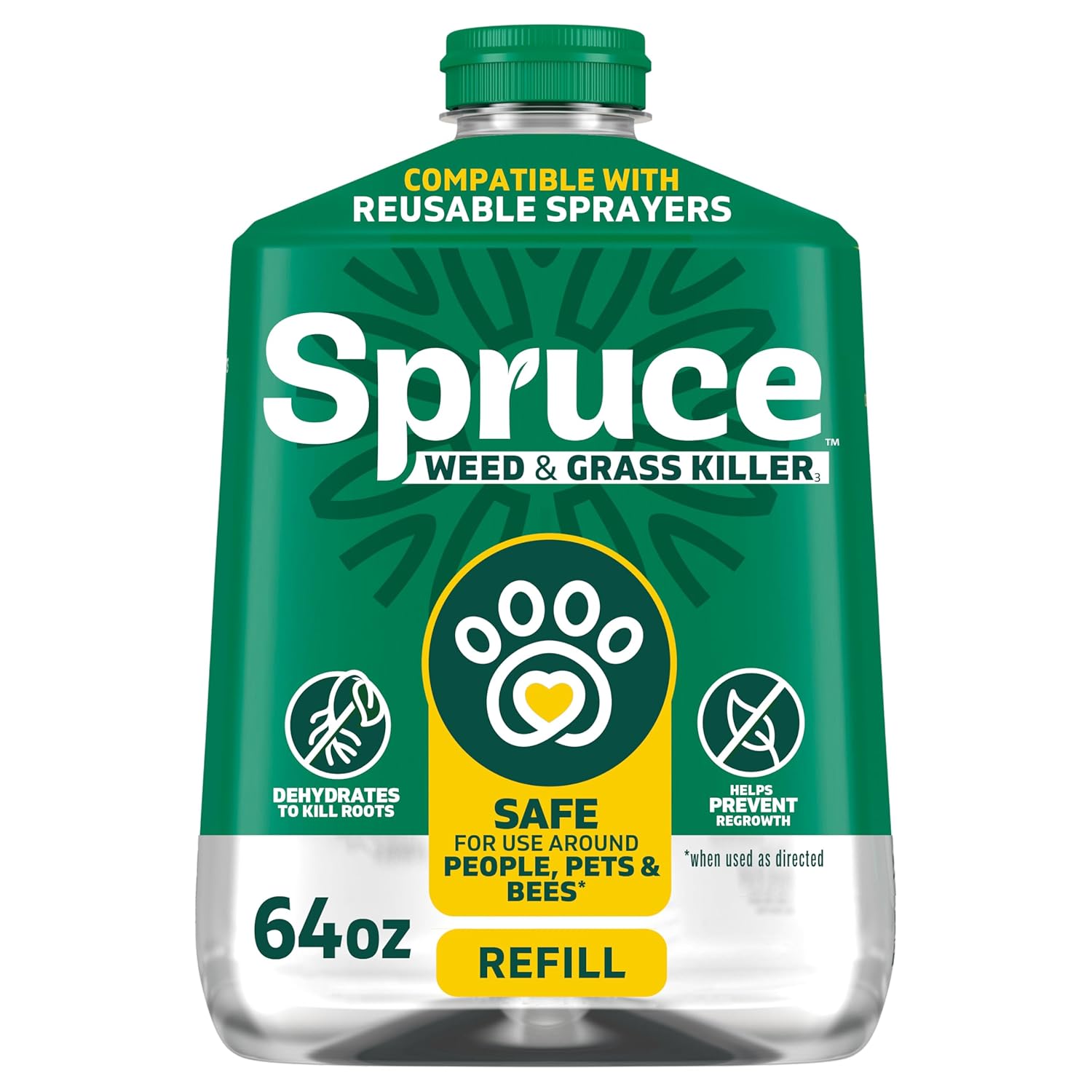
Spruce Weed & Grass Killer Refill, Ready-to-Use 64 fl oz
| Unit Count | 64 Fluid Ounces |
|---|---|
| Item Form | Spray |
| Coverage | 1 bottle treats up to 400 weeds |
| Active Ingredients | Sodium Lauryl Sulfate, Geraniol, Cornmint Oil |
This 64 fl oz Spruce refill is a no-mix replacement for the brand's Snap & Spray system that provides a convenient, ready-to-use weed and grass killer for spot treatments. It works on contact, dehydrating foliage with visible leaf darkening or wilting within an hour and complete plant death often by 24 hours. The formula relies on water, essential oils and sodium lauryl sulfate rather than synthetic herbicides, which makes it suitable for use around people and pets when directions are followed. One bottle is rated to treat up to about 400 weeds and is designed for hard surfaces, mulch beds, driveways and pavers rather than broadcast lawn application. Practical features include a snap-on refill top for the existing spray handle and a fast rainproof window of roughly 10 minutes. Be aware it is non-selective and must be applied carefully to avoid desirable plants, and it is most effective on young or small weeds rather than deep perennial roots where reapplication may be needed.
Best for: Buyers who want a low-fuss, pet-conscious spot weed killer for driveways, pavers and mulch beds and who prioritize convenience and visible speed of action.
Less Ideal for: Homeowners seeking a selective lawn treatment or long-term control of deeply rooted perennials should consider different systemic or professional options.
- Ready-to-use refill eliminates mixing and pouring
- Visible results in about one hour with full effect by 24 hours
- Formulated with water and essential oils for pet- and people-friendly use when directed
- Covers a high estimated count — one bottle treats up to 400 weeds
- Snap-on refill design fits the Spruce Snap & Spray handle for quick replacement
- Non-selective formula will damage desirable plants if oversprayed
- Less effective on large established perennial roots compared with systemic herbicides
Verdict: Choose this refill if you want a fast, ready-to-use, pet-conscious spot treatment that snaps into the Spruce spray handle for effortless weed control on hardscapes and beds.
Spruce Weed & Grass Killer Power Wand Kit with 64 oz Refill

| Unit Count | 64 Fluid Ounces |
|---|---|
| Coverage | 1 bottle treats up to 400 weeds |
| Item Form | Multiple |
| Liquid Volume | 64 fluid ounces |
This kit combines a 64 oz ready-to-use herbicide with a battery-powered Power Wand for fast, targeted spot treatments. The formula is non-mixing and designed to work on contact, dehydrating leaves so you can see darkening or wilting within an hour and complete die-off by about 24 hours when used as directed. The wand is reusable and comes with two AA batteries so you can spray cracks, edges, mulch beds, driveways, and walkways without pouring or measuring. Practical benefits include ease of use, rainproofing within 10 minutes, and a formula advertised as safe around people, pets, and bees when directions are followed. Limitations are that it is non-selective so it must be applied carefully to avoid desirable plants and grass, it is intended for spot treatment rather than broadcast lawn application, and best results require spraying in dry, warm conditions above 60°F with no immediate rain forecast.
Best for: Buyers who want a fast, easy-to-use spot weed killer for driveways, cracks, mulch beds, and edges and who prioritize quick visible results and minimal setup.
Less Ideal for: Those needing large-area lawn herbicide or selective weed control within turf should look for products made for broadcast lawn treatments or selective formulas.
- Ready-to-use 64 oz refill eliminates measuring or mixing
- Visible results in about one hour and full effect around 24 hours
- Includes battery-powered reusable wand for precision spot treatments
- Rainproof within 10 minutes so light showers are less likely to wash it off
- Formulated for use around people, pets, and bees when directions are followed
- Non-selective formula can damage desirable plants if oversprayed
- Designed for spot treatments not for broadcasting over large lawns
- Performance depends on spraying in recommended weather conditions
Verdict: A convenient, no-mix spot-treatment kit that delivers fast visible weed kill with a reusable powered wand for precise, low-fuss applications.
Just For Pets Pet Safe Weed Killer, 1 Gallon Ready-to-Use

| Unit Count | 128 Fluid Ounces |
|---|---|
| Item Form | Liquid |
| Active Ingredients | Vinegar |
This one-gallon ready-to-use weed killer is a vinegar-based, non-glyphosate formula packaged with a pump sprayer for straightforward spot treatment of unwanted weeds and grass. You simply shake, pressurize the sprayer, and coat target plants; visible wilting can appear within hours and clearer results are typical by 24 hours. The product is presented as pet- and family-friendly when used according to directions and is suitable for hardscape areas, rock beds, driveways, patios and fence lines where you want non-selective contact control. Practical benefits include no mixing or measuring, fast action on common weeds like dandelions and crabgrass, and a formulation that avoids glyphosate. Important limitations are that it is non-selective so it will harm desirable plants on contact, it requires thorough coverage to be effective, and contact herbicides sometimes need repeat applications for deep-rooted perennials. Also follow drying and safety guidance before allowing pets or children back into treated areas.
Best for: Homeowners who prioritize low-toxicity, easy-to-use weed control around hardscapes and landscape beds and want a quick, no-mix solution that avoids glyphosate.
Less Ideal for: Gardeners seeking a selective herbicide for lawns or those needing a systemic solution for tough perennial roots should consider other products or integrated removal methods.
- Ready-to-use pump sprayer requires no mixing or measuring
- Vinegar-based formula with no glyphosate for a more natural active ingredient
- Fast visible results often within 24 hours on annual weeds and grasses
- Versatile for use on driveways, sidewalks, patios, rock beds and fence lines
- Non-selective contact action can damage desirable plants if oversprayed
- May require repeat treatments for deep-rooted or persistent perennial weeds
Verdict: A fast, ready-to-use vinegar weed killer for homeowners who want a non-glyphosate, easy contact solution for weeds on hardscape and beds.
Choosing the Right Pet Safe Weed Killer for Lawns: Key Factors to Consider
Active Ingredient and Toxicity
Knowing the active ingredient is the first step to choosing a pet-safe weed killer. Different chemistries have different acute and chronic toxicity profiles for dogs and cats, and labels spell out hazard information. Look for products with active ingredients that have established safety data and clear, conservative re-entry or wait-time guidance.
Beyond the ingredient itself, consider how the formulation is delivered. Granules, ready-to-use sprays, or concentrated liquids mixed at home affect how much product is present on grass blades and how easily pets can contact it. Less residue on leaf surfaces and clear instructions to water after application when appropriate can reduce exposure risk.
Label Instructions and Re-Entry Interval
Labels provide the legal and safety instructions you must follow, and re-entry intervals vary by product. Some treatments allow immediate access once the product dries, while others recommend waiting several hours or longer. For households with curious pets that sniff or roll in grass, shorter and well-documented re-entry guidance reduces disruption to daily life.
Also pay attention to any restrictions on mowing, watering, or feeding the lawn around the time of application. These restrictions affect how long treated turf remains a contact risk and influence when normal pet activity can resume without extra precautions.
Spectrum of Weeds Controlled
Different weed killers target different groups of plants. Many pet-safe lawn options focus on broadleaf weeds like dandelions, clover, and plantain, while others include selective grasses or sedges. Identify the common weeds in your lawn and choose a product whose labeled targets match them.
If your lawn has a mix of broadleaf weeds and grassy invasives, a single selective product may not solve everything. In those cases, plan for integrated control: spot treatments, cultural practices, and follow-up applications rather than relying on one blanket treatment.
Impact on Lawn Health and Recovery
A pet-safe label does not guarantee zero impact on turf. Some products can cause temporary discoloration or slowed growth while weeds die back. Consider how quickly the turf is likely to recover, especially if you host pets that use specific parts of the yard frequently.
Faster turf recovery matters for both aesthetics and for reducing bare patches that invite new weeds. Look for products and instructions that minimize stress on grass, for example by avoiding application during high heat or drought and by following recommended watering schedules after treatment.
Application Method and Coverage
Ease of application affects whether you will follow label directions consistently. Ready-to-use hose-end applicators or handheld trigger sprays are straightforward for small yards, while concentrated liquids plus a pump sprayer may be more economical for larger lawns but require careful mixing.
Consider how uniform coverage is achieved and whether the delivery method creates fine droplets that can drift or larger droplets that reduce drift. The right applicator reduces the chance of accidental treatment of flower beds, vegetable patches, or areas pets frequent before the product dries.
Residual Activity and Need for Repeat Treatments
Residual control means how long a product prevents weeds from resprouting or new seedlings from establishing. Some pet-safe options act quickly but lack long residual activity, requiring follow-up applications. Others have a longer window of control but may leave more active ingredient in the turf for a period.
Decide whether you prefer a short-acting product that lets you resume normal lawn uses sooner or a longer-acting solution that reduces the frequency of treatments. Factor in the season, weed lifecycle, and your willingness to perform repeat spot treatments.
When to Treat Your Lawn
Timing treatments to weed growth stage and weather reduces the amount of product needed and improves results. Cool-season broadleaf weeds are often most vulnerable in early spring and fall when they are actively growing. Warm-season invaders respond best when temperatures are warm and weeds are not drought-stressed.
Avoid applying during extremes of heat or drought because stressed grass and weeds do not absorb treatments as well and turf damage risk rises. Also plan applications when pets can be restricted for the recommended re-entry interval and when rain is not expected for at least 24 hours unless the product label specifies otherwise.
- Target actively growing weeds for faster control.
- Avoid treatment before heavy rain or during drought.
- Schedule when pets can be kept off the lawn for the labeled wait time.
Spot Treatment Vs Whole-Lawn Applications
Spot treatment uses less product and limits pet exposure to treated patches. It works well for isolated weed outbreaks and allows you to protect high-use play areas while addressing problem spots. For small lawns or widespread infestations, whole-lawn applications may be more efficient and can create uniform control.
Think about how pets move through your yard. If they frequent a single area, avoid treating that zone unless necessary, or choose a product with a short re-entry interval. Spot applications also make it easier to combine chemical control with hand pulling and cultural improvements.
- Use spot treatments for isolated weeds and to reduce treated area.
- Whole-lawn treatments simplify care when weeds are widespread.
- Combine spot spraying with manual removal for faster cleanup.
Post-Application Care and Pet Access
Follow label directions for watering, mowing, and re-entry times. Some products recommend watering lightly after application to move the herbicide into the soil and reduce residue on leaf surfaces. Others require waiting until the product has fully dried before allowing foot traffic or pet access.
If pets are allowed back after the labeled interval, wipe paws and check for residue after high-contact activities, especially for pets that roll in grass. For households with very young animals or frequent guests, consider temporarily restricting access to treated areas until turf has visibly recovered and any residue has diminished.
- Adhere closely to label watering and mowing instructions.
- Delay pet access per label and check pets after outdoor play.
- Use physical barriers or temporary fencing for high-use areas if needed.
Integrating Cultural Practices
Chemical control is more effective when combined with good lawn care. Proper mowing height, regular fertilization according to soil tests, and adequate irrigation create a dense turf that competes with weeds. Overseeding thin spots reduces future weed pressure and reduces reliance on chemical controls.
Regular hand weeding of young seedlings and removing seed heads can reduce the number of chemical treatments needed. Consider seasonal aeration and topdressing to promote healthy roots that better resist invasion by weeds.
- Mow at the recommended height for your grass type to shade out weed seedlings.
- Overseed thin areas to close gaps that weeds exploit.
- Use soil testing to guide fertilization and avoid overfeeding, which can favor weeds.
Safety Practices for Households With Pets
Store all lawn care products out of reach of pets and children and in their original labeled containers. Keep application equipment cleaned after use to avoid accidental transfer of residues to surfaces pets contact.
Consider nonchemical options in areas used frequently by pets, such as high-traffic play zones. When a chemical product is used, follow label directions for protective measures like washing hands, keeping pets off the treated area for the specified time, and cleaning pet paws if they contacted the grass before the re-entry time elapsed.
- Store products securely and clean applicators after use.
- Restrict pet access according to label directions.
- Use barriers or alternate play areas during treatment and recovery.
How We Chose the Best Pet Safe Weed Killer for Lawns
We focused on products designed specifically for use on lawns where pets spend time, and we applied filters that reflect practical garden use. Primary evaluation criteria included documented safety profile for common household pets and recommended re-entry intervals, as well as efficacy against the typical lawn weeds encountered in home turf. We also scored how quickly turf recovers after treatment and whether the product requires special watering or mowing restrictions that affect normal pet access. We excluded treatments intended only for ornamental beds, agricultural herbicides, or concentrated industrial chemicals that are not intended for domestic lawn use. We also set aside products with unclear label instructions for pet safety or with insufficient guidance on when pets can safely return to treated areas. Other dimensions we considered were ease of application for homeowners, compatibility with common grass types, and the product's residual activity against weed regrowth. These criteria align with the scoring metrics used across the shortlisted options.
FAQ
Are pet-safe weed killers truly non-toxic to dogs and cats?
Pet-safe formulations are intended to lower risk, but non-toxic does not mean zero risk. Safety depends on active ingredients, application method, and whether label instructions are followed. Always observe re-entry intervals and avoid letting pets lick treated grass until the product is dry or the labeled wait time has passed.
How long after treatment can pets use the lawn again?
Re-entry times vary by product and formulation. Some allow access once treated surfaces are dry, while others recommend several hours or longer. Check the product label for the exact re-entry interval and consider keeping pets off the area for a bit longer if they tend to roll or eat grass.
Can I use pet-safe weed killers around vegetable gardens or flower beds?
Most lawn-directed pet-safe products are labeled for turf use only. Avoid drift into edible or ornamental beds and do not use lawn-specific formulations directly on garden plots unless the label explicitly permits it. Use targeted tools and physical barriers to protect nearby plantings during application.
Will pet-safe options control stubborn or deep-rooted weeds?
Many pet-safe selective herbicides effectively reduce common broadleaf weeds, but some deep-rooted or perennial species may require repeated treatments or combined approaches. Mechanical removal, cultural improvements, and targeted follow-up applications are often necessary for long-term control of persistent weeds.
Is spot treatment safer than whole-lawn spraying for households with pets?
Spot treatment minimizes the treated area and reduces overall exposure, which can be safer for active pets. It also allows you to avoid treating high-use zones. However, widespread infestations may be impractical to treat this way, so weigh coverage needs against exposure reduction.
Are there nonchemical alternatives that are safe for pets?
Yes. Hand pulling, targeted mechanical removal, and cultural practices like overseeding and proper mowing can reduce weed pressure without chemicals. For small lawns, steam or boiling water spot treatments can be effective against some weeds but require caution around pets and desirable turf.
Final Verdict
Choose a pet-safe weed killer based on the types of weeds you need to control, the product's safety instructions for pets, and how quickly your turf is likely to recover. Prioritize clear label guidance on re-entry time and select an application method that limits treated areas Pets and people use frequently. Balance the desire for fewer repeat applications with the need for minimal residue and fast lawn recovery. When in doubt, use spot treatments and bolster chemical control with cultural practices to keep your lawn healthy and safer for pets.
