

Note: This article contains affiliate links. If you click on these links and make a purchase, I may earn a small commission at no extra cost to you. This helps support my research and content. Read my full affiliate disclosure here.
Carpenter ants inside a house can damage wood and create ongoing nests if they are not controlled quickly and safely. You need solutions that remove workers and interrupt the colony while minimizing risk to people, pets, and indoor surfaces. This guide shortlists five top indoor carpenter ant killers chosen for effectiveness in enclosed spaces and practical ease of use. Below you will find a concise evaluation of each option based on how fast it works, how safe it is for households, and how simple it is to apply and maintain. Read on to see the decision factors we used and which features matter most for indoor ant control.
Top Picks at a Glance
| Best Overall The best all-around choice for most situations | Syngenta Advion Ant Gel (4 Tubes, 30 g each) |  |
| Best Quality Built to a higher standard if you want something more solid | Syngenta Advion Ant Gel Bait, 30 g |  |
| Best Value The sweet spot between price and what you get | ROUTADE 48-Pack Slow-Acting Ant Gel Bait Stations |  |
| Most Popular A crowd favorite that many people choose with confidence | Ortho Home Defense Insect Killer for Indoor & Perimeter, 1.33 gal. with Comfort Wand |  |
| Best Seller A high-volume bestseller chosen again and again | Atticus Talak 7.9% Bifenthrin Indoor/Outdoor Insecticide Concentrate, 32 oz |  |
Syngenta Advion Ant Gel (4 Tubes, 30 g each)

| Unit Count | 4.23 Ounce |
|---|---|
| Included Components | 4 Tubes x 30-Grams, 1 Plunger and 2 Tips |
| Item Form | Gel |
| Active Ingredients | 0.05% indoxacarb |
| Target Species | Insects |
Advion Ant Gel is a user-friendly gel bait intended to control common household and structural ant species by exploiting worker foraging behavior. You apply small spots or short lines of the odorless gel along active trails, in cracks and crevices, and near entry points; foraging workers consume the bait and carry it back to the nest where it is shared, helping to eliminate the queen and other nestmates. The kit ships with four 30 g tubes plus an applicator plunger and tips for precise placement, which makes targeting tight spaces straightforward. Its non-repellent formula with 0.05% indoxacarb is formulated to be attractive to a range of species including Argentine and carpenter ants, and it is labeled for both indoor and outdoor use. Limitations to note are that it is a chemical bait so safety precautions are needed around children and pets and efficacy depends on ants accepting the bait matrix versus other available food sources.
Best for: Homeowners and renters who want a targeted, easy-to-apply solution to eliminate established ant infestations and prefer a bait that works via worker-mediated transfer to treat whole colonies.
Less Ideal for: People seeking non-chemical or immediate-contact kill methods or those who need a one-time spray rather than ongoing baiting strategies should consider other options.
- Non-repellent gel formulation designed for worker ants to feed and transfer bait to the colony
- Includes four 30 g tubes plus a plunger and application tips for precise placement
- Labelled for both indoor and outdoor use, suitable for common pest species
- Odorless formula that is easy to place along trails, cracks, and crevices
- Contains a chemical active ingredient so it must be kept away from children and pets
- Effectiveness depends on ants preferring the bait over other available food sources
Verdict: Choose Advion Ant Gel when you want a precise, bait-based solution that encourages workers to carry poison back to the nest for colony-level control.
Syngenta Advion Ant Gel Bait, 30 g
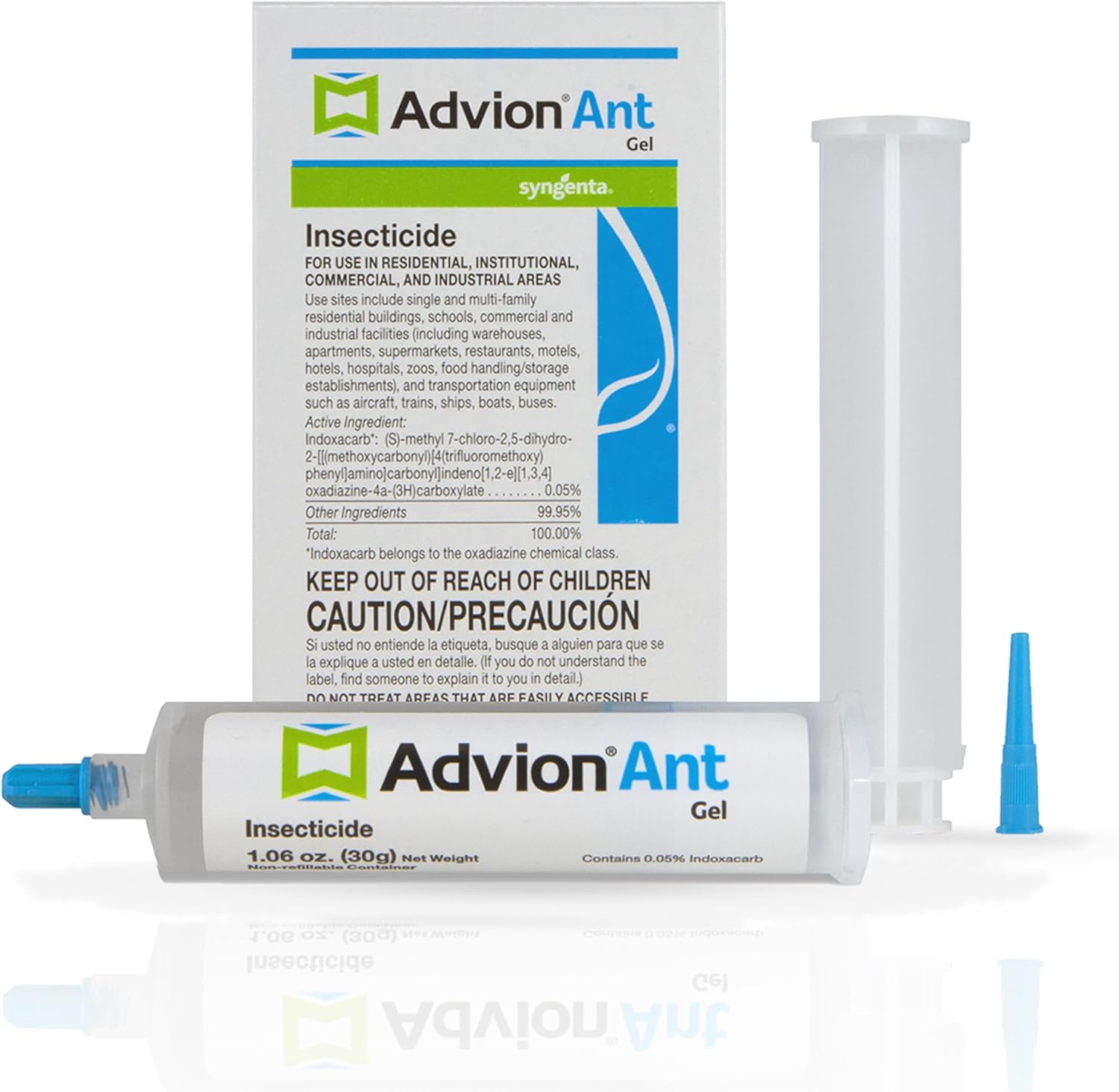
| Item Form | Gel |
|---|---|
| Target Species | Insects |
| Active Ingredients | Indoxacarb |
Advion Ant Gel is a concentrated, professional-style ant bait formulated around indoxacarb and a highly palatable gel matrix to lure foraging ants and carry toxicant back to the colony. You apply small dabs of the translucent, nonstaining gel in ant trails, near nesting sites, or in voids where ants forage; workers feed on the gel and transfer it through trophallaxis, which helps suppress entire colonies rather than just worker ants. The formulation is touted for lasting integrity with low odor and high attractiveness to sweet-feeding species, so you do not need frequent reapplication in protected spots. Because it is a targeted bait rather than a broadcast insecticide, it is practical for spot treatments in kitchens, pantries, and around baseboards as well as sheltered outdoor locations. Important limits are that it is a bait product requiring worker-mediated distribution so results are not instant and indoor use requires keeping it away from children and pets.
Best for: Buyers who prioritize effective colony-level control and want a concentrated, professional-style bait for spot treatments inside homes or in sheltered outdoor locations.
Less Ideal for: People needing immediate knockdown of visible ants or those who require a product for widespread outdoor perimeter treatments should consider different control methods.
- Contains indoxacarb, a potent active ingredient with a unique mode of action
- Highly palatable, translucent gel that attracts sweet-feeding ants
- Maintains formulation integrity for extended periods in sheltered application sites
- Suitable for indoor and sheltered outdoor spot treatments
- Relies on worker feeding and transfer so colony elimination can take several days to weeks
- Not intended for broad outdoor broadcast use or exposed wet areas
Verdict: Choose Advion Ant Gel when you want a high-performance, worker-transferred bait that targets colonies rather than just knocking down visible ants.
ROUTADE 48-Pack Slow-Acting Ant Gel Bait Stations

| Package quantity | 48 pack |
|---|
These bait stations provide a simple, no-mess way to tackle indoor carpenter ant problems by using a slow-acting gel that worker ants carry back to the nest. Use the prefilled stations along baseboards, cabinets, entryways, and other ant trails; the included double-sided tape keeps them in place so they are not easily disturbed. The formula is intended to be palatable to common household species and carpenter ants so it can reach hidden colony members rather than only killing visible foragers. Selling points are the ready-to-use design, the stationary low-profile housing that reduces spills, and the bulk 48-pack which lets you cover multiple hotspots or replace units over time. Limitations are that results depend on ants finding and accepting the bait, so placement and monitoring are important, and slow-acting baits take days to show colony-level effects rather than instant elimination. This is a practical option for users who want systematic, long-term indoor control without sprays or messy applications.
Best for: Homeowners and renters who want a low-effort, systematic way to remove indoor carpenter ant colonies and prefer focused baiting over sprays or DIY mixes.
Less Ideal for: People who need an immediate knockdown of visible ants or those looking for a one-time fast-acting spray solution.
- Slow-acting gel is designed for transfer to the nest to target entire colonies
- Prefilled, ready-to-use stations require no mixing or messy application
- Double-sided tape keeps stations fixed and reduces accidental spills
- Large 48-pack provides coverage for whole-house placement and regular replacement
- Effectiveness depends on ants finding and accepting the bait, so placement matters
- Work is not immediate since the formula is slow-acting and may take days to reduce activity
Verdict: Choose this bulk prefilled gel bait set when you want a low-mess, colony-focused indoor solution for carpenter ants that you can deploy across multiple hotspots.
Ortho Home Defense Insect Killer for Indoor & Perimeter, 1.33 gal. with Comfort Wand

| Item Form | Spray |
|---|---|
| Target Species | Insects |
| Liquid Volume | 1.33 gallons |
| Active Ingredients | Bifenthrin 0.05%, Zeta-Cypermethrin 0.0125% |
This 1.33 gallon Ortho Home Defense spray is designed to treat both indoor problem spots and the outdoor perimeter of a home to reduce ants, roaches, spiders and many other crawling and flying insects. It comes with a battery-powered Comfort Wand that delivers a continuous spray so you can apply a uniform band around foundations, patios and entry points without bending or pumping. The formula with bifenthrin and zeta-cypermethrin is intended to kill on contact and establish a barrier that the manufacturer says lasts up to 12 months for ants, roaches and spiders on non-porous indoor surfaces. In real-world use that means fewer repeat treatments in busy yard perimeters and around doors and windows. The spray dries clear with minimal fumes which helps for indoor use near kitchens and living areas. Limitations are that this is a chemical insecticide so users should follow safety directions around children, pets and plants and it is not a specific solution for pests not listed on the label. For homeowners focused on strong, perimeter-level protection this product simplifies application and covers a large area per container.
Best for: Homeowners who want a performance-focused perimeter treatment to reduce recurring yard and entry-point insect problems and prefer a ready-to-use product that is easy to apply.
Less Ideal for: People seeking organic or non-chemical control methods or those who need a targeted solution for pests not listed on the label should consider alternative products.
- Includes battery-powered Comfort Wand for continuous, fatigue-free application
- Ready-to-use 1.33 gallon container covers large perimeters without mixing
- Formula creates a barrier claimed to provide up to 12 months protection against ants, roaches and spiders on non-porous indoor surfaces
- Dries clear and gives off minimal fumes, making indoor use more practical
- Contains synthetic insecticides so precautions are required around children, pets and ornamentals
- Protection claims are specific to certain species and surfaces so results vary by pest and conditions
Verdict: A powerful, ready-to-use perimeter and indoor spray for homeowners who want long-lasting, performance-oriented protection against common yard and household insects.
Atticus Talak 7.9% Bifenthrin Indoor/Outdoor Insecticide Concentrate, 32 oz

| Active Ingredient | Bifenthrin |
|---|---|
| Formulation | Suspension Concentrate |
| Liquid Volume | 32 fluid ounces |
| Length of Control | Up to three months |
| Target Species | Insects |
Talak 7.9% is a liquid concentrate for treating lawns, landscaping, outdoor living areas and indoor perimeter spots like baseboards and cabinets. You dilute the concentrate with water to create a spray for barrier treatments, spot applications or lawn mixes; label rates explain how much to mix per gallon depending on the use. The product uses bifenthrin, a proven broad-spectrum active ingredient, and the manufacturer states it controls over 75 species and can give residual control for as long as three months. Its water-based formula dries clear, leaves no odor or visible residue, and is not phytotoxic on plants when used per label. Practical benefits include flexible indoor and outdoor use, clear drying, and a bottle designed for easier pouring. Important limitations are that solutions should be mixed only for same-day use, it is not registered for sale in a few states, and it is not approved for fogger application, so professional-style misting methods are not appropriate.
Best for: Buyers who want a single, reliable product to protect yards, patios and building perimeters from a wide range of common pests and prefer conservative, label-driven application practices.
Less Ideal for: People seeking ready-to-use sprays or fogger-compatible products or those in states where this formulation is not registered should look at alternatives.
- Broad-spectrum control listed for 75+ indoor and outdoor pest species
- Water-based formula that dries clear and leaves no odor or residue
- Flexible label directions for lawns, landscapes, hardscapes and indoor perimeter treatments
- Long residual activity up to three months when applied at recommended rates
- Mixed spray solutions cannot be stored and must be used the same day
- Not approved for fogger application and not available for sale in some states
Verdict: A versatile, water-based bifenthrin concentrate that delivers long-lasting, broad-spectrum outdoor (and perimeter indoor) control when used according to the label.
Choosing the Right Indoor Carpenter Ant Killer: Key Factors to Consider
Active Ingredient and Mode of Action
Knowing the active ingredient and how it affects ants determines whether a product will kill workers on contact, act as a slow-acting bait that workers carry back to the colony, or simply repel ants. Slow-acting baiting strategies often work best for carpenter ants because workers feed nestmates and can transfer toxicant through trophallaxis, which helps reach hidden queens and brood.
Different actives also carry different indoor safety profiles and residue behaviors. Choose a mode of action that suits how much direct contact you expect and whether you need a product designed to be placed near food-prep areas or in living spaces where children or pets roam.
Delivery Format and Placement Options
Delivery format-gel bait, granular bait, liquid concentrate, or aerosol-affects how and where you can place the material indoors. Gel and bait stations are easy to position along baseboards, inside wall void access points, and near ant trails without leaving visible residue. Liquid concentrates or sprays can reach exposed workers but may not reach deep galleries inside structural wood.
Consider whether the product allows discrete placement in cracks and crevices, can be applied to vertical surfaces, or needs frequent reapplication. For interior use, formats that limit airborne spray and surface residue are often preferable.
Attractiveness to Carpenter Ants
Carpenter ants have different feeding preferences by season and colony stage, often favoring sweet or protein-rich foods. A bait that matches the colony's current food preference will be consumed more readily, increasing the chance that toxicant is carried back to the nest and shared. Some formulations offer dual-mode attractants or protein-and-sugar blends to broaden appeal.
If ants ignore a bait, even a potent toxicant will fail to control the colony. Watch trails and worker behavior to select an attractive option and be prepared to switch bait type if uptake is low.
Ability to Reach Hidden Nests
Carpenter ants often nest in voids, structural timbers, and behind wallboard, so a product's capacity to penetrate or be transferred to those locations is critical. Baits that rely on worker foraging and trophallaxis can reach deep nests indirectly. Some liquid formulations can be injected into crevices, but access points must be available.
Evaluate how the product will be applied around likely nest sites and whether you can safely open access points or use noninvasive placement strategies to increase contact with nest-bound ants.
Safety and Residue Concerns for Indoor Use
Indoor use raises different safety expectations than outdoor treatments. Look for formulations with low acute toxicity to humans and pets, clear label instructions for indoor application, and minimal persistent residues on floors and surfaces. Consider whether the product requires area evacuation during application or leaves residues that need cleanup.
Also review recommended exclusion distances from food prep areas and sleeping spaces. Products designed for indoor use typically include placement guidance to reduce exposure while maintaining efficacy.
Application Frequency and Monitoring
Some products require a one-time application while others need repeated placement or topping up of bait stations. Ongoing monitoring of trails and bait uptake helps confirm colony decline and indicates whether additional placements are needed. Frequent reapplication increases maintenance but can be necessary for persistent infestations.
Plan for follow-up inspections after initial treatment and choose an option that matches how much time you can spend checking and maintaining bait stations or treated spots.
Signs That You Have a Carpenter Ant Problem
Detecting carpenter ants early makes indoor control simpler and lowers the risk of structural damage. Look for large black or red-black workers following consistent trails to food or nesting locations, piles of sawdust-like frass near wooden joinery, and rustling within wall voids at night when workers are most active.
Also check window sills, door frames, attics, and crawlspaces for ant traffic and small exit holes in wood. Photographs of trails and frass can help you track activity patterns and plan targeted placement of baits or treatments.
- Saw dust or frass piles near wood
- Worker ants visible along baseboards or structural seams
- Nocturnal activity and hollow-sounding wood
Preparing Indoor Spaces for Treatment
Before applying an indoor carpenter ant killer, clear clutter and vacuum visible trails to remove competing food sources. Clean up spills and store food in sealed containers so ants focus on the bait you place.
Seal obvious entry points such as gaps around utility penetrations, window frames, and foundation joints to reduce new worker traffic. However, do not immediately seal all suspected nest openings until baiting progress is underway, because you want workers to continue foraging and carrying bait back to the colony.
- Vacuum ant trails to eliminate alternative food cues
- Store foods in airtight containers
- Delay permanent sealing of suspected nest access until baiting has reduced activity
Nonchemical and Preventive Measures
Physical exclusion and moisture control often reduce carpenter ant pressure. Trim vegetation away from siding, repair leaky roofs and pipes, and replace damp or decayed wood that attracts nesting. Reducing humidity inside wall cavities and basements makes those spaces less hospitable.
Sticky barriers or simple traps can help monitor activity but rarely eliminate an established colony on their own. Use these methods as complements to targeted baits or spot treatments rather than as sole remedies.
- Fix leaks and replace water-damaged wood
- Maintain a gap between mulch and exterior siding
- Use traps for detection and monitoring
How to Apply Indoor Baits and Placements
Place baits along visible ant trails, near entry points, and adjacent to wood where frass appears. Small dab stations or bait stations are less intrusive and lower the risk of accidental contact. Keep bait out of reach of children and pets and follow label instructions for indoor positioning.
For gels, apply small dots or beads in cracks and behind appliances. For prepackaged stations, replace according to uptake and follow the product guidance for when to refresh or remove a spent station.
- Target baseboards, wall void access points, and near frass
- Use small, discrete bait placements to limit residue
- Monitor bait uptake and move placements if ignored
When to Call a Professional
Consider professional help when ant activity persists after reasonable baiting attempts, when nests are extensive inside structural timbers, or when homeowners are uncomfortable applying indoor treatments. Professionals can inspect hidden voids and use tools or access techniques not appropriate for DIY application.
Also seek help if you suspect multiple colonies or recurring infestation despite good sanitation and exclusion efforts. A trained technician can provide a targeted plan that minimizes unnecessary indoor exposure.
- Persistent activity after baiting
- Visible structural damage or large frass deposits
- Multiple infestation sites inside the building
How We Chose the Best Indoor Carpenter Ant Killer
We focused on products and formulations suited specifically for indoor carpenter ant control and judged them on concrete, gardener- and homeowner-relevant criteria. Evaluation criteria included speed of colony knockdown, indoor safety profile, bait attractiveness or active delivery, and ease of application in typical house settings. We also considered persistence on treated surfaces and how well a product reaches hidden galleries in wood and wall voids. Excluded items included outdoor-only treatments, large-scale structural fumigants, and products that require professional-only application. We filtered out formulations known to leave heavy residues or that pose high acute risk in enclosed living areas. The remaining selections emphasize a balance between effective ant population reduction and minimized exposure risk for occupants and pets. To create the shortlist we reviewed typical active ingredients and delivery formats used indoors, prioritized options with documented bait transfer or contact knockdown suitable for carpenter ants, and favored products that are straightforward to place around entry points, baseboards, and wood joinery. Durability of effect and practical application steps were also factored into selection.
FAQ
How long does it take for indoor carpenter ant baits to reduce activity?
Results vary, but many slow-acting baits show reduced worker activity within a few days to a couple of weeks as foragers carry toxicant back to the nest. Persistent monitoring is important because full colony elimination can take several weeks depending on colony size.
Are indoor ant baits safe around pets and children?
Many indoor-targeted baits are formulated with lower-toxicity actives and enclosed stations to reduce exposure risk. Still, follow label placement instructions carefully and keep stations out of reach. If you have concerns about a specific household, choose bait formats designed for secure indoor placement.
Will sprays and contact treatments eliminate a carpenter ant colony?
Contact sprays can kill exposed workers quickly but often fail to reach the hidden queen and brood in galleries. For long-term control of an indoor carpenter ant colony, baiting strategies that rely on worker transfer are generally more effective than contact-only treatments.
Can sealing entry points alone stop an indoor carpenter ant infestation?
Sealing helps prevent new foragers from entering but does not remove an established colony already inside walls or timber. Use sealing along with baiting and removal of nesting material, and delay permanent sealing of nest access until baits have reduced activity.
How should I monitor bait effectiveness indoors?
Check bait stations or gel placements every few days, noting whether ants are feeding and whether worker numbers decline. Photographing trails and bait uptake helps track progress. If no uptake occurs, switch bait type or relocate placements to more active trails.
Final Verdict
For indoor carpenter ant control, prioritize methods that combine effective colony knockdown with minimized exposure to people and pets. Choose formulations and formats that encourage worker uptake and transfer to reach hidden nests while allowing safe, discrete placement in living spaces. Balance speed, attractiveness, and indoor safety when selecting a solution. Monitor bait uptake and follow label directions for placement and follow-up. If you cannot reduce activity after careful baiting and sanitation, seek professional inspection to address larger or hard-to-access nests.
