

Note: This article contains affiliate links. If you click on these links and make a purchase, I may earn a small commission at no extra cost to you. This helps support my research and content. Read my full affiliate disclosure here.
You want a bug spray that works around the house and in the garden without creating new problems for people, pets, or plants. The right House and Garden Bug Spray kills or repels the pests you have, lasts long enough to reduce repeat treatments, and is safe to use on the surfaces you need to protect. This guide shortlists seven top-performing options for typical home and garden situations and evaluates them on how long they last and how safe they are to use. Below we summarize how each option performs on knockdown, residual control, and surface compatibility so you can match a spray to the pest pressures and planting zones in your space.
Top Picks at a Glance
| Best Overall The best all-around choice for most situations | Raid House & Garden Bug Killer Aerosol Spray (11 oz, 3-Pack) |  |
| Best Quality Built to a higher standard if you want something more solid | Ortho Home Defense Insect Killer for Indoor & Perimeter, 1.33 gal. with Comfort Wand |  |
| Best Value The sweet spot between price and what you get | Raid House & Garden Bug Killer Spray, 11 Ounce |  |
| Best Budget The cheapest option that still gets the job done reliably | Raid Ant & Roach Killer Spray, Lemon Scent, 17.5 oz |  |
| Highest Rated A top-rated pick with lots of positive feedback | Raid House & Garden Insect Killer Spray, Orange Scent, 11 oz (pack of 12) |  |
| Most Popular A crowd favorite that many people choose with confidence | Raid House & Garden Insect Killer Bug Spray, Orange Breeze, 11 oz |  |
| Best Seller A high-volume bestseller chosen again and again | Mighty Mint Peppermint Oil Insect Repellent Spray, 16 oz |  |
Raid House & Garden Bug Killer Aerosol Spray (11 oz, 3-Pack)

| Unit Count | 33 Ounce |
|---|---|
| Item Form | Spray |
| Target Species | Insects |
This Raid House & Garden Bug Killer is an easy-to-use aerosol spray for treating common household and garden pests. The formula targets crawling and flying insects such as ants, roaches, spiders, flies, aphids, caterpillars, Japanese beetles and mosquitoes, and is formulated to be used both indoors and outdoors without harming plants when applied as directed. Typical use is spot treatment around entry points, baseboards, outdoor patios and garden plants showing insect damage; repeat applications are recommended where infestations persist. Notable features include a broad species list, a fast knockdown on contact and a low lingering odor. Practical benefits are quick visible results, the convenience of an aerosol can for difficult-to-reach spots and flexible indoor/outdoor use. Limitations are that it is a contact spray so it will not provide long-term residual control on large areas and repeated applications may be needed for heavy infestations; users should follow label directions for safe application around edible plants and avoid overuse.
Best for: For gardeners and homeowners who want a single, convenient spray to handle spot problems on houseplants, patios and around foundations and prefer quick knockdown over long-term residual control.
Less Ideal for: Not the best choice for people seeking long‑lasting perimeter protection or professional‑level blanket treatments for large properties.
- Broad-spectrum formula labeled for many common indoor and garden pests
- Can be applied indoors and outdoors without harming plants when used as directed
- Aerosol delivery offers fast contact kill and easy spot treatment
- Leaves little lingering chemical odor compared with some sprays
- Provides contact kill only and limited residual control over time
- Requires repeated applications for heavy or persistent infestations
Verdict: A convenient, plant-safe spot-treatment aerosol that quickly kills many common indoor and garden pests on contact.
Ortho Home Defense Insect Killer for Indoor & Perimeter, 1.33 gal. with Comfort Wand

| Item Form | Spray |
|---|---|
| Target Species | Insects |
| Liquid Volume | 1.33 gallons |
| Active Ingredients | Bifenthrin 0.05%, Zeta-Cypermethrin 0.0125% |
This 1.33 gallon Ortho Home Defense spray is designed to treat both indoor problem spots and the outdoor perimeter of a home to reduce ants, roaches, spiders and many other crawling and flying insects. It comes with a battery-powered Comfort Wand that delivers a continuous spray so you can apply a uniform band around foundations, patios and entry points without bending or pumping. The formula with bifenthrin and zeta-cypermethrin is intended to kill on contact and establish a barrier that the manufacturer says lasts up to 12 months for ants, roaches and spiders on non-porous indoor surfaces. In real-world use that means fewer repeat treatments in busy yard perimeters and around doors and windows. The spray dries clear with minimal fumes which helps for indoor use near kitchens and living areas. Limitations are that this is a chemical insecticide so users should follow safety directions around children, pets and plants and it is not a specific solution for pests not listed on the label. For homeowners focused on strong, perimeter-level protection this product simplifies application and covers a large area per container.
Best for: Homeowners who want a performance-focused perimeter treatment to reduce recurring yard and entry-point insect problems and prefer a ready-to-use product that is easy to apply.
Less Ideal for: People seeking organic or non-chemical control methods or those who need a targeted solution for pests not listed on the label should consider alternative products.
- Includes battery-powered Comfort Wand for continuous, fatigue-free application
- Ready-to-use 1.33 gallon container covers large perimeters without mixing
- Formula creates a barrier claimed to provide up to 12 months protection against ants, roaches and spiders on non-porous indoor surfaces
- Dries clear and gives off minimal fumes, making indoor use more practical
- Contains synthetic insecticides so precautions are required around children, pets and ornamentals
- Protection claims are specific to certain species and surfaces so results vary by pest and conditions
Verdict: A powerful, ready-to-use perimeter and indoor spray for homeowners who want long-lasting, performance-oriented protection against common yard and household insects.
Raid House & Garden Bug Killer Spray, 11 Ounce

| Unit Count | 11 Ounce |
|---|---|
| Item Form | Spray |
| Target Species | Insects |
Raid House & Garden Bug Killer is an easy-to-use aerosol spray intended for quick knockdown of common household insects such as flies, mosquitoes, roaches, spiders, and aphids. You use it by spraying directly where insects congregate or enter the home, or on nonedible ornamental plants outdoors, and it claims to kill on contact with minimal lingering odor. The product is convenient for spot treatments around baseboards, window frames, and porch areas and works for both indoor and outdoor nuisance pests. Notable features include a compact 11 ounce aerosol can that is simple to aim and repeat-apply as needed. Important limitations are that it is not labeled for edible plants and is intended for localized spray treatment rather than broad residual barrier control, so frequent reapplication may be necessary for recurrent infestations. As with any aerosol insecticide, avoid direct inhalation and keep treated areas ventilated until residues dissipate.
Best for: Homeowners who prioritize a reliable, easy-to-apply spray for fast removal of visible indoor pests and occasional outdoor spot treatments on ornamental plants.
Less Ideal for: People seeking a long-duration barrier treatment, professional pest controllers, or gardeners needing a product safe for edible crops should look elsewhere.
- Kills a broad list of common household and garden pests on contact
- Suitable for both indoor spot treatments and outdoor ornamental use
- Leaves little lingering chemical odor compared with heavier formulations
- Compact aerosol can that is easy to store and apply for quick treatments
- Not labeled for use on edible plants so cannot be used in vegetable gardens
- Provides immediate knockdown but not a long-lasting perimeter barrier
- Requires repeated applications for recurring pest problems
Verdict: Choose this aerosol when you want a dependable, easy-to-use spray for quick indoor knockdown of common household insects.
Raid Ant & Roach Killer Spray, Lemon Scent, 17.5 oz

| Unit Count | 17.5 Ounce |
|---|---|
| Item Form | LIQUID |
| Active Ingredients | IMIPROTHRIN 0.060%, CYPERMETHRIN 0.100% |
| Residual Control | Up to 13 weeks (listed) |
Raid Ant & Roach Killer is an easy-to-use aerosol spray designed to kill ants, roaches and many other crawling pests on contact and leave a residual barrier on treated surfaces. You shake and spray directly onto baseboards, under sinks, garbage cans and other problem areas; the formula lists imiprothrin and cypermethrin as active ingredients and promises up to 13 weeks of residual control for roaches and carpenter ants. In practice it works well for spot treatments and quick knockdown of visible insects and is useful for keeping treated cracks and crevices hostile to re-infestation. The lemon scent reduces chemical odor compared with some alternatives, but it is still an insecticide so use with ventilation and keep away from food and pets. This product is primarily for indoor surface applications rather than outdoor broadcast use, and repeated treatments are needed over time to maintain control in heavy infestations.
Best for: Buyers looking for an affordable, no-fuss indoor spray to quickly stop visible ants and roaches and maintain treated surfaces between deeper control measures.
Less Ideal for: Homeowners facing large or persistent infestations who need professional-grade or long-term structural solutions should consider integrated pest control options instead.
- Kills a wide range of crawling insects on contact including ants and roaches
- Residual action up to 13 weeks helps reduce follow-up treatments on treated surfaces
- Simple aerosol application for spot treatments and hard-to-reach baseboards
- Lemon scent mutes strong chemical smell compared with unscented sprays
- Contains synthetic insecticides so requires ventilation and pet/child precautions
- Not intended for broad outdoor perimeter use or as a long-term structural treatment
Verdict: A straightforward, budget-friendly indoor spray that quickly kills crawling pests and provides weeks of residual control for routine home spot treatments.
Raid House & Garden Insect Killer Spray, Orange Scent, 11 oz (pack of 12)

| Item Form | Spray |
|---|---|
| Target Species | Insects |
| Unit Count | 132 Ounce |
Raid House & Garden Insect Killer Spray is a ready-to-use aerosol designed to kill ants, roaches, spiders, flies and other listed insects on contact for use both indoors and outdoors. Typical use is a targeted spray to infested areas around baseboards, entry points, patios and garden beds; the label says it will not damage house or garden plants and it has minimal lingering chemical odor, which makes spot treatments less intrusive. The formula and aerosol delivery make it fast-acting and convenient when you need an immediate knockdown. Because it is intended for repeated applications, it works well for ongoing seasonal problems but you should follow label directions for frequency and safety around people and pets. Limitations are that it is a contact spray rather than a residual barrier product so it will not provide long-term protection on its own, and aerosol cans require careful storage and disposal. For someone who wants a straightforward, effective spray for quickly reducing visible insects in and around the home, this is a practical choice.
Best for: Buyers who prioritize reliable, immediate control of visible insects and want a spray they can use safely around houseplants and garden beds for routine spot treatments.
Less Ideal for: People seeking long-term perimeter protection or non-chemical alternatives should consider barrier treatments or traps instead.
- Kills a broad range of common household and garden insects on contact
- Formulated to avoid damaging houseplants and garden plants
- Minimal lingering chemical odor compared with typical insect sprays
- Ready-to-use aerosol makes spot treatment fast and convenient
- Provides contact knockdown but not long-lasting residual protection
- Aerosol cans need careful storage and eventual disposal
Verdict: A fast, easy-to-use contact spray that reliably knocks down common household and garden insects while being safe for plants.
Raid House & Garden Insect Killer Bug Spray, Orange Breeze, 11 oz

| Active ingredients | d-phenothrin 0.125%, prallethrin 0.100% |
|---|---|
| Form | Aerosol spray |
| Intended use | Indoor and outdoor, ornamental plants |
Raid House & Garden Bug Spray is an easy-to-use aerosol meant for spot treatment of pests around the home and garden. It is typically used to spray infested plants, porch areas, window sills, and other entry points where listed insects congregate. The formula advertises contact kill for a long list of pests including aphids, mosquitoes, flies, roaches, spiders, and Japanese beetles and is labelled safe to use on ornamental plants when directions are followed. Notable features are its broad insect scope and a formulation that the brand says leaves no lingering chemical odor, which makes post-treatment ventilation simpler. Practical benefits include quick knockdown of visible insects and the convenience of a press-button aerosol for targeted spraying. Important limitations are that it is an aerosol under pressure with precautions around pets, people, and aquatic life, and it is not a long-term residual barrier or a systemic plant treatment, so repeat applications may be needed for ongoing infestations.
Best for: Homeowners who want an inexpensive, ready-to-use spray for quickly killing visible insects around the house and on ornamental plants and prioritize convenience over long-term pest control.
Less Ideal for: Gardeners seeking organic, systemic, or long-lasting residual protection or people who need treatments safe for pollinators and aquatic environments.
- Kills a wide range of common garden and household pests on contact
- Labeled for use on ornamental plants so it can be used both indoors and outdoors
- Aerosol spray is easy to apply for quick spot treatments
- Reportedly leaves little lingering chemical odor, simplifying ventilation after use
- Contains petroleum distillates and is toxic to fish and bees, so it cannot be used near water or blooming plants
- Provides only short-term contact knockdown and requires repeat applications for persistent problems
Verdict: A low-cost, easy-to-use aerosol for fast, on-the-spot control of a broad list of household and garden pests.
Mighty Mint Peppermint Oil Insect Repellent Spray, 16 oz
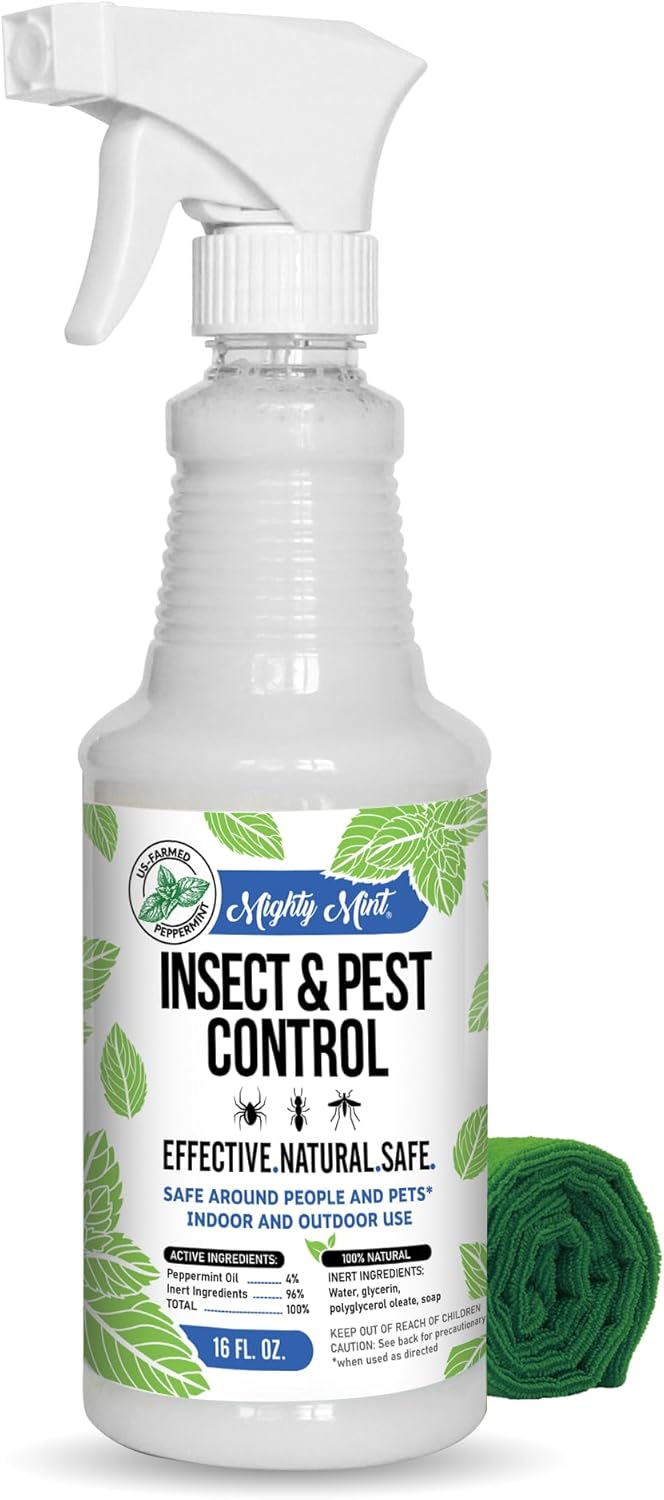
| Ingredients | Water, Glycerine, Polyglycerol oleate, Soap, Peppermint oil |
|---|---|
| Use Areas | Indoor / Outdoor |
| Size | 16 oz |
Mighty Mint is a plant-based, ready-to-use spray that uses concentrated peppermint oil to repel a broad range of household and patio pests. You apply it directly to problem areas such as baseboards, entryways, patios and around outdoor seating; the manufacturer recommends shaking and spraying until surfaces are covered and repeating applications two or more times per week for best results. Notable features include a peppermint-only scent profile, a formulation that avoids synthetic fragrances and the convenience of a 16 oz spray bottle for targeted spot treatments. Practical benefits are that it is safe to use around people and pets when dry and does not leave obvious stains on most surfaces, and the scent can make treated areas smell fresher than chemical alternatives. Important limitations are that it is a repellent rather than a pesticide so it works by discouraging pests rather than killing them, effectiveness depends on regular reapplication and it should not be applied when pollinators are present or to skin or food-contact surfaces.
Best for: Buyers who prioritize natural, low-toxicity solutions and want a targeted spray to reduce insects around patios and entryways while keeping family and pets in mind.
Less Ideal for: Anyone needing a one-time extermination or long-term residual pesticide for severe infestations should consider professional treatments or products formulated to kill pests rather than repel them.
- Plant-based peppermint formula that avoids synthetic fragrances
- Ready-to-use spray for quick, targeted indoor and outdoor applications
- Safe for people and pets when used as directed and allowed to dry
- Nonstaining on most surfaces and leaves a fresh mint scent
- Repels rather than kills insects so regular reapplication is needed to maintain protection
- Strong peppermint concentration may bother scent-sensitive individuals and requires keeping children and pets away until dry
Verdict: Choose Mighty Mint when you want a pet-friendly, plant-based spray to reduce patio and entryway insects with a fresh peppermint scent.
Choosing the Right House and Garden Bug Spray: Key Factors to Consider
Residual Protection Duration
How long a spray continues to control pests after application matters for scheduling treatments and reducing repeat use. Longer residual activity reduces the number of applications needed but can increase exposure risk to non-targets if the label does not allow use on certain plants or near pollinator-attractive flowers.
Consider expected weather conditions and where you will treat surfaces. In sunny, rainy, or irrigated areas, some active ingredients break down faster and require more frequent reapplication. Read label language about residual life on treated surfaces, and balance longevity with safety for beneficial insects and pets.
Plant and Surface Compatibility
Not all sprays are safe on foliage, edible crops, painted siding, or outdoor fabrics. Some formulas can scorch tender leaves or leave residues that discolor mulch or decking.
Identify where you need to spray: garden beds, container plants, patios, or inside near baseboards. Choose products with explicit label directions for those surfaces. When treating near ornamentals or vegetables, look for options labeled safe for use on foliage or with clear pre-harvest intervals for edibles.
Pest Spectrum and Targeting
Different formulas control different groups of pests. Broad-spectrum sprays can handle many common invaders but may harm beneficial insects. Targeted products minimize collateral damage but might miss unexpected pests.
Match the active ingredients and label claims to the pests you commonly see, such as ants, flies, spiders, aphids, or caterpillars. If you face multiple pest types, favor sprays that list those pests on the label or that combine contact knockdown with residual action against crawling insects.
Application Method and Ease
How you apply a spray affects coverage, safety, and time spent treating. Ready-to-use bottles, hose-end sprayers, and concentrates each have tradeoffs in convenience and waste. Spray pattern, droplet size, and recommended distance influence how well the product covers foliage or cracks and crevices.
Consider whether you need a fine mist for foliage, a coarse spray for patio surfaces, or a crevice-directed applicator for indoor perimeter work. Ease of cleanup, required protective equipment, and mixing instructions also determine whether a product fits your routine.
Safety Around People and Pets
Household use demands attention to inhalation and contact risks. Some active ingredients require longer re-entry times or are not recommended near children or pets. Labels provide guidance on ventilation, waiting periods, and steps to limit exposure.
Prefer formulations with clear, practical safety instructions and minimal required re-entry intervals for typical residential use. Think about where family members and pets frequent when treating and whether you can restrict access until residues are dry or settled.
Environmental and Beneficial Insect Impact
Garden sprays can harm pollinators and predatory insects important for long-term pest balance. Some products specify not to apply when pollinators are active or to avoid flowering plants. Others break down more rapidly and reduce non-target exposure.
When possible, time treatments for early morning or late evening, spot-treat rather than blanket-spray, and choose options labeled as lower risk to bees or beneficials if pollinator protection is a priority. Balancing efficacy with environmental stewardship preserves garden health over time.
Matching Spray Choice to Common Garden Scenarios
Different garden setups call for different tradeoffs. In a large mixed border you may prioritize products that are foliage-safe and have moderate residual activity so you can treat pests on ornamental leaves without risking damage. On patios and hard surfaces you can often use longer-lasting contact sprays that tolerate sunlight and moisture better.
For vegetable gardens look for products with clear pre-harvest directions and minimal persistence on edible parts. In indoor or greenhouse settings prioritize low-odor formulas and those labeled for use on indoor surfaces to reduce fumes and re-entry intervals.
- Ornamental beds: choose foliage-safe labels and time treatments outside pollinator activity periods
- Vegetable plots: check pre-harvest intervals and rinse instructions for edible crops
- Patios and sheds: favor durable residuals that resist rain and UV exposure
- Indoor baseboards: select low-odor, quick-dry options with crevice application guidance
Reducing Risk to Beneficial Insects
Protecting pollinators and predators helps reduce pest pressure long term. Targeted applications, avoiding blooms, and treating at times when pollinators are inactive are practical steps to limit harm.
Consider spot treatments on problem plants rather than whole-garden sprays. When a broader application is necessary, select products with shorter residual times or those explicitly labeled as reduced-risk to bees and other beneficials.
- Apply early morning or late evening when pollinators are less active
- Avoid spraying flowering plants unless the product label permits and application timing is safe
- Use spot treatments and barrier methods to protect beneficial insect habitat
Safe Application Practices for Home and Garden
Follow the label directions for mixing, protective gear, and re-entry intervals. Wear recommended gloves and eye protection when handling concentrates and avoid inhaling sprays. Keep children and pets away until residues are dry or the label allows re-entry.
When spraying near edible plants, follow any wash or waiting instructions. Clean equipment after use and store products in labeled, child-resistant locations away from direct heat.
- Measure concentrates carefully and avoid over-application
- Rinse sprayers thoroughly after use to prevent cross-contamination
- Store products in a cool, secure place out of reach of children and pets
Timing Treatments for Best Results
Treat when the target pests are most active for better knockdown and coverage. For many insects this means early morning or late evening, which also minimizes heat stress on plants and reduces drift.
Avoid application before heavy rain unless the label indicates rainfast performance. Reapply according to label-specified intervals rather than on a fixed schedule to prevent overuse.
- Monitor pest activity to time treatments for peak effectiveness
- Check weather forecasts to avoid washing away fresh sprays
- Reapply based on label residual guidance or visible pest rebound
Mixing Spot Treatments with Cultural Controls
Integrating sprays with cultural practices reduces reliance on pesticides. Good sanitation, proper watering, and choosing pest-resistant plants all reduce pest habitat and pressure.
Use traps, barriers, and hand removal where possible to handle small outbreaks. Saving sprays for established infestations or high-value plants extends the useful life of treatments and protects beneficial organisms.
- Remove infested debris and weeds that harbor pests
- Use physical barriers for crawling pests near foundations
- Encourage natural predators by providing habitat and avoiding broad blanket sprays
How We Chose the Best House and Garden Bug Spray
We focused on properties gardeners and homeowners care about when using treatments inside and outside the living landscape. Key evaluation criteria were residual protection, surface compatibility with plants and common household materials, spectrum of pests controlled, application flexibility, and safety for people and pets when used according to directions. We considered whether a formula works on contact and provides lasting control, how well it tolerates sun and rain outdoors, and whether it can be used on foliage, mulch, patios, and indoor baseboards. We excluded specialty professional-only products and materials whose labels restrict use in typical residential gardens. We also filtered out formulas that require specialized applicators or those with application constraints that make them impractical for most homeowners. The final shortlist prioritizes products that balance rapid knockdown with measurable residual activity, offer clear surface-use guidance, and include directions that reduce exposure risks for households with children or pets.
FAQ
Can I use the same bug spray indoors and on garden plants?
It depends on the product label. Some formulas are labeled for both indoor surfaces and foliage, but many indoor sprays are not safe for plants and some garden sprays are too strong for indoor use. Always follow the label for surface and site restrictions.
How long should I wait to re-enter an area after spraying?
Re-entry times vary by formulation and application method. Many ready-to-use sprays allow re-entry once surfaces are dry, while stronger concentrates may require airing out for a specified period. Check the label for exact re-entry instructions and follow protective recommendations.
Will a broad-spectrum spray harm pollinators in my garden?
Broad-spectrum sprays can harm pollinators if applied to flowering plants or during pollinator activity. To reduce risk, avoid spraying blooms, treat when pollinators are inactive, and consider spot treatments or lower-risk products.
How often should I reapply a garden bug spray?
Reapplication depends on the product's residual duration, weather exposure, and pest pressure. Follow label intervals for re-treatment and monitor pest levels to decide if another application is needed sooner.
Are natural or botanical sprays safer for vegetables?
Botanical or low-toxicity options often have shorter residuals and lower non-target toxicity, which can be useful around vegetables. However, they may require more frequent applications and are not always effective against heavy infestations.
What precautions should I take when spraying near pets?
Keep pets away from treated areas until the label indicates it is safe. Avoid direct sprays on animals and store products out of reach. If a product specifies a dry-residue-only re-entry, ensure surfaces are fully dry before allowing pets access.
Final Verdict
Choose a spray that matches where you will use it and the pests you need to control. Prioritize plant and surface compatibility if you will treat foliage or edible crops, and pick longer-residual options for hardscape areas where persistence matters more than pollinator exposure. Balance quick knockdown with safety by following label directions for timing, protective equipment, and re-entry. When in doubt, use targeted, spot treatments and integrate cultural controls to reduce overall pesticide reliance and protect beneficial insects.
