

Note: This article contains affiliate links. If you click on these links and make a purchase, I may earn a small commission at no extra cost to you. This helps support my research and content. Read my full affiliate disclosure here.
If you manage a large lawn, sports field, or commercial landscape, crabgrass can quickly turn a neat turf into a patchy mess. Choosing the right commercial crabgrass killer matters because coverage, residual activity, and turf safety determine whether you eliminate crabgrass without damaging desirable grasses. This guide looks at the top shortlisted commercial crabgrass killer options for heavy-duty situations and explains how each was evaluated for real-world use. We focus on how products behave in large areas, application logistics, and how long control lasts. Below you'll find the top picks and a breakdown of the decision factors to help you pick the right solution for your setting.
Top Picks at a Glance
| Best Overall The best all-around choice for most situations | BASF Drive XLR8 Crabgrass Killer Concentrate, 64 oz |  |
| Best Quality Built to a higher standard if you want something more solid | ALLIGARE Diuron 4L Herbicide (2.5 gal) |  |
| Best Value The sweet spot between price and what you get | Quali-Pro Prodiamine Pre-Emergent Herbicide, 5 lb Granules |  |
| Best Budget The cheapest option that still gets the job done reliably | Liquid Harvest Pro Crabgrass & Grassy Weed Killer, 32 oz, 18.92% Quinclorac |  |
| Highest Rated A top-rated pick with lots of positive feedback | Target 6 Plus MSMA 48.3% Post-Emergent Turf Herbicide, 2.5 Gallon |  |
| Most Popular A crowd favorite that many people choose with confidence | Syngenta Tenacity Turf Herbicide, 8 oz |  |
| Best Seller A high-volume bestseller chosen again and again | Drive XLR8 Crabgrass Killer for Lawn & Turf, 2.5 Gallon |  |
BASF Drive XLR8 Crabgrass Killer Concentrate, 64 oz
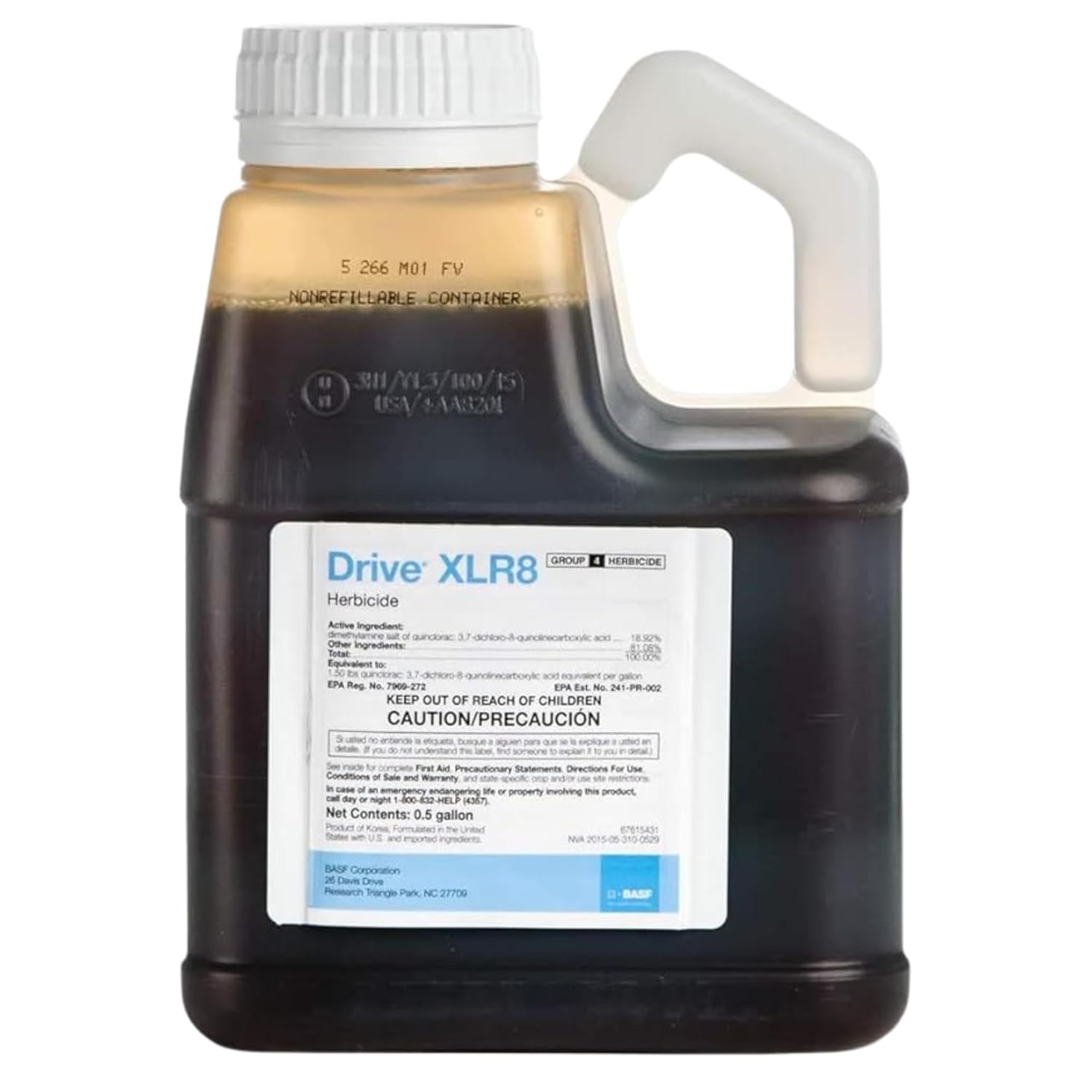
| Unit Count | 64 Ounce |
|---|---|
| Item Form | Liquid |
| Active Ingredients | Quinclorac 18.92% |
| Coverage | Full |
Drive XLR8 is a concentrated liquid herbicide built mainly to knock down crabgrass and other grassy and broadleaf weeds in turf. You mix a small measured amount with water and a methylated seed oil adjuvant and spray over the turf for spot or broadcast treatment. Its water-based formulation and quinclorac active ingredient deliver relatively fast uptake and labeled rainfast protection within about an hour, and the product advertises up to 30 days of residual control, which reduces how often you need to reapply. It is labeled for both warm- and cool-season turf and can be tank-mixed with other turf herbicides when label directions allow, giving flexibility for complicated weed problems. Important limitations are that it is a chemical herbicide that requires careful PPE and strict adherence to label directions, and some local restrictions apply, including reduced use patterns in certain states and spot-application limits. For gardeners who follow the label, it offers reliable, professional-strength control of crabgrass and many common lawn weeds.
Best for: Homeowners and groundskeepers who want a strong, professional-style postemergent solution to quickly reduce crabgrass and mixed weed populations and who are comfortable following label safety and application steps.
Less Ideal for: People seeking an organic or nonchemical approach to crabgrass control or users who prefer no-handling of concentrated herbicides should consider alternative cultural or nonchemical options.
- Concentrated 64 oz formula covers large areas when mixed per label directions
- Water-based formulation for faster plant uptake and rainfast protection in under an hour
- Provides up to 30 days of residual control against crabgrass and several grassy weeds
- Labeled for use on both warm-season and cool-season turf and compatible with some tank mixes
- Requires careful handling and PPE because it is a chemical herbicide
- Some state-specific use restrictions and label limitations apply
Verdict: Choose Drive XLR8 when you want a concentrated, fast-acting postemergent herbicide that delivers reliable crabgrass control and multi-week residual protection.
ALLIGARE Diuron 4L Herbicide (2.5 gal)

| Unit Count | 320 Fluid Ounces |
|---|---|
| Liquid Volume | 2.5 gallons |
| Item Form | Liquid |
| Coverage | Non-selective broad spectrum coverage |
| Active Ingredients | Herbicide |
ALLIGARE Diuron 4L is a concentrated liquid herbicide designed to prevent and kill tough grasses like crabgrass, foxtail, and ryegrass across large lawns or fields. It is used by mixing the liquid with water and applying as a spray for either pre-emergent protection or post-emergent control, and it is compatible with tank mixes for integrated programs. The product’s non-selective, broad-spectrum coverage means it can deliver wide-area control and reduce repeat treatments when applied correctly. Practical benefits include a large 2.5 gallon volume that covers substantial acreage and a formulation that experienced applicators can combine with other products to manage resistant populations. Important limitations are that it is a non-selective herbicide so care is required to protect desirable plants, and it requires correct timing and application technique to achieve labeled performance and avoid damage to turf or ornamental species. Users must follow label directions and local regulations when applying to commercial sites.
Best for: Commercial landscapers or experienced property managers who need broad, reliable control of grassy weeds across large areas and who plan applications as part of an integrated weed program.
Less Ideal for: Casual homeowners with small lawns or gardeners who need selective spot treatments or who lack experience with concentrated herbicides.
- Concentrated 2.5 gallon liquid provides coverage suitable for large lawns or commercial sites
- Effective on both pre-emergent and post-emergent control of annual and perennial grasses including crabgrass and foxtail
- Compatible with tank mixes to allow integration into resistance management programs
- Non-selective formulation can damage desirable turf and plants if not applied carefully
- Requires proper timing and application technique to achieve expected control
Verdict: Choose this concentrated 2.5 gallon Diuron formulation when you need powerful, large-area pre- and post-emergent control of crabgrass and other tough grassy weeds.
Quali-Pro Prodiamine Pre-Emergent Herbicide, 5 lb Granules

| Item Form | Granule |
|---|---|
| Coverage | Pre-emergent grass and broadleaf weed control, season long crabgrass control |
| Active Ingredients | Prodiamine 65% |
Quali-Pro Prodiamine is a granular pre-emergent herbicide designed to prevent germination of common annual grassy and broadleaf weeds across lawns and landscape beds. You apply it before weed seeds germinate in spring or as a fall treatment to build residual control through the growing season. The product contains 65% prodiamine, which is widely used for reliable, long-lasting control of crabgrass, annual bluegrass and several broadleaf weeds, and it mixes readily when tank-mixed with fertilizers or iron. In real-world use it offers predictable, season-long suppression when applied at the labeled rate and incorporated by irrigation or rainfall. Important practical limits are that it is preventive only and will not kill established weeds, and proper timing and rate are essential to avoid reduced effectiveness. For larger areas the 5 lb package covers moderate lawn acreage but may require multiple bags for extensive turf.
Best for: Homeowners and lawn care professionals who prioritize a dependable, season-long preventive solution to keep crabgrass and annual weeds from establishing in turf.
Less Ideal for: Gardeners needing a post-emergent solution for existing weeds or those who prefer liquid ready-to-use products for spot treatments.
- High active ingredient concentration (Prodiamine 65%) for long residual control
- Granular form allows easy broadcast application and tank mixing with fertilizers
- Effective season-long crabgrass and annual weed suppression when applied correctly
- Suitable for spring or fall applications to build preventive control
- Pre-emergent only and will not control established weeds
- 5 lb bag may be insufficient for large lawns without purchasing additional quantity
Verdict: Choose this prodiamine granule when you want a proven, season-long preventive herbicide to reliably stop crabgrass and other annual weeds before they start.
Liquid Harvest Pro Crabgrass & Grassy Weed Killer, 32 oz, 18.92% Quinclorac
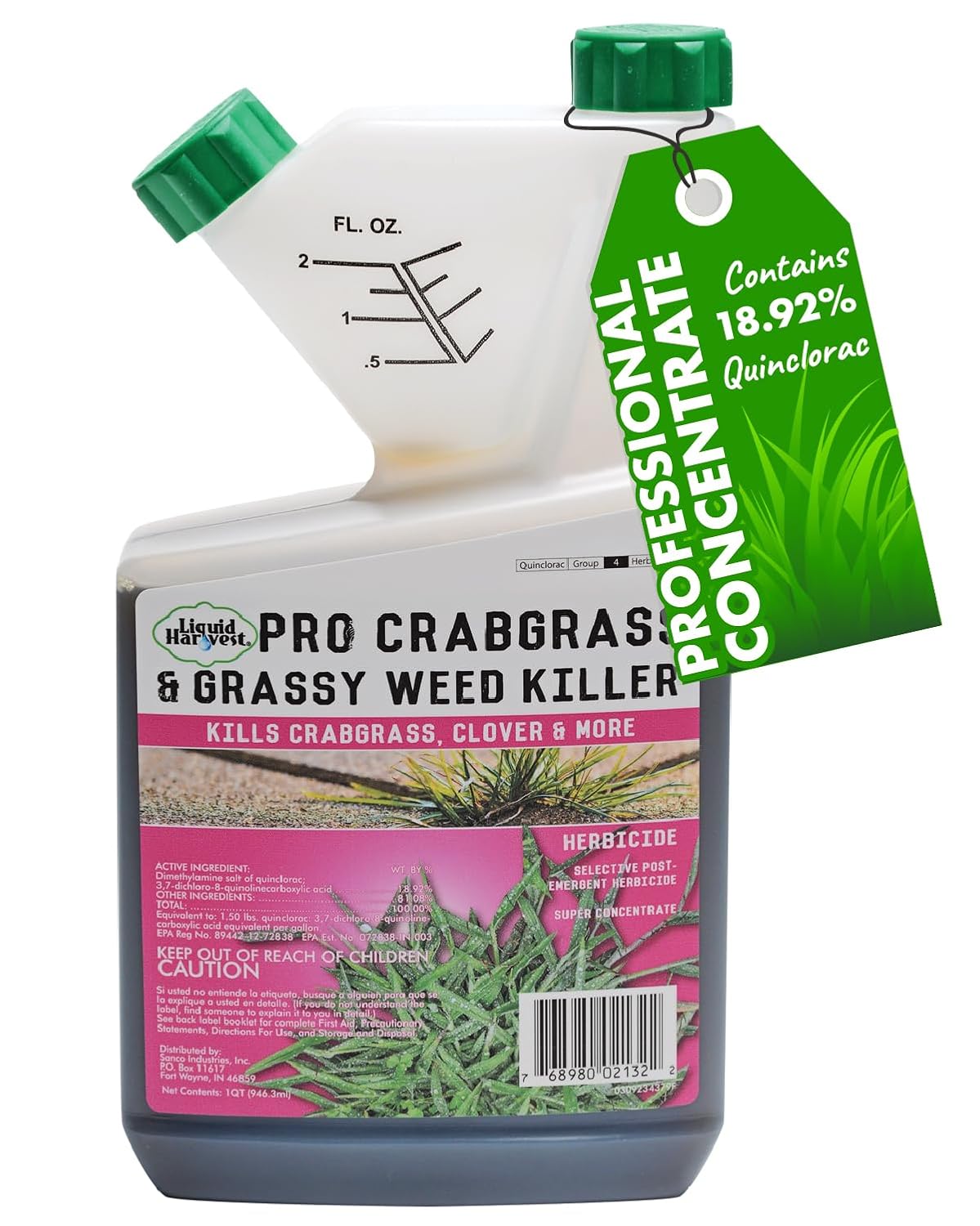
| Active ingredient concentration | 18.92% Quinclorac |
|---|---|
| Formulation | Liquid concentrate |
| Unit count | 32 Fluid Ounces |
| Coverage note | Residual control up to 90 days |
This 32-ounce concentrate from Liquid Harvest is built to treat crabgrass and a broad range of grassy and broadleaf lawn weeds using a high 18.92% quinclorac formulation. It is mixed down for spot or broadcast application with typical use involving a pump or hose-end sprayer and following label dilution rates (about 1.45 ounces per 1,000 sq ft for spot post-emergence). Notable features include residual control that can last up to 90 days, labeled use on both residential and commercial turf, and compatibility with adding a surfactant to improve leaf uptake. Practical benefits are strong performance against tough summer annuals like crabgrass and foxtail and convenience from a concentrated bottle that covers a larger area than a ready-to-use product. Important limitations are that correct timing and mixing are required for safe, effective results and that it is a chemical solution not suitable for overseeding windows without observing the stated wait times; safety precautions must be followed and the label consulted for exact instructions.
Best for: Buyers managing larger lawns or commercial turf who want a budget-conscious concentrated herbicide that reduces per-application cost while delivering multi-month residual control.
Less Ideal for: Homeowners seeking an all-in-one ready-to-use product or those planning imminent overseeding should consider gentler or prepackaged alternatives.
- High active ingredient level (18.92% quinclorac) for effective post-emergent control of crabgrass and other grassy weeds.
- Concentrated 32 oz bottle covers more area than ready-to-use mixes, reducing per-application cost for larger lawns or commercial sites.
- Provides residual control lasting up to about 90 days, lowering the need for frequent reapplications.
- Labeled for both residential and commercial turf use, including golf courses and sod farms, giving flexibility for different properties.
- Requires careful dilution and application equipment such as a sprayer to avoid over- or under-application.
- Not appropriate for use immediately before or during seeding; timing restrictions limit use around overseeding windows.
Verdict: A concentrated, high-strength quinclorac formula that stretches your budget by treating larger turf areas with lasting post-emergent crabgrass control.
Target 6 Plus MSMA 48.3% Post-Emergent Turf Herbicide, 2.5 Gallon
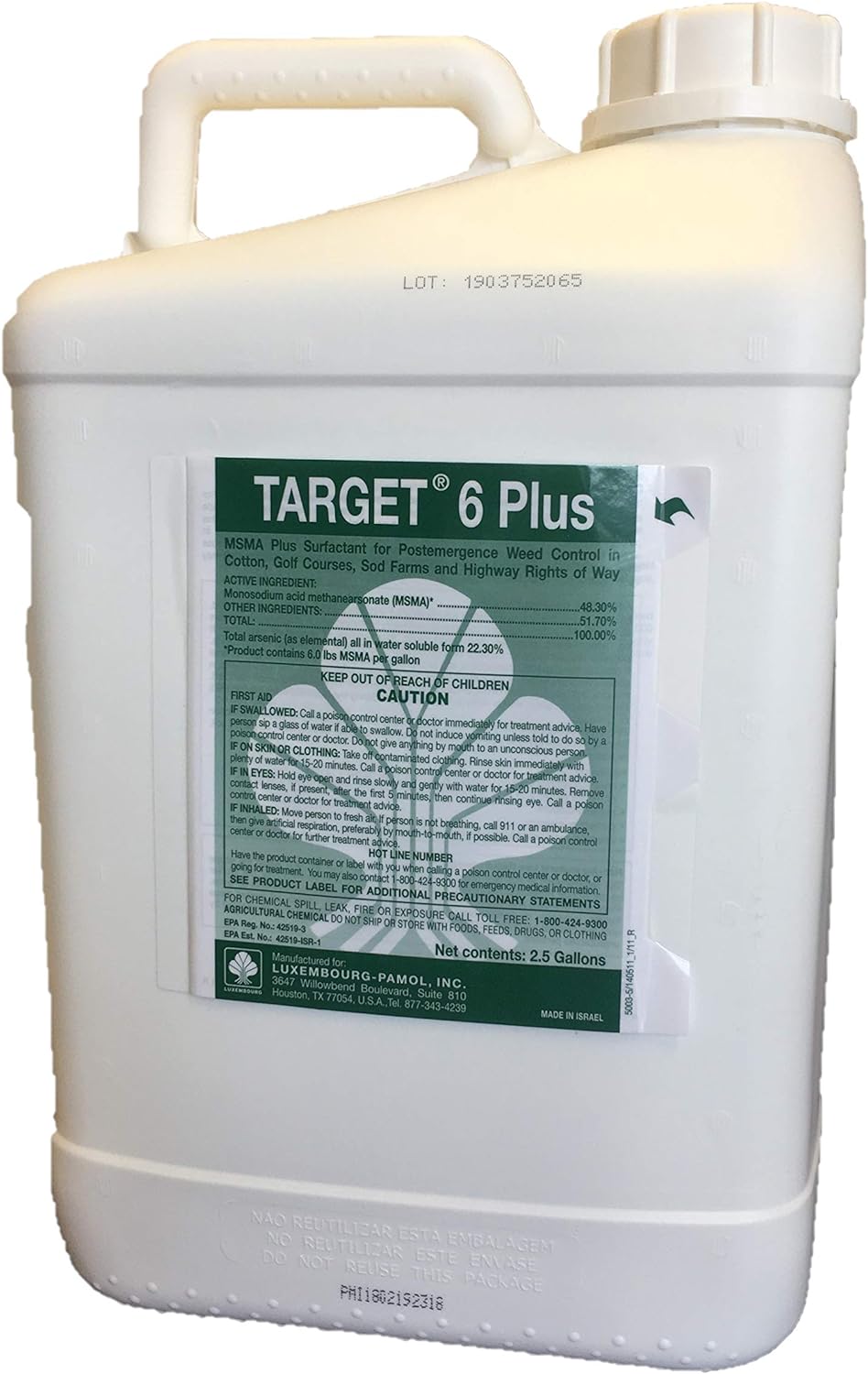
| Active Ingredients | Monosodium acid Methanearsonate MSMA |
|---|---|
| Unit Count | 320 Fluid Ounces |
| Item Form | Liquid |
| Coverage | Selective: Crabgrass, Dallisgrass, Johnsongrass, Nutsedge, Pigweed, Chickweed |
Target 6 Plus MSMA is a concentrated post-emergent herbicide intended for selective control of crabgrass, dallisgrass, johnsongrass, nutsedge, pigweed, and chickweed in turf. It is mixed at about 2 ounces per gallon and applied as a coarse spray, so most users will use it with a pump sprayer to spot-treat or cover larger areas such as golf course turf, sod farms, or established lawns. The primary strength is its active ingredient, monosodium acid methanearsonate (MSMA), which is effective on weeds that many general lawn products struggle to suppress. The product comes in a 2.5 gallon jug, which provides a substantial supply for repeated treatments across medium to large lawns. Important practical considerations are safety and label directions: the product can be harmful if absorbed or swallowed and must not be applied where food is grown, and protective equipment and careful handling are required. This makes it suitable for experienced users or contractors who follow label instructions, while casual gardeners should exercise caution or seek professional application.
Best for: Buyers who prioritize reliable, contractor-grade control of stubborn post-emergent turf weeds and who are comfortable following strict label safety and application procedures.
Less Ideal for: Casual gardeners, small-plot vegetable or edible growers, or anyone unwilling to use personal protective equipment or follow restricted-use safety guidance.
- High concentration of MSMA effective on hard-to-control grassy weeds
- Large 2.5 gallon volume supports multiple treatments for medium to large turf areas
- Selective post-emergent activity targets both grassy and some broadleaf weeds listed on the label
- Simple mix rate (2 oz per gallon) makes dilution and repeat applications straightforward
- Contains an arsenical active ingredient that requires strict safety precautions and may have regulatory restrictions
- Not intended for use where food is grown and requires protective equipment during handling and application
Verdict: Choose this concentrated MSMA formulation when you need proven, contractor-grade post-emergent control of tough turf weeds and will follow label safety and application requirements.
Syngenta Tenacity Turf Herbicide, 8 oz
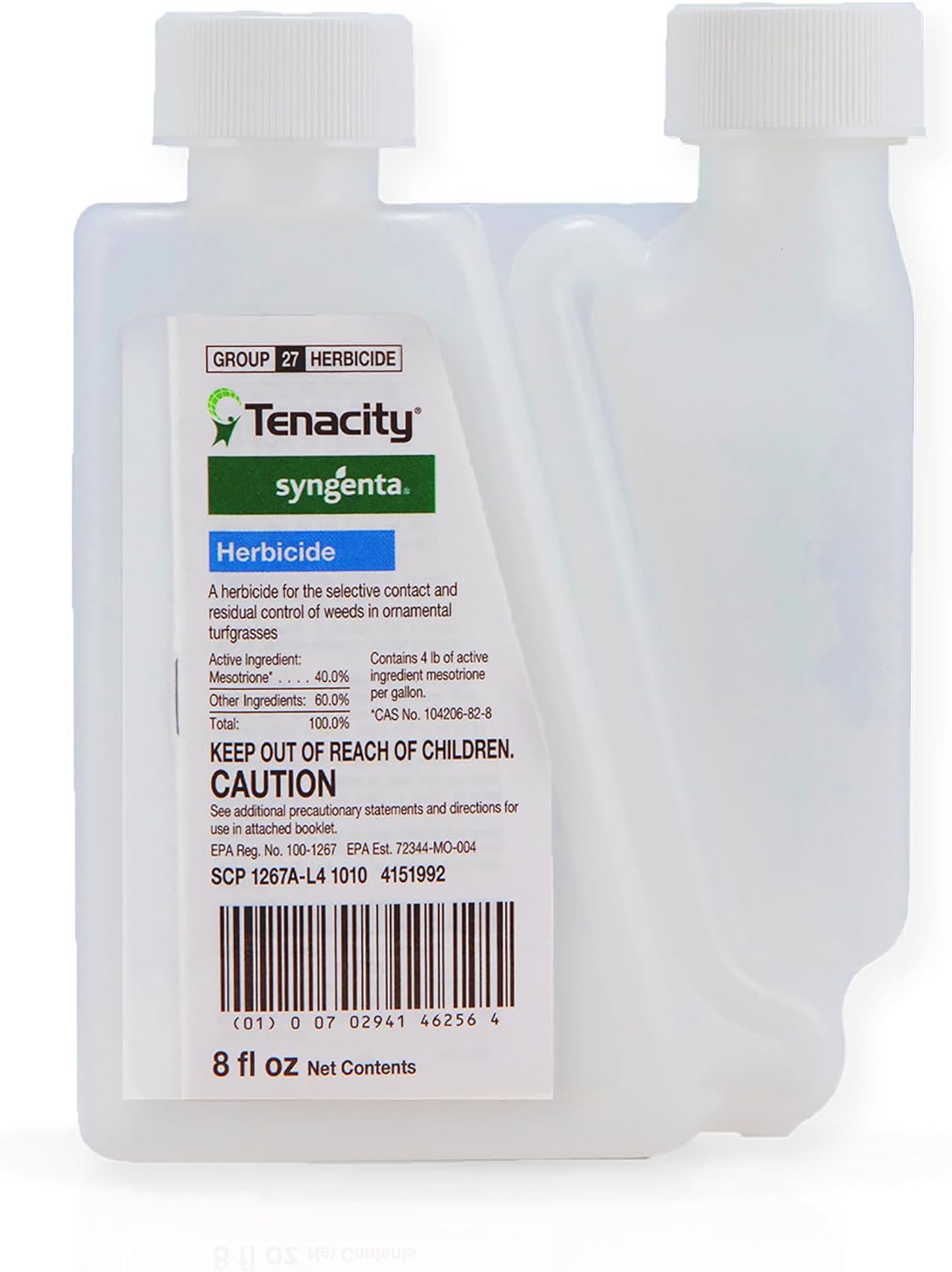
| Unit Count | 8 Fluid Ounces |
|---|---|
| Item Form | Liquid |
| Coverage | 2000 ft^2 per 1sp of product |
| Active Ingredients | Mesotrione |
Tenacity Turf Herbicide is a concentrated mesotrione-based liquid designed for both pre-emergent and post-emergent control of common lawn weeds including crabgrass, clover, chickweed and dandelions. You apply it diluted according to label rates with a handheld or hose-end sprayer to target problem areas or broadcast across the lawn; when used as a pre-emergent it is taken up as weeds emerge and when applied post-emergent it acts systemically for selective control. The product covers a large area per bottle and the active ingredient provides residual control so you can expect longer suppression than a contact-only herbicide. Important practical points are that it is turf-selective so follow the label for grass species and mixing instructions to avoid turf injury, and results can take several days to appear. Also this is a concentrated chemical intended for careful, measured application rather than spot-use by people who prefer non-chemical methods.
Best for: Gardeners focused on strong, reliable crabgrass and broadleaf weed control who are comfortable using concentrated herbicides and following label directions for turf safety.
Less Ideal for: People seeking organic, mechanical, or spot-only solutions or those unwilling to follow detailed mixing and application instructions should consider other options.
- Systemic mesotrione active ingredient controls both pre- and post-emergent weeds
- Selective to turf when used per label, allowing treatment without killing desirable grass species
- Concentrated 8 oz liquid provides wide coverage per bottle
- Provides residual suppression, reducing frequency of repeat applications
- Requires careful mixing and adherence to label for turf safety
- Not a non-chemical or organic option for weed control
Verdict: Choose Tenacity when you want a concentrated, turf-selective herbicide that delivers pre- and post-emergent control of crabgrass and other common lawn weeds.
Drive XLR8 Crabgrass Killer for Lawn & Turf, 2.5 Gallon

| Item Form | Liquid |
|---|---|
| Coverage | Grassy and broadleaf weeds |
| Unit Count | 1 Ounce |
| Included Components | Drive XLR8 (2.5gal) |
Drive XLR8 is a concentrated, water-based post-emergent herbicide designed for turf professionals and property managers to knock back crabgrass and a wide range of other grassy and broadleaf weeds. It is typically mixed per label directions and applied with standard boom or spot-spray equipment on both warm- and cool-season turf. The formulation emphasizes quick uptake and becomes rainfast in under an hour, so treatments are less likely to wash off shortly after application. Notable features include coverage of tough grassy weeds such as crabgrass, foxtail and torpedo grass plus broadleaves like dandelion and clover, and up to 30 days of residual control to reduce reapplications. Practical benefits are efficient weed reduction across large areas and suitability for commercial sites like golf courses or sports fields. Important limitations are that it requires proper PPE and strict adherence to label restrictions and state regulations, some areas may limit application methods, and the product is concentrated so accurate mixing and professional handling are necessary to avoid turf damage.
Best for: Professional landscapers, turf managers, and risk-averse property owners who need dependable, longer-lasting control of crabgrass and other turf weeds across commercial or large residential lawns.
Less Ideal for: Homeowners seeking an easy, one-step consumer product for small yards or those unwilling to follow strict label safety and application procedures should consider simpler, ready-to-use alternatives.
- Water-based formula for faster plant uptake and quicker visible results
- Rainfast in under an hour, reducing loss from light rain after application
- Broad-spectrum activity against major grassy and broadleaf weeds common in turf
- Provides up to 30 days of residual control to limit repeat treatments
- Requires professional handling and proper personal protective equipment during mixing and application
- Label restrictions and some state-specific application limits may reduce where or how it can be used
Verdict: Choose Drive XLR8 when you need a professional-grade, fast-acting post-emergent that delivers broad-spectrum control and up to 30 days of residual protection on turf.
Choosing the Right Commercial Crabgrass Killer: Key Factors to Consider
Coverage and Product Concentration
Coverage determines how much area a single container will treat, which directly affects labor and logistics for large sites. Products with higher concentrations often require dilution but can treat many more square feet per gallon of concentrate. Understanding label rates in terms of square feet per gallon at recommended dilution helps you estimate how many containers and how much sprayer time you will need.
Also consider how concentration affects mixing accuracy. Highly concentrated products require precise measuring to avoid overapplication, which can increase turf stress. For commercial work, choose formulations that balance high coverage with straightforward mixing instructions to reduce operator error.
Residual Activity and Timing
Residual activity tells you how long the product prevents new crabgrass seedlings from establishing. Longer residuals reduce the need for repeat applications during the crabgrass germination window, which is valuable on large properties where re-treating is costly. However, longer residuals may restrict reseeding windows, so check how long the product persists in the soil and when it is safe to overseed.
Timing relates to seasonal germination patterns. Preemergent products must be applied before crabgrass germinates, typically in spring as soil temperatures reach a threshold. Postemergent controls are useful for actively growing patches but may require multiple passes and careful selection to avoid turf injury.
Turfgrass Safety and Species Compatibility
Different active ingredients and use rates interact with turf species differently. What is safe on a durable warm-season turf might injure a cool-season lawn or newly sodded areas. For commercial sites with mixed turf types, pick products with broad compatibility or use targeted treatments where species are uniform.
Also account for turf age and stress. Newly established turf, heat-stressed lawns, or areas under drought can be more sensitive to herbicides. Confirm labeled setbacks for newly seeded or sodded areas and any temperature-related warnings on the label to minimize injury risks.
Application Method and Equipment Compatibility
Large-area work often uses boom sprayers, ATV-mounted sprayers, or calibrated backpack units. Choose a formulation that is compatible with your equipment and that mixes cleanly without clogging nozzles or creating excessive foaming. Liquid concentrates, water-dispersible granules, and flowables each behave differently in pumps and strainers.
Consider nozzle selection and boom height for even coverage. Some products require low-drift nozzles or specific droplet sizes to achieve labeled control and reduce off-target movement. Also check agitation requirements and whether the product separates in storage, which affects field mixing routines.
Environmental Persistence and Runoff Risk
Residual herbicides can persist in soil and move with runoff or irrigation. For properties near sensitive areas such as waterways, beds, or native plantings, select products with lower runoff potential or follow buffer guidance on the label. Timing applications to avoid heavy rain forecasts and managing irrigation schedules after treatment reduce off-target movement.
Also review any restrictions for use near edible crops or pollinator plantings. Some active ingredients have specific prohibitions or waiting periods that matter when landscapes include garden beds or community areas.
Regulatory Label and Worker Safety Information
Commercial products include specific personal protective equipment and reentry interval requirements. For landscape crews, clear PPE guidance and short reentry intervals reduce operational friction and downtime. Verify label instructions for application rates, tank-mix compatibility, required PPE, and any notification requirements for treated areas.
Training staff on label compliance prevents misuse and legal exposure. Keep a copy of the product label accessible when crews mix and apply to ensure on-site adherence to safety and regulatory directions.
When to Apply Treatments
Timing determines whether you use a preemergent or postemergent approach. Preemergent applications should go down before soil temperatures consistently reach the threshold for crabgrass germination. In many regions this means applying in early spring and sometimes following up with a midseason application if the product label supports it.
Postemergent treatments are best for visible crabgrass patches. They work most effectively when weeds are young and actively growing. Large properties often need a combined strategy: a preemergent program to suppress new seedlings and spot postemergent treatments for escaped plants.
- Check local soil temperature data to schedule preemergent timing.
- Avoid postemergent application on very hot, drought-stressed turf to reduce injury.
- Plan applications around irrigation and rainfall forecasts to improve uptake and limit runoff.
Equipment and Mixing Best Practices
Calibrate sprayers before treating large areas to ensure correct delivery rate. Use the label's recommended gallons per acre or square foot rates and match nozzle type and boom height to the application. Replace worn nozzles to maintain consistent droplet size and avoid uneven control.
When mixing concentrates, add water first, then product, and maintain agitation as specified. Strain wells and use clean water sources to prevent contaminant reactions. For tank mixes, confirm compatibility with a jar test before full-scale application.
- Record nozzle sizes and pressure settings for repeatable mixes.
- Rinse tanks and equipment thoroughly between different chemistries to avoid cross-contamination.
- Use antisiphon and backflow prevention to protect water supplies during mixing.
Managing Reseeding and Overseeding
Residual herbicides often limit when you can overseed treated areas. If you plan to reseed, choose products with shorter plant-back intervals or plan seeding before treating. For overseeding after a residual product, test small areas first and consult label reentry or seeding intervals.
When renovating turf, allow enough time between the last application and seeding or sod installation to reduce establishment problems. Mechanical methods and targeted hand removal may be preferable when reseeding windows are narrow.
- Document last application dates to track safe reseeding windows.
- Consider using non-residual spot treatments in areas scheduled for immediate reseeding.
- Combine cultural practices like aeration and topdressing to help seeded areas establish after waiting periods.
Integrating Cultural Controls
Herbicides are most effective when combined with cultural practices that favor turf density and vigor. Proper mowing height, balanced fertility, and timely irrigation make turf more competitive and less hospitable to crabgrass. Thin, stressed turf invites crabgrass invasion and reduces the effectiveness of any chemical control.
Cultural approaches also reduce overall herbicide needs. Improving soil health, overseeding bare spots in appropriate seasons, and managing shade and compaction address underlying causes of crabgrass outbreaks so that chemical controls are less relied upon over time.
- Raise mowing height to encourage deeper roots on cool-season grasses.
- Use soil tests to guide fertility and avoid excess nitrogen that can favor grassy weeds.
- Address compaction with aeration to improve root growth and turf resilience.
Safety and Environmental Stewardship
Follow label PPE and buffer requirements to protect applicators and bystanders. For commercial work, maintaining records of applications and having SDS information on hand are essential components of responsible operations. Use signage or verbal notifications as required to keep the public informed when areas are treated.
Minimize environmental impact by avoiding applications before heavy rain and by using the lowest effective labeled rate. Where possible, select products and practices that reduce runoff and protect nearby plantings, water features, and pollinator habitat.
- Keep application records with product names, rates, and weather conditions.
- Coordinate with property managers about sensitive areas and scheduled activities.
- Use buffer zones around water features as indicated on the label.
How We Chose the Best Commercial Crabgrass Killer
We shortlisted products designed for large-area and professional use, then filtered options using criteria that reflect how treatments perform in commercial settings. Key evaluation dimensions included labeled broadcast coverage per container, residual control duration against crabgrass, turfgrass safety on common warm- and cool-season lawns, and the clarity of application rates and reentry intervals. We also considered ease of application for large sites, including compatibility with common sprayer and spreader equipment. Products were excluded if they lacked clear labeled instructions for commercial turf, did not provide measurable residual control data, or were intended only for home garden containers or spot treatments. We prioritized products with transparent active-ingredient information and documented guidance on timing, water volumes, and compatible turf species. This process ensured the final list focuses on practicality, safety, and predictable performance for landscape managers and large-property owners.
FAQ
Can commercial products be used on newly seeded turf?
It depends on the product. Many commercial crabgrass killers have specific waiting periods before seeding or after seeding. Check the label for plant-back and reseeding intervals and test small areas if you are unsure.
How often should I reapply a residual product in commercial settings?
Reapplication frequency depends on the labeled residual duration and local growing conditions. Some products provide season-long control with one timely application, while others may require follow-up applications. Monitor turf and follow label timing guidance.
Are liquid concentrates better than granular formulations for large areas?
Both have pros and cons. Liquids often provide more uniform coverage and are easier to apply with boom sprayers, while granules can be convenient for precise broadcast rates. Equipment compatibility and coverage goals usually determine which format is more efficient for a given site.
Will rain reduce the effectiveness of an application?
Rain can reduce effectiveness if it occurs immediately after application and before the product binds to soil or is absorbed by plants. Many labels specify a rainfast period; scheduling applications during stable weather improves control and reduces wash-off risk.
Can I mix different herbicides to broaden control?
Tank mixes are common but should be approached cautiously. Check label compatibility and perform a jar test to detect adverse reactions. Always follow label restrictions regarding tank mixes, application rates, and sequential use to avoid turf injury.
How does irrigation affect treated areas after application?
Irrigation timing matters. Some products require irrigation to activate residual control, while others need a dry window after application. Follow label directions on irrigation events to ensure activation and minimize runoff and off-target movement.
Final Verdict
For large lawns and commercial landscapes, prioritize products that clearly state coverage per container, offer the residual length you need, and list compatible turf species. Match the formulation to your equipment and plan timing around germination windows and weather to maximize effectiveness. Weigh the tradeoff between long residual control and reseeding restrictions, and coordinate application practices with cultural maintenance to reduce long-term herbicide dependence. With clear labels and proper application, you can control crabgrass effectively while protecting turf and the surrounding environment.
