

Note: This article contains affiliate links. If you click on these links and make a purchase, I may earn a small commission at no extra cost to you. This helps support my research and content. Read my full affiliate disclosure here.
Good compost tea can quickly add living microbes and soluble nutrients to garden beds, containers, and established lawns. Choosing the right compost tea approach matters because brewing method, feedstocks, and application timing determine whether you are boosting beneficial soil life or simply diluting nutrients. This guide covers six top compost tea approaches and products shortlisted for reliable extraction, microbial diversity, and ease of use. We evaluate each option on measurable brewing performance and garden readiness so you know which tea style fits your patch, whether you grow vegetables, ornamentals, or houseplants. Read on for the decisions that matter before you start brewing.
Top Picks at a Glance
| Best Overall The best all-around choice for most situations | VermisTerra Earthworm Casting Tea Gallon – Organic Worm Casting Concentrate with Kelp |  |
| Best Quality Built to a higher standard if you want something more solid | Mighty Plant Instant Compost Tea (1 lb) |  |
| Best Value The sweet spot between price and what you get | Bloom City Organic Earthworm Tea Concentrate, 32 oz |  |
| Best Budget The cheapest option that still gets the job done reliably | Xtreme Gardening Xtreme Tea Brews Compost Tea Kit, 2-Pack |  |
| Highest Rated A top-rated pick with lots of positive feedback | Gardenersbud Enriched Super Compost Tea (64 fl oz) |  |
| Most Popular A crowd favorite that many people choose with confidence | Real Growers Recharge 16 oz Powdered Soil Microbe Blend |  |
VermisTerra Earthworm Casting Tea Gallon – Organic Worm Casting Concentrate with Kelp

| Form | Concentrate |
|---|---|
| Makes | 42 – 128 gallons of feed mixture |
| Usage rate | 1–3 oz per gallon of water |
| Intended crops | Vegetables, flowers, fruit and trees |
VermisTerra Earthworm Casting Tea is a ready-to-dilute organic soil amendment made from fermented worm castings plus kelp and biological inoculants. You dilute 1 to 3 ounces per gallon to make a feed and apply as a splash or drench to support roots, blooms and overall plant vigor. The formula emphasizes living enzymes and fulvic compounds that can improve nutrient uptake, buffer pH, and help plants tolerate stresses like drought or salinity. It also claims broad microbial populations rather than just leachate, so it functions as a true biofertilizer and compost tea substitute that can be used across vegetables, flowers, fruit and trees. Practical benefits include making a large volume of feed from one gallon of concentrate and avoiding heavy metals or common pathogens per lab testing. Limitations are that benefits depend on consistent, correct dilution and application and that results vary with existing soil biology and cultural care; this is a biology-focused supplement rather than a complete synthetic fertilizer replacement for immediate major nutrient deficiencies.
Best for: Gardeners seeking an organic, biology-first soil booster to improve long-term soil health and plant resilience across edibles and ornamentals.
Less Ideal for: People who need fast, high-dose synthetic nutrients for acute deficiencies or those who prefer a single-product granular fertilizer approach.
- Contains fermented worm castings with living enzymes and a diverse biological inoculum
- Includes kelp and fulvic compounds to support nutrient uptake and root development
- Makes a large volume of feed when diluted (42 to 128 gallons per gallon of concentrate)
- Lab tested to show absence of common pathogens and heavy metals
- Effectiveness depends on existing soil biology and regular applications rather than providing immediate high NPK levels
- Requires correct dilution and handling to avoid overapplication
Verdict: Buy this if you want a concentrated, lab-tested worm-casting tea that builds soil biology and stretches into many gallons of organic feed.
Mighty Plant Instant Compost Tea (1 lb)

| Item Form | Liquid (mixable powder){ |
|---|---|
| Specific Uses For Product | Organic |
| Application Method | root drench or foliar spray |
| Target Species | All plants |
Mighty Plant Instant Compost Tea is a concentrated powder designed to make repeatable, ready-to-use compost tea without traditional brewing. Mix at the recommended rate and apply as a root drench, foliar spray, or through irrigation for conventional gardens, hydroponics, and container plants. The formula contains microbes, amino acids, kelp and yeast extracts intended to boost root-zone biology and nutrient conversion, which can translate into stronger vegetative growth and improved flowering when used consistently. It is economical in use — one pound stretches to many gallons — and the manufacturer emphasizes a pharmaceutical-grade base to reduce variability compared with homemade brews. Important limitations are that the product is an additive rather than a complete fertilizer so it works best alongside a feeding program, and claimed benefits depend on correct dosing and regular applications. It also does not replace practices like proper soil management or pH control. For growers focused on measurable performance, it is a practical way to add microbial activity and amino acids without the time and unpredictability of traditional tea brewing.
Best for: Serious hobbyists and performance-focused growers who want a reproducible microbial boost to improve root health and yields without brewing traditional compost tea.
Less Ideal for: Casual gardeners seeking an all-in-one fertilizer or those unwilling to follow a regular feeding routine should consider simpler complete plant foods instead.
- Concentrated formula that makes many gallons per package for economical applications
- Designed for both root drench and foliar spray use across soil and hydroponic systems
- Contains microbes and amino acids plus kelp and yeast extracts to support root-zone biology
- Consistent, instant mix reduces variability compared with homemade compost tea brewing
- Not a complete fertilizer so must be used alongside a nutrient program
- Efficacy depends on repeated correct dosing and overall growing conditions
Verdict: Use this concentrated instant compost tea when you want a reliable, performance-oriented microbial and amino-acid boost without brewing variability.
Bloom City Organic Earthworm Tea Concentrate, 32 oz

| Item Form | Liquid |
|---|---|
| Specific Uses For Product | Plant Growth |
| Coverage | Medium |
| Mixing Ratio | Dilute 1 part concentrate with 9 parts water |
Bloom City Organic Earthworm Tea Concentrate is a ready-to-dilute microbial soil booster made from earthworm castings and compost-derived nutrients. You mix the concentrate with water (manufacturer suggests 1:9 for routine watering and weaker ratios for larger areas) and apply it with a watering can, hose-end sprayer, or add to compost to accelerate decomposition. The formula emphasizes living microbes, humic substances, and organic inputs to stimulate soil life and improve nutrient uptake and root development. In practice it is easy to use for container plants, raised beds, and compost piles because the dilution directions are straightforward and the liquid form spreads evenly. Expect improved soil activity over repeated applications rather than instant visual changes to foliage. Limitations are that it is a biological supplement so results vary with existing soil conditions and it requires recurring use for best effect; it is not a single-application fertilizer or a quick chemical fix. For growers who want to build living soil, it integrates cleanly into regular watering routines and compost management.
Best for: Buyers who prioritize building healthy, microbially active soil and prefer regular, practical supplements to improve root strength and long-term soil function.
Less Ideal for: Gardeners seeking a one-time quick-feed chemical fertilizer or immediate visible foliar changes should consider alternative fast-acting products.
- Concentrated liquid for easy dilution and even application across pots, beds, and compost.
- Formulated from earthworm castings and compost nutrients to encourage microbial activity and healthier roots.
- Simple, clear mixing ratios for routine watering and larger-area use.
- Suitable for both indoor houseplants and outdoor garden beds and compost boosts.
- Effects depend on existing soil biology so improvements may take multiple applications and time to appear.
- Not a complete nutrient fertilizer for immediate macronutrient correction.
Verdict: Choose this concentrate if you want an easy-to-use organic microbial booster to strengthen roots and grow living soil through regular applications.
Xtreme Gardening Xtreme Tea Brews Compost Tea Kit, 2-Pack

| Item Form | Powder |
|---|---|
| Specific Uses For Product | Vegetable Gardens, Fruit Trees, Herbs, Houseplants, Flowers |
| Coverage | Full |
| Liquid Volume | 10 gallons |
Xtreme Gardening Xtreme Tea Brews is a simple, two-part powdered kit for making compost tea at home. Each pouch brews several gallons of active tea that you can apply to the root zone weekly to boost soil biology and nutrient availability. The product pairs a compost material with targeted microbe food so the finished brew supports beneficial microbial populations without needing separate recipes or bulky compost piles. It is easy to use for container gardens, raised beds, vegetable rows, ornamentals, and even soilless or hydroponic setups. Practical benefits include consistent, repeatable batches and concentrated packaging that stores dry until needed. Limitations are that application rates are not specific on the packaging so you may need to follow general compost tea guidance for dilution and dosing, and the powdered form requires stirring or aeration to activate microbes. This kit is best when you want a quick, low-fuss way to introduce beneficial microbes and organic matter into your routine rather than making traditional compost or large-scale aerated brews.
Best for: Gardeners who want an affordable, low-effort way to add beneficial microbes to vegetables, herbs, flowers, and container plants and prefer a ready-to-brew option over making their own compost tea from scratch.
Less Ideal for: People looking for exact, measured dosing instructions on-pack or those needing large commercial-scale tea production should consider other options.
- Two-part sealed powder keeps ingredients stable until brewing
- Brews multiple gallons per pouch for full coverage applications
- Formulated to feed and increase beneficial soil microbes
- Compatible with soil, soilless, and hydroponic systems
- No specific application rate printed on the package
- Requires mixing or aeration to activate microbes since it ships dry
Verdict: A convenient, budget-friendly kit for brewing biologically active compost tea at home to boost soil biology and plant nutrient uptake.
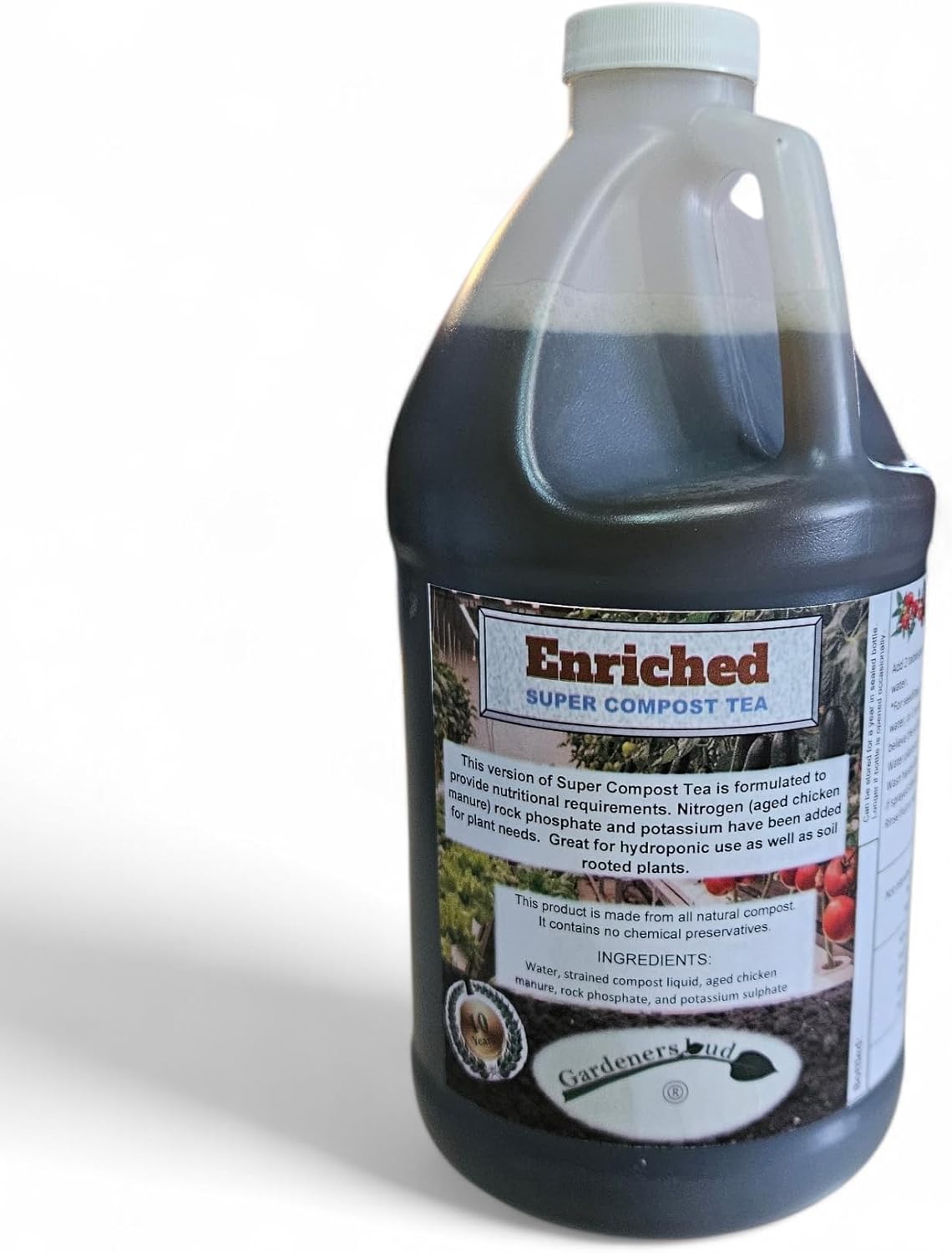
Gardenersbud Enriched Super Compost Tea (64 fl oz)
| Item Form | Liquid |
|---|---|
| Unit Count | 64 Fluid Ounces |
| Mixing Ratio | 3:4:4 |
| Specific Uses For Product | Organic,Plant Food |
| Target Species | plants, flowers |
Gardenersbud Enriched Super Compost Tea is a 64-ounce liquid fertilizer designed to deliver organic nutrients and beneficial compost compounds to garden plants. It is typically diluted per the label and applied up to once a week during active growth to supply nitrogen, phosphorus and potassium in an NPK of 3-4-4 while also adding compost-derived microbes and particulates to improve soil nutrient pathways. The product is made from aged chicken and horse manure plus rock phosphate, potassium sulfate, and pulverized eggshells, so it provides real feeding value rather than just a microbial inoculant. Practical benefits include reducing reliance on synthetic fertilizers, easy mixing for foliar or soil drench applications, and suitability for use in hydroponic systems as noted by the maker. Important limitations are the strong odor before dilution and the product’s raw-organic composition, which means it must be handled and mixed outdoors and is explicitly not for human or pet consumption. Buyers should follow the recommended weekly use during growth and expect a natural-smelling organic amendment rather than a neutral commercial fertilizer.
Best for: Gardeners who prioritize dependable, organic nutrient feeding during the active growth stage and want a single liquid product to supply NPK plus compost biology for container, garden bed, or hydroponic use.
Less Ideal for: People looking for an odorless or inert fertilizer concentrate, or those who need a dry, shelf-stable granular product for infrequent feeding.
- Amended formula provides balanced NPK of 3-4-4 for growth-stage feeding
- Contains compost particulates and microbes that help improve soil nutrient pathways
- Ready-to-dilute liquid form that can be used as a soil drench or in hydroponic systems
- Formulated to reduce or replace synthetic chemical fertilizers
- Strong odor before dilution requires outdoor mixing
- Contains raw composted manures and microbes so it is not safe for consumption and needs careful handling
Verdict: Choose this compost tea if you want an organic, ready-to-dilute liquid that delivers both NPK nutrients and compost biology to reliably feed plants during the growth stage.
Real Growers Recharge 16 oz Powdered Soil Microbe Blend

| Item Form | Powder |
|---|---|
| Application Method | Drench |
| Specific Uses For Product | Seed Development, Root Soil Conditioning |
| Mixing Ratio | 1-2 teaspoons per gallon |
| Ingredients | Mycorrhizae, Bacillus strains, Trichoderma, humic and fulvic acids |
Real Growers Recharge is a concentrated powdered microbial blend designed to be mixed at 1 to 2 teaspoons per gallon and applied as a drench to the root zone. It delivers mycorrhizae, Trichoderma and several Bacillus strains plus humic and fulvic acids to boost root development, reduce transplant shock and help plants access nutrients more efficiently. Typical use is weekly watering or at transplant, seedling inoculation, and during veg and bloom cycles until two weeks before harvest. The powder form stores compactly and will not burn plants when used at recommended dilutions, and it is compatible with organic or synthetic feeding programs and both indoor and outdoor containers or beds. Expect stronger, denser roots and improved resilience to stress, but results depend on proper application and existing soil biology; it is not an instant fertilizer and benefits build over repeated applications. Users should follow mixing and storage directions to keep microbes viable and protect them from high heat or direct sunlight.
Best for: Buyers who want evidence-backed soil biology to build root strength and improve long-term nutrient uptake and who prefer products with many positive user reviews and clear usage guidance.
Less Ideal for: Gardeners seeking a quick-acting fertilizer response or a one-time fix for nutrient deficiencies should consider a conventional fertilizer instead.
- Broad microbial mix including multiple mycorrhizae, Trichoderma and Bacillus strains for diverse soil biology
- Powder concentrate stores easily and mixes into an instant compost tea for root drench applications
- Compatible with organic and synthetic nutrient programs and suitable for indoor and outdoor container or bed use
- Gentle formulation that will not burn plants when used at the recommended 1–2 teaspoons per gallon
- Benefits accrue over time rather than delivering immediate nutrient boosts
- Requires careful mixing, storage and regular application to maintain microbial viability
Verdict: Use Recharge when you want a compact, review-backed compost-tea style microbial booster to build stronger roots and improve nutrient uptake over time.
Choosing the Right Compost Tea: Key Factors to Consider
Feedstock Quality
The compost you use is the primary determinant of what ends up in the tea. Well-aged, diverse compost with a mix of green and brown inputs tends to support richer microbial communities and a broader nutrient profile. Compost that smells strongly of ammonia or is still hot indicates incomplete decomposition and can produce imbalanced or potentially phytotoxic brews.
Using cured compost avoids introducing large numbers of human or plant pathogens and reduces the chance of weed seed germination. If your compost is primarily woody or low in nitrogen, expect lower extraction of soluble nutrients and a tea that benefits soil structure more than quick fertilizer needs.
Brewing Method
Aerated and non-aerated brewing extract microbes differently. Aerated brewing favors aerobic bacteria and protozoa and often yields a tea that stimulates rapid nutrient cycling in the root zone. Non-aerated approaches can encourage different microbial balances, including facultative organisms, but are more sensitive to temperature and oxygen depletion.
The brewing vessel, agitation method, and aeration rate affect extraction strength and brew stability. Simpler steeping methods require less equipment but offer less control over microbial outcomes, while active aeration systems improve repeatability for gardeners willing to invest in a small pump and air stones.
Water Source And Quality
Tap water, well water, and rainwater differ in chlorine, chloramine, mineral content, and pH, all of which influence microbial survival during brewing. Chlorinated or highly chloraminated tap water can suppress microbial populations unless dechlorinated first. Hard water minerals may precipitate nutrients or alter pH in ways that change extraction efficiency.
Using low-chlorine water and checking pH before brewing helps protect sensitive microbes. If your water is very alkaline or acidic, simple amendments or buffering can improve the biological outcome of the tea.
Timing And Temperature
Brew length and ambient temperature strongly affect which microbes proliferate and how concentrated the tea becomes. Shorter brews favor extraction of soluble nutrients but may not build large microbial populations. Typical aerated brews run 12 to 48 hours; longer brewing can increase microbial growth but raises contamination risk if conditions become anaerobic.
Temperature matters because microbial activity accelerates in warm conditions. Brewing in very hot weather can cause oxygen depletion and off-odors; cool temperatures slow growth and may require longer brew times. Adjusting brew duration to local temperatures helps produce a stable, beneficial tea.
Application Technique
How you apply compost tea changes its effect. Soil drenches place microbes directly into the root zone, supporting long-term soil food web benefits. Foliar sprays deliver soluble nutrients and microbes to leaf surfaces, which can aid plant health but require attention to timing to avoid leaf burn and to maximize microbe survival.
Dilution rate, spray volume, and frequency all matter. Overly concentrated tea can stress plants, while too-dilute applications may have little effect. Plan applications around plant growth stages and weather to get the most benefit from each brew.
Aerated Versus Non-Aerated Brewing
Aerated brewing systems introduce oxygen and encourage aerobic microbes that drive rapid nutrient mineralization. They are often the first choice when you want a predictable, active tea to apply as a drench or foliar feed.
Non-aerated methods are simpler and require only a container and occasional stirring. They can still produce useful teas but require more attention to timing and smell to avoid anaerobic conditions that harm plant roots.
- Aerated brews: stronger microbial activity, more equipment
- Non-aerated brews: simpler, more variable results
- Match method to your comfort with equipment and monitoring
Preparing Compost For Best Results
Sift or screen compost to remove large chunks and uncomposted material. A finer particle size increases the surface area available to microbes and improves extraction efficiency.
Mix in a small source of labile carbon or kelp to feed microbes during brewing if your compost is very mature and low in readily available food. Always avoid introducing fresh manure or uncured materials that can spike ammonia levels.
- Screen compost for uniform particle size
- Avoid fresh manures and high-ammonia feedstocks
- Consider a mild microbial feed for very cured composts
Safety And Contamination Prevention
Preventing contamination starts with clean equipment and good water. Sanitize containers between brews and use food-grade tubing and stones if you will handle the tea frequently. Avoid cross-contamination from diseased plant material.
Monitor your brew for off-odors and visible film. A foul smell or slimy surface suggests anaerobic conditions or unwanted microbial growth; discard and start again rather than risking plant harm.
- Use dechlorinated water to protect beneficial microbes
- Keep brewing area shaded and cool when possible
- Dispose of questionable brews safely away from desirable plants
When And How Often To Apply
Apply compost tea during active growth phases: early season root flush, transplanting, and after pruning or stress events. These times let the introduced microbes help with nutrient uptake and disease suppression.
Frequency depends on goals and time. For maintenance, monthly applications can sustain soil biology. For establishing beds or recovering stressed plants, weekly to biweekly applications for a short period are common.
- Use soil drench for long-term soil benefits
- Use foliar sprays for quick nutrient boosts or targeted leaf treatments
- Avoid spraying during the hottest part of the day
Measuring Brew Success
You can gauge a tea's effectiveness by its smell, clarity, and activity. A pleasant earthy aroma and slight cloudiness suggests active microbial life, while extreme odors indicate problems.
More precise measures include dissolved oxygen during brewing, simple pH checks, and observing plant responses after application. Track outcomes like root vigor, reduced transplant shock, or improved leaf color over several cycles to judge long-term benefits.
- Check dissolved oxygen if using aeration
- Note pH and avoid extreme acidity or alkalinity
- Record plant performance after repeated applications
How We Chose the Best Compost Tea
We focused on attributes that actually affect how well compost tea performs in the garden. Key evaluation criteria included extraction strength, which measures how effectively the brewing process draws soluble nutrients and microbes from the compost; microbial diversity, meaning the range of bacteria, fungi, and protozoa likely supported by the feedstock and method; and brew stability, which considers how tolerant the tea is to temperature swings and brewing time. We also assessed ease of use and setup time, since many gardeners prefer a straightforward brewing routine that fits weekend schedules. Material compatibility and contamination risk were examined to prefer methods and supplies that minimize harmful pathogens or chemical residues. Finally, application versatility was considered to ensure the tea could be used as a soil drench, foliar feed, or transplant starter. We excluded anecdotal, single-source claims and any brewing approaches that rely on unverified additives or unsafe practices. Our short list favors repeatable, garden-safe techniques and supplies that produce measurable, stable brews under typical backyard conditions.
FAQ
Can I make compost tea with any compost?
Often you can, but not all composts produce the same results. Well-aged, balanced compost yields a safer, more biologically diverse tea. Avoid using fresh, hot, or ammonia-smelling compost because it can create harmful brews.
Is aeration necessary for good compost tea?
Aeration is not strictly necessary but it changes the microbial profile. Aerated brews favor aerobic microbes and tend to be more predictable. Non-aerated methods are simpler but require careful monitoring to avoid anaerobic conditions.
How long should I brew compost tea?
Typical aerated brews run 12 to 48 hours depending on temperature and goals. Shorter brews extract soluble nutrients while longer ones can increase microbial populations. Adjust time for local temperatures and check for off-odors.
Can I use tap water to brew compost tea?
You can but tap water with chlorine or chloramine can suppress microbes. Let water sit or dechlorinate before brewing, or use low-chlorine sources like rainwater when possible to protect beneficial organisms.
Will compost tea prevent plant diseases?
Compost tea can support a healthier soil microbiome that helps suppress some diseases, but it is not a guaranteed cure. It often reduces disease pressure over time when combined with good cultural practices.
Final Verdict
Focus on the compost quality, brewing method, and application technique that match your garden goals. Aerated systems give more control and a reliably active tea, while simpler methods can still benefit soil life with attentive brewing. Prioritize safe feedstocks, appropriate water, and timing to avoid contamination and maximize plant response. With consistent, measured use you can boost soil biology and help plants access nutrients more efficiently.
