

Note: This article contains affiliate links. If you click on these links and make a purchase, I may earn a small commission at no extra cost to you. This helps support my research and content. Read my full affiliate disclosure here.
Picking the right fertilizer for acidic soil matters because nutrient availability and plant uptake change as pH shifts. In strongly acidic beds, some nutrients become overly available while others lock up, so the wrong feed can worsen deficiencies or toxicities. You want a fertilizer that matches the needs of acid-loving plants and complements whatever soil-amendment plan you already use. This guide covers seven shortlisted fertilizers that are well-suited to acidic growing conditions. We evaluated each option against practical gardener concerns like nutrient balance, pH buffering, and ease of application so you can choose the best fit for your planting situation.
Top Picks at a Glance
| Best Overall The best all-around choice for most situations | Espoma Organic Soil Acidifier, 30 lb |  |
| Best Quality Built to a higher standard if you want something more solid | FoxFarm Happy Frog Acid-Loving Plant Fertilizer, 4 lb |  |
| Best Value The sweet spot between price and what you get | Earth Science Fast Acting Sulfur Granules, 5 lb |  |
| Best Budget The cheapest option that still gets the job done reliably | Down To Earth Acid Mix Organic Fertilizer 4-3-6, 1 lb |  |
| Highest Rated A top-rated pick with lots of positive feedback | Espoma Organic Holly-Tone 4-3-4 Evergreen & Acid-Loving Plant Food, 4 lb. Bag (Pack of 2) |  |
| Most Popular A crowd favorite that many people choose with confidence | True Organic Prilled Sulfur — Prilled Elemental Sulfur Granules, 5 lb |  |
| Best Seller A high-volume bestseller chosen again and again | Jobe's Organics Granular Soil Acidifier, 6 lb |  |
Espoma Organic Soil Acidifier, 30 lb

| Unit Count | 480 Ounce |
|---|---|
| Item Type Name | Espoma UL30 Organic Soil Acidifier Fertilizer, 30 lb |
| Included Components | Fertilizer |
| Manufacturer | Espoma |
Espoma Organic Soil Acidifier is a pelletized, elemental sulfur-based amendment designed to lower soil pH for acid-loving plants like hydrangeas and blueberries. It is applied by spreading around the root zone or across beds and watering in; the package gives straightforward application rates for new plants, established plants, containers, and per-100 sq. ft. for gradual pH changes. The product is approved for organic gardening and avoids aluminum sulfate, so it is a safer choice for repeated use to achieve bluer hydrangea blooms. Practical benefits include clear instructions for different plant situations, a large 30 lb bag that covers significant area, and pellet form that is easy to handle and spread. Important limitations are that pH changes are gradual and may require repeat applications every 60 days, and it can irritate skin and eyes so gloves and a mask are recommended. Expect to monitor soil pH and plant response rather than seeing instant color shifts.
Best for: Gardeners who want a reliable, organic method to lower soil pH for blue hydrangeas and other acid-loving plants and who are willing to test and follow repeated applications for gradual results.
Less Ideal for: People who need instant pH shifts or a one-time quick fix for blooms or those unwilling to use protective gear when handling fertilizers.
- Pelletized elemental sulfur formula specifically formulated to lower soil pH for acid-loving plants
- Clear application rates for pots, individual plants, and per 100 sq. ft. make dosing straightforward
- Approved for organic gardening so it fits organic production and home organic beds
- Large 30 lb bag covers a lot of ground for repeated seasonal applications
- pH adjustment is gradual and requires repeat applications over months to see full effect
- Can cause irritation on contact so protective gear is needed when handling
Verdict: Use this organic, pelletized sulfur amendment if you want a safe, repeatable way to lower soil pH and intensify blue hydrangea blooms over time.
FoxFarm Happy Frog Acid-Loving Plant Fertilizer, 4 lb

| Item Form | Powder |
|---|---|
| Application Method | Granular |
| Coverage | Medium |
| Target Species | Acid-loving plants |
| Mixing Ratio | 1/16 cup per gallon |
FoxFarm Happy Frog Acid-Loving Plant Fertilizer is a granular, slow-release powder designed for azaleas, rhododendrons and other low-pH garden plants. It is typically worked into potting mix or top-dressed around established shrubs following the package mixing instructions, and it delivers gentle feedings that reduce the risk of burning sensitive roots. Notable features include an OMRI-listed formulation and added soil microbes and mycorrhizal fungi intended to enhance nutrient uptake and water absorption. In practice this means steady, low-maintenance nutrient delivery and healthier root development over weeks rather than a single flush of growth. Application is straightforward using the suggested mixing ratio or the established plant application table, making it suitable for beds and containers. The main limitations are that it is tailored specifically to acid-loving species and does not replace targeted micronutrient or corrective soil amendments if your soil test shows deficiencies or pH issues; gardeners with neutral or alkaline soils will need to adjust pH first for best results.
Best for: Gardeners focused on getting consistent, long-term performance from azaleas, rhododendrons and other acid-loving ornamentals who prefer low-maintenance, steady feeding rather than frequent liquid fertilizing.
Less Ideal for: Growers who need an all-purpose fertilizer for mixed beds or who require rapid corrective feeding based on specific soil test results should consider other products.
- Formulated specifically for acid-loving plants like azaleas and rhododendrons
- Slow-release granular formula provides steady, low-burn feedings
- Contains mycorrhizal fungi and beneficial soil microbes to support root health and nutrient uptake
- Easy-to-follow mixing ratio and application instructions for beds and containers
- Not suitable as a general-purpose fertilizer for neutral or alkaline soil without pH adjustment
- Does not replace corrective amendments when specific nutrient deficiencies are identified
Verdict: Choose this product when you want a purpose-built, slow-release feed that supports stronger roots and steady growth in azaleas and rhododendrons.
Earth Science Fast Acting Sulfur Granules, 5 lb

| Item Form | Granules |
|---|---|
| Specific Uses For Product | Lawn |
| Target Species | acid-loving plants |
| Unit Count | 80 Ounce |
Earth Science Fast Acting Sulfur is a 5 lb granular sulfur treatment formulated to lower soil pH quickly for acid-loving plants such as hydrangeas, azaleas, and blueberries and to help green up lawns. It is applied with a broadcast spreader or by hand at the recommended rate (1 lb per 100 sq ft for beds or 5 lbs per 1,000 sq ft for lawns) and can be watered in after 15 minutes to accelerate results. The product uses Nutri-Bond technology to bind granules to soil and reduce runoff so more of the material stays where you apply it. Practical benefits include targeted pH adjustment, improved nutrient availability for acid-loving species, and safe re-entry for people and pets immediately after application. Limitations are that it is a single-purpose pH-lowering amendment rather than an all-in-one fertilizer, so gardeners will still need balanced nutrients for overall fertility, and correct dosing depends on knowing current soil pH so you avoid over-acidifying sensitive areas.
Best for: Buyers who test their soil and want a practical, single-purpose solution to lower pH for acid-loving shrubs, berries, and lawns and who prioritize efficient, targeted amendments.
Less Ideal for: Gardeners seeking an all-in-one fertilizer or those who have neutral to already-acid soils and do not need pH adjustment.
- Designed to lower soil pH quickly to improve nutrient uptake for acid-loving plants
- Nutri-Bond formulation reduces runoff so more product remains in the root zone
- Granular form is easy to distribute with any spreader or by hand
- Safe for people and pets to re-enter treated areas immediately after application
- Does not supply a complete mix of macro- and micronutrients so additional fertilization is often needed
Verdict: Use this fast-acting sulfur when you need a reliable, targeted way to lower soil pH and improve nutrient availability for acid-loving plants.
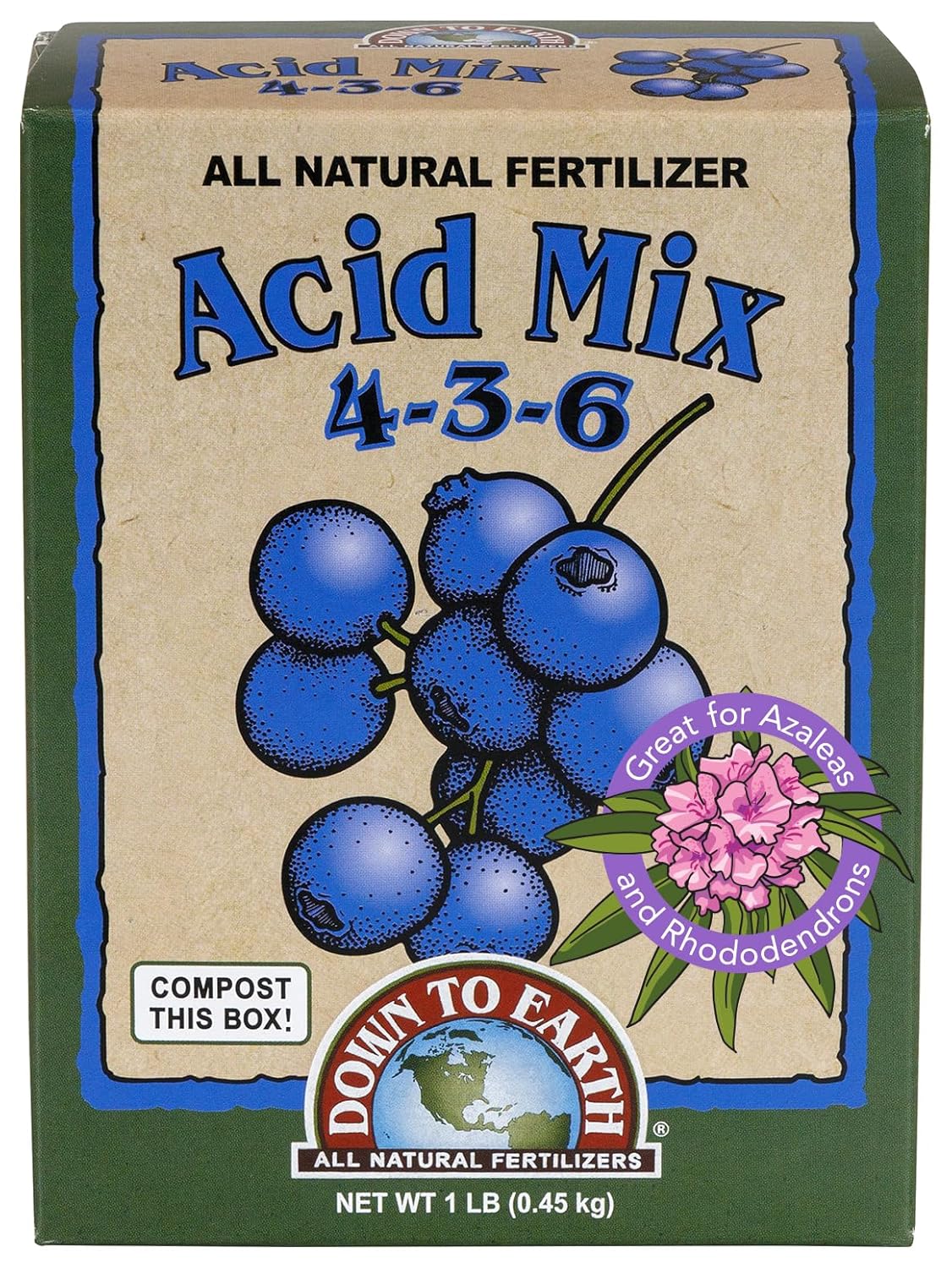
Down To Earth Acid Mix Organic Fertilizer 4-3-6, 1 lb
| Item Form | Granules |
|---|---|
| Specific Uses For Product | Acid-loving plants |
| Target Species | rhododendrons, azaleas, hydrangeas, evergreen trees and shrubs, blueberries, raspberries |
| Mixing Ratio | 4:3:6 |
Down To Earth Acid Mix is an organic granular fertilizer designed to feed acid-loving plants such as blueberries, azaleas, rhododendrons and other shrubs. You can broadcast it on the soil surface or mix it into planting holes, then water it in; the manufacturer recommends applications in early spring, at bloom and again in fall to support vegetative growth, flowering and root development. The 4-3-6 formula delivers a higher potassium ratio to help fruiting and overall plant vigor, while slow-release materials like feather meal, fish bone meal and kelp provide longer-lasting nutrition so you do not need to feed frequently. It is shelf stable and OMRI-listed ingredients support organic gardening practices. Limitations to note are the small 1 lb unit size, which means frequent repurchase for larger beds, and that this product is a fertilizer rather than a soil pH fixer so you will still need sulfur or lime to significantly change soil acidity. For gardeners feeding a few blueberry plants or refreshening planting holes, it is an effective, low-fuss organic option.
Best for: Gardeners with a few blueberry plants or small acid-loving beds who want an easy-to-use organic fertilizer and prefer low-maintenance, sustained feeding.
Less Ideal for: Large-scale blueberry plantings or growers who need to change soil pH significantly without using separate amendments.
- Formulated specifically for acid-loving plants including blueberries and azaleas
- Slow-release organic ingredients provide sustained feeding and reduce application frequency
- Can be applied on the soil surface or mixed into planting holes for flexible use
- OMRI-friendly ingredient sources support organic gardening practices
- Small 1 lb package limits coverage for larger beds or multiple bushes
Verdict: A compact, slow-release organic fertilizer tailored for small blueberry plantings and other acid-loving plants to provide steady, low-maintenance nutrition.
Espoma Organic Holly-Tone 4-3-4 Evergreen & Acid-Loving Plant Food, 4 lb. Bag (Pack of 2)

| Item Form | Powder |
|---|---|
| Specific Uses For Product | Organic,Plant Food |
| Application Method | Sprinkle over the root zone and water in |
| Coverage | Medium |
| Target Species | Acid-loving Plants |
Espoma Holly-Tone is a ready-to-use organic fertilizer made for acid-loving plants such as blueberries and raspberries. Supplied as a powder/granular form with an N-P-K of 4-3-4 and added sulfur, it is intended to be sprinkled around the root zone and watered in, providing a slow-release nutrient reservoir that supports blooms and fruiting over the growing season. Its organic ingredients and Bio-tone inoculant are designed to feed plants while improving soil biology, which suits gardeners who prefer low-chemical approaches. Practical benefits include simple application with no mixing, suitability for spring and fall feedings, and certification for organic gardening. Limitations are that it delivers modest nutrient levels per application, so heavy-feeding situations may need more frequent use or supplementary fertilizer, and the medium coverage means larger plantings require multiple bags. For cautious gardeners wanting predictable, organic nutrition for blueberries and raspberries, Holly-Tone offers a reliable, low-risk option that integrates easily into standard care routines.
Best for: Gardeners who prioritize organic, low-risk feeding for acid-loving fruit shrubs and want a simple, no-mix fertilizer to maintain soil health and steady fruiting.
Less Ideal for: Growers managing large commercial patches or plants that need high immediate nutrient boosts should consider higher-analysis or concentrated products instead.
- Organic formula with Bio-tone to support soil biology and gradual nutrient release
- Formulated specifically for acid-loving plants like blueberries and raspberries
- Ready-to-use granular powder that requires no mixing and is simple to apply
- Contains sulfur to help maintain acidic soil conditions favored by target plants
- Low N-P-K ratio means heavier feeders may need additional applications or supplements
- Medium coverage requires multiple bags for larger patches or rows
Verdict: A dependable organic, ready-to-use fertilizer that makes feeding blueberries and raspberries simple while supporting soil biology.
True Organic Prilled Sulfur — Prilled Elemental Sulfur Granules, 5 lb

| Item Form | Granules |
|---|---|
| Specific Uses For Product | Agriculture, Gardening |
| Coverage | Medium |
| Unit Count | 80 Ounce |
| Target Species | Plants |
True Organic Prilled Sulfur is a granular elemental sulfur product intended to acidify soil and improve nutrient availability for in-ground gardens. It is typically broadcast or worked into soil one to two weeks before planting to gradually lower pH and support better flowering and fruiting. The prilled form makes it easy to spread evenly over beds, and a 5 lb bag advertises coverage up to about 1,333 sq. ft., which suits larger blueberry patches or multiple planting areas. Because it is pure elemental sulfur, results are gradual and best for long-term pH adjustment rather than an immediate fix. The product is made with organic inputs and is presented for gardening and agricultural use, which may appeal to buyers avoiding synthetic acidifiers. Important practical limits are that you must test soil pH first and calculate application rates carefully to avoid over-acidifying, and it does not provide nutrients beyond its pH effect, so plan a complementary fertilizer program for blueberry-specific needs.
Best for: Gardeners who test soil and want a conservative, organic-compatible way to lower pH for acid-loving plants like blueberries and are comfortable planning applications ahead of planting.
Less Ideal for: People needing rapid pH change immediately before harvest or those who want an all-in-one fertilizer that also supplies macronutrients.
- Prilled granular form spreads evenly for straightforward application to beds
- Formulation is elemental sulfur, which reliably lowers soil pH over time
- 5 lb bag claims wide coverage suitable for multiple blueberry planting areas
- Made with organic inputs and presented for garden use
- Acts slowly so it is not a quick pH correction
- Contains only sulfur and does not supply other nutrients blueberries need
Verdict: A practical organic-compatible sulfur granule for gardeners who plan ahead to safely acidify soil for blueberries and other acid-loving plants.
Jobe's Organics Granular Soil Acidifier, 6 lb

| Item Form | Granules |
|---|---|
| Target Species | Hydrangeas and blueberries plants |
| Specific Uses For Product | Soil Conditioning, Plant Growth, Root Development |
| Unit Count | 96 Ounce |
| Derived from | Elemental Sulfur and Gypsum |
Jobe's Organics Granular Soil Acidifier is a sulfur-based granular amendment designed to lower soil pH and support acid-loving plants like blue hydrangeas and blueberries. You apply it at planting and reapply two to three times a year or about every eight weeks to maintain a more acidic root zone. The product is OMRI-listed and made from natural elemental sulfur and gypsum, so it is suitable for organic gardens and will slowly change soil acidity without burning roots when used as directed. Practical benefits include easy measuring and application, targeted action on the root zone to encourage blue flower coloration in hydrangeas, and reduced need for frequent liquid treatments. Important limitations are that pH change is gradual so results take weeks to months and a soil test is recommended beforehand to avoid overcorrection. The granules do not supply NPK nutrients, so you will still need a fertilizer if plants require additional nitrogen or phosphorus. Follow safety guidance to avoid inhalation and skin or eye contact during handling.
Best for: Gardeners who want a proven, organic way to acidify soil for blue hydrangeas and similar acid-loving plants and who prefer measured, low-risk treatments backed by broad user acceptance.
Less Ideal for: People needing immediate pH change or quick nutrient feeding for poor-growth plants, or those who prefer liquid pH adjusters for faster short-term results.
- OMRI-listed organic formula suitable for organic gardens
- Elemental sulfur-based granules specifically formulated to lower soil pH for acid-loving plants
- Easy granular application at planting and periodic reapplication
- Slow-release action reduces risk of burning roots when used as directed
- Works gradually so it can take weeks to shift pH and show blueing in hydrangeas
- Does not contain NPK nutrients so separate fertilization may be needed
Verdict: A practical organic granular acidifier that reliably lowers soil pH for blue hydrangeas when applied and maintained as directed.
Choosing the Right Fertilizer for Acidic Soil: Key Factors to Consider
Nutrient Profile and Ratios
A fertilizer's macronutrient ratios matter more in acidic soil because availability of nitrogen, phosphorus, and potassium shifts with pH. Choose a formula that supplies the nutrients your acid-loving plants need without excess of elements that can become toxic at low pH. Look for balanced N-P-K and adequate secondary nutrients so you are not relying solely on soil reserves.
Also consider micronutrients. Iron, manganese, and aluminum behave differently in acidic soils; some micronutrients can become overly available while others are still limiting. A fertilizer that accounts for typical deficiencies in acidic conditions will reduce the need for frequent corrective treatments.
Effect on Soil pH and Buffering
Some fertilizers subtly influence soil pH through the form of nitrogen or sulfur they contain. Ammonium-based nitrogen tends to acidify over time while nitrate sources are less acidifying. In an already acidic bed you want to avoid products that drive pH lower unless you plan to correct it with lime or other amendments.
Buffering capacity is also important. A fertilizer that releases nutrients steadily rather than in a large acidic pulse helps prevent sudden pH swings. Consider pairing a fertilizer with independent pH amendments when long-term pH stability is a priority for plant health.
Release Pattern and Timing
How quickly nutrients become available affects both plant response and soil chemistry. Fast-release feeds give quick green-up but can cause short-term nutrient surges and leaching in acidic, low-Cation Exchange Capacity soils. Slow-release or controlled-release formulations provide steadier nutrition and reduce the risk of transient toxicity or nutrient loss.
Match the release pattern to plant needs and season. For perennial shrubs or acid-loving ornamentals, a steady-release fertilizer reduces maintenance. For spring-flowering bulbs or annuals, a more immediate feed may be appropriate but applied carefully.
Physical Form and Application Method
Granular, soluble, liquid, and organic forms each behave differently in acidic soils. Granular slow-release products often persist in the root zone and supply steady nutrition. Water-soluble fertilizers let you correct deficiencies quickly but can move away from roots or leach in heavy rainfall. Organic amendments contribute nutrients slowly while improving soil structure and microbial life.
Choose a form that fits your watering habits, planting layout, and ability to apply evenly. Ease of application can determine whether a gardener follows through with recommended feeding schedules in acidic beds where timing matters.
Impact on Soil Biology
Acidic soils already shift the microbial community compared with neutral soils. Some fertilizers support beneficial microbes and mycorrhizae, while others can reduce microbial diversity if overused. Organic inputs and those that include composted or biological components tend to support a healthier soil food web.
Consider how a fertilizer interacts with soil life because microbes mediate nutrient cycling, especially phosphorus and nitrogen. Supporting a robust microbial community helps maintain nutrient availability without aggressive chemical corrections.
Environmental and Runoff Considerations
Nutrient runoff and leaching are garden concerns regardless of pH but acidic soils with low organic matter can be more prone to nutrient movement. Pick fertilizers with lower soluble salt spikes or slow-release formulations to reduce runoff risk after heavy rains.
Also think about nearby waterways and pollinators. Fertilizers that minimize soluble phosphorus peaks and avoid unnecessary nitrogen surges help protect downstream ecosystems and reduce stress on beneficial insects that use the landscape.
Best Fertilizer Strategies for Acid-Loving Plants
Acid-loving plants such as azaleas, rhododendrons, blueberries, and camellias often do best with fertilizers formulated specifically for acid soils because those products account for nutrient availability at lower pH. Strategies include using feeds with modest nitrogen levels, adequate potassium for root health, and controlled phosphorus to avoid fixation. Incorporating slow-release options can prevent nutrient shocks that make deficiencies worse.
In practical terms, plan feeds around growth cycles. Apply a balanced, low-salt fertilizer in early spring as new growth begins, then follow up with lighter maintenance applications. If you use soluble feeds for quick corrections, reduce application rates and monitor plants for leaf burn or yellowing that could indicate micronutrient imbalances.
- Match feed strength to rootzone conditions and recent rainfall.
- Favor steady-release formulations for established shrubs and trees.
- Use soluble corrections sparingly for rapid deficiency fixes.
How to Apply Fertilizer in Acidic Beds
Application technique matters more in acidic beds because nutrients can concentrate around roots or be immobilized. For granular feeds, broadcast evenly and gently incorporate into the topsoil or mulch layer without disturbing fine feeder roots. For liquid feeds, apply at recommended dilution and avoid applying during the hottest part of the day to reduce stress.
When fertilizing containers or raised beds with acidic mixes, water thoroughly after application to move nutrients into the root zone and prevent surface salt buildup. For established shrubs, use an annular pattern out to the dripline rather than only at the trunk to reach the majority of feeder roots.
- Apply granular fertilizers before a forecasted light rain or irrigation.
- Avoid concentrated applications near trunks and crowns.
- Measure and follow label dilutions for soluble feeds.
Combining Fertilizer with pH Amendments
If your soil is too acidic for a wider plant palette, you may want to raise pH slowly with lime while continuing to feed acid-loving plants. Timing matters: apply lime well before major feeding so pH changes do not interfere with nutrient uptake. Conversely, do not use highly acidifying fertilizers if you are actively liming to raise soil pH.
Test soil pH regularly and adjust both fertilizer choice and lime applications in small increments. This coordinated approach prevents counterproductive swings and helps maintain nutrient balance for the plants you are growing.
- Test pH before changing fertilizer or liming routines.
- Apply lime in the fall or several months before planting when possible.
- Choose fertilizer forms that complement planned pH amendments.
Recognizing Nutrient Deficiencies in Acidic Soil
Symptoms of nutrient issues can look different in acidic soils. For example, iron and manganese often show as leaf spotting or interveinal chlorosis that mimics several other problems. Low phosphorus can cause stunted growth even when soil tests show adequate total phosphorus because fixation can make it unavailable to plants.
Use tissue testing or targeted soil tests to diagnose persistent problems before increasing application rates. Corrective foliar sprays provide a fast temporary fix for some micronutrient deficiencies, but long-term solutions usually involve adjusting fertilizer practices and soil organic matter.
- Look for interveinal chlorosis on new growth for iron issues.
- Stunted growth may indicate phosphorus unavailability despite test numbers.
- Combine soil and tissue tests for accurate diagnosis.
Organic Options and Their Role in Acid Soils
Organic fertilizers and amendments can improve structure and microbial activity while supplying nutrients gradually. Compost, well-aged leaf mold, and certain manures release nutrients slowly and help buffer pH swings by increasing organic matter. For gardeners wanting to build soil health over time, organics are a sensible complement to targeted feeds.
Keep in mind that organic materials vary in nutrient concentration and release timing. Plan applications seasonally and use soil testing to track improvements rather than relying on visible greening alone.
- Use compost as a baseline amendment to build soil resilience.
- Topdress with organic fertilizers in late winter or early spring.
- Expect slower nutrient responses compared with soluble chemical feeds.
How We Chose the Best Fertilizer for Acidic Soil
Our selection focused on products suited to naturally acidic soils and conditions where gardeners prefer or require lower pH. We prioritized fertilizers with nutrient profiles and formulations that maintain availability for common acid-loving plants while minimizing elements that worsen micronutrient imbalances. Evaluation criteria included nutrient composition and release pattern, pH impact and buffering capacity, solubility and application flexibility, physical form and ease of use, and environmental safety for soil biota. We also considered how reliably a fertilizer supplies key nutrients that are commonly limiting in acid soils, such as calcium, magnesium, and available phosphorus when appropriate. We excluded products formulated specifically to raise pH as primary function, specialty blends for neutral- or alkaline-loving crops, and incomplete feeds that lack key macronutrients. The final shortlist emphasizes balanced performance in acidic garden beds, user-friendly application, and predictable effects on nutrient availability.
FAQ
How often should I fertilize plants in acidic soil?
Frequency depends on plant type and fertilizer form. Slow-release or organic options often need feeding once or twice per year, while water-soluble feeds may be applied more often at lower rates. Monitor growth and soil tests to adjust timing.
Will a fertilizer change my soil pH significantly?
Most fertilizers cause only small pH shifts over time. Form matters: ammonium-based nitrogen can acidify slowly, whereas nitrate forms are less acidifying. Large pH changes usually require deliberate amendments like lime.
Can I use the same fertilizer for container-grown acid-loving plants?
Yes, but choose formulations suitable for containers and follow dilution instructions. Containers have less buffering capacity, so use lower-strength feeds and water thoroughly after application to avoid salt buildup.
Are organic fertilizers effective in acidic soils?
Organic fertilizers can be very effective long-term because they improve soil structure and feed microbes that mobilize nutrients. They release nutrients more slowly, so combine them with targeted corrections if plants need a quick response.
How do I correct iron deficiency in acid soils?
Iron deficiency in acid soils is usually addressed with foliar treatments for quick correction or chelated iron products for longer-term fixes. Also check for competing high levels of manganese or aluminum and adjust overall fertility and organic matter to improve root health.
Final Verdict
For acidic soil, prioritize fertilizers that supply the nutrients acid-loving plants need without driving further pH problems. Focus on nutrient balance, steady release patterns, and products that support soil biology so you get predictable, long-term results. Adjust feeding frequency and formulation to match plant type, container or in-ground conditions, and your plans for pH amendments. Ultimately, choose a fertilizer that complements your soil management approach. Favor steady feeding and soil-building tactics over aggressive, high-salt quick fixes to keep acid-adapted plants healthy and resilient.
