

Note: This article contains affiliate links. If you click on these links and make a purchase, I may earn a small commission at no extra cost to you. This helps support my research and content. Read my full affiliate disclosure here.
If carpenter ants are trailing around eaves, fence posts, or the foundation, the right outdoor carpenter ant bait can interrupt foraging and reduce colony pressure on nearby wood. You need products that attract workers quickly, survive sun and rain long enough to be carried back to the nest, and can be deployed safely around children and pets. This guide shortlists the top options for yard and structure perimeter control and explains the practical tradeoffs that matter in real gardens and around homes. Below you will find our top picks and the criteria we used to evaluate attractant effectiveness, persistence outdoors, application flexibility, and safety.
Top Picks at a Glance
| Best Overall The best all-around choice for most situations | Terro Perimeter Ant Bait Plus Granules, 2-Pack Shaker Canisters |  |
| Best Quality Built to a higher standard if you want something more solid | Syngenta Advion Ant Gel (4 Tubes, 30 g each) |  |
| Best Value The sweet spot between price and what you get | ROUTADE 48-Pack Slow-Acting Ant Gel Bait Stations |  |
| Highest Rated A top-rated pick with lots of positive feedback | Zappix Ant Gel Bait, 4 × 10 g Ready-to-Use Syringes |  |
| Most Popular A crowd favorite that many people choose with confidence | Terro Outdoor Liquid Ant Bait Stakes, 12-Pack |  |
| Best Seller A high-volume bestseller chosen again and again | Spectracide Ant Shield Outdoor Killing Stakes, 6 Count |  |
Terro Perimeter Ant Bait Plus Granules, 2-Pack Shaker Canisters

| Unit Count | 2 Count |
|---|---|
| Item Form | Granules |
| Target Species | Insects |
| Active Ingredients | Orthoboric Acid 5% |
| Specification Met | EPA |
Terro Perimeter Ant Bait Plus is a granular bait sold in easy-to-use shaker canisters intended for outdoor perimeter treatments and localized nest applications. You sprinkle a 2 to 4 foot band around structures, trees, stumps, firewood piles, or directly into cavities to target carpenter ants and other crawling pests. The active ingredient is orthoboric acid at 5% in weather-resistant granules, which lets it remain effective through light rain and provides protection for up to four weeks between applications. The shaker format makes spot treatment simple without a spreader, and the product description and directions include guidance for rates and repeat timing for gardens, yards, attics, and crawl spaces. Limitations to note are that it is a slow-acting bait, so visible results can take days as worker ants return to the colony, and it is for outdoor and perimeter use rather than direct indoor broadcast. Also follow safety directions carefully to avoid accidental exposure to people or pets.
Best for: Buyers who want a straightforward, low-maintenance perimeter bait to reduce carpenter ant activity before colonies establish indoors and who prefer a product with clear application instructions.
Less Ideal for: People seeking an immediate knockdown solution or indoor-wide broadcast treatment should look at fast-acting insecticides or indoor-specific baits instead.
- Weather-resistant granules provide up to four weeks of outdoor protection
- Easy-to-use shaker canister allows targeted perimeter bands and spot treatments
- Active orthoboric acid bait works slowly so worker ants can carry bait back to the colony
- Also labeled to control other outdoor pests such as cockroaches, earwigs, slugs, and snails
- Slow-acting method can take several days to reduce visible ant activity
- Not intended for broad indoor broadcast use; designed for perimeter and localized applications
Verdict: A simple, weather-resistant granular bait that is well suited for cautious homeowners who want to bait carpenter ants at the perimeter and target nests before they move indoors.
Syngenta Advion Ant Gel (4 Tubes, 30 g each)

| Unit Count | 4.23 Ounce |
|---|---|
| Included Components | 4 Tubes x 30-Grams, 1 Plunger and 2 Tips |
| Item Form | Gel |
| Active Ingredients | 0.05% indoxacarb |
| Target Species | Insects |
Advion Ant Gel is a user-friendly gel bait intended to control common household and structural ant species by exploiting worker foraging behavior. You apply small spots or short lines of the odorless gel along active trails, in cracks and crevices, and near entry points; foraging workers consume the bait and carry it back to the nest where it is shared, helping to eliminate the queen and other nestmates. The kit ships with four 30 g tubes plus an applicator plunger and tips for precise placement, which makes targeting tight spaces straightforward. Its non-repellent formula with 0.05% indoxacarb is formulated to be attractive to a range of species including Argentine and carpenter ants, and it is labeled for both indoor and outdoor use. Limitations to note are that it is a chemical bait so safety precautions are needed around children and pets and efficacy depends on ants accepting the bait matrix versus other available food sources.
Best for: Homeowners and renters who want a targeted, easy-to-apply solution to eliminate established ant infestations and prefer a bait that works via worker-mediated transfer to treat whole colonies.
Less Ideal for: People seeking non-chemical or immediate-contact kill methods or those who need a one-time spray rather than ongoing baiting strategies should consider other options.
- Non-repellent gel formulation designed for worker ants to feed and transfer bait to the colony
- Includes four 30 g tubes plus a plunger and application tips for precise placement
- Labelled for both indoor and outdoor use, suitable for common pest species
- Odorless formula that is easy to place along trails, cracks, and crevices
- Contains a chemical active ingredient so it must be kept away from children and pets
- Effectiveness depends on ants preferring the bait over other available food sources
Verdict: Choose Advion Ant Gel when you want a precise, bait-based solution that encourages workers to carry poison back to the nest for colony-level control.
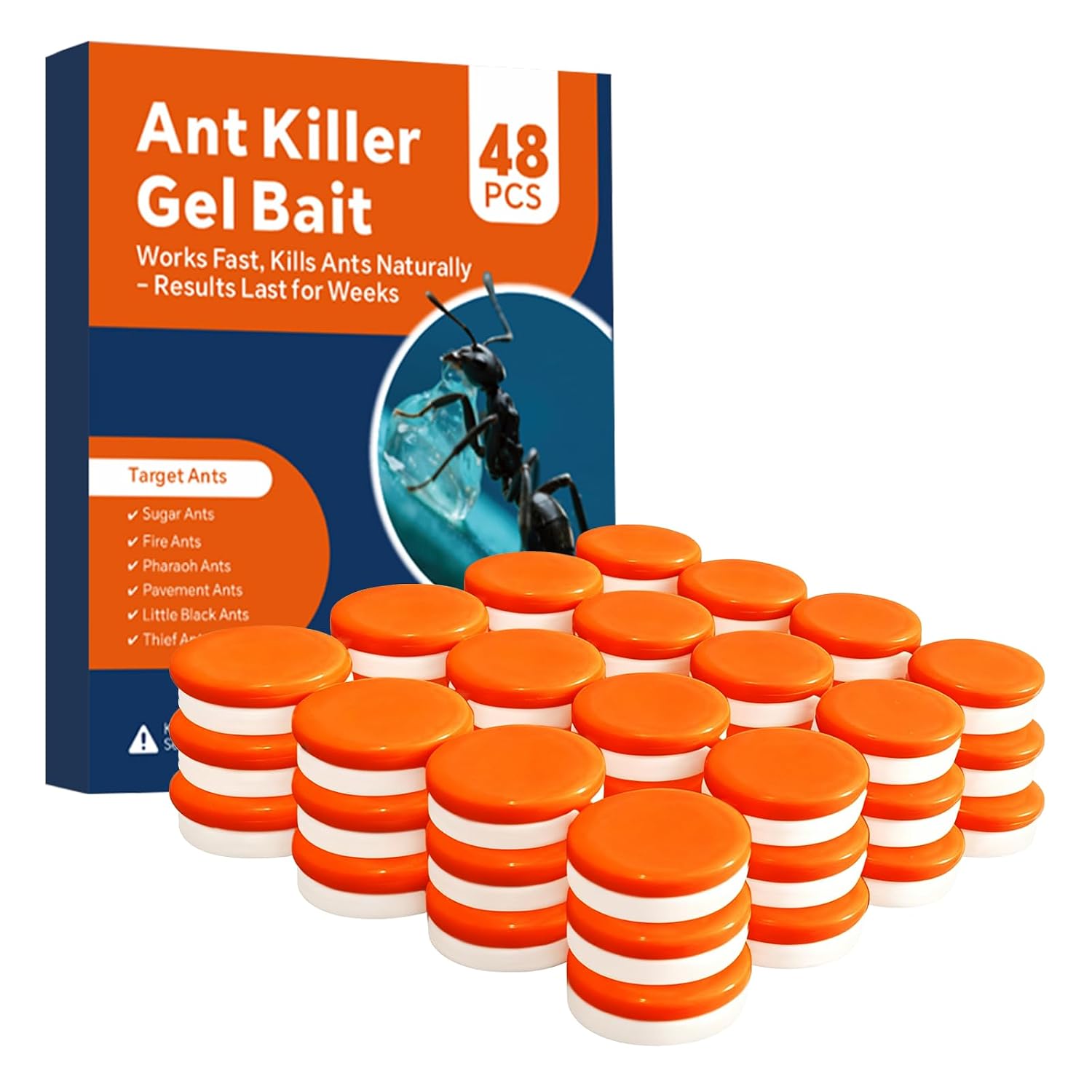
ROUTADE 48-Pack Slow-Acting Ant Gel Bait Stations
| Unit Count | 48 Count |
|---|---|
| Item Form | Gel |
| Target Species | Ants |
| Included Components | Ant gel bait |
This 48-pack of ROUTADE slow-acting ant gel bait stations is built for systematic, long-term ant control in and around the kitchen. Each station contains a gel formula that worker ants consume and carry back to the nest, which helps reduce the entire colony rather than only visible foragers. The product is supplied in ready-to-use stations with adhesive tape so you can place them along baseboards, in cabinets, near sinks, and on entry thresholds without messy sprays or frequent repositioning. The large pack lets you deploy multiple stations in high-traffic areas and replace them over time for continuous coverage. Because the formula is slow-acting, it is effective against a range of common household species including carpenter ants and sugar ants, but it requires several days to weeks to knock down a colony and will not give instant removal of visible ants. Also the stations are small and contain gel rather than a tamper-resistant hard block, so keep them away from children and pets. For someone wanting a low-maintenance, colony-focused approach to kitchen ant problems, this kit makes it easy to set and forget while the bait works.
Best for: Homeowners who prioritize reliable, long-term elimination of ant colonies in kitchens and want a low-maintenance bait they can deploy across multiple hotspots.
Less Ideal for: People who need an immediate knockdown of visible ants or who require childproof solid bait stations should consider alternatives.
- Slow-acting gel designed for worker ants to carry bait back to the nest for colony-level control
- Ready-to-use bait stations with adhesive for easy placement along baseboards and in cabinets
- 48-count pack provides broad coverage around a kitchen and enough replacements for extended use
- Versatile for indoor and outdoor placement to block entry points and high-traffic ant routes
- Slow-acting formula takes days to weeks to eliminate a colony so visible results are not immediate
- Gel in small stations may require careful placement to keep away from children and pets
Verdict: A practical, deploy-and-forget gel bait kit for reliable colony-level control of kitchen ant infestations.
Zappix Ant Gel Bait, 4 × 10 g Ready-to-Use Syringes

| Unit Count | 4 Count |
|---|---|
| Included Components | 4Tubes x 10-Grams |
| Item Form | Gel |
| Target Species | Ant |
| Liquid Volume | 0.04 kg |
Zappix Ant Gel Bait is a syringe-style, ready-to-use gel designed to be placed along ant trails, in cracks and crevices, and around entry points to control common household ant species. You apply small dots of gel from the syringe tip in kitchens, bathrooms, basements, garages, on patios, and near foundations where ants forage. Worker ants consume the bait and transport it back to hidden nest areas, which helps suppress both visible foragers and colonies you cannot see. The kit contains four 10 g tubes, so you can treat multiple hotspots without mixing or measuring. Practical benefits include precise application into tight gaps and flexible indoor or outdoor placement. Limitations are that the product is formulated for general ant species rather than being specific to carpenter ants, and repeated or strategic placement may be required for large or well-established colonies; the gel also relies on ants accepting the bait, which can vary by species and local food preferences.
Best for: Buyers who prioritize a reliable, easy-to-apply bait to treat visible ant trails and entry points around a home and want a no-mess, ready solution they can deploy themselves.
Less Ideal for: Homeowners confronting heavy outdoor carpenter ant nests or large structural infestations who need professional-grade or species-targeted treatments.
- Syringe applicator allows precise placement into cracks, crevices, and along trails.
- Ready-to-use formula requires no mixing or setup.
- Suitable for indoor and outdoor use for flexible placement around structures.
- Four tubes provide multiple treatment points for homes and perimeter spots.
- Not labeled specifically for carpenter ants so effectiveness can vary for large outdoor colonies.
- Small tube size may require frequent reapplication for widespread infestations.
Verdict: A simple, ready-to-use syringe gel that makes targeted spot treatments reliable and convenient for routine ant control.
Terro Outdoor Liquid Ant Bait Stakes, 12-Pack

| Unit Count | 12 Count |
|---|---|
| Material Type | Plastic |
| Target Species | Ant |
| Power Source | manual |
These Terro Outdoor Liquid Ant Bait Stakes are simple, low-effort bait stations designed to intercept ant colonies outdoors before they reach the house. Each stake contains a sweet liquid bait with borax that worker ants feed on and carry back to the nest, which can eliminate the queen and much of the colony over a 2 to 4 week period. They are weather-resistant, see-through so you can monitor bait consumption, and install by cutting a tab and pushing the stake into soil or mulch near ant trails. For homeowners dealing with small common species such as little black, odorous house, pavement, and ghost ants, the stakes provide targeted perimeter protection without sprays or direct contact. Limitations are that baiting takes days to weeks to fully work and you may see increased ant activity at first as foragers discover the bait. Also they must be placed where children and pets cannot access them and replaced periodically to maintain protection.
Best for: Homeowners who want a low-effort, evidence-based way to stop small common outdoor ants at the source and prefer baiting over sprays, using visual confirmation of activity before replacing units.
Less Ideal for: People needing an immediate knockdown or single-visit solution for heavy indoor infestations or those who cannot place bait stations out of reach of children and pets.
- Colony-level control via borax bait that foraging ants share with the nest
- Ready-to-use stakes are easy to deploy by cutting the tab and inserting in soil
- See-through design lets you monitor bait consumption and know when to replace
- Weather-resistant stations suitable for yards, patios, and garden perimeters
- Works gradually and can take 2–4 weeks for complete colony control
- Not child- or pet-proof if placed in accessible areas and requires careful placement
Verdict: A practical, easy-to-use baiting solution that stops small outdoor ant colonies by getting worker ants to carry borax bait back to the nest.
Spectracide Ant Shield Outdoor Killing Stakes, 6 Count

| Unit Count | 6 Count |
|---|---|
| Target Species | Ant |
| Liquid Volume | 6 fluid ounces |
Spectracide Ant Shield Outdoor Killing Stakes are ground-in bait stations designed to control ant colonies around the exterior of a home. You push the stake into soil along ant trails, where foraging ants enter the weather-resistant station, eat the bait, and carry it back to the colony to kill the queen and other ants. The stakes are child-resistant and formulated to start killing within hours and remain effective for up to three months under normal outdoor conditions. They are simple to deploy in multiple locations and can be replaced every three months or sooner for heavy infestations. Limitations to keep in mind are that stakes must be placed where children, pets, and non-target animals cannot access them and larger properties may need multiple stakes for full control. These are a straightforward, low-effort option for exterior ant control when you want a long-lasting, ready-to-use bait rather than repeated sprays or traps.
Best for: Budget-minded homeowners who want an easy, low-effort way to reduce outdoor ant activity without frequent reapplication. Good for people who prefer set-and-forget solutions for perimeter ant control.
Less Ideal for: Indoor ant problems or situations where pets and children freely access yard areas; those users should choose targeted indoor products or professional services instead.
- Long-lasting bait that can remain effective up to three months
- Weather-resistant stations suitable for outdoor placement
- Targets the colony by killing foragers and the queen rather than only visible ants
- Simple stake format makes placement quick and low-effort
- Must be placed out of reach of children and pets limiting placement options
- Heavily infested or large properties may require multiple packs for full control
Verdict: An inexpensive, easy-to-deploy outdoor bait stake that gives months of colony-level ant control with minimal effort.
Choosing the Right Outdoor Carpenter Ant Bait: Key Factors to Consider
Attractant Type and Foraging Behavior
Carpenter ants forage for both carbohydrate and protein sources depending on season and colony needs. A bait that matches what workers prefer at the time you apply it will be discovered and carried back to the nest faster. Consider whether the bait is sugar-based, protein-based, or dual-attractant; seasonal timing and local food availability affect which option will perform best.
Knowing basic ant foraging behavior helps you decide where to place bait stations. For example, workers often trail along tree roots, mulched edges, and structure perimeters. Placing bait along these travel routes increases chance of pickup and transfer to nestmates.
Bait Persistence in Sun and Rain
Outdoor use means exposure to sunlight, heat, humidity, and intermittent rain. Some formulations dry out quickly or lose attractiveness when heated, while others are packaged to resist evaporation or moisture. Bait persistence determines how often you must check and replace the bait, and whether it will still be attractive long enough for workers to transport it to the nest.
If you have long periods of rain or intense sun, choose delivery formats or containers designed to shield the bait. Regular monitoring is still essential because even weather-resistant baits can be compromised by debris or heavy downpours.
Delivery Format and Placement Options
Baits come in multiple delivery forms such as weatherproof stations, granular formulations, liquid syringes, or tray inserts. The format affects where you can safely deploy bait and how well it is protected from non-target animals and the elements. Weatherproof stations and sealed inserts work well along foundation lines and under eaves, while granular baits can be spread in mulch but may be accessible to pets or wildlife.
Consider access for monitoring and replacement when choosing a format. A well-designed bait station makes it easy to check uptake without exposing product, and it guides worker traffic to the bait source rather than scattering bait in the landscape.
Active Ingredient and Speed of Kill
Different active ingredients act at different speeds and mechanisms. Fast-acting toxicants may kill worker carriers before they reach the nest, reducing transfer, while slower-acting ingredients allow workers to return and distribute the bait within the colony. For colony-level control around structures, a balance is needed: attractant uptake followed by delayed mortality maximizes transfer to brood and the queen.
Also consider recorded efficacy against carpenter ant species common in your area. Some actives are more effective against particular ant groups, and local extension resources can help identify typical species and behavior patterns.
Safety and Non-target Risk
Outdoor deployment raises concerns about exposure to pets, wildlife, and children. Enclosed bait stations reduce non-target access, whereas loose granules or open trays increase risk. Look for products with clear handling instructions and protective packaging.
Follow label directions for placement distance from play areas, and choose stations that can be secured or anchored. Proper placement and signage reduce accidental encounters and help keep control targeted to ant traffic.
Monitoring and Maintenance Requirements
Effective ant control requires regular checks to confirm bait uptake and to replace spent bait. Some products require weekly monitoring, while more persistent formulations can go longer between visits. Consider how much time you are willing to commit to checking stations and whether the bait format simplifies refill or requires disposal procedures for used inserts.
Good monitoring also tells you when the bait has reduced activity and when to stop treatments. Expect several weeks of follow-up to ensure colony suppression rather than a temporary drop in foraging.
Best Placement Strategies for Perimeter Control
Place bait stations along established ant trails, near tree roots, along foundationlines, under porch skirting, and at mulched planting beds that contact wood. Position stations close enough to the trail that workers find them but avoid placing directly against building siding where moisture or debris can quickly foul the bait.
Rotate placement if you see little uptake after a few days; workers may be using a different route. For large yards, start with stations at suspected entry points and expand outward until you see active recruitment.
- Use sheltered spots to reduce direct sun and rain exposure.
- Avoid placing baits where irrigation will spray them.
- Secure stations to prevent tipping by wildlife.
Timing Applications With Ant Biology
Carpenter ant dietary preferences shift through the season. In spring and early summer, protein needs rise as colonies rear brood; later in summer and fall, carbohydrate sources may be more attractive. Match bait type to season when possible to increase uptake.
If you face a persistent infestation, alternating bait types across the season can catch different foraging cohorts and improve the chances of reaching the nest and brood.
- Protein baits often work best in brood-rearing periods.
- Sugar baits can be more effective in late summer when carbohydrate foraging increases.
Integrating Nonchemical Measures
Reduce wood-to-soil contact, trim tree limbs away from structures, and remove rotting wood near foundations. Eliminating moisture sources and repairing leaks reduces the habitat carpenters use for nesting and can improve long-term control when combined with baiting.
Sealing visible entry points and storing firewood away from the house lower the chance new colonies will establish near structures. Nonchemical measures reduce overall ant pressure and let baiting focus on remaining active nests.
- Repair water-damaged wood and eliminate leaks.
- Clear mulch and debris from immediate foundation edges.
Monitoring Uptake and When To Stop
Check bait stations at least weekly for signs of worker activity and bait reduction. Early heavy uptake indicates good attractant matching, while no activity after several days suggests repositioning or switching bait type.
Continue monitoring for several weeks after activity drops. A gradual decline in worker visits followed by weeks without sightings usually indicates successful suppression. If activity returns, inspect for new entry points or satellite nests and reapply as needed.
- Record visits and bait levels to track progress.
- Remove or secure spent bait according to label instructions.
Safety Best Practices for Outdoor Use
Always follow label directions for placement, handling, and disposal. Use weatherproof stations to limit access by pets and wildlife and keep unsecured baits out of play areas and food gardens.
Wear simple protective gloves when handling concentrated formulations and wash hands after placement. Store unused product in its original container, out of reach of children and animals, and clearly mark any deployed stations if they are in areas frequented by neighbors.
- Choose enclosed stations near ant trails to reduce non-target exposure.
- Avoid placing baits where food is prepared or children frequently play.
How We Chose the Best Outdoor Carpenter Ant Bait
Our selection focused on products designed specifically for use outside around structures and landscape features where carpenter ants forage. We prioritized baits that combine an effective attractant formulation with a delivery format suited to outdoor conditions. Key evaluation criteria included attractant effectiveness, bait persistence under variable weather, delivery format and placement options, and safety and non-target risk. We also considered how easy each bait is to monitor and replace during multi-week control efforts, and whether the active ingredient is appropriate for structural perimeter use. We excluded indoor-only gels, treatments intended for direct wood injection, and any formulations unsuited to outdoor exposure. Products that required specialist licensing or professional-only application were not included. The final list reflects items that a homeowner or gardener can reasonably deploy around foundations, landscape beds, patios, and outbuildings. Our scoring emphasized real-world performance concerns gardeners face: will worker ants find and carry the bait, and will it persist long enough to reach and suppress the colony?
FAQ
How long does outdoor baiting usually take to reduce carpenter ant activity?
Results often appear within a few days to a few weeks. Uptake by workers can be rapid, but colony-level suppression depends on sufficient transfer to nestmates and the queen, which usually requires repeated monitoring over several weeks.
Can I use indoor ant bait stations outside?
Indoor-only formulations and stations are often not weatherproof and may degrade quickly outdoors. Use products labeled for outdoor perimeter use or that include weather-resistant stations to maintain attractiveness and reduce waste.
Will baiting alone eliminate a carpenter ant infestation?
Baiting can be highly effective at reducing colony pressure, especially when combined with habitat modification and exclusion work. In some cases, particularly with multiple or hidden satellite nests, additional control measures or professional assessment may be necessary.
Are granular baits safe around pets and wildlife?
Granular baits are more accessible to non-target animals than enclosed stations. If you have pets or wildlife, use secured bait stations or place granules where animals cannot reach them, and follow label restrictions on placement.
How often should I check bait stations?
Check stations at least once a week. More frequent checks during hot or wet weather help ensure bait remains attractive and has not been fouled by debris or irrigation.
Final Verdict
Focus on matching bait type and delivery format to the ants' current foraging preference and your outdoor conditions. Prioritize weather-resistant stations that allow secure placement along trails and perimeter lines, and commit to weekly monitoring so you can adjust placement or bait type as needed. Combine baiting with habitat changes that reduce nesting sites to increase long-term success. With consistent placement, monitoring, and sensible safety steps, you can reduce carpenter ant activity and protect wood structures effectively.
