
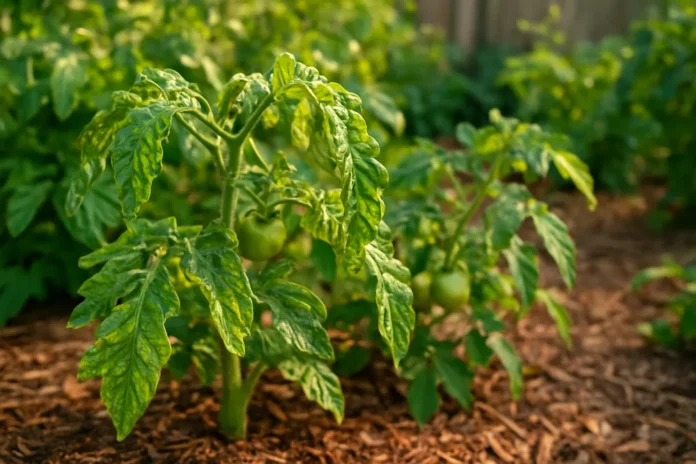
Tomato leaves usually curl because of heat, uneven watering, transplant stress, pests, herbicide exposure, or disease. Mild upward curl is often environmental, while severe twisting or distorted new growth points to a more serious problem.
Seeing tomato leaves curling can be alarming, especially when you were expecting fast summer growth and a heavy crop. The good news is that leaf curl is often a stress response rather than a sign that the whole plant is doomed.
Tomatoes react quickly to hot weather, inconsistent moisture, root disturbance, and strong pruning. In many home gardens, the leaves roll or cup upward simply because the plant is trying to conserve water and protect itself from tough growing conditions.
That said, not all leaf curl looks the same. A plant with older leaves curling in the afternoon has a very different issue from one with twisted new growth, sticky foliage, yellowing, or stunted stems. Once you match the curl pattern with the likely cause, it becomes much easier to decide whether to wait, adjust care, or step in with treatment.
What Tomato Leaf Curl Usually Means
Leaf curl is a symptom, not a diagnosis. Tomato leaves may roll upward, fold inward, twist, cup, or look puckered depending on what is stressing the plant. The most common causes in home gardens are environmental stress, root stress after planting, pest feeding, herbicide injury, and viral disease.
In many cases, especially on otherwise healthy plants with green foliage and normal flowering, leaf curl is called physiological leaf roll. This is a noninfectious response to stress. It usually affects older leaves first and does not always reduce harvest much if the plant recovers quickly.
- Older leaves curling upward with normal color often suggest heat or moisture stress.
- New leaves that are twisted, narrow, or badly distorted often suggest herbicide injury, broad mite damage, or viral disease.
- Leaves curling with yellowing, spotting, sticky residue, or insects point more toward pests or disease than simple weather stress.
- Temporary afternoon curling during extreme heat is less concerning than all-day distortion that keeps getting worse.
Heat, Sun, and Watering Stress
Hot Weather Can Trigger Protective Leaf Rolling
Tomatoes commonly curl leaves during hot, dry, bright conditions. When temperatures stay high, especially above about 90 degrees Fahrenheit, the plant may roll leaves upward to reduce surface area and slow water loss. This is especially common in containers, raised beds, and sites with reflected heat from walls or pavement.
Inconsistent Moisture Stresses Roots
Alternating between very dry soil and heavy watering is one of the biggest reasons tomato leaves curl. When roots repeatedly dry out and then get flooded, the plant struggles to regulate water movement. Leaves may curl, become leathery, or droop during the hottest part of the day.
Overwatering can create similar symptoms because waterlogged soil reduces oxygen around the roots. Instead of taking up water efficiently, stressed roots send distress signals through the plant, and foliage responds by curling or sagging.
- Curling starts during heat waves or after missed waterings
- Older leaves are affected more than new growth
- Leaves stay mostly green without severe spotting or mosaic patterns
- Plants perk up when temperatures moderate
How to Reduce Environmental Leaf Curl
- Water deeply and consistently rather than shallowly every day
- Mulch with straw, shredded leaves, or untreated grass clippings to keep soil moisture even
- Water early in the day so plants are better prepared for afternoon heat
- Use containers large enough to buffer roots from rapid drying
- Add temporary shade cloth during extreme heat if plants are in a very exposed spot
Transplant Shock, Pruning, and Root Disturbance
Tomatoes often curl leaves shortly after transplanting. Moving a young plant from a nursery pot into the garden disturbs the root system, even when you are careful. The plant may lose water faster through the leaves than the roots can replace it for several days, so foliage curls as a defense.
Heavy pruning can cause a similar reaction. Removing many suckers or a large amount of foliage at once changes how the plant balances water, shade, and growth. Tomatoes that are pruned hard during hot weather may respond with rolled leaves, sunscalded fruit, or slowed growth.
Cultivating too close to the base of the plant, tying stems too tightly, or transplanting into compacted soil can also stress roots enough to trigger curl. In these cases, the plant usually recovers if overall care is good and no disease is involved.
- Curling appears soon after planting or pruning
- Damage is fairly uniform rather than patchy or insect-like
- New growth may look slightly stressed at first but improves over time
- The plant is not usually sticky, speckled, or badly discolored
Pests That Make Tomato Leaves Curl
Aphids and Whiteflies
Sap-feeding insects like aphids and whiteflies can cause leaves to curl, pucker, or distort. They feed by piercing plant tissue and removing fluids, which interferes with normal growth. You may also see sticky honeydew, ants, or black sooty mold on the leaves.
Broad Mites
Broad mites are tiny and hard to see without magnification, but the damage can be dramatic. New leaves may become tightly curled, twisted, bronzed, or brittle. Growing tips may look deformed, and flowers can abort. Because the mites are nearly invisible, gardeners often mistake this for disease or herbicide injury.
Thrips
Thrips can scar tender tissue and distort young tomato leaves. They may also spread certain plant viruses. Damage often shows up as silvery streaking, rough texture, and misshapen new growth.
What Pest-related Curl Looks Like
- Curling is strongest on tender new growth or the undersides of leaves
- Leaves may look sticky, speckled, bronzed, or puckered
- Insects or cast skins may be visible on stems and leaf undersides
- Nearby plants may show the same symptoms if the pest pressure is high
How to Manage Insect Damage
- Rinse aphids from plants with a firm stream of water
- Use insecticidal soap or horticultural oil according to label directions
- Avoid spraying during the hottest part of the day
- Encourage beneficial insects like lady beetles, lacewings, and minute pirate bugs
- Remove badly distorted tips if mites are severe, but do not overprune stressed plants
Herbicide Drift and Chemical Injury
Tomatoes are extremely sensitive to herbicides, especially growth-regulator types used on lawns and broadleaf weeds. Even tiny amounts drifting from a nearby spray, volatilizing in hot weather, or arriving on contaminated compost, mulch, or manure can cause curling and twisted growth.
This kind of injury usually affects the newest leaves first. The foliage may look narrow, strappy, cupped, fernlike, or severely distorted. Stems can bend oddly, flowers may drop, and fruit set may be poor. Unlike simple heat stress, the growth pattern itself becomes abnormal.
Unfortunately, herbicide injury cannot be reversed directly. Mild cases may grow out if exposure was limited, but severe cases often leave plants permanently stunted.
- Damage appears soon after weed spraying nearby
- New growth is more twisted than older leaves
- Several sensitive plants may be affected at once, including beans, peppers, or grapes
- Leaves may be deformed without the spots, insects, or yellow mosaic common in other issues
Diseases Linked to Curling Leaves
Tomato Yellow Leaf Curl Virus
Tomato yellow leaf curl virus, often spread by whiteflies, causes upward curling, yellowing, reduced leaf size, and stunted growth. Plants infected early often stay small and unproductive. Leaves may become thickened and brittle, and flowering can be reduced.
Mosaic Viruses
Mosaic viruses can produce curling along with mottled light and dark green patterns, distortion, and reduced vigor. Symptoms vary depending on the virus and the tomato variety, but the foliage usually does not look like simple heat stress.
Leaf Diseases and Root Problems
Fungal or bacterial diseases do not always cause major curling by themselves, but when they weaken the plant, leaves may roll, droop, or distort as a secondary response. Root-knot nematodes and root rots can also lead to curl because damaged roots cannot support normal growth.
Signs That Disease Is More Likely
- Leaf curl comes with yellowing, mottling, or mosaic patterns
- New growth is stunted or abnormally small
- Plants stop growing normally even with good water and weather
- Symptoms spread through the garden instead of staying limited to one stressed plant
Viral diseases cannot be cured once a plant is infected. If symptoms strongly fit a virus and the plant is declining, removal is often the best way to reduce spread to healthy tomatoes.
How to Tell Which Cause Is Most Likely
The key is to look at which leaves are curling, what other symptoms are present, and what happened right before the problem started. Tomatoes usually tell a clear story once you connect the timing and pattern.
- Older leaves curled, plant still green, weather hot: most likely environmental stress or physiological leaf roll.
- Curling started after transplanting or heavy pruning: most likely temporary root or canopy stress.
- New growth twisted or strap-like: more likely herbicide injury or broad mites.
- Curling with sticky residue or visible insects: more likely aphids or whiteflies.
- Curling with yellowing and stunting: more likely viral disease or serious root trouble.
- Container tomatoes drying out fast: inconsistent moisture is a top suspect.
If the plant is growing, flowering, and setting fruit normally, the problem is often manageable. If growth tips are badly deformed, plants are shrinking instead of expanding, or symptoms are spreading quickly, look beyond basic watering issues.
What to Do Next for Healthier Tomato Plants
Most tomato leaf curl improves when the underlying stress is reduced. Focus first on stable growing conditions, because that solves the greatest number of cases. Then rule out pests, chemical exposure, and disease if the plant does not improve.
- Keep soil evenly moist, not soaked and not bone dry.
- Mulch around plants to cool roots and reduce evaporation.
- Avoid heavy pruning during heat or drought.
- Inspect leaf undersides and growing tips for aphids, whiteflies, mites, and thrips.
- Think back to any recent herbicide use nearby, including lawn weed sprays.
- Remove severely diseased plants if symptoms strongly fit a virus and the plant is declining.
Do not rush to fertilize just because leaves are curling. Extra nitrogen can push soft new growth and make some problems worse, especially if the real issue is watering, heat, or root damage. If you feed tomatoes, use a balanced approach based on plant growth and soil conditions rather than on curl alone.
Also remember that some tomato varieties naturally show more leaf roll than others, particularly during fruiting and summer heat. If your plant is otherwise vigorous, productive, and free of severe distortion, mild curl may simply be part of how it handles stress.
FAQ
Will Curled Tomato Leaves Uncurl?
Sometimes. Leaves curled from heat, watering swings, or transplant stress may flatten somewhat once conditions improve, but badly curled leaves often stay that way while new growth comes in more normal.
Should I Cut Off Curled Tomato Leaves?
Usually no, unless the leaves are diseased, badly damaged, or pest-infested. Curled but still green leaves are still helping the plant make energy.
Can Too Much Fertilizer Make Tomato Leaves Curl?
Yes. Excess fertilizer, especially high nitrogen, can stress roots or push soft, uneven growth that curls more easily. Salt buildup in containers can also contribute.
Why Are Only the Bottom Tomato Leaves Curling?
Bottom leaves often curl first from heat, moisture stress, normal aging, or physiological leaf roll. If the top growth looks normal, the cause is usually environmental rather than viral.
Why Are My Tomato Leaves Curling Upward but Still Green?
Upward green leaf curl is commonly caused by heat, intense sun, or inconsistent watering. This pattern often fits physiological leaf roll rather than disease.
Can Overwatering and Underwatering Both Cause Leaf Curl?
Yes. Tomatoes curl leaves when roots are too dry and also when soil stays soggy long enough to limit oxygen. Both conditions interfere with normal water movement in the plant.
How Do I Know if Leaf Curl Is From Herbicide Drift?
Herbicide injury usually shows up on new growth as twisting, strapping, cupping, or fernlike distortion. Symptoms often begin after nearby weed control treatments and may affect several sensitive plants at once.
Is Tomato Leaf Curl Disease Always Fatal?
No. Environmental leaf curl is often mild and manageable. Viral leaf curl diseases are more serious because infected plants do not recover, but not every curled leaf means the plant has a virus.
Need help narrowing down the cause fast? Read our tomato problem guide or compare the best tomato sprays, mulches, and supports to protect plants and keep harvests on track.
