

Note: This article contains affiliate links. If you click on these links and make a purchase, I may earn a small commission at no extra cost to you. This helps support my research and content. Read my full affiliate disclosure here.
If earwigs are chewing your seedlings and hiding under pots, you need solutions that stop damage without disrupting the rest of the yard. The right insect killer for earwigs focuses on where these nocturnal scavengers live and feed, and fits your outdoor routine whether you tend flower beds, vegetable patches, or containers. This guide shortlists six top-performing options suited to the earwig problem, then evaluates each by how it attracts and kills earwigs, how safe it is around beneficial insects and pets, and how easy it is to use. Below you will find a concise buying guide, the selection criteria used to choose the picks, and practical tips for deploying any control method effectively in a real garden.
Top Picks at a Glance
| Best Quality Built to a higher standard if you want something more solid | Advion Insect Granular Bait 1 lb. Shaker Bottle (0.22% Indoxacarb) |  |
| Best Value The sweet spot between price and what you get | Sunday Ant Adios Outdoor Ant Killer Granules (2 lb, 2-pack) |  |
| Best Budget The cheapest option that still gets the job done reliably | Safer Home Ant & Crawling Insect Killer Diatomaceous Earth (7 oz) |  |
| Highest Rated A top-rated pick with lots of positive feedback | Envu Maxforce Complete Granular Insect Bait, 4 lb |  |
| Most Popular A crowd favorite that many people choose with confidence | Harris Diatomaceous Earth Crawling Insect Killer, 8 oz |  |
| Best Seller A high-volume bestseller chosen again and again | Ortho Home Defense Insect Killer for Indoor & Perimeter, 1.33 gal. with Comfort Wand |  |
Advion Insect Granular Bait 1 lb. Shaker Bottle (0.22% Indoxacarb)

| Item Form | Granules |
|---|---|
| Target Species | Insects |
| Item Weight | 16 ounces |
Advion Insect granular bait is a performance-focused perimeter treatment supplied in a 1 lb. shaker bottle for easy band or spot applications around foundations and landscape beds. The product uses 0.22% indoxacarb in a highly palatable bait matrix that is designed to attract and be eaten by target pests, including earwigs, which activates the ingredient internally for effective knockdown. Typical use is to apply a continuous band around a home or targeted spots where earwigs and other nuisance insects congregate; for larger properties the same formulation is available in a 12 lb. bag for spreader application. Practical benefits include a non-staining, odorless formula and a ready-to-use applicator that avoids mixing and simplifies spot treatments. Limitations to consider are that it is strictly for outdoor perimeter use and users must follow label directions and local regulations; it will not replace indoor cleaning or exclusion measures and repeated applications may be needed for heavy infestations.
Best for: Gardeners and homeowners focused on fast, effective perimeter pest control who prioritize a potent, ingestion-based bait for nuisance insects like earwigs and want a ready-to-use product that is simple to apply.
Less Ideal for: People seeking a multi-purpose indoor and outdoor insect solution or those who prefer non-chemical control methods should consider other approaches.
- Indoxacarb 0.22% active ingredient designed for ingestion-based control of earwigs and other perimeter pests
- Ready-to-use 1 lb. shaker bottle allows straightforward band or spot application without mixing
- Non-staining and odorless formulation suitable for use around foundations and landscape areas
- Attractive bait matrix promotes consumption which can lower the amount needed compared with some other granular baits
- Formulated only for outdoor perimeter use and not labeled for indoor treatments
- Smaller 1 lb. bottle may be insufficient for large properties without purchasing the larger bag
Verdict: Choose this granular bait when you need a high-performance, ready-to-use perimeter treatment that reliably targets earwigs and other common outdoor nuisance insects.
Sunday Ant Adios Outdoor Ant Killer Granules (2 lb, 2-pack)

| Active Ingredient | Spinosad |
|---|---|
| Quantity | 2 lb. bag (per unit) |
| Coverage | Up to 4,000 sq. ft. |
| Organic Gardening | Approved |
Sunday Ant Adios is a ready-to-use granular treatment formulated with spinosad to reduce foraging ants, earwigs, cutworms, and similar crawling insects in outdoor spaces. You broadcast the granules around lawn edges, along foundations, and near garden beds where ants forage; the product claims coverage up to about 4,000 square feet per 2 lb bag and gives results within days to a couple of weeks. Notable features are its biologically derived active ingredient and organic gardening approval, which make it suitable to use around fruits, vegetables, and ornamentals when label directions are followed. The granules are odor-free and designed for low-fuss application without mixing or special equipment. Limits to expect: it is not intended for fire ant mound treatments and control is not instant for every colony since it targets foragers and takes time to reduce populations. Also, granules offer spot and perimeter control rather than systemic protection of plants, so follow-up applications or integrated baiting may be needed for heavy infestations.
Best for: Gardeners who prioritize effective, garden-safe pest control and want a low-effort granular option to protect vegetable beds and surrounding lawn areas.
Less Ideal for: People needing immediate knockdown of large or established ant mounds or those who want a spray or bait system for continuous, long-term colony suppression.
- Uses spinosad, a biologically derived active ingredient approved for organic gardening
- Ready-to-use granules require no mixing or special equipment
- Odor-free formulation suitable for use near edible gardens when label directions are followed
- Coverage stated up to 4,000 sq ft per 2 lb bag for perimeter and spot treatments
- Not labeled for fire ant mound treatment
- Works by reducing foraging activity so visible results can take several days to weeks
Verdict: Choose this if you want a garden-safe, ready-to-use granular treatment that reduces foraging ants around vegetable beds without harsh fumes.
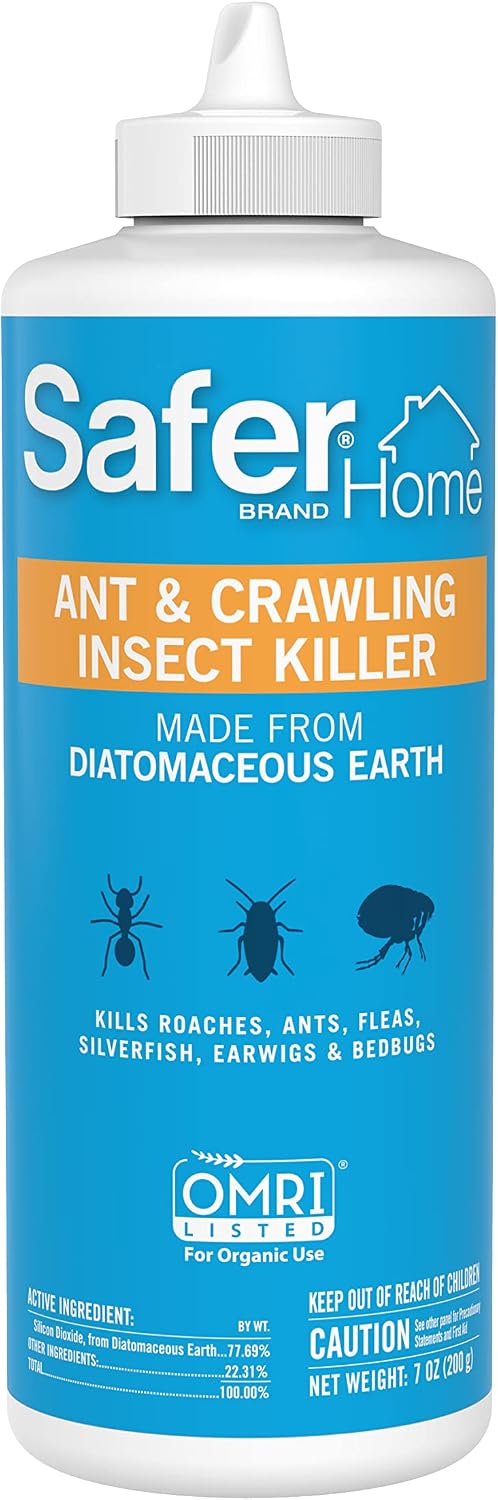
Safer Home Ant & Crawling Insect Killer Diatomaceous Earth (7 oz)
| Item Form | Powder |
|---|---|
| Target Species | Insects |
| Active Ingredients | Silicon Dioxide from Diatomaceous Earth 77.69% |
| Liquid Volume | 7 fluid ounces |
| Specification Met | EPA |
Safer Home Ant & Crawling Insect Killer is a 7 oz diatomaceous earth powder packaged in a puffer bottle for targeted application in cracks, along baseboards, and entry points. It works mechanically rather than chemically: microscopic silica particles abrade insect exoskeletons and desiccate pests that walk through or ingest the powder, with kills typically seen within 48 hours. The puffer makes it easy to place small amounts in tight spaces or to create a perimeter barrier outdoors, and the formula is OMRI listed for use in organic gardening. It is labeled for a broad range of crawling pests including earwigs, ants, roaches, fleas, and silverfish. Important limitations are that it must remain dry to be effective and needs reapplication after rain or watering, and larger infestations may take several days as insects must physically contact the powder. Use carefully to avoid dust inhalation and keep away from areas where fine powder could be spread by airflow.
Best for: Buyers who prioritize low-toxicity, evidence-backed solutions and want a product they can place precisely around the home or garden to control earwigs and other crawling pests.
Less Ideal for: People needing a fast surface spray for flying insects or those who prefer a single-application chemical barrier for heavy indoor infestations.
- Kills a wide range of crawling insects through a non-chemical, mechanical action
- Puffer bottle allows precise placement in cracks, crevices, and around entry points
- OMRI listed and suitable for use in organic gardening
- Effective within 48 hours after insect contact when kept dry
- Must stay dry and requires reapplication after rain or watering to remain effective
- Not an instant knockdown for large, established infestations since insects need to contact the powder
Verdict: A low-toxicity, OMRI-listed diatomaceous earth powder that gives precise, nonchemical control of earwigs and other crawling pests when applied and kept dry.
Envu Maxforce Complete Granular Insect Bait, 4 lb

| Item Form | Granules |
|---|---|
| Target Species | Ants, Cockroaches, Crickets, Silverfish |
| Specification Met | EPA |
Envu Maxforce Complete is a broad-spectrum granular bait intended for placement along foundations, lawns, and other perimeter travel routes to reduce populations of crawling insects including earwigs. It is used by scattering granules in areas where insects forage or in crack-and-crevice and mound treatments around structures; the formulation is bait-first and designed to be taken back to nests for colony control rather than producing immediate knockdown. Practical benefits include flexible outdoor and non-living indoor placement, ease of application compared with gels or sprays, and suitability for integrated perimeter strategies. Notable features are the ready-to-use granule form, multi-species effectiveness, and EPA specification. Important limitations are that results require correct placement and time to work, it does not produce fast-contact kills, and it is not intended for use on living plants or for treating indoor living spaces where pets or children may contact loose granules.
Best for: Buyers who prioritize reliable, long-term perimeter control and want a bait designed to reduce colonies through forager-mediated distribution rather than instant knockdown.
Less Ideal for: People seeking fast-contact sprays for immediate visible kill or those who need a product safe to apply directly on plants or in active living areas with frequent human or pet contact.
- Ready-to-use granules that are simple to scatter for perimeter and targeted treatments
- Formulated to be carried back to nests for colony-level control rather than just surface knockdown
- Effective against a range of crawling pests including earwigs, ants, roaches, crickets and silverfish
- Can be used in outdoor lawn, foundation and non-living indoor perimeter locations
- Works gradually and requires correct placement and patience for colony reduction
- Not suitable for application on living plants or in areas where loose granules could contact people or pets
Verdict: Choose this granular bait when you need a dependable perimeter product that works by getting foragers to carry treatment back to nests for lasting control of earwigs and other crawling insects.
Harris Diatomaceous Earth Crawling Insect Killer, 8 oz

| EPA registration | No. 3-18 |
|---|---|
| Active ingredient | 100% freshwater diatomaceous earth |
| Intended use | Indoor & outdoor |
This ready-to-use diatomaceous earth product provides a non-chemical way to control ants and other crawling pests around the home. You apply the fine powder in cracks, along baseboards, near entry points, or in crawlspaces using the included puffer tip for targeted placement. The diatomaceous earth works mechanically by abrading insect exoskeletons and causing dehydration, so insects that contact the dust typically die within 48 hours. Because the material is 100% freshwater diatomaceous earth with no additives and is EPA registered, it is a good fit when you want a low-toxicity option usable near people and pets when directions are followed. It stays effective indefinitely as long as it stays dry, making it a convenient barrier treatment in attics, basements, garages, and around foundations. Limitations are that it must remain dry to work and it is a contact-only control method, so heavy infestations or nesting insects may require repeated application or combined methods for faster results.
Best for: Practical households that prioritize low-toxicity, long-lasting ant control and want a simple, targeted treatment they can apply themselves around entry points and inside cracks.
Less Ideal for: People facing severe or widespread infestations who need rapid knockdown or prefer liquid chemical treatments should consider professional services or a different product.
- 100% freshwater diatomaceous earth with no additives for a non-chemical control option
- Built-in puffer tip allows precise application into cracks and crevices
- Remains effective indefinitely when kept dry, providing long-lasting barrier protection
- Mechanically kills a wide range of crawling insects including ants, roaches, fleas, and bed bugs
- Only effective on insects that contact the powder and must stay dry to work
- Not a fast-acting spray alternative for large, established infestations
Verdict: Choose this product if you want a low-toxicity, long-lasting mechanical barrier to control ants and other crawling insects around the home.
Ortho Home Defense Insect Killer for Indoor & Perimeter, 1.33 gal. with Comfort Wand

| Item Form | Spray |
|---|---|
| Target Species | Insects |
| Liquid Volume | 1.33 gallons |
| Active Ingredients | Bifenthrin 0.05%, Zeta-Cypermethrin 0.0125% |
This 1.33 gallon Ortho Home Defense spray is designed to treat both indoor problem spots and the outdoor perimeter of a home to reduce ants, roaches, spiders and many other crawling and flying insects. It comes with a battery-powered Comfort Wand that delivers a continuous spray so you can apply a uniform band around foundations, patios and entry points without bending or pumping. The formula with bifenthrin and zeta-cypermethrin is intended to kill on contact and establish a barrier that the manufacturer says lasts up to 12 months for ants, roaches and spiders on non-porous indoor surfaces. In real-world use that means fewer repeat treatments in busy yard perimeters and around doors and windows. The spray dries clear with minimal fumes which helps for indoor use near kitchens and living areas. Limitations are that this is a chemical insecticide so users should follow safety directions around children, pets and plants and it is not a specific solution for pests not listed on the label. For homeowners focused on strong, perimeter-level protection this product simplifies application and covers a large area per container.
Best for: Homeowners who want a performance-focused perimeter treatment to reduce recurring yard and entry-point insect problems and prefer a ready-to-use product that is easy to apply.
Less Ideal for: People seeking organic or non-chemical control methods or those who need a targeted solution for pests not listed on the label should consider alternative products.
- Includes battery-powered Comfort Wand for continuous, fatigue-free application
- Ready-to-use 1.33 gallon container covers large perimeters without mixing
- Formula creates a barrier claimed to provide up to 12 months protection against ants, roaches and spiders on non-porous indoor surfaces
- Dries clear and gives off minimal fumes, making indoor use more practical
- Contains synthetic insecticides so precautions are required around children, pets and ornamentals
- Protection claims are specific to certain species and surfaces so results vary by pest and conditions
Verdict: A powerful, ready-to-use perimeter and indoor spray for homeowners who want long-lasting, performance-oriented protection against common yard and household insects.
Choosing the Right Insect Killer for Earwigs: Key Factors to Consider
Attraction Method and Placement
Earwigs are nocturnal and seek shelter in narrow, damp crevices during the day. An effective attraction method targets those shelter spots rather than trying to blanket-treat an entire bed. Baits that use food-based attractants or oil-soaked refuges placed under pots, boards, or mulch often outperform scatter-applied granules because they concentrate the earwigs where you can remove or treat them.
Placement affects effectiveness and safety. Placing a bait or trap in a known harborage minimizes exposure to pollinators and reduces the amount of active material in the open garden. Consider how often you can check and refresh placements; methods that require frequent maintenance may be impractical in larger yards.
Mode of Action and Target Specificity
Different insect killers act in different ways: contact killers, ingestion baits, or physical traps. For earwigs, ingestion baits and traps that exploit shelter-seeking behavior typically give the best control. A product that relies on ingestion reduces the need for widespread spraying but requires that earwigs feed on the treated material.
Target specificity matters because you want to limit harm to beneficial arthropods. A mode of action that confines exposure to sheltered spots or uses attractants specific to earwig feeding habits lowers non-target risk. If a treatment is broad-spectrum and spray-applied, plan to avoid flowering plants and active predator zones.
Safety Around Pets, Children, and Pollinators
Most gardeners share spaces with pets, children, or pollinator-friendly plantings. Choose insect killers that allow containment of active ingredients in traps or bait stations to reduce accidental contact. Physical traps and sheltered bait placements minimize surface residues and are easier to monitor.
If you must use a chemical treatment, prefer formulations with low persistence and clear label instructions for safe re-entry and pet access. Avoid applying any product directly to flowers and keep treated materials away from areas where pets and kids play. Consider nonchemical options where safety is a primary concern.
Ease of Use and Maintenance
A solution that is effective in theory may fail in practice if it is awkward to set up or hard to maintain. Ease of use includes how simply a bait or trap can be deployed, how often it needs checking, and whether disposing of caught earwigs or spent bait is straightforward.
Gardeners with limited time benefit from low-maintenance approaches like durable bait stations or long-lasting formulations. Conversely, if you enjoy regular garden chores, manual traps and regular removals can be integrated into routine maintenance with good results.
Suitability for Garden Microclimates
Earwigs prefer cool, moist microclimates such as compost edges, dense mulch, and the underside of pots. Choose products that remain effective in damp conditions: water-stable baits, traps that do not degrade in moisture, or physical barriers that withstand rain.
Consider how irrigation patterns, shade, and seasonal humidity affect product longevity. A bait that dissolves quickly in regular watering may require more frequent replacement, while a trap designed for sheltered placement will last longer and remain attractive to earwigs.
Environmental Persistence and Cleanup
Gardeners should think about how long residues remain and how easy cleanup is after control is achieved. Nonpersistent options that can be removed or physically collected reduce long-term exposure risks in soil and leaf litter. Traps and contained baits are easier to remove at season end, while broadcast materials may leave residues that interact with soil organisms.
When using any material, factor in disposal practices and whether the product requires special handling for used bait or trapped pests. Methods that allow simple removal of spent components help restore natural predator activity after control is complete.
Practical Trap and Refuge Techniques
Simple traps and refuge methods are often the most reliable first step for earwig control. Placing rolled-up cardboard, shallow tins with oil, or overturned flowerpots in likely harborages catches earwigs where they shelter during the day. Check traps in the morning and dispose of contents away from planting areas.
Traps let you monitor populations and reduce numbers without applying chemicals. For long-term pressure, rotate trap locations and combine trap removal with habitat modifications like reducing dense mulches and clearing debris where earwigs hide.
- Place traps near compost, mulch edges, and under potted plants.
- Empty or refresh traps daily when populations are high.
- Combine trapping with habitat cleanup for durable results.
Using Baits Effectively
Baits that rely on ingestion should be placed where earwigs will encounter them while sheltered. Use small bait stations or protected placements to concentrate effectiveness and limit access to non-target organisms. Refresh baits after heavy rain if they become waterlogged.
If you choose a baiting approach, monitor uptake and adjust placement toward the most active harborages. Baiting can reduce the need for broadcast treatment and helps preserve beneficials when used carefully.
- Install baits under boards, pots, or dense mulch to attract hiding earwigs.
- Avoid placing baits on exposed soil or flowering plants.
- Check baits on a regular schedule and replace when depleted.
Nonchemical Options to Reduce Reliance on Treatments
Cultural controls are important for long-term reduction of earwig pressure. Keep garden beds tidy, remove dense ground litter, and elevate pots to reduce sheltered microhabitats. Managing irrigation to avoid prolonged dampness near plant bases lowers habitat suitability for earwigs.
Encouraging natural predators and maintaining diverse plantings can help keep earwig numbers in balance. Use nonchemical tactics as the foundation and supplement with targeted controls only where necessary.
- Reduce overmulching and remove piles of debris where earwigs shelter.
- Allow drier edges between irrigated beds and mulch.
- Maintain predator-friendly habitats like undisturbed ground cover in peripheral areas.
Seasonal Timing and Monitoring
Earwig activity fluctuates seasonally and after rainy periods. Monitor damage and trap catches to time interventions for when adults are most active. Early season monitoring helps prevent population buildup before plants become vulnerable.
Regular checks make treatments more efficient because you apply control only where and when it is needed, which reduces product use and non-target exposure.
- Increased catches after wet weather indicate a good time to intensify control.
- Start monitoring in spring and continue during warm, wet spells through summer.
Integrating Controls Into Small Spaces and Containers
In containers and small planting areas, space is limited so targeted placement is essential. Small bait stations or traps tucked under saucers and inside pot trays can intercept earwigs without spreading material across the growing medium. Regularly inspect container saucers and beneath edges where earwigs can shelter.
Because containers dry more quickly, choose moisture-tolerant trapping methods or plan to refresh baits more often. Container use also reduces risk to ground-dwelling beneficials because treatments are confined.
- Tuck traps into pot saucers and check them frequently.
- Avoid placing bait directly on potting mix to protect root health.
- Use physical exclusion like tight-fitting saucers or gravel layers to limit harborages.
How We Chose the Best Insect Killer for Earwigs
We prioritized methods and products that address earwig behavior and typical garden situations. Evaluation focused on attraction and delivery, kill effectiveness, safety for non-target animals and beneficial insects, ease of application in garden settings, and durability in outdoor conditions. We favored options with a clear mode of action appropriate for earwigs rather than broad, nonselective treatments. Excluded from consideration were general household insect controls that are inappropriate for outdoor or soil-edge use, products designed only for indoor pests, and tools that require specialized commercial licenses. Practical factors that mattered included whether a treatment can be placed under mulch or in tight sheltering spots where earwigs hide, how weather-resistant the application is, and whether the method allows spot treatment to protect predatory insects and pollinators. The final shortlist balances effectiveness against typical garden constraints: safety near children and pets, minimal disruption to beneficials, ease of repeated use through a season, and consistent performance in damp, shaded garden microclimates where earwigs thrive.
FAQ
Will traps and baits harm pollinators?
Traps and sheltered baits placed under pots or in crevices minimize exposure to pollinators. Avoid placing any attractant on or near open flowers, and use contained bait stations to further reduce risk.
How often should I check and refresh earwig baits?
Check traps and baits at least every few days when earwig activity is high and after heavy rain. Baits in exposed or wet spots may need more frequent replacement because moisture reduces attractiveness.
Can I use water to flush earwigs out of hiding spots?
Occasional flushing with a strong water stream can dislodge earwigs, but it is not a long-term solution. Flushing may temporarily increase surface activity, so combine it with trapping or removal to reduce numbers.
Are natural repellents effective against earwigs?
Some gardeners report limited success with diatomaceous earth or certain essential oil blends, but these methods often require repeated application and specific placement to be effective. They are best used as part of a broader control plan rather than a single fix.
Should I treat the whole garden if I find earwigs?
Whole-garden broadcast treatments are rarely necessary. Targeted trapping and spot baits in known harborages are usually more effective and reduce harm to beneficials. Widespread application can disrupt predators and pollinators.
When is the best time of day to set or check traps?
Set traps during the day in likely harborage spots and check them in the morning when earwigs are still sheltering. You can clear or refresh traps each morning to prevent escape and measure activity levels.
Final Verdict
Choose solutions that match how and where earwigs live in your garden. Targeted traps and sheltered baits placed in known harborages give effective control while limiting exposure to beneficial insects and people. Combine those methods with habitat modifications and routine monitoring to reduce pressure season-long. Prioritize safety and practicality: use contained placements in high-traffic areas, refresh or remove treatments after rain, and integrate nonchemical tactics whenever possible. That approach helps you control earwigs without compromising the broader garden ecosystem.
