

Note: This article contains affiliate links. If you click on these links and make a purchase, I may earn a small commission at no extra cost to you. This helps support my research and content. Read my full affiliate disclosure here.
Silverfish survive in hidden cracks, cupboards, basements, and attics and can damage books, papers, and textiles. Choosing the right insecticide for silverfish matters because treatment needs to control active insects, suppress future breeding, and be usable around sensitive household items. This guide presents seven shortlisted insecticides selected for indoor silverfish control and explains the factors we used to evaluate knockdown speed, residual protection, ease of application, and safety for use around fabrics and stored materials. Read on to compare the tradeoffs and find the right product for your infestation and living space.
Top Picks at a Glance
| Best Overall The best all-around choice for most situations | Ortho Home Defense Insect Killer Concentrate, 32 oz. |  |
| Best Quality Built to a higher standard if you want something more solid | Rockwell Labs Cimexa Insecticide Dust 4 oz |  |
| Best Value The sweet spot between price and what you get | Geomust Diatomaceous Earth with Peppermint Oil, Food Grade Insect Killer, 1 lb |  |
| Best Budget The cheapest option that still gets the job done reliably | HARRIS Boric Acid Roach Tablets with Lure (6 oz, ~145 Tablets) |  |
| Highest Rated A top-rated pick with lots of positive feedback | Colton's Naturals Silverfish Killer Spray, Ready-to-Use Trigger Spray |  |
| Most Popular A crowd favorite that many people choose with confidence | HARRIS Boric Acid Roach and Silverfish Killer Powder (16 oz) |  |
| Best Seller A high-volume bestseller chosen again and again | Atticus Talak 7.9% Bifenthrin Indoor/Outdoor Insecticide Concentrate, 32 oz |  |
Ortho Home Defense Insect Killer Concentrate, 32 oz.

| Liquid Volume | 32 fluid ounces |
|---|---|
| Included Components | Ortho Home Defense Insect Killer for Indoor |
| Target Species | Insects |
| Active Ingredients | Bifenthrin,Zeta Cypermethrin |
Ortho Home Defense Concentrate is a DIY indoor and perimeter insect killer formulated to be diluted and applied with a tank sprayer. You mix the 32 ounce bottle with water to make up to four gallons of product, then spray around foundations, doorways, patios, garages, and indoor non-porous surfaces where insects travel. The formula lists bifenthrin and zeta-cypermethrin as active ingredients and targets ants, roaches, spiders and many other common invaders. Notable benefits are long residual control—the label claims up to 12 months of protection against ants, roaches and spiders on indoor non-porous surfaces—plus a non-staining, low-odor formula that dries quickly. Because it is a concentrate it is economical for treating large perimeters compared with ready-to-use cans. Important limitations are that it must be mixed correctly and applied with appropriate equipment and protective measures, and some users may prefer ready-to-spray options for spot treatments or inside tight spaces. Follow the label for indoor use, safety around pets and children, and the full list of target pests.
Best for: Buyers who want an economical, long‑lasting perimeter and indoor treatment and are comfortable mixing and applying a concentrate with a sprayer for whole‑house prevention.
Less Ideal for: People who need quick spot treatments inside cupboards or prefer ready‑to‑use aerosol sprays or non-chemical alternatives should look elsewhere.
- Concentrate makes up to 4 gallons so one bottle treats large areas economically
- Active ingredients (bifenthrin and zeta-cypermethrin) provide broad-spectrum control
- Non-staining, low-odor formula that dries quickly for indoor use
- Label claims long residual control up to 12 months for ants, roaches and spiders
- Requires dilution and a separate tank sprayer for application
- Not intended for use on porous indoor surfaces for long-term residual protection
Verdict: Choose this concentrate if you want a cost‑effective, long‑lasting indoor and perimeter insect treatment that covers large areas when applied with a sprayer.
Rockwell Labs Cimexa Insecticide Dust 4 oz

| Unit Count | 4 Fluid Ounces |
|---|---|
| Item Form | Powder |
| Target Species | Insects |
| Item Weight | 2 pounds |
Cimexa insecticide dust is a professional-style silica product used to control silverfish and many other indoor arthropods by destroying their waxy cuticle and causing rapid dehydration. It is applied as a light dust into cracks, crevices, voids, behind baseboards, attics and other harborage areas; the standard usage rate is given so you can dose by area and the bottle can be used as a puffer for targeted placement. Notable features include a non-repellent, odorless formula that does not stain and remains effective for up to 10 years when undisturbed, making it a long-lasting option for prevention and treatment. Because it acts by physical desiccation rather than chemistry, it works on resistant populations and on a broad spectrum of pests including silverfish, roaches, ants, fleas and mites. Limitations are that it is a dust product so placement matters for effectiveness and it requires careful application around living areas and pets to avoid unnecessary exposure; it is not a spray and will not provide instant knockdown like contact aerosols.
Best for: Buyers who prioritize proven, long-lasting control and want a performance-focused product for eliminating silverfish and other indoor pests with a non-chemical desiccant approach.
Less Ideal for: People who need fast surface knockdown or who prefer ready-to-use sprays and fumigants should consider other products; it is also not ideal for users unwilling to take basic application precautions around living spaces.
- Effective physical mode of action that dehydrates and kills silverfish and other resistant insects
- Long residual activity, remaining viable for up to 10 years when undisturbed
- Odorless, non-staining and non-repellent so pests pick up lethal exposure without avoiding treated areas
- Versatile use labeled for cracks, crevices, mattresses, carpets, attics and pet rest areas
- Packaged in a bottle that can be used as a puffer for precise, professional-style placement
- Requires careful, targeted dusting because loose dust can be messy and misapplied
- Works slower than contact insecticides and relies on pest movement through treated areas
Verdict: Choose Cimexa when you want a long-lasting, non-repellent dust that reliably kills silverfish and other resistant indoor pests by physical desiccation.
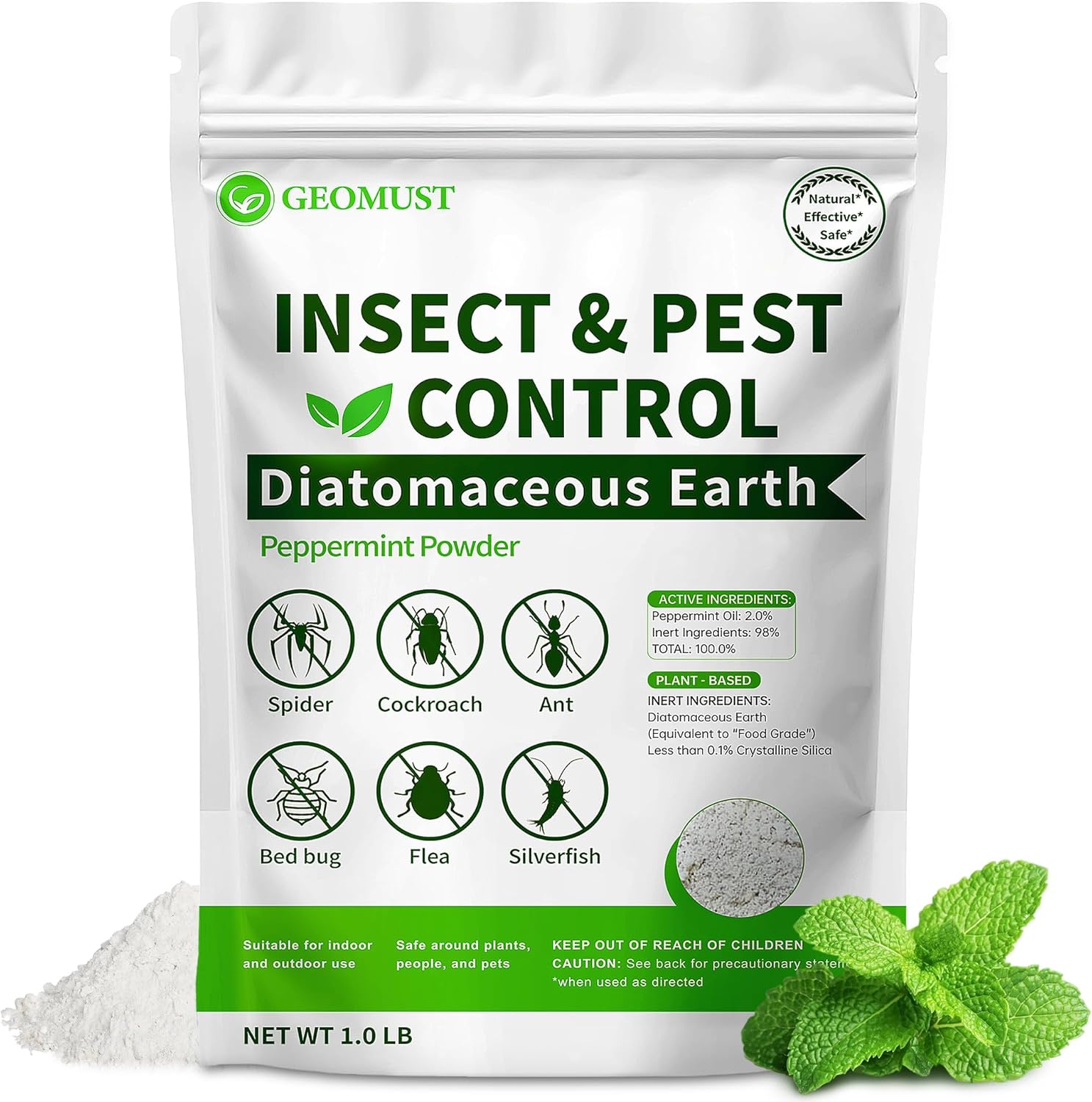
Geomust Diatomaceous Earth with Peppermint Oil, Food Grade Insect Killer, 1 lb
| Item Form | Powder |
|---|---|
| Target Species | Ants; Cockroaches; Fleas; Bed Bugs; Silverfish; Insects |
| Unit Count | 16 Ounce |
| Ingredients | Diatomaceous Earth; Peppermint Oil |
This Geomust product is a food-grade diatomaceous earth powder mixed with peppermint oil intended to control ants, roaches, fleas, bed bugs, silverfish and other crawling pests. You apply the dry powder to cracks, baseboards, entry points and around foundations or garden areas where insects travel; it works by dehydrating and abrading insect exoskeletons rather than poisoning them. The added peppermint oil gives a fresh scent and may help deter insects in treated zones. Because the formula is inert and labeled food grade it is suitable for use where households want a nonchemical option and safer handling around people and pets when used as directed. It must be kept dry to remain effective and its effects are contact-based, so it requires placement where insects will cross and occasional reapplication after cleaning or moisture exposure. For heavy, established infestations you may need repeated treatments or to combine this with exclusion and sanitation measures.
Best for: Homeowners who prioritize a low-toxicity, maintenance-friendly approach to crawling pests and want a straightforward, preventive product to use around living spaces and garden edges.
Less Ideal for: People needing a fast-acting or broad-spectrum solution for large, active infestations where immediate reduction is required.
- Food-grade diatomaceous earth provides a nonchemical, physical mode of kill safe for many home environments when used as directed
- Peppermint oil adds a pleasant scent and may increase deterrent effect in treated areas
- Versatile for indoor and outdoor use around baseboards, entry points, and garden perimeters
- Long-lasting when kept dry and simple to apply as a powder barrier
- Needs to stay dry and only works on insects that contact the powder, so wet areas reduce effectiveness
- Not an instant knockdown for heavy infestations and may require repeated applications or complementary controls
Verdict: Choose this if you want a simple, food-grade, nonchemical powder to prevent and reduce crawling pests with safe indoor and outdoor use when kept dry.
HARRIS Boric Acid Roach Tablets with Lure (6 oz, ~145 Tablets)

| Item Form | Tablets |
|---|---|
| Target Species | Insects |
| Active Ingredients | boric acid |
| Specification Met | EPA |
These HARRIS boric acid tablets are a low-cost, no-frills insecticide for treating indoor crawling insect problems. The tablet form and built-in lure make them easy to use: place tablets in hidden locations such as under appliances, inside drawer wells, behind sinks, and in cracks and crevices; the manufacturer recommends up to twelve tablets per room. The active ingredient is boric acid, which insects pick up and carry back to nests so the effect can extend beyond the tablet location. Because the product is EPA registered it is intended for use around people and pets when used according to directions. Practical benefits include long shelf life when kept dry, a large count that treats multiple rooms, and the ability to hide tablets out of sight. Limitations are that placement is manual and discreet so they are not suitable for visible or heavy infestations that need fast surface knockdown, and they require careful placement to avoid access by children or curious pets. For budget-focused home pest control this is an economical option for preventive maintenance and small to moderate infestations.
Best for: Homeowners on a tight budget who want an affordable, long-lasting option for concealed placement and preventive control of crawling insects.
Less Ideal for: People needing immediate visible elimination of a large active infestation or those who prefer non-chemical or catch-based methods.
- High tablet count treats multiple rooms, offering good value per application
- Boric acid active ingredient is carried back to nests for colony-level control
- Tablet form and lure make placement simple for hidden spot treatment
- EPA registered for intended use in homes when directions are followed
- Works slowly compared with contact sprays and is not ideal for rapid knockdown
- Requires careful placement to keep tablets out of reach of children and pets
Verdict: A cost-conscious, EPA-registered boric acid tablet that provides long-lasting, hidden-spot control for minor to moderate crawling insect problems.
Colton's Naturals Silverfish Killer Spray, Ready-to-Use Trigger Spray

| Product type | Ready-to-use trigger spray |
|---|---|
| Target pest | Silverfish |
| Intended use areas | Bathrooms, closets, basements, baseboards |
This ready-to-use trigger spray is designed to target silverfish where they hide, such as bathrooms, closets, basements, and along baseboards. You use it by spraying cracks, crevices, baseboards, shelving and other common silverfish areas for immediate knockdown and a residual barrier that helps deter return infestations. The convenient spray bottle allows for precise application in tight spaces and storage areas, which makes spot treatments quick and low-effort. It is formulated for indoor surfaces so you can treat corners, edges and shelves without needing specialized equipment. Important limitations are that it is a surface treatment only and will not address infestations inside walls or large-scale infestations without integrated sanitation and moisture control; follow label directions for indoor use and safety precautions. For routine home maintenance and targeted control this spray provides a practical, easy option for reducing silverfish activity.
Best for: Homeowners and renters who want a dependable, easy-to-use indoor product for routine spot control of silverfish in visible areas and storage spaces.
Less Ideal for: People dealing with heavy or structural infestations that likely require professional treatment or products designed for wall voids and large-scale remediation.
- Ready-to-use trigger bottle for precise spot applications in cracks and along baseboards
- Formulated specifically for indoor use on common surfaces where silverfish appear
- Provides a residual barrier to help deter silverfish from returning after treatment
- Suitable for multiple indoor areas including bathrooms, closets, basements and attics
- Surface spray only and will not reach pests hiding inside walls or deep voids
Verdict: A practical, ready-to-use indoor spray that makes routine silverfish spot control quick and reliable.
HARRIS Boric Acid Roach and Silverfish Killer Powder (16 oz)

| Item Form | Powder |
|---|---|
| Target Species | Insects |
| Active Ingredients | boric acid |
| Unit Count | 1 Count |
This 16 oz HARRIS boric acid powder is a straightforward, no-frills roach and silverfish killer that pairs an attractant lure with a dry powder that continues working as long as it stays dry. You apply it from the puffer-style bottle to cracks, baseboards, behind appliances, and other hard-to-reach hiding spots where insects travel. The lure draws insects to the powder, and affected pests typically die within a few days after contact; the residue can remain effective for weeks in dry locations. Notable features are the built-in food-grade lure, EPA registration for household use, and a compact applicator that makes spot treatments quick. Limitations are inherent to boric acid powder: it must remain dry to work, it is not an immediate knockdown, and extra care is required to keep it away from children and pets. For widespread heavy infestations you will likely need repeated treatments or a complementary baiting strategy to reach deep harborage sites.
Best for: Buyers looking for a low-cost, easy-to-apply solution to reduce roach and silverfish activity in localized areas of the home and who prefer a product that provides lasting residue when applied correctly.
Less Ideal for: Homes needing immediate elimination of a heavy, widespread infestation or users who cannot safely restrict access to treated areas from children or pets.
- Contains a food-grade lure to attract insects to the powder
- Long-lasting residual effect when applied in dry areas
- Puffer applicator allows targeted application into cracks and tight spaces
- EPA registered for use in homes
- Requires dry placement to remain effective and will fail if disturbed or wetted
- Not an instant knockdown—pests can take up to 72 hours to die
Verdict: A budget-friendly, EPA-registered boric acid powder that provides an easy, long-lasting spot treatment for household roaches and silverfish.
Atticus Talak 7.9% Bifenthrin Indoor/Outdoor Insecticide Concentrate, 32 oz

| Active Ingredient | Bifenthrin |
|---|---|
| Formulation | Suspension Concentrate |
| Liquid Volume | 32 fluid ounces |
| Length of Control | Up to three months |
| Target Species | Insects |
Talak 7.9% is a liquid concentrate for treating lawns, landscaping, outdoor living areas and indoor perimeter spots like baseboards and cabinets. You dilute the concentrate with water to create a spray for barrier treatments, spot applications or lawn mixes; label rates explain how much to mix per gallon depending on the use. The product uses bifenthrin, a proven broad-spectrum active ingredient, and the manufacturer states it controls over 75 species and can give residual control for as long as three months. Its water-based formula dries clear, leaves no odor or visible residue, and is not phytotoxic on plants when used per label. Practical benefits include flexible indoor and outdoor use, clear drying, and a bottle designed for easier pouring. Important limitations are that solutions should be mixed only for same-day use, it is not registered for sale in a few states, and it is not approved for fogger application, so professional-style misting methods are not appropriate.
Best for: Buyers who want a single, reliable product to protect yards, patios and building perimeters from a wide range of common pests and prefer conservative, label-driven application practices.
Less Ideal for: People seeking ready-to-use sprays or fogger-compatible products or those in states where this formulation is not registered should look at alternatives.
- Broad-spectrum control listed for 75+ indoor and outdoor pest species
- Water-based formula that dries clear and leaves no odor or residue
- Flexible label directions for lawns, landscapes, hardscapes and indoor perimeter treatments
- Long residual activity up to three months when applied at recommended rates
- Mixed spray solutions cannot be stored and must be used the same day
- Not approved for fogger application and not available for sale in some states
Verdict: A versatile, water-based bifenthrin concentrate that delivers long-lasting, broad-spectrum outdoor (and perimeter indoor) control when used according to the label.
Choosing the Right Insecticide for Silverfish: Key Factors to Consider
Active Ingredient and Mode of Action
Different active ingredients kill silverfish in different ways and have different residual lifespans. Some chemistries provide rapid knockdown but shorter residual control, while others offer longer-lasting residues that suppress newly hatched nymphs. Understanding the mode of action helps you plan follow-up treatments and rotate chemistries if infestations persist.
Also consider that certain ingredients are formulated for indoor use and come with specific precautions around fabrics and paper. Choose an active ingredient whose label supports the treatment locations you need, and follow reapplication intervals to avoid gaps in protection.
Residual Activity on Common Indoor Surfaces
Silverfish spend most of their time on baseboards, cracks, behind bookcases, cardboard boxes, and inside closets. A product with strong residual activity on wood, plaster, and cardboard will continue to protect treated areas after the initial application. Residual life determines how often you need to retreat and how quickly a population can rebound.
Consider whether the formulation leaves visible residue or stains porous materials. For stored papers and textiles, a low-staining residual that still remains effective is preferable.
Safety Around Fabrics, Books, and Stored Food Areas
Because silverfish damage books, photos, and textiles, many treatments will be applied near or on storage items. You need an insecticide that is labeled safe for use in closets, attics, and bookshelves or has clear instructions for treating cracks and crevices rather than directly spraying valuables.
Inspect label restrictions for applications near food preparation surfaces and follow drying times and ventilation recommendations to reduce odor and exposure. Personal protective equipment and careful placement minimize risk to household members and pets.
Formulation and Application Method
Insecticides come as sprays, aerosols, dusts, baits, and residual concentrates. Spot sprays and dusts are useful for cracks, voids, and behind baseboards where silverfish hide. Baits may be less effective for silverfish because they do not feed on bait formulations as readily as other pests. Choose a formulation that matches where silverfish are active and how you plan to apply treatment.
Ease of application also affects how thoroughly you can treat an area. Fine spray or non-staining residual concentrates are good for broad perimeter treatments, while dusts and aerosols can reach voids but require more careful placement to avoid contamination of stored items.
Odor and Indoor Acceptability
Treatments applied indoors can leave detectable odors that bother occupants or affect delicate stored items. Low-odor formulations and products with short volatilization periods let you re-enter spaces sooner and reduce the chance of lingering chemical smells on fabrics or paper. Check drying time recommendations and ventilate treated areas as directed.
If odor sensitivity is a concern, choose products explicitly described as low-odor or formulated for indoor household use and apply them in small, targeted treatments rather than broad sprays.
Label Directions and Reapplication Interval
Labels provide legally required directions for safe and effective use, including dilution rates, treated area limits, and reapplication intervals. A product with clear, specific label instructions makes it easier to apply correctly and avoid overuse or unsafe applications near sensitive belongings.
Look for labels that describe treatment of cracks, crevices, and storage areas and provide guidance for follow-up inspections and re-treatments. Lack of clear label instructions should be a disqualifying factor for indoor silverfish control.
Preparing the Space Before Treatment
Decluttering, removing infested papers and damaged items you plan to discard, and vacuuming corners and shelves reduce the population before applying insecticide. Vacuuming removes eggs, nymphs, and debris that can shield silverfish from contact treatments.
For treated items you intend to keep, remove or temporarily relocate textiles and loose papers when the label recommends avoiding direct contact. Treat cracks, baseboards, and voids where silverfish hide rather than spraying valuables.
- Vacuum shelves, book edges, and baseboards thoroughly.
- Seal or discard heavily damaged papers and fabrics.
- Identify moisture sources such as leaks or high humidity and address them to reduce recurrence.
Non-Chemical Measures That Complement Insecticides
Silverfish thrive in humid, cool environments. Reducing humidity with dehumidifiers, improving ventilation, and fixing leaks makes treated areas less hospitable and extends the usefulness of any chemical control. Sticky traps can help monitor activity and indicate whether treatments are working.
Physical exclusion such as sealing cracks, weatherstripping, and keeping storage in plastic bins rather than cardboard will reduce shelter and food sources for silverfish over the long term.
- Use silica gel or desiccant packets in closed storage to protect papers.
- Keep basements and attics well ventilated and below 60 percent relative humidity.
- Store valuable papers in plastic boxes rather than cardboard.
Targeting Treatment Zones for Best Effect
Concentrate treatments along baseboards, behind bookcases, in closets, and in attics where silverfish activity concentrates. Treat cracks and crevices, voids, and areas under trim using products labeled for such applications. Avoid broad, indiscriminate spraying of shelves and fabrics.
Map hotspots by checking sticky traps, looking for scales or frass, and noting damaged items. Targeted placement of dusts or residual sprays in these zones reduces overall chemical use and improves control.
- Treat along baseboards and behind shelving rather than directly on books.
- Apply dusts sparingly into voids using a duster for deep penetration.
- Retreat only where activity persists according to label intervals.
Dealing With Heavy Infestations
Heavy infestations may require a combination of aggressive preparation, more extensive spot treatments, and repeated applications spaced according to the product label. Prioritize reducing humidity and removing heavily damaged items before applying insecticide to maximize contact with active insects.
If activity continues after several properly applied treatments, reassess hiding places and application thoroughness. Non-chemical controls and physical exclusion should be tightened while following label-guided retreatment schedules.
- Increase inspection frequency and monitor traps weekly.
- Consider sealing wall voids and repairing moisture problems that sustain populations.
- Retreat targeted zones only as the label permits and after verifying ongoing activity.
Safety and Post-Treatment Care
After treating, follow label directions for ventilation and re-entry times. Remove or isolate treated items when labels advise. Wash hands and clothing after application, and keep pets away from treated zones until residues are dry or inaccessible.
For stored papers and textiles, inspect treated areas for staining and ensure residues are applied to structural surfaces rather than directly onto valuables. Maintain monitoring to determine whether additional spot treatments are necessary.
- Ventilate treated rooms per label instructions.
- Keep children and pets away from wet residues.
- Document treated zones and reapplication dates for later reference.
How We Chose the Best Insecticide for Silverfish
We focused on products formulated specifically to control silverfish indoors and evaluated each option across concrete, gardener- and homeowner-relevant criteria. Our filters prioritized products with proven activity against silverfish life stages, clear application methods for indoor use, and label directions suitable for treating cracks, baseboards, cupboards, attics, and storage areas. Evaluation criteria included immediate knockdown and mortality against active silverfish, residual activity on common indoor surfaces, formulation safety and low odor for use around fabrics and books, and clarity of label instructions for treatment rates and reapplication intervals. We also considered ease of application and compatibility with fabric- and paper-safe treatments. Products lacking clear indoor use directions or with formulations inappropriate for fabric- or paper-rich environments were excluded. The resulting shortlist emphasizes options that balance effectiveness with practical safety and user-friendly application for household silverfish problems.
FAQ
Will a household insecticide kill silverfish instantly?
Many insecticides cause rapid mortality for exposed adults but may not kill eggs. Knockdown speed depends on the active ingredient and formulation. Expect initial reductions quickly, but plan follow-up treatments to address newly hatched nymphs according to label directions.
Are there low-odor options safe for use around books and fabrics?
Low-odor formulations and products labeled for indoor use minimize detectable smell and are preferable near books and textiles. Even with low-odor products, avoid spraying directly on valuables and ventilate treated areas as recommended.
Can I use insecticide dusts in wall voids and behind baseboards?
Yes. Dust formulations are effective in voids and tight spaces when applied sparingly and according to label directions. Use a proper duster to place dust into cracks and voids to reach hiding silverfish while minimizing spread to living spaces.
How long should I wait to reapply treatment?
Reapplication intervals vary by product and residual lifespan. Follow the specific label interval, which often ranges from several weeks to a few months, depending on formulation and infestation severity. Use monitoring traps to guide retreatment timing.
Will treating for silverfish harm pets or houseplants?
Risk depends on the product and application method. Many indoor formulations are safe when applied to structural surfaces and allowed to dry before re-entry, but avoid applying treatments to houseplants and keep pets away from treated zones until residues are dry or inaccessible. Always follow label precautions.
Are baits effective against silverfish?
Baits are generally less reliable for silverfish because these insects have varied diets and do not always accept bait formulations. Contact treatments, residual concentrates, and dusts targeted at hiding places usually provide more consistent control.
Final Verdict
Choose an insecticide for silverfish by prioritizing knockdown where you see activity and residual protection where they hide. Balance formulation choice with safety around books, fabrics, and stored materials, and select an application method that reaches cracks and voids without contacting valuables. Address moisture and clutter to reduce re-infestation risk, follow label directions closely, and use monitoring to time retreatments. With targeted preparation and the right indoor-ready formulation, you can control silverfish while minimizing exposure to household items.
