

Note: This article contains affiliate links. If you click on these links and make a purchase, I may earn a small commission at no extra cost to you. This helps support my research and content. Read my full affiliate disclosure here.
Leafhopper feeding can quickly stunt new growth, scar fruit, and spread plant diseases if not controlled. Choosing the right insecticide for leafhoppers matters because treatment speed, residual activity, and safety to ornamental or edible plants determine whether you stop an outbreak or make the problem worse. This guide shortlists the top options tested for common garden situations and evaluates them on effectiveness, phytotoxicity risk, and impact on beneficial insects. Use the summaries and evaluation criteria below to match a product to your crop, application method, and tolerance for collateral effects before treating.
Top Picks at a Glance
| Best Overall The best all-around choice for most situations | BioAdvanced 3-in-1 Insect, Disease & Mite Control Spray, 32 fl oz |  |
| Best Quality Built to a higher standard if you want something more solid | Bonide Tomato & Vegetable Pyrethrins Ready-to-Use Spray, 1 qt (Pack of 3) |  |
| Best Value The sweet spot between price and what you get | Bonide Insecticidal Soap Ready-to-Use Spray, 32 oz |  |
| Best Budget The cheapest option that still gets the job done reliably | GardenTech Sevin Insect Killer Dust, 1 lb |  |
| Highest Rated A top-rated pick with lots of positive feedback | Venerate CG Bioinsecticide (1 Gallon) — Marrone Bio Innovations |  |
| Most Popular A crowd favorite that many people choose with confidence | Bonide Captain Jack's Deadbug Brew Ready-to-Use Spray, 32 oz |  |
| Best Seller A high-volume bestseller chosen again and again | Atticus Talak 7.9% Bifenthrin Indoor/Outdoor Insecticide Concentrate, 32 oz |  |
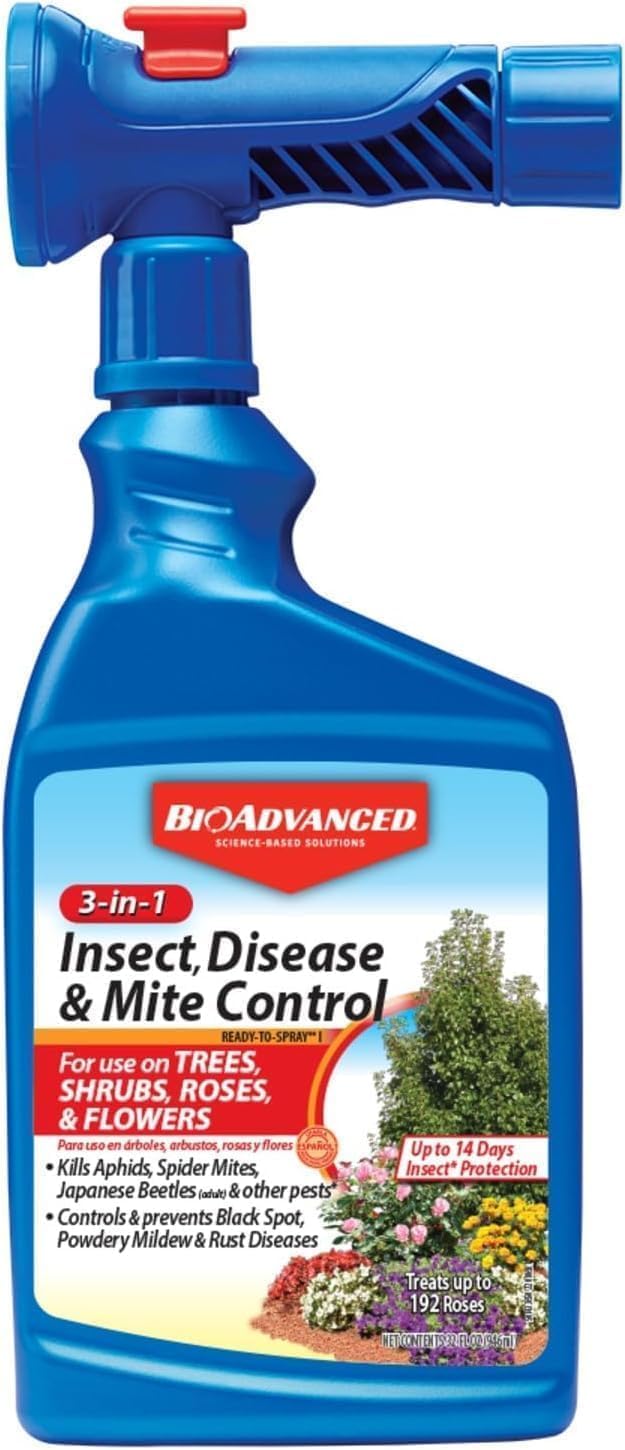
BioAdvanced 3-in-1 Insect, Disease & Mite Control Spray, 32 fl oz
| Unit Count | 32 Fluid Ounces |
|---|---|
| Item Form | Spray |
| Target Species | Aphids, caterpillars, leafminers, whiteflies and other listed pests |
| Active Ingredients | Tau-fluvalinate 0.61%, Tebuconazole 0.65% |
This BioAdvanced 3-in-1 spray is a performance-focused ready-to-use treatment that kills common pests on contact while also preventing and curing listed fungal diseases and controlling spider mites. It attaches to a garden hose for broad, even coverage and is labeled to treat up to 192 rose bushes, making it practical for medium to large beds and multiple shrubs. Key features include systemic ingredients plus contact control, rainproof protection lasting up to 14 to 30 days depending on labeled claims, and active ingredients targeting aphids, caterpillars, whiteflies, and mites. In use you spray foliage including undersides, and the product provides both immediate knockdown of insects and longer residual control so follow-up applications are less frequent. Limitations: it is a chemical treatment so users must follow safety directions and keep children and pets away until treated areas have dried, and it is not sold for use in New York. For someone prioritizing reliable, one-step control of aphids and associated fungal problems on roses and ornamentals, this bottle delivers convenient, broad-spectrum protection.
Best for: Gardeners who want a fast, high-performance one-step solution to control aphids and related pests while also preventing common fungal diseases on roses and ornamental plants.
Less Ideal for: Organic gardeners or those seeking nonchemical options should look for botanical or soap-based aphid controls instead.
- Combines insecticide, fungicide, and miticide in one ready-to-use formula for streamlined treatment
- Attaches to a garden hose for fast coverage of many plants including up to 192 roses
- Provides knockdown on contact and residual protection between labeled reapplications
- Controls a wide list of pests including aphids, spider mites, whiteflies, and caterpillars
- Contains chemical active ingredients that require careful handling and adherence to safety directions
- Not approved for sale in all states which limits availability for some users
Verdict: For gardeners focused on performance, this ready-to-spray 3-in-1 formula delivers fast aphid knockdown plus disease prevention in one convenient application.
Bonide Tomato & Vegetable Pyrethrins Ready-to-Use Spray, 1 qt (Pack of 3)

| Item Form | Spray |
|---|---|
| Target Species | Insects |
| Liquid Volume | 1 quarts |
The Bonide Tomato & Vegetable Pyrethrins RTU is a one-quart ready-to-use spray that targets a wide range of soft-bodied and chewing insects commonly found on vegetable plants. It is typically applied directly to foliage and is labeled as safe for use even on the day of harvest, which makes it convenient for growers who need quick knockdown without long withholding periods. The formula uses a botanical pyrethrin active ingredient at a low concentration and is described as effective on all insect life stages, giving both immediate adult control and action against larvae. Practical benefits include no mixing, easy spray application, and broad-spectrum control that covers leafhoppers as well as aphids and caterpillars. Limitations are that botanical pyrethrins provide relatively short residual protection compared with systemic or longer-lasting synthetics, so repeated applications may be needed during heavy infestations, and effectiveness can decline after rain or irrigation. For growers focusing on fast, contact control with minimal re-entry restrictions, this product is a straightforward option.
Best for: Gardeners and vegetable growers who prioritize quick, contact control of leafhoppers and other common foliar pests and want a product safe to use close to harvest.
Less Ideal for: Growers seeking long-lasting residual protection or those who prefer systemic treatments for hard-to-reach or persistent infestations should consider alternative options.
- Ready-to-use formula requires no mixing and is easy to apply.
- Broad-spectrum activity covers leafhoppers, aphids, whiteflies, loopers and caterpillars.
- Labeled for use up to day of harvest, allowing safe application on edible plants.
- Effective as a quick contact knockdown against multiple life stages.
- Short residual activity compared with systemic insecticides, requiring more frequent reapplication.
- Contact-based action can be less effective if thorough coverage is not achieved or after rainfall.
Verdict: Choose this product when you need a ready-to-use, fast-acting botanical spray for controlling leafhoppers and other common vegetable garden pests close to harvest.
Bonide Insecticidal Soap Ready-to-Use Spray, 32 oz

| Unit Count | 32 Ounce |
|---|---|
| Item Form | Spray |
| Target Species | Insects |
| Active Ingredients | Potassium salt of fatty acids |
This ready-to-use insecticidal soap spray kills soft-bodied insects on contact using potassium salts of fatty acids derived from plants, making it suitable for organic vegetable beds and container vegetables. It is applied with the built-in spray nozzle directly to affected foliage to control aphids, mites, caterpillars, whiteflies and other listed pests; the label allows use up to the day of harvest on many food crops. Practical benefits include an easy spray application with no mixing, low residual toxicity compared with conventional insecticides, and a broad list of target species for small-scale home gardens and greenhouses. Important limitations are that it works by contact so complete coverage is required and it will not control pests hidden inside fruit or stems; repeated applications may be necessary for heavy infestations. Users should follow label safety directions and test on a few plants first since some sensitive foliage can show damage under hot conditions.
Best for: Gardeners who prioritize simple, low-residue organic solutions for vegetables and want a no-mix spray they can use quickly on affected plants.
Less Ideal for: Large-scale growers who need systemic or long‑residual control or anyone needing a product to reach pests hidden inside fruit or stems.
- Ready-to-use spray with an easy nozzle for immediate application
- Active ingredient is a plant-derived potassium salt suitable for organic gardening
- Labeled for use on a wide range of vegetables, herbs, ornamentals and houseplants
- Low residual toxicity compared with synthetic insecticides
- Kills only on contact so full coverage and repeat treatments are often required
- May cause phytotoxicity on some sensitive plants or under high heat if not spot-tested
Verdict: A convenient, ready-to-use organic spray that gives practical contact control of common vegetable garden pests with minimal residual impact.
GardenTech Sevin Insect Killer Dust, 1 lb

| Item Form | Dust |
|---|---|
| Target Species | Insects |
| Active Ingredients | Bifenthrin |
| Unit Count | 1 Count |
Sevin Insect Killer Dust is a handheld dust formulation of bifenthrin for spot and perimeter treatment of garden pests, including Japanese beetles. You apply it by shaking a thin, uniform layer onto leaves, stems and around plants as a preventative or when you first see damage. The product kills by contact and lists more than 150 target insects, so it works across vegetables, fruit, ornamentals and turf. Practical features include a flip-open cap for easy dispensing and a 1 pound container sized for small-to-medium beds; the manufacturer states one pound treats about 2,000 sq. ft. The dust does not require mixing and settles quickly so treated areas can be reoccupied after it dries. Important limitations are typical for contact insecticides: it should not be applied to open blooms to protect pollinators and it provides little residual control if plants are watered or receive heavy rain within 24 hours of application. Users must follow label safety steps like avoiding the eyes and washing hands after use.
Best for: Gardeners who want a straightforward, no-mix contact treatment to quickly reduce visible beetle and chewing insect pressure in mixed vegetable, fruit and ornamental plantings.
Less Ideal for: People prioritizing pollinator-safe or long-residual biological controls should choose targeted or non-chemical methods instead.
- Kills by contact a wide range of garden pests including Japanese beetles and aphids
- Ready-to-use dust needs no mixing and is simple to apply with a flip-open cap
- Label lists use on vegetables, fruits, ornamentals and lawns so it fits mixed garden beds
- Contains bifenthrin which can harm beneficial insects if applied to open blooms or overused
Verdict: If you need a simple, ready-to-use contact treatment to quickly knock down Japanese beetles and other common garden pests, Sevin dust delivers fast, broad-spectrum control.
Venerate CG Bioinsecticide (1 Gallon) — Marrone Bio Innovations

| Unit Count | 128 Fluid Ounces |
|---|---|
| Item Form | Oil |
| Target Species | Insects |
| Special Features | organic |
| Liquid Volume | 1 gallons |
Venerate CG is a concentrated bioinsecticide formulated to control a broad range of chewing and sucking pests including leafhoppers, mites, thrips, aphids and whiteflies. It is typically mixed and applied as a ground or aerial spray in integrated pest management programs, and its multiple modes of action are intended to reduce resistance buildup. Notable features are its organic compatibility, tolerance exemption that allows use close to harvest, and claims of being easy on beneficial insects which helps preserve natural predators. For growers focused on consistent, programmatic pest control it fits into rotation schedules and resistance management plans. Important limitations are regulatory restrictions in several U.S. states and the need to follow label directions for mixing and application rates; because it is a biological product results can be slower or more variable than with conventional synthetic insecticides under heavy pest pressure.
Best for: Growers and crop managers who prioritize dependable, resistance-aware pest control that fits into integrated pest management and organic production plans.
Less Ideal for: Home gardeners seeking immediate knockdown for severe outbreaks or users in states where this product is not registered should consider alternative registered options.
- Broad-spectrum activity against chewing and sucking insects including leafhoppers
- Compatible with organic production and IPM programs
- Zero-day pre-harvest interval and claimed residue-free produce
- Multiple modes of action to help manage insect resistance
- Not registered for sale or use in several U.S. states
- Biological performance can be slower or less consistent than synthetic chemistries under heavy infestations
Verdict: Choose Venerate CG when you need an organic-compatible bioinsecticide that supports IPM and resistance management for leafhoppers and related pests.
Bonide Captain Jack's Deadbug Brew Ready-to-Use Spray, 32 oz

| Item Form | Spray |
|---|---|
| Target Species | Insects |
| Liquid Volume | 32 fluid ounces |
| Active Ingredients | Spinosad 0.5% |
Bonide Captain Jack's Deadbug Brew is a 32 oz ready-to-use spinosad spray formulated for organic gardening and aimed at controlling chewing and some leaf-feeding insects. You use it like a typical foliar spray, shaking the bottle and applying thoroughly to the tops and undersides of leaves on vegetables, fruit trees, and ornamentals. The active ingredient spinosad is effective against caterpillars, beetles, loopers, thrips, and similar pests and is labeled to spare many predatory beneficial insects when used as directed, which helps maintain biological control in the garden. The built-in spray nozzle makes application quick for small to medium beds and container crops. Limitations are that it is a contact and stomach poison so thorough coverage is required and repeat applications may be necessary for heavy infestations; it is not systemic and will not protect new growth after application. Also users must follow safety directions and avoid use when pollinators are active.
Best for: Gardeners who prioritize practical, low-fuss pest control for vegetables and fruit and who want an organic-approved spray they can apply quickly without mixing.
Less Ideal for: Large acreage growers or those who need long-lasting systemic protection should look for professional or systemic options instead.
- Contains spinosad, an approved active ingredient for organic gardening that targets many chewing pests
- Ready-to-use spray with integrated nozzle for simple, no-mixing application
- Label supports use on a wide variety of vegetables and fruit crops
- Designed to have limited impact on many predatory beneficial insects when used properly
- Works by contact and ingestion so thorough coverage and repeat applications are necessary
- Not systemic, so new growth after treatment is unprotected
Verdict: A convenient, organic-approved spinosad spray that delivers effective contact control of common foliage-feeding pests on cucurbits and other garden crops.
Atticus Talak 7.9% Bifenthrin Indoor/Outdoor Insecticide Concentrate, 32 oz

| Active Ingredient | Bifenthrin |
|---|---|
| Formulation | Suspension Concentrate |
| Liquid Volume | 32 fluid ounces |
| Length of Control | Up to three months |
| Target Species | Insects |
Talak 7.9% is a liquid concentrate for treating lawns, landscaping, outdoor living areas and indoor perimeter spots like baseboards and cabinets. You dilute the concentrate with water to create a spray for barrier treatments, spot applications or lawn mixes; label rates explain how much to mix per gallon depending on the use. The product uses bifenthrin, a proven broad-spectrum active ingredient, and the manufacturer states it controls over 75 species and can give residual control for as long as three months. Its water-based formula dries clear, leaves no odor or visible residue, and is not phytotoxic on plants when used per label. Practical benefits include flexible indoor and outdoor use, clear drying, and a bottle designed for easier pouring. Important limitations are that solutions should be mixed only for same-day use, it is not registered for sale in a few states, and it is not approved for fogger application, so professional-style misting methods are not appropriate.
Best for: Buyers who want a single, reliable product to protect yards, patios and building perimeters from a wide range of common pests and prefer conservative, label-driven application practices.
Less Ideal for: People seeking ready-to-use sprays or fogger-compatible products or those in states where this formulation is not registered should look at alternatives.
- Broad-spectrum control listed for 75+ indoor and outdoor pest species
- Water-based formula that dries clear and leaves no odor or residue
- Flexible label directions for lawns, landscapes, hardscapes and indoor perimeter treatments
- Long residual activity up to three months when applied at recommended rates
- Mixed spray solutions cannot be stored and must be used the same day
- Not approved for fogger application and not available for sale in some states
Verdict: A versatile, water-based bifenthrin concentrate that delivers long-lasting, broad-spectrum outdoor (and perimeter indoor) control when used according to the label.
Choosing the Right Insecticide for Leafhoppers: Key Factors to Consider
Mode of Action and Contact Vs Systemic Control
Knowing whether an insecticide works by contact, ingestion, or systemically changes how you apply it and what outcomes to expect. Contact insecticides kill on direct hit and give fast visible results but miss hidden or newly hatched nymphs. Systemic materials are taken up through roots or leaves and protect new growth for days to weeks, which is useful for sap-sucking pests that feed in concealed spots. Match mode of action to the infestation pattern: use contact sprays for small localized outbreaks and systemic options for recurring leafhopper pressure or when treating tall shrubs and trees where thorough coverage is difficult.
Understanding mode of action also helps with resistance management. Rotating products with different action modes reduces the chance leafhopper populations develop tolerance after repeated use.
Speed of Knockdown and Residual Activity
How quickly an insecticide reduces visible leafhopper numbers affects plant recovery and the need for repeat applications. Fast knockdown limits immediate feeding damage, while longer residual activity reduces how often you must reapply. Some gardeners prefer quick-acting sprays when crops are near harvest and they need immediate relief. Others accept slower systemic uptake if it means fewer treatments over the season.
Consider weather and cropping cycles. Heavy rain can wash off contact residues and shorten residual control, whereas systemic products are less affected by wash-off but need time to be absorbed and translocated within the plant.
Plant Safety and Phytotoxicity Risk
Different formulations and application rates carry varying risks of leaf burn, spotting, or growth suppression, especially on tender new foliage or heat-stressed plants. Always check label directions for sensitive species, maximum application temperatures, and recommended dilution. Some water-soluble concentrates are safe on vegetables but may cause spotting on succulents or certain ornamentals.
If you grow edible crops, verify pre-harvest intervals and whether the product is labeled for food plants. When treating mixed borders or container plantings, select options with a lower phytotoxicity record to avoid damaging desirable plants near the treatment zone.
Impact on Beneficial and Nontarget Insects
Leafhoppers often share habitat with pollinators, predatory insects, and parasitoids that help suppress other pests. Broad-spectrum contact insecticides can remove these allies and create secondary outbreaks of mites or aphids. Choose formulations and application timing that minimize exposure to bees and predatory bugs: apply in the evening, avoid spraying blooms, and prefer products with lower toxicity to beneficials when feasible.
Some systemic materials translocate to pollen and nectar; check label guidance about flowering crops and pollinator protections. Integrated pest management techniques that combine targeted sprays with cultural controls reduce reliance on chemicals and preserve beneficial populations.
Application Method and Garden Fit
How you apply an insecticide affects coverage, convenience, and effectiveness. Hand-pump or hose-end sprayers are practical for small beds and container groups, while larger landscapes may need backpack sprayers or soil drench options. Granules and soil-applied systemic treatments are useful for perennials and shrubs where foliar coverage is hard to maintain.
Consider safety features like clear mixing instructions, compatibility with common sprayer materials, and whether the product requires protective gear beyond gloves and eye protection. Ease of use influences how likely you are to apply treatments correctly and at the right frequency.
Application Timing and Environmental Conditions
Timing treatments to pest life stage and daily weather reduces wasted applications. Leafhopper nymphs are more vulnerable to contact sprays, so early-season scouting and treating before populations peak gives better outcomes. Avoid spraying in extreme heat or when rain is expected within 24 hours to prevent phytotoxicity and wash-off.
Environmental considerations also include runoff risk. For sloped sites or near water features, prefer products with lower mobility or use application methods that limit soil transport.
When to Treat Leafhopper Outbreaks
Inspect foliage regularly for stippling, leaf curl, and adults that jump when disturbed. Treat when you detect active feeding on new growth or when more than a threshold number of nymphs are present per plant, depending on the crop and tolerance for cosmetic damage. Early spot treatment prevents rapid spread.
Target juvenile stages when possible. Nymphs are less mobile and more vulnerable to contact sprays, while adults can fly and reinfest treated areas.
- Scout weekly during warm months when leafhoppers are most active
- Treat small hotspots rather than entire beds when infestations are limited
- Combine physical controls like row covers with targeted spraying for high-value plants
Integrating Nonchemical Controls
Cultural practices reduce leafhopper pressure and the need for frequent insecticide use. Maintain plant vigor with proper watering and nutrition so plants can tolerate occasional feeding. Reduce wide monocultures that attract large populations and encourage a diversity of flowering plants to support predators.
Physical barriers such as fine mesh row covers protect young transplants during peak migration windows. Sticky traps can help monitor adult numbers but rarely control populations by themselves.
- Encourage predatory insects by providing flowering plants and shelter
- Remove heavily infested plant debris to reduce overwintering sites
- Use reflective mulches in small-scale vegetable beds to deter leafhoppers
Safe Application Practices for Gardeners
Read and follow the label every time, matching dilution rates to the target plant and growth stage. Wear recommended PPE, avoid drift onto non-target plants, and keep pollinators in mind by treating after dusk or before dawn when bees are least active.
Rinse sprayers thoroughly between different chemistries to avoid mixing incompatible products. Store insecticides in a cool, dry place away from children and pets and keep containers intact with original labeling.
- Avoid spraying during bloom unless label indicates pollinator-safe timing
- Calibrate sprayers to deliver even coverage without run-off
- Record application dates to respect reapplication intervals and pre-harvest limits
Managing Resistance and When to Rotate Modes
Routinely using the same active ingredient increases the chance leafhopper populations develop reduced sensitivity. Rotate products with different modes of action across seasons and avoid back-to-back treatments with identical chemistries.
Combine nonchemical tactics with chemical rotation to lower selection pressure. When control falters after repeated treatments, re-evaluate timing, coverage, and whether a different mode of action is warranted.
- Keep records of active ingredients used each season
- Alternate contact and systemic modes where label directions allow
- Use label-recommended resistance management guidance
Special Considerations for Edible Gardens
If you grow vegetables or fruit, check pre-harvest intervals and whether the product is labeled for food crops. Some materials require withholding harvest for days or weeks, or have restrictions on application near pollinator-attractive blooms.
When treating ornamentals next to edibles, avoid drift and wash-off into vegetable beds. Consider soil-applied systemics with appropriate label clearances if foliar sprays would contaminate harvestable parts.
- Follow label pre-harvest intervals exactly
- Avoid spraying edible foliage close to harvest
- Prefer contact sprays for spot-treating nonbearing ornamentals
How We Chose the Best Insecticide for Leafhoppers
We shortlisted products that are formulated or labeled specifically for sucking pests and have application methods suitable for home gardeners and small-scale growers. Editorial filters prioritized ingredients with documented activity against leafhoppers, clear directions for foliar and soil applications, and guidance for use on common garden plants including ornamentals, vegetables, and fruit trees. We evaluated residual control duration, speed of knockdown, and systemic versus contact action because those determine how quickly damage ceases and whether young growth remains protected. Safety to plants under full sun or warm conditions and label restrictions for edible crops were key exclusion criteria. We excluded broad insecticides with no specific mention of leafhoppers or those lacking clear gardener-facing directions. Laboratory toxicity numbers were considered only insofar as they affect application precautions and beneficial insect impact. The resulting selection emphasizes practical performance, clear labeling for garden use, and reasonable safety margins for use around pollinators when used as directed.
FAQ
How quickly should I expect to see leafhoppers die after spraying?
It depends on the product's mode of action. Contact sprays can reduce visible adults and nymphs within hours, while systemic products may take a few days to translocate and affect feeding. Expect faster visible knockdown with contact materials and slower, longer-lasting control from systemics.
Can I treat flowering plants without harming pollinators?
Often not during active bloom. Many insecticides can contaminate pollen and nectar or directly kill foraging bees. If treatment is necessary on flowering plants, choose a product labeled for pollinator safety and apply when pollinators are inactive, such as early morning or late evening, following label guidance.
Will a soil drench control leafhoppers on shrubs or trees?
Soil-applied systemic treatments can be effective for larger plants where foliar coverage is difficult. They require uptake through roots and time to move into foliage, so they are better for preventative or longer-term control rather than immediate knockdown of an active outbreak.
How often can I reapply insecticide if leafhoppers return?
Follow label reapplication intervals, which vary by active ingredient and formulation. Shorter intervals are allowed for some contact sprays, while systemics often advise longer gaps. Repeated applications with the same mode of action should be avoided to reduce resistance risk.
Are homemade sprays effective against leafhoppers?
Some homemade remedies may have modest deterrent or contact effects but are often inconsistent and short-lived. For serious or recurring infestations, labeled products with demonstrated activity provide more reliable control and come with instructions to protect plants and nontarget organisms.
Final Verdict
Choosing the right insecticide for leafhoppers comes down to matching mode of action, speed of control, and safety to the plants and beneficial insects in your garden. For immediate outbreaks, choose contact materials that provide quick knockdown and plan follow-up scouting. For recurring pressure or hard-to-reach plants, select systemic options with appropriate label clearance for your crops. Balance treatment urgency with pollinator protections and rotate modes of action to limit resistance.
