

Note: This article contains affiliate links. If you click on these links and make a purchase, I may earn a small commission at no extra cost to you. This helps support my research and content. Read my full affiliate disclosure here.
Keeping pests off your home's exterior matters for comfort and to reduce indoor infestations. The right insecticide spray for outside the house treats foundations, eaves, patios, and vegetation where insects start or shelter. This guide covers seven shortlisted options selected for typical yard situations and application needs. We focus on how sprays behave in real outdoor conditions, including spray pattern, surface coverage, and how long protection lasts after rain or watering. Use the evaluation notes to match a spray to your property layout and routine maintenance.
Top Picks at a Glance
| Best Overall The best all-around choice for most situations | Atticus Talak 7.9% Indoor/Outdoor Bifenthrin Insecticide Concentrate (1 gal) |  |
| Best Quality Built to a higher standard if you want something more solid | Quali-Pro Bifenthrin I/T 7.9F Insecticide, 1 Gallon |  |
| Best Value The sweet spot between price and what you get | Ortho Home Defense Insect Killer for Lawn & Landscape Ready-to-Spray, 32 fl oz |  |
| Best Budget The cheapest option that still gets the job done reliably | Ortho BugClear Insect Killer for Lawns & Landscapes Ready-to-Spray, 32 oz |  |
| Highest Rated A top-rated pick with lots of positive feedback | Talstar One Insecticide Concentrate, 1 Gallon |  |
| Most Popular A crowd favorite that many people choose with confidence | Atticus Talak 7.9% Bifenthrin Indoor/Outdoor Insecticide Concentrate, 32 oz |  |
| Best Seller A high-volume bestseller chosen again and again | Spectracide Triazicide Insect Killer for Lawns & Landscapes, 32 oz |  |
Atticus Talak 7.9% Indoor/Outdoor Bifenthrin Insecticide Concentrate (1 gal)

| Active Ingredients | Bifenthrin |
|---|---|
| Formulation | Suspension Concentrate |
| Unit Count | 128 Fluid Ounces |
| Specification Met | EPA |
Talak 7.9% is a water-based bifenthrin concentrate meant as a flexible indoor and outdoor insect control product. You dilute the concentrate with water and apply it as a spray for perimeter barrier treatments, to turf, to ornamentals, or to interior baseboards and other problem areas. The label lists control of more than 75 pests including mosquitoes and ticks, and the formula is designed to kill on contact and provide residual control for up to three months. Practical benefits include a clear, odor-free spray that dries without staining and a bottle that allows easier small pours for accurate mixing. Important limitations are that mixed solutions should be used the same day and it is not approved for fogger use, so it is best for targeted spray applications rather than broadcast fogging. As with any bifenthrin product, users should follow label directions closely and consider nonchemical options for integrated mosquito management.
Best for: Buyers who want a single, versatile insecticide to treat both perimeter and landscape mosquito problems and prefer a product that delivers residual control without odors or visible residue.
Less Ideal for: People seeking a ready-to-use fogging or misting solution or those who need an insecticide they can pre-mix and store for later use.
- Broad-spectrum control listing more than 75 indoor and outdoor pests including mosquitoes and ticks.
- Water-based formula that dries clear, leaves no residue, and is odor-free for use around living areas.
- Long residual effect with label claim of up to three months of control per application.
- Mixes with water for adjustable application rates across lawns, landscapes, and surfaces.
- Bottle design supports easier small pours to reduce mess when measuring concentrate.
- Mixed spray cannot be stored and must be used the same day.
- Not approved for use in foggers, limiting application methods to direct sprays.
Verdict: A versatile, long-lasting bifenthrin concentrate that provides broad-spectrum mosquito and perimeter control for users who want one product for indoor and outdoor applications.
Quali-Pro Bifenthrin I/T 7.9F Insecticide, 1 Gallon

| Item Form | Spray |
|---|---|
| Target Species | Termites, Carpenter Ants |
| Liquid Volume | 1 gallons |
| Active Ingredients | Bifenthrin |
This one-gallon Quali-Pro Bifenthrin I/T 7.9F is a flowable pyrethroid designed for preventive and residual control of a broad range of pests in lawns and landscaped areas. It is typically mixed and applied as a spray to turf, ornamental beds, foundations and around structures to suppress termites, carpenter ants, fleas, ticks, mites and similar pests. Key features include a long-lasting residual, compatibility with many turf and ornamental tank-mix partners, and a no-odor, non-irritating formulation that dries without visible residue. In practice it provides dependable knockdown and weeks of protection when applied at recommended rates, making it suited for routine perimeter treatments and spot-control of persistent infestations. Important limitations are that it is a concentrated professional-style product requiring careful dilution, protective equipment, and adherence to label directions for safe use around people, pets and desirable plants. It is not a ready-to-use consumer spray and should be used only where labeled.
Best for: Buyers who prioritize a reliable, long-lasting perimeter or spot-treatment solution for recurring or hard-to-control outdoor pests and who are comfortable following label directions and using concentrated products.
Less Ideal for: Casual users who want a simple ready-to-use spray for occasional bug bites or very small lawns should consider consumer-grade aerosols or hose-end products instead.
- Long-lasting residual control effective against termites, carpenter ants and other pests
- Compatible with herbicides, fungicides, insecticides and liquid fertilizers for tank mixes
- No-odor, non-irritating formula that dries with no visible residue
- Available in a one-gallon concentrated flowable for multiple applications
- Concentrated product requires dilution and protective equipment for safe handling
- Not intended as a ready-to-use consumer spray and may be overkill for very small yards
Verdict: Choose this product when you need a dependable, long-lasting concentrated insecticide for routine perimeter and spot treatments in lawns and ornamentals.
Ortho Home Defense Insect Killer for Lawn & Landscape Ready-to-Spray, 32 fl oz

| Unit Count | 1 Count |
|---|---|
| Liquid Volume | 32 fluid ounces |
| Item Form | Spray |
| Target Species | Dog |
Ortho Home Defense Ready-to-Spray is a garden hose‑connected insect killer designed to protect lawns, foundation perimeters and ornamental plants from a broad list of outdoor pests. You attach the bottle to a standard garden hose, turn on the water and flip the lever to apply a continuous spray over lawns, around the house foundation or on shrubs and small trees. The formula claims fast knockdown and up to three months of residual protection against ants, fleas, ticks and many spiders when used as directed, and one 32 fl. oz. bottle treats sizable areas so you can cover most suburban yards in a single application. Practical benefits include quick application without mixing, non-staining and odor‑free performance, and coverage options for lawns, foliage and foundation lines. Important limitations are that it is a chemical insecticide so you must follow safety precautions, keep people and pets away until dry, and it excludes control of certain species such as black widow spiders; repeat applications may be needed in high‑pressure pest years.
Best for: Homeowners who want a no‑mix, easy-to-apply perimeter and lawn treatment that reduces common outdoor pests with periodic reapplication as part of routine yard maintenance.
Less Ideal for: People wanting an organic or non-chemical approach or those who need targeted control of medically significant spiders should consider alternative methods.
- Ready-to-use hose attachment makes application fast and simple without mixing
- Broad-spectrum control listed for up to 235 outdoor pests including ants, fleas, ticks and many spiders
- Claims up to three months residual protection when applied to perimeter and foliage
- Large treatment coverage from a single 32 fl. oz. bottle for typical yard sizes
- Contains chemical insecticide requiring protective clothing and keeping people and pets away until dry
- Does not list effectiveness against some species such as black widow spiders
Verdict: Pick this ready-to-spray Ortho product if you want a quick, hose-attached solution to cut common outdoor pests and establish a multi-month perimeter barrier with minimal setup.
Ortho BugClear Insect Killer for Lawns & Landscapes Ready-to-Spray, 32 oz

| Item Form | Aerosol |
|---|---|
| Target Species | Ant |
| Liquid Volume | 32 fluid ounces |
Ortho BugClear Ready-to-Spray is a hose‑end insecticide designed for homeowners who want a fast, no-mix solution to reduce mosquitoes and many other yard pests. You attach the 32 oz. bottle to a garden hose and apply across lawns, foundation perimeters and ornamentals; one bottle covers up to about a 5,300 sq ft lawn or targeted perimeter areas. The formula lists bifenthrin and zeta‑cypermethrin and is described as non‑staining and odor free, with knockdown that starts within minutes and protection that can last for months. Practical benefits include quick application without measuring, broad-spectrum control of dozens of species including mosquitoes and ticks, and compatibility with turf, shrubs and listed edibles when used as directed. Important limitations are that it is a contact/residual insecticide so timing matters for weather and pollinator safety, and hose-end coverage is fixed so very large properties may need multiple bottles; follow label precautions for pets, people and bloom protection.
Best for: Homeowners who want an affordable, easy-to-use mosquito and general yard pest treatment they can apply themselves without mixing concentrates.
Less Ideal for: People who prefer organic or non-chemical mosquito control methods or those managing very large properties who need professional-scale coverage.
- Ready-to-spray hose-end design for quick, no-mix application
- Claims fast knockdown and long-lasting residual control
- Broad-spectrum label lists many outdoor pests including mosquitoes and ticks
- Non-staining and low odor for outdoor use near living spaces
- Contains synthetic pyrethroids that require careful timing and avoidance of blooming plants to protect pollinators
- Single bottle covers limited area for very large yards
Verdict: A budget-friendly, ready-to-spray option that makes quick, DIY mosquito and yard pest control simple for typical residential lawns.
Talstar One Insecticide Concentrate, 1 Gallon

| Active ingredient | Bifenthrin 7.9% |
|---|---|
| Formulation | Concentrate, water-based |
| Coverage intent | Perimeter and structural applications |
| Pest range | Controls 75+ pests including ticks |
Talstar One is a professional-strength bifenthrin concentrate designed to provide broad-spectrum control of ants, spiders, roaches, fleas, ticks, mosquitoes, and many other pests. You mix the concentrate with water and apply it as a perimeter spray around foundations, doors, and windows or to targeted cracks and crevices indoors. Notable features include a water-based, low-odor formula that dries clear and a residual effect that reduces the need for frequent reapplications on lawns, ornamentals, shrubs, and structural surfaces. For yards with tick pressure, treating perimeters and vegetation provides a dependable barrier that helps reduce tick encounters when applied according to label directions. The product is concentrated so one gallon treats large areas, which makes it efficient for seasonal maintenance across multiple structures. Important limitations are that it is a pesticide that requires careful handling and strict adherence to label rates and application restrictions, and it is not a ready-to-use spray so you will need appropriate mixing and application equipment for safe, effective coverage.
Best for: Buyers who prioritize reliable, residual pest control for yards and perimeters and who are comfortable using concentrated pesticides with proper safety practices.
Less Ideal for: Casual users who want a ready-to-use product or those unwilling to follow pesticide label precautions and use appropriate application equipment.
- Broad-spectrum control that includes ticks and common yard pests
- Concentrated formula covers large areas and is cost-efficient for seasonal treatments
- Water-based, low-odor formula dries clear and is suitable for outdoor living spaces
- Suitable for both perimeter and targeted indoor/structural applications
- Concentrate requires proper mixing and application equipment for safe use
- Contains bifenthrin so users must follow label precautions to protect people, pets, and beneficial insects
Verdict: Choose Talstar One when you need a concentrated, long-lasting perimeter treatment that reliably reduces tick pressure across yards and structures.
Atticus Talak 7.9% Bifenthrin Indoor/Outdoor Insecticide Concentrate, 32 oz

| Active Ingredient | Bifenthrin |
|---|---|
| Formulation | Suspension Concentrate |
| Liquid Volume | 32 fluid ounces |
| Length of Control | Up to three months |
| Target Species | Insects |
Talak 7.9% is a liquid concentrate for treating lawns, landscaping, outdoor living areas and indoor perimeter spots like baseboards and cabinets. You dilute the concentrate with water to create a spray for barrier treatments, spot applications or lawn mixes; label rates explain how much to mix per gallon depending on the use. The product uses bifenthrin, a proven broad-spectrum active ingredient, and the manufacturer states it controls over 75 species and can give residual control for as long as three months. Its water-based formula dries clear, leaves no odor or visible residue, and is not phytotoxic on plants when used per label. Practical benefits include flexible indoor and outdoor use, clear drying, and a bottle designed for easier pouring. Important limitations are that solutions should be mixed only for same-day use, it is not registered for sale in a few states, and it is not approved for fogger application, so professional-style misting methods are not appropriate.
Best for: Buyers who want a single, reliable product to protect yards, patios and building perimeters from a wide range of common pests and prefer conservative, label-driven application practices.
Less Ideal for: People seeking ready-to-use sprays or fogger-compatible products or those in states where this formulation is not registered should look at alternatives.
- Broad-spectrum control listed for 75+ indoor and outdoor pest species
- Water-based formula that dries clear and leaves no odor or residue
- Flexible label directions for lawns, landscapes, hardscapes and indoor perimeter treatments
- Long residual activity up to three months when applied at recommended rates
- Mixed spray solutions cannot be stored and must be used the same day
- Not approved for fogger application and not available for sale in some states
Verdict: A versatile, water-based bifenthrin concentrate that delivers long-lasting, broad-spectrum outdoor (and perimeter indoor) control when used according to the label.
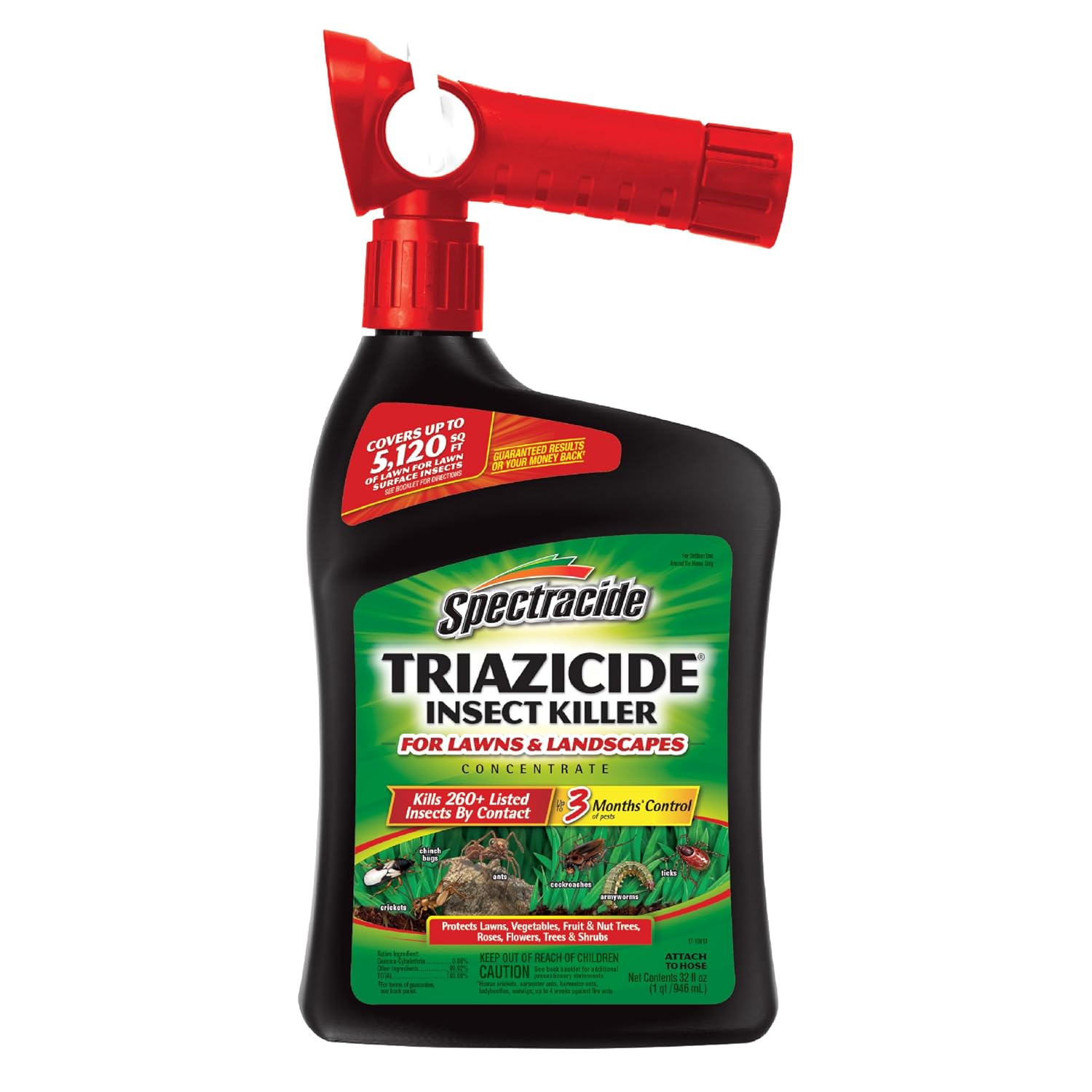
Spectracide Triazicide Insect Killer for Lawns & Landscapes, 32 oz
| Unit Count | 32 Ounce |
|---|---|
| Item Form | Spray |
| Target Species | Insects |
| Active Ingredients | Gamma-Cyhalothrin (0.08%) |
Spectracide Triazicide is a 32-ounce concentrate formulated to control more than 260 listed insects on lawns, flower beds, trees, shrubs and around vegetables. You mix the concentrate with water and apply it with a tank or hose-end sprayer; the ready-to-spray variant can attach to a garden hose for quicker application. The active ingredient, gamma-cyhalothrin, delivers fast contact kill for pests such as fleas, ticks, Japanese beetles and many surface insects, and the label claims protection for up to three months in some uses. It is non-staining when used as directed and can treat large areas, making it practical for whole-yard applications and targeted mound treatments like fire ants. Important limitations include toxicity to fish and bees, so it must not be applied near water or blooming plants, and the product requires careful handling and adherence to safety directions. Follow mixing rates and timing recommendations for best results and to minimize environmental risk.
Best for: Buyers who need an affordable, large-area solution to knock down common lawn and landscape pests and prefer a concentrate that stretches coverage when mixed.
Less Ideal for: People with small ornamental gardens near ponds, homeowners who prioritize pollinator-safe products, or those unwilling to follow pesticide safety precautions should consider gentler or targeted alternatives.
- Concentrate covers large areas so a single bottle treats many square feet when mixed correctly
- Fast-acting contact kill for a wide range of listed insects including fleas, ticks and Japanese beetles
- Versatile use on lawns, flower beds, trees, shrubs and around vegetables
- Non-staining when used as directed and available in hose-end ready-to-spray format for easier application
- Highly toxic to aquatic life and bees so it cannot be used near water or blooming plants
- Requires careful mixing and protective handling due to chemical toxicity
Verdict: A cost-effective, fast-acting concentrate for treating broad lawn and landscape pest problems when used with care and proper precautions.
Choosing the Right Insecticide Spray for Outside the House: Key Factors to Consider
Coverage and Spray Pattern
How the product sprays affects how much surface you can treat without missing spots. A fine, consistent spray is useful for reaching cracks, crevices, and gaps under eaves, while a wider cone is better for treating vegetation and large foundation areas.
Think about how the spray behaves at the distance you will use it. Hose-end and pump sprayers throw different patterns than aerosol cans or trigger bottles. Good coverage reduces the need to repeat applications and helps create a continuous treated barrier around doors, windows, and vents.
Residual Duration and Longevity
Residual duration determines how often you need to reapply. Longer residuals are more convenient for busy homeowners but can be reduced by UV, rain, and routine irrigation. Check labels for estimated residual activity and whether the product binds to different surfaces such as concrete, wood, or foliage.
Shorter residual products can still be useful when you need quick knockdown or want to limit prolonged chemical presence near pollinator plants. Balance longevity with site-specific safety concerns and the interval the label requires between applications.
Weather and UV Resistance
Outdoor sprays face sun, heat, and rain. Weather resistance affects whether the product remains effective after exposure. Some formulations are designed to resist wash-off for a period after application, while others require reapplication after heavy rain.
Consider your local climate and typical rainfall timing. If applications are likely to get rained on soon after treatment, choose a product with label claims for rainfastness or plan applications when dry weather is forecast for at least 24 to 48 hours.
Target Pest Spectrum
Not all sprays control the same insects. Some are formulated mainly for flying pests like mosquitoes, while others target crawling pests such as ants, spiders, and ticks. Choose a product whose active ingredients and label claims include the species you encounter around foundations, patios, and lawn edges.
If you have a mix of pests, look for broad-spectrum outside sprays or plan a combination approach that treats both vegetation where mosquitoes breed and structural entry points where ants and spiders enter.
Application Method and Ease
How you apply the spray affects precision, comfort, and how much product you use. Ready-to-use aerosol or trigger-spray bottles are convenient for spot work, while hose-end and pump sprayers are better for treating larger perimeters and lawns.
Also consider how easy the product is to mix if it is a concentrate. Clear dilution instructions and measurable containers reduce waste and ensure you meet label rates. Ergonomic design and sturdier fittings matter if you will be treating large areas.
Safety, Label Restrictions, and Environmental Considerations
Labels list where you can and cannot apply a product, required protective gear, and environmental precautions to protect pollinators and aquatic life. Exterior sprays can drift or run off into flower beds and storm drains if misapplied.
Read directions for buffer zones near water, restrictions on blooming plants, and re-entry intervals. Choose formulations with clear guidance and follow label instructions to minimize non-target impacts, especially if you have vegetable gardens, bee-friendly plantings, or small ponds nearby.
Where To Apply Around the Home
Focus treatments on likely entry points and insect harborage areas. Common zones include the foundation perimeter, door thresholds, window frames, vents, eaves, and under decks. Treat soil and mulch adjacent to the foundation sparingly, following label rates, to create a treated barrier.
Vegetation close to the house is a frequent source of pests. Trim shrubs so they do not touch siding, then treat the lower foliage and the base of plants rather than wide blanket sprays. This reduces pesticide contact with pollinators while still breaking pest movement corridors.
- Treat a 2 to 3 foot band along foundations for most crawling pests
- Spot-treat cracks, utility penetrations, and gaps around service lines
- Avoid over-spraying flower heads and blooming plants during active pollination
Timing Applications for Best Results
Apply treatments during times when target pests are active for faster knockdown. Many mosquitoes and flying pests are most active at dawn and dusk while ants and spiders move during the day. Evening treatments can reduce immediate human exposure and still give good control.
Check weather forecasts and avoid scheduling applications immediately before rain. For products without strong rainfast claims, plan treatments at least 24 to 48 hours before expected precipitation to allow binding to surfaces.
- Target application timing to pest behavior for quicker results
- Reapply after heavy rain if label indicates reduced efficacy
- Space preventative treatments according to label residual recommendations
Protecting Pollinators and Beneficials
Be mindful that many outdoor sprays can harm bees and other pollinators. Avoid spraying blooms and apply when pollinators are least active. Selective application to base foliage and non-flowering parts of plants reduces risk.
Consider non-chemical control measures where practical, such as removing standing water to reduce mosquito breeding or sealing gaps to limit crawling insect entry. Using integrated strategies reduces reliance on repeated chemical treatments.
- Do not treat flowering plants during daytime when pollinators visit
- Use targeted perimeter sprays rather than broadcast spraying landscapes
- Combine sanitation and exclusion tactics with chemical options
Mixing and Dosage Best Practices
Follow label dilution rates exactly when using concentrates. Under-dosing can reduce efficacy and encourage resistance while over-dosing may damage plants and increase non-target risk. Measure carefully and mix only what you will use that day.
Rinse sprayers and equipment after use according to instructions to avoid cross-contamination with other garden products. Store concentrates in original containers and keep them out of reach of children and pets.
- Use calibrated measuring cups or marked sprayer reservoirs
- Prepare only the volume needed for the job
- Dispose of rinsate and leftover mix as directed on the label
Managing Expectations and Follow-Up
Perimeter sprays reduce pest pressure but rarely eliminate all insects. Expect a reduction in activity rather than total eradication. Regular inspection and spot treatments help maintain control without constant full-perimeter applications.
Document application dates, treated areas, and weather conditions. This record helps you time follow-up treatments and identify patterns, such as re-infestation points that might need structural fixes or habitat change instead of repeated chemical treatment.
- Combine perimeter treatments with habitat modification for long-term control
- Inspect treated zones periodically and target new hotspots promptly
- Adjust frequency based on residual performance and seasonal pest cycles
How We Chose the Best Insecticide Spray for Outside the House
We prioritized real-world performance factors that matter on house exteriors. Coverage and spray pattern were weighted heavily because even application along foundations, soffits, and around doors reduces pest entry. Residual activity and weather resistance were included to reflect how long treatment lasts after sunlight exposure, rain, or irrigation. Safety and user instructions were assessed for clear label directions, appropriate personal protective equipment, and restrictions near edible plants or pollinator habitats. Ease of application covered available delivery systems such as ready-to-use hoses, pump sprayers, and concentrate dilution options. Finally, target pest spectrum was considered to ensure products address common outdoor invaders such as ants, spiders, mosquitoes, and perimeter fleas and ticks. We excluded indoor-only formulations, foggers, and products labeled for direct application to edible crops. Options that required professional-only licensing were also removed. The remaining selections are those that meet label directions for exterior home use and balance broad target spectrum, practical application, and reasonable weather durability.
FAQ
How often should I spray the outside of my house?
Frequency depends on the product residual and local pest pressure. Many exterior sprays list reapplication intervals from 2 weeks to several months. Reapply sooner after heavy rain if the label indicates lowered effectiveness.
Can I use insecticide spray on plants near the foundation?
Some products are labeled for foliage, others only for non-plant surfaces. When treating plants, avoid spraying blooms and follow label rates to prevent plant injury and harm to pollinators. Spot-apply to lower foliage and the plant base rather than blanket-spraying garden beds.
Is it safe to spray around children and pets?
Safety depends on the product and how it is applied. Keep children and pets away from treated areas until the spray has dried and follow all re-entry and pet safety instructions on the label. Prefer targeted applications and consider timing treatments when the yard is not in use.
Will spraying the outside of my house stop mosquitoes completely?
Exterior sprays can reduce adult mosquito activity and kill resting adults, but they do not address breeding sites. Combining perimeter sprays with source reduction, such as removing standing water, provides much better control than spray alone.
Can I spray just the foundation instead of the whole yard?
Treating a perimeter band along the foundation and near doors and windows is an effective strategy for limiting indoor incursions by many crawling pests. Broader yard treatments may be warranted for flying pests or heavy infestations.
Final Verdict
When choosing an insecticide spray for outside the house, prioritize coverage pattern, weather resistance, and the pest species you need to control. Match the application method to the size of the area you will treat and follow label directions closely for safe and effective use. Balance longer residuals with environmental considerations around pollinators and water, and pair chemical measures with exclusion and habitat management for lasting results.
