

Note: This article contains affiliate links. If you click on these links and make a purchase, I may earn a small commission at no extra cost to you. This helps support my research and content. Read my full affiliate disclosure here.
Picking the right Japanese bonsai scissors changes how cleanly you prune small branches and shape fine growth. The right pair will make crisp, precise cuts that heal quickly on thin shoots and help preserve the tree's taper and silhouette. This guide presents five shortlisted Japanese bonsai scissors chosen for their edge quality, durability, and gardener-focused ergonomics. We'll explain the evaluation criteria you can expect, including sharpness, blade geometry, and handling, so you can match a tool to your pruning style and the species you tend.
Top Picks at a Glance
| Best Overall The best all-around choice for most situations | Wazakura Satsuki Bonsai Scissors 7in (High Carbon Steel) |  |
| Best Quality Built to a higher standard if you want something more solid | Wazakura Traditional 7 in Bonsai Scissors — Japanese Stainless Steel |  |
| Best Value The sweet spot between price and what you get | SenkichiKin 7in (180mm) Bonsai Scissors — Forged Yasuki White Steel |  |
| Highest Rated A top-rated pick with lots of positive feedback | TONMA Ashinaga Bonsai Scissors 8" (TGS-3) |  |
| Most Popular A crowd favorite that many people choose with confidence | Wazakura Traditional 7" Bonsai Scissors, High Carbon Steel |  |
Wazakura Satsuki Bonsai Scissors 7in (High Carbon Steel)

| Blade Material | High Carbon Steel (S58C) |
|---|---|
| Blade Type | Straight |
| Hand Orientation | Right |
| Blade Length | 9.5 centimeters |
These Wazakura Satsuki bonsai scissors are a slim, precision tool made in Sanjo, Japan for detailed pruning, thinning, and deadheading in small bonsai canopies. The 7-inch form and long, narrow blades let you reach tight areas while cutting branches up to about 4 mm cleanly. Made from S58C high-carbon steel with alloy-steel handles, the blades hold a keen edge and are straightforward to resharpen, so they stay useful through repeated sessions. The straight, round-point blade profile produces clean severing of wood fibers, which helps cuts close quickly and reduces scarring on delicate material. They are right-handed and lightweight, so long periods of detailed work feel less tiring. Limitations to note are the small cutting capacity and right-hand orientation, which make these unsuitable for heavier pruning or left-handed users, and carbon steel needs routine drying and light oiling to avoid rust. For everyday bonsai shaping, floral work, and fine garden trimming these scissors offer traditional craftsmanship and dependable cutting performance.
Best for: Gardeners who want a reliable, traditionally made bonsai scissor for precise shaping, pruning small shoots, and regular detailed maintenance.
Less Ideal for: Anyone needing tools for heavy branch removal, large-scale pruning, or left-handed users should look for larger cutters or left-handed models instead.
- Handmade in Sanjo, Japan by traditional artisans for consistent quality
- S58C high-carbon steel blades hold a sharp edge and are easy to resharpen
- Slim 7-inch profile and long narrow blades reach tight canopy spots for precise cuts
- Straight, round-point blades make clean cuts that reduce scarring
- Small cutting capacity (about 4 mm) limits use to fine trimming rather than branch removal
- Right-handed orientation excludes left-handed users
- Carbon steel requires regular drying and oiling to prevent rust
Verdict: Choose these scissors if you want a lightweight, traditionally made Japanese bonsai tool that delivers precise, low-scarring cuts for everyday shaping and maintenance.
Wazakura Traditional 7 in Bonsai Scissors — Japanese Stainless Steel
| Size | 7 in (180 mm) |
|---|---|
| Cutting width | 0.5 inches |
| Blade Edge | Hollow |
| Blade Type | Anvil |
| Hand Orientation | Right |
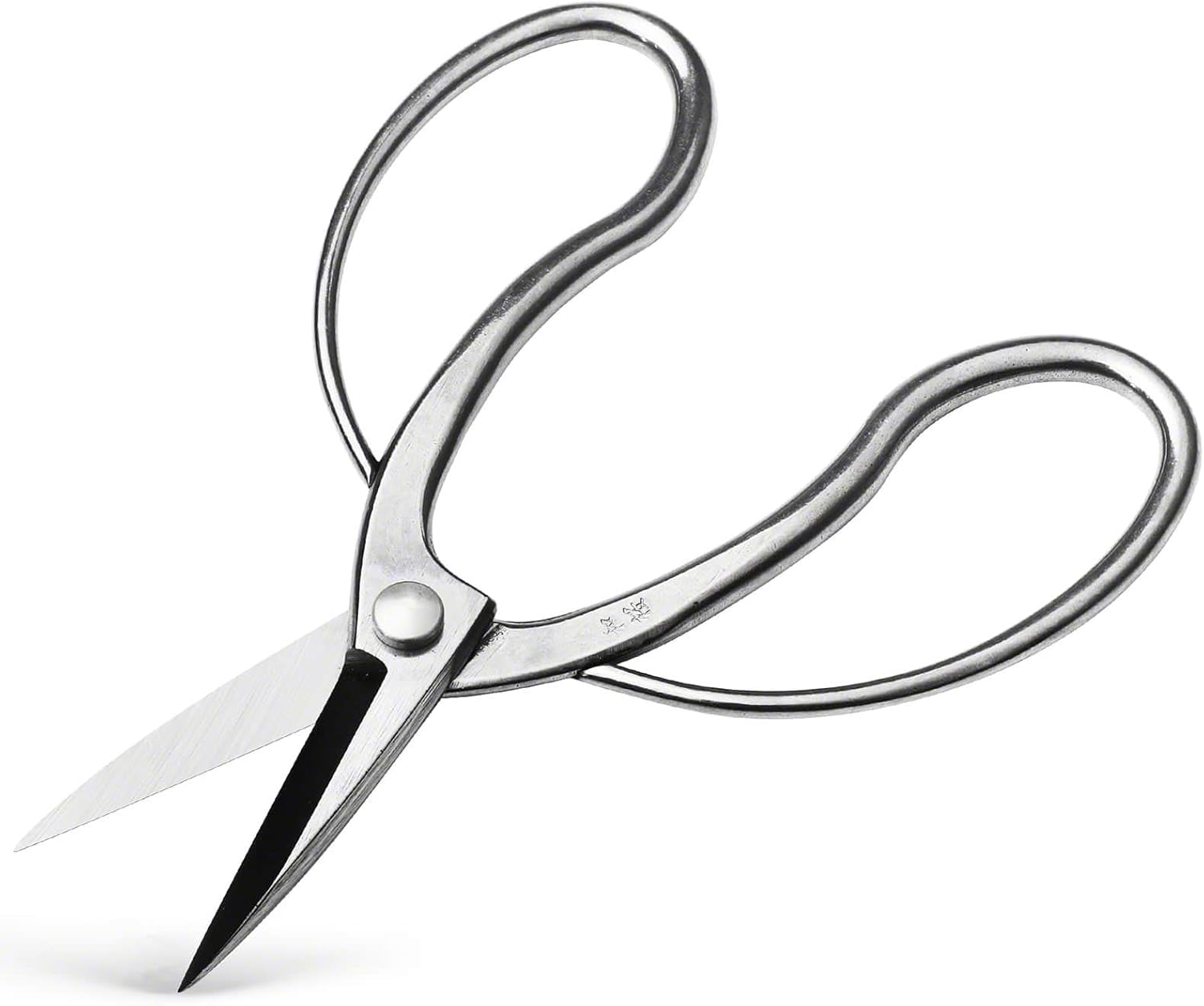
These Wazakura 7-inch traditional bonsai scissors are handcrafted in Sanjo, Japan and built for precision pruning of shoots, leaves, small branches and floral work. The hollow-edged, anvil-style 60 mm stainless blades deliver clean cuts that reduce scarring, which helps maintain tree health and neat branch collars. Butterfly loop handles sit close to the blade for fine control without excessive grip force, making them comfortable for repeated trimming sessions. Because they are stainless steel and rust resistant they are low maintenance and suited to humid conditions or outdoor use. The scissors are right-hand oriented and aimed at detail work rather than heavy branch removal, so they pair well with concave cutters for larger work. For a performance-focused buyer they offer Japanese craftsmanship and consistently sharp cutting action out of the box, though users who need ambidextrous or heavy-duty branch cutting will need different tools. Overall these are a strong choice for serious bonsai growers who prioritize clean, repeatable cuts and traditional build quality.
Best for: Serious bonsai enthusiasts and experienced hobbyists who want a precision, low-maintenance shear for frequent shaping, wiring cleanup, and detailed leaf or flower work.
Less Ideal for: People who need ambidextrous tools or those who regularly cut thicker branches should choose larger branch cutters or a left-handed model instead.
- Handcrafted in Sanjo, Japan reflecting traditional toolmaking quality
- Sharp hollow-edged stainless blades produce clean cuts that minimize scarring
- Butterfly loop handles provide close control for delicate trimming
- Rust-resistant stainless steel construction lowers maintenance in humid conditions
- Anvil blade and 60 mm cutting length limit use to fine pruning rather than cutting thicker branches
- Right-handed orientation makes them unsuitable for left-handed users
Verdict: For performance-minded bonsai growers who want clean, repeatable cuts and traditional Japanese craftsmanship, these Wazakura 7-inch stainless scissors are an excellent precision tool.
SenkichiKin 7in (180mm) Bonsai Scissors — Forged Yasuki White Steel

| Blade Material | Forged Yasuki White Steel #2 |
|---|---|
| Size | 7 inches (180 mm) |
| Cutting width | 6 millimeters |
| Handle Material | Rubber |
| Made in | Japan |
These SenkichiKin bonsai scissors are built for detailed shaping and regular bonsai upkeep. The fully forged Yasuki White Steel blades deliver crisp, clean cuts ideal for thinning, pinching back new growth, and trimming buds or small branches up to about 6mm. Their 7-inch length and balanced, lightweight feel make them easy to hold for extended sessions, and the ambidextrous rubber handles offer steady control without adding bulk. A practical feature is the bolt-fastened removable blades, which let you detach and sharpen the blades rather than replace the tool. The satin straight blade and nashiji finish combine a traditional look with practical edge performance. Limitations to note are the cut capacity, which is for fresh wood and small branches only, and the lack of a locking mechanism or spring, so they behave more like precision scissors than heavy pruning shears. For anyone who needs repeatable, fine trims rather than heavy cutting, these scissors translate Japanese forging into a reliable everyday bonsai tool.
Best for: A gardener who prioritizes clean, repeatable precision for bonsai shaping and routine detail work and prefers tools that can be maintained rather than replaced.
Less Ideal for: People who need a heavy-duty pruning tool for thick branches or fast harvesting should choose sturdier bypass pruners with higher cutting capacity.
- Forged Yasuki White Steel blade provides crisp, precise cuts for fine pruning
- Removable bolt-fastened blades simplify sharpening and long-term maintenance
- Balanced, lightweight 7-inch design reduces hand fatigue during detailed work
- Ambidextrous, rubberized handle offers steady grip for controlled snips
- Cutting capacity limited to small fresh wood (about 6mm) so not for larger branches
- No locking mechanism or spring limits speed compared with locking pruners
Verdict: Buy these if you want a maintainable, Japanese-forged bonsai scissor that delivers consistently clean, precise trims for detailed shaping.
TONMA Ashinaga Bonsai Scissors 8" (TGS-3)

| Blade Edge | Straight |
|---|---|
| Hand Orientation | Ambidextrous |
| Blade Material | Japanese AUS-8 stainless steel |
| Blade Length | 2.36 inches |
These TONMA Ashinaga bonsai scissors are built as a single-piece tool from Japanese AUS-8 stainless steel, so they feel very solid and consistent in use. The straight, 2.36-inch blade and ambidextrous polished handles make them suitable for precise cuts on bonsai branches, floral buds, and small stems. Because the tool is all-metal with ergonomic non-slip handles it provides good leverage and stays comfortable during longer pruning sessions. The rust-resistant finish and recommendation to dry and oil the blades after use mean they are low maintenance compared with carbon-steel shears. Expect excellent edge retention thanks to the hardened steel, but note the blades are thick and aimed at heavier-duty trimming rather than ultra-fine leaf work. The all-steel construction also makes the scissors heavier than composite-handled models, which some users may prefer for control while others may find fatiguing. For gardeners who prioritize a lifetime-quality tool, these scissors deliver dependable cutting performance and straightforward care.
Best for: A buyer who wants a long-lasting, serviceable bonsai shear that performs reliably for regular pruning and heavier trimming tasks. Ideal for growers who prefer robust, low-maintenance tools they can depend on over years of use.
Less Ideal for: Not the best choice for collectors seeking the lightest, ultra-fine leaf scissors or for users who need the lowest possible tool weight for very delicate wiring and pinching work.
- One-piece Japanese AUS-8 stainless steel construction for durability and consistent alignment
- Hardened blade with good edge retention suitable for repeated pruning tasks
- Ambidextrous ergonomic handles provide comfortable grip and good leverage
- Polished rust-resistant finish that is easy to clean and maintain
- Heavier all-steel build can be tiring during very long sessions
- Blade thickness is better for heavier trimming and less ideal for extremely fine foliage work
Verdict: A one-piece Japanese AUS-8 stainless steel bonsai shear that delivers reliable, long-term cutting performance for gardeners who value durability.
Wazakura Traditional 7" Bonsai Scissors, High Carbon Steel

| Blade Material | High Carbon Steel |
|---|---|
| Handle Material | Alloy Steel |
| Blade Edge | Straight |
| Hand Orientation | Right |
These Wazakura 7" bonsai scissors are a traditional, precision pruning tool made in Sanjo, Japan. The sharp S58C high-carbon steel blades deliver clean shears that reduce tearing and scarring, which is useful for shaping branches, trimming new shoots and finishing detailed work on bonsai, ikebana and small ornamentals. The butterfly loop handles sit close to the blade for fine control without needing a strong grip, so they are comfortable for repeated light-to-moderate sessions. Because the blades are carbon steel they hold an edge well and are straightforward to resharpen, though they will require occasional drying and light oiling to prevent rust. These scissors are right-handed and built with traditional artisan workmanship, so buyers get a durable, well-balanced tool rather than a mass-produced multipurpose shear. For someone who values proven craftsmanship and consistent cutting performance, these will serve as a reliable everyday bonsai scissor; if you need rustproof stainless or ambidextrous use, other models would be worth considering.
Best for: Buyers who prioritize proven craftsmanship and consistent cutting performance for bonsai or other detailed pruning tasks and who want a tool backed by many positive user experiences.
Less Ideal for: Gardeners who need ambidextrous or stainless, low-maintenance scissors for humid conditions should consider alternative models.
- Handmade in Sanjo, Japan with traditional artisan craftsmanship
- S58C high carbon steel blades that stay sharp and are easy to resharpen
- Butterfly loop handles provide precise control for detailed bonsai work
- Sharp straight blades produce clean cuts that minimize scarring
- Carbon steel requires regular drying and oiling to avoid corrosion
- Right-hand orientation limits use for left-handed gardeners
Verdict: A traditionally made Japanese bonsai scissor that delivers precise, long-lasting sharpness for collectors and serious hobbyists who value craft and cutting performance.
Choosing the Right Japanese Bonsai Scissors: Key Factors to Consider
Blade Steel and Hardening
The steel type and heat treatment dictate how well a bonsai scissor holds a fine edge and how often it needs sharpening. Harder steels can keep a razor edge longer but may be more brittle; softer steels are tougher but will require more frequent honing. For everyday bonsai pruning you want a balance where the edge lasts through multiple sessions without chipping yet can be resharpened by hand tools if needed.
Also consider whether the manufacturer describes the tempering process or gives a specific steel grade. That information helps predict long-term performance and maintenance intervals.
Blade Geometry and Cutting Action
Blade profile and the way the two cutting faces meet determine whether a scissors slice smoothly or crushes tissue. A fine, precise bevel with a tight blade alignment produces clean scissor cuts that promote faster healing on small branches. For wiring and delicate shoots, a narrow pointed tip improves access and accuracy.
Different blade shapes suit different tasks. Straight blades are versatile for shoots and leaves, while slightly curved or convex blades can follow branch contours. Think about the typical cuts you make on your bonsai and choose geometry that matches those motions.
Handle Shape, Size, and Balance
Ergonomics matter because many bonsai tasks require steady, controlled motions rather than forceful pruning. Handles that fit your hand size and provide a secure grip reduce fatigue and improve accuracy. Balance between blade and handle affects how the tool seats in your palm and how easily you can make micro-adjustments.
Also check for features like reduced pinching at the pivot, smooth opening and closing, and whether the tool allows single-handed fine trimming without wobble. Small differences in handle geometry become obvious during long shaping sessions.
Corrosion Resistance and Finish
Bonsai work often happens outdoors or in humid environments where moisture and acidic sap can promote rust. A corrosion-resistant finish or stainless alloy extends the life of the cutting edge and reduces maintenance. Protective coatings, mirror-polished finishes, or stainless steels help resist staining and pitting.
Consider how often you will clean and oil your tools and whether you prefer brushed or polished surfaces that hide scratches. Long-term exposure to soil and fertilizer residues makes rust resistance a practical concern.
Pivot Quality and Adjustability
The pivot joint controls blade alignment and the smoothness of the cutting action. A well-fitted rivet or adjustable screw lets you fine-tune tension so blades meet cleanly without binding. Poor pivot fit causes lateral play, uneven cuts, and faster dulling because parts rub instead of shearing.
Adjustable pivots also let you compensate for wear over time, restoring tightness without professional servicing. For gardeners who maintain their own tools, easy access to pivot adjustment is a useful feature.
Maintainability and Sharpening
Even the best Japanese bonsai scissors will need periodic sharpening and basic care. Consider how easy it is to hone the blade profile, whether replacement parts or sharpening guides are commonly available, and whether the tool can be serviced at home. Simple, open blade geometries are easier to reprofile with stones or fine files, while complex finishes may hide wear until performance declines.
Regular cleaning, light oiling, and correct storage prolong edge life and prevent corrosion. If you prefer low-maintenance tools, prioritize steels and finishes that require less frequent attention.
Matching Scissors to Bonsai Species and Tasks
Different bonsai species and pruning tasks call for different scissor characteristics. Fine-leaved species and delicate deciduous shoots benefit from very sharp, narrow-point blades that let you cut close to the trunk without tearing. Conifers often require slightly sturdier tips for cutting harder shoots and removing buds.
Think about whether you mostly do structural pruning, delicate trimming, or regular maintenance. Structural work sometimes needs larger shears, but for the scale of bonsai scissors focus on balance between thinness and robustness so a single pair can accomplish the majority of routine shaping without frequent switching.
- Fine-tip blades for detail work and leaf trimming
- Stronger tip geometry for tougher shoots
- Moderate-length blades for reach while maintaining control
Maintaining Edge and Preventing Rust
Routine maintenance preserves cutting performance. Wipe blades after each session to remove sap and moisture, and use a light oil to prevent corrosion. When the edge becomes dull, use a fine whetstone or dedicated sharpening system that preserves the original blade angle.
If you work with fertilizer or soil that can accelerate corrosion, increase cleaning frequency and avoid leaving tools in damp environments. Storing scissors in a dry, padded roll or case prevents dings and helps them remain aligned.
- Clean sap and debris after use
- Oil pivot and blade lightly to prevent rust
- Sharpen with fine stones keeping the original bevel
Sizing and Reach for Bench and Outdoor Work
Scissors sized for bench work should give you fine control without being so small that they strain your hand. Consider blade length and overall tool length: longer blades increase reach but can reduce fingertip precision. For outdoor repotting or field work, slightly larger bonsai scissors may be more versatile.
Balance that matches your hand size reduces the need to reposition the tool constantly, which helps when you are making repeated identical cuts during wiring or defoliation.
- Shorter overall length for fine detail
- Longer blades for reach and cutting multiple shoots
- Choose handle span that suits your grip
Transporting and Storing Bonsai Tools Safely
Protective storage prevents accidental dulling and keeps edges from damaging other equipment. Padded rolls, sheaths, or hard cases secure blades during transport. For field visits, a compact sheath that covers the tip reduces risk of snagging and injury.
Labeling or separating tools used for soil work from trimming tools reduces contamination and helps you maintain a consistent hygiene routine for your bonsai collection.
- Use sheaths or padded rolls for storage
- Keep trimming tools separate from soil-handling tools
- Inspect tools before each use for nicks or misalignment
Common Mistakes When Switching Scissors
A frequent mistake is assuming any sharp garden scissors will behave the same on bonsai. Differences in blade profile and pivot fit change how the tool cuts and how the tree heals. Switching to a new pair may require an adjustment period to get used to balance and blade entry angle.
Also avoid using bonsai scissors for non-pruning tasks like wire cutting or cutting heavy material. That misuse quickly dulls or chips the fine edge and shortens the tool's useful life.
- Do not use bonsai scissors for wire or heavy pruning
- Allow time to adapt to differences in balance and blade entry
- Keep a dedicated sharpening routine for each pair
How We Chose the Best Japanese Bonsai Scissors
We evaluated candidates using criteria that matter to gardeners working at the scale of bonsai: blade steel and edge retention, blade geometry and cut quality, handle ergonomics and hand comfort for precise work, corrosion resistance and finish for humid or outdoor bench use, and overall build consistency including joint fit and adjustment. Each product had to demonstrate reliable, repeatable cuts on thin live wood and small deadwood without excessive crushing or tearing. We excluded tools designed primarily for heavy pruning, shears for hedges, and multipurpose garden scissors that lack the fine control bonsai work demands. Tools with unclear steel specifications or inconsistent assembly were omitted. Final selections favored scissors with documented heat treatment or steel grades suited to holding a fine edge, paired with ergonomic handles and corrosion-resistant finishes appropriate for regular bonsai maintenance.
FAQ
How often should I sharpen Japanese bonsai scissors?
It depends on use frequency and the steel, but many hobbyists sharpen lightly after several months of regular use and perform a fuller honing once edge dulling becomes noticeable. Light touch-ups with a fine stone keep the bevel consistent.
Can I disinfect bonsai scissors between trees?
Yes. Wipe blades clean and use a mild disinfectant when moving between diseased or stressed trees. Rinse and dry thoroughly, then apply light oil to protect the steel from corrosion caused by moisture and cleaning agents.
Are stainless blades better than carbon steel for bonsai scissors?
Stainless steels resist rust and require less frequent oiling, which is convenient for outdoor use. Carbon steels may take and hold a finer edge but need more careful maintenance to prevent corrosion. The best choice depends on your tolerance for upkeep.
Can I use the same scissors for wiring and pruning?
Usually you should avoid using fine bonsai pruning scissors to cut wire because wire can nick or chip the edge. Keep a separate cutter for wire and heavier tasks to preserve the precision edge on your scissors.
What blade angle is best for clean cuts on small branches?
A relatively acute bevel that forms a tight meeting line between blades produces clean shearing action on small branches. Very acute angles cut well but require harder steel or more frequent maintenance to avoid rolling or chipping.
Final Verdict
When choosing Japanese bonsai scissors, prioritize blade geometry and edge quality for the types of cuts you make most often, then match handle ergonomics to your hand size and working style. Expect a tradeoff between edge retention and ease of sharpening; steels that hold a finer edge often need more careful maintenance. Focus on corrosion resistance and pivot adjustability for long-term consistency. With the right balance of these traits you can select a pair that offers precise, repeatable cuts and low frustration during regular shaping sessions.
