

Note: This article contains affiliate links. If you click on these links and make a purchase, I may earn a small commission at no extra cost to you. This helps support my research and content. Read my full affiliate disclosure here.
If you split and stack firewood for heat or weekend campfires, the right bow saw makes a big difference in how quickly you move through rounds and how cleanly logs are cut. This guide focuses on bow saws for cutting firewood and explains the practical tradeoffs you will face in the yard, at the campsite, or on a rural property. We shortlisted seven top-performing saws that suit different sized logs, user strength, and replacement-blade availability. Below you will find the evaluation factors gardeners and homeowners care about, from blade durability and tooth geometry to frame stiffness and safety features. Use the quick notes to match a saw to your typical log size and cutting pace before checking individual product details.
Top Picks at a Glance
| Best Overall The best all-around choice for most situations | Spear & Jackson Razorsharp 24-Inch Bow Saw |  |
| Best Quality Built to a higher standard if you want something more solid | Bahco SE-15-36 Economy Bowsaw 36-inch |  |
| Best Value The sweet spot between price and what you get | AB Tools 30" Heavy Duty Bow Saw with 6 Spare Blades |  |
| Best Budget The cheapest option that still gets the job done reliably | MBS 12" Bow Saw with Tubular Steel Frame and Ergonomic Handle |  |
| Highest Rated A top-rated pick with lots of positive feedback | Bahco 30-Inch Ergo Bow Saw for Green Wood |  |
| Most Popular A crowd favorite that many people choose with confidence | Fiskars 24" Bow Saw SW31 with Plastic Blade Guard |  |
| Best Seller A high-volume bestseller chosen again and again | Truper 30-Inch Bow Saw with Cam-Lever Tension (Model AJT-30) |  |
Spear & Jackson Razorsharp 24-Inch Bow Saw

| Blade Length | 24 inches |
|---|---|
| Blade Material | High Carbon Steel |
| Number of Teeth | 72 |
| Power Source | Manual |
| Other Special Features of the Product | Keyless Blade Change |
The Spear & Jackson Razorsharp 24-inch bow saw is a straightforward manual log saw built for cutting branches and firewood. It uses a hard-point high carbon steel blade treated to hold an edge longer than untreated blades and has 72 teeth that cut on both forward and backward strokes for faster, freer sawing. The bow frame and a lever tension device make blade changes simple and keep the blade taut during use. In practice this saw works well for felling small trunks, cutting rounds for split firewood, and trimming larger limbs where a chainsaw is overkill. Its design favors controlled, two-handed sawing and delivers predictable progress through green or seasoned wood. Important limitations are that it is a manual tool so it requires more effort and time than powered alternatives, and the 24-inch blade length sets the maximum cut capacity. For anyone wanting a durable, low-maintenance hand saw for regular firewood cutting, it is a practical choice; heavy continuous cutting or very large diameter logs are better handled with powered equipment or a larger saw.
Best for: Buyers who want a reliable, low-maintenance hand saw for cutting firewood and occasional larger pruning tasks and who prioritize durability and predictable manual performance over speed.
Less Ideal for: People who need to process very large-diameter logs frequently or who prioritize fast, high-volume cutting should choose a powered chainsaw or a larger saw instead.
- Hard-point high carbon steel blade stays sharp longer than untreated blades
- Teeth cut on both forward and backward strokes for faster cutting
- Keyless lever tension system for quick blade changes and reliable tension
- Sturdy bow frame suitable for two-handed sawing and controlled cuts
- Manual operation requires significant physical effort compared with powered saws
- 24-inch blade limits the maximum single-pass cut diameter
Verdict: A durable, easy-to-maintain 24-inch bow saw that delivers efficient, controlled manual sawing for firewood and larger pruning jobs.
Bahco SE-15-36 Economy Bowsaw 36-inch

| Blade Length | 36 inches |
|---|---|
| Blade Material | High Speed Steel |
| Power Source | Manual |
| Other Special Features | Ergonomic Handle |
The Bahco SE-15-36 Economy Bowsaw is a straightforward, no-frills 36-inch bowsaw built for cutting wood for tasks like firewood preparation, pruning large limbs, and general outdoor work. It uses a peg-tooth, heat-induction hardened high speed steel blade that delivers aggressive cutting on green and seasoned wood, and the rectangular 36-inch blade length suits larger logs and branches. The plastic handle with an ergonomic shape and a knuckle protector makes extended use more comfortable and a bit safer when working in brush. Because the saw is manual, it is quiet, fuel-free, and easy to control for straight cuts or trimming awkward branches. Limitations include an economy-level construction that may not be as durable under heavy daily professional use and a plastic handle that is less robust than metal or full-tang designs. Blade replacement and tensioning are typical for bowsaws but the listing does not include spare blades, so you may want to source replacements before prolonged use.
Best for: Buyers who prioritize cutting performance for firewood and heavy yard work and want a long 36-inch blade that cuts aggressively without motors or fuel.
Less Ideal for: People who need a heavy‑duty, professional‑grade saw for daily commercial use or those who prefer power tools for faster multi‑log processing.
- 36-inch peg-tooth, heat-induction hardened high speed steel blade for aggressive cutting of green and dry wood
- Ergonomic plastic handle with knuckle protector improves comfort and safety during outdoor use
- Manual operation provides quiet, fuel-free cutting and precise control for firewood and limb work
- Blade shape and 144 teeth support efficient crosscutting of larger branches and small logs
- Economy construction and plastic handle may wear faster under heavy professional or frequent use
- No spare blades included with the saw
Verdict: A long 36-inch heat-treated HSS bowsaw that delivers aggressive manual cutting for homeowners who want effective firewood and limb cutting without a power tool.
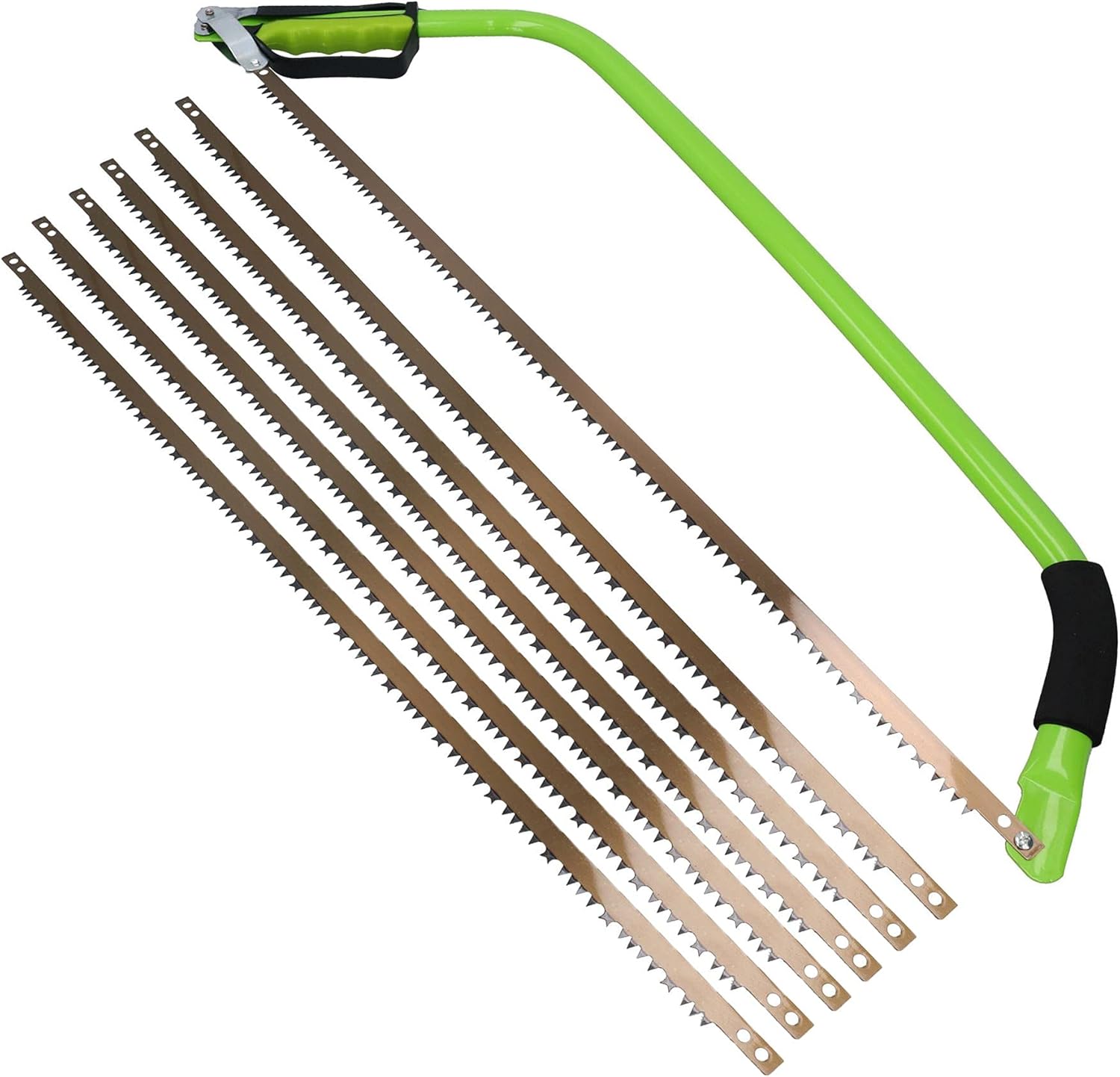
AB Tools 30" Heavy Duty Bow Saw with 6 Spare Blades
| Power Source | Manual |
|---|---|
| Blade Length | 30 inches |
| Blade Material | Alloy Steel |
| Included Components | 6 Spare Blades |
| Other Special Features of the Product | Ergonomic Handle, Quick Blade Change |
This AB Tools 30" bow saw is built for cutting branches and processing firewood by hand. The long 30-inch blade and raker teeth are designed to cut both green and wet wood, and the hardened alloy-steel blades with two cutting edges per tooth give aggressive, lasting bite for crosscutting logs and larger branches. The tubular steel frame keeps the blade tensioned, while the wooden soft-grip handle and knurled safety guard make longer jobs more comfortable and secure. Quick blade-change hardware and a cover on the frame make swapping and storing spare blades straightforward; the included six spare blades extend service life for many sessions of cutting. Expect effective manual cutting of mid-sized logs and limbs without needing power tools, though progress depends on user effort and technique. The saw is optimized for durability and repeated use, but as a manual tool it will be slower than powered alternatives for large volumes of firewood and needs physical exertion for thicker hardwoods.
Best for: Someone who wants a durable, no-frills hand saw to process firewood and prune larger branches without a power tool and values replaceable blades and a comfortable grip.
Less Ideal for: Not a good fit for users who need to cut large volumes of hardwood quickly or prefer a powered chainsaw for minimal physical effort.
- Long 30" blade suitable for cutting larger branches and mid-sized logs
- Hardened alloy-steel blades with raker teeth cut green and wet wood effectively
- Ergonomic wooden handle with cushioned grip and knurled guard for secure handling
- Includes six spare blades and quick blade-change for easy maintenance and long service life
- Sturdy tubular steel frame provides consistent blade tension and durability
- Manual operation requires significant physical effort on dense hardwoods or high volumes of firewood
- Blade and handle materials are durable but may need sharpening or replacement over time
Verdict: A hard‑working 30" manual bow saw with replaceable hardened blades that lets you process firewood effectively without a power tool.
MBS 12" Bow Saw with Tubular Steel Frame and Ergonomic Handle

| Blade Length | 12 inches |
|---|---|
| Blade Material | Metal, Steel |
| Handle Material | Plastic |
| Other Special Features | Lightweight |
This MBS 12" bow saw is a straightforward, budget-friendly tool for cutting small to medium pieces of firewood and general yard work. It pairs a tubular steel frame with a replaceable 12-inch blade and a quick-release tightening mechanism that makes blade changes fast and simple. The ergonomic plastic handle gives decent control for one-handed pruning or two-handed sawing on small logs. Because it is lightweight and compact it is easy to carry and use for short sessions, but the 12" blade limits the maximum log diameter you can cut in a single pass. The steel frame and metal blade provide acceptable durability for seasonal use, though the simpler plastic handle and lower-cost construction mean it is best for occasional splitting and trimming rather than heavy, daily firewood processing. For someone prioritizing value and portability, it offers practical performance, but users who need high-volume cutting or longer reach should consider a larger or more heavy-duty saw.
Best for: Buyers who want a low-cost, portable saw for occasional firewood cutting and general yard jobs and who value ease of blade replacement and simple, reliable performance.
Less Ideal for: People who process large amounts of firewood, regularly cut thick logs, or need a heavy-duty professional saw should look for a larger or more robust model.
- Quick-release blade tightening makes blade changes fast and tool-free
- Tubular steel frame offers solid rigidity for basic cutting tasks
- Lightweight and compact for easy carrying and maneuvering
- Ergonomic handle improves grip and control during sawing
- 12-inch blade limits the diameter of logs that can be cut in one pass
- Plastic handle and budget construction are less durable under heavy daily use
Verdict: A budget-minded, portable 12" bow saw that makes quick blade changes and handles occasional firewood and yard cutting with minimal fuss.
Bahco 30-Inch Ergo Bow Saw for Green Wood

| Power Source | Manual |
|---|---|
| Blade Length | 30 inches |
| Blade Material | Alloy Steel |
| Handle Material | Beechwood |
| Other Special Features | Innovative tensioning mechanism |
The Bahco 30-inch Ergo Bow Saw is a professional-grade handsaw built for cutting both green and dry wood in demanding outdoor and construction settings. It uses an innovative tensioning mechanism to keep the blade tight for straighter cuts and consistent performance, and the lightweight steel tubing frame makes the saw easy to maneuver for extended use. The 30-inch alloy steel blade with 18 teeth is suited to larger branches and timber, while the beechwood handle provides a comfortable, traditional grip. Typical use cases are limb pruning, firewood cutting, and rough carpentry where a robust, dependable manual saw is preferred over powered tools. Important limitations are that manual cutting requires physical effort and technique for fast work on large volumes, and the saw is optimized for straight cuts rather than fine finish work. For users who value durability, reliable tensioning, and an ergonomic feel, this saw performs well as a go-to tool for heavy-duty outdoor sawing.
Best for: Users who want a durable, professional-grade manual saw for pruning, firewood preparation, and on-site timber cutting and who prioritize reliable performance and ergonomic handling.
Less Ideal for: Those who need high-volume commercial cutting with minimal effort or who require precise finish cuts should consider powered saws or finer-toothed hand saws instead.
- Innovative tensioning mechanism keeps blade tight for straight, consistent cuts
- 30-inch alloy steel blade and 18 teeth suitable for cutting large branches and timber
- Lightweight steel tubing frame offers durability with easier handling
- Ergonomic beechwood handle provides comfortable grip for extended use
- Manual operation requires significant physical effort for large or prolonged jobs
- Not intended for fine finish or precision joinery cuts
Verdict: Choose this Bahco bow saw if you need a rugged, ergonomic manual saw that holds high blade tension for reliable cutting of large branches and timber.
Fiskars 24" Bow Saw SW31 with Plastic Blade Guard

| Blade Length | 24 inches |
|---|---|
| Blade Material | Alloy Steel |
| Handle Material | Plastic |
| Included Components | Plastic blade guard |
The Fiskars 24" Bow Saw SW31 is a traditional manual saw built for cutting firewood, logs, and large branches. Its 24-inch alloy steel blade with specially shaped teeth cuts on both pull and push strokes, so it clears wood quickly when you use long, steady strokes. The ergonomic plastic handle with a finger guard fits right- or left-handed users and helps maintain a firm grip during heavy cutting. A plastic blade guard protects the teeth in storage and during transport. The saw is straightforward to use in the yard or at a campsite and the blade is replaceable when worn. Because it is a manual tool, it needs steady physical effort for thick hardwood and will be slower than powered options, but it requires no fuel or batteries and is reliable where engines are impractical. The design emphasizes durability and simple maintenance rather than lightweight backpacking use, so it performs best as a dedicated firewood or yard saw rather than an ultralight hiking saw.
Best for: Buyers who want a reliable, no-fuss manual saw for cutting firewood and yard logs and who prioritize durability and proven performance over minimal weight.
Less Ideal for: Backpackers or ultralight hikers who need a compact, lightweight saw for trail use should choose a smaller, lighter model designed for portability.
- Long 24-inch alloy steel blade suitable for large branches and logs
- Teeth cut on both pull and push strokes for efficient sawing
- Ergonomic handle with finger guard comfortable for right- or left-handed use
- Plastic blade guard protects teeth during storage and transport
- Blade is replaceable to extend service life
- Manual operation requires significant physical effort on dense hardwoods
- Heavier and bulkier than ultralight hiking saws
Verdict: Choose this saw if you want a durable, easy-to-maintain manual bow saw that reliably cuts logs and large branches for firewood.
Truper 30-Inch Bow Saw with Cam-Lever Tension (Model AJT-30)

| Power Source | Manual |
|---|---|
| Other Special Features of the Product | Lightweight |
| Blade Shape | Rectangular |
| Blade Material | High Speed Steel |
| Blade Length | 30 inches |
The Truper 30-inch bow saw is a straightforward, workmanlike saw for cutting branches, green wood, and small logs for firewood. Its long high-speed steel blade covers more cutting per stroke, and the cam-lever tension system makes blade changes and tightening quick so the blade stays firm during use. The tubular steel frame and steel handle give the saw durability for frequent yard work and landscaping tasks, while the lightweight design keeps it reasonably easy to maneuver when cutting overhead or on the ground. Practical benefits include faster cuts on longer branches and a reliable tensioning mechanism that reduces blade wobble. Limitations are that it is a manual tool so it requires time and effort for larger firewood volumes, and the open bow design offers less protection from gumming or sap compared with a closed-frame or powered option. For routine backyard firewood prep and occasional heavy limbs this saw balances durability and control, but it is not a substitute for a chainsaw when tackling large-diameter logs or high-volume splitting jobs.
Best for: Buyers who want a reliable, no-frills hand saw for occasional to moderate firewood cutting and regular yard pruning and who prioritize a durable, easy-to-tension tool.
Less Ideal for: People who need to process large volumes of firewood quickly or regularly cut very thick logs should consider powered saws or larger cutting equipment instead.
- 30-inch high-speed steel blade covers long cuts and reduces strokes per cut
- Cam-lever tension system allows quick, secure blade tightening and easier blade changes
- Tubular steel frame and steel handle for durable, frequent outdoor use
- Lightweight design improves maneuverability for pruning and overhead work
- Manual saw requires significant physical effort for large volumes of firewood
- Not suitable for cutting very large-diameter logs compared with powered saws
Verdict: A durable, easy-to-tension 30-inch bow saw that delivers efficient manual cutting for small to moderate firewood and pruning jobs.
Choosing the Right Bow Saw for Cutting Firewood: Key Factors to Consider
Blade Tooth Geometry and Pitch
Tooth shape and pitch determine how aggressively a bow saw bites into wood and how smoothly it clears chips. A coarser pitch removes material faster but requires more force and is better suited to soft or partially green wood, while a finer pitch produces cleaner cuts and lasts longer on hard, seasoned logs.
Matching tooth geometry to the typical log diameters you cut reduces fatigue and speeds processing. For firewood work, look for teeth that combine a durable file profile with a design that resists clogging when cutting resinous or slightly wet wood.
Blade Material and Heat Treatment
Blade metal and heat treatment affect edge retention and resistance to bending or breaking when sawing knots. High-carbon steels or carbide-treated teeth hold an edge longer and tolerate harder woods, which means fewer blade changes during a big season of splitting.
However, treated blades can be more brittle if abused, so consider the balance between hardness and toughness for the types of trees you typically process. Proper storage and occasional light sharpening extend life significantly.
Frame Stiffness and Tensioning System
A rigid frame keeps blade alignment consistent, producing straighter cuts and reducing binding on thicker logs. Look for tensioning systems that are easy to adjust and maintain tension under load; slipping tension is the most common operational annoyance during heavy cutting.
Frames that flex under pressure force you to add more downward force and can distort blade tooth engagement, increasing effort and wear. For portable setups, evaluate how the frame design trades off stiffness against weight.
Handle Design and Ergonomics
Cutting firewood is repetitive work, so handle shape, grip material, and vibration dampening matter more than on occasional pruning saws. A comfortable handle reduces blistering and lets you maintain steady control for longer sessions.
Consider whether the handle allows two-handed guidance for awkward log positions and whether its surface remains grippy when wet or sweaty. Some designs offer replaceable or molded grips to suit different hand sizes.
Blade Replacement and Standardization
You will eventually need replacement blades. Models that accept standardized blades or use common attachment systems make sourcing spares easier, especially if you process large volumes of firewood away from major retailers.
Check whether the blade can be swapped without tools or with basic tools and whether spare blades for that tooth pitch and length are widely available. Quick, secure blade changes minimize downtime in the yard.
Weight, Portability, and Storage
A heavy, beefy bow saw can cut better by virtue of its mass, but too much weight makes repeated transport between piles or to campsite woodlots tiring. Consider how often you carry the tool and whether you need a saw that packs down for storage.
Look for models with reversible or folding frames if portability is critical. Also factor in whether the saw fits in your vehicle or tool storage and whether a sheath or cover is provided to protect blades and hands during transport.
Matching Saw Tooth Pitch to Log Diameter
To get the most efficient cuts, match the tooth pitch to the diameter and hardness of the logs you typically process. Coarser pitches work best on larger, softer rounds because they clear chips quickly, while finer pitches give better control and cleaner faces on smaller or hardwood logs.
- Coarse pitch: faster removal on large, softer logs
- Fine pitch: cleaner cuts and better control on hardwoods
- Mixed-pitch options: aim to balance speed and finish
Field Tips for Faster, Safer Cutting
Set the log on stable supports to prevent pinching and make sure the blade enters at a shallow angle so it starts cutting smoothly. Use steady, full-length strokes and let the saw do the work rather than forcing it, which helps preserve the tooth profile.
Position yourself to avoid twisting the saw on the return stroke and keep a clear escape path for the blade if the log suddenly shifts. Regularly inspect the blade for chips or bends and replace it when cutting efficiency drops significantly.
- Secure logs on sawhorses or raised supports
- Maintain a steady cadence and full stroke length
- Inspect and retension the blade after heavy cuts
Maintaining Blades and Preventing Rust
Wipe blades clean after use and store them in a dry place or with a thin oil film to prevent corrosion. Lightly honing the teeth with a file or using a sharpening tool designed for saw teeth restores cutting performance without full replacement for many users.
Avoid exposing blades to prolonged moisture, and if you work with green wood often, clean sap and resin off as part of your maintenance routine to avoid buildup that accelerates wear.
- Dry blades before storage
- Lightly hone teeth to refresh bite
- Remove sap buildup after cutting green wood
Using a Bow Saw with Other Firewood Tools
Bow saws are often part of a workflow that includes chainsaws, wedges, and splitting axes. Use the bow saw for finishing or cutting rounds that are already down to manageable length where a handsaw is safer or more convenient than a chainsaw.
For large-scale processing, alternate power and hand tools to reduce fatigue and extend the life of saw blades. Keep blades separate from striking tools to avoid accidental damage.
- Use bow saws for crosscuts and final sizing
- Alternate with power tools to reduce wear
- Store blades away from hammers and wedges
How We Chose the Best Bow Saw for Cutting Firewood
Our list highlights bow saws that perform reliably for cutting firewood under real-world yard conditions. We evaluated candidates using measurable, garden-relevant criteria: blade durability and tooth profile for cut quality and life; frame stiffness and tension system that affect straight cuts and user effort; handle ergonomics and vibration control to reduce fatigue during repetitive sawing; blade changeability and standardization so replacements are easy to source; and weight versus portability for moving between woodpiles, trucks, and campsites. We prioritized blades and frames built for sustained use on seasoned and slightly green hardwoods rather than decorative or occasional trimming saws. Options with hard-to-find blades, flimsy tensioning, or handles that cause repeated hand strain were excluded. The resulting shortlist balances cutting performance with long-term serviceability, safety, and practical features that matter when processing firewood outdoors.
FAQ
What blade length is best for cutting firewood?
Blade length depends on the typical log diameter you cut. Longer blades span bigger logs and allow longer strokes, reducing the number of passes. For smaller logs and portability, shorter blades are easier to control.
How often should I replace a bow saw blade when cutting firewood?
Replacement frequency varies with wood hardness and cutting volume. Heavy seasonal use on hardwoods may need new blades after dozens of logs, while light use on softer wood can last much longer. Replace when cutting slows noticeably or teeth are visibly damaged.
Can I sharpen my own bow saw blade?
You can often refresh teeth with a small file or a purpose-made saw sharpening tool, which works well for minor dulling. Full re-profiling or severe damage usually means replacement is more practical than complex sharpening.
Is a folding frame worth it for firewood work?
Folding frames improve portability and storage but can sacrifice some stiffness compared with one-piece frames. If you transport a saw frequently or have limited storage, a high-quality folding design can be a good compromise.
Should I choose a more aggressive tooth pitch for green wood?
Yes, a coarser pitch clears chips faster in green or soft wood and reduces binding. For mixed wood types, a mid-range pitch or a blade designed for general-purpose cutting offers a balance between speed and finish.
Final Verdict
Prioritize the features that match how, where, and how much firewood you process. Blade geometry and material drive cutting speed and life, while frame stiffness and tensioning influence ease of use and cut straightness. Handle comfort and blade availability are practical factors that determine how long a saw is comfortable and economical to own. Choose a bow saw that suits your regular log sizes and that accepts replacement blades you can actually get. That approach balances cutting efficiency, long-term maintenance, and portability so you can keep the woodpile stocked without unnecessary frustration.
