

Note: This article contains affiliate links. If you click on these links and make a purchase, I may earn a small commission at no extra cost to you. This helps support my research and content. Read my full affiliate disclosure here.
An electric broadcast spreader can cut the time you spend applying seed, fertilizer, or granular amendments across a lawn or large landscape. The right model delivers even application without constant hand-cranking, helps you avoid missed strips, and reduces physical effort for bigger yards. This guide covers seven shortlisted options that performed well against practical garden-use criteria. We evaluated machines for things gardeners actually notice: how evenly they distribute material, how much the hopper holds, and how easy they are to move, refill, and clean. Read on to match a spreader to your lawn size and the materials you plan to apply.
Top Picks at a Glance
| Best Overall The best all-around choice for most situations | Fimco 5301845 ATV Dry Material Spreader, 12V, 2.2 cu ft hopper |  |
| Best Quality Built to a higher standard if you want something more solid | JRCO 504 Electric Broadcast Spreader with Cable Control |  |
| Best Value The sweet spot between price and what you get | Buyers Products ATVS15A ATV 12V Broadcast Spreader, 15 Gallon Hopper |  |
| Best Budget The cheapest option that still gets the job done reliably | Yard Commander 80 lb ATV/UTV Broadcast Spreader (12V Motor, Adjustable Drop Rate) |  |
| Highest Rated A top-rated pick with lots of positive feedback | Cavusheo UTVS16 UTV Broadcast Spreader (150 lb capacity) |  |
| Most Popular A crowd favorite that many people choose with confidence | Buyers Products ATVS100 100 lb ATV Rear Rack Broadcast Spreader with Rain Cover |  |
| Best Seller A high-volume bestseller chosen again and again | Buyers Products UTVS16 150 lb UTV/ATV Receiver-Mount Broadcast Spreader |  |
Fimco 5301845 ATV Dry Material Spreader, 12V, 2.2 cu ft hopper
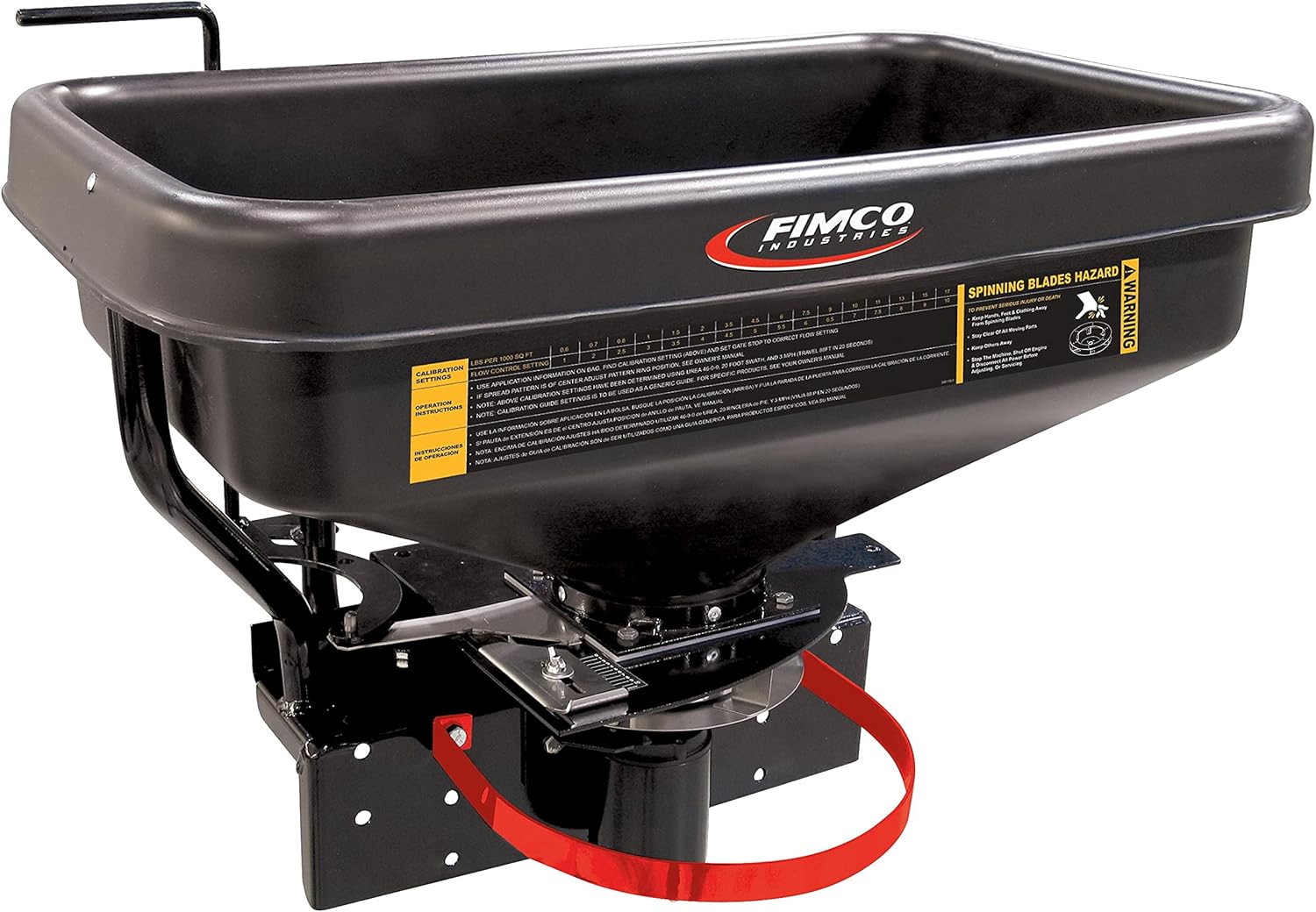
| Power | 12V motor |
|---|---|
| Hopper capacity | 2.2 cubic foot (up to 145 lb) |
| Spread width | Adjustable, ~5 to 45 feet |
| Fan | Stainless steel radial 6 blade |
| Special feature | Water resistant rain cover |
The Fimco 5301845 is a compact, performance-focused ATV dry material spreader designed to broadcast seed, granular fertilizer, ice melt and similar dry materials across a wide swath. It mounts to standard ATV cargo racks with included brackets and uses a 12 volt motor with a variable speed controller to adjust spread width from about 5 to 45 feet. The 2.2 cubic foot polymer hopper holds up to 145 pounds and the stainless steel radial six-blade fan is built to give consistent, even distribution. A water-resistant rain cover helps keep materials dry and prevents clumping in damp conditions. Typical use is mounting on an ATV, setting the gate and speed for desired feed rate, and driving the route while monitoring dispersal. Expect strong broadcast performance for pasture seeding and large lawn applications, but note it is intended for ATV mounting; heavier UTV or truck use requires an optional hitch bracket. The unit is practical and rugged but relatively heavy and sized for medium-scale jobs rather than very small handheld tasks.
Best for: Buyers who need a robust ATV-mounted broadcaster for seeding and fertilizer tasks and prioritize adjustable spread control and large-capacity runs over portability. Ideal for landowners and contractors covering medium to large acreage from an ATV.
Less Ideal for: Not a good fit for gardeners or homeowners needing a lightweight handheld spreader or for those who only have UTVs or trucks and do not want to add a hitch bracket.
- Variable-speed 12V motor lets you control spread width from approximately 5 to 45 feet
- Stainless steel radial six-blade fan provides consistent, even distribution
- Large 2.2 cubic foot polymer hopper holds up to 145 lb of material for fewer refills
- Water-resistant rain cover protects materials from moisture and clumping
- Includes mounting brackets for standard ATV cargo racks for straightforward installation
- Designed primarily for ATV mounting; requires optional hitch bracket for UTVs or pickup trucks
- Significant unit weight makes it less convenient to move by hand
Verdict: Choose the Fimco 5301845 when you want a heavy-duty ATV-mounted spreader that delivers controllable, wide-area broadcasting and large hopper capacity for efficient seeding and fertilizer runs.
JRCO 504 Electric Broadcast Spreader with Cable Control
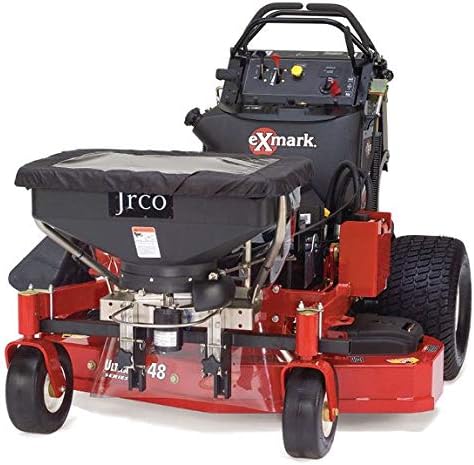
| Operation Mode | Electric |
|---|---|
| Material Type | Stainless Steel |
| Number of Positions | 1 |
| Item Weight | 90 pounds |
The JRCO 504 is a tow/attach electric broadcast spreader designed for contractors and homeowners who need fast, consistent coverage over medium to large turf areas. It mounts to a walk-behind, stand-on, or utility mower (mounting bar sold separately) and uses a 12V direct-drive motor with an electronic speed control to maintain spread patterns from about 5 to 24 feet. The polyethylene hopper holds up to 120 pounds and stainless steel components including a vibrating agitator and four-bladed fan help resist corrosion and keep material flowing. Installation requires a compatible JRCO mounting bar and basic wiring to the mower battery, and the push-pull cable gate suits walk-behind setups. Practical benefits include higher operating speeds with steady application rates, reduced clogging on pelletized or granular products, and a durable build for frequent seasonal use. Limitations are the need to buy the mounting bar separately and the extra setup compared with a pull-behind tow spreader, which may add cost and installation time.
Best for: Ideal for performance-minded users who run frequent or large-area spread jobs and want faster coverage with consistent application rates using a compatible mower-mounted setup.
Less Ideal for: Not a good fit for casual homeowners who need a simple, standalone spreader or for users unwilling to install a separate mounting bar or wire to a mower battery.
- Electric direct-drive motor with electronic speed control keeps spread pattern consistent at higher ground speeds
- 120 lb polyethylene hopper reduces refill frequency for larger areas
- Stainless steel agitator and fan resist corrosion and reduce material bridging
- Removable fan and sealed wiring harness simplify maintenance and hookup
- Requires JRCO Universal Mounting Bar which is sold separately
- Designed to attach to a mower so not usable as a standalone push or tow spreader
Verdict: Buy this if you need a robust mower-mounted electric spreader that delivers consistent high-speed coverage for large lawns and frequent jobs.
Buyers Products ATVS15A ATV 12V Broadcast Spreader, 15 Gallon Hopper

| Hopper capacity | 15 gallons |
|---|---|
| Power | 12V motor |
| Mounting | ATV utility rack quick-detach bracket |
| Spread width | 5 to 30 feet |
The Buyers Products ATVS15A is an ATV-mounted broadcast spreader built for routine property maintenance, hunting plots, and winter work. It mounts vertically to an ATV utility rack with a quick-detach bracket so you can install or remove it without tools, and the sealed 12V motor is operated from the seat for convenient control. The rust-proof polyethylene 15-gallon hopper and protective lid hold a large volume of free-flowing material and reduce refill stops. An adjustable shut-off gate and a 5 to 30-foot spread width let you tailor output for narrow paths or larger turf areas. Practical benefits include fast coverage compared with hand spreading and weather protection for materials. Important limitations are that it requires a compatible 12V power source on the vehicle and is intended for broadcast applications only, so it will not provide row-accurate placement or very fine metering for specialized seed types.
Best for: Buyers who need a dependable, easy-to-use spreader for routine property tasks like overseeding, fertilizing, feeding, or salt application and want faster coverage than manual methods.
Less Ideal for: Gardeners who need precise row-by-row seeding, very fine calibration for specialty seed, or those without an ATV/UTV with a 12V power hookup.
- Large 15-gallon polyethylene hopper resists rust and reduces refill frequency
- Quick-detach rack bracket for easy mounting and removal on an ATV utility rack
- Adjustable spread width from 5 to 30 feet for flexible coverage
- Sealed 12V motor with seat-mounted switch for on-vehicle, hands-free operation
- Requires an ATV with a 12V power source and compatible rack for installation
- Broadcast-style distribution is not suitable for precision placement or very small seed types
Verdict: A practical, heavy-duty ATV-mounted spreader that maximizes coverage and convenience for routine seeding, fertilizing, or salt spreading on medium to large properties.
Yard Commander 80 lb ATV/UTV Broadcast Spreader (12V Motor, Adjustable Drop Rate)

| Capacity | 80 pounds |
|---|---|
| Motor | 12‑volt vinyl coated motor |
| Spread radius | Up to 12 feet |
| Frame finish | Powder‑coated steel |
| Includes | Hopper rain cover |
The Yard Commander 80 lb ATV/UTV broadcast spreader mounts quickly to an ATV or UTV utility rack and uses a vinyl‑coated 12‑volt motor to fling material up to about 12 feet for wide coverage. It is built around a powder‑coated steel frame and a corrosion‑resistant hopper that holds up to 80 pounds of seed, fertilizer, salt, or feed, and includes a rain cover to prevent clumping in wet conditions. The drop rate is controlled by an easy access handle and an on/off switch can be mounted to handlebars for convenient operation while driving. Practical benefits include fewer hopper refills on larger jobs, year‑round versatility for winter salt and seasonal lawn tasks, and a durable finish that tolerates corrosive materials. Expect a straightforward install and simple controls rather than advanced metering electronics. The unit is compact and rugged but depends on your vehicle for power and mobility and may require occasional cleaning if using fine or damp materials to avoid buildup in the hopper and motor area.
Best for: Buyers who want a no‑fuss, durable spreader to cover medium to large acres from an ATV/UTV and who prioritize uptime and year‑round versatility over electronic precision.
Less Ideal for: Not a great fit for users who need ultra‑precise small‑rate fertilizing or a self‑powered walk‑behind solution; homeowners with only small lawns should consider smaller walk‑behind units.
- High 80 lb hopper capacity reduces refill frequency on larger properties
- 12‑volt vinyl‑coated motor allows up to ~12 ft spread radius for wide coverage
- Corrosion‑resistant hopper and powder‑coated frame stand up to salt and fertilizer
- Included rain cover prevents material clumping in wet conditions
- Simple adjustable drop rate and handle make calibration quick in the field
- No onboard battery; relies on ATV/UTV 12V power source and wiring
- Lacks electronic metering or precision calibration for very small application rates
Verdict: Choose this ATV/UTV spreader if you want a rugged, high‑capacity, year‑round tool that covers ground quickly with simple, reliable controls.
Cavusheo UTVS16 UTV Broadcast Spreader (150 lb capacity)

| Capacity | 150 pounds |
|---|---|
| Hopper volume | 15 gallons |
| Effective spread distance | Up to 30 feet |
| Intended mounting | UTV/ATV hitch mount |
The Cavusheo UTVS16 is a hitch-mounted broadcast spreader designed for use on UTVs and ATVs to distribute salt, grass seed, fertilizer and similar granular materials. Its large 15-gallon hopper and 150 pound capacity reduce refill frequency on medium to large properties, and the spinner is rated to throw material up to about 30 feet for good coverage. Typical use includes spring and summer fertilizer or seed applications, fall material spreading, and winter de-icing with rock salt. Notable features include a straightforward hitch mount that fits common UTV setups, a high-capacity hopper for longer runs, and a simple design that the manufacturer says is easy to install and maintain. In practice this translates to faster jobs on acreage, fewer stops to reload, and a robust tool for seasonal tasks. Important limitations are that it is an ATV/UTV-only unit so it requires a compatible vehicle and hitch, and its weight when loaded means handling and mounting need two people or an assist for safety. Controls and metering details are basic, so precise low-rate applications may require calibration or multiple passes.
Best for: Buyers who own a UTV or ATV and need a single, heavy-duty spreader to handle seasonal fertilizer, seed, and de-icing tasks across medium to large properties.
Less Ideal for: Gardeners with only small yards, homeowners without a UTV/ATV, or anyone who needs a lightweight walk-behind spreader for precise small-area work.
- Large 15-gallon hopper and 150 lb capacity reduce refill frequency on medium to large properties
- Designed for UTV/ATV hitch mounting for stable towing and straightforward installation
- Capable of spreading a variety of materials including seed, fertilizer and salt for year-round use
- Spinner disperses material up to approximately 30 feet for good coverage
- Requires a compatible UTV/ATV and hitch so not useful for walk-behind or non-vehicle users
- Loaded unit is heavy and may require two people or equipment to lift and mount safely
- Metering and controls are basic and may need calibration for very precise low-rate applications
Verdict: If you have a UTV or ATV and need a rugged, high-capacity spreader for year-round fertilizer, seed and salt jobs, the UTVS16 delivers reliable coverage with fewer refills.
Buyers Products ATVS100 100 lb ATV Rear Rack Broadcast Spreader with Rain Cover

| Material Type | Polyethylene (PE) |
|---|---|
| Maximum Weight Recommendation | 100 pounds |
| Included Components | Spreader with raincover |
| Drive | 12V motor |
The Buyers Products ATVS100 converts an ATV rear rack into a year-round spreader for seed, fertilizer, animal feed, bagged rock salt, and ice melt. Mount it to a compatible ATV utility rack, fill the rustproof polyethylene hopper (max 100 lb) and use the enclosed 12V motor to broadcast material across a wide path — the manufacturer states up to about 30 feet — while the manual feed-gate lets you fine tune flow for different materials. The included rain cover keeps moist or bagged material drier during transport. Practical benefits include quick coverage of lawns, fields, driveways, and larger properties and straightforward control of application rate. Important limitations are the need to confirm your ATV rack and vehicle load limits before use and to clean the unit after spreading corrosive materials to avoid damage; heavier loads also increase strain on smaller racks. Assembly and mounting are typical for ATV attachments and the unit favors free-flowing granules rather than sticky mixes.
Best for: Buyers who prioritize proven, work-ready outdoor equipment and want a powered ATV attachment that covers large areas quickly for seasonal tasks like seeding, fertilizing, feeding, or winter salt application.
Less Ideal for: Owners with small ATVs or lightweight racks that cannot safely support large loads or users who need to spread non free-flowing, wet, or sticky products without additional processing.
- Large 100 lb polyethylene hopper resists rust and carries substantial loads
- Enclosed 12V motor provides powered broadcast coverage up to roughly 30 feet
- Adjustable manual feed-gate for matching flow rate to different materials
- Included rain cover protects material from moisture during use and transport
- Requires a compatible ATV rear rack rated for the combined weight of spreader plus loaded material
- Needs thorough cleaning after spreading corrosive materials to prevent damage
Verdict: Choose the ATVS100 if you want a sturdy, powered ATV-mounted spreader that moves large, free-flowing materials quickly and reliably across big properties.
Buyers Products UTVS16 150 lb UTV/ATV Receiver-Mount Broadcast Spreader

| Compatible with Vehicle Type | ATV, UTV |
|---|---|
| Load Capacity | 15 gallon |
| Fastener Type | Hitch Pin |
| Material Type | Polyethylene, Polyurethane |
The Buyers Products UTVS16 is a receiver-mounted broadcast spreader built to turn a UTV or ATV into a year-round spreading tool for seed, fertilizer, salt, or animal feed. It mounts to a standard 2-inch hitch and uses a sealed 12V motor and an 8.5-foot wiring harness with on/off switch to power a spinner that can broadcast material up to about 30 feet. The 15-gallon polyethylene hopper resists corrosion from salt and fertilizer and holds roughly 150 lb for longer runs between refills. An adjustable shut-off gate and manual control rod let you fine-tune flow rate for different materials, and stainless hardware improves durability where metal parts are exposed. Practical benefits include straightforward hitch installation, weather-resistant construction, and wide coverage so you can seed or treat larger acres more quickly than with a handheld spreader. Important limitations are that it requires a compatible receiver and power source, the motor is 12V so heavier-duty hydraulics are not available, and setup or wiring routing can add a bit of installation time. For buyers focused on proven, rugged gear this model provides a dependable, well-supported option for UTV-based spreading.
Best for: Buyers who want a rugged, proven UTV-mounted spreader to cover acres more quickly and prefer gear with established user feedback and solid build quality.
Less Ideal for: People who need a tow-behind or tractor-mounted high-volume commercial spreader or those without a compatible receiver hitch and on-board 12V power.
- Durable 15-gallon polyethylene hopper resists corrosion from salt and fertilizer
- Sealed 12V motor with wiring harness and switch for reliable powered spreading
- Adjustable flow gate and control rod for precise output with different materials
- Receiver-hitch mount installs to standard 2-inch hitches for easy attachment
- Requires a vehicle with a 2-inch receiver and a 12V power source for operation
- No hydraulic or heavier-duty drive option for very high-volume commercial use
Verdict: If you want a sturdy, receiver-mounted spreader that reliably broadcasts seed and amendments from a UTV with minimal fuss, the UTVS16 is a practical, well-built choice.
Choosing the Right Electric Broadcast Spreader: Key Factors to Consider
Hopper Capacity and Refill Convenience
Hopper size directly affects how often you stop to refill. Larger hoppers are useful for medium to large lawns because they let you cover more area per load, which saves time and reduces disruption to your walking pattern. Consider the shapes of the hopper mouth and how easy it is to pour materials in without spilling; wide, tapered mouths and clear level indicators help you keep an eye on remaining material.
Refill convenience also encompasses lid design and whether the hopper has features to prevent moisture entry. If you frequently switch materials, look for hoppers with smooth interiors and rounded corners that minimize material hang-up so you can pour out the remainder easily before changing product types.
Spread Pattern Uniformity and Calibration
Even coverage is the central purpose of a broadcast spreader. Differences in spread pattern can create stripes, clumps, or thin zones that affect turf health. Models with adjustable spread rates and clear calibration guides allow you to match the output to product label rates for fertilizer, seed, or ice melt. Pay attention to how manufacturers define spread width and whether they provide test charts for different settings.
Also consider how the unit distributes across wind or slight slopes. Designs that throw material with a flatter arc and wider overlap between passes reduce visible banding. If you need precise seeding for repair work, look for finer control at low settings so you can apply small amounts without overspreading.
Power System Reliability and Runtime
An electric spreader depends on its battery and motor to deliver consistent flow. Runtime is important for larger properties; a model with short battery life will force frequent recharges and interrupt work. Consider not just advertised runtime but how battery access and replacement work in practice. Removable batteries that are easy to swap let you keep a charged spare on hand, while built-in batteries may be less convenient for extended jobs.
Motor torque and gearing influence how well a spreader handles heavier materials or slightly damp granules. A motor with adequate torque maintains consistent distribution instead of bogging down when the hopper is near empty or when coarse materials are being used.
Chassis, Wheels, and Maneuverability
How a spreader travels across grass matters for speed and control. Wide, grippy wheels roll better over uneven ground and are less likely to sink into wet turf. Wheelbase and center of gravity determine how stable the unit feels when turning or when loaded. Lighter frames are easier to maneuver but can be blown off course by wind or bounced by rough terrain, while heavier frames track steadier but may be harder to lift or load into a vehicle.
Also evaluate handle height, folding or telescoping features, and whether the unit can be guided with a single hand. If you plan to use it on slopes, look for good low-speed traction and stable balance when starting and stopping.
Material Compatibility and Ease of Cleaning
Different granular products vary in size and abrasiveness. A good electric broadcast spreader accepts seed, lawn fertilizer, lime, and ice melt without rapid wear or frequent clogging. Check whether the flow gate and agitator design prevent bridging of damp materials. Non-corrosive hopper materials and components simplify maintenance when you use salt or other corrosive products occasionally.
Ease of cleaning is a practical concern. Units with simple disassembly or smooth internal surfaces let you rinse or brush out residue quickly. This reduces cross-contamination between product types and protects moving parts from buildup, prolonging the life of the spreader.
Calibration Options and Control Precision
Fine control over application rate helps you match manufacturer recommendations for seed and fertilizer. Look for clearly marked settings and the ability to make small adjustments rather than broad, imprecise steps. Digital or dial-based controls both work, but the user interface should be intuitive and repeatable so you can return to a known setting for later jobs.
Some models offer variable-speed feed or separate flow controls for left and right sides to correct uneven throws. If you plan to use specialized seed mixes or do spot treatments, those finer calibration features give you better outcomes with less waste.
Best Uses by Lawn Size and Coverage Goals
Match the spreader to the area you treat most often. Smaller yards and tight urban plots benefit from compact units that are easy to store and maneuver between beds, while medium to large lawns need larger hoppers and longer runtimes to minimize refills.
Think about coverage goals. For regular fertilizer schedules you want even, repeatable patterns. For one-off overseeding jobs you may prioritize finer control at low feed rates. If you also plan to use a spreader for winter salt, pick a model built to resist corrosion and handle heavier granules.
- Small lawns under 5,000 sq ft: prioritize maneuverability and small hopper capacity.
- Medium lawns 5,000-15,000 sq ft: balance hopper size with battery runtime.
- Large lawns above 15,000 sq ft: larger hoppers and swappable batteries reduce interruptions.
Preparing Materials and Measuring Coverage
Weigh or measure the bag's coverage rate before loading so you know how many passes are required. Many product labels list coverage in pounds per 1,000 square feet which you can convert into hopper loads. Pre-measuring helps avoid over-application, especially when using fertilizers.
Dry, free-flowing materials spread most predictably. If a product is lumpy or slightly damp, break it up and sieve if possible, or use a spreader with agitation or anti-bridging features. Use consistent walking speed and overlap passes slightly to prevent thin stripes.
- Calculate how much material you need for the entire lawn before starting.
- Test a short pass on a driveway or sidewalk to verify throw width and rate before treating turf.
Maintenance Tips to Extend Service Life
Rinse and dry the hopper after each use to remove corrosive residues. Remove batteries when storing the unit for long periods and keep electrical contacts clean and dry. Lubricate moving parts per the owner's guidance to prevent binding.
Inspect tires, gears, and the agitator periodically for wear. Replace worn components promptly to maintain consistent spread patterns. Store the spreader under cover to protect it from UV and moisture that can degrade plastic and rubber components.
- Flush out residual granules and let the hopper fully dry before storage.
- Keep a simple toolkit for tightening fasteners and replacing minor parts.
Common Mistakes to Avoid
Applying at inconsistent walking speeds or using an unclear calibration setting are common causes of uneven coverage. Maintain a steady pace and use a visible marker or lawn-mowing line to guide parallel passes.
Another frequent error is mixing incompatible products in the hopper. Clean thoroughly between different materials to avoid chemical interactions or clogged gates. Avoid overfilling the hopper beyond the recommended level to prevent spillover and uneven feed.
Ignoring battery care reduces runtime and long-term performance. Charge batteries fully before large jobs and avoid deep discharges where possible. Keep spare batteries charged if you have large areas to treat.
- Do not guess feed settings. Test and adjust on a hard surface first.
- Avoid starting on a slope; begin on level ground to set an even rate.
Accessories and Add-Ons That Help
Consider spare batteries or a charging system if you routinely treat large areas. A folding cart or stand can aid in loading heavy bags into the hopper and reduce strain on your back. Some spreaders accept drop spreader attachments or different hopper inserts to handle specialty tasks.
Protective covers and storage trays keep residual product contained when the spreader is stored. Quick-release hardware and toolkits make maintenance faster, while wheel upgrades improve traction on soft ground.
- Spare battery for extended jobs.
- Folding loading stand to reduce lifting strain.
How We Chose the Best Electric Broadcast Spreader
We selected spreaders based on real-garden practicality and measurable specs that matter when you are treating turf, overseeding, or spreading granular amendments. Key evaluation criteria included hopper capacity and refill ergonomics, because bigger hoppers reduce trips during larger jobs. Spread consistency and calibration accuracy were tested on technical specs or manufacturer spread charts to estimate how reliably a model delivers uniform coverage. Drive and wheel design were reviewed to judge traction, turning behavior, and how a unit handles uneven lawns. Power system reliability and battery access were considered to estimate run time and ease of replacement. Ease of cleaning and material compatibility was included to reflect how simple it is to switch between seed, fertilizer, or ice melt without clogging. We excluded push-only or tow-only units and products designed exclusively for commercial vehicles; this list focuses on garden-scale electric broadcast spreaders suited to homeowners and landscape hobbyists. Models that lacked published spread patterns, clear capacity specs, or accessible battery details were not considered. The scoring focused on objective, gardener-facing features rather than brand reputation alone.
FAQ
Can an electric broadcast spreader handle different granular sizes?
Often it depends on the model. Many electric broadcast spreaders accept a range of granular sizes, but some struggle with very coarse or damp materials. Check whether the unit has anti-bridging features and an adjustable flow gate to accommodate different products.
How do I calibrate an electric spreader for my fertilizer?
Calibration usually involves setting the flow gate to a recommended setting and running a short test pass to measure output. Measure the amount collected over a fixed distance or time and adjust the setting until the output matches the product's application rate.
How long do batteries typically last on a single charge?
Battery runtime varies widely by battery capacity and motor load. Smaller batteries might run for under an hour while larger removable batteries can deliver several hours of work. Runtime also depends on terrain, material weight, and whether you use continuous or intermittent feed.
Is it safe to use a broadcast spreader on wet grass?
Using a spreader on wet turf is possible but increases the risk of wheel ruts and uneven distribution from clumping. If materials are damp they may bridge in the hopper. When possible, wait for drier conditions or use agitation features designed to handle moist granules.
How do I prevent corrosion when spreading salt in winter?
Rinse the hopper and metal parts after each salt application and dry thoroughly. Use models with corrosion-resistant components or plastics in areas exposed to salt. Regular maintenance and prompt cleaning reduce long-term damage.
Can I use an electric broadcast spreader for seed and fertilizer in the same season?
Yes, but avoid mixing materials in the hopper. Clean the unit between products to prevent contamination. Use settings appropriate for each material and verify calibration separately for seed and for fertilizer.
Final Verdict
Match the spreader to your lawn size and the materials you plan to use. Prioritize hopper capacity and battery runtime for larger properties, and choose models with precise calibration and anti-bridging features if you handle multiple product types. Consider traction and maintenance needs to keep patterns consistent over time. Focus on the features that reduce refills, prevent clogs, and make calibration repeatable. With those priorities in mind you can pick an electric broadcast spreader that delivers even coverage and fewer interruptions so routine lawn care becomes faster and more predictable.
