

Note: This article contains affiliate links. If you click on these links and make a purchase, I may earn a small commission at no extra cost to you. This helps support my research and content. Read my full affiliate disclosure here.
A reliable grass soil tester tells you what your lawn actually needs instead of guessing. The right tester helps you identify pH imbalances, nutrient shortfalls, and compaction issues that directly affect grass color, density, and resilience. This guide presents our shortlisted options for common lawn situations, from small city yards to larger suburban turf, and explains the features gardeners care about most. We evaluated meters on measurement accuracy, sensor durability, and day-to-day ease of use so you can pick a tool that matches how you maintain your grass. Read on for straightforward guidance and practical sections that explain how testers behave in the real garden and how to interpret their readings.
Top Picks at a Glance
| Best Overall The best all-around choice for most situations | YAMRON 4-in-1 Digital Soil Tester (Moisture, pH, Temperature, Light) with Backlit LCD |  |
| Best Quality Built to a higher standard if you want something more solid | MySoil Soil Test Kit — Mail‑in Professional Nutrient and pH Analysis (Single Test) |  |
| Best Value The sweet spot between price and what you get | Hathdia 2-Pack Soil Moisture Meter (No Battery) |  |
| Best Budget The cheapest option that still gets the job done reliably | Soonkoda S-9 3-in-1 Soil Tester (Moisture, Fertility, pH) |  |
| Highest Rated A top-rated pick with lots of positive feedback | SaySummer 4-in-1 Home Soil Test Kit — pH, N, P, K (80 Tests) |  |
| Most Popular A crowd favorite that many people choose with confidence | SONKIR MS02 3-in-1 Soil pH, Moisture & Light Meter |  |
| Best Seller A high-volume bestseller chosen again and again | XLUX T10 Soil Moisture Meter (battery-free) |  |
YAMRON 4-in-1 Digital Soil Tester (Moisture, pH, Temperature, Light) with Backlit LCD

| Lower Temperature Range | 32 °F |
|---|---|
| Upper Temperature Range | 122 °F |
| Temperature Accuracy | 1.8 °F |
| Mounting Type | Freestanding |
| Voltage | 6 volts |
This YAMRON 4-in-1 soil tester is a straightforward meter for gardeners who want quick, on-the-spot readings of moisture, pH, temperature, and light. You insert the probe about 4 inches into the soil, wait roughly 10 seconds, and the backlit LCD displays intuitive numeric and graphic readouts. The rotating head and white backlight make the screen easy to read without bending over or working in low light. Its probe-based sensors are useful for routine checks across lawns, garden beds, or pots and help decide when to water, adjust pH, or assess light exposure. The device runs on standard AAA batteries and includes a low-battery alert. Important limits are that it is not designed for liquid testing and can be damaged if forced into very dry, compacted soil, so lightly moistening very dry test spots first is advised. Also, pH accuracy depends on multiple readings averaged across locations rather than a single spot. For regular grass and garden checks this meter gives practical, fast feedback but it is not a lab-grade instrument.
Best for: Gardeners who want a simple, all-in-one tool to monitor lawn and garden soil conditions quickly and make practical watering, light, and pH adjustments without lab equipment.
Less Ideal for: Users needing laboratory-grade accuracy or professional soil analysis for large properties should choose a dedicated laboratory test or more advanced instruments.
- Combines moisture, pH, temperature, and light in one handheld unit for quick multi-parameter checks
- Backlit LCD and 45° rotating head make readings easy to see in low light and without stooping
- Fast probe measurement delivers results in about 10 seconds for efficient spot testing
- Suitable for both indoor pots and outdoor garden beds and lawns
- Not suitable for direct liquid testing and can be damaged if forced into very dry, compacted soil
- pH readings are best used as approximate indicators and require multiple samples for averaging
Verdict: A convenient multi-parameter handheld meter that gives quick, readable soil and light checks ideal for regular lawn and garden maintenance.
MySoil Soil Test Kit — Mail‑in Professional Nutrient and pH Analysis (Single Test)
| Tests included | Full nutrient and pH analysis (13 nutrients) |
|---|---|
| Sample return | Prepaid mailing envelope to lab |
| Results delivery | Online dashboard in 6-8 days |
| Kit contents | Sample jar, soil scoop, instructions, prepaid mailer |
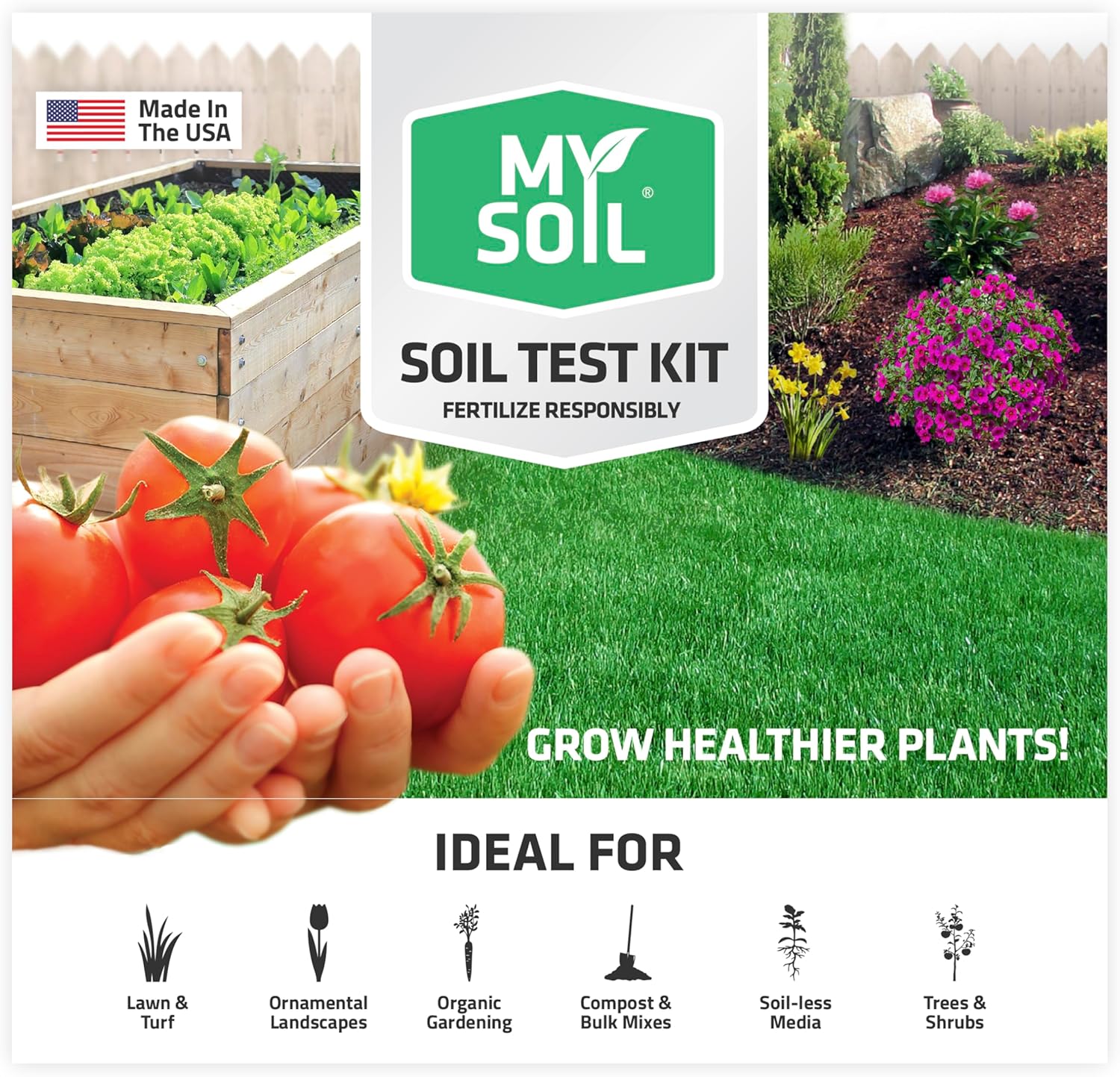
The MySoil kit is a single-use mail-in soil test that gives a lab-grade nutrient and pH analysis aimed at improving lawn and garden performance. You collect a small soil sample using the included jar and scoop, register the kit online, and send it back in the prepaid envelope; results and custom fertilizer recommendations arrive through an online dashboard in roughly 6 to 8 days. The report covers 13 plant-available nutrients, offers both organic and conventional amendment options, and translates findings into step‑by‑step application guidance so you can target weak areas instead of guessing. For turf-focused buyers this reduces wasted inputs and helps prioritize fixes that improve greening and vigor. The main limitation is that the kit is single-use, so multiple problem spots or seasonal checks require buying additional kits; turnaround also depends on mail and lab timing. The process is straightforward and supported by customer help if you need clarification on results.
Best for: Gardeners and turf managers who prioritize measured, performance-driven decisions and want lab-quality nutrient data to target fertilizer and lime applications for better lawn results.
Less Ideal for: People who need immediate in-field readings or who want to test many locations frequently without recurring kit purchases should consider multi-test bundles or in-field meters.
- Laboratory analysis of 13 plant-available nutrients and pH for reliable, actionable data
- Prepaid mailer and online registration make sample submission simple
- Custom, plant- and soil-specific recommendations including organic and non-organic options
- Fast turnaround with results typically available in 6–8 days
- Suitable for all soil types and common turf and garden scenarios
- Single-use kit means you must purchase additional kits for multiple samples or repeated seasonal testing
- No in-home instant read — requires mailing sample and waiting for lab results
Verdict: If you want lab-accurate nutrient and pH results to improve lawn performance and reduce wasted inputs, this mail-in MySoil kit delivers clear, actionable recommendations.
Hathdia 2-Pack Soil Moisture Meter (No Battery)

| Quantity | 2 pack |
|---|---|
| Probe length | 6.7 inch probe noted in description |
| Power | No battery required |
| Applications | Indoor and outdoor |
This Hathdia two-pack soil moisture meter is a no-frills tool that tells you whether soil at root depth is dry, moist, or wet. You use it by inserting the long probe into the pot or turf to about root level and reading the dial immediately—no batteries or setup required. The 6.7-inch probes reach deeper than finger tests, so you can check the moisture where grass and potted plant roots actually grow. Its analog dial is easy to read at a glance and the pair gives you coverage for multiple spots or a comparison between pots or lawn areas. Expect straightforward, low-tech reliability for routine monitoring, but not lab-grade precision or digital logging. The meter is best for quick checks to avoid over- or under-watering across lawns, planters, and garden beds; cleaners and gentle handling are recommended because the probe and casing are basic and can bend if forced into compacted soil.
Best for: Gardeners who want a practical, low-maintenance way to check root-zone moisture across a lawn or multiple containers and prefer quick visual guidance over high-precision instruments.
Less Ideal for: Users who need precise moisture measurements, data logging, or ruggedized probes for heavy professional use should look at digital or lab-grade soil testers instead.
- No batteries or wiring required for instant readings
- Long 6.7-inch probe accesses root-zone moisture beyond surface tests
- Two meters in the pack let you spot-check multiple locations or compare areas
- Simple analog dial is easy to read quickly in the field
- Analog readout provides general ranges rather than precise moisture percentage
- Construction is basic so probe can bend in very compacted or rocky soil
Verdict: A cheap, battery-free two-pack that gives fast, root-level moisture checks ideal for keeping grass and potted plants properly watered.
Soonkoda S-9 3-in-1 Soil Tester (Moisture, Fertility, pH)

| Brand Name | Soonkoda |
|---|---|
| Model | S-9 |
| Included Components | Soil Tester, English Manual, Paper Box |
| Unit Count | 1 Count |
The Soonkoda S-9 is a no-frills, battery-free soil tester intended for quick spot checks around a lawn or garden. You slide the probe into the soil and use the switch to read moisture, fertility, or pH on the needle dial; moisture is shown on a 1–10 scale while fertility and pH use simple left-middle-right zones. Its practical benefits are immediate: it helps decide whether a patch of grass needs water, too much fertilizer, or pH adjustment without lab tests or apps. The unit is lightweight and easy to carry so you can test multiple areas quickly. Important limitations are that the readings are approximate rather than laboratory-accurate, the probe needs reasonably moist soil to register reliably, and the dial-style indicator gives coarse categories instead of exact numbers. For budget lawn care this meter is a useful first step, but users who need precise pH values or professional soil analysis will want a higher-end digital meter or lab testing for confirmation.
Best for: Homeowners and DIY lawn keepers who want an inexpensive, easy way to spot-check grass health and adjust watering or basic feeding without lab tests.
Less Ideal for: Soil scientists, turf professionals, and gardeners who need laboratory-grade accuracy or precise pH and nutrient concentrations should choose a digital meter or lab testing instead.
- Measures moisture, fertility, and pH in one handheld tool
- Simple dial readout that is easy to interpret for quick lawn checks
- No batteries or electronics to power or maintain
- Lightweight and portable for testing multiple areas around a yard
- Provides approximate, categorical readings rather than precise numeric data
- Requires somewhat moist soil to register accurately
Verdict: A very affordable, portable 3-in-1 tester for quick lawn spot checks when you need simple guidance on watering and basic fertility.
SaySummer 4-in-1 Home Soil Test Kit — pH, N, P, K (80 Tests)

| Tests included | pH, Nitrogen, Phosphorus, Potassium |
|---|---|
| Total tests | 80 tests (20 per parameter) |
| Manufacturer | SaySummer |
The SaySummer 4-in-1 Home Soil Test Kit provides a straightforward way to check the four main soil parameters that matter for healthy turf and garden plants: pH, nitrogen, phosphorus, and potassium. Designed for routine use, the kit includes test strips, reagent tablets, tubes, a scoop, a grinding rod, and a color chart so you can collect a sample, run the appropriate reaction, and compare results without lab visits. With 20 tests per parameter the kit supports seasonal checks across a small lawn or several potted areas. Its clear instructions and color-matched results make it accessible for gardeners who want repeatable readings rather than rough estimates. The main limitations are that the results depend on careful sample prep and visual interpretation of color charts, so very precise numeric values or lab-grade accuracy are not provided. This kit is best used as a reliable screening tool to detect when adjustments are needed rather than as a substitute for professional soil analysis when exact concentrations are required.
Best for: Gardeners and homeowners who prioritize dependable, repeatable screening for common soil problems and want to monitor lawn and garden nutrient levels over a season without sending samples to a lab.
Less Ideal for: Soil scientists, commercial turf managers, or users who require laboratory-grade quantitative results or tests for trace elements should consider professional analysis or electronic meters instead.
- Tests four key parameters (pH, nitrogen, phosphorus, potassium) for balanced turf care.
- Includes 80 total tests (20 per parameter) suitable for seasonal monitoring.
- Comes with needed accessories and a color chart for on-site testing.
- User-friendly instructions make it accessible to gardeners without lab experience.
- Color-chart interpretation can introduce some variability compared with instrument or lab measurements.
- Not designed to deliver precise numeric concentrations or detect micronutrients.
Verdict: A practical, all-in-one kit for reliably tracking pH and the three main macronutrients across a small lawn or garden throughout the season.
SONKIR MS02 3-in-1 Soil pH, Moisture & Light Meter
| pH Range | 3.5-8 pH |
|---|---|
| Moisture Range | 1-10 scale |
| Probe Length | 7.9 inches |
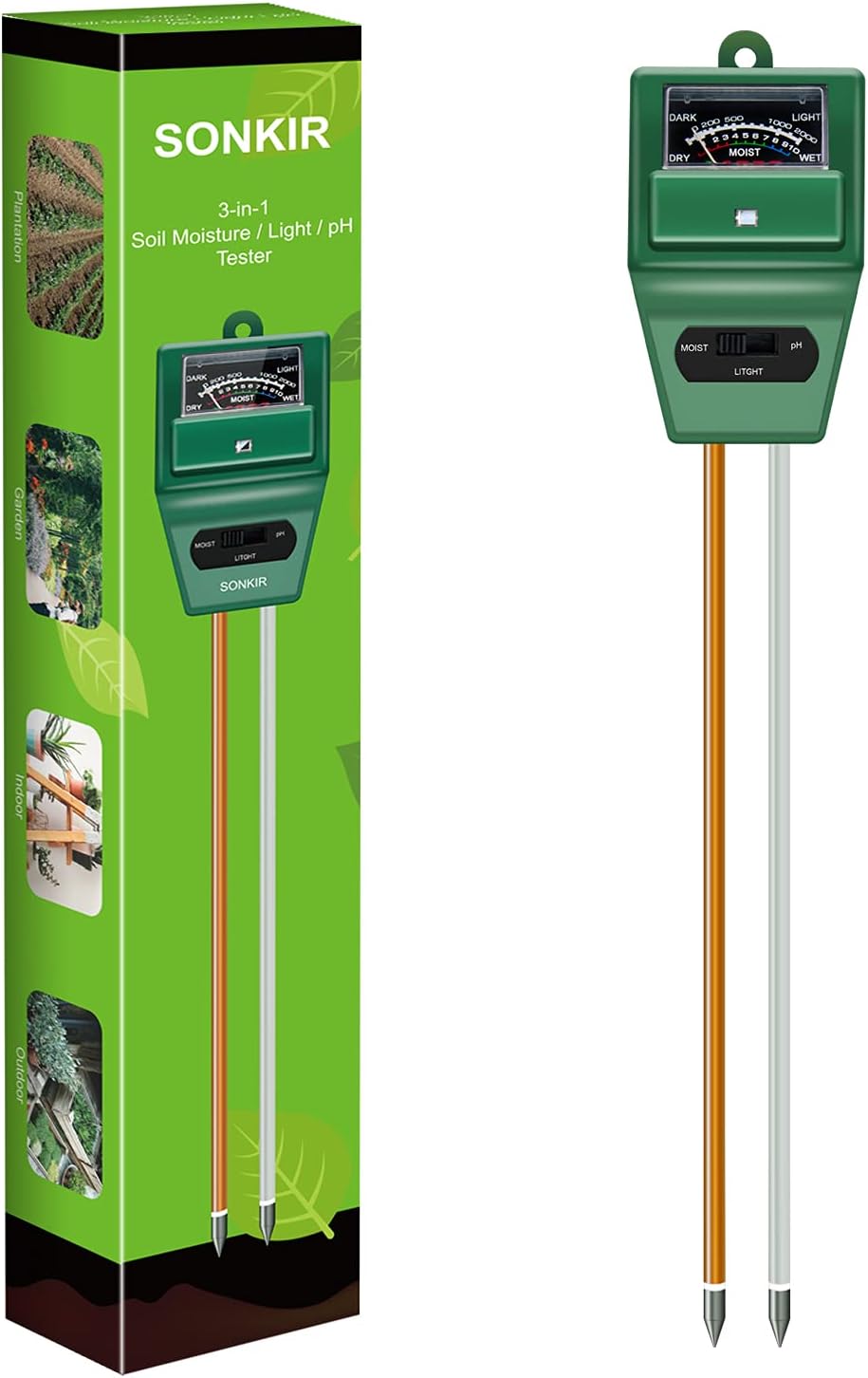
The SONKIR MS02 is a simple, no-battery soil tester that gives gardeners quick, at-a-glance readings for moisture, pH, and sunlight. You switch the dial to the function you need, push the probe into the soil about 6 to 7 inches, wait roughly ten minutes, and read results on the analog display. For lawn and grass troubleshooting it helps determine whether turf is too dry, whether soil pH leans acidic or alkaline, and whether a spot receives adequate light. The probe design and straightforward scale make it easy to use without tech setup, and the portable plastic body is convenient to carry between beds. Important limitations are that the pH range is limited to about 3.5 to 8 and the meter cannot test liquids or very hard compacted soil; very dry soil may need watering first to get a reading. Readings are best treated as directional rather than lab-accurate, so use this as an inexpensive screening tool before making larger amendments.
Best for: Gardeners and turf owners who want a low-cost, easy-to-use tool to spot-check soil moisture, pH, and light across a lawn before making care decisions.
Less Ideal for: Users needing laboratory-level pH accuracy or continuous electronic logging should look to professional meters or digital probes with data output.
- Three functions in one unit: moisture, pH, and light for quick diagnostics
- No battery required, simple analog dial for easy outdoor use
- Portable, lightweight design suitable to move across a lawn or garden
- Clear usage steps and widespread user adoption make it easy for beginners
- pH accuracy and range are limited compared with lab meters
- Probe can be damaged if forced into hard or rocky soil
- Will not register in very dry soils unless moistened first
Verdict: A simple, battery-free 3-in-1 tester that provides fast, practical soil and light checks for everyday lawn and garden decisions.
XLUX T10 Soil Moisture Meter (battery-free)

| Battery Description | No batteries required |
|---|---|
| Mounting Type | Tabletop |
| Operating Humidity | 1 to 10% |
| Upper Temperature Range | 45 °C |
The XLUX T10 is a straightforward analog soil moisture meter designed to give instant root-zone readings without batteries. You use it by inserting the slim 304 stainless steel probe into the soil for a few seconds and reading the large color-coded dial that marks Dry, Moist, and Wet zones. Its single, narrow probe reduces disturbance to grass and delicate roots, making it well suited for spot-checking lawn soil and potted plants. The tabletop mounting type and included protective sleeve help keep the probe in good condition between uses. Practical benefits include immediate feedback to avoid over- or under-watering and a clear, easy-to-read display that beginners can interpret at a glance. Important limitations are that it provides a relative moisture reading rather than precise volumetric measurements and is intended for temporary tests only, so it is not a permanent in-soil sensor. Also it does not use batteries so you cannot log data or get digital readouts.
Best for: Buyers who prioritize simple, low-maintenance tools to remove guesswork from lawn and plant watering and prefer quick visual guidance over technical data.
Less Ideal for: Users who need continuous monitoring, digital logging, or laboratory-grade volumetric moisture measurements should consider electronic sensors or data-loggers instead.
- Battery-free operation for instant use without maintenance
- Slim single probe minimizes root disturbance when testing turf or potted plants
- Large color-coded dial that is easy to read and interpret
- 304 stainless steel probe resists rust and comes with a protective sleeve
- Provides relative moisture categories rather than precise numeric soil moisture values
- Intended for brief, manual spot checks only and not for continuous monitoring
Verdict: Choose the XLUX T10 when you want a low-maintenance, battery-free meter that gives fast, easy-to-read root-zone moisture guidance for lawn and spot checks.
Choosing the Right Grass Soil Tester: Key Factors to Consider
Measurement Accuracy and Repeatability
Accurate pH and nutrient readings are the foundation of any soil-testing decision. Lawn soil can vary over short distances, so a tester that gives repeatable results when used in the same spot is far more valuable than one-off numbers that jump around.
Repeatable performance reduces guesswork when you are deciding whether to lime, acidify, or add fertilizer. Look for devices that specify accuracy ranges and include calibration procedures to restore baseline readings after use. For nutrient detection, understand whether the tester reports broad categories like nitrogen, phosphorus, and potassium or only gives a general fertility index; that affects how you interpret results and choose amendments.
Probe Length and Construction
Probe length determines how deep into the root zone you sample. For most cool- and warm-season lawns, a probe that reaches 2 to 4 inches captures the biologically active soil where grass roots and surface feeders concentrate nutrients.
Construction matters for longevity. Stainless steel or corrosion-resistant alloys hold up better in moist, fertilized soils than soft metals or cheap coatings that flake. Solid single-piece probes resist bending during insertion, while segmented or thin probes may fail if you push through compacted zones or encounter stones.
Ease of Use and Readability
A tester that is cumbersome or hard to read will sit unused. Clear, backlit displays, simple one-button operation, and intuitive iconography let you take quick spot checks across a lawn. Analog meters can be fast and durable, but they must have unambiguous scales and labeled ranges for pH and nutrient levels.
Consider whether you want digital logging or immediate, on-device values only. Some users prefer straightforward meters that show a single number, while others benefit from devices that store multiple readings for mapping problem areas over time.
Calibration and Maintenance
Calibration keeps electronic probes accurate and offsets sensor drift from temperature and soil chemistry. Check whether the tester includes calibration solutions or straightforward procedures with common buffer solutions. Devices that require frequent, complicated recalibration add maintenance overhead and increase the chance of user error.
Also consider cleaning and storage. Removable probes or protective caps reduce corrosion risk, and clear guidance on winter storage prevents damage during wet, cold months.
Power Design and Longevity
Power design affects reliability in the backyard. Battery-powered digital testers should offer long runtimes and use common battery types, or include rechargeable options so you are not left without a functional meter during the season. Passive analog testers have the advantage of no batteries but may trade off on feature set and precision.
Durable housings that resist moisture and impact extend service life. For electronically enhanced meters, check for simple battery access and water-resistant seals to reduce failure risk when working on damp turf.
Range of Readings and Reporting Detail
Different testers report different levels of detail. Basic models may only show pH and a general moisture bar, while more advanced units add N-P-K estimates, soil temperature, and conductivity. Decide how much information you actually need.
If you routinely manage fertilizer programs or overseed based on nutrient levels, choose a tester that reports specific nutrient indicators or conductivity values that correlate with available fertility. For casual lawn keepers, a reliable pH and moisture reading may be sufficient.
When to Test Your Lawn
Routine testing gives you a baseline and helps spot trends. Test once in spring before the main growing surge and again in fall after intensive summer use. Test earlier if you notice sudden color loss, patchy growth, or if a previous treatment did not have the expected effect.
Test multiple spots across the lawn to account for variability. Areas near driveways, under trees, or sections that get heavy traffic often show different chemistry than undisturbed turf, and identifying those zones helps you tailor localized treatments.
- Test before major fertilizer or lime applications
- Retest problem patches after treatment to verify change
- Sample high-traffic and shaded areas separately
How to Take Representative Samples
Insert the probe into the soil to the depth appropriate for your grass type, usually 2 to 4 inches. Avoid sampling right after heavy watering or rain when readings can be diluted. For each zone, take several adjacent readings and average them mentally or record them to get a representative value.
When testing for nutrients, scrape away sod and organic debris so the probe contacts mineral soil. For moisture and temperature readings, leave the surface slightly undisturbed and probe to the root zone to capture the conditions grass roots actually experience.
- Take three to five readings per lawn zone and average
- Avoid freshly fertilized or recently watered spots for pH
- Document location and conditions for each reading
Interpreting pH and Nutrient Numbers
Soil pH affects nutrient availability more than absolute nutrient content. Many turf species prefer a pH between 6.0 and 7.0. If your readings fall outside that range, correct pH first because amendments like iron or phosphorus will behave differently depending on acidity.
Nutrient readouts on handheld testers are often indicative rather than laboratory-precise. Use nutrient readings to detect broad deficiencies or excesses and pair them with visual assessment of the lawn. When a tester shows low nitrogen but overall plant vigor is poor, investigate thatch, compaction, or disease as alternative causes.
- Prioritize pH adjustments before targeted nutrient additions
- Use nutrient readings as directional indicators, not absolute lab values
- Combine meter data with visual checks for best results
Maintaining and Calibrating Your Tester
Follow the manufacturer's calibration schedule for electronic meters, and re-calibrate after heavy use or long storage. Rinse probes with distilled water after each use and dry before storage to reduce mineral buildup. Replace worn probe tips or protective caps according to guidance to maintain accuracy.
Store testers in a dry, temperature-stable place. If your lawn work involves frost or very wet seasons, consider removing batteries and using protective cases to avoid corrosion and electrical faults.
- Rinse and dry probes after every use
- Calibrate after several uses or before a major testing session
- Store in a cool, dry area with batteries removed if unused long-term
Mapping Your Lawn for Targeted Care
Create a simple map of your lawn showing testing zones and typical readings. Mapping helps you apply lime, fertilizer, or soil amendments precisely where they are needed instead of blanket treatments. Over time, the map shows whether previous corrections worked and where persistent problems remain.
You do not need fancy software. A drawn plan with recorded pH and nutrient notes, plus dates, is often enough to plan seasonal maintenance and adjust mowing, irrigation, and fertilization practices.
- Divide lawn into logical zones before testing
- Record date, conditions, and readings for each zone
- Use maps to plan targeted treatments and track results
How We Chose the Best Grass Soil Tester
We focused on attributes that matter for diagnosing lawn problems and making practical amendments. Accuracy and repeatability were primary filters, since unreliable pH or nutrient readings lead to misguided treatments. We also prioritized sensor durability and build materials because these tools see moisture, soil abrasion, and repeated insertion. Ease of use and readability were essential; meters with clear displays, simple calibration, and minimal maintenance are more useful to everyday gardeners. Battery life and power design were considered for electronic testers, while probe length and construction were key for purely analog models. We excluded tools intended only for agricultural fieldwork or laboratory-grade analyzers that require specialist handling. Products that lacked clear calibration procedures, had flimsy probes, or did not report pH or basic nutrient metrics were removed. Final selection balanced reliable measurements, longevity in outdoor use, and straightforward operation for home lawns.
FAQ
How often should I test my lawn soil with a Grass Soil Tester?
Test at least once in spring and once in fall for routine monitoring. Test more frequently if you are troubleshooting problems, after major amendments, or when establishing new turf.
Can handheld testers replace a full lab soil analysis?
Handheld testers are useful for regular spot checks and directional guidance but are not as precise as lab analyses. Use a lab test when you need exact nutrient levels or if persistent problems do not respond to meter-guided treatments.
What depth should I probe for lawn readings?
Aim for the active root zone, typically 2 to 4 inches for most turfgrasses. Deeper samples may be useful for compacted or deeply rooted areas, but standard depths capture the conditions most affecting turf vigor.
Do digital testers need regular calibration?
Yes. Digital probes experience sensor drift and should be calibrated according to the manufacturer's schedule or after extended storage. Regular calibration maintains measurement reliability.
Will a soil tester work after heavy rain?
Readings taken immediately after heavy rain can be diluted, especially for moisture and soluble nutrient measures. Wait 24 to 48 hours after significant rainfall for more representative pH and nutrient readings.
How do I use meter readings to decide on liming or fertilizing?
Prioritize pH adjustments first when readings are outside the recommended range for your grass. Once pH is in range, use nutrient indicators and visual turf health to decide on targeted fertilizer or organic amendments.
Final Verdict
Choose a Grass Soil Tester that matches how you manage your lawn. Prioritize pH accuracy and probe durability if you need consistent, actionable readings across a season. If you prefer low maintenance, consider robust analog options; if you want data logging and finer detail, look for digital models with easy calibration. Balance the level of information the tester provides against the time you will spend testing and maintaining the device. With representative sampling and basic calibration, a good tester becomes a practical tool for healthier, more resilient turf.
