

Note: This article contains affiliate links. If you click on these links and make a purchase, I may earn a small commission at no extra cost to you. This helps support my research and content. Read my full affiliate disclosure here.
Ants inside a home can be more than a nuisance. You want a product that attracts worker ants reliably, allows them to carry bait back to the nest, and reduces overall activity without creating new hazards for people or pets. This guide covers seven shortlisted indoor ant baits chosen for dependable attraction, safety in household spaces, and practical application across common ant species found inside homes and apartments. Below we summarize how each option performs on attractiveness, transfer effect, and placement ease so you can pick the right bait for your situation.
Top Picks at a Glance
| Best Overall The best all-around choice for most situations | TERRO Liquid Ant Killer 3-Pack (T200-3SR) |  |
| Best Quality Built to a higher standard if you want something more solid | Syngenta Advion Ant Gel Bait, 4 x 30 g Tubes with Plungers and Tips |  |
| Best Value The sweet spot between price and what you get | Combat Max Ant Killing Bait Stations, 6 Count |  |
| Best Budget The cheapest option that still gets the job done reliably | Raid Ant Killer Baits, Child-Resistant, 8 Count |  |
| Highest Rated A top-rated pick with lots of positive feedback | TERRO Ultra Complete Kill Ant Baits, 6 Dual-Formula Bait Stations |  |
| Most Popular A crowd favorite that many people choose with confidence | Terro Liquid Ant Killer Bait Stations, 18 Count (3-Pack) |  |
| Best Seller A high-volume bestseller chosen again and again | Syngenta Advion Ant Gel Bait, 30 g |  |
TERRO Liquid Ant Killer 3-Pack (T200-3SR)

| Active Ingredients | Sodium Tetraborate Decahydrate (Borax) 5.40% |
|---|---|
| Item Form | Liquid |
| Included Components | Ant Bait |
| Specification Met | EPA |
The TERRO Liquid Ant Killer 3-Pack is a simple, borax-based indoor bait system intended to eliminate common household ants by having workers feed on the liquid and transport it back to the nest. Each 2 oz bottle dispenses drops onto the included cardboard tiles; place them along trails, baseboards, and near food sources and leave undisturbed while ants feed. The formula is designed to be attractive to a broad range of sugar-feeding ants, and because workers share the bait, you can expect visible reductions within a few days and colony-level impact over time. Practical benefits include ready-to-use bottles with easy spot application and multiple placements from the three-pack for treating several hotspots at once. Limitations are that it requires ants to find and feed on the bait so results vary by species and activity level, and it is an indoor-only solution that must be kept away from children and pets unless used exactly as directed.
Best for: Homeowners who want a low-effort indoor solution to eliminate visible ant trails and reduce colony populations using bait stations placed around the house.
Less Ideal for: People needing an outdoor or perimeter ant control product or those seeking an instant-contact spray for immediate knockdown of nests.
- Targets ants at the colony level by using a borax bait workers carry back to the nest
- Ready-to-use liquid bottles with included cardboard tiles for straightforward placement
- Three bottles provide multiple bait stations to treat several indoor hotspots
- Fast-acting formula often shows visible reduction in ant activity within days
- Effectiveness depends on ants finding and preferring the bait, so results vary by species and conditions
- Not formulated or packaged for outdoor use
Verdict: A dependable, easy-to-use indoor bait system that treats ant problems at the colony level with minimal setup and multiple placements.
Syngenta Advion Ant Gel Bait, 4 x 30 g Tubes with Plungers and Tips

| Active Ingredients | Indoxacarb |
|---|---|
| Item Form | Gel |
| Target Species | ant |
| Specification Met | EPA |
Advion Ant Gel is a professional-style gel bait formulated with 0.05% indoxacarb that targets worker ants so they carry the bait back to the nest and eliminate the colony. It arrives in easy-to-use 30 gram syringes with plungers and application tips for precise placement in cracks, crevices, along trails, or under appliances. The gel matrix is designed to be highly attractive to sugar-seeking species, so it works well where workers are actively foraging. Because the active ingredient is non-repellent, ants do not avoid treated spots, which improves bait uptake and speeds control across typical indoor infestations. Practical benefits include low-odor application, small discreet spots that reduce exposure, and suitability for both indoor and sheltered outdoor use. Important limitations are that it targets ants specifically and is not a general insecticide for other pests, and success depends on correctly locating trails and replenishing spots until activity declines. Protective handling and following label directions are required for safe use around people and pets.
Best for: Buyers who prioritize fast, colony-level ant control and want a professional-strength bait they can place precisely inside the home.
Less Ideal for: People seeking a multipurpose household insecticide or those unwilling to follow label safety directions and manage repeat applications.
- Non-repellent indoxacarb formulation encourages ants to feed and transfer bait to the colony
- Comes with plungers and precision tips for controlled placement in cracks and along trails
- Odorless gel suitable for discreet indoor application
- Suitable for many major ant species including Argentine and carpenter ants
- Not effective against non-ant household pests since it is an ant-specific bait
- Requires locating active trails and periodic reapplication until colony activity stops
Verdict: Choose Advion Ant Gel when you need a professional-strength, non-repellent gel bait that reliably draws foragers to deliver colony-wide ant control.
Combat Max Ant Killing Bait Stations, 6 Count

| Active ingredient | Fipronil 0.01% |
|---|---|
| Units included | 6 bait stations |
| Intended use | Indoor and outdoor |
| Protection duration | Up to 3 months per station |
Combat Max Ant Killing Bait Stations are compact, child-resistant plastic stations prefilled with a Fipronil-based bait intended for indoor and outdoor use. You place the stations along ant trails or near entry points and foraging ants enter, feed, and carry the bait back to the nest where it works to eliminate the queen and other colony members. The package includes six stations, each designed to provide up to three months of protection, and the odorless, fuss-free formula means they can sit in kitchens, bathrooms, and living areas without noticeable fumes. Practical benefits include no-mess setup, a discreet low-profile housing that fits under sinks and behind appliances, and a bait attractive to multiple common ant species. Limitations are that results depend on ants finding and accepting the bait and that replacement every three months is recommended to maintain effectiveness. As with any insecticide, keep stations out of reach of children and pets and follow label directions for safe placement and disposal.
Best for: Buyers who want a practical, low-effort indoor ant solution they can place and forget for weeks at a time; good for homeowners prioritizing convenience and discreet placement.
Less Ideal for: People who need immediate knockdown of visible ants by contact spray or who prefer non-chemical control methods; not suitable where children or pets may repeatedly access bait despite child-resistant design.
- Ready-to-use, no activation or messy application required
- Child-resistant, low-profile plastic housing suitable for tight spaces
- Uses Fipronil for fast-acting control that targets the colony via forager transfer
- Odorless and vapor-free formula safe for use in living areas when used as directed
- Effectiveness depends on ants locating and accepting the bait so placement matters
- Requires replacing stations approximately every three months to maintain control
Verdict: A convenient, ready-to-use bait station pack that reliably targets entire ant colonies with minimal setup for buyers who prioritize low-effort indoor control.
Raid Ant Killer Baits, Child-Resistant, 8 Count
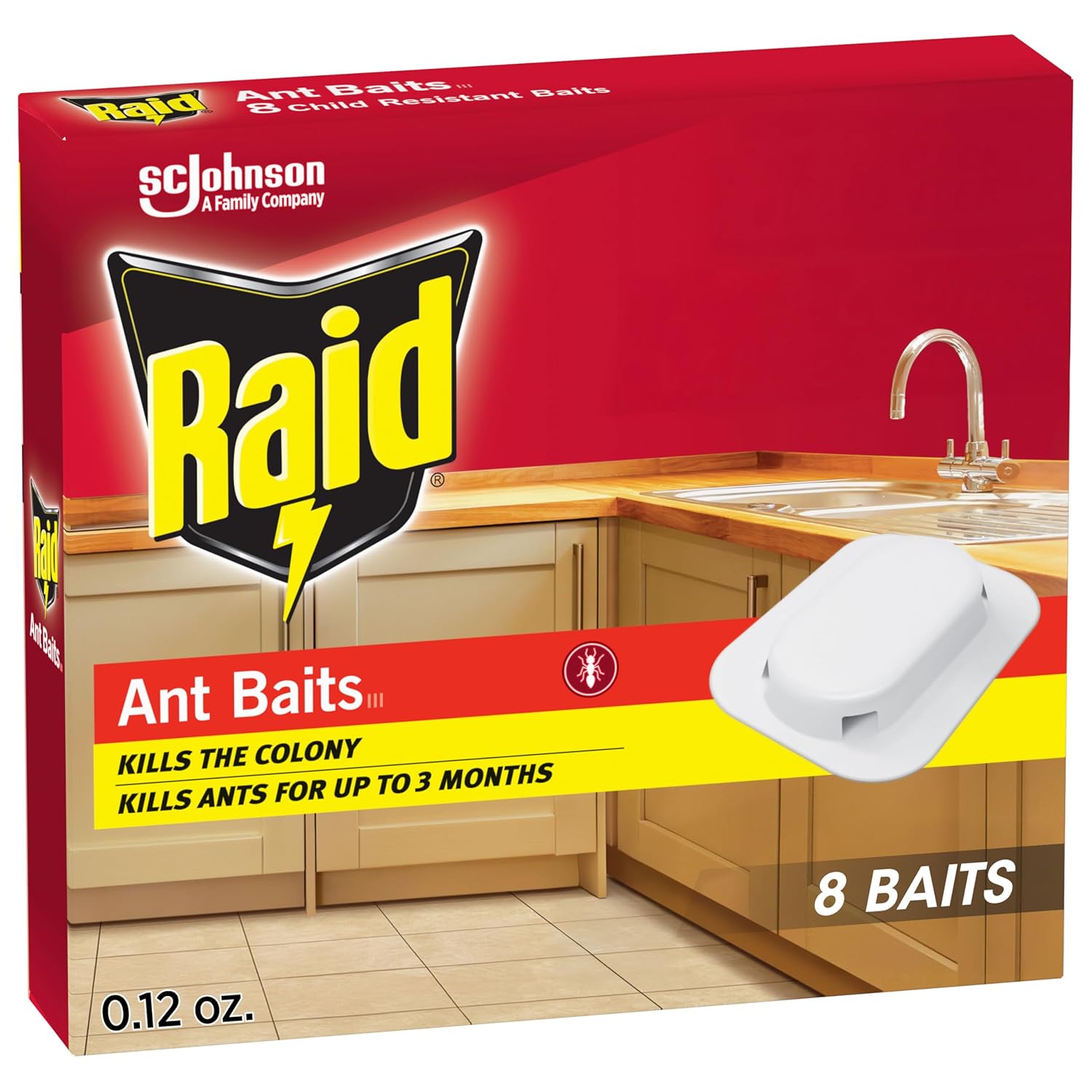
| Count | 8 |
|---|---|
| Use | Indoor |
| Child-resistant | Yes |
| Residual control | Up to 3 months |
These Raid Ant Killer Baits come as ready-to-use, child-resistant stations you place along walls, in corners, or near entry points indoors. Ants feed on the bait and carry it back to the colony where it is transferred to other ants and the queen, which can eliminate infestations at the source rather than just killing visible workers. The product is simple to deploy and requires little maintenance; one set of stations is intended to remain in place and can provide control for up to three months. Because the stations are sealed and child-resistant they reduce accidental contact compared with loose bait. A practical limitation is that the baits target foraging ants specifically, so they work best when ant trails and entry points are identified; heavy or repeated infestations may need replacement stations or a complementary control approach. For a straightforward, low-effort indoor ant control option, these baits are easy to use and effectively reduce colonies when positioned correctly.
Best for: Buyers who want an inexpensive, low-effort indoor solution to control common household ant trails and small infestations without handling loose bait.
Less Ideal for: People dealing with extensive or recurring infestations that require professional intervention or a multi-pronged treatment plan.
- Ready-to-use, prefilled stations require no mixing or pouring
- Child-resistant design lowers risk of accidental exposure indoors
- Works via transfer to the colony so it can eliminate the nest rather than only visible ants
- Designed for placement along walls and near entry points for targeted use
- Effectiveness depends on ants finding and feeding on the bait so placement matters
- May not be sufficient alone for very large or well-established infestations
Verdict: A simple, budget-friendly indoor bait station that kills the colony when placed on ant trails, making it a practical first step for small household infestations.
TERRO Ultra Complete Kill Ant Baits, 6 Dual-Formula Bait Stations

| Unit Count | 6 Count |
|---|---|
| Included Components | 4 Bait Stations |
| Target Species | Ant |
TERRO Ultra Complete Kill Ant Baits use a dual-formula design—liquid sugar in the top chamber and a protein paste in the bottom—to appeal to ants in different feeding cycles and life stages. You simply open a station and place it near ant trails, baseboards, counters, or other indoor hotspots; worker ants feed on the baits and carry the active ingredient back to the nest, which helps eliminate the queen and colony over time. The product is sold as a 6-count pack of ready-to-use stations and is intended for common indoor species such as pavement, odorous house, and little black ants. In practice you may see increased ant activity initially as more workers are drawn to the bait, but reductions are typically noticeable within days and full control can take a few weeks. The stations are convenient for indoor placement and can remain effective for weeks while visited, but they are not labeled for fire ants, pharaoh ants, carpenter ants, or harvester ants and will not address outdoor mound-only infestations.
Best for: Buyers who prioritize a dependable, low-effort indoor solution for common household ant sightings and want a product that targets the colony rather than only the visible workers.
Less Ideal for: Those dealing primarily with outdoor mound infestations or with specialist ant species that the formula does not cover should consider targeted outdoor treatments or professional pest control.
- Dual bait formula (liquid sugar plus protein paste) attracts ants with different dietary needs
- Ready-to-use stations require no mixing or setup for quick placement
- Designed to be carried back to the nest to reach the queen and reduce the entire colony
- Compact stations suitable for indoor use along baseboards, counters, and corners
- Not effective against fire ants, pharaoh ants, carpenter ants, or harvester ants
Verdict: Use TERRO Ultra when you want a reliable, ready-to-use indoor bait that targets the whole ant colony by offering both sugar and protein attractants.
Terro Liquid Ant Killer Bait Stations, 18 Count (3-Pack)

| Unit Count | 18 Count |
|---|---|
| Item Form | Liquid |
| Liquid Volume | 6.6 fluid ounces |
| Active Ingredients | Sodium Tetraborate Decahydrate (Borax) |
Terro Liquid Ant Bait stations are compact, pre-filled liquid traps designed for indoor ant control. You simply open a tab and place stations where you see ants—along baseboards, in corners, under appliances, or on countertops—and worker ants feed on the sweet bait and carry it back to the colony. The active ingredient is borax (sodium tetraborate decahydrate), which acts slowly so multiple foragers spread it through the nest. Because the bait is liquid and contained, it resists drying out and continues to attract ants for days or weeks until depleted. In practice this product is straightforward and low-effort: use multiple stations for larger infestations, remove competing food sources first, and monitor placements rather than disturbing them. Limitations are that results can take several days to a few weeks for full colony control and bait stations need replacement when empty; also they are formulated for sweet-eating common household ants and may be less effective on species with different feeding preferences.
Best for: Buyers who want a simple, low-maintenance indoor solution that targets whole ant colonies rather than just killing visible workers, and who prefer products supported by widespread positive use.
Less Ideal for: People needing immediate knockdown for large visible infestations or those dealing with non-sweet‑feeding ant species should consider fast-acting sprays or species-specific baits instead.
- Ready-to-use stations require no mixing or setup
- Liquid formula resists drying so bait remains attractive longer
- Compact shape fits along baseboards, under appliances, and in tight spots
- Slow-acting borax allows ants to carry bait back to the colony for broader control
- Works primarily on sweet-attracted household ants and may be less effective on other species
- Not an instant knockdown; full control can take up to several weeks
Verdict: A no‑fuss, ready‑to‑place liquid bait that quietly eliminates sweet‑feeding indoor ant colonies when you want an evidence-backed, low-effort control option.
Syngenta Advion Ant Gel Bait, 30 g

| Item Form | Gel |
|---|---|
| Target Species | Insects |
| Active Ingredients | Indoxacarb |
Advion Ant gel is a ready-to-use bait that targets a broad range of household ants by combining a highly palatable gel formulation with the active ingredient indoxacarb. In practice you place small dabs near trails, entry points, or nests indoors where ants forage, and worker ants feed on the gel and carry it back to the colony, which helps reduce the infestation at the source. The gel is described as translucent, non-staining and low-odor so it is suited for use in kitchens, pantries and other indoor spaces where discretion matters. Its formulation remains attractive over time, which reduces the need for constant reapplication. Important limitations are that it is a chemical control product so it must be kept away from children and pets and it works more slowly than contact sprays because it relies on bait uptake and colony transfer. For someone who prefers a contained, targeted indoor bait rather than broad-surface spraying, this product offers a practical and effective option.
Best for: Buyers who want a discreet, bait-based indoor ant control solution and prefer targeted treatments that remove colonies rather than surface sprays.
Less Ideal for: Those seeking instantaneous knockdown of visible ants or who cannot guarantee safe placement away from children and pets should consider alternative approaches.
- Palatable gel formulation that attracts sweet-feeding ants and supports colony transfer
- Translucent, low-odor, non-staining formula suitable for visible indoor areas
- Labeled for indoor and outdoor use so placement options are flexible
- Active ingredient indoxacarb provides a different mode of action compared with many common baits
- Requires time for ants to feed and transfer bait so results are not immediate
- Contains a pesticide that must be stored and applied with care around children and pets
Verdict: A discreet, palatable gel bait that is a strong choice for indoor ant control when you want targeted colony-level elimination rather than immediate knockdown.
Choosing the Right Indoor Ant Bait: Key Factors to Consider
Bait Type and Ant Diet Preferences
Different ant species prefer different food sources at different times of year or day. Sweet, sugar-based gels and syrups attract carbohydrate-seeking workers, which is common for many indoor species. Protein- or oil-based baits target workers that are foraging for fats and proteins, such as during brood-rearing periods.
Choosing the right bait type matters because a poor match will be ignored and slow or prevent nest transfer. When you cannot identify the species, starting with a sweet bait is usually effective for typical kitchen-invading ants, but having an alternate bait type ready can speed control if activity continues.
Delivery Format and Containment
Bait comes in several delivery formats including pre-filled low-profile stations, gel syringes, liquid dispensers, and solid blocks. For indoor use, tamper-resistant stations or contained gels reduce the risk of accidental contact by children and pets and keep bait viable longer.
Consider where you will place the bait. Narrow stations fit along baseboards and under appliances, while smaller gel dots can be tucked into cracks. Open liquids or loose granules are less suitable indoors because they are easier to spill or be accessed by non-targets.
Transfer Efficacy and Timeframe
Transfer efficacy refers to how well foraging workers take bait back to the nest and distribute it among nestmates. Some active ingredients act slowly enough to allow wide sharing before ants die, which increases the chance of colony reduction. Fast-acting compounds may remove visible workers quickly but fail to reach the queen or brood.
Expect variable timeframes: some baits show reduction in a few days, others require one to two weeks of consistent worker feeding. Monitor activity and maintain bait presence until trails stop appearing for several days.
Household Safety Considerations
Indoor bait selection must balance effectiveness with safety for people and pets. Look for formulations designed for indoor placement with tamper-resistant packaging and clear instructions on placement. Avoid open containers in high-traffic areas and keep stations out of reach of children and pets.
Read labels for active ingredient information and follow any recommended waiting periods after placement before allowing pets access to treated areas. Proper containment also reduces accidental spills and preserves bait attractiveness.
Stability and Shelf Life in Indoor Conditions
Humidity, temperature, and dust can affect bait consistency and attractiveness. Gel and solid baits tend to hold up better on kitchen floors and under counters than thin liquids that evaporate or leak. Choose products with good stability in the typical indoor microclimate where you plan to deploy them.
Also consider shelf life if you keep backups. Products with clearly labeled storage guidance and longer shelf life reduce waste and ensure bait remains effective when you need it.
Identifying Where to Place Indoor Bait
Successful placement targets foraging trails, entry points, and likely nesting areas. Follow visible ant trails to find where workers regularly travel and set bait stations along that path rather than scattering stations randomly across a room. Common placement spots include along baseboards near sinks, behind appliances, at cabinet seams, and near wall voids.
If ants appear near food prep areas, place bait slightly away from the immediate food work surface but along the trail so workers encounter bait before reaching human food. Replace stations when they are empty and keep a small map or note of placement locations so you can monitor which stations are most effective.
- Place stations along clear ant trails, not directly on food prep surfaces.
- Use multiple small stations near separate entry points for large infestations.
- Check stations daily at first, then every few days as activity declines.
How to Monitor and Maintain Bait
Monitoring requires simple observation: note whether ants are entering stations, whether bait levels are decreasing, and whether trail activity drops over time. Replace or refill bait when it is depleted, contaminated with debris, or dried out.
Keep monitoring consistent for at least a week after visible activity stops to ensure the colony has been affected. Clean up any spills promptly and move stations if pets or children have access to them. Maintain bait placements even if activity seems low in adjacent areas, since foragers may return.
- Record bait uptake daily for the first 3 to 5 days.
- Refill before a station is completely empty to maintain continuous feeding.
- Move stations slightly if no ants visit after 48 hours.
Non-Bait Measures to Support Control
Bait alone is often the most effective long-term solution, but integrated steps speed results. Remove easy food sources, keep counters wiped, store pantry items in sealed containers, and seal obvious entry points where feasible. Reducing competing food cuts competition and increases the chance ants choose bait.
For nests inside wall voids or under floors, expect longer timelines and consider combining careful sanitation, exclusion, and multiple bait placements along foraging routes to improve transfer back to the nest.
- Store pet food off floors and clean pet bowls promptly.
- Fix moisture issues and seal gaps around pipes and windows.
- Use physical exclusion methods such as door sweeps and mesh in vents.
Common Indoor Ant Species and Typical Behaviors
Indoor ant species vary in diet and trail behavior. Some form long, persistent foraging trails and readily recruit nestmates to food, while others forage in smaller numbers. Understanding whether ants are heavily recruiting or foraging individually helps predict bait uptake.
Observation at different times of day can reveal when bait will be most attractive. Many ants forage more actively during cool or moist periods, so placing bait in the evening may improve initial uptake for certain species.
- Look for long, repeatable trails for best bait station placement.
- Note time-of-day activity to time bait placement for maximum uptake.
Safe Disposal and Cleanup After Control
Once activity has stopped and baits are spent, remove stations and dispose of them according to label instructions. Clean surfaces that had spilled bait with a mild detergent to remove residual sugars or oils that could attract future foragers.
If you used tamper-resistant stations, replace them with fresh unused units if you plan to maintain monitoring. Keep leftover unused bait stored securely and out of reach of children and pets.
- Follow label disposal guidance for bait packaging.
- Clean contaminated surfaces to remove residual attractants.
- Store leftover bait in a cool, dry place away from household access.
How We Chose the Best Indoor Ant Bait
We shortlisted products that demonstrate reliable attraction to common indoor ant species and clear potential for colony-level control through worker transfer. Selection focused on bait formulation variety, including sugar-based and protein-based matrices, plus delivery formats suited for indoor use such as low-profile stations and placements that limit non-target access. Evaluation criteria emphasized bait attractiveness to foraging workers, transfer potential (how likely bait is transported back to the nest), safety in occupied spaces including child and pet exposure risk, and ease of placement and maintenance inside kitchens, pantries, and living areas. We also considered product stability under household conditions and clarity of application instructions. Excluded items included outdoor-only formulations, broadcast dusts, and volatile sprays that are not intended as internal baits. We did not include products lacking clear labeling for indoor bait use or those without a viable tamper-resistant delivery form.
FAQ
How long does it usually take for indoor ant bait to reduce visible ant activity?
It often takes several days to a few weeks. Many effective baits need time for workers to feed, return to the nest, and distribute the active ingredient. Expect to monitor and maintain bait for at least one to two weeks.
Can I place bait anywhere in the kitchen?
Place bait along ant trails and near entry points rather than on food prep surfaces. Avoid high-traffic spots and keep stations out of reach of children and pets. Follow label guidance on recommended placement locations.
What if ants ignore the bait?
Ants may ignore bait if it does not match their current food preference or if competing food sources are available. Try a different bait type, remove competing food, and relocate stations along confirmed trails to increase uptake.
Are indoor baits safe around pets?
Many baits are designed for indoor use with containment, but safety depends on the formulation and how well stations prevent access. Use tamper-resistant stations and follow label instructions to minimize pet exposure.
Should I keep bait out after ant activity stops?
Keep monitoring for several days after activity stops. Removing baits immediately can allow surviving workers to regroup. Once trails have been absent for a week or more, you can remove and dispose of stations per label instructions.
Can cleaning or spraying around the bait affect its performance?
Cleaning reduces competing food sources and can improve bait uptake, but avoid spraying insecticide directly on bait stations. Sprays that kill foragers too quickly will reduce transfer to the nest and may limit long-term control.
Final Verdict
Choose an indoor ant bait based on the ants' feeding preferences, the delivery format that keeps bait contained, and the product's potential for worker-to-nest transfer. Balance attraction and transfer time against household safety and placement needs. Prioritize tamper-resistant formats for homes with children or pets, monitor uptake closely, and be prepared to switch bait types if ants ignore the first choice. With targeted placement and consistent monitoring you can reduce activity and reach nest-level control.
